What is a lateral flow assay?
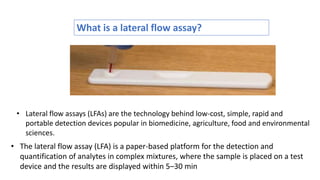
• Lateral flow assays (LFAs) are the technology behind low-cost, simple, rapid and
portable detection devices popular in biomedicine, agriculture, food and environmental
sciences.
• The lateral flow assay (LFA) is a paper-based platform for the detection and
quantification of analytes in complex mixtures, where the sample is placed on a test
device and the results are displayed within 5–30 min
What is a lateral flow assay?
• Basically, it is a simple to use diagnostic device used to confirm the presence or
absence of a target analyte, such as pathogens or biomarkers in humans or animals,
or contaminants in water supplies, foodstuffs, or animal feeds.
• The most commonly known type of lateral flow rapid test strip is the pregnancy test.​
• This assay has recently attracted considerable interest because of its potential to
provide instantaneous diagnosis directly to patients.
• Low development costs and ease of production of LFAs have resulted in the
expansion of its applications to multiple fields in which rapid tests are required
What is a lateral flow
assay?
LFAs typically contain a control line to
confirm the test is working properly,
along with one or more target or test
lines. They are designed to incorporate
intuitive user protocols and require
minimal training to operate. They can
be qualitative and read visually, or
provide data when combined with
reader technology
Applications of
lateral flow assay
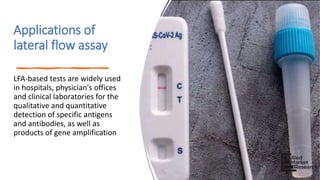
LFA-based tests are widely used
in hospitals, physician's offices
and clinical laboratories for the
qualitative and quantitative
detection of specific antigens
and antibodies, as well as
products of gene amplification
Applications of
lateral flow assay
• Further industries in which LFA-based tests are employed
include veterinary medicine, quality control, product
safety in food production, and environmental health and
safety
• In these areas of utilization, rapid tests are used to
screen for animal diseases, pathogens, chemicals, toxins
and water pollutants.​
• Lateral flow tests are widely across many industries for point of care testing. They
can be performed by professionals, trained lay users or a patient, and in a range of
settings including the laboratory, clinic or home.
• In the medical diagnostic industry, there are strict regulatory requirements which
must be adhered to for all products.
• A variety of biological samples can be tested using LFAs, including urine, saliva,
sweat, serum, plasma, whole blood and other fluids.
• Due to their versatile nature, lateral flow rapid tests are used across a number of
other industry sectors including pharma, environmental testing, animal health, food
and feed testing and plant and crop health.
Applications of lateral flow assay
• Lateral flow assays have played a critical role in COVID-19 testing as
they have the benefit of delivering a result in 15–30 minutes. The
systematic evaluation of lateral flow assays during the COVID-19
pandemic was initiated at Oxford University.
• LFTs have been used for mass testing for COVID-19 globally and
complement other public health measures for COVID-19.
• Some scientists outside government have expressed serious misgivings
about the use of LFDs for screening for Covid.
LFA potential in market
• In recent years there has been an increasing demand
for point-of-care multiple diagnostic assays with
multiple test lines allowing the rapid and simultaneous
detection of multiple analytes present in samples.
• Such assays should be easy to perform without the use
of laboratory investigation, or individuals trained in
chemical analysis. LFAs are very good candidates as they
are cheap to produce, easy to use and, importantly,
widely accepted by users and regulatory authorities.
LFA
potential in
market
LFA has the potential to produce devices
that may become powerful tools for new
challenging applications such as early
cancer detection.
Moreover, because of the long shelf life
and the fact that refrigeration is not
required for their storage, LFA are very well
adapted for use in developing countries,
small ambulatory care settings, remote
regions and battlefields.
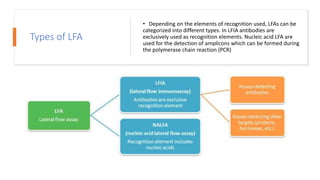
Types of LFA
• Depending on the elements of recognition used, LFAs can be
categorized into different types. In LFIA antibodies are
exclusively used as recognition elements. Nucleic acid LFA are
used for the detection of amplicons which can be formed during
the polymerase chain reaction (PCR)
Principle of the lateral
flow assay
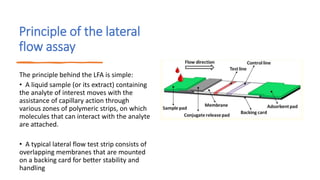
The principle behind the LFA is simple:
• A liquid sample (or its extract) containing
the analyte of interest moves with the
assistance of capillary action through
various zones of polymeric strips, on which
molecules that can interact with the analyte
are attached.
• A typical lateral flow test strip consists of
overlapping membranes that are mounted
on a backing card for better stability and
handling
Principle of the lateral flow assay
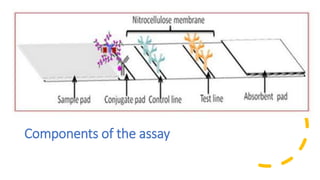
• The sample is applied at one end of the strip, on the adsorbent sample pad, which
is impregnated with buffer salts and surfactants that make the sample suitable for
interaction with the detection system.
• The sample pad ensures that the analyte present in the sample will be capable of
binding to the capture reagents of conjugates and on the membrane.
Principle of the lateral flow assay
• The treated sample migrates through the conjugate
release pad, which contains antibodies that are specific to
the target analyte and are conjugated to colored or
fluorescent particles–most commonly colloidal gold and
latex microspheres.
• The sample, together with the conjugated antibody
bound to the target analyte, migrates along the strip into
the detection zone.
• This is a porous membrane (usually composed of
nitrocellulose) with specific biological components (mostly
antibodies or antigens) immobilized in lines. Their role is to
react with the analyte bound to the conjugated antibody.
Principle of the lateral flow assay
• Recognition of the sample analyte results in an
appropriate response on the test line, while a response
on the control line indicates the proper liquid flow
through the strip.
• The read-out, represented by the lines appearing
with different intensities, can be assessed by eye or
using a dedicated reader. In order to test multiple
analytes simultaneously under the same conditions,
additional test lines of antibodies specific to different
analytes can be immobilized in an array format.
Principle of
the lateral
flow assay
The liquid flows across the device
because of the capillary force of the
strip material and, to maintain this
movement, an absorbent pad is
attached at the end of the strip.
The role of the absorbent pad is to wick
the excess reagents and prevent
backflow of the liquid.
Assay
formats
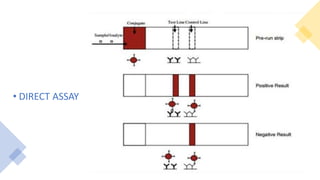
• A direct test is used for larger analytes such as the
p24 antigen used in the human immunodeficiency
virus (HIV) test, as well as analytes with multiple
antigenic sites such as human chorionic
gonadotropin (hCG) used in pregnancy tests.
• In the direct test, the presence of the test line
indicates a positive result and the control line
usually contains species-specific anti-
immunoglobulin antibodies, specific for the
antibody in the particular conjugate.
Two formats of the LFIA can be
distinguished: direct and competitive.
• DIRECT ASSAY
ASSAY
FORMATS
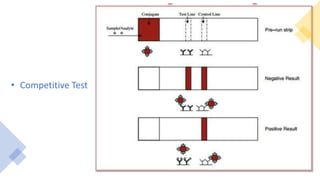
• In the case of small molecules with single antigenic
determinants, which cannot bind to two antibodies
simultaneously, competitive tests are used.
• In this type of test, the analyte blocks the binding
sites on the antibodies on the test line, preventing their
interactions with the colored conjugate.
• Therefore, a positive result is indicated by the lack of
signal in the test line, while the control line should be
visible independently of the test result.
Competitive Test
• Competitive Test
Components of the assay
• The most common difficulties in the manufacture of
LFA devices are caused by the hidden complexity of
the device.
• As the test is composed of many elements,
problems can be caused by material incompatibility,
flaws in the connection of the overlapping elements
or imperfect material characteristics.
• During the development of LFAs, most attention has
been focused on finding the most suitable detection
method or choosing the best antigen or antibody.
• Nonetheless, it is very important to pay attention to
all elements of the test, including the basic
components such as the backing card, adhesive
strip and cover tape, in order to produce a
consistent and high-quality product.
Components of the assay
Components
of the assay
• Although the physical components of the test strip,
construction techniques and buffers play the major
role in optimizing the test, the heart of these
processes are the antibodies, which need to be
carefully designed and highly purified.
• It is very important to ensure a consistent antibody
supply with proven affinity and specificity.
• Use of monoclonal antibodies is preferable, as it
allows the production of specific antibodies in large
quantities.
Antibody
Components
of the assay
The most important requirements of the nanoparticle label
include:
• colloidal stability in solution under various conditions
and temperatures
• susceptibility for detection over a large (and useful)
dynamic range
• efficiency and reproducibility of conjugation (without the
loss of chemical and biological integrity and activity)
• commercial availability at low cost
• easy and scalable conjugation procedure.
Label
Components
of the assay
• Nowadays colloidal gold is the most widely used label in
commercial LFIA. Although it can be prepared in the
laboratory at low cost, there are many commercial sources
available. It has an intense color and no development process
is needed for visualization. Moreover, it has high stability in
both liquid and dried forms.
• Another popular label is latex, which can be tagged with a
variety of detector reagents such as colored or fluorescent
dyes, and magnetic or paramagnetic components. As latex can
be produced in multiple colors, it has an application in
multiplex assays.
• Carbon and fluorescent labels, or enzymatic modification of
the labels, are also used to improve the sensitivity of the
assay.
Label
Components
of the assay
• The membrane is considered the most critical element in LFA
strips and nitrocellulose is by far the most commonly used
material.
• Important parameters characterizing a good membrane
material are the capillary forces, as well as the ease of binding
and immobilizing proteins necessary for subsequent selection,
reaction and detection.
• A range of nitrocellulose pore sizes are available, from 0.05 to
12 μm. However, as the pores are not equally distributed
(because of the manufacturing process), capillary flow time is
a more accurate parameter and it should be used when
selecting the most effective strip material. The capillary flow
time is the time required for the liquid to travel to and
completely fill the strip of the membrane.
Membrane
Components
of the assay
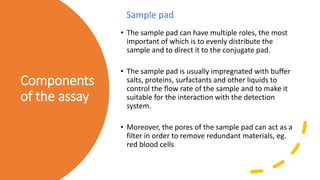
• The sample pad can have multiple roles, the most
important of which is to evenly distribute the
sample and to direct it to the conjugate pad.
• The sample pad is usually impregnated with buffer
salts, proteins, surfactants and other liquids to
control the flow rate of the sample and to make it
suitable for the interaction with the detection
system.
• Moreover, the pores of the sample pad can act as a
filter in order to remove redundant materials, eg.
red blood cells
Sample pad
Components
of the assay
• The main role of the conjugate pad is to hold the detector
particles and keep them functionally stable until the test is
performed.
• This is ensured by the composition of the conjugate buffer,
containing carbohydrates (such as sucrose), which serve as a
preservative and a resolubilization agent.
• When the conjugate particles are dried in the presence of
sugar, the sugar molecules form a layer around them
stabilizing their biological structures.
• When the sample enters the conjugate pad, the sugar
molecules rapidly dissolve carrying the particles into the fluid
stream. It is crucial that the release is consistent between
individual test strips.
Conjugate pad
Components
of the assay
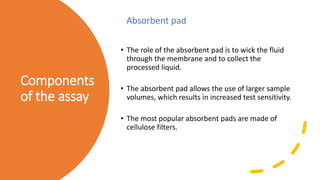
• The role of the absorbent pad is to wick the fluid
through the membrane and to collect the
processed liquid.
• The absorbent pad allows the use of larger sample
volumes, which results in increased test sensitivity.
• The most popular absorbent pads are made of
cellulose filters.
Absorbent pad
Detection methods
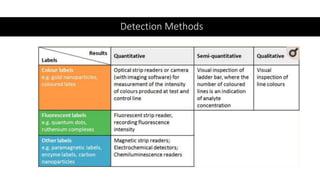
• Since the LFIA is an antibody-based technique, specificity and sensitivity may be affected by other
chemicals with similar structures, leading to false positive results.
• The sensitivity of assays is limited by the dissociation constant of the antibody–antigen conjugate and by
the colorimetric read-out. In order to overcome these limitations, both readers and novel biochemical
techniques have been developed to improve product quality and customer convenience.
• The selection of a detection system is mainly determined by the label employed in the analysis.
• Fluorescent dyes or paramagnetic particles cannot be detected directly by the naked eye and require
dedicated readers for quantitative analysis
• Moreover, automated detection methods provide advantages over manual imaging and processing in
terms of time consumption, interpretation of results and adjustment of variables.
Detection Methods
Advantages of LFA
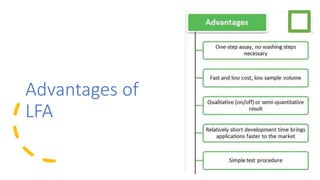
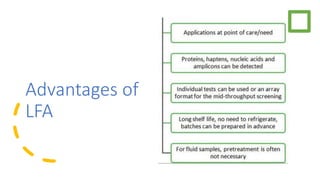
• Many LFIAs are designed for use at point-of-care/need, providing cheap, rapid
and easy tests desirable in many industries.
• As the visual result is usually clear and easily distinguished, no additional
specific equipment is needed.
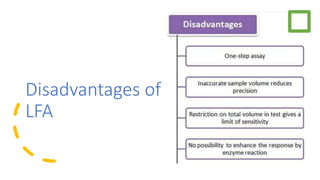
• Research is on-going to address some of the key weaknesses of LFAs,
especially with respect to quantitative results. Data can be digitized using
scanners or cameras with dedicated software, which will also allow the
documentation of results. However, technological improvements will affect
the cost of apparatus and the duration of analysis.
Advantages of
LFA
Advantages of
LFA​
Disadvantages of
LFA
Disadvantages
of LFA​​
Conclusion
• The unique and remarkable properties of LFAs have
contributed to the detection of disease biomarkers
and infectious agents in medicine, agriculture, food
and environmental safety.
• Although the principle of the method has remained
unchanged for decades, there have been continuous
improvements of LFA techniques leading to increased
sensitivity and reproducibility, and the simultaneous
detection of several analytes.
• Importantly, these assays can now be effectively
performed outside the laboratory, providing great
advantages for use in developing countries and at the
point-of-care, whether in the field or in more
traditional clinical settings.

Lateral Flow Assay LSA

  • 1.
    What is alateral flow assay? • Lateral flow assays (LFAs) are the technology behind low-cost, simple, rapid and portable detection devices popular in biomedicine, agriculture, food and environmental sciences. • The lateral flow assay (LFA) is a paper-based platform for the detection and quantification of analytes in complex mixtures, where the sample is placed on a test device and the results are displayed within 5–30 min
  • 2.
    What is alateral flow assay? • Basically, it is a simple to use diagnostic device used to confirm the presence or absence of a target analyte, such as pathogens or biomarkers in humans or animals, or contaminants in water supplies, foodstuffs, or animal feeds. • The most commonly known type of lateral flow rapid test strip is the pregnancy test.​ • This assay has recently attracted considerable interest because of its potential to provide instantaneous diagnosis directly to patients. • Low development costs and ease of production of LFAs have resulted in the expansion of its applications to multiple fields in which rapid tests are required
  • 3.
    What is alateral flow assay? LFAs typically contain a control line to confirm the test is working properly, along with one or more target or test lines. They are designed to incorporate intuitive user protocols and require minimal training to operate. They can be qualitative and read visually, or provide data when combined with reader technology
  • 4.
    Applications of lateral flowassay LFA-based tests are widely used in hospitals, physician's offices and clinical laboratories for the qualitative and quantitative detection of specific antigens and antibodies, as well as products of gene amplification
  • 5.
    Applications of lateral flowassay • Further industries in which LFA-based tests are employed include veterinary medicine, quality control, product safety in food production, and environmental health and safety • In these areas of utilization, rapid tests are used to screen for animal diseases, pathogens, chemicals, toxins and water pollutants.​
  • 6.
    • Lateral flowtests are widely across many industries for point of care testing. They can be performed by professionals, trained lay users or a patient, and in a range of settings including the laboratory, clinic or home. • In the medical diagnostic industry, there are strict regulatory requirements which must be adhered to for all products. • A variety of biological samples can be tested using LFAs, including urine, saliva, sweat, serum, plasma, whole blood and other fluids. • Due to their versatile nature, lateral flow rapid tests are used across a number of other industry sectors including pharma, environmental testing, animal health, food and feed testing and plant and crop health.
  • 7.
    Applications of lateralflow assay • Lateral flow assays have played a critical role in COVID-19 testing as they have the benefit of delivering a result in 15–30 minutes. The systematic evaluation of lateral flow assays during the COVID-19 pandemic was initiated at Oxford University. • LFTs have been used for mass testing for COVID-19 globally and complement other public health measures for COVID-19. • Some scientists outside government have expressed serious misgivings about the use of LFDs for screening for Covid.
  • 8.
    LFA potential inmarket • In recent years there has been an increasing demand for point-of-care multiple diagnostic assays with multiple test lines allowing the rapid and simultaneous detection of multiple analytes present in samples. • Such assays should be easy to perform without the use of laboratory investigation, or individuals trained in chemical analysis. LFAs are very good candidates as they are cheap to produce, easy to use and, importantly, widely accepted by users and regulatory authorities.
  • 9.
    LFA potential in market LFA hasthe potential to produce devices that may become powerful tools for new challenging applications such as early cancer detection. Moreover, because of the long shelf life and the fact that refrigeration is not required for their storage, LFA are very well adapted for use in developing countries, small ambulatory care settings, remote regions and battlefields.
  • 10.
    Types of LFA •Depending on the elements of recognition used, LFAs can be categorized into different types. In LFIA antibodies are exclusively used as recognition elements. Nucleic acid LFA are used for the detection of amplicons which can be formed during the polymerase chain reaction (PCR)
  • 11.
    Principle of thelateral flow assay The principle behind the LFA is simple: • A liquid sample (or its extract) containing the analyte of interest moves with the assistance of capillary action through various zones of polymeric strips, on which molecules that can interact with the analyte are attached. • A typical lateral flow test strip consists of overlapping membranes that are mounted on a backing card for better stability and handling
  • 12.
    Principle of thelateral flow assay • The sample is applied at one end of the strip, on the adsorbent sample pad, which is impregnated with buffer salts and surfactants that make the sample suitable for interaction with the detection system. • The sample pad ensures that the analyte present in the sample will be capable of binding to the capture reagents of conjugates and on the membrane.
  • 13.
    Principle of thelateral flow assay • The treated sample migrates through the conjugate release pad, which contains antibodies that are specific to the target analyte and are conjugated to colored or fluorescent particles–most commonly colloidal gold and latex microspheres. • The sample, together with the conjugated antibody bound to the target analyte, migrates along the strip into the detection zone. • This is a porous membrane (usually composed of nitrocellulose) with specific biological components (mostly antibodies or antigens) immobilized in lines. Their role is to react with the analyte bound to the conjugated antibody.
  • 14.
    Principle of thelateral flow assay • Recognition of the sample analyte results in an appropriate response on the test line, while a response on the control line indicates the proper liquid flow through the strip. • The read-out, represented by the lines appearing with different intensities, can be assessed by eye or using a dedicated reader. In order to test multiple analytes simultaneously under the same conditions, additional test lines of antibodies specific to different analytes can be immobilized in an array format.
  • 15.
    Principle of the lateral flowassay The liquid flows across the device because of the capillary force of the strip material and, to maintain this movement, an absorbent pad is attached at the end of the strip. The role of the absorbent pad is to wick the excess reagents and prevent backflow of the liquid.
  • 16.
    Assay formats • A directtest is used for larger analytes such as the p24 antigen used in the human immunodeficiency virus (HIV) test, as well as analytes with multiple antigenic sites such as human chorionic gonadotropin (hCG) used in pregnancy tests. • In the direct test, the presence of the test line indicates a positive result and the control line usually contains species-specific anti- immunoglobulin antibodies, specific for the antibody in the particular conjugate. Two formats of the LFIA can be distinguished: direct and competitive.
  • 17.
  • 18.
    ASSAY FORMATS • In thecase of small molecules with single antigenic determinants, which cannot bind to two antibodies simultaneously, competitive tests are used. • In this type of test, the analyte blocks the binding sites on the antibodies on the test line, preventing their interactions with the colored conjugate. • Therefore, a positive result is indicated by the lack of signal in the test line, while the control line should be visible independently of the test result. Competitive Test
  • 19.
  • 20.
    Components of theassay • The most common difficulties in the manufacture of LFA devices are caused by the hidden complexity of the device. • As the test is composed of many elements, problems can be caused by material incompatibility, flaws in the connection of the overlapping elements or imperfect material characteristics. • During the development of LFAs, most attention has been focused on finding the most suitable detection method or choosing the best antigen or antibody. • Nonetheless, it is very important to pay attention to all elements of the test, including the basic components such as the backing card, adhesive strip and cover tape, in order to produce a consistent and high-quality product.
  • 21.
  • 22.
    Components of the assay •Although the physical components of the test strip, construction techniques and buffers play the major role in optimizing the test, the heart of these processes are the antibodies, which need to be carefully designed and highly purified. • It is very important to ensure a consistent antibody supply with proven affinity and specificity. • Use of monoclonal antibodies is preferable, as it allows the production of specific antibodies in large quantities. Antibody
  • 23.
    Components of the assay Themost important requirements of the nanoparticle label include: • colloidal stability in solution under various conditions and temperatures • susceptibility for detection over a large (and useful) dynamic range • efficiency and reproducibility of conjugation (without the loss of chemical and biological integrity and activity) • commercial availability at low cost • easy and scalable conjugation procedure. Label
  • 24.
    Components of the assay •Nowadays colloidal gold is the most widely used label in commercial LFIA. Although it can be prepared in the laboratory at low cost, there are many commercial sources available. It has an intense color and no development process is needed for visualization. Moreover, it has high stability in both liquid and dried forms. • Another popular label is latex, which can be tagged with a variety of detector reagents such as colored or fluorescent dyes, and magnetic or paramagnetic components. As latex can be produced in multiple colors, it has an application in multiplex assays. • Carbon and fluorescent labels, or enzymatic modification of the labels, are also used to improve the sensitivity of the assay. Label
  • 25.
    Components of the assay •The membrane is considered the most critical element in LFA strips and nitrocellulose is by far the most commonly used material. • Important parameters characterizing a good membrane material are the capillary forces, as well as the ease of binding and immobilizing proteins necessary for subsequent selection, reaction and detection. • A range of nitrocellulose pore sizes are available, from 0.05 to 12 μm. However, as the pores are not equally distributed (because of the manufacturing process), capillary flow time is a more accurate parameter and it should be used when selecting the most effective strip material. The capillary flow time is the time required for the liquid to travel to and completely fill the strip of the membrane. Membrane
  • 26.
    Components of the assay •The sample pad can have multiple roles, the most important of which is to evenly distribute the sample and to direct it to the conjugate pad. • The sample pad is usually impregnated with buffer salts, proteins, surfactants and other liquids to control the flow rate of the sample and to make it suitable for the interaction with the detection system. • Moreover, the pores of the sample pad can act as a filter in order to remove redundant materials, eg. red blood cells Sample pad
  • 27.
    Components of the assay •The main role of the conjugate pad is to hold the detector particles and keep them functionally stable until the test is performed. • This is ensured by the composition of the conjugate buffer, containing carbohydrates (such as sucrose), which serve as a preservative and a resolubilization agent. • When the conjugate particles are dried in the presence of sugar, the sugar molecules form a layer around them stabilizing their biological structures. • When the sample enters the conjugate pad, the sugar molecules rapidly dissolve carrying the particles into the fluid stream. It is crucial that the release is consistent between individual test strips. Conjugate pad
  • 28.
    Components of the assay •The role of the absorbent pad is to wick the fluid through the membrane and to collect the processed liquid. • The absorbent pad allows the use of larger sample volumes, which results in increased test sensitivity. • The most popular absorbent pads are made of cellulose filters. Absorbent pad
  • 29.
    Detection methods • Sincethe LFIA is an antibody-based technique, specificity and sensitivity may be affected by other chemicals with similar structures, leading to false positive results. • The sensitivity of assays is limited by the dissociation constant of the antibody–antigen conjugate and by the colorimetric read-out. In order to overcome these limitations, both readers and novel biochemical techniques have been developed to improve product quality and customer convenience. • The selection of a detection system is mainly determined by the label employed in the analysis. • Fluorescent dyes or paramagnetic particles cannot be detected directly by the naked eye and require dedicated readers for quantitative analysis • Moreover, automated detection methods provide advantages over manual imaging and processing in terms of time consumption, interpretation of results and adjustment of variables.
  • 30.
  • 31.
    Advantages of LFA •Many LFIAs are designed for use at point-of-care/need, providing cheap, rapid and easy tests desirable in many industries. • As the visual result is usually clear and easily distinguished, no additional specific equipment is needed. • Research is on-going to address some of the key weaknesses of LFAs, especially with respect to quantitative results. Data can be digitized using scanners or cameras with dedicated software, which will also allow the documentation of results. However, technological improvements will affect the cost of apparatus and the duration of analysis.
  • 32.
  • 33.
  • 34.
  • 35.
  • 36.
    Conclusion • The uniqueand remarkable properties of LFAs have contributed to the detection of disease biomarkers and infectious agents in medicine, agriculture, food and environmental safety. • Although the principle of the method has remained unchanged for decades, there have been continuous improvements of LFA techniques leading to increased sensitivity and reproducibility, and the simultaneous detection of several analytes. • Importantly, these assays can now be effectively performed outside the laboratory, providing great advantages for use in developing countries and at the point-of-care, whether in the field or in more traditional clinical settings.