A Step-by-step Guide on
How to Write an Ideal
Medical Thesis
What do you need to write a medical
thesis?
Of course, a knowledge about how to
conduct a research and how to pen down its
results in an appropriate format. Even if
you are adept in clinical research, it doesn’t
mean writing a thesis comes easily to you.
A medical thesis has a structure that is
important to follow.
Here we provide a step-
by-step guide on how to
write an ideal medical
thesis
Step 1: Start your thesis with a suitable ‘Title’. The title
is an intro to the contents of your medical thesis. An ideal
title should be within 65 characters, devoid of all
abbreviations and grammatical mistakes, and not contain
stop words like ‘a’, ‘an’, ‘the’, ‘of’, ‘but’, etc.
Step 2: Next, write your thesis ‘Abstract’. An abstract is
an introduction that tells the readers why you conducted
the particular study. What has already been done in the
field, what were the gaps, and how you fill those gaps
with your study?
To write an ideal abstract:
Give a brief background information about your topic
State the importance of the problem and what is unknown
about it
Tell the readers about the objectives of your study clearly
Give references to the research papers written on your research
topic. However, do not cite the well-known facts. For example,
“Isaac Newton discovered gravity…”
Include no information other than the problem being examined
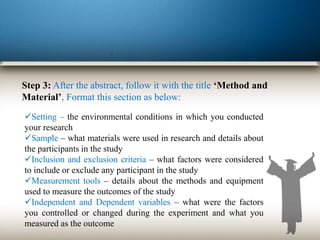
Step 3: After the abstract, follow it with the title ‘Method and
Material’. Format this section as below:
Setting – the environmental conditions in which you conducted
your research
Sample – what materials were used in research and details about
the participants in the study
Inclusion and exclusion criteria – what factors were considered
to include or exclude any participant in the study
Measurement tools – details about the methods and equipment
used to measure the outcomes of the study
Independent and Dependent variables – what were the factors
you controlled or changed during the experiment and what you
measured as the outcome
Step 4: Write the “Analysis of Data“.
Step 5: Write the ‘Results’ where you will show the
conclusion of your study. You can present your results as a
text, table, figure, or illustrative graphs, but keep in mind
the aim of your study. Include no result that doesn’t satisfy
the aim of your study.
Step 6: It is the most crucial step where you include
the ‘Discussion’ of your results.
An ideal discussion should include:
The principal findings of your study
Strengths and weaknesses of your study in
relation to other studies in the field
A take-home message for the clinicians and
policymakers
Questions that your study can’t answer to
propagate further research
Step 7: Follow the discussion with
the ‘Limitations of your study’
Step 8: At the end of your thesis, include
your ‘References’. Track all your references so
you don’t miss out on anyone.
Finally, the quality of your thesis depends
upon the topic you choose, whether you opt
for a purely scientific experiment or a
clinical trial or a social research study
addressing the experiences of the patients,
etc.
Seek help from your mentor at every stage
of clinical research as well as medical
thesis writing. To be ideal, the study should
be carried out ethically in compliance with
the legal regulations.
Contact Us
Email ID: project@cognibrain.com
Phone: 044-49595223
Visit us: https://www.cognibrain.com/

Medical Thesis Writing - Beginner Guide

  • 1.
    A Step-by-step Guideon How to Write an Ideal Medical Thesis
  • 2.
    What do youneed to write a medical thesis? Of course, a knowledge about how to conduct a research and how to pen down its results in an appropriate format. Even if you are adept in clinical research, it doesn’t mean writing a thesis comes easily to you. A medical thesis has a structure that is important to follow.
  • 3.
    Here we providea step- by-step guide on how to write an ideal medical thesis
  • 4.
    Step 1: Startyour thesis with a suitable ‘Title’. The title is an intro to the contents of your medical thesis. An ideal title should be within 65 characters, devoid of all abbreviations and grammatical mistakes, and not contain stop words like ‘a’, ‘an’, ‘the’, ‘of’, ‘but’, etc. Step 2: Next, write your thesis ‘Abstract’. An abstract is an introduction that tells the readers why you conducted the particular study. What has already been done in the field, what were the gaps, and how you fill those gaps with your study?
  • 5.
    To write anideal abstract: Give a brief background information about your topic State the importance of the problem and what is unknown about it Tell the readers about the objectives of your study clearly Give references to the research papers written on your research topic. However, do not cite the well-known facts. For example, “Isaac Newton discovered gravity…” Include no information other than the problem being examined
  • 6.
    Step 3: Afterthe abstract, follow it with the title ‘Method and Material’. Format this section as below: Setting – the environmental conditions in which you conducted your research Sample – what materials were used in research and details about the participants in the study Inclusion and exclusion criteria – what factors were considered to include or exclude any participant in the study Measurement tools – details about the methods and equipment used to measure the outcomes of the study Independent and Dependent variables – what were the factors you controlled or changed during the experiment and what you measured as the outcome
  • 7.
    Step 4: Writethe “Analysis of Data“. Step 5: Write the ‘Results’ where you will show the conclusion of your study. You can present your results as a text, table, figure, or illustrative graphs, but keep in mind the aim of your study. Include no result that doesn’t satisfy the aim of your study. Step 6: It is the most crucial step where you include the ‘Discussion’ of your results.
  • 8.
    An ideal discussionshould include: The principal findings of your study Strengths and weaknesses of your study in relation to other studies in the field A take-home message for the clinicians and policymakers Questions that your study can’t answer to propagate further research
  • 9.
    Step 7: Followthe discussion with the ‘Limitations of your study’ Step 8: At the end of your thesis, include your ‘References’. Track all your references so you don’t miss out on anyone.
  • 10.
    Finally, the qualityof your thesis depends upon the topic you choose, whether you opt for a purely scientific experiment or a clinical trial or a social research study addressing the experiences of the patients, etc.
  • 11.
    Seek help fromyour mentor at every stage of clinical research as well as medical thesis writing. To be ideal, the study should be carried out ethically in compliance with the legal regulations.
  • 13.
    Contact Us Email ID:project@cognibrain.com Phone: 044-49595223 Visit us: https://www.cognibrain.com/