TYPES OF THESIS
1.Research study with primary data collection: Data are collected specifically for the
thesis/ dissertation which directly addresses the research question.
2. Research study with secondary data analysis: Here data collected for a different
project is used (secondary analysis) i.e. analysis of data that have already been
3.
Structure of athesis
Chapter 0: Title and Abstract: Key words, Dedication, Acknowledgements, List of abbreviations
used, Table of contents, List of figures, List of tables, List of graphs, Statement of original authorship.
Chapter 1: Introduction: Rationale, ending with broad objectives of the study
Chapter 2: Review of Literature
Chapter 3: Methods: Experimental technique, sampling strategy, detailed methodology
Chapter 4: Results
Chapter 5: Discussion
Chapter 6: Summary and Conclusions: Limitations, Suggestions for further research
References
Annexures
4.
Chapter 0: TitlePage AND ABSTRACT
It should contain Title of the thesis, Author’s full legal name and Year of acceptance
a. Title of the thesis:
The title of thesis/dissertation is your first opportunity to let the reader know
what your dissertation is about.
The title has to highlight the aim, design and setting of the study in a few words.
Title should never contain any abbreviation.
A title predicts the content of the thesis, contains keywords that will make it easy
to access it by a search engine.
Title must be short, informative, attractive, specific and accurate subject matter of
the thesis and generally should not exceed 15 words.
The title gives the potential reader; concise and accurate first impression of the
article’s content and hence, should be a concise summary of the topic.
5.
b. Authors:
Author’sfull legal name.
Authorship is the currency of a scientist’s career and research experience.
When the thesis is converted to a research paper, the person who did the work
and wrote the paper is generally listed as the first author, the guide as second
author, co-guide or statistician who actively participated in the research work as
third author.
Other persons who made substantial contribution to the work are also listed as
authors.
6.
c. Abstract:
Anabstract is a greatly condensed version of a longer piece of writing that
highlights the major points covered, and concisely describes the content and
scope of the writing.
Abstracts give readers a chance to quickly see what the main contents are.
Readers can decide whether the work is of interest for them by looking at the
abstract.
Generally structured abstract is used and the components of a structured
abstract are; introduction, the objectives of study, the methods, results in brief
with their statistical significance and the main conclusions
7.
d. Dedication:
Itis used to mention those who supported the study by all means during your
research work.
This is not typically the place to recognize those who assisted you in your
academic research, which is done on the required Acknowledgements page.
e. Acknowledgements:
This page can be in the beginning or at the end of the dissertation.
Names of the colleagues who supported the study can be included.
8.
f. List ofabbreviations used:
It is the explanation of acronyms.
This list provides topic specific abbreviations and definitions that are not
common in your field of study or between disciplines.
By looking at this alphabetized list, the reader can easily locate defined
abbreviations.
Use abbreviations accepted in the specific discipline only, not abbreviations
made by researcher for convenience.
g. Table of contents, List of figures, List of tables, List of graphs
9.
Chapter1: Introduction
a) Backgroundof the research
• Introduction is the part that gives the first impression about the thesis.
• The purpose of introduction is to inform the reader about the background and context of
the study and how it relates to the previous works done in the area.
• The introduction should outline the broad field of study and then lead on to the focus of
the research problem.
The introduction is used to
(i) to establish the overall field
(ii) summarise previous research
(iii) indicate the research gap and
(iv) state the purpose of the study
Introduction introduces subject matter of the investigation to the reader, the background of
the study, current state of knowledge regarding the subject and gaps in existing knowledge.
10.
b) Rationale/Justification ofthe research
• Ideally, this section should progress from the general to the specific as done in
journalistic writing (inverted triangle).
• Start broadly laying out the background and then narrow it down to the
specific question that is being addressed .
• This section should include, Background of the project, Short history and
current situation, context of the work, gaps in the research, nature of the
problem and its relevance, reason for specific interest, rationale /justification in
brief and ends with broad objectives of the study.
11.
Chapter 2: Reviewof literature
• This section carries an overview and evaluation of the writings in a specific area
of interest.
• It is the compilation of the essence of papers related to the subject.
• The literature review demonstrates an author’s knowledge about a particular
field of study and its methods.
• It also provides a framework for relating new findings to the available findings
later in the discussion section of a dissertation.
12.
STEPS IN LITERATUREREVIEW
Step1: After deciding the central topic of the study, the literature review leads to
the dark areas to be surveyed further. It helps to relate new findings to existing
knowledge.
Step2: Identification of the specific literatures to be surveyed and relevant reviews
to be collected especially on definition, prevalence, etiological factors, previous
interventions, cost effective issues and up scaling problems.
Step3: Redefine or refine the research question, from a broad area, to a narrower
but specific area of interest.
Step4: Narrow down your search to get methodological insights in other similar
studies done elsewhere
Step5:Set a stage for our own study, based on strengths and weaknesses of other
studies.
Step6: Identify problems encountered and possible solutions from previous similar
studies.
13.
Procedure of literaturereview:
1. Collection of original articles
2. Separate them into descriptive, analytical and interventional studies.
3. Review of descriptive studies can give useful information on definition;
incidence/prevalence etc while analytical studies give risk associations.
Interventional studies particularly RCTs give insight into effectiveness of
interventions.
4. Systematic reviews give broad statements on description, evaluation, and
integration of materials found in this collection, meta analysis would give risk
quantification like attributable risk and a chance for comparison of Odds ratios
and their confidence intervals
5. Consolidation and writing the findings in an appropriate manner under
definition, incidence/prevalence, risk associations and effectiveness of
interventions.
6. For doctoral and post doctoral thesis it is a must to do critical review of each
article or reference included in the review of literature.
14.
Sources of literaturereview:
1. Primary sources: Original materials, on which subsequent researches are
based, not interpreted or evaluated. E.g.: original documents, original
articles published in peer reviewed journals
2. Secondary sources: Interpretation and evaluation of the primary source E.g.:
bibliographies, biographical work, criticisms, magazines, newspapers etc.
3. Tertiary sources: Information derived and collected from primary and
secondary sources E.g.: text books, dictionaries, guide books
Apart from printed or physical sources like books, magazines, journal etc.
electronic sources particularly medical related search sources like Pubmed,
Medline etc can be very useful if the correct MESH headings can be typed in.
15.
Chapter 3: Methods
Thissection describes in detail how the study was conducted.
i. What and how it was done?
ii. How would the study answer the specific questions?
iii. Who are the study population and what was the sample size and sampling
strategies?
iv. Describe research procedure in detail. Give enough information for another
scientist to repeat your experiment.
v. Describe Laboratory techniques used: You have to describe what apparatus and
materials was used and from where you obtained them. A well made schematic
diagram is more helpful than a photograph of the apparatus.
vi. Reproducibility:- key principle of science, study results are valid if it can be
consistently repeated. The method section is expected to describe, all stages of
planning, composition of the study sample eg: patients, animals, execution of the
study, statistical methods planned.
16.
Steps in methodology
1.Describe the subjects/materials used Animals – species, strains, rearing method, suppliers name,
animal diet given Drugs – generic and trade name, schedule of drug, form of giving and usage
2. Mode of selection of subjects: Sample size, Inclusion and exclusion criteria, Specific procedures
adopted.
3. Description of control group (active historical or placebo controls)
4. In case control studies, cohort studies and non randomised clinical trials, choice of the controls must
be described precisely.
5. Randomisation procedure
6. Blinding procedures: Procedure of blinding investigators who measure the outcome, blinding study
participants, and blinding the biostatistician.
7. Measurements of data: Instruments and techniques, i.e. the measuring devices, scale of measured
values, laboratory data and time point should be described in details. So also standardisation of
instruments, validity, blinding etc.
8. Methods of data collection: Observation, Questionnaire or Interview method.
9. The accuracy of a method i.e. its reliability (precision) and validity of instruments used.
10. Response rate of the participants.
11. Loss to follow up particularly in Randomised Control Trial (RCT).
12. Plan of Data analysis
17.
Chapter 4: Result
•In this section the findings should be presented clearly and objectively without
interpretation.
•The result section should address directly aims of the study. Results should be
presented in a well structured readily understandable and consistent manner.
•This section should include a comprehensive description of the study population.
•Results can be summarised and presented as texts, tables, charts, illustrations/pictures.
•Tables and figures may improve the clarity and the data therein should be self-
explanatory and to be interpreted under each table.
•Same data should not be represented in more than one method.
18.
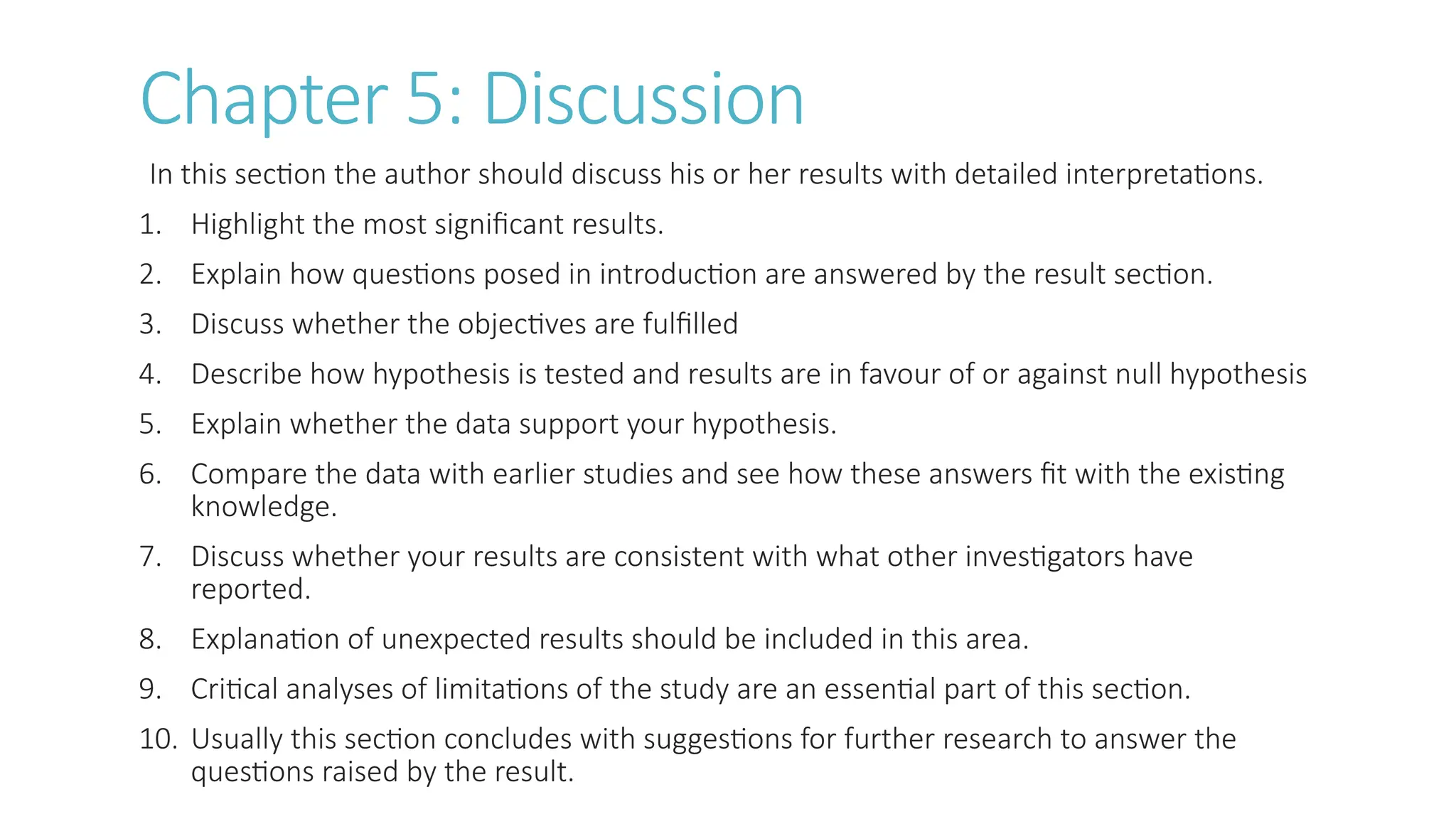
Chapter 5: Discussion
Inthis section the author should discuss his or her results with detailed interpretations.
1. Highlight the most significant results.
2. Explain how questions posed in introduction are answered by the result section.
3. Discuss whether the objectives are fulfilled
4. Describe how hypothesis is tested and results are in favour of or against null hypothesis
5. Explain whether the data support your hypothesis.
6. Compare the data with earlier studies and see how these answers fit with the existing
knowledge.
7. Discuss whether your results are consistent with what other investigators have
reported.
8. Explanation of unexpected results should be included in this area.
9. Critical analyses of limitations of the study are an essential part of this section.
10. Usually this section concludes with suggestions for further research to answer the
questions raised by the result.
19.
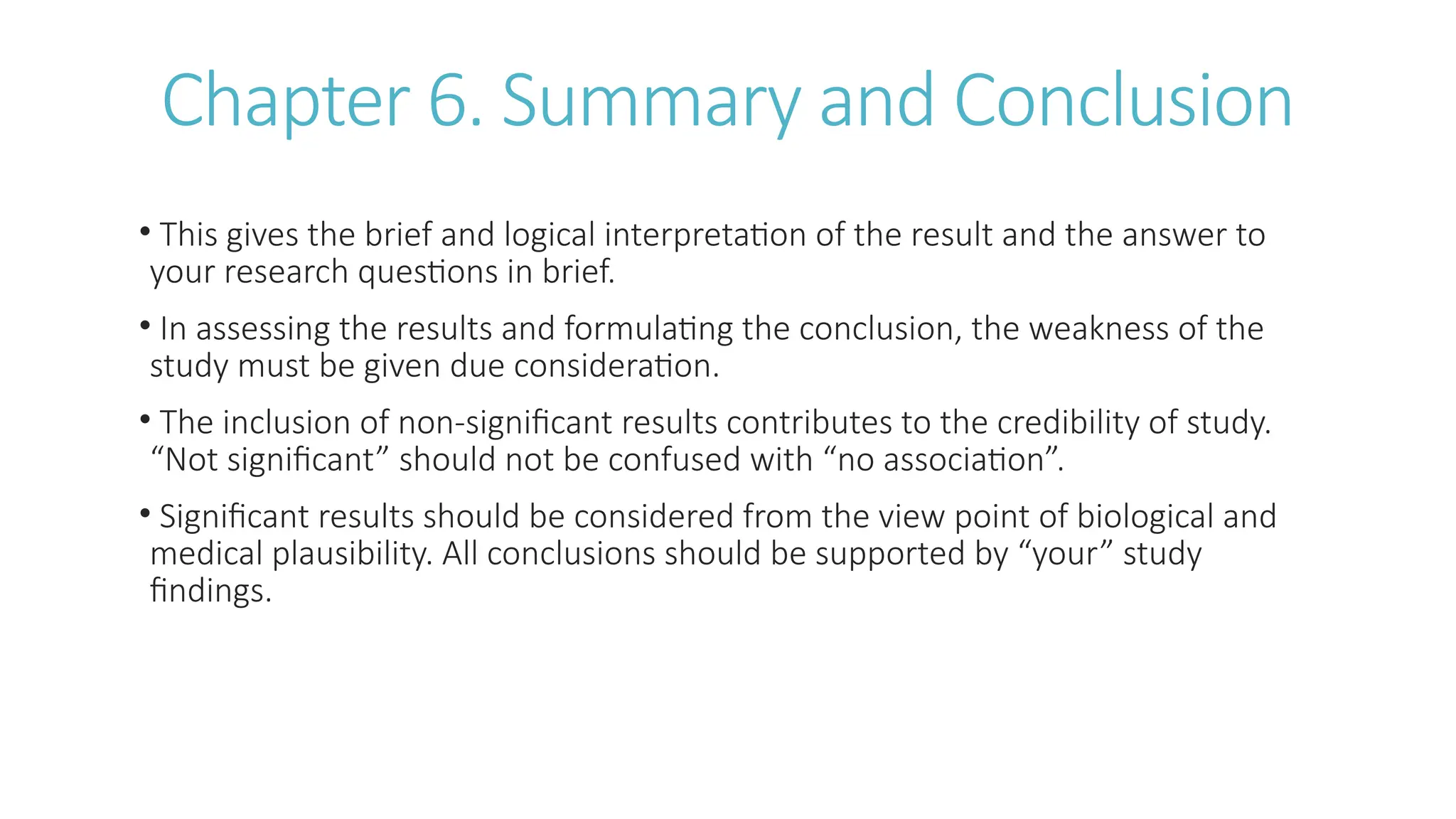
Chapter 6. Summaryand Conclusion
• This gives the brief and logical interpretation of the result and the answer to
your research questions in brief.
• In assessing the results and formulating the conclusion, the weakness of the
study must be given due consideration.
• The inclusion of non-significant results contributes to the credibility of study.
“Not significant” should not be confused with “no association”.
• Significant results should be considered from the view point of biological and
medical plausibility. All conclusions should be supported by “your” study
findings.
20.
References
The authenticity ofthe literature review is enhanced by the use of references
citing their source, author, time period etc.
Modes of referencing should be in an accepted format
1. Vancouver referencing style for referencing ·
Mostly in health and physical science ·
List of references: numbered consecutively in chronological order of quotation
in the text.
Arabic numbers are assigned in the order of citation ·
Numbers are commonly enclosed in round brackets, e.g. (1) but it can also be
written in square brackets, e.g. [1] or as superscripts, e.g.1
or as a combination
of bracket and superscript, e.g. (1)
·
If more than once cited, the same citation number is used.
21.
2. Harvard referencingstyle for referencing. ·
Mostly in Humanities and Social sciences ·
List of references placed in alphabetical order. ·
References quoted in the text: surname of author(s) and publication year are
listed.
A properly drafted thesis starts with evolution of a new research question which
evolves into a scientifically executed research process, which in turn leads to new
research findings.
These findings are discussed in the light of existing knowledge to evolve new
conclusions and further research questions.


![References
The authenticity of the literature review is enhanced by the use of references
citing their source, author, time period etc.
Modes of referencing should be in an accepted format
1. Vancouver referencing style for referencing ·
Mostly in health and physical science ·
List of references: numbered consecutively in chronological order of quotation
in the text.
Arabic numbers are assigned in the order of citation ·
Numbers are commonly enclosed in round brackets, e.g. (1) but it can also be
written in square brackets, e.g. [1] or as superscripts, e.g.1
or as a combination
of bracket and superscript, e.g. (1)
·
If more than once cited, the same citation number is used.](https://image.slidesharecdn.com/thesiswriting-250815105507-6ce09806/75/Thesis-writing-ppt-about-the-biostatstaticd-20-2048.jpg)