ADD and ADHD

BY CHELSEA JOHNSTON
What is ADD and ADHD?

 Attention deficit disorder or attention deficit
  hyperactive disorder is a common childhood
  disorder that can continue on through adolescences
  and adulthood.
 This condition effects 3%-7% of children worldwide.
 Symptoms of this condition are low attention and
  concentration levels, high levels of
  activity, distractibility, impulsivity and the inability
  to inhibit actions.

                                               (Loitti,   936)
Is there a difference between ADD and ADHD?

 ADD used to be the only term for this condition, but
  in 1987 the term ADD was revised to ADHD in the
  Diagnostic Statistic Manual III.
 Along with the revision ADHD was broken into three
  categories.
    Predominantly Inattentive Type
    Predominantly Hyperactive-Impulsive Type
    Combined Type: Symptoms of the above types are equally
     evident.
 So basically ADD and ADHD are just different names
 for the same condition.
                                                    (Chambers, np)
The four brain regions implicated in ADD/ADHD

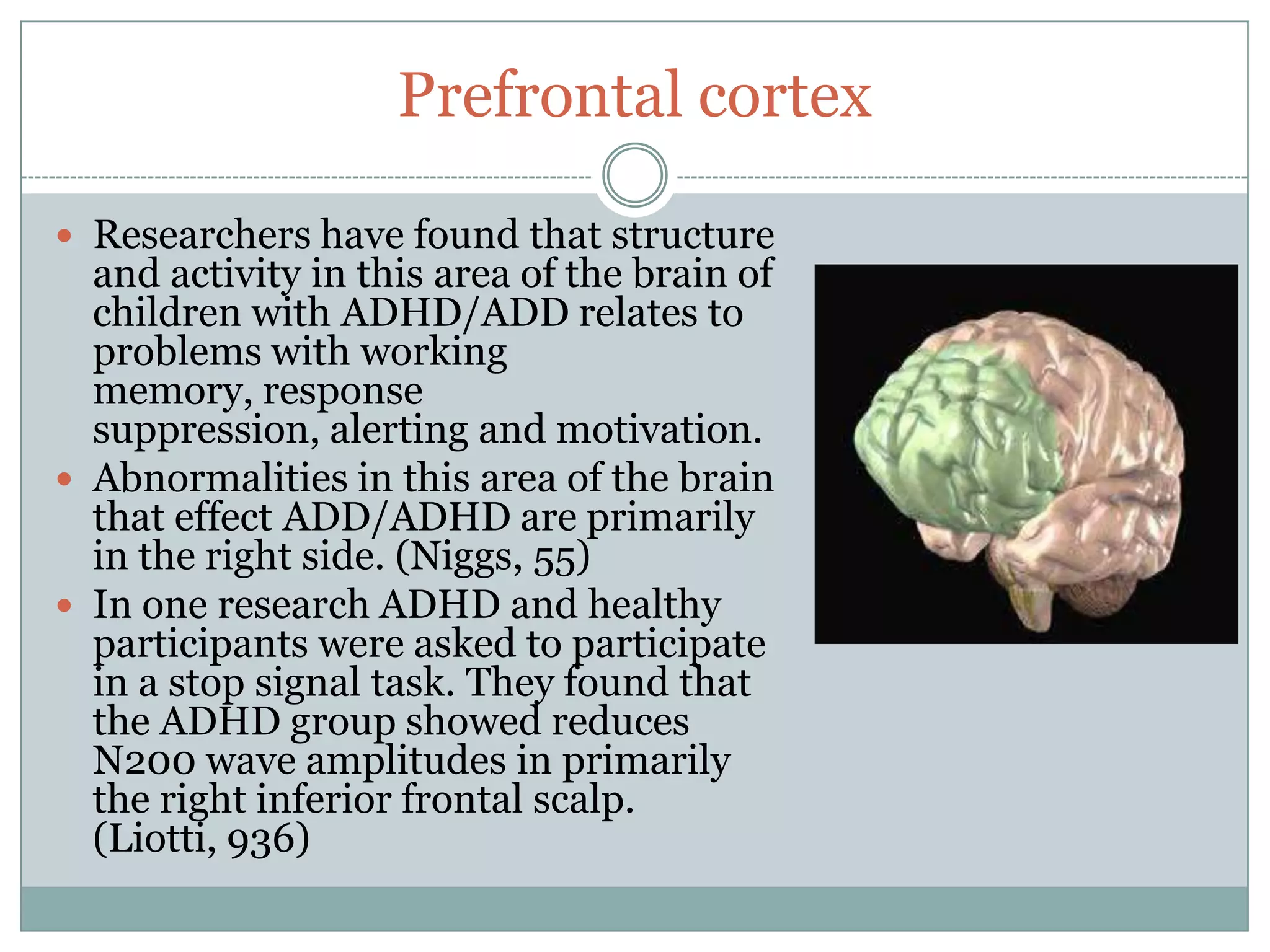
 The prefrontal cortices (especially the right
  prefrontal cortex)
 The basal ganglia (especially the caudate)
 The cerebellum (especially the cerebellar
  vermis)
 The corpus callosum (especially the genu)


                                       (Nigg,   54)
Prefrontal cortex

 Researchers have found that structure
  and activity in this area of the brain of
  children with ADHD/ADD relates to
  problems with working
  memory, response
  suppression, alerting and motivation.
 Abnormalities in this area of the brain
  that effect ADD/ADHD are primarily
  in the right side. (Niggs, 55)
 In one research ADHD and healthy
  participants were asked to participate
  in a stop signal task. They found that
  the ADHD group showed reduces
  N200 wave amplitudes in primarily
  the right inferior frontal scalp.
  (Liotti, 936)
Basal Ganglia

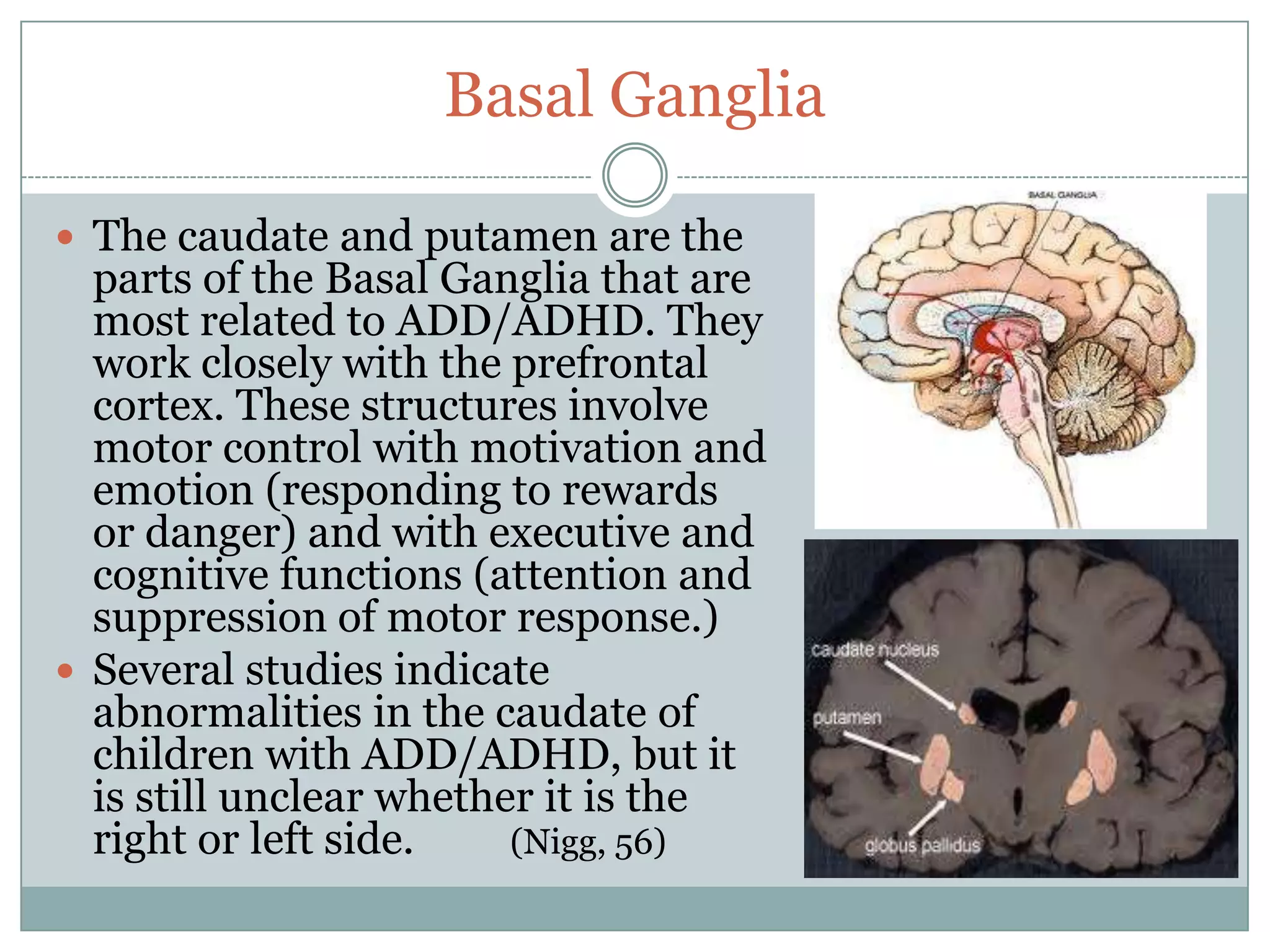
 The caudate and putamen are the
  parts of the Basal Ganglia that are
  most related to ADD/ADHD. They
  work closely with the prefrontal
  cortex. These structures involve
  motor control with motivation and
  emotion (responding to rewards
  or danger) and with executive and
  cognitive functions (attention and
  suppression of motor response.)
 Several studies indicate
  abnormalities in the caudate of
  children with ADD/ADHD, but it
  is still unclear whether it is the
  right or left side.    (Nigg, 56)
Cerebellum

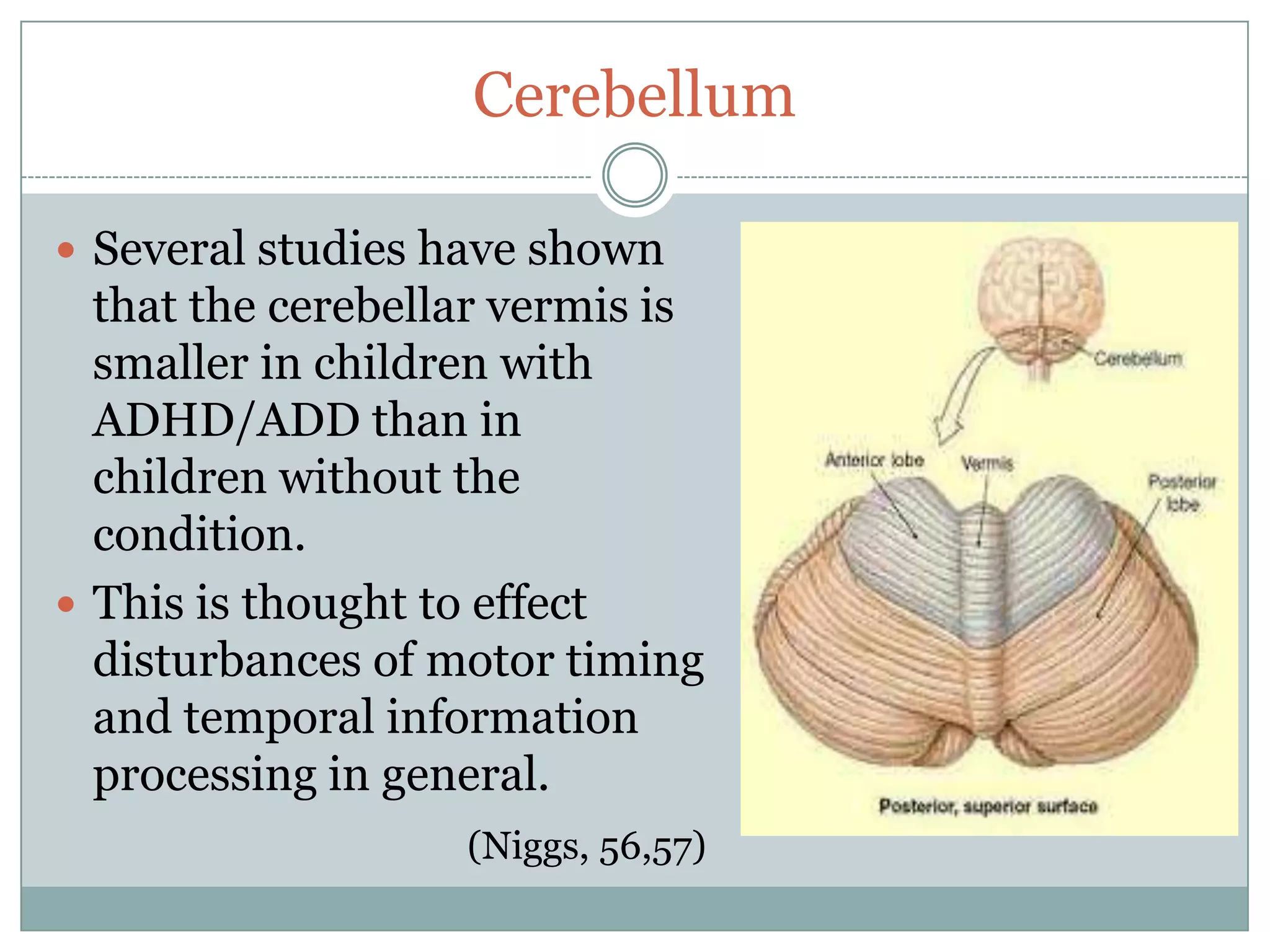
 Several studies have shown
  that the cerebellar vermis is
  smaller in children with
  ADHD/ADD than in
  children without the
  condition.
 This is thought to effect
  disturbances of motor timing
  and temporal information
  processing in general.
                   (Niggs, 56,57)
Corpus Callosum

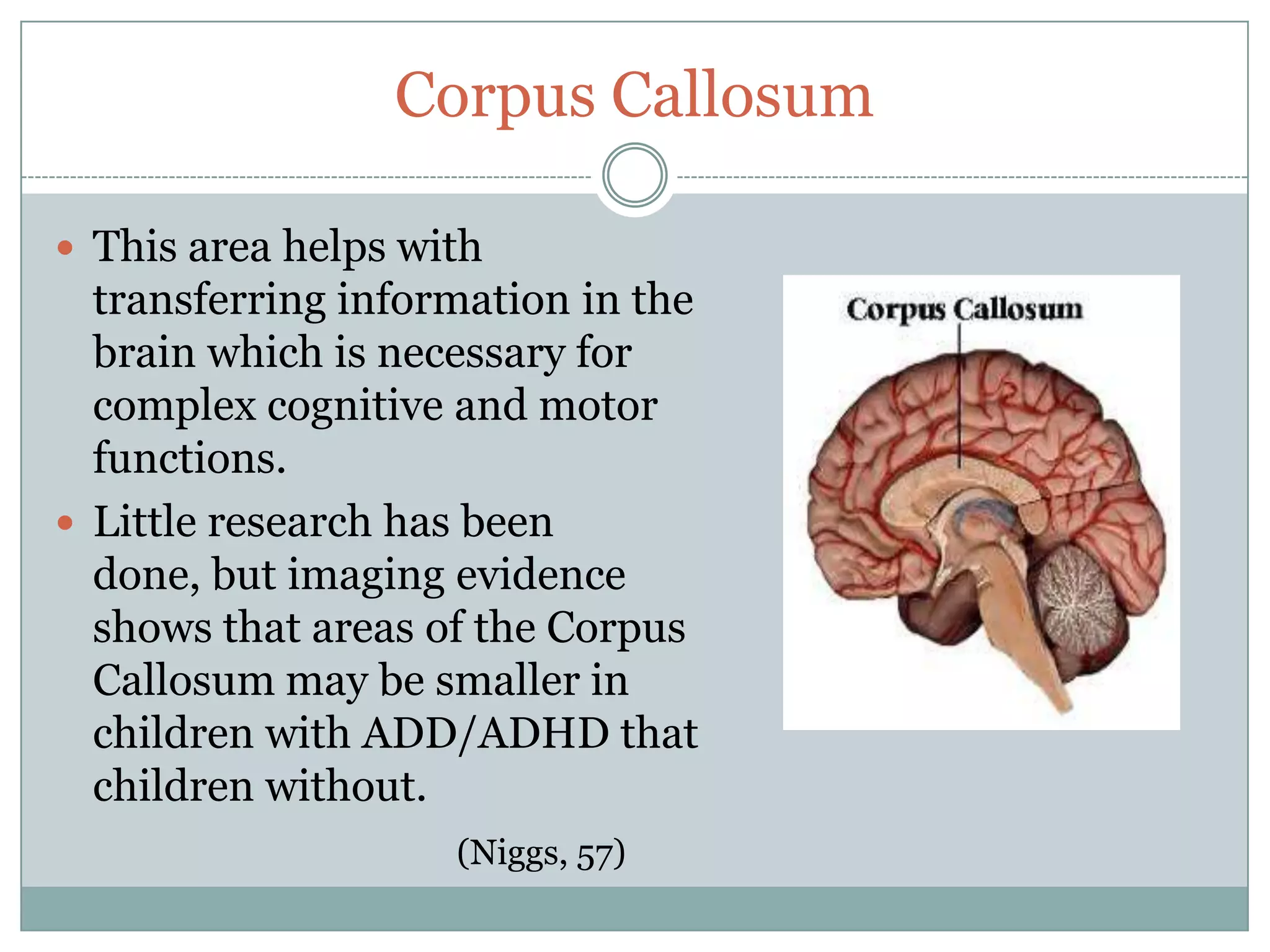
 This area helps with
  transferring information in the
  brain which is necessary for
  complex cognitive and motor
  functions.
 Little research has been
  done, but imaging evidence
  shows that areas of the Corpus
  Callosum may be smaller in
  children with ADD/ADHD that
  children without.
                    (Niggs, 57)
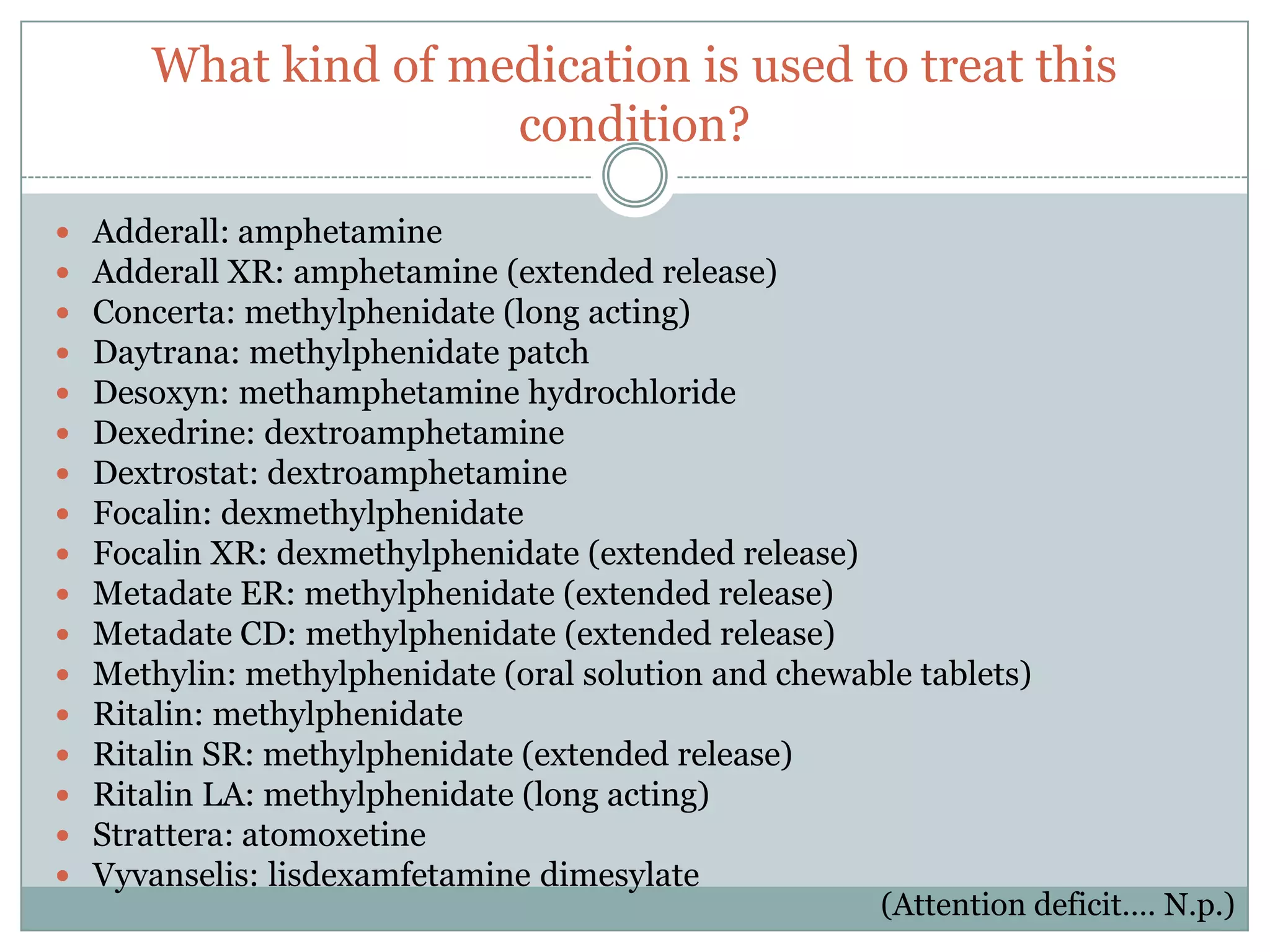
What kind of medication is used to treat this
                      condition?

   Adderall: amphetamine
   Adderall XR: amphetamine (extended release)
   Concerta: methylphenidate (long acting)
   Daytrana: methylphenidate patch
   Desoxyn: methamphetamine hydrochloride
   Dexedrine: dextroamphetamine
   Dextrostat: dextroamphetamine
   Focalin: dexmethylphenidate
   Focalin XR: dexmethylphenidate (extended release)
   Metadate ER: methylphenidate (extended release)
   Metadate CD: methylphenidate (extended release)
   Methylin: methylphenidate (oral solution and chewable tablets)
   Ritalin: methylphenidate
   Ritalin SR: methylphenidate (extended release)
   Ritalin LA: methylphenidate (long acting)
   Strattera: atomoxetine
   Vyvanselis: lisdexamfetamine dimesylate
                                                        (Attention deficit…. N.p.)
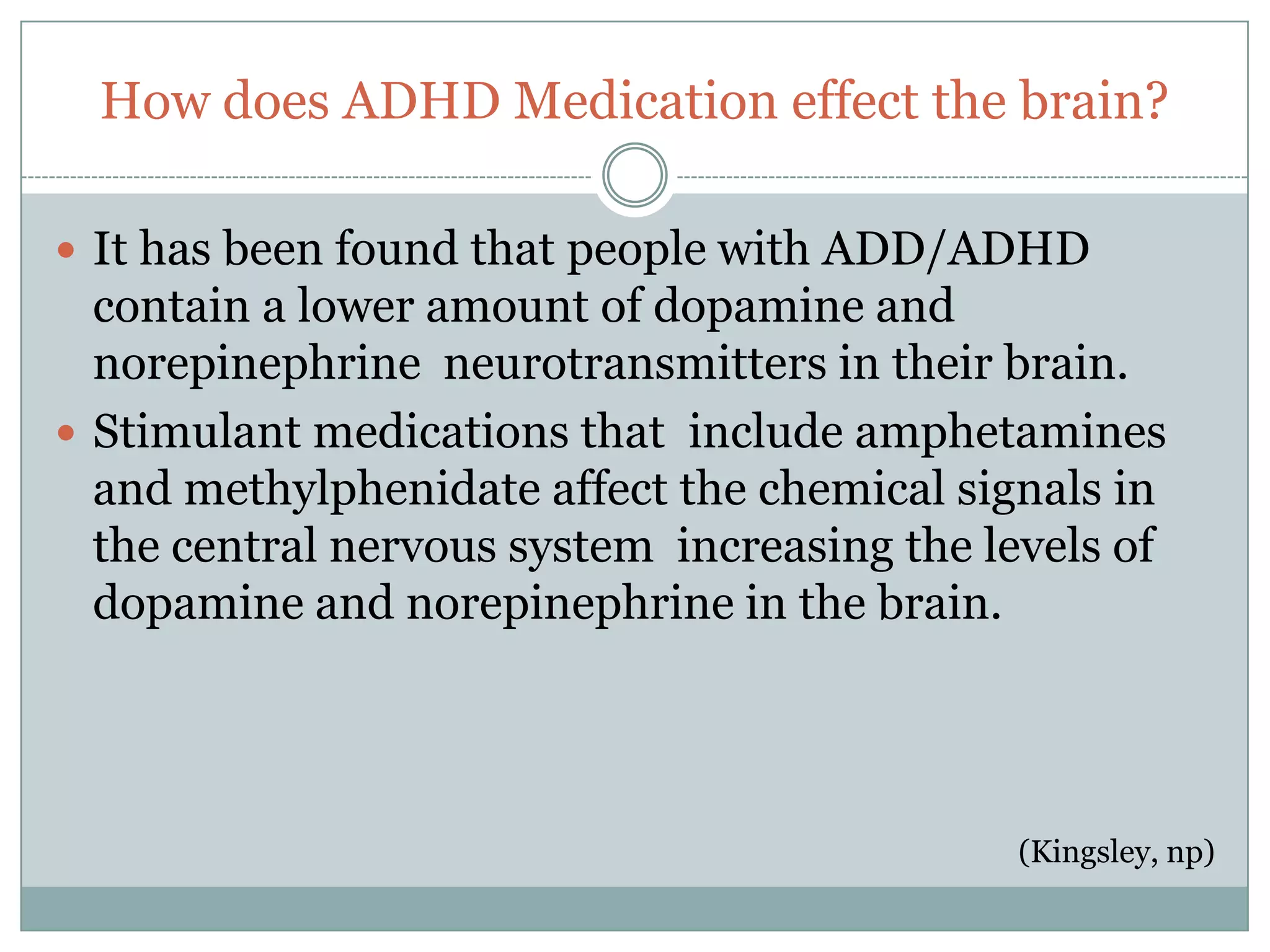
How does ADHD Medication effect the brain?

 It has been found that people with ADD/ADHD
  contain a lower amount of dopamine and
  norepinephrine neurotransmitters in their brain.
 Stimulant medications that include amphetamines
  and methylphenidate affect the chemical signals in
  the central nervous system increasing the levels of
  dopamine and norepinephrine in the brain.


                                             (Kingsley, np)
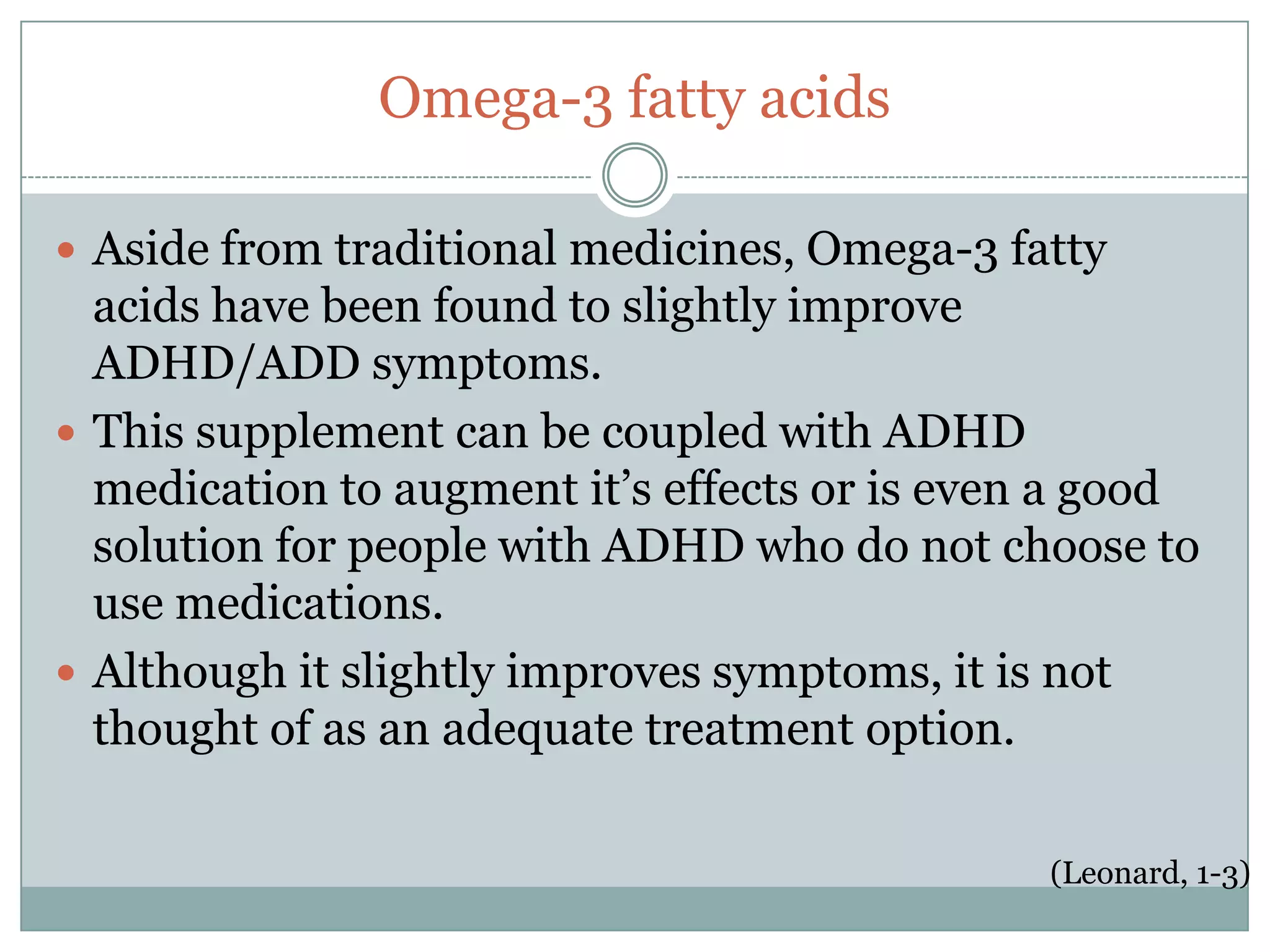
Omega-3 fatty acids

 Aside from traditional medicines, Omega-3 fatty
  acids have been found to slightly improve
  ADHD/ADD symptoms.
 This supplement can be coupled with ADHD
  medication to augment it’s effects or is even a good
  solution for people with ADHD who do not choose to
  use medications.
 Although it slightly improves symptoms, it is not
  thought of as an adequate treatment option.

                                              (Leonard, 1-3)
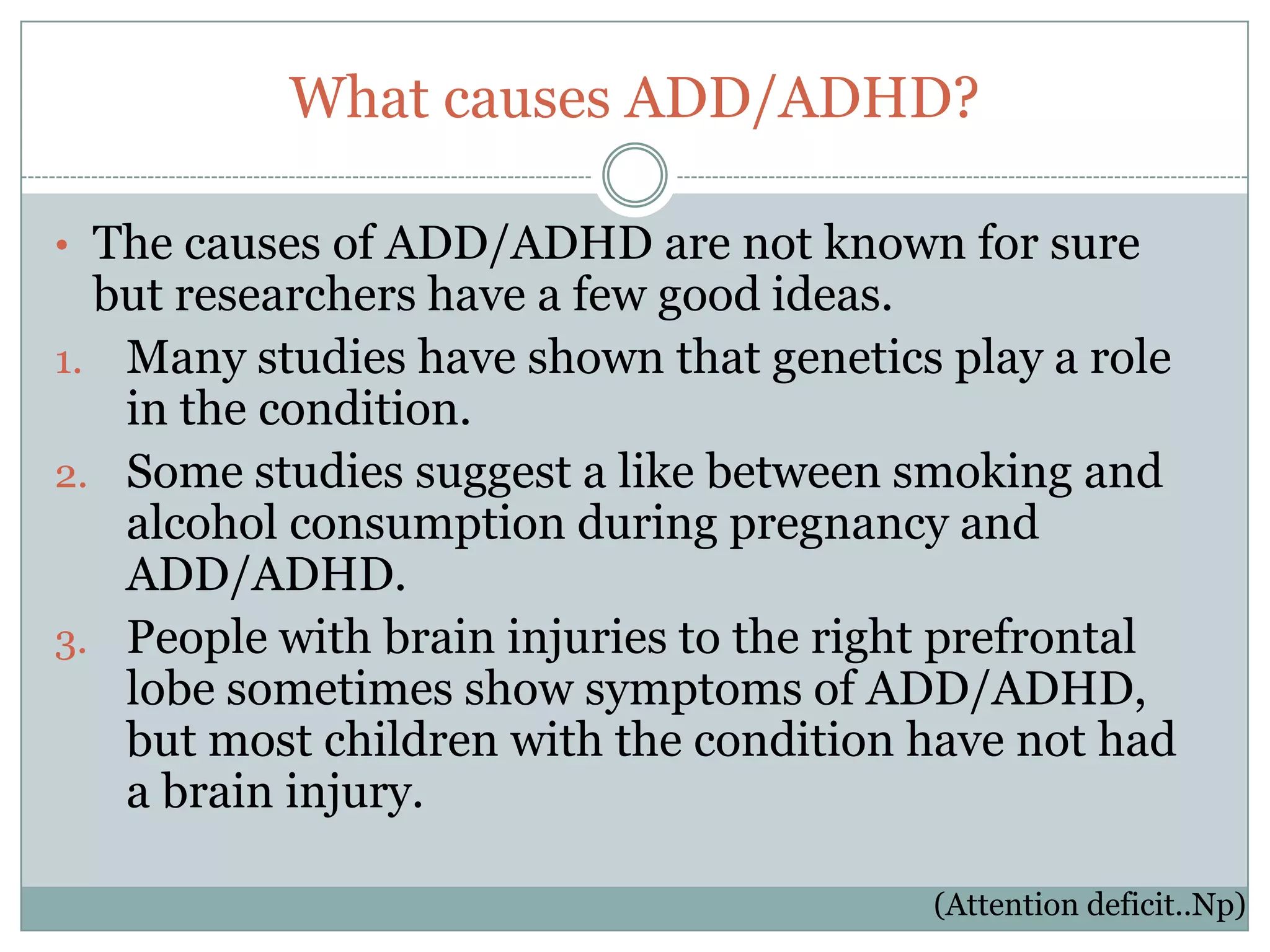
What causes ADD/ADHD?

• The causes of ADD/ADHD are not known for sure
  but researchers have a few good ideas.
1. Many studies have shown that genetics play a role
   in the condition.
2. Some studies suggest a like between smoking and
   alcohol consumption during pregnancy and
   ADD/ADHD.
3. People with brain injuries to the right prefrontal
   lobe sometimes show symptoms of ADD/ADHD,
   but most children with the condition have not had
   a brain injury.

                                         (Attention deficit..Np)
Bibliography

   “Attention Deficit Hyperactive Disorder ADHD.” National institute of mental health. NIMH.
    Web. 6 Aug 2012. This website was very informative in providing the different types of
    medications used for ADHD. It also listed what chemical was used in each medication.
   Chambers, TJ. ADHD Awareness.Web. 6 Aug 2012. This website was very informative and
    contributed noticeably to my research. It helped to describe the different types of ADHD and
    the changes to the name of the condition.
   Kingsley, Richard. “Managing ADHD with medication” kids health. Web. 6 Aug 2012. This
    website gave me clear information about how ADHD medication stimulants effect the brain.
    This website described how these medications worked very well.
   *Leonard, Henrietta. “Omega-3 fatty acids may be benificial as augmentation to ADHD
    medications.” The Brown University child and adolescent psychopharmacology update. 13
    (2011): 1-3, Web. October. 6 Aug. 2012. This source had information of ADHD treatment
    beyond just medication. It explains the study that lead to the thought that Omega-3 could help
    with ADHD.
   * Liotti, Mario, et al. “Electrophysiological correlates of response inhibition in children and
    adolescents with ADHD: Influence of gender, age, and previous treatment history.”
    Psychophysiology, 44 (2007) : 936-948, Web. 8 Feb. 6 Aug. 2012. This source provided very
    solid information regarding the effects of the prefrontal cortex in people with ADHD. The study
    was explained in depth with information applying to What ADHD is and how the condition
    relates to the prefrontal cortex.
   *Nigg, Joel. What Causes ADHD? : Understanding What Goes Wrong and Why. New
    York, NY, USA: Guilford Press, 2006. Print. This book provided me with so much information
    about ADHD as a serious condition. The information that was especially helpful to me was that
    about the brain regions implicated in the mind of a child with ADHD.

Add and adhd_powerpoint

  • 1.
    ADD and ADHD BYCHELSEA JOHNSTON
  • 2.
    What is ADDand ADHD?  Attention deficit disorder or attention deficit hyperactive disorder is a common childhood disorder that can continue on through adolescences and adulthood.  This condition effects 3%-7% of children worldwide.  Symptoms of this condition are low attention and concentration levels, high levels of activity, distractibility, impulsivity and the inability to inhibit actions. (Loitti, 936)
  • 3.
    Is there adifference between ADD and ADHD?  ADD used to be the only term for this condition, but in 1987 the term ADD was revised to ADHD in the Diagnostic Statistic Manual III.  Along with the revision ADHD was broken into three categories.  Predominantly Inattentive Type  Predominantly Hyperactive-Impulsive Type  Combined Type: Symptoms of the above types are equally evident.  So basically ADD and ADHD are just different names for the same condition. (Chambers, np)
  • 4.
    The four brainregions implicated in ADD/ADHD  The prefrontal cortices (especially the right prefrontal cortex)  The basal ganglia (especially the caudate)  The cerebellum (especially the cerebellar vermis)  The corpus callosum (especially the genu) (Nigg, 54)
  • 5.
    Prefrontal cortex  Researchershave found that structure and activity in this area of the brain of children with ADHD/ADD relates to problems with working memory, response suppression, alerting and motivation.  Abnormalities in this area of the brain that effect ADD/ADHD are primarily in the right side. (Niggs, 55)  In one research ADHD and healthy participants were asked to participate in a stop signal task. They found that the ADHD group showed reduces N200 wave amplitudes in primarily the right inferior frontal scalp. (Liotti, 936)
  • 6.
    Basal Ganglia  Thecaudate and putamen are the parts of the Basal Ganglia that are most related to ADD/ADHD. They work closely with the prefrontal cortex. These structures involve motor control with motivation and emotion (responding to rewards or danger) and with executive and cognitive functions (attention and suppression of motor response.)  Several studies indicate abnormalities in the caudate of children with ADD/ADHD, but it is still unclear whether it is the right or left side. (Nigg, 56)
  • 7.
    Cerebellum  Several studieshave shown that the cerebellar vermis is smaller in children with ADHD/ADD than in children without the condition.  This is thought to effect disturbances of motor timing and temporal information processing in general. (Niggs, 56,57)
  • 8.
    Corpus Callosum  Thisarea helps with transferring information in the brain which is necessary for complex cognitive and motor functions.  Little research has been done, but imaging evidence shows that areas of the Corpus Callosum may be smaller in children with ADD/ADHD that children without. (Niggs, 57)
  • 9.
    What kind ofmedication is used to treat this condition?  Adderall: amphetamine  Adderall XR: amphetamine (extended release)  Concerta: methylphenidate (long acting)  Daytrana: methylphenidate patch  Desoxyn: methamphetamine hydrochloride  Dexedrine: dextroamphetamine  Dextrostat: dextroamphetamine  Focalin: dexmethylphenidate  Focalin XR: dexmethylphenidate (extended release)  Metadate ER: methylphenidate (extended release)  Metadate CD: methylphenidate (extended release)  Methylin: methylphenidate (oral solution and chewable tablets)  Ritalin: methylphenidate  Ritalin SR: methylphenidate (extended release)  Ritalin LA: methylphenidate (long acting)  Strattera: atomoxetine  Vyvanselis: lisdexamfetamine dimesylate (Attention deficit…. N.p.)
  • 10.
    How does ADHDMedication effect the brain?  It has been found that people with ADD/ADHD contain a lower amount of dopamine and norepinephrine neurotransmitters in their brain.  Stimulant medications that include amphetamines and methylphenidate affect the chemical signals in the central nervous system increasing the levels of dopamine and norepinephrine in the brain. (Kingsley, np)
  • 11.
    Omega-3 fatty acids Aside from traditional medicines, Omega-3 fatty acids have been found to slightly improve ADHD/ADD symptoms.  This supplement can be coupled with ADHD medication to augment it’s effects or is even a good solution for people with ADHD who do not choose to use medications.  Although it slightly improves symptoms, it is not thought of as an adequate treatment option. (Leonard, 1-3)
  • 12.
    What causes ADD/ADHD? •The causes of ADD/ADHD are not known for sure but researchers have a few good ideas. 1. Many studies have shown that genetics play a role in the condition. 2. Some studies suggest a like between smoking and alcohol consumption during pregnancy and ADD/ADHD. 3. People with brain injuries to the right prefrontal lobe sometimes show symptoms of ADD/ADHD, but most children with the condition have not had a brain injury. (Attention deficit..Np)
  • 13.
    Bibliography  “Attention Deficit Hyperactive Disorder ADHD.” National institute of mental health. NIMH. Web. 6 Aug 2012. This website was very informative in providing the different types of medications used for ADHD. It also listed what chemical was used in each medication.  Chambers, TJ. ADHD Awareness.Web. 6 Aug 2012. This website was very informative and contributed noticeably to my research. It helped to describe the different types of ADHD and the changes to the name of the condition.  Kingsley, Richard. “Managing ADHD with medication” kids health. Web. 6 Aug 2012. This website gave me clear information about how ADHD medication stimulants effect the brain. This website described how these medications worked very well.  *Leonard, Henrietta. “Omega-3 fatty acids may be benificial as augmentation to ADHD medications.” The Brown University child and adolescent psychopharmacology update. 13 (2011): 1-3, Web. October. 6 Aug. 2012. This source had information of ADHD treatment beyond just medication. It explains the study that lead to the thought that Omega-3 could help with ADHD.  * Liotti, Mario, et al. “Electrophysiological correlates of response inhibition in children and adolescents with ADHD: Influence of gender, age, and previous treatment history.” Psychophysiology, 44 (2007) : 936-948, Web. 8 Feb. 6 Aug. 2012. This source provided very solid information regarding the effects of the prefrontal cortex in people with ADHD. The study was explained in depth with information applying to What ADHD is and how the condition relates to the prefrontal cortex.  *Nigg, Joel. What Causes ADHD? : Understanding What Goes Wrong and Why. New York, NY, USA: Guilford Press, 2006. Print. This book provided me with so much information about ADHD as a serious condition. The information that was especially helpful to me was that about the brain regions implicated in the mind of a child with ADHD.