Attention Deficit
Hyperactivity Disorder

            BY:
       JANIS S KYZER
Systems
 The symptoms of ADHD fall
     into three groups:
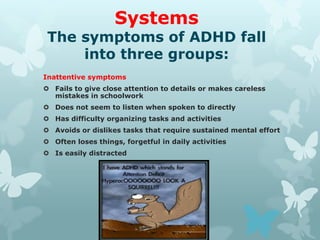
Inattentive symptoms
 Fails to give close attention to details or makes careless
  mistakes in schoolwork
 Does not seem to listen when spoken to directly
 Has difficulty organizing tasks and activities
 Avoids or dislikes tasks that require sustained mental effort
 Often loses things, forgetful in daily activities
 Is easily distracted
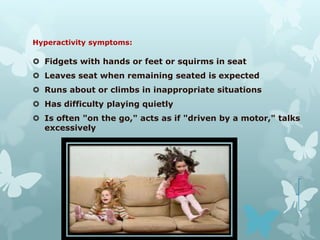
Hyperactivity symptoms:

 Fidgets with hands or feet or squirms in seat
 Leaves seat when remaining seated is expected
 Runs about or climbs in inappropriate situations
 Has difficulty playing quietly
 Is often "on the go," acts as if "driven by a motor," talks
  excessively
Impulsivity symptoms:

o Blurts out answers before questions have been
  completed
o Has difficulty awaiting turn
o Interrupts or intrudes on others
Causes of ADHD
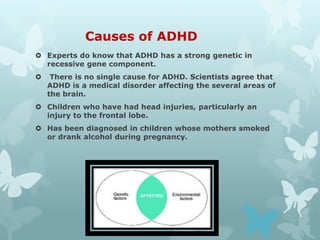
 Experts do know that ADHD has a strong genetic in
  recessive gene component.
    There is no single cause for ADHD. Scientists agree that
    ADHD is a medical disorder affecting the several areas of
    the brain.
 Children who have had head injuries, particularly an
  injury to the frontal lobe.
 Has been diagnosed in children whose mothers smoked
  or drank alcohol during pregnancy.
o A study involving 544 MRIs from children with ADHD has provided
  evidence that ADHD is associated with an atypical pattern of brain
  development that appears in early childhood.

                    WHICH ARE AS FOLLOWS

o   Frontal lobe volume is smaller, less active has less white matter.
o   Total cerebral volume is smaller.
o   There is a relative decrease in the size of the cerebellum
o   Various regions of the basal ganglia, particularly the caudate
    nucleus, have been reported to be smaller
Organs/Hormones
       Involved in ADHD
o ADHD affects only the brain.
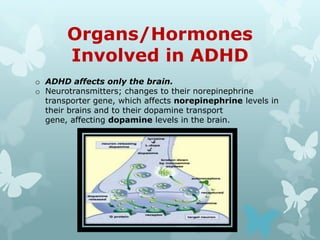
o Neurotransmitters; changes to their norepinephrine
  transporter gene, which affects norepinephrine levels in
  their brains and to their dopamine transport
  gene, affecting dopamine levels in the brain.
TREATMENT
 Early identification and treatment can prevent
  many of the problems associated with ADHD along
  with behavior therapy.
 Stimulants are the most commonly used drug to
  treat ADHD, Although these drugs are called
  stimulants, they actually have a calming effect on
  people with ADHD. Adderall, Vyvanse and Ritalin
  are the most common drugs used. A non stimulant
  drug called Strattera may work as well as
  stimulants
UNTREATED ADHD

 Alcoholism or other substance abuse is more likely
  among people with untreated ADHD
 Likely to get in trouble with the law. Again, an
  inability to control impulsive and risk taking
  behavior is the problem.
                 INTERESTING FACT
 Study has shown 40% of our current prison
  system population has ADHD, likely never
  recognized or treated. Imagine all the lives that
  could have been changed if someone had only
  noted the ADHD and helped them find a way to
  manage it.
REFERENCES


Kytja K. S. Voeller, MD
   J Child Neurol. 2004; 19 (10): 798-814.
http://people.csail.mit.edu/senef
http://www.ncbi.nlm.nih.gov/pubmedhealth/PMH0002518/
http://psychcentral.com/lib/2010/neurotransmitters-involved-
in-adhd/
http://www.ncbi.nlm.nih.gov/pubmedhealth/PMH0002518/
http://addstudent.com/2009/04/the-dangers-of-untreated-
adhd/

ADHD Mental Disorder?

  • 1.
  • 2.
    Systems The symptomsof ADHD fall into three groups: Inattentive symptoms  Fails to give close attention to details or makes careless mistakes in schoolwork  Does not seem to listen when spoken to directly  Has difficulty organizing tasks and activities  Avoids or dislikes tasks that require sustained mental effort  Often loses things, forgetful in daily activities  Is easily distracted
  • 3.
    Hyperactivity symptoms:  Fidgetswith hands or feet or squirms in seat  Leaves seat when remaining seated is expected  Runs about or climbs in inappropriate situations  Has difficulty playing quietly  Is often "on the go," acts as if "driven by a motor," talks excessively
  • 4.
    Impulsivity symptoms: o Blurtsout answers before questions have been completed o Has difficulty awaiting turn o Interrupts or intrudes on others
  • 5.
    Causes of ADHD Experts do know that ADHD has a strong genetic in recessive gene component.  There is no single cause for ADHD. Scientists agree that ADHD is a medical disorder affecting the several areas of the brain.  Children who have had head injuries, particularly an injury to the frontal lobe.  Has been diagnosed in children whose mothers smoked or drank alcohol during pregnancy.
  • 6.
    o A studyinvolving 544 MRIs from children with ADHD has provided evidence that ADHD is associated with an atypical pattern of brain development that appears in early childhood. WHICH ARE AS FOLLOWS o Frontal lobe volume is smaller, less active has less white matter. o Total cerebral volume is smaller. o There is a relative decrease in the size of the cerebellum o Various regions of the basal ganglia, particularly the caudate nucleus, have been reported to be smaller
  • 7.
    Organs/Hormones Involved in ADHD o ADHD affects only the brain. o Neurotransmitters; changes to their norepinephrine transporter gene, which affects norepinephrine levels in their brains and to their dopamine transport gene, affecting dopamine levels in the brain.
  • 8.
    TREATMENT  Early identificationand treatment can prevent many of the problems associated with ADHD along with behavior therapy.  Stimulants are the most commonly used drug to treat ADHD, Although these drugs are called stimulants, they actually have a calming effect on people with ADHD. Adderall, Vyvanse and Ritalin are the most common drugs used. A non stimulant drug called Strattera may work as well as stimulants
  • 9.
    UNTREATED ADHD  Alcoholismor other substance abuse is more likely among people with untreated ADHD  Likely to get in trouble with the law. Again, an inability to control impulsive and risk taking behavior is the problem. INTERESTING FACT  Study has shown 40% of our current prison system population has ADHD, likely never recognized or treated. Imagine all the lives that could have been changed if someone had only noted the ADHD and helped them find a way to manage it.
  • 10.
    REFERENCES Kytja K. S.Voeller, MD J Child Neurol. 2004; 19 (10): 798-814. http://people.csail.mit.edu/senef http://www.ncbi.nlm.nih.gov/pubmedhealth/PMH0002518/ http://psychcentral.com/lib/2010/neurotransmitters-involved- in-adhd/ http://www.ncbi.nlm.nih.gov/pubmedhealth/PMH0002518/ http://addstudent.com/2009/04/the-dangers-of-untreated- adhd/