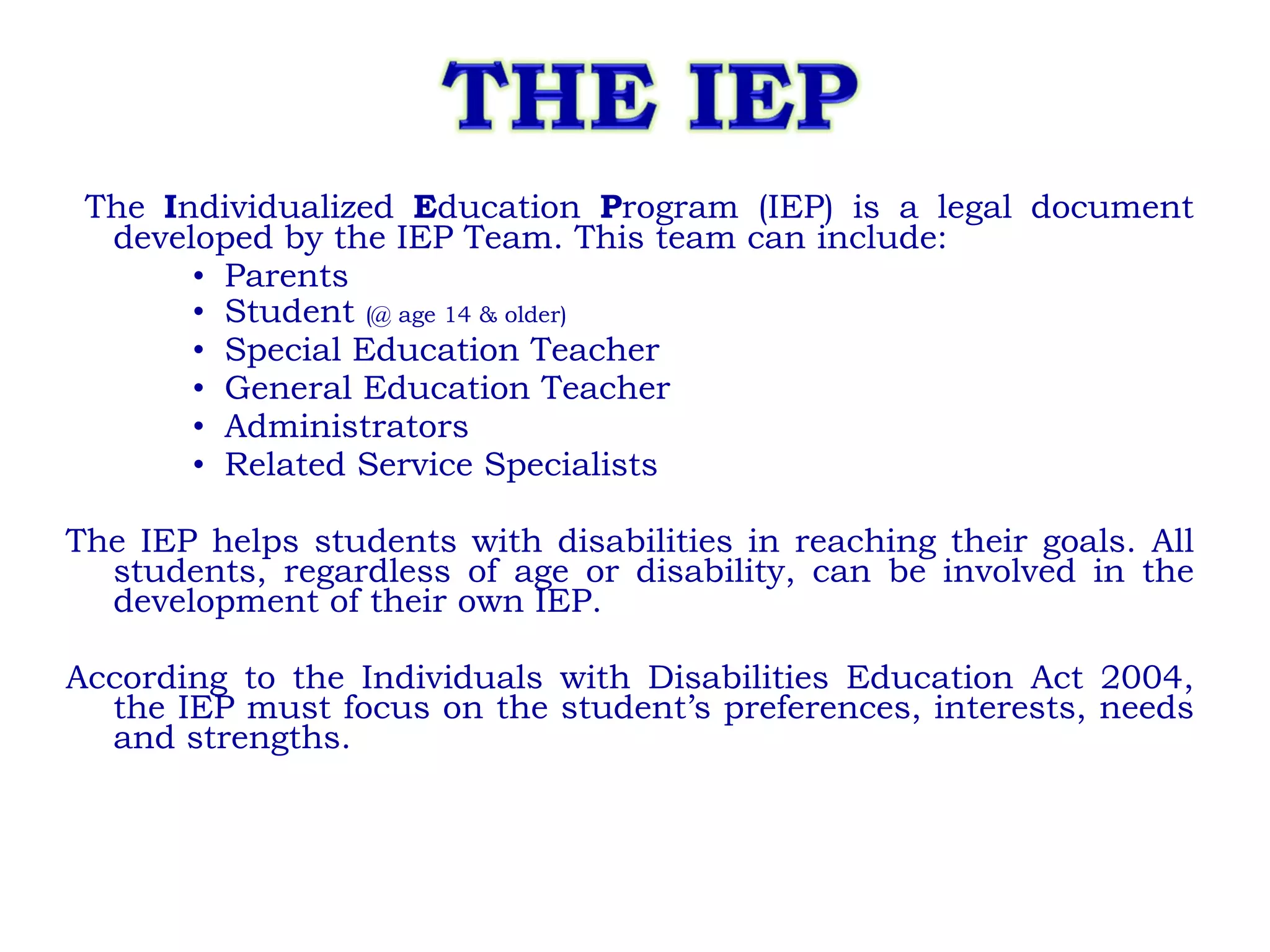
The  I ndividualized  E ducation  P rogram (IEP) is a legal document developed by the IEP Team. This team can include: Parents Student  (@ age 14 & older) Special Education Teacher  General Education Teacher Administrators Related Service Specialists The IEP helps students with disabilities in reaching their goals. All students, regardless of age or disability, can be involved in the development of their own IEP. According to the Individuals with Disabilities Education Act 2004, the IEP must focus on the student’s preferences, interests, needs and strengths.
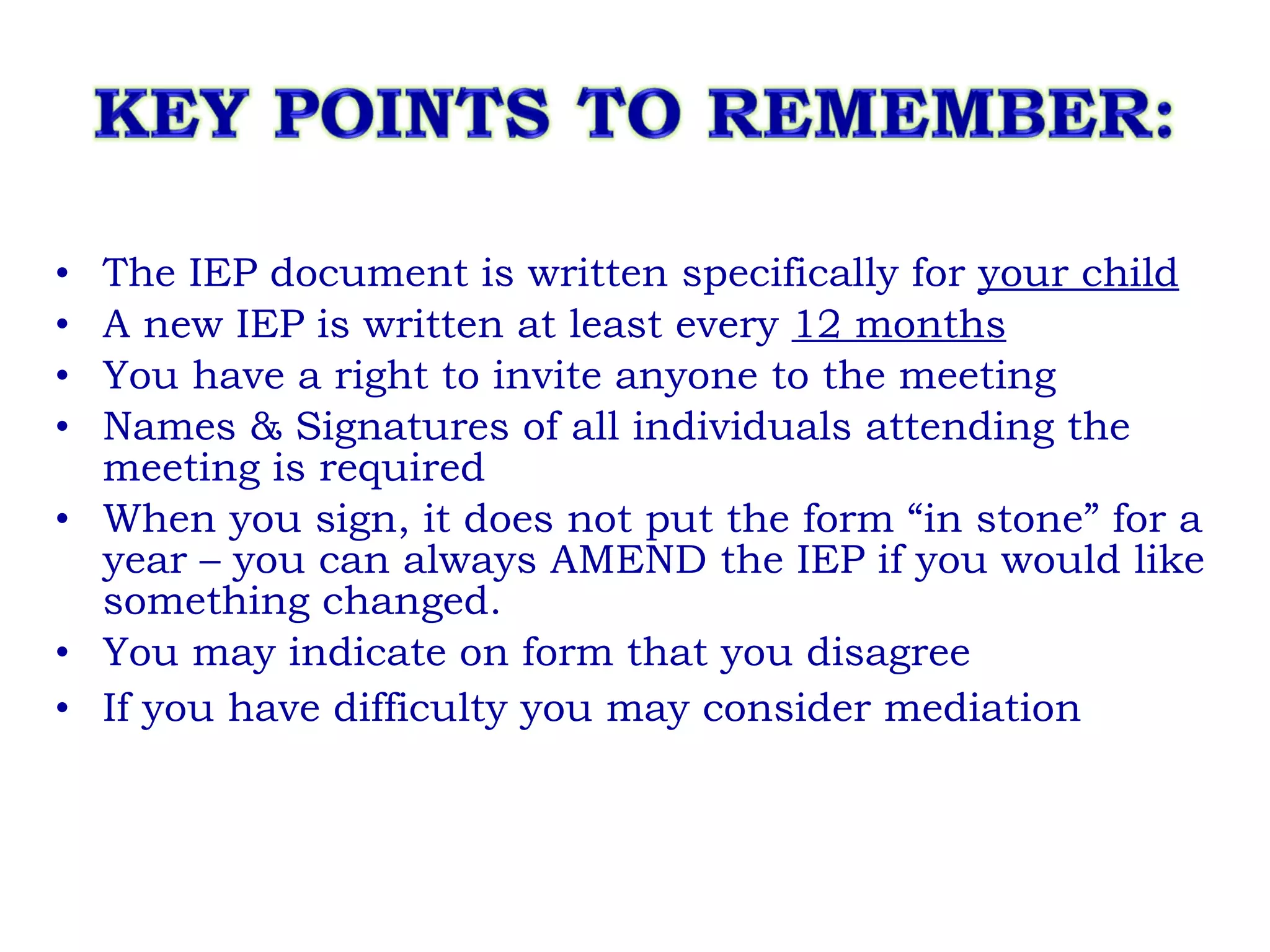
The IEP document is written specifically for  your child A new IEP is written at least every  12 months You have a right to invite anyone to the meeting Names & Signatures of all individuals attending the meeting is required When you sign, it does not put the form “in stone” for a year – you can always AMEND the IEP if you would like something changed.  You may indicate on form that you disagree If you have difficulty you may consider mediation
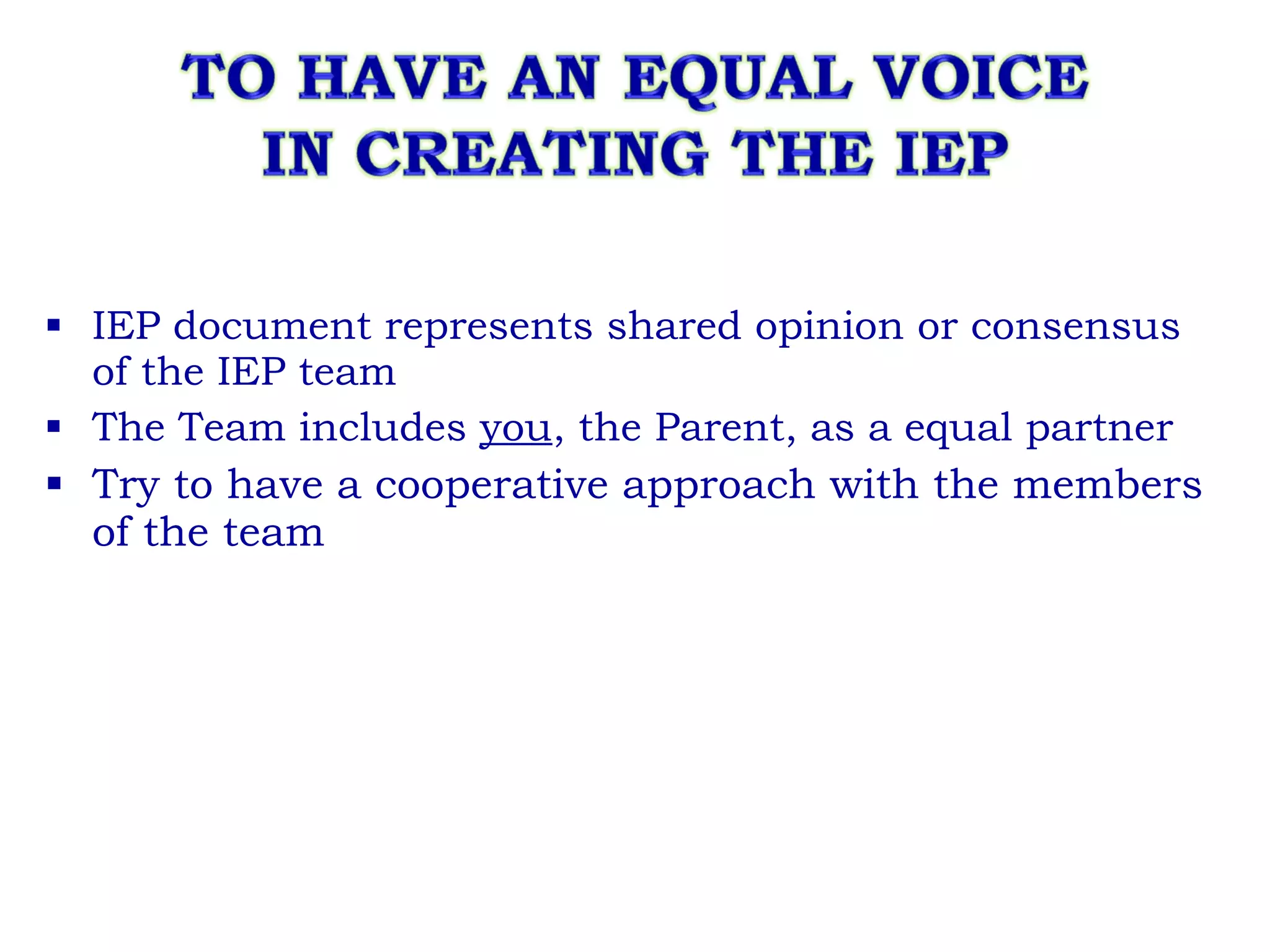
IEP document represents shared opinion or consensus of the IEP team The Team includes  you , the Parent, as a equal partner Try to have a cooperative approach with the members of the team
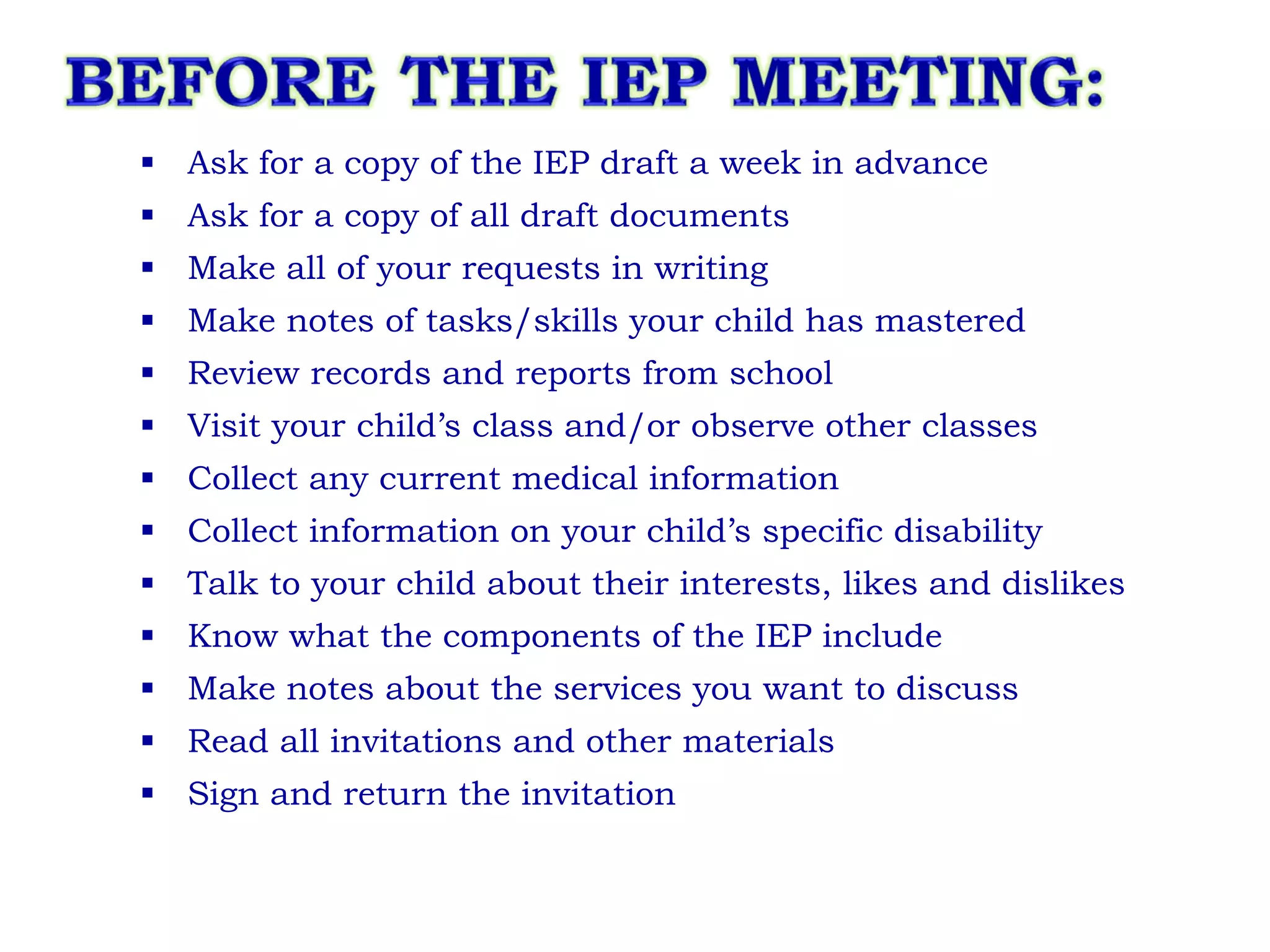
Ask for a copy of the IEP draft a week in advance Ask for a copy of all draft documents Make all of your requests in writing Make notes of tasks/skills your child has mastered Review records and reports from school Visit your child’s class and/or observe other classes Collect any current medical information Collect information on your child’s specific disability Talk to your child about their interests, likes and dislikes Know what the components of the IEP include Make notes about the services you want to discuss Read all invitations and other materials Sign and return the invitation
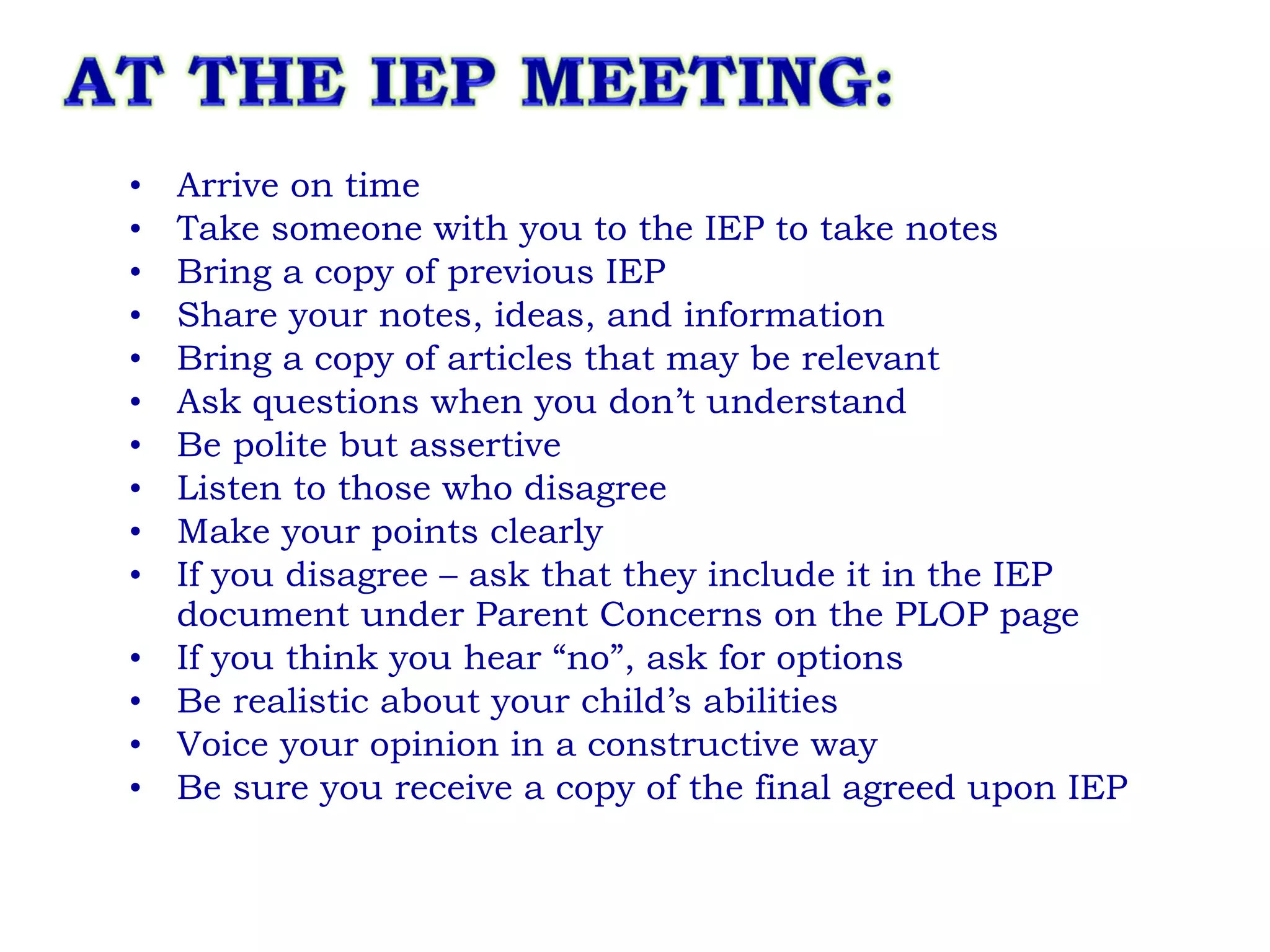
Arrive on time Take someone with you to the IEP to take notes Bring a copy of previous IEP Share your notes, ideas, and information Bring a copy of articles that may be relevant Ask questions when you don’t understand Be polite but assertive Listen to those who disagree Make your points clearly If you disagree – ask that they include it in the IEP document under Parent Concerns on the PLOP page If you think you hear “no”, ask for options  Be realistic about your child’s abilities Voice your opinion in a constructive way Be sure you receive a copy of the final agreed upon IEP
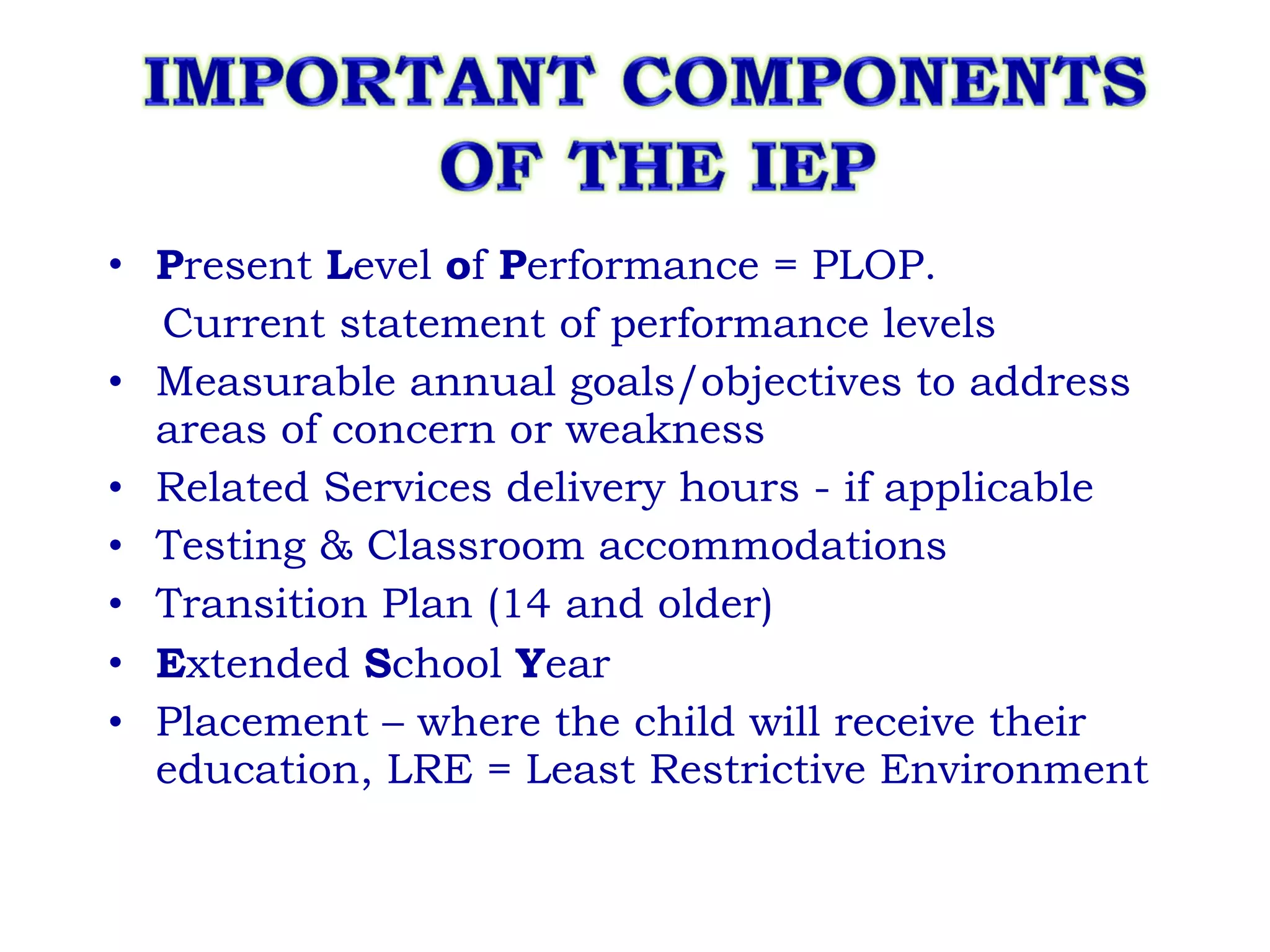
P resent  L evel  o f  P erformance = PLOP.  Current statement of performance levels Measurable annual goals/objectives to address areas of concern or weakness Related Services delivery hours - if applicable Testing & Classroom accommodations Transition Plan (14 and older) E xtended  S chool  Y ear Placement – where the child will receive their education, LRE = Least Restrictive Environment
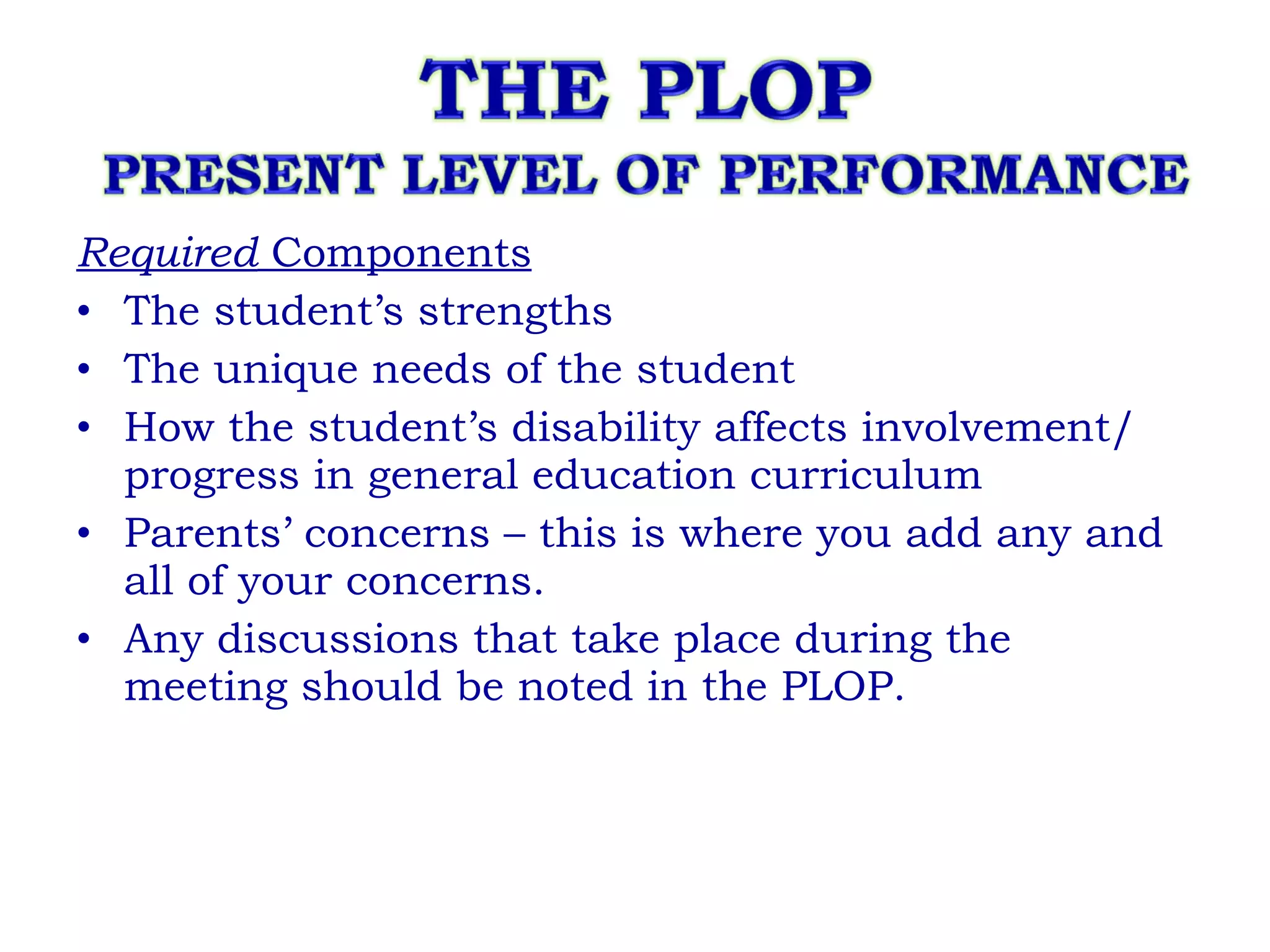
Required  Components The student’s strengths The unique needs of the student How the student’s disability affects involvement/ progress in general education curriculum Parents’ concerns – this is where you add any and all of your concerns.  Any discussions that take place during the meeting should be noted in the PLOP.
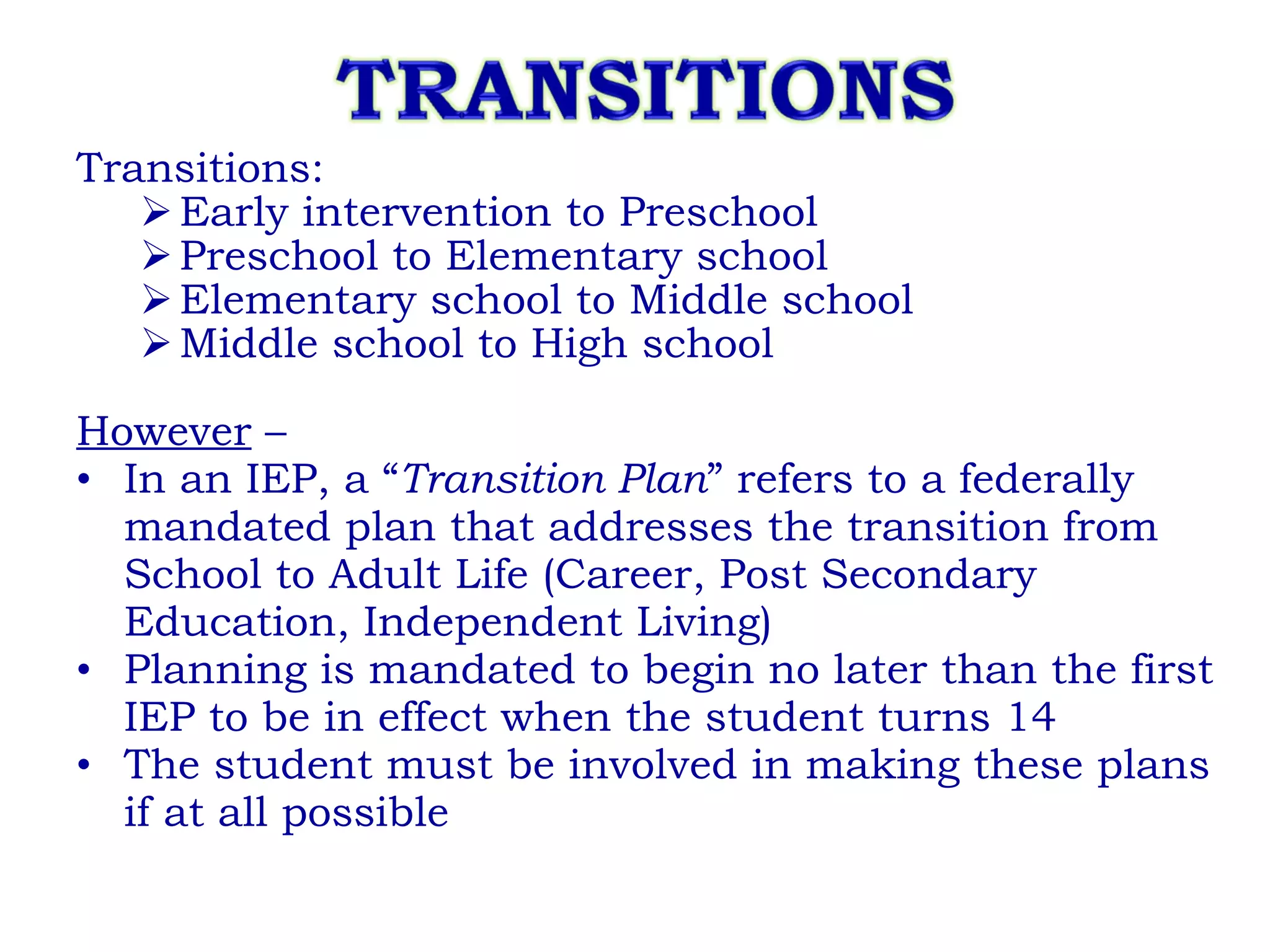
Transitions: Early intervention to Preschool Preschool to Elementary school Elementary school to Middle school Middle school to High school However  –  In an IEP, a “ Transition Plan ” refers to a federally mandated plan that addresses the transition from School to Adult Life (Career, Post Secondary Education, Independent Living) Planning is mandated to begin no later than the first IEP to be in effect when the student turns 14 The student must be involved in making these plans if at all possible
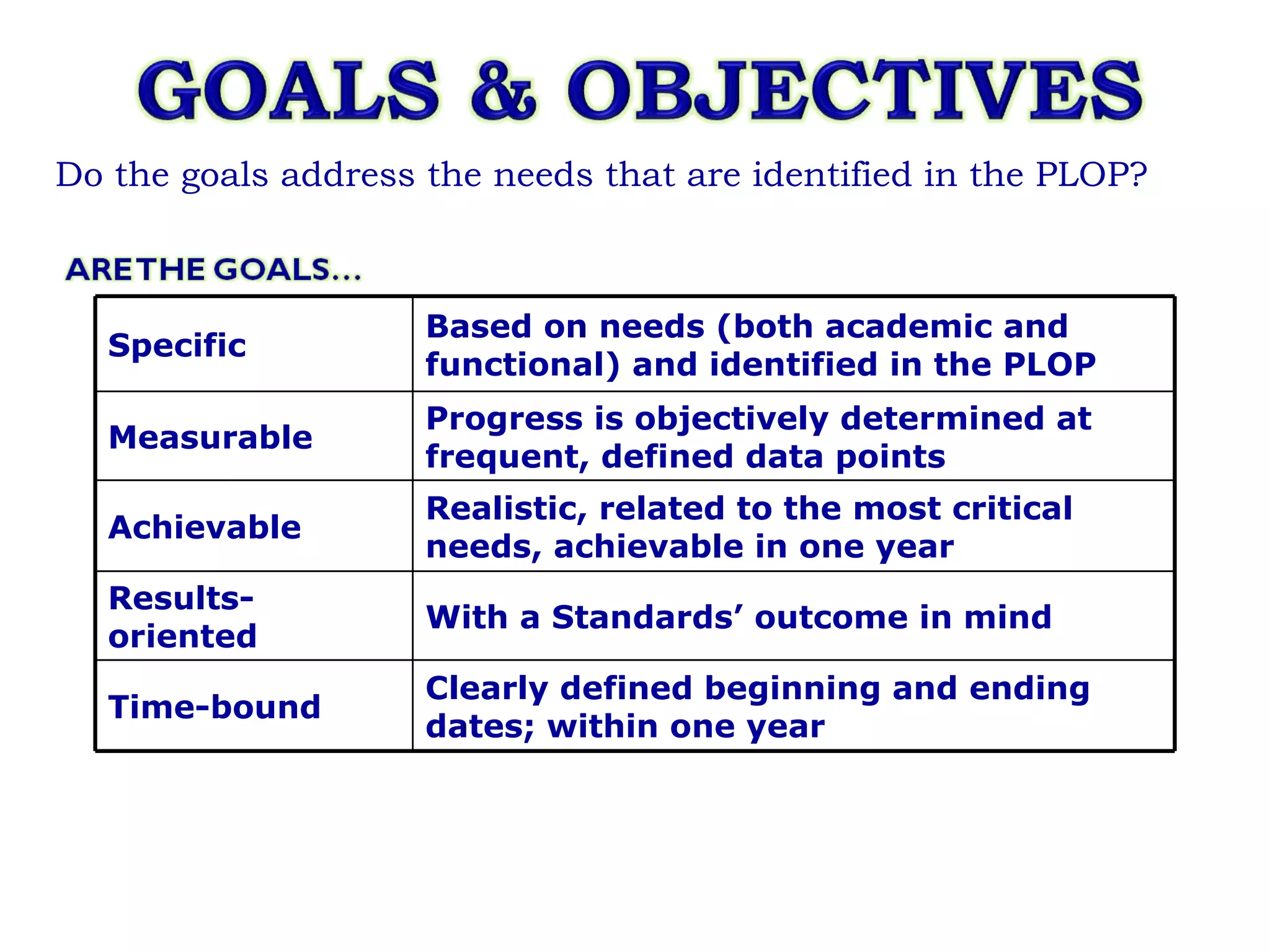
Do the goals address the needs that are identified in the PLOP? Specific Based on needs (both academic and functional) and identified in the PLOP Measurable Progress is objectively determined at frequent, defined data points Achievable Realistic, related to the most critical needs, achievable in one year Results-oriented With a Standards’ outcome in mind Time-bound Clearly defined beginning and ending dates; within one year
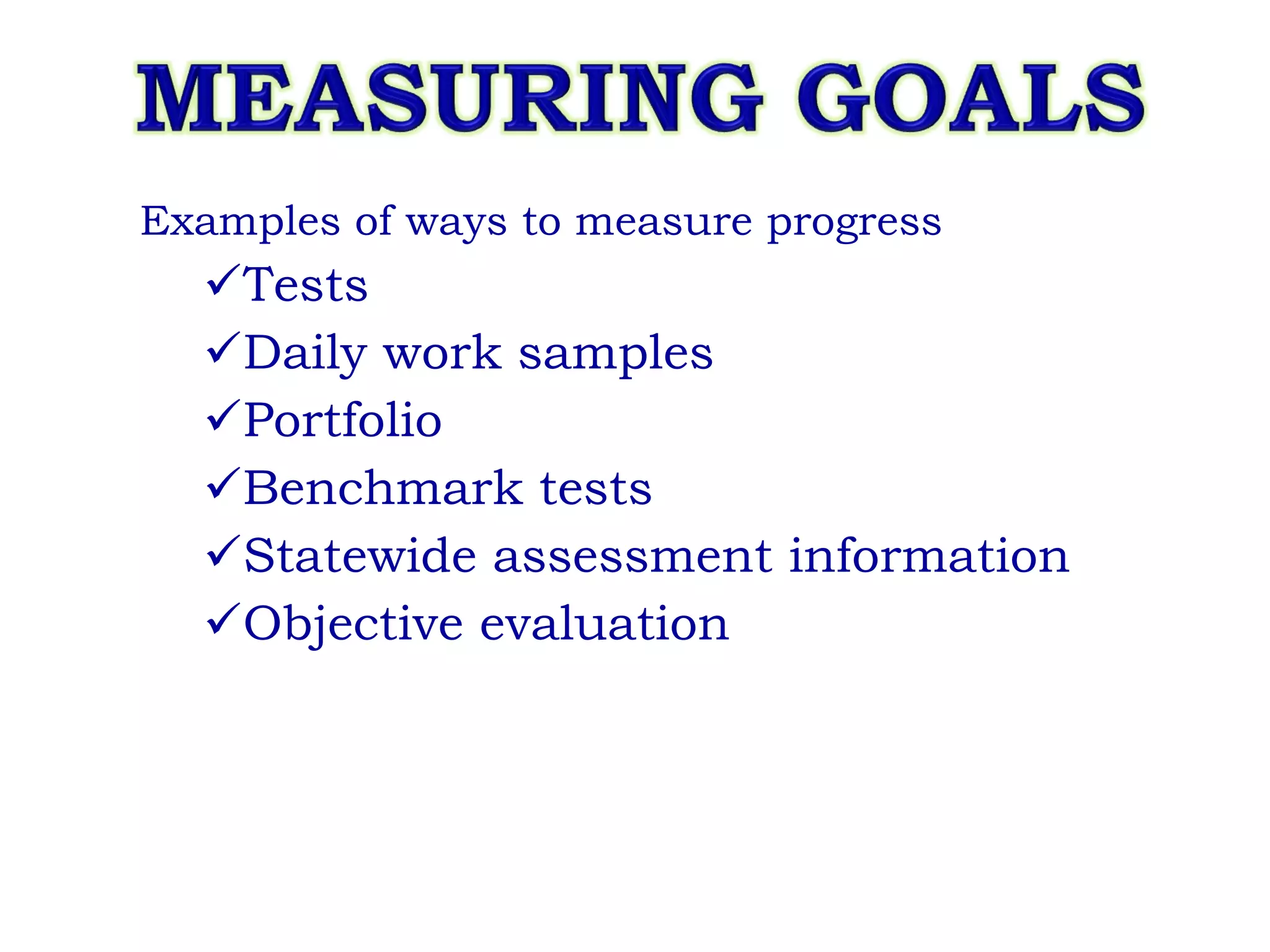
Examples of ways to measure progress Tests Daily work samples Portfolio Benchmark tests Statewide assessment information Objective evaluation
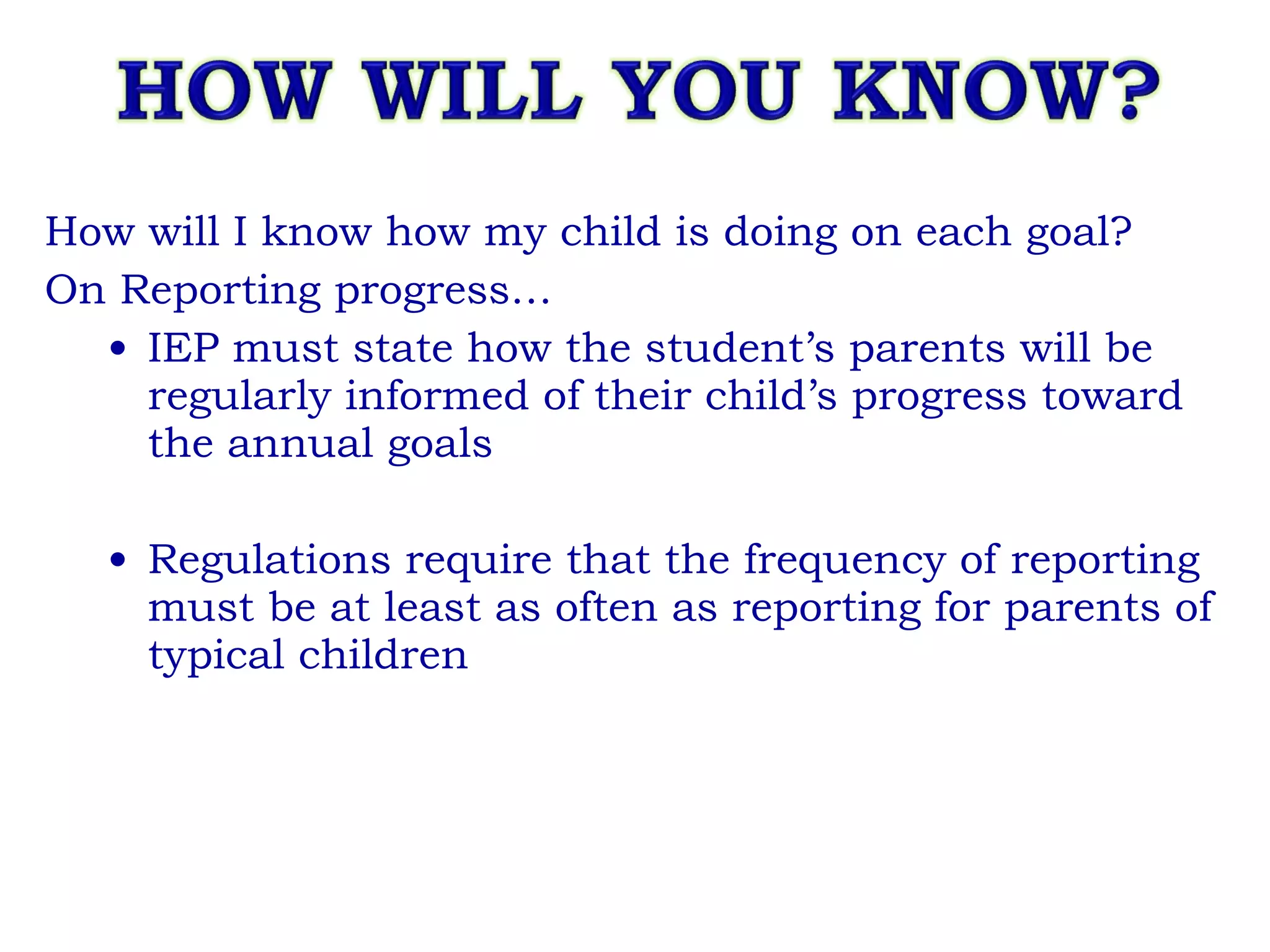
How will I know how my child is doing on each goal? On Reporting progress… IEP must state how the student’s parents will be regularly informed of their child’s progress toward the annual goals Regulations require that the frequency of reporting must be at least as often as reporting for parents of typical children
Related services supplement the activities provided in the classroom. These may include:  Assistive technology Audiology Counseling Services Occupational Therapy Physical Therapy Psychological Services Speech-Language Therapy
When deciding Special Education Placement: The most appropriate placement in the  Least Restrictive Environment   This means, as much as possible, with regular education peers. This will be determined after the goals and objectives have been developed. Many school districts provide a range of placements, and the team's goal is to decide which is the most appropriate. The IEP must state how much time the child will spend in the general education classroom and how much will be in Special Education classes and/or Related Services.
Accommodations might be necessary to measure academic achievement and functional performance on state and district wide assessments. What ever accommodations are selected for testing use are the same ones to be used for classroom instruction.
Get child to school on time Look at your child’s schoolwork daily Be sure child is eating and sleeping well Volunteer to help out at school Monitor progress of IEP goals & objectives Schedule conference with various educators… if necessary
You will meet annually to update your child’s IEP. It must be on or before the “Annual date” on the IEP You can update or make changes to the IEP at any time. You just need to request a meeting. You will meet every 3 years to see if your child is still  eligible  for Special Education Services. This is called “Eligibility” and it is possible your child will go through an assessment (testing) process.


The IEP Process for Parents

  • 1.
  • 2.
    The Individualized E ducation P rogram (IEP) is a legal document developed by the IEP Team. This team can include: Parents Student (@ age 14 & older) Special Education Teacher General Education Teacher Administrators Related Service Specialists The IEP helps students with disabilities in reaching their goals. All students, regardless of age or disability, can be involved in the development of their own IEP. According to the Individuals with Disabilities Education Act 2004, the IEP must focus on the student’s preferences, interests, needs and strengths.
  • 3.
    The IEP documentis written specifically for your child A new IEP is written at least every 12 months You have a right to invite anyone to the meeting Names & Signatures of all individuals attending the meeting is required When you sign, it does not put the form “in stone” for a year – you can always AMEND the IEP if you would like something changed. You may indicate on form that you disagree If you have difficulty you may consider mediation
  • 4.
    IEP document representsshared opinion or consensus of the IEP team The Team includes you , the Parent, as a equal partner Try to have a cooperative approach with the members of the team
  • 5.
    Ask for acopy of the IEP draft a week in advance Ask for a copy of all draft documents Make all of your requests in writing Make notes of tasks/skills your child has mastered Review records and reports from school Visit your child’s class and/or observe other classes Collect any current medical information Collect information on your child’s specific disability Talk to your child about their interests, likes and dislikes Know what the components of the IEP include Make notes about the services you want to discuss Read all invitations and other materials Sign and return the invitation
  • 6.
    Arrive on timeTake someone with you to the IEP to take notes Bring a copy of previous IEP Share your notes, ideas, and information Bring a copy of articles that may be relevant Ask questions when you don’t understand Be polite but assertive Listen to those who disagree Make your points clearly If you disagree – ask that they include it in the IEP document under Parent Concerns on the PLOP page If you think you hear “no”, ask for options Be realistic about your child’s abilities Voice your opinion in a constructive way Be sure you receive a copy of the final agreed upon IEP
  • 7.
    P resent L evel o f P erformance = PLOP. Current statement of performance levels Measurable annual goals/objectives to address areas of concern or weakness Related Services delivery hours - if applicable Testing & Classroom accommodations Transition Plan (14 and older) E xtended S chool Y ear Placement – where the child will receive their education, LRE = Least Restrictive Environment
  • 8.
    Required ComponentsThe student’s strengths The unique needs of the student How the student’s disability affects involvement/ progress in general education curriculum Parents’ concerns – this is where you add any and all of your concerns. Any discussions that take place during the meeting should be noted in the PLOP.
  • 9.
    Transitions: Early interventionto Preschool Preschool to Elementary school Elementary school to Middle school Middle school to High school However – In an IEP, a “ Transition Plan ” refers to a federally mandated plan that addresses the transition from School to Adult Life (Career, Post Secondary Education, Independent Living) Planning is mandated to begin no later than the first IEP to be in effect when the student turns 14 The student must be involved in making these plans if at all possible
  • 10.
    Do the goalsaddress the needs that are identified in the PLOP? Specific Based on needs (both academic and functional) and identified in the PLOP Measurable Progress is objectively determined at frequent, defined data points Achievable Realistic, related to the most critical needs, achievable in one year Results-oriented With a Standards’ outcome in mind Time-bound Clearly defined beginning and ending dates; within one year
  • 11.
    Examples of waysto measure progress Tests Daily work samples Portfolio Benchmark tests Statewide assessment information Objective evaluation
  • 12.
    How will Iknow how my child is doing on each goal? On Reporting progress… IEP must state how the student’s parents will be regularly informed of their child’s progress toward the annual goals Regulations require that the frequency of reporting must be at least as often as reporting for parents of typical children
  • 13.
    Related services supplementthe activities provided in the classroom. These may include: Assistive technology Audiology Counseling Services Occupational Therapy Physical Therapy Psychological Services Speech-Language Therapy
  • 14.
    When deciding SpecialEducation Placement: The most appropriate placement in the Least Restrictive Environment This means, as much as possible, with regular education peers. This will be determined after the goals and objectives have been developed. Many school districts provide a range of placements, and the team's goal is to decide which is the most appropriate. The IEP must state how much time the child will spend in the general education classroom and how much will be in Special Education classes and/or Related Services.
  • 15.
    Accommodations might benecessary to measure academic achievement and functional performance on state and district wide assessments. What ever accommodations are selected for testing use are the same ones to be used for classroom instruction.
  • 16.
    Get child toschool on time Look at your child’s schoolwork daily Be sure child is eating and sleeping well Volunteer to help out at school Monitor progress of IEP goals & objectives Schedule conference with various educators… if necessary
  • 17.
    You will meetannually to update your child’s IEP. It must be on or before the “Annual date” on the IEP You can update or make changes to the IEP at any time. You just need to request a meeting. You will meet every 3 years to see if your child is still eligible for Special Education Services. This is called “Eligibility” and it is possible your child will go through an assessment (testing) process.
  • 18.
  • 19.