Stephen Ward, AECOM
Regional Director
Michelle Agha-Hossein, BSRIA
Sustainable Building Engineer
Post Occupancy
Evaluation (POE)
#SoftLandingsConference
 What is POE?
 Techniques and Methods
 The Benefits of POE
 Issues and pitfalls to be aware of for a
successful POE campaign
"... the process of evaluating buildings in a
systematic and rigorous manner after they have
been built and occupied for some time“
Preiser et al. (1988)
 Post Occupancy : evaluate project success
 Pre- and Post-Project: set benchmarks
(baselines)
 Regular intervals: identify potential areas for
improvements.
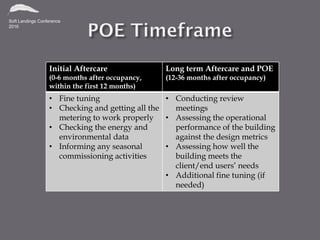
Initial Aftercare
(0-6 months after occupancy,
within the first 12 months)
Long term Aftercare and POE
(12-36 months after occupancy)
• Fine tuning
• Checking and getting all the
metering to work properly
• Checking the energy and
environmental data
• Informing any seasonal
commissioning activities
• Conducting review
meetings
• Assessing the operational
performance of the building
against the design metrics
• Assessing how well the
building meets the
client/end users’ needs
• Additional fine tuning (if
needed)
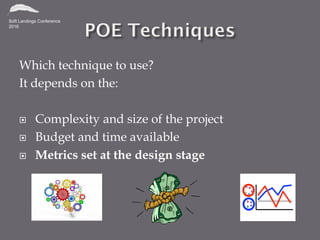
Which technique to use?
It depends on the:
 Complexity and size of the project
 Budget and time available
 Metrics set at the design stage
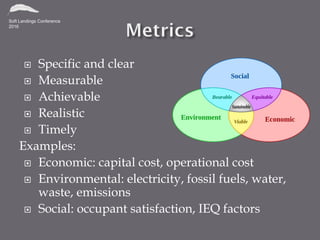
 Specific and clear
 Measurable
 Achievable
 Realistic
 Timely
Examples:
 Economic: capital cost, operational cost
 Environmental: electricity, fossil fuels, water,
waste, emissions
 Social: occupant satisfaction, IEQ factors
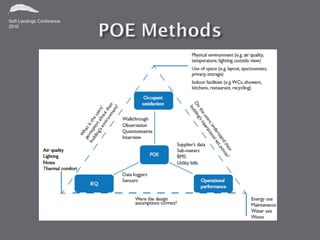
• AUDE (Association of University Directors of
Estates) guide for existing available POE
methods, for example:
 Design Quality Indicators
 BUS Survey
 CIBSE TM22: Energy Assessment and
Reporting Methodology
• BREEAM In-Use
 To provide feedback on how buildings perform
 To help building operators to manage their
building effectively
 To provide the end users the opportunity to
express their views
 To be fed back into the design brief for the
future projects
 To help to reduce the “performance gap”
 To help to achieve BREEAM credits for
minimum Excellent rating
 General points
 Planning for POE is key – making sure it forms part
of procurement and roles and responsibilities
 Will you get an independent view?
 Have to look beyond the standard 12 month defects
period
 Try to avoid POE being too “energy focussed” –
occupant and FM team experience also critical – all
feed into each other
 How will you information be fed back to client –
what does client need, how quickly and how to keep
them engaged?
 Operational Performance
 What are you measuring against?
 Need some realistic prediction of operational energy
performance – NOT PART L!
 Ideally, should break down into different end uses –
e.g. lighting, heating, cooling, pumps and fans, etc
 Use of CIBSE TM54 is ideal
 Use as diagnostic tool if measured use for system or
end use is different
 Operational Performance
 Metering, metering, metering
 Need clear metering strategy from design stage –
metering hierarchy set out in log book
 Pay close attention to detail of specification,
installation (especially heat meters), and
commissioning of meters and data transmission and
storage
 Be careful with meters that only feed into BMS, and
don’t have separate AMR system
 Allow time after handover for thorough review and
sense check of meter data, and data reconciliation
 Occupant satisfaction
 Maximising response rate is key (e.g. 50-66%)
 Suggest use of paper forms rather than on-line – use
coloured paper!
 Physically hand survey to people and say when will
collect
 Keep it brief – no more than 10-15 minutes to
complete
 Need minimum of two people for survey
 Incentives – sweets!
 Communications prior to survey day are key
 IEQ (air quality, thermal comfort, noise and
lighting)
 Check that BMS will store data
 Check sensors are properly located
 Can use data to check operation of building
ventilation strategy, and inform seasonal
commissioning
 Can use “tiny tag” sensors to sense check BMS data
and get finer grained picture of conditions
 Don’t forget people can be the best sensors!!!
 Survey responses and discussion with building
manager can identify specific areas for review of IEQ
Thank you!
Any Questions

Post Occupancy Evaluation (POE)

  • 1.
    Stephen Ward, AECOM RegionalDirector Michelle Agha-Hossein, BSRIA Sustainable Building Engineer Post Occupancy Evaluation (POE) #SoftLandingsConference
  • 2.
     What isPOE?  Techniques and Methods  The Benefits of POE  Issues and pitfalls to be aware of for a successful POE campaign
  • 3.
    "... the processof evaluating buildings in a systematic and rigorous manner after they have been built and occupied for some time“ Preiser et al. (1988)
  • 4.
     Post Occupancy: evaluate project success  Pre- and Post-Project: set benchmarks (baselines)  Regular intervals: identify potential areas for improvements.
  • 6.
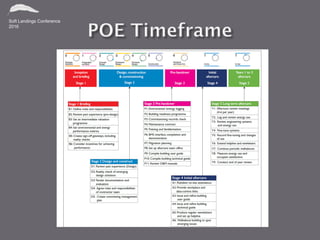
    Initial Aftercare (0-6 monthsafter occupancy, within the first 12 months) Long term Aftercare and POE (12-36 months after occupancy) • Fine tuning • Checking and getting all the metering to work properly • Checking the energy and environmental data • Informing any seasonal commissioning activities • Conducting review meetings • Assessing the operational performance of the building against the design metrics • Assessing how well the building meets the client/end users’ needs • Additional fine tuning (if needed)
  • 7.
    Which technique touse? It depends on the:  Complexity and size of the project  Budget and time available  Metrics set at the design stage
  • 8.
     Specific andclear  Measurable  Achievable  Realistic  Timely Examples:  Economic: capital cost, operational cost  Environmental: electricity, fossil fuels, water, waste, emissions  Social: occupant satisfaction, IEQ factors
  • 9.
    • AUDE (Associationof University Directors of Estates) guide for existing available POE methods, for example:  Design Quality Indicators  BUS Survey  CIBSE TM22: Energy Assessment and Reporting Methodology • BREEAM In-Use
  • 11.
     To providefeedback on how buildings perform  To help building operators to manage their building effectively  To provide the end users the opportunity to express their views  To be fed back into the design brief for the future projects  To help to reduce the “performance gap”  To help to achieve BREEAM credits for minimum Excellent rating
  • 12.
     General points Planning for POE is key – making sure it forms part of procurement and roles and responsibilities  Will you get an independent view?  Have to look beyond the standard 12 month defects period  Try to avoid POE being too “energy focussed” – occupant and FM team experience also critical – all feed into each other  How will you information be fed back to client – what does client need, how quickly and how to keep them engaged?
  • 13.
     Operational Performance What are you measuring against?  Need some realistic prediction of operational energy performance – NOT PART L!  Ideally, should break down into different end uses – e.g. lighting, heating, cooling, pumps and fans, etc  Use of CIBSE TM54 is ideal  Use as diagnostic tool if measured use for system or end use is different
  • 14.
     Operational Performance Metering, metering, metering  Need clear metering strategy from design stage – metering hierarchy set out in log book  Pay close attention to detail of specification, installation (especially heat meters), and commissioning of meters and data transmission and storage  Be careful with meters that only feed into BMS, and don’t have separate AMR system  Allow time after handover for thorough review and sense check of meter data, and data reconciliation
  • 15.
     Occupant satisfaction Maximising response rate is key (e.g. 50-66%)  Suggest use of paper forms rather than on-line – use coloured paper!  Physically hand survey to people and say when will collect  Keep it brief – no more than 10-15 minutes to complete  Need minimum of two people for survey  Incentives – sweets!  Communications prior to survey day are key
  • 16.
     IEQ (airquality, thermal comfort, noise and lighting)  Check that BMS will store data  Check sensors are properly located  Can use data to check operation of building ventilation strategy, and inform seasonal commissioning  Can use “tiny tag” sensors to sense check BMS data and get finer grained picture of conditions  Don’t forget people can be the best sensors!!!  Survey responses and discussion with building manager can identify specific areas for review of IEQ
  • 17.