Convergence – what is it
really good for?
By Raphael
Chalogany
April 2016
2
Excellence in Market Intelligence
Contents
 BSRIA Convergence definition
 Convergence benefits (1-3)
 Barriers for convergence
 Uptake of convergence in NA
 Data, WAP and DBS, worldwide million outlets, 2014-2020
 Impact of convergence
 Who is driving convergence ?
 Example of a revolutionary converged lighting system offering many benefits
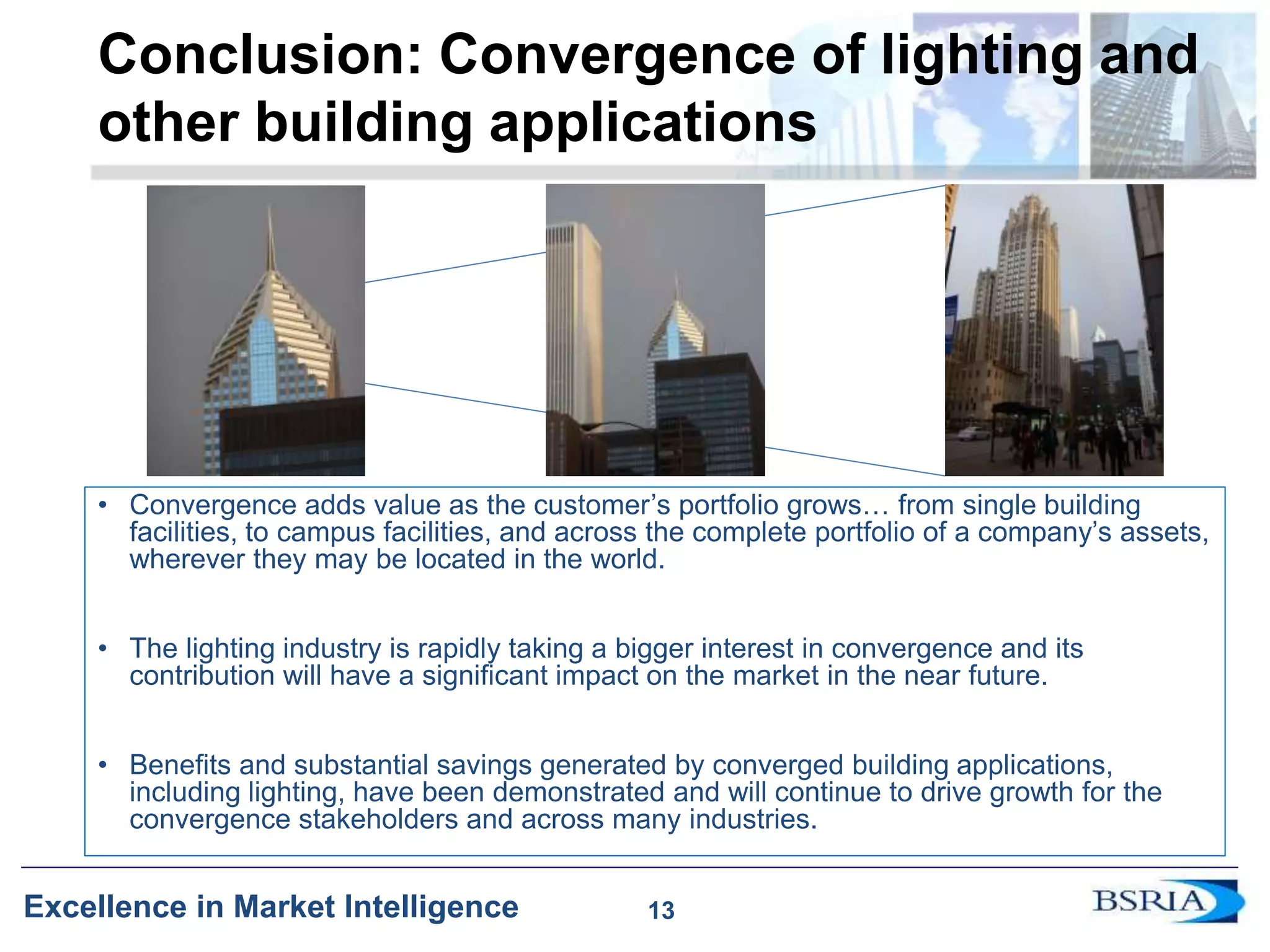
 Conclusion: Convergence of lighting and other building applications
2
3
Excellence in Market Intelligence
BSRIA Convergence definition
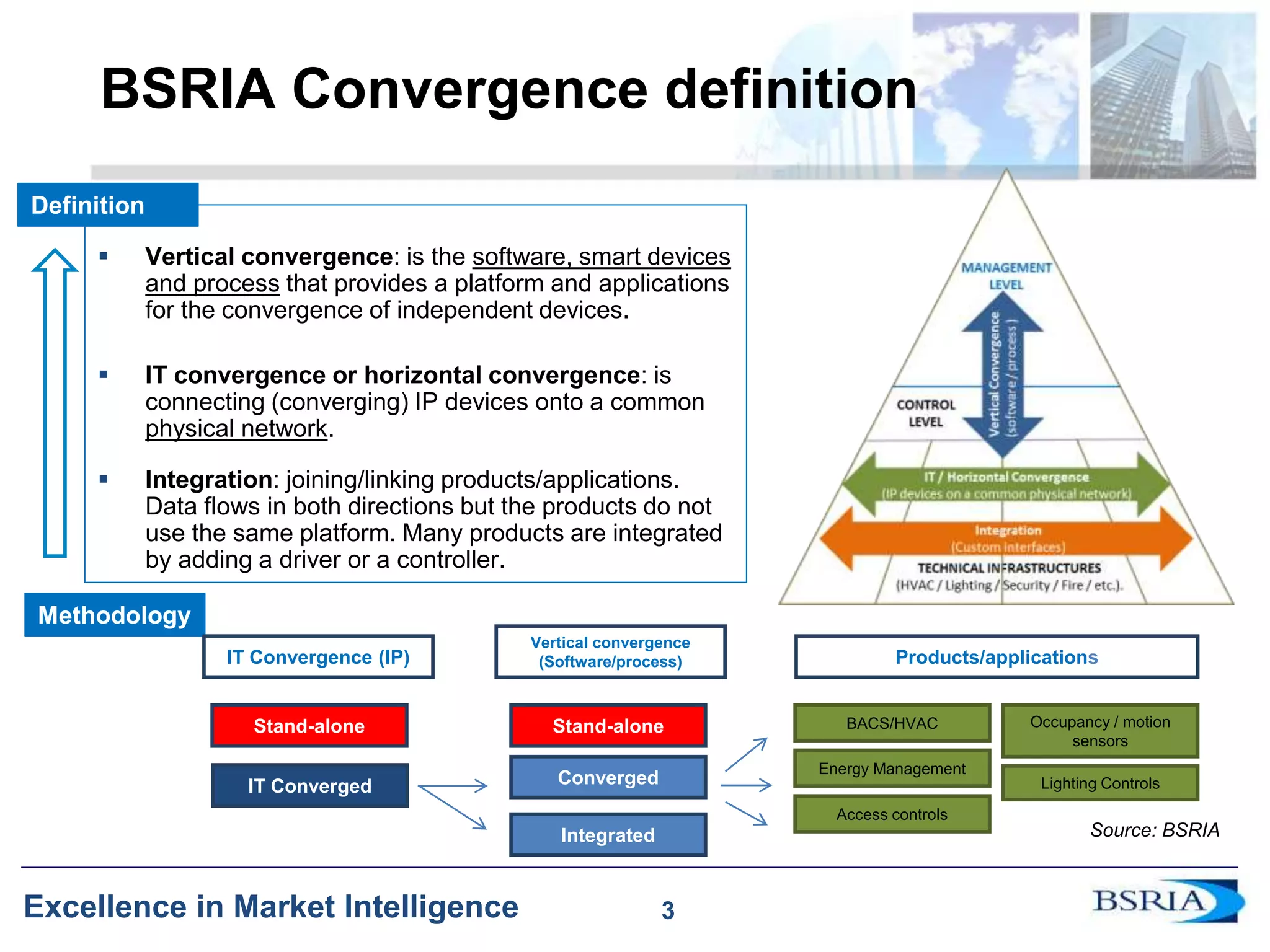
 Vertical convergence: is the software, smart devices
and process that provides a platform and applications
for the convergence of independent devices.
 IT convergence or horizontal convergence: is
connecting (converging) IP devices onto a common
physical network.
 Integration: joining/linking products/applications.
Data flows in both directions but the products do not
use the same platform. Many products are integrated
by adding a driver or a controller.
Methodology
Definition
Stand-alone
IT Converged
Stand-alone
Integrated
Converged
BACS/HVAC
Energy Management
Lighting Controls
Access controls
IT Convergence (IP)
Vertical convergence
(Software/process) Products/applications
Source: BSRIA
Occupancy / motion
sensors
3
4
Excellence in Market Intelligence
Convergence process and benefits (1)
Sensors Cameras Valves
LightingSecurity Fire
Meters Field level
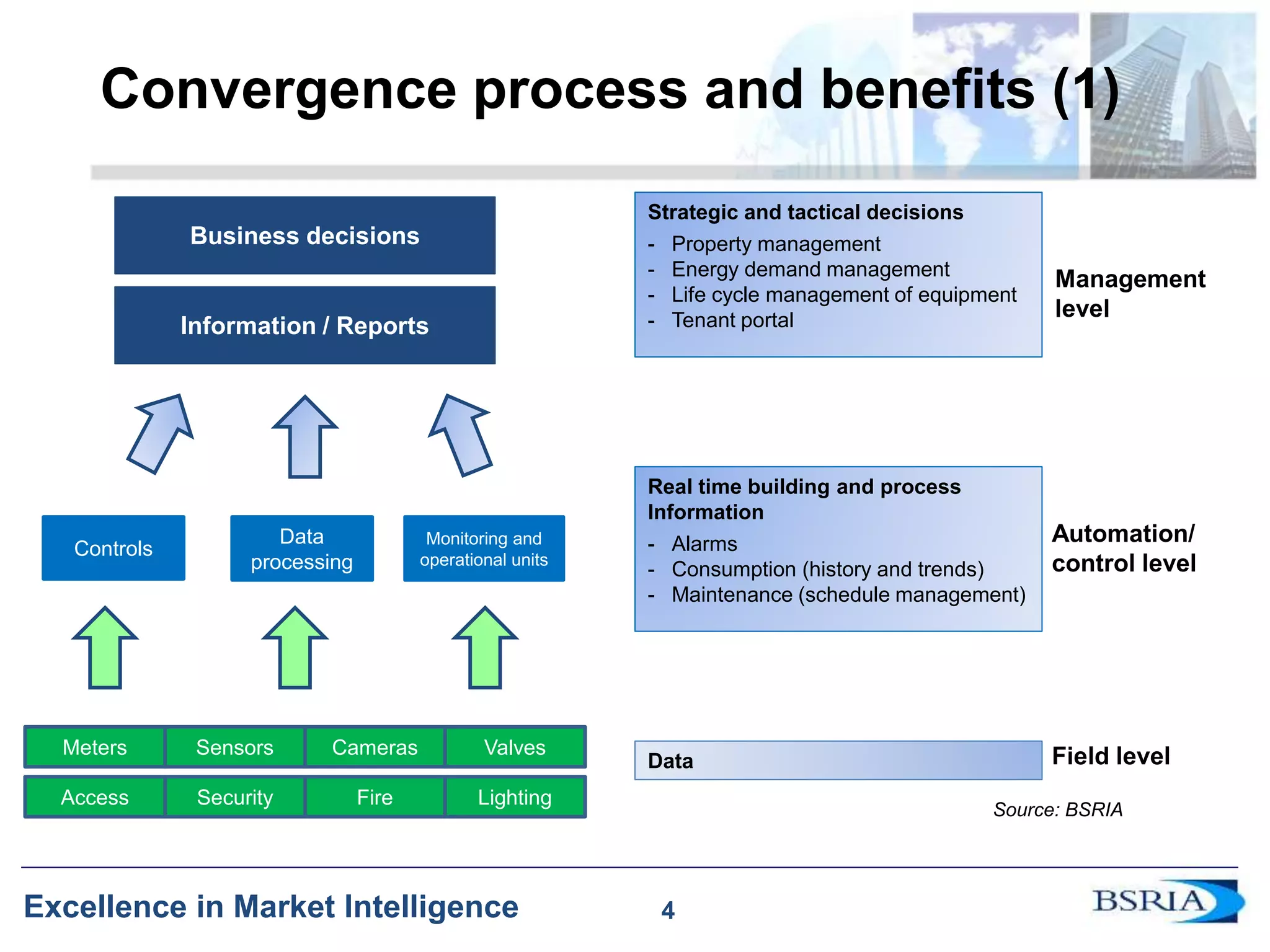
Real time building and process
Information
- Alarms
- Consumption (history and trends)
- Maintenance (schedule management)
Controls
Data
processing
Data
Monitoring and
operational units
Automation/
control level
Management
level
Strategic and tactical decisions
- Property management
- Energy demand management
- Life cycle management of equipment
- Tenant portalInformation / Reports
Business decisions
Source: BSRIA
Access
4
5
Excellence in Market Intelligence
Convergence benefits (2)
Owner/investor
 The investment is lower
 Improves productivity and working
practises
 Reduced number of maintenance staff
 Reduced energy consumption
 Customer attraction - satisfaction –
retention
 Potential new revenue streams enabled by
new technologies
Tenants:
 Improved security
 Indoor comfort
 Higher building “up-time”
Facility manager/building maintenance
staff
 Easier - centralised management
 Real time information
 Location of malfunctions and problems
 Asset management and tracking
5
6
Excellence in Market Intelligence
Convergence (3)
A converged system cost the same – or less!
Hospital (large campus):
Reduced cost by:
- Single source/better management
- Reduced material cost (wiring,
networking hardware etc.)
- Reduced installation cost (one vendor)
- Lower operational cost (less staff)
(Performance Contracting)
Community Centre
The solution includes HVAC, solar thermal and
PV, BMS, data, fire and general upgrades.
- $56,000 per year in maintenance savings
- Projected saving over 15 years: ~$3 million
(Performance Contracting)
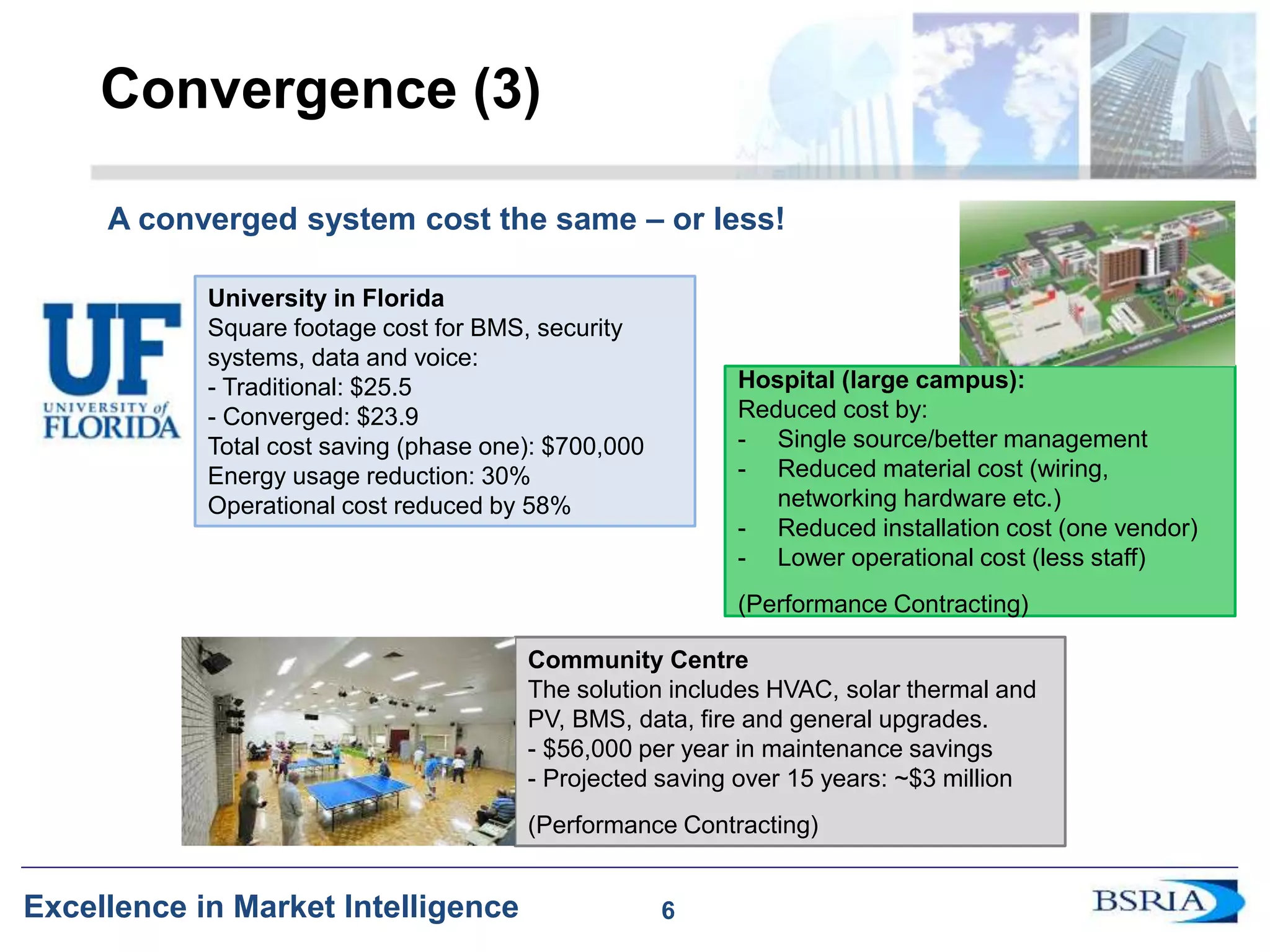
University in Florida
Square footage cost for BMS, security
systems, data and voice:
- Traditional: $25.5
- Converged: $23.9
Total cost saving (phase one): $700,000
Energy usage reduction: 30%
Operational cost reduced by 58%
6
7
Excellence in Market Intelligence
Barriers for convergence
Limited new build (economic recession)
70% of buildings in the US are “dumb”
Conflict between IT managers and the FM/operational side
IP devices used as stand alone
Cybersecurity
End user perception
Use of traditional routes to market
Focus on up-front cost, not operational and life cycle cost
7
8
Excellence in Market Intelligence
Uptake of convergence, NA
Access
Lighting
CCTV
AV - Signage
Power
Monitoring
Data, video
Energy
BACS/HVAC
Smoke detector
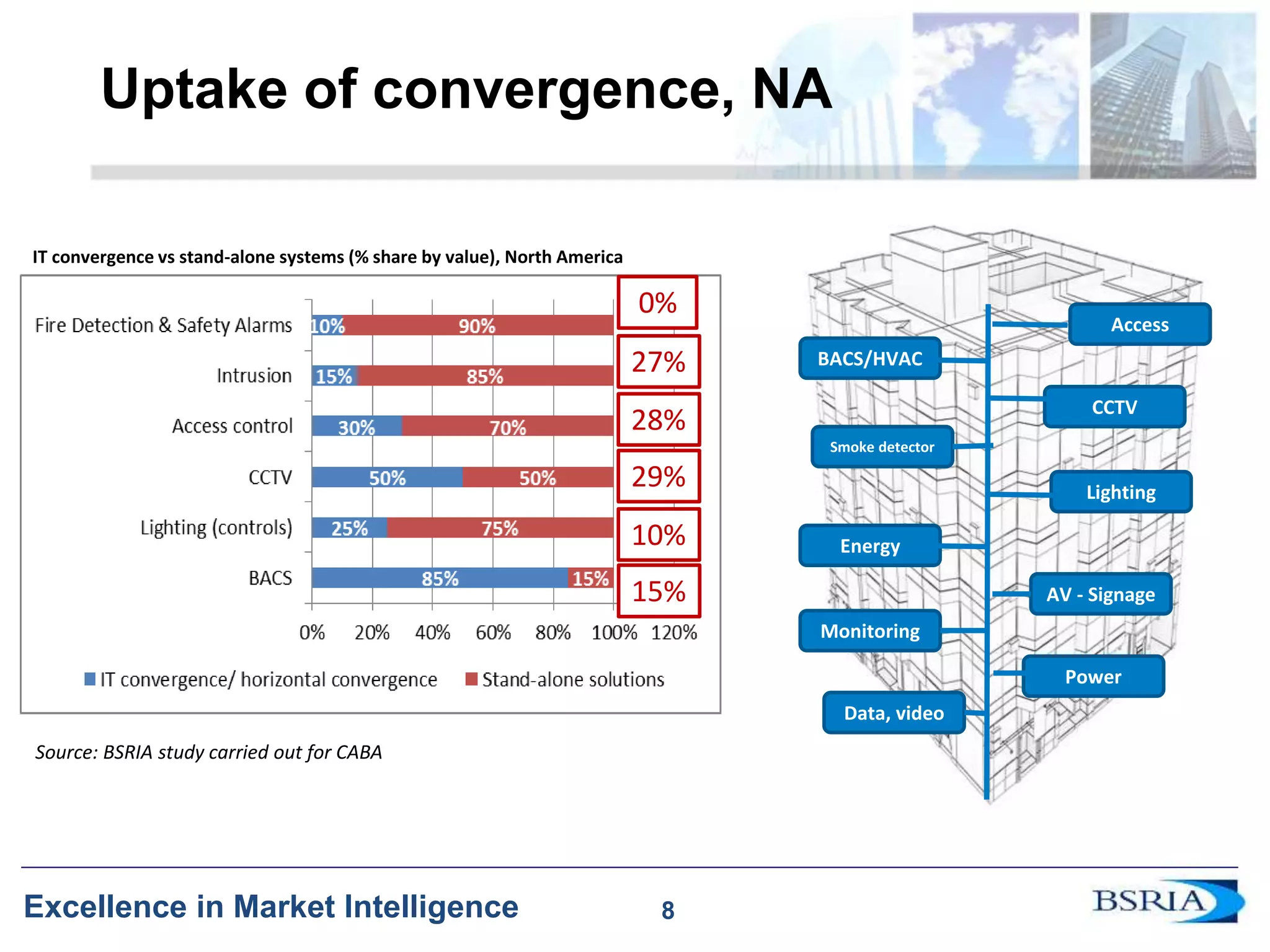
IT convergence vs stand-alone systems (% share by value), North America
29%
15%
28%
0%
27%
10%
Source: BSRIA study carried out for CABA
8
9
Excellence in Market Intelligence
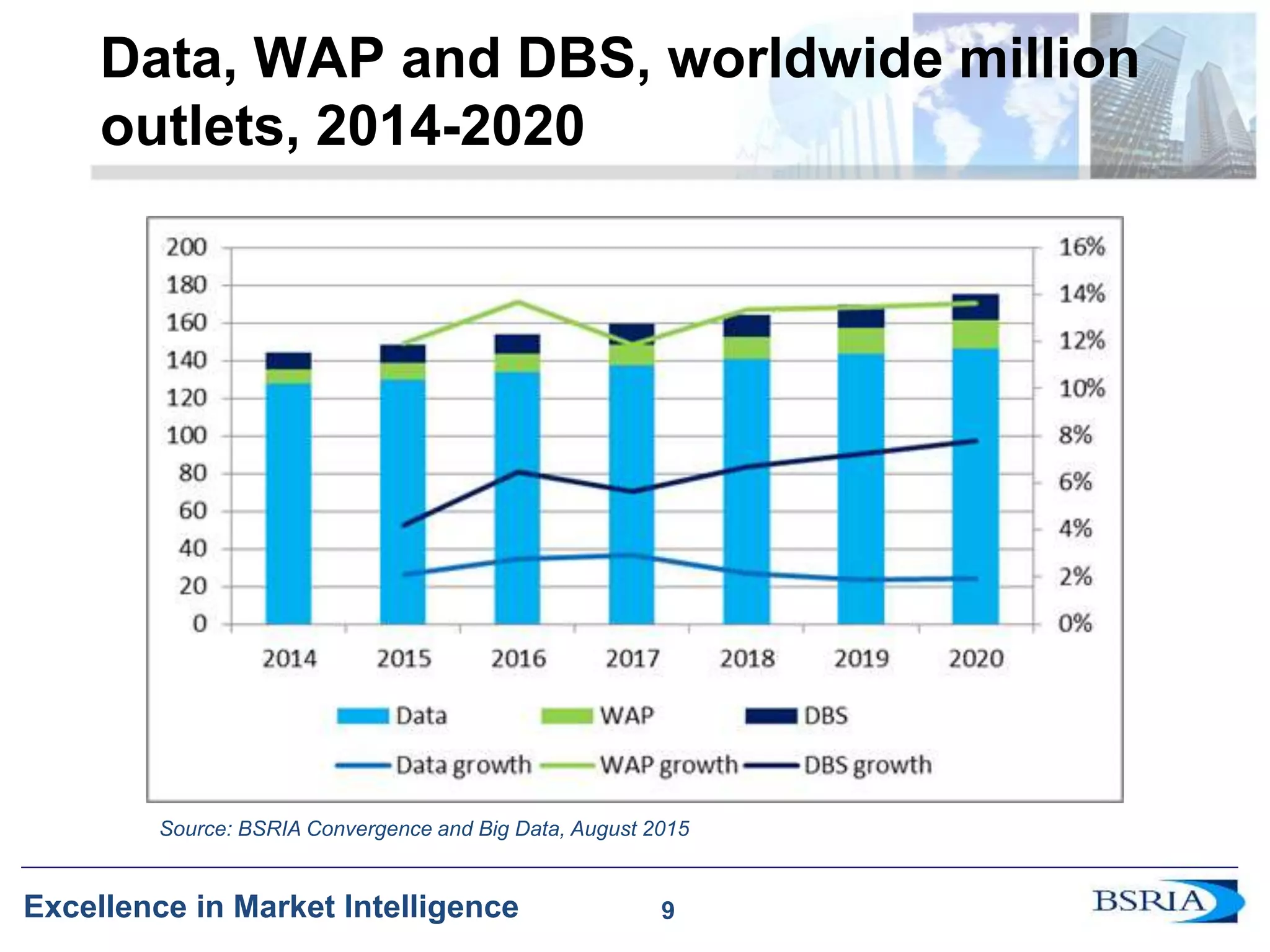
Data, WAP and DBS, worldwide million
outlets, 2014-2020
Source: BSRIA Convergence and Big Data, August 2015
9
10
Excellence in Market Intelligence
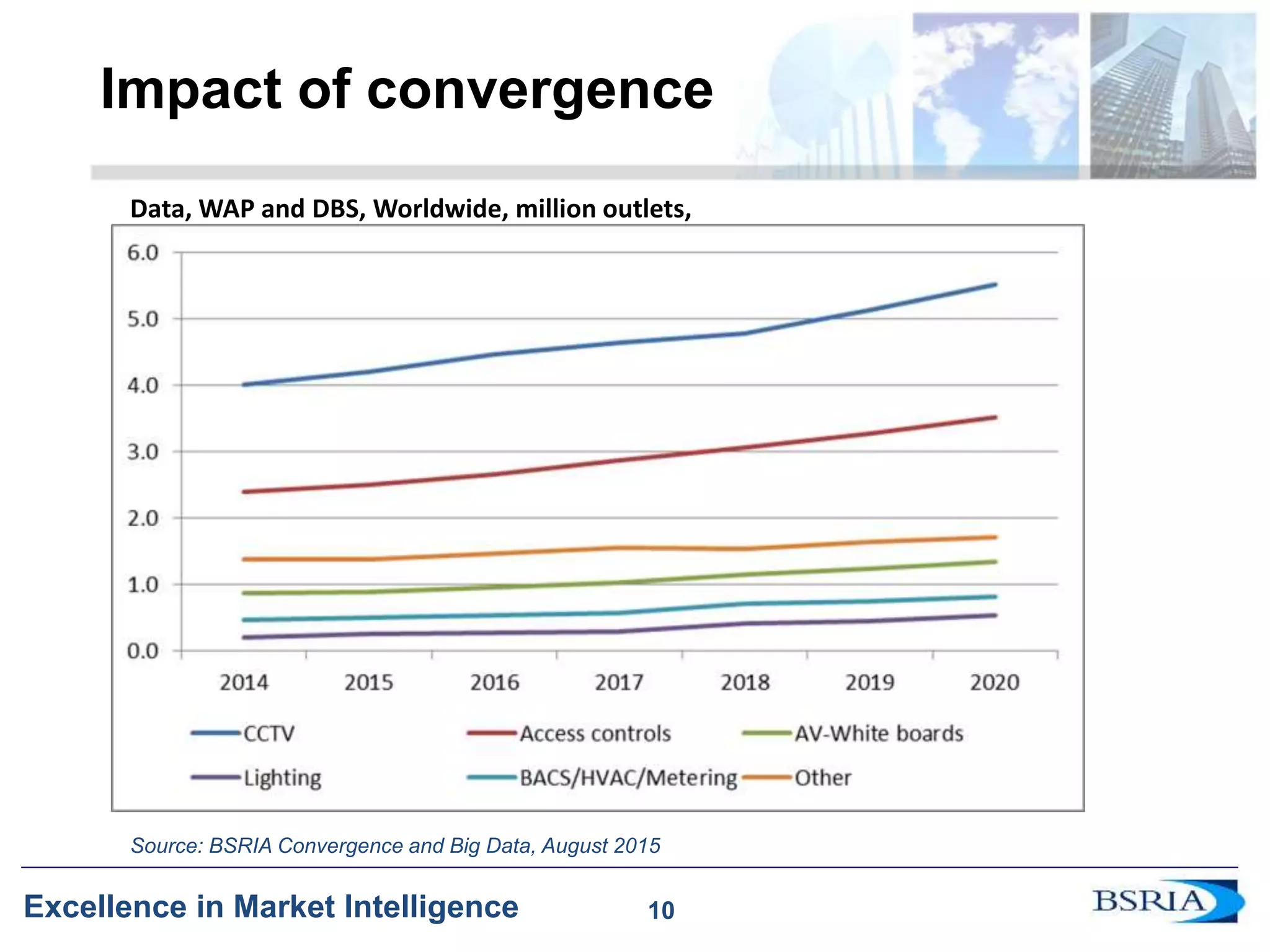
Impact of convergence
Data, WAP and DBS, Worldwide, million outlets,
2014 - 2020
Source: BSRIA Convergence and Big Data, August 2015
10
11
Excellence in Market Intelligence
Who is driving convergence ?
Political/
economic
factors
End-user,
property
investors,
developers
Energy rating
schemes
BMS suppliers
IT suppliers
PoE (lighting)
Security
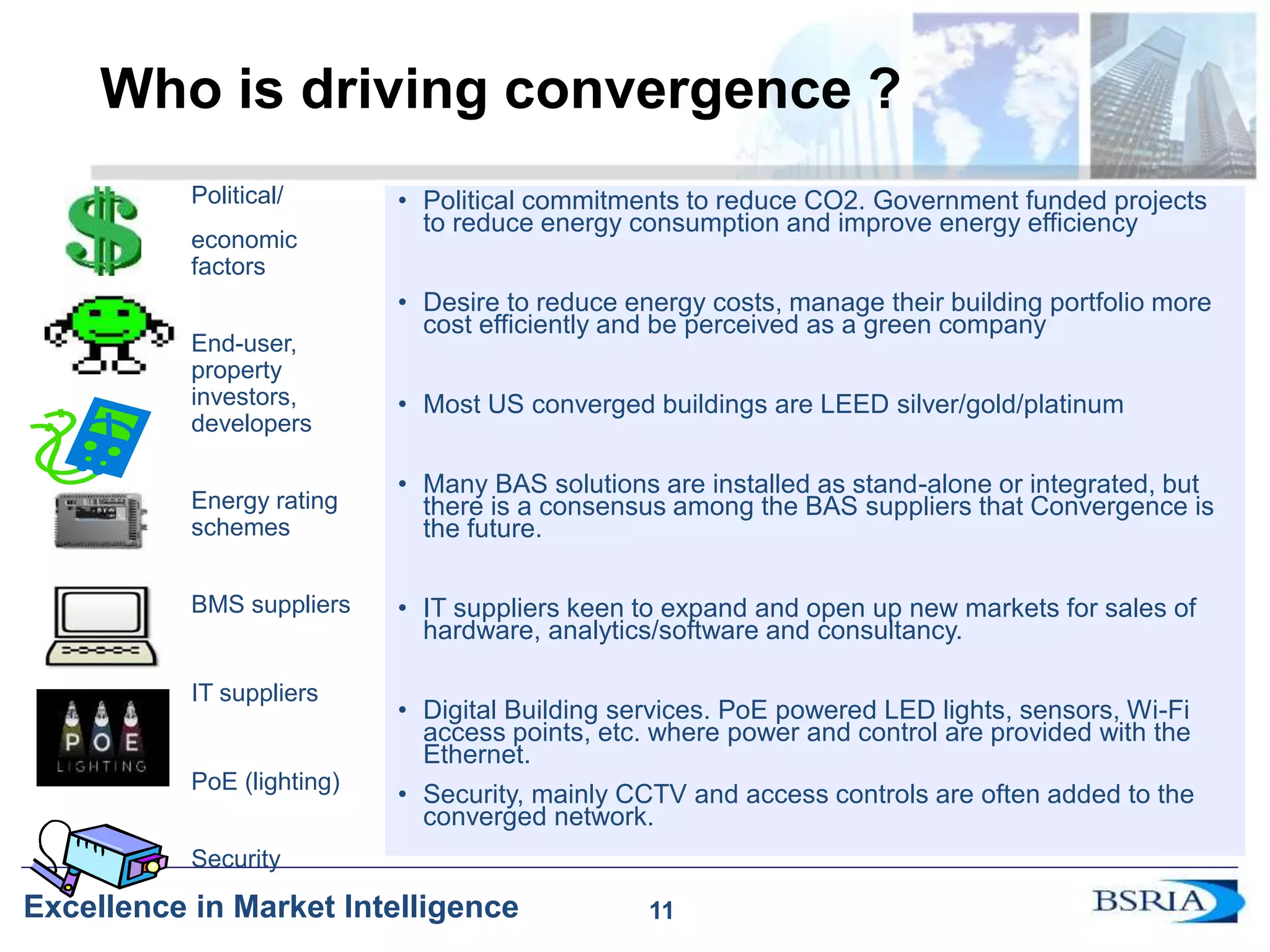
• Political commitments to reduce CO2. Government funded projects
to reduce energy consumption and improve energy efficiency
• Desire to reduce energy costs, manage their building portfolio more
cost efficiently and be perceived as a green company
• Most US converged buildings are LEED silver/gold/platinum
• Many BAS solutions are installed as stand-alone or integrated, but
there is a consensus among the BAS suppliers that Convergence is
the future.
• IT suppliers keen to expand and open up new markets for sales of
hardware, analytics/software and consultancy.
• Digital Building services. PoE powered LED lights, sensors, Wi-Fi
access points, etc. where power and control are provided with the
Ethernet.
• Security, mainly CCTV and access controls are often added to the
converged network.
11
12
Excellence in Market Intelligence
Example of a revolutionary converged
lighting system offering many benefits
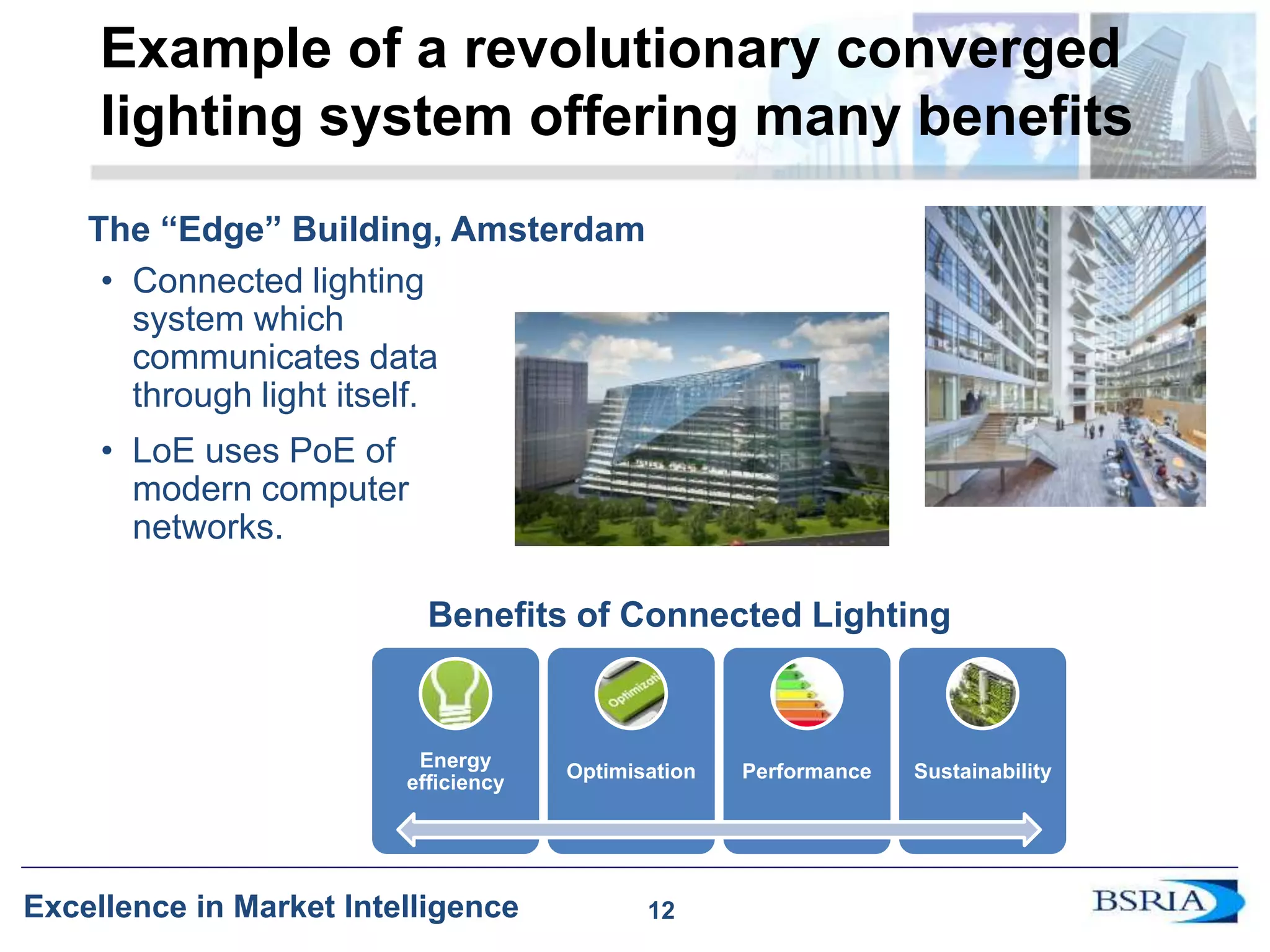
• Connected lighting
system which
communicates data
through light itself.
• LoE uses PoE of
modern computer
networks.
The “Edge” Building, Amsterdam
Energy
efficiency
Optimisation Performance Sustainability
Benefits of Connected Lighting
12
13
Excellence in Market Intelligence
Conclusion: Convergence of lighting and
other building applications
• Convergence adds value as the customer’s portfolio grows… from single building
facilities, to campus facilities, and across the complete portfolio of a company’s assets,
wherever they may be located in the world.
• The lighting industry is rapidly taking a bigger interest in convergence and its
contribution will have a significant impact on the market in the near future.
• Benefits and substantial savings generated by converged building applications,
including lighting, have been demonstrated and will continue to drive growth for the
convergence stakeholders and across many industries.
13
14
Excellence in Market Intelligence
CONTACT CABA
Continental Automated Buildings Association (CABA)
1173 Cyrville Road, Suite 210
Ottawa, ON K1J 7S6
613.686.1814
Toll free: 888.798.CABA (2222)
Fax: 613.744.7833
caba@caba.org
www.CABA.org
www.twitter.com/caba_news
www.linkedin.com/groups?gid=2121884
Connect to what’s next™
14

Convergence - What is it really good for?

  • 1.
    Convergence – whatis it really good for? By Raphael Chalogany April 2016
  • 2.
    2 Excellence in MarketIntelligence Contents  BSRIA Convergence definition  Convergence benefits (1-3)  Barriers for convergence  Uptake of convergence in NA  Data, WAP and DBS, worldwide million outlets, 2014-2020  Impact of convergence  Who is driving convergence ?  Example of a revolutionary converged lighting system offering many benefits  Conclusion: Convergence of lighting and other building applications 2
  • 3.
    3 Excellence in MarketIntelligence BSRIA Convergence definition  Vertical convergence: is the software, smart devices and process that provides a platform and applications for the convergence of independent devices.  IT convergence or horizontal convergence: is connecting (converging) IP devices onto a common physical network.  Integration: joining/linking products/applications. Data flows in both directions but the products do not use the same platform. Many products are integrated by adding a driver or a controller. Methodology Definition Stand-alone IT Converged Stand-alone Integrated Converged BACS/HVAC Energy Management Lighting Controls Access controls IT Convergence (IP) Vertical convergence (Software/process) Products/applications Source: BSRIA Occupancy / motion sensors 3
  • 4.
    4 Excellence in MarketIntelligence Convergence process and benefits (1) Sensors Cameras Valves LightingSecurity Fire Meters Field level Real time building and process Information - Alarms - Consumption (history and trends) - Maintenance (schedule management) Controls Data processing Data Monitoring and operational units Automation/ control level Management level Strategic and tactical decisions - Property management - Energy demand management - Life cycle management of equipment - Tenant portalInformation / Reports Business decisions Source: BSRIA Access 4
  • 5.
    5 Excellence in MarketIntelligence Convergence benefits (2) Owner/investor  The investment is lower  Improves productivity and working practises  Reduced number of maintenance staff  Reduced energy consumption  Customer attraction - satisfaction – retention  Potential new revenue streams enabled by new technologies Tenants:  Improved security  Indoor comfort  Higher building “up-time” Facility manager/building maintenance staff  Easier - centralised management  Real time information  Location of malfunctions and problems  Asset management and tracking 5
  • 6.
    6 Excellence in MarketIntelligence Convergence (3) A converged system cost the same – or less! Hospital (large campus): Reduced cost by: - Single source/better management - Reduced material cost (wiring, networking hardware etc.) - Reduced installation cost (one vendor) - Lower operational cost (less staff) (Performance Contracting) Community Centre The solution includes HVAC, solar thermal and PV, BMS, data, fire and general upgrades. - $56,000 per year in maintenance savings - Projected saving over 15 years: ~$3 million (Performance Contracting) University in Florida Square footage cost for BMS, security systems, data and voice: - Traditional: $25.5 - Converged: $23.9 Total cost saving (phase one): $700,000 Energy usage reduction: 30% Operational cost reduced by 58% 6
  • 7.
    7 Excellence in MarketIntelligence Barriers for convergence Limited new build (economic recession) 70% of buildings in the US are “dumb” Conflict between IT managers and the FM/operational side IP devices used as stand alone Cybersecurity End user perception Use of traditional routes to market Focus on up-front cost, not operational and life cycle cost 7
  • 8.
    8 Excellence in MarketIntelligence Uptake of convergence, NA Access Lighting CCTV AV - Signage Power Monitoring Data, video Energy BACS/HVAC Smoke detector IT convergence vs stand-alone systems (% share by value), North America 29% 15% 28% 0% 27% 10% Source: BSRIA study carried out for CABA 8
  • 9.
    9 Excellence in MarketIntelligence Data, WAP and DBS, worldwide million outlets, 2014-2020 Source: BSRIA Convergence and Big Data, August 2015 9
  • 10.
    10 Excellence in MarketIntelligence Impact of convergence Data, WAP and DBS, Worldwide, million outlets, 2014 - 2020 Source: BSRIA Convergence and Big Data, August 2015 10
  • 11.
    11 Excellence in MarketIntelligence Who is driving convergence ? Political/ economic factors End-user, property investors, developers Energy rating schemes BMS suppliers IT suppliers PoE (lighting) Security • Political commitments to reduce CO2. Government funded projects to reduce energy consumption and improve energy efficiency • Desire to reduce energy costs, manage their building portfolio more cost efficiently and be perceived as a green company • Most US converged buildings are LEED silver/gold/platinum • Many BAS solutions are installed as stand-alone or integrated, but there is a consensus among the BAS suppliers that Convergence is the future. • IT suppliers keen to expand and open up new markets for sales of hardware, analytics/software and consultancy. • Digital Building services. PoE powered LED lights, sensors, Wi-Fi access points, etc. where power and control are provided with the Ethernet. • Security, mainly CCTV and access controls are often added to the converged network. 11
  • 12.
    12 Excellence in MarketIntelligence Example of a revolutionary converged lighting system offering many benefits • Connected lighting system which communicates data through light itself. • LoE uses PoE of modern computer networks. The “Edge” Building, Amsterdam Energy efficiency Optimisation Performance Sustainability Benefits of Connected Lighting 12
  • 13.
    13 Excellence in MarketIntelligence Conclusion: Convergence of lighting and other building applications • Convergence adds value as the customer’s portfolio grows… from single building facilities, to campus facilities, and across the complete portfolio of a company’s assets, wherever they may be located in the world. • The lighting industry is rapidly taking a bigger interest in convergence and its contribution will have a significant impact on the market in the near future. • Benefits and substantial savings generated by converged building applications, including lighting, have been demonstrated and will continue to drive growth for the convergence stakeholders and across many industries. 13
  • 14.
    14 Excellence in MarketIntelligence CONTACT CABA Continental Automated Buildings Association (CABA) 1173 Cyrville Road, Suite 210 Ottawa, ON K1J 7S6 613.686.1814 Toll free: 888.798.CABA (2222) Fax: 613.744.7833 caba@caba.org www.CABA.org www.twitter.com/caba_news www.linkedin.com/groups?gid=2121884 Connect to what’s next™ 14

Editor's Notes

  • #8 Although Convergence can indeed bring many benefits, it has also its barriers. Here are some examples: In times of economic turbulence, the focus of investors is typically more on up-front cost, and the new construction sector is affected; in contrast, most convergence projects occur in the new built sector. In the US, 70% of buildings are “dumb” (lacking intelligence) IT systems have traditionally been designed in silo, and IT managers have operated in silo as well. Today, IT needs to bring simplification in the use of data management to the hands of the FM, and align both business lines. We still see IP devices or systems that still operating as standalone or with a minimum integration, preventing to get the full benefits of a real converged solution. Cybersecurity: the threat is real and you can hear about it almost every day! End user perception: there is still a lack of end-user knowledge about convergence, and he may not convinced by the benefits Developers may still be opting for the traditional route to market – buying from distinct specialised vendors instead of looking at a complete solution for example Up-front cost can be the main concern for the developer, instead of the operational cost and life cycle cost, as the specifier is in most cases not the occupier of the building
  • #11 Looking at the Distributed building services, which is a small portion of the outlets measured in the study (6%), the largest proportion is used by electronic security installations and only a fraction is used for lighting.