Making buildings better
BSRIA Industry Presentation
BRIEF SUMMARY SLIDES
Chillventa 2016
For more details contact Mike Vardanian
mike.vardanian@bsria.co.uk
12 Oct 2016
2Making buildings better
BSRIA ©
BSRIA Values
3Making buildings better
BSRIA ©
Agenda
18:15 Welcome Andrew Giles
18:15 – 18:25 Testing and integration PICBV’s in Buildings Cory Chadoka
18:25 – 18:45 Global Trends in AC&R Anette Holley
18:45 – 19:00 The traditional heating markets and the growth of renewable technologies Krystyna Dawson
19:00–19:15 Keeping up with the "Smart" revolution Greg Corty
19:15-19:30 2020 Overlapping and merging markets and conclusions Andrew Giles
Making buildings better
Testing and integration PICBV’s
in Buildings
(Pressure Independent Balancing & Control Valves )
Cory Chadoka
12 Oct 2016
5Making buildings better
BSRIA ©
BSRIA Test
• ISO/IEC 17025 accredited laboratory ( UKAS No.1053).
• Listed on NANDO as a Notified Body (NB 0480).
• Product validation and verification for:
• CE marking
• Thermal performance
• Efficiency
• Smoke emissions
• Acoustics
• Corrosion
• Benchmarking product performance and product
development
• Development of bespoke test methodologies
• Physical modelling (mock-up), testing and validation
• On-site, witness and factory acceptance testing.
• Test laboratory design
6Making buildings better
BSRIA ©
What is a Pressure Independent
Control Valve?
7Making buildings better
BSRIA ©
What is a PICV?
• A PICV is a multi-functional valve
combining the operation of three
different valves.
• A PICV operates as a Pressure
Independent Control Valve, Two-Port
Control Valve and Regulating Valve.
• The valve body incorporates a
differential pressure controller and a
control valve element. The
differential pressure controller
maintains the pressure difference
across the control valve element.
8Making buildings better
BSRIA ©
What is PICV?
The purpose of a Pressure Independent Control Valve (PICV) is to maintain
the flow rate in a hydronic system regardless of any changes in pressure.
PICV’s can be used in a number of hydronic systems such as:
• Air Handling Units (AHU)
• Fan Coils
• Chilled Beams
• Radiant Panels and Radiators
• Heater Batteries etc.
9Making buildings better
BSRIA ©
Example of PICV on an Air Handling Unit (AHU)
BMS = (Building Management System)
10Making buildings better
BSRIA ©
Benefits
• Reduced commissioning
• Maintaining design ΔT (energy efficiency)
• Simplified valve sizing
• Reduced number of valves
11Making buildings better
BSRIA ©
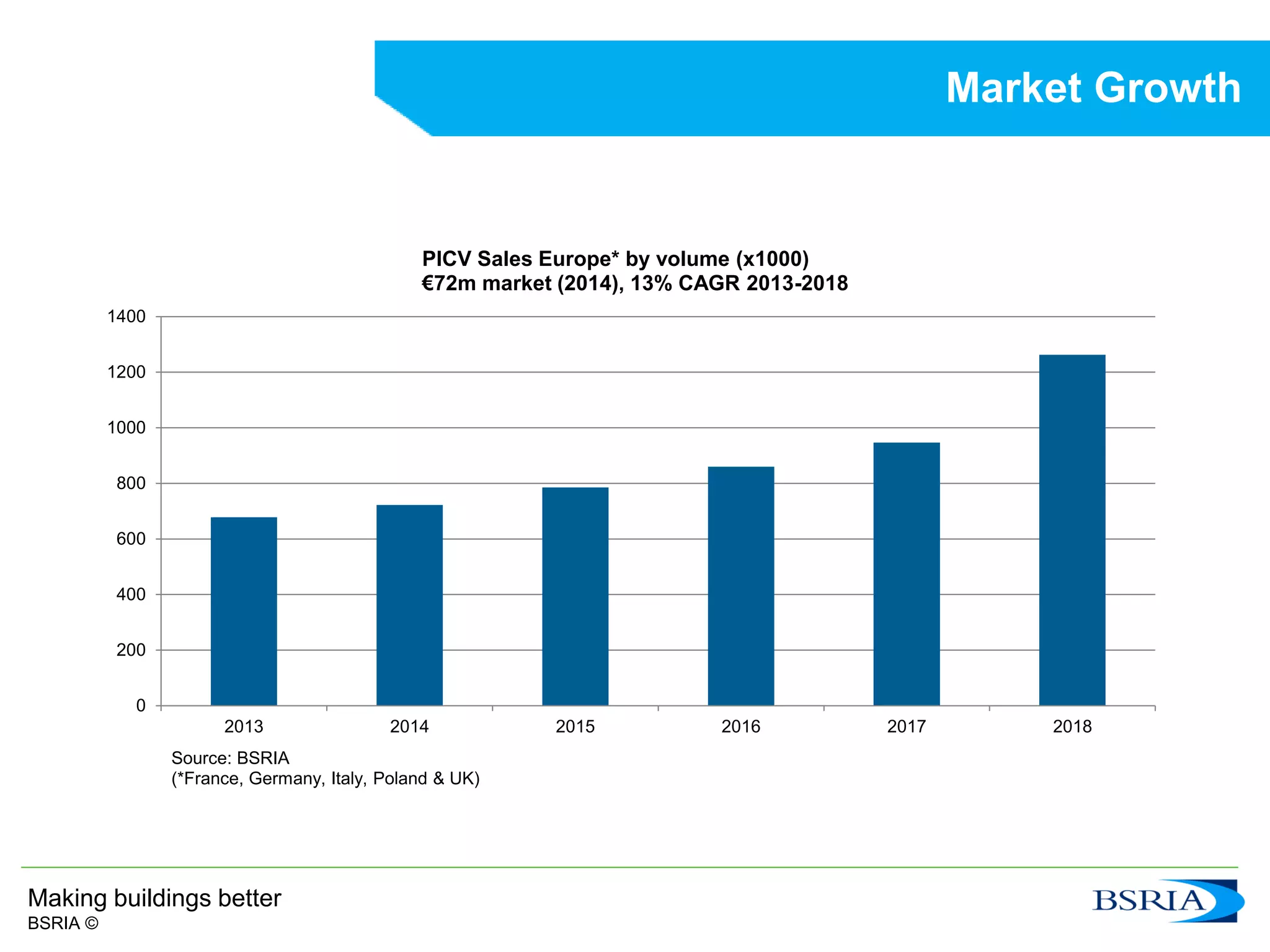
Market Growth
0
200
400
600
800
1000
1200
1400
2013 2014 2015 2016 2017 2018
Source: BSRIA
(*France, Germany, Italy, Poland & UK)
PICV Sales Europe* by volume (x1000)
€72m market (2014), 13% CAGR 2013-2018
12Making buildings better
BSRIA ©
BSRIA Technical Standard BTS No: 1 “Test Method for
Pressure Independent Control Valves”
• Allows for comparison between
manufacturer’s
• Creates a balanced playing field
across the industry
• Serves as a reference point for
manufacturer’s, contractors and
the end user.
13Making buildings better
BSRIA ©
Measured flow Versus Nominal Flow
• Example of valve setting scale • Example of Measured Flow Versus
Nominal Flow test data
Test Sample
Nominal
setting (l.s¯¹)
Measured flow
(l.s¯¹) at 100
kPa
Deviation
(%)
Manufacturer's
nomenclature
0.010 0.011 9%
0.025 0.025 0%
0.050 0.052 4%
0.075 0.071 -6%
0.100 0.095 -5%
14Making buildings better
BSRIA ©
Flow Limitation Test
This test indicates any inherent hysteresis in the valve
flow rate performance as differential pressure rises and
falls across its full range (defined by the manufacturer).
15Making buildings better
BSRIA ©
Flow Limitation Graph Example (good performance)
0
0.02
0.04
0.06
0.08
0.1
0.12
0.14
0.16
0.18
0 50 100 150 200 250 300 350 400 450 500
Flow(l.s¯¹)
Valve ΔP (kPa)
Flow Limitation Test - 100% Pre-setting
16Making buildings better
BSRIA ©
Flow Limitation Graph Example (poor performance)
0.000
0.050
0.100
0.150
0.200
0.250
0 50 100 150 200 250 300 350 400 450 500
Flow(l.s¯¹)
Valve ΔP (kPa)
Flow Limitation Test - 100% Presetting
17Making buildings better
BSRIA ©
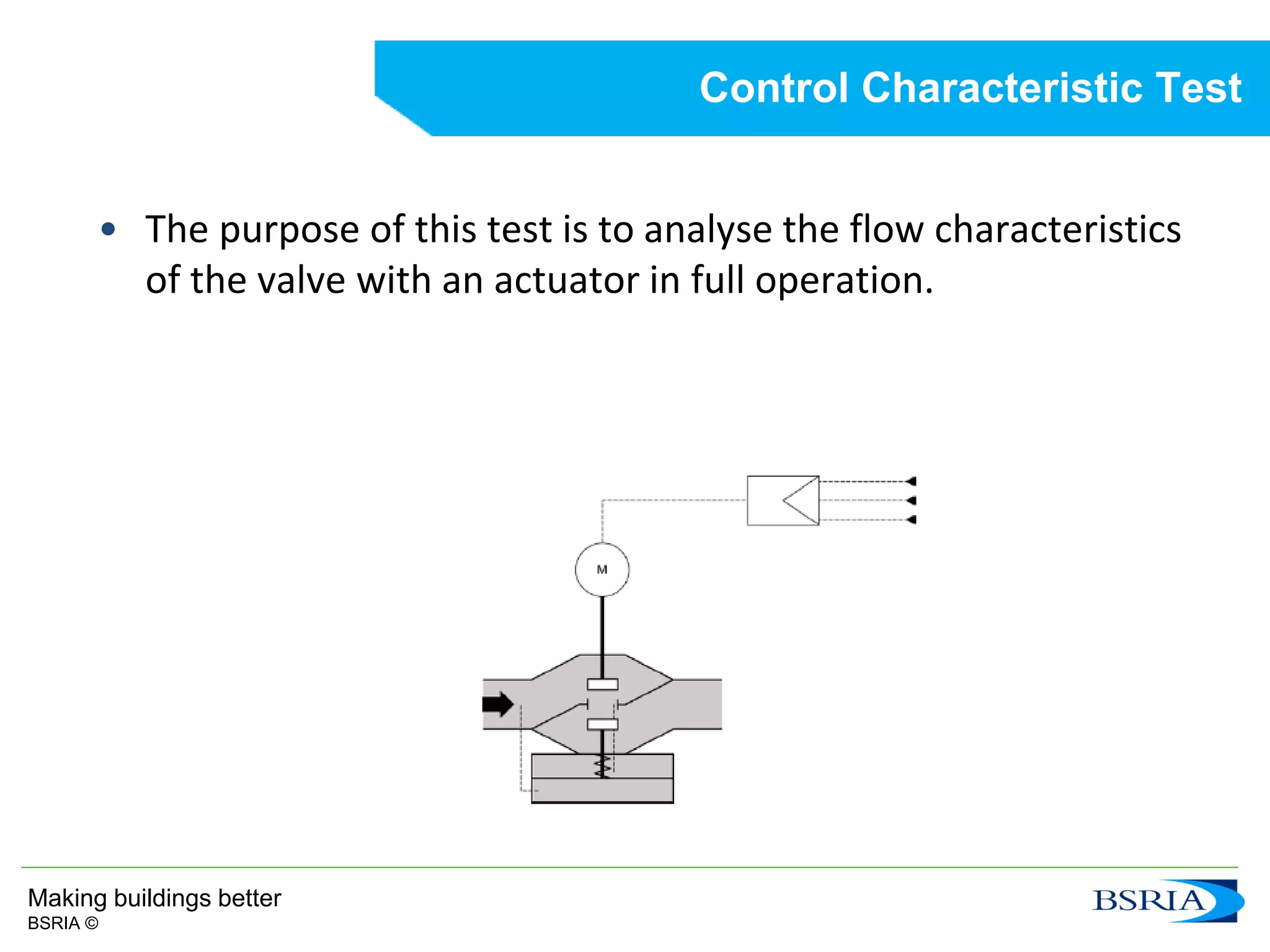
Control Characteristic Test
• The purpose of this test is to analyse the flow characteristics
of the valve with an actuator in full operation.
18Making buildings better
BSRIA ©
Control Characteristic Graph
0.000
0.020
0.040
0.060
0.080
0.100
0.120
0.140
0.160
0 1 2 3 4 5 6 7 8 9 10
Flow(l.s¯¹)
Actuator (VDC)
Control Characteristic Graph - 100% Pre-setting 100 kPa
19Making buildings better
BSRIA ©
Seat Leakage Test
• The purpose of this test is to
demonstrate the capability to shut
off flow to the terminal or other
device being controlled.
• The test is based on BS EN 60534-4:
“Industrial Process Control Valves
Part 4: Inspection and routine
maintenance”.
20Making buildings better
BSRIA ©
Cycling Test
The purpose of this tests is to determine the ageing effect on the
constant flow components within the valve. This is done by subjecting
the valve to repeated pressure variation cycles, and re-testing some of
the performance characteristics after cycling.
21Making buildings better
BSRIA ©
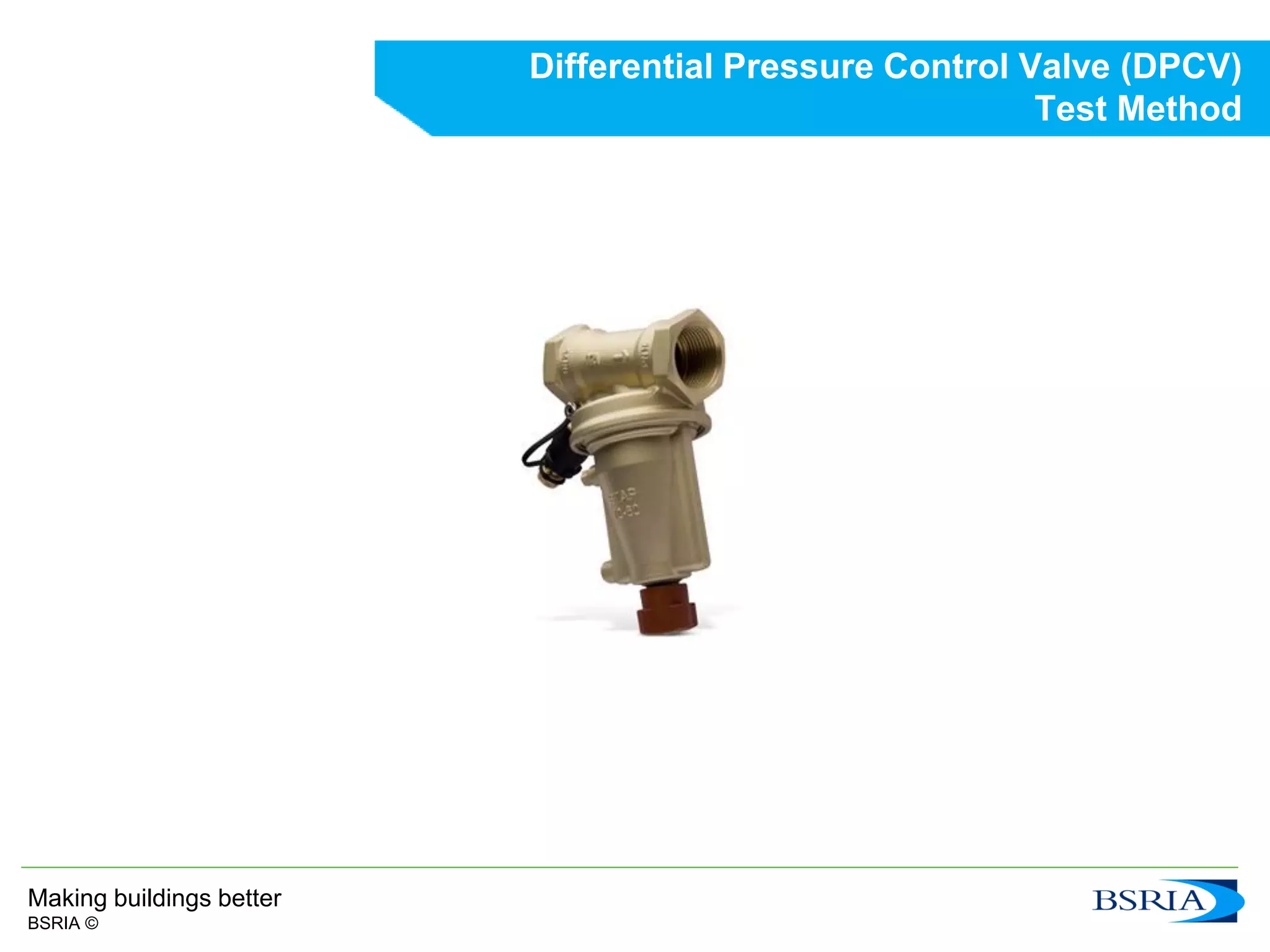
Differential Pressure Control Valve (DPCV)
Test Method
22Making buildings better
BSRIA ©
Thank you
Cory Chadoka
Contact BSRIA Test:
test@bsria.co.uk
+44 (0) 1344 465600
Test Engineer
Making buildings better
Global Trends in AC&R
Finding the hot spots
Anette Meyer Holley
12 Oct 2016
24Making buildings better
BSRIA ©
AC Global Trends
Critical
Very Certain
Energy efficiency and renewables
Market globalization &
industry consolidation
Refrigerants
Market Drivers
European economy slow to pick up, but
good 2016 in Southern Europe helps
Market Restraints
Chinese
slowdown
AC products
going into
the cloud
Legislation
Increasing focus
on Chillers &
Ventilation
US slowdown/ uncertainty
Smart buildings
smart homes
25Making buildings better
BSRIA ©
AC Global Trends
World Air Conditioning Market from 2014 to
2021 (F) in unit terms
World Air Conditioning Market from 2014 to
2021(F) in value (US$ million)
Total Units in 2016: 113 million Total Value in 2016: US$ 88 billion
26Making buildings better
BSRIA ©
Global minisplit market – VRF and Splits,
outdoor units
Top 10 countries in Europe in 2016 by units
(number of pieces)
5.5 million
World market for splits & VRF from 2014 to 2020 in units
(number of pieces)
27Making buildings better
BSRIA ©
World fastest growing markets, CAGR 2015-20
Brazil
Warm spots
Cold spots
Hot spots
Mexico
India
Vietnam
ChinaItaly
Saudi
Arabia
Indonesia
Philippines
Qatar
USA
Spain
UK
Bangladesh
Thailand
28Making buildings better
BSRIA ©
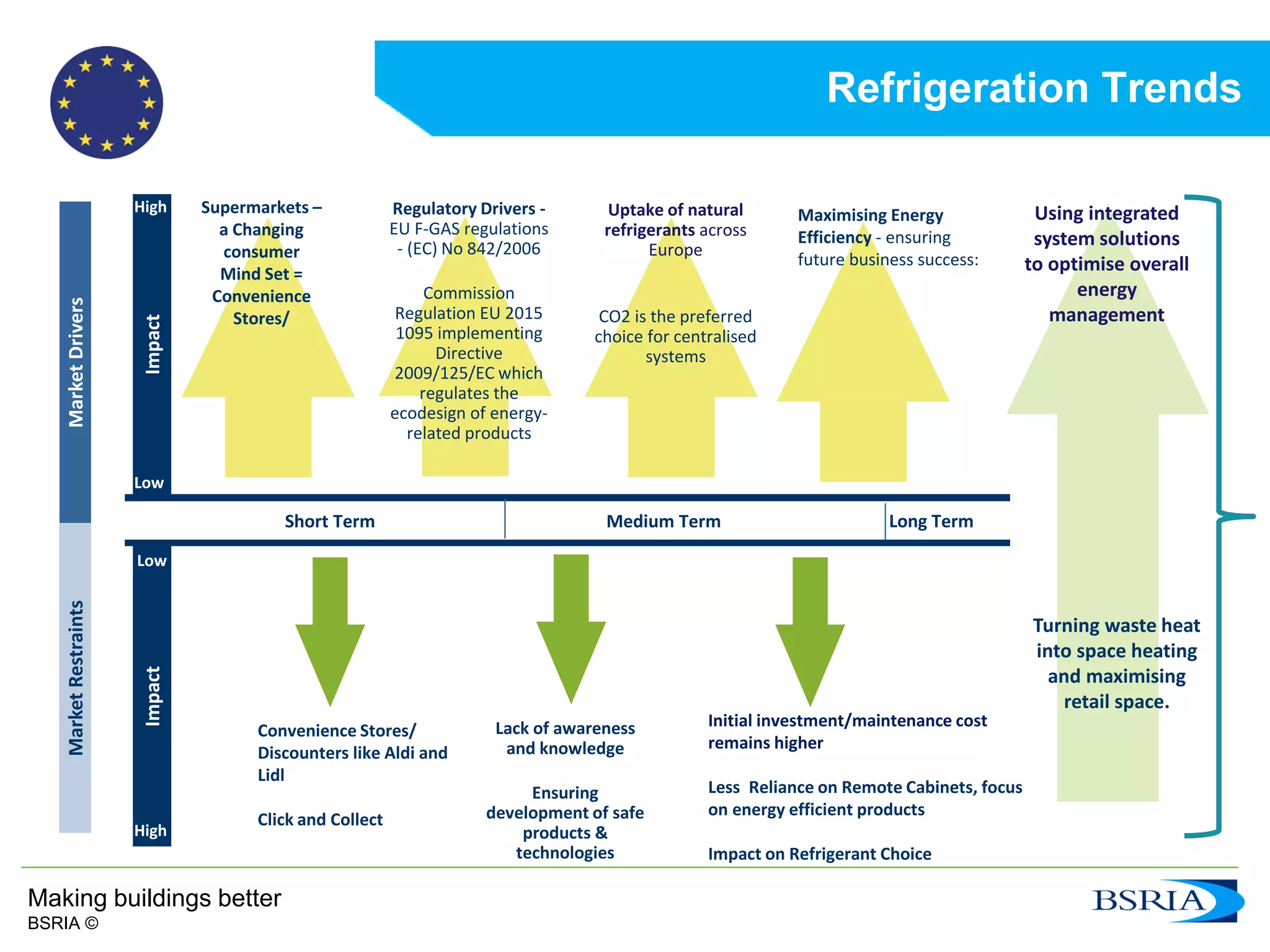
Refrigeration Trends
Short Term Medium Term
Impact
MarketDriversMarketRestraints
Impact
Long Term
Low
High
Low
High
Supermarkets –
a Changing
consumer
Mind Set =
Convenience
Stores/
Lack of awareness
and knowledge
Ensuring
development of safe
products &
technologies
Initial investment/maintenance cost
remains higher
Less Reliance on Remote Cabinets, focus
on energy efficient products
Impact on Refrigerant Choice
Regulatory Drivers -
EU F-GAS regulations
- (EC) No 842/2006
Commission
Regulation EU 2015
1095 implementing
Directive
2009/125/EC which
regulates the
ecodesign of energy-
related products
Uptake of natural
refrigerants across
Europe
CO2 is the preferred
choice for centralised
systems
Maximising Energy
Efficiency - ensuring
future business success:
Using integrated
system solutions
to optimise overall
energy
management
Turning waste heat
into space heating
and maximising
retail space.
Convenience Stores/
Discounters like Aldi and
Lidl
Click and Collect
29Making buildings better
BSRIA ©
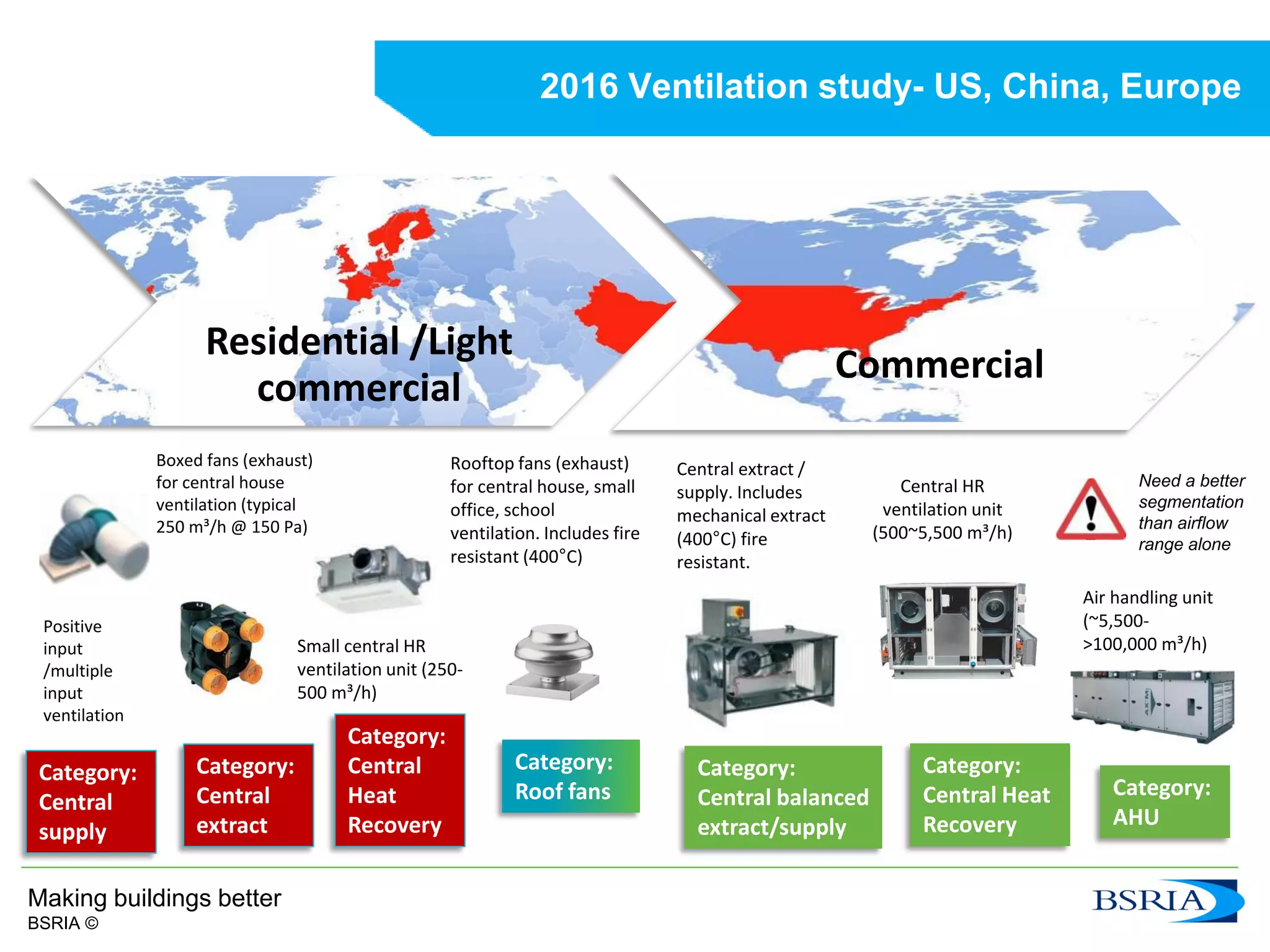
2016 Ventilation study- US, China, Europe
Residential /Light
commercial
Commercial
Boxed fans (exhaust)
for central house
ventilation (typical
250 m³/h @ 150 Pa)
Rooftop fans (exhaust)
for central house, small
office, school
ventilation. Includes fire
resistant (400°C)
Small central HR
ventilation unit (250-
500 m³/h)
Central extract /
supply. Includes
mechanical extract
(400°C) fire
resistant.
Category:
Roof fans
Category:
Central
extract
Category:
Central
Heat
Recovery
Central HR
ventilation unit
(500~5,500 m³/h)
Category:
Central Heat
Recovery
Category:
Central balanced
extract/supply
Air handling unit
(~5,500-
>100,000 m³/h)
Category:
AHU
Category:
Central
supply
Positive
input
/multiple
input
ventilation
Need a better
segmentation
than airflow
range alone
30Making buildings better
BSRIA ©
Market Drivers and Restraints
2016 2017 2020
Drivers
Indoor air quality: The main driver for heat recovery in new build.
Energy savings are becoming increasingly small with efficient new
dwellings.
Legislation: National legislations imposing the installation of
ventilation in all new dwellings (France, Belgium), but not in
Germany.
Size of sphere indicates the importance of the driverMarket Trends and Dynamics
Ecodesign 1253/2014 and labelling : Speed-controlled fans,
growth in EC motors, higher-efficiency heat exchangers, bypass
facility
Demand control ventilation: increasing market in the North of
Europe
31Making buildings better
BSRIA ©
Market Drivers and Restraints
2016 2017 2020
Lack of skills: Progression of products such as HR hindered by
lack of skilled installers. Need to create a category of
specialised ventilation installers
Low awareness: End users are the main specifiers for HR
systems. There is a need to increase their awareness level
Growth of the parallel markets: DIY sales, Internet market place
and specialised website a growing threat to suppliers of high-end
products
Size of sphere indicates the importance of the restraint
Restraints
Market Trends and Dynamics
32Making buildings better
BSRIA ©
Thank you
Anette Meyer Holley
General Manager, VACR and Consultancy
anette.meyer.holley@bsria.co.uk
Making buildings better
The traditional heating markets and
the growth of renewable
technologies
Krystyna Dawson
Heating & Renewables Manager
12 Oct 2016
34Making buildings better
BSRIA ©
Main trends in world heating markets, 2015 - 2017
Move towards
Integrated HVAC
systems
Controls & energy
management of
buildings are growing
Low penetration of
renewables in
existing buildings
Growing
importance
of Energy networks
In cities
Importance
Urgency
• Energy efficiency
legislation for
buildings &
products
• Increased RES &
distributed energy
generation
• Low oil/gas prices
• Slow economic
development
Global Drivers:
ErP
and other efficiency
targets drive sales
of condensing
products
Substitution
of boilers by
renewables
in new build
Gas-fuelled boilers
dominance grows,
mostly wall hung
Sluggish new build,
Low consumer
confidence
Energy storage and
demand response
are developing
35Making buildings better
BSRIA ©
World heating market value by region, 2015
• Europe includes 25 countries: Austria, Belgium , France, Germany , Greece, Italy, Netherlands, Norway ,
Spain, Sweden, Switzerland , Turkey, United Kingdom, Belarus, Bulgaria, Czech Republic, Hungary, Poland,
Romania, Russia, Serbia, Slovakia, Slovenia, Ukraine
** Domestic boilers in NA do not include furnaces.
Population (million inhabitants)
USA + Canada Europe China
352 778 1,360
North America
Total: 5.4 €billion
Europe*
Total: 13.4 €billion
China
Total: 9.7 €billion
DB
54%
CB
6%
WH
22%
Ren
18%**DB
10%
CB
7%
WH
81%
Ren
2%
DB
7%
CB
4%
WH
56%
Ren
33%
DB = domestic boilers
CB = commercial boilers
WH = water heaters
Ren = Ground/water + air/water heat pumps + Solar thermal
36Making buildings better
BSRIA ©
Heat pump market growth
Ground source / Air source, 2011 - 2017
Ground/Water-to-Water
(+1.2%)
*Based on research for 21 countries
Air-to-Water
(+8.6%)
units units
-5.0%
0.0%
5.0%
10.0%
15.0%
20.0%
-
50,000
100,000
150,000
200,000
250,000
300,000
2011 2012 2013 2014 2015 2016 2017
Splits Monoblocs
Growth splits Growth monoblocs
2.5%
-6.6%
-5.3%
-4.7%
-1.8%
1.2%
2.5%
-8.0%
-6.0%
-4.0%
-2.0%
0.0%
2.0%
4.0%
-
20,000
40,000
60,000
80,000
100,000
120,000
140,000
2011 2012 2013 2014 2015 2016 2017
Ground/ water to water Growth GSHP
Source: BSRIA
REMAIN
37Making buildings better
BSRIA ©
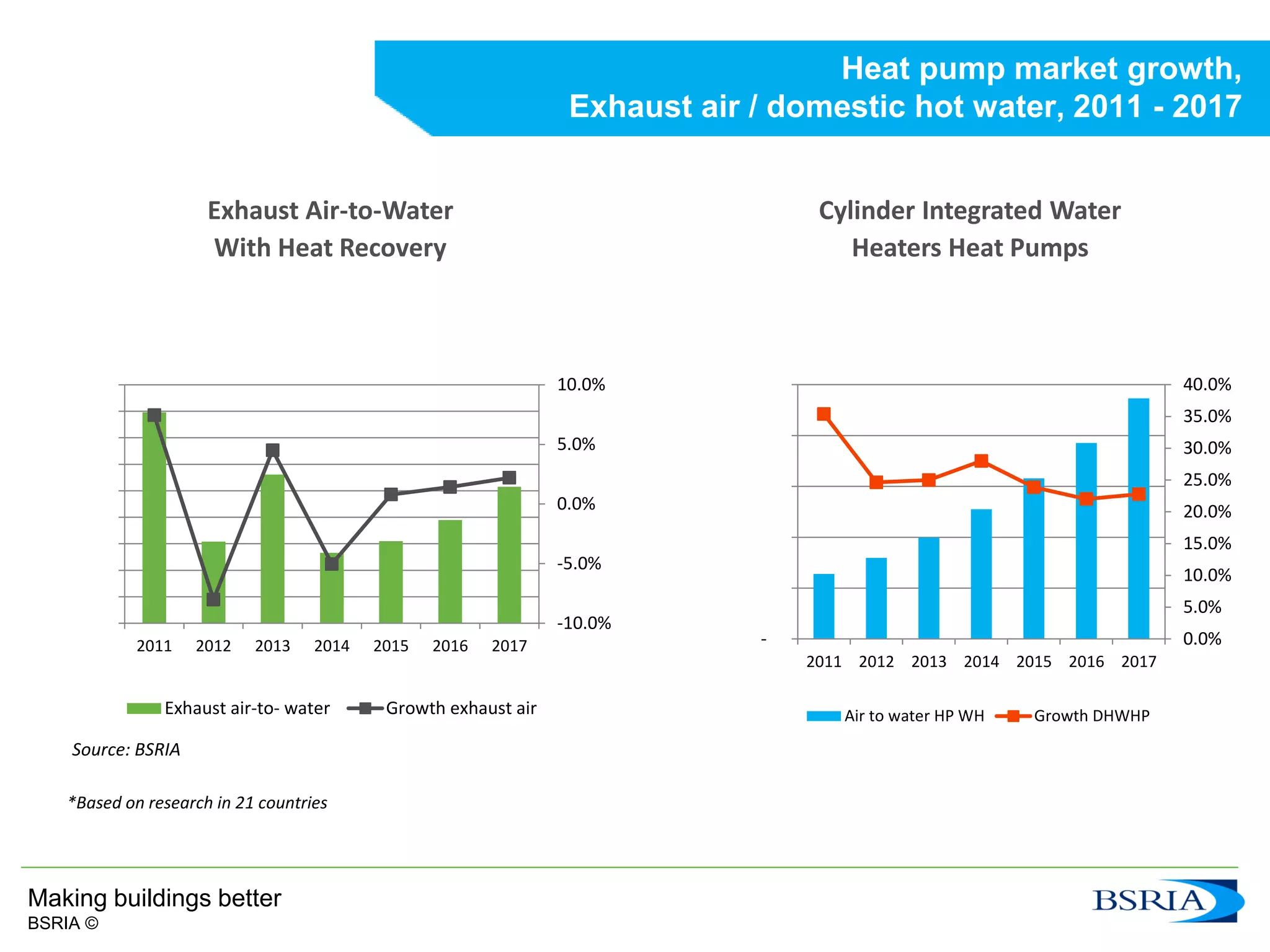
Heat pump market growth,
Exhaust air / domestic hot water, 2011 - 2017
*Based on research in 21 countries
Exhaust Air-to-Water
With Heat Recovery
Cylinder Integrated Water
Heaters Heat Pumps
units units
-10.0%
-5.0%
0.0%
5.0%
10.0%
26,500
27,000
27,500
28,000
28,500
29,000
29,500
30,000
30,500
31,000
2011 2012 2013 2014 2015 2016 2017
Exhaust air-to- water Growth exhaust air
0.0%
5.0%
10.0%
15.0%
20.0%
25.0%
30.0%
35.0%
40.0%
-
50,000
100,000
150,000
200,000
250,000
2011 2012 2013 2014 2015 2016 2017
Air to water HP WH Growth DHWHP
Source: BSRIA
38Making buildings better
BSRIA ©
DHW HP - economic choice in troubled times
Share of Domestic Hot Water Heat Pumps in Europe & the biggest markets
2011
2015
000 units
-
50,000
100,000
150,000
200,000
250,000
300,000
350,000
2013 2014 2015 2016 2017 2018
France
Germany
Italy
Slovenia
Poland
Switzerland
Others
Based on the research from 21 countriesSource: BSRIA
Other
HP
83%
DHW HP
17%
Other HP
70%
DHW HP
30%
REMOVE
39Making buildings better
BSRIA ©
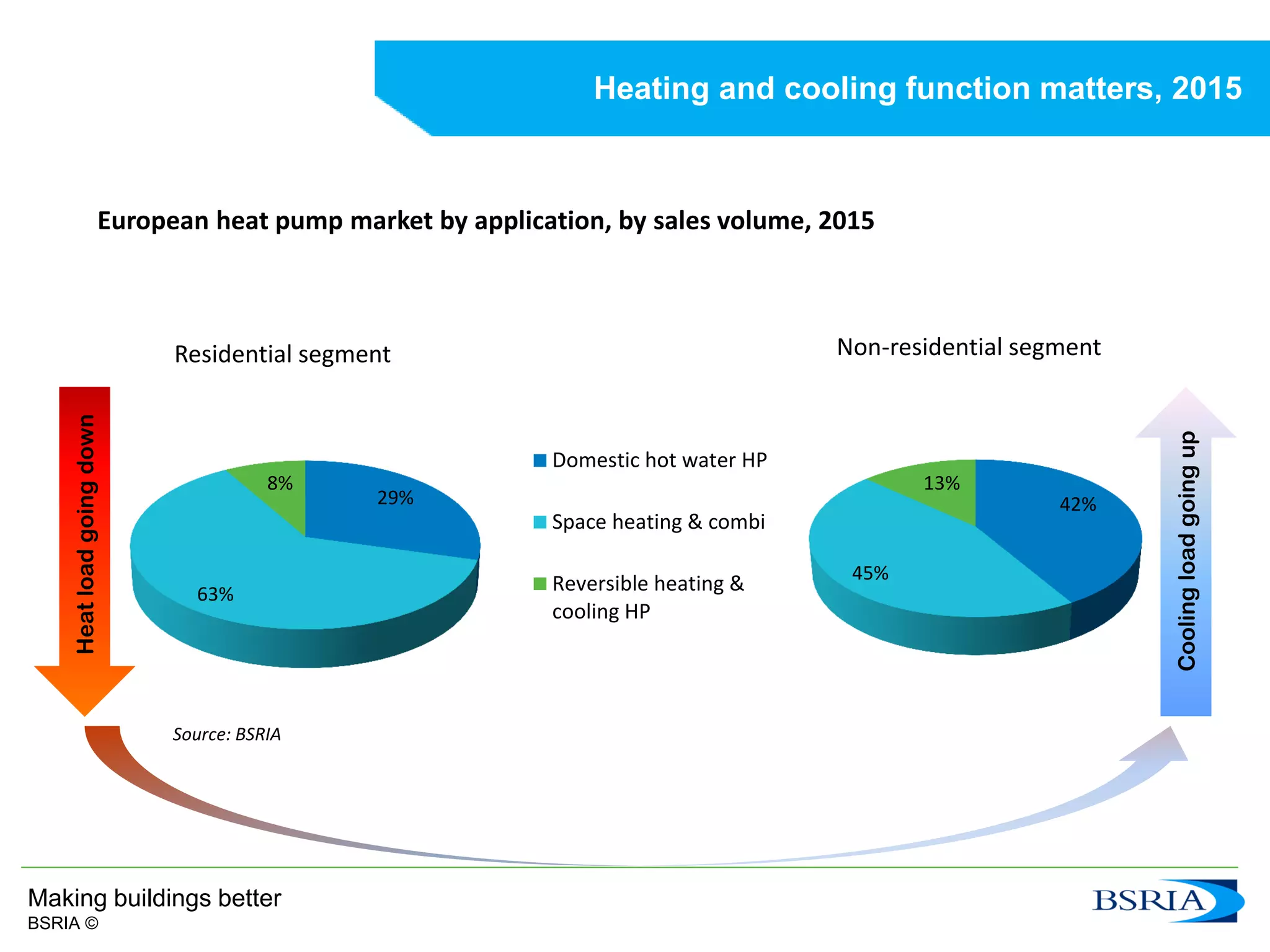
Heating and cooling function matters, 2015
European heat pump market by application, by sales volume, 2015
29%
63%
8%
Domestic hot water HP
Space heating & combi
HP
Reversible heating &
cooling HP
42%
45%
13%
Residential segment Non-residential segment
Source: BSRIA
Heatloadgoingdown
Coolingloadgoingup
40Making buildings better
BSRIA ©
Heat pump market by output, 2015
0% 10% 20% 30% 40% 50% 60% 70%
smal domestic HP (<10kW)
large domestic HP (10-20kW)
commercial HP (> 20kW)
2015
2014
Source: BSRIA
64%
36%
New build
Existing buildings
European heat pump market by output, % share in the total market, 2015
41Making buildings better
BSRIA ©
Heat pump market 2020 outlook
European heat pump market by output, % share in the total market, 2015
units growth
4%
9%
2%
11%
5%
15%
4%
1%
3%
6%
9% 9%
0%
2%
4%
6%
8%
10%
12%
14%
16%
-
50,000
100,000
150,000
200,000
250,000
300,000
2015
2020
CAGR 2015-2020
• CAGR 2020 for all: 8%
Source: BSRIA
42Making buildings better
BSRIA ©
New products on the European market
HR & Ventilation HP
Stiebel Eltron
LWZ 304 Integral
Genvex Combi 185 Itho Daalderop
HP Cool Cube
Vitosorp 200F
Robur K18
ZeoTherm
Gas HP Solar PV + HP
Panasonic
PV panel & HPM
43Making buildings better
BSRIA ©
Long term market drivers for Heat Pumps
Building regulations . . .
Energy efficiency regulations for products . . .
PV & storage market development . . .
Smart grid development. . .
Mostly related to new
build might open up to
renovation
Requirements are
becoming tighter
Storage batteries needed to
support own consumption
Slow but ongoing with HPs
being already used in smaller
networks
2010 2015 2020 2030
timeline
market size
44Making buildings better
BSRIA ©
Thank you
Krystyna Dawson
Heating & Renewables Manager –
BSRIA Worldwide Market Intelligence
krystyna.dawson@bsria.co.uk
D : +44 (0)1344 465638
Making buildings better
Keeping up with the "Smart"
revolution
Greg Corty
12 Oct 2016
46Making buildings better
BSRIA ©
Agenda
1. BACS and Smart Homes - Market dimensions, new players entering market
2. NEW STUDY – World Smart Homes/ Light Commercial Mid-market - First
results from Germany
– High-end Whole home systems vs. new “DIY” standalone solutions
– What makes it “Smart”?
– Connectivity – Proliferation of communication technologies / standards.
3. IoT – the “Cloud” and the renovation opportunity
4. NEW STUDY – Smart- connected HVAC – a new market
5. The BEMS Market
6. BSRIA’s new subscription services
47Making buildings better
BSRIA ©
New players entering the buildings market
January 2014:
Google’s Acquisition of
Nest Labs marks
potential new entry
into Smart Homes
March 2014
Apple announce
Siri Smart Home
application
April 2013: Honda
USA launched Smart Home US,
including Energy Management and
direct charging of vehicles from
photovoltaic power.
March 2014: US Smart Home
Showcase opens.
January 2015
Facebook acquires
speech-recognition
start-up Wit.ai
August 2014
Samsung acquire
US based Smart
things
Sept 2015
launch
June 2015
Amazon launch
Echo on general
market. Voice-
activated control of
lighting etc.
REMOVE
48Making buildings better
BSRIA ©
Smart Home Evolution
• Mass-market breakthrough
• Telecoms/Utilities “connected
home” solutions.
• IoT enabled “ubiquitous Home”
• Systems learn user behaviour/
lifestyle - respond accordingly
• Approx. USD 5bn
Smart home market
today
• “50 billion devices by
2020” (Cisco)
49Making buildings better
BSRIA ©
World Smart Homes/
Light Commercial Mid-market
Smart characteristics
Source: Fraunhofer FOKUS
50Making buildings better
BSRIA ©
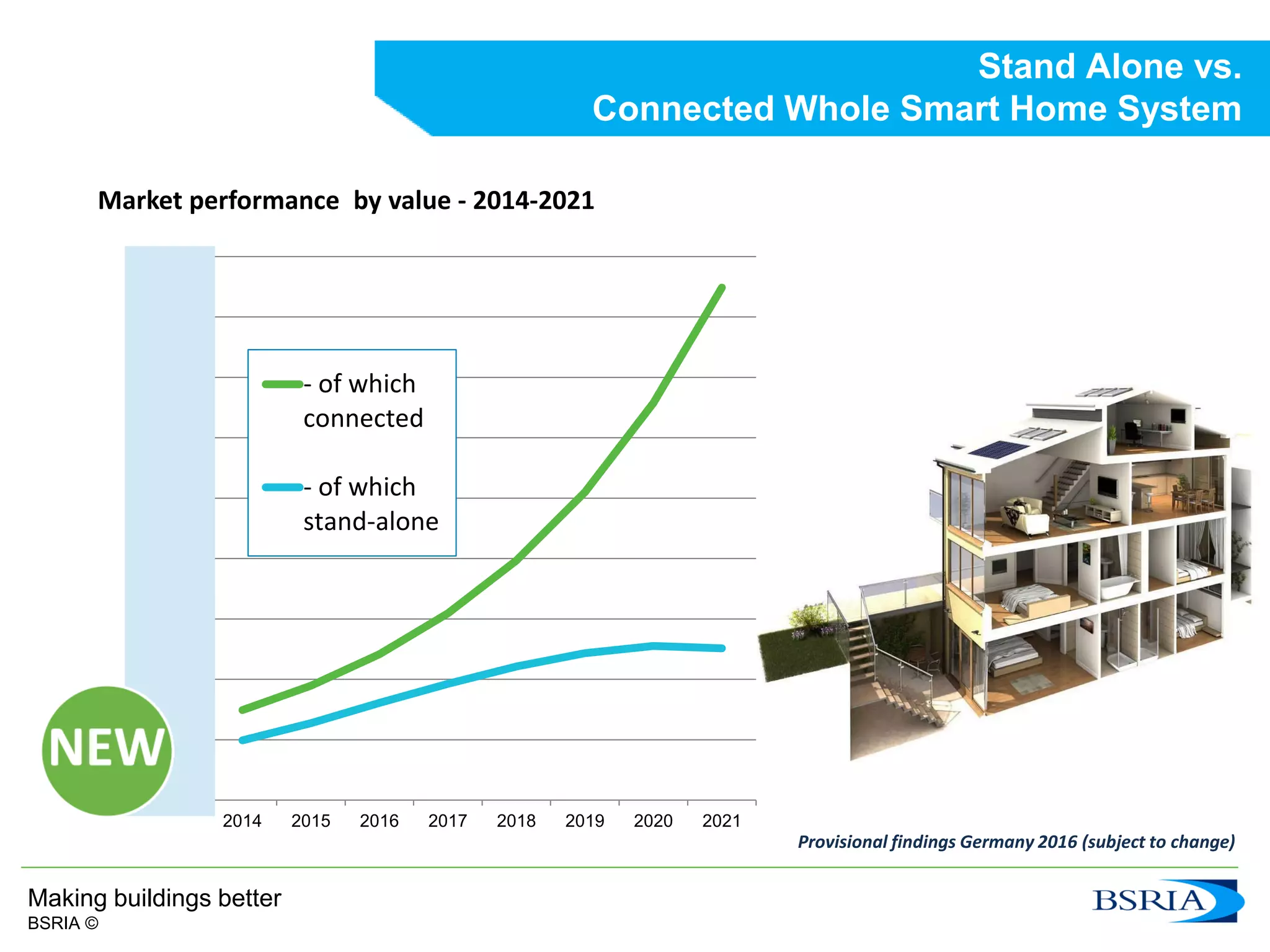
Stand Alone vs.
Connected Whole Smart Home System
Market performance by value - 2014-2021
0
200
400
600
800
1,000
1,200
1,400
1,600
1,800
2014 2015 2016 2017 2018 2019 2020 2021
MillionUSD
- of which
connected
- of which
stand-alone
Provisional findings Germany 2016 (subject to change)
51Making buildings better
BSRIA ©
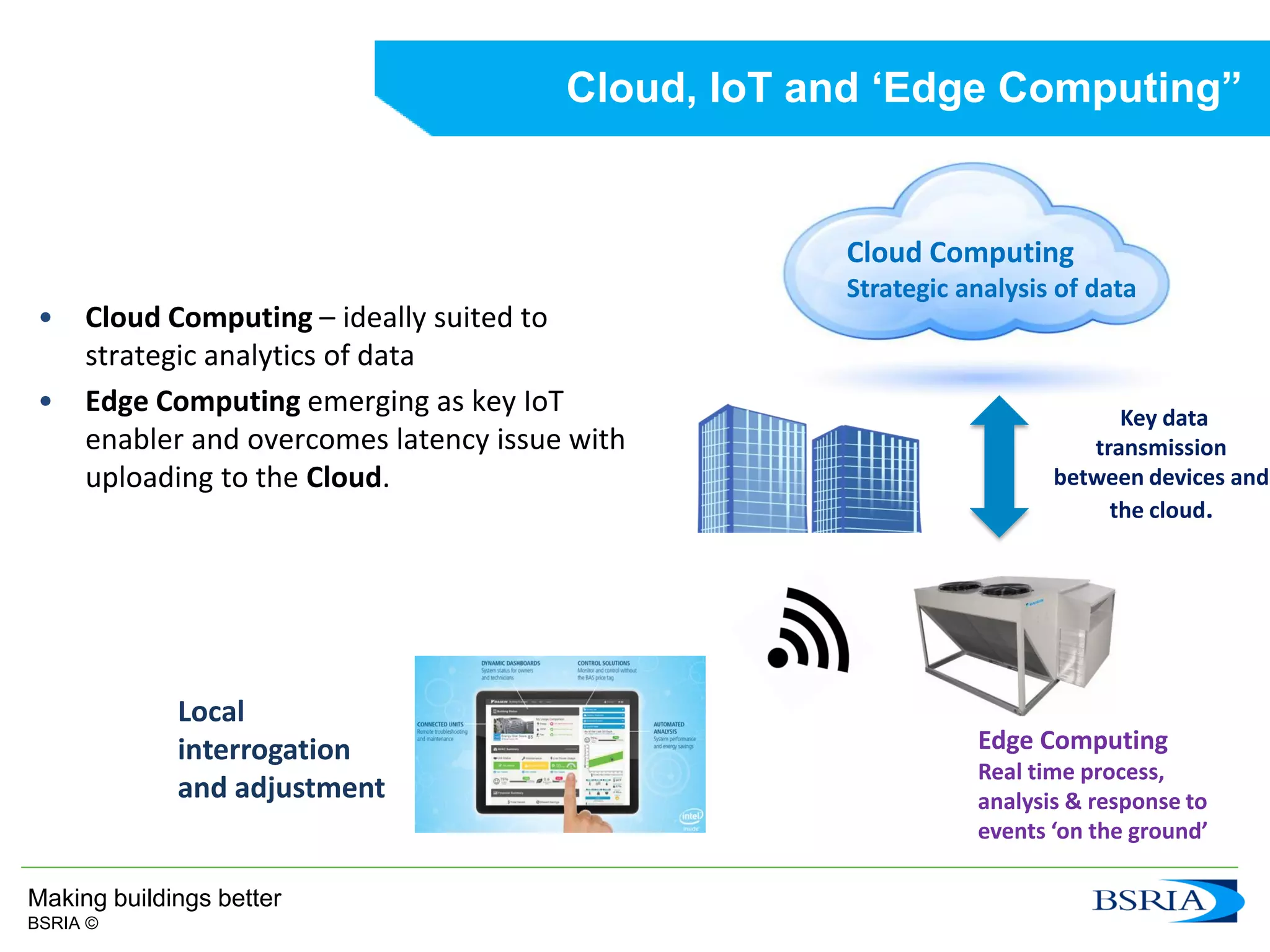
Cloud, IoT and ‘Edge Computing”
Cloud Computing
Strategic analysis of data
Edge Computing
Real time process,
analysis & response to
events ‘on the ground’
Key data
transmission
between devices and
the cloud.
• Cloud Computing – ideally suited to
strategic analytics of data
• Edge Computing emerging as key IoT
enabler and overcomes latency issue with
uploading to the Cloud.
Local
interrogation
and adjustment
52Making buildings better
BSRIA ©
Smart Connected HVAC –
What is it and which verticals
Source: Johnson Controls
• New trend - principally in USA
• HVAC manufacturers furnishing HVAC
equipment at factory (or on-site refurb)
• Microproc.-based, web-enabled controls
accessed wirelessly on-site and from the
Cloud
• Local control + remote analytics & predictive
maintenance
• Less sophisticated than full BACS
• Typical verticals:
– Education
– Offices
– Hospitality
– Retail (main target today)
– Restaurants / Food Service
– Outpatient healthcare - Clinics, dentists
– Multi-family buildings
• HVAC equip. suppliers & new start-ups, addressing
specific verticals and the IoT opportunity.
53Making buildings better
BSRIA ©
How much is BEMS worth?
$0
$1,000
$2,000
$3,000
$4,000
$5,000
$6,000
$7,000
$8,000
2009 2010 2011 2012 2013 2014 2015 2016 2017 2018 2019 2020
MillionUSDollars
Total BEMS Market Growth
Total
EU
USA
Rest of World
EU, 1,900, 43%
USA, 1,453,
33%
Rest of World,
1,082, 24%
Global BEMS Market Value Forecast 2016
Million
US
Dollars
Total USD 4.4billion
54Making buildings better
BSRIA ©
How BSRIA will address this complex new
environment
Residential / Light
Commercial
Smart Homes and
light commercial
6 month update –
Main products
Threats &
Opportunities
New package of studies - Modular offerings
+ Several hours of free consultancy
Smart, Connected
HVAC
US First /mid-
market
Spread to other
countries
Updating service
to follow
Lighting &
Lighting Controls
Selected
countries
One –off report
Updating
service to
follow
Commercial
WWBACS
6 month update –
DDC Controllers
Threats &
Opportunities
BACS & BEMS
55Making buildings better
BSRIA ©
Thank you
Greg Corty
BSRIA WMI Regional Manager - France
greg.corty@bsria.fr
Making buildings better
2020 Overlapping and merging
markets and conclusions
Beyond Huge threats and even greater opportunities
Andrew Giles
12 Oct 2016
57Making buildings better
BSRIA ©
Agenda
The move to big monsters – hybrids and district systems
Peering beyond 2020 and the thing that doesn’t change
The big opportunity
The supply structure changes, multi – headed threats
What will customers be wanting from you
What are the pathways to success
58Making buildings better
BSRIA ©
Expansion of hybrid technologies
59Making buildings better
BSRIA ©
District Energy in Europe*
40%
47%
10%
2%
0%
1%
Ind boilers
CHP
Biomass boilers
Heat pumps
Solar thermals
Chillers
*Based on research in Germany, Italy, France, UK, Poland
Estimated growth in district energy capacity, 2015 - 2030 Share of energy generators sold to
District Energy networks, 2015
0
50
100
150
200
250
300
2015e 2016f 2017f 2018f 2019f 2020f 2025f 2030f
Heating capacity Cooling capacity
GWh
60Making buildings better
BSRIA ©
Long term outlook 2020/25/30 - UK
‘000 units
-
200
400
600
800
1,000
1,200
1,400
1,600
1,800
2,000
2014 2015 2016 2017 2018 2019 2020 2025 2030
Fixed electric heat emitters
Heat Interface Unit **
Fuel cell
mCHP
Gas heat pump
Air to air heat pump
Exhaust air heat pump
Ground to water heat pump
Air to water heat pump
Biomass boiler
Coal boiler*
Oil boiler
Gas boiler
-
50
100
150
200
250
2014 2015 2016 2017 2018 2019 2020 2025 2030
‘000 unitsNew build
Existing dwellings
70%
61Making buildings better
BSRIA ©
Gen-Z expect solutions
62Making buildings better
BSRIA ©
Sell outcome – not products
• Provision of “optimal” building
temperature
• Sell benefit – sell savings
• New delivery models
– Buy the service not the
capital
Your heating has a fault…
Engineer on the way…
Expect problem resolved by…
63Making buildings better
BSRIA ©
More data and communications and more
collaboration
• Prediction,
anticipation,
optimisation
 Data processing in the
cloud & SaaS
 Everything connected!
 Need for open standards
 Integrated and converged
 Edge computing
 Controls augmented
through data
64Making buildings better
BSRIA ©
Thank you
Andrew Giles
Director of Worldwide Market Intelligence
andrew.giles@bsria.co.uk
65Making buildings better
BSRIA ©
BSRIA Values

BSRIA Industry Presentation at Chillventa 2016

  • 1.
    Making buildings better BSRIAIndustry Presentation BRIEF SUMMARY SLIDES Chillventa 2016 For more details contact Mike Vardanian mike.vardanian@bsria.co.uk 12 Oct 2016
  • 2.
  • 3.
    3Making buildings better BSRIA© Agenda 18:15 Welcome Andrew Giles 18:15 – 18:25 Testing and integration PICBV’s in Buildings Cory Chadoka 18:25 – 18:45 Global Trends in AC&R Anette Holley 18:45 – 19:00 The traditional heating markets and the growth of renewable technologies Krystyna Dawson 19:00–19:15 Keeping up with the "Smart" revolution Greg Corty 19:15-19:30 2020 Overlapping and merging markets and conclusions Andrew Giles
  • 4.
    Making buildings better Testingand integration PICBV’s in Buildings (Pressure Independent Balancing & Control Valves ) Cory Chadoka 12 Oct 2016
  • 5.
    5Making buildings better BSRIA© BSRIA Test • ISO/IEC 17025 accredited laboratory ( UKAS No.1053). • Listed on NANDO as a Notified Body (NB 0480). • Product validation and verification for: • CE marking • Thermal performance • Efficiency • Smoke emissions • Acoustics • Corrosion • Benchmarking product performance and product development • Development of bespoke test methodologies • Physical modelling (mock-up), testing and validation • On-site, witness and factory acceptance testing. • Test laboratory design
  • 6.
    6Making buildings better BSRIA© What is a Pressure Independent Control Valve?
  • 7.
    7Making buildings better BSRIA© What is a PICV? • A PICV is a multi-functional valve combining the operation of three different valves. • A PICV operates as a Pressure Independent Control Valve, Two-Port Control Valve and Regulating Valve. • The valve body incorporates a differential pressure controller and a control valve element. The differential pressure controller maintains the pressure difference across the control valve element.
  • 8.
    8Making buildings better BSRIA© What is PICV? The purpose of a Pressure Independent Control Valve (PICV) is to maintain the flow rate in a hydronic system regardless of any changes in pressure. PICV’s can be used in a number of hydronic systems such as: • Air Handling Units (AHU) • Fan Coils • Chilled Beams • Radiant Panels and Radiators • Heater Batteries etc.
  • 9.
    9Making buildings better BSRIA© Example of PICV on an Air Handling Unit (AHU) BMS = (Building Management System)
  • 10.
    10Making buildings better BSRIA© Benefits • Reduced commissioning • Maintaining design ΔT (energy efficiency) • Simplified valve sizing • Reduced number of valves
  • 11.
    11Making buildings better BSRIA© Market Growth 0 200 400 600 800 1000 1200 1400 2013 2014 2015 2016 2017 2018 Source: BSRIA (*France, Germany, Italy, Poland & UK) PICV Sales Europe* by volume (x1000) €72m market (2014), 13% CAGR 2013-2018
  • 12.
    12Making buildings better BSRIA© BSRIA Technical Standard BTS No: 1 “Test Method for Pressure Independent Control Valves” • Allows for comparison between manufacturer’s • Creates a balanced playing field across the industry • Serves as a reference point for manufacturer’s, contractors and the end user.
  • 13.
    13Making buildings better BSRIA© Measured flow Versus Nominal Flow • Example of valve setting scale • Example of Measured Flow Versus Nominal Flow test data Test Sample Nominal setting (l.s¯¹) Measured flow (l.s¯¹) at 100 kPa Deviation (%) Manufacturer's nomenclature 0.010 0.011 9% 0.025 0.025 0% 0.050 0.052 4% 0.075 0.071 -6% 0.100 0.095 -5%
  • 14.
    14Making buildings better BSRIA© Flow Limitation Test This test indicates any inherent hysteresis in the valve flow rate performance as differential pressure rises and falls across its full range (defined by the manufacturer).
  • 15.
    15Making buildings better BSRIA© Flow Limitation Graph Example (good performance) 0 0.02 0.04 0.06 0.08 0.1 0.12 0.14 0.16 0.18 0 50 100 150 200 250 300 350 400 450 500 Flow(l.s¯¹) Valve ΔP (kPa) Flow Limitation Test - 100% Pre-setting
  • 16.
    16Making buildings better BSRIA© Flow Limitation Graph Example (poor performance) 0.000 0.050 0.100 0.150 0.200 0.250 0 50 100 150 200 250 300 350 400 450 500 Flow(l.s¯¹) Valve ΔP (kPa) Flow Limitation Test - 100% Presetting
  • 17.
    17Making buildings better BSRIA© Control Characteristic Test • The purpose of this test is to analyse the flow characteristics of the valve with an actuator in full operation.
  • 18.
    18Making buildings better BSRIA© Control Characteristic Graph 0.000 0.020 0.040 0.060 0.080 0.100 0.120 0.140 0.160 0 1 2 3 4 5 6 7 8 9 10 Flow(l.s¯¹) Actuator (VDC) Control Characteristic Graph - 100% Pre-setting 100 kPa
  • 19.
    19Making buildings better BSRIA© Seat Leakage Test • The purpose of this test is to demonstrate the capability to shut off flow to the terminal or other device being controlled. • The test is based on BS EN 60534-4: “Industrial Process Control Valves Part 4: Inspection and routine maintenance”.
  • 20.
    20Making buildings better BSRIA© Cycling Test The purpose of this tests is to determine the ageing effect on the constant flow components within the valve. This is done by subjecting the valve to repeated pressure variation cycles, and re-testing some of the performance characteristics after cycling.
  • 21.
    21Making buildings better BSRIA© Differential Pressure Control Valve (DPCV) Test Method
  • 22.
    22Making buildings better BSRIA© Thank you Cory Chadoka Contact BSRIA Test: test@bsria.co.uk +44 (0) 1344 465600 Test Engineer
  • 23.
    Making buildings better GlobalTrends in AC&R Finding the hot spots Anette Meyer Holley 12 Oct 2016
  • 24.
    24Making buildings better BSRIA© AC Global Trends Critical Very Certain Energy efficiency and renewables Market globalization & industry consolidation Refrigerants Market Drivers European economy slow to pick up, but good 2016 in Southern Europe helps Market Restraints Chinese slowdown AC products going into the cloud Legislation Increasing focus on Chillers & Ventilation US slowdown/ uncertainty Smart buildings smart homes
  • 25.
    25Making buildings better BSRIA© AC Global Trends World Air Conditioning Market from 2014 to 2021 (F) in unit terms World Air Conditioning Market from 2014 to 2021(F) in value (US$ million) Total Units in 2016: 113 million Total Value in 2016: US$ 88 billion
  • 26.
    26Making buildings better BSRIA© Global minisplit market – VRF and Splits, outdoor units Top 10 countries in Europe in 2016 by units (number of pieces) 5.5 million World market for splits & VRF from 2014 to 2020 in units (number of pieces)
  • 27.
    27Making buildings better BSRIA© World fastest growing markets, CAGR 2015-20 Brazil Warm spots Cold spots Hot spots Mexico India Vietnam ChinaItaly Saudi Arabia Indonesia Philippines Qatar USA Spain UK Bangladesh Thailand
  • 28.
    28Making buildings better BSRIA© Refrigeration Trends Short Term Medium Term Impact MarketDriversMarketRestraints Impact Long Term Low High Low High Supermarkets – a Changing consumer Mind Set = Convenience Stores/ Lack of awareness and knowledge Ensuring development of safe products & technologies Initial investment/maintenance cost remains higher Less Reliance on Remote Cabinets, focus on energy efficient products Impact on Refrigerant Choice Regulatory Drivers - EU F-GAS regulations - (EC) No 842/2006 Commission Regulation EU 2015 1095 implementing Directive 2009/125/EC which regulates the ecodesign of energy- related products Uptake of natural refrigerants across Europe CO2 is the preferred choice for centralised systems Maximising Energy Efficiency - ensuring future business success: Using integrated system solutions to optimise overall energy management Turning waste heat into space heating and maximising retail space. Convenience Stores/ Discounters like Aldi and Lidl Click and Collect
  • 29.
    29Making buildings better BSRIA© 2016 Ventilation study- US, China, Europe Residential /Light commercial Commercial Boxed fans (exhaust) for central house ventilation (typical 250 m³/h @ 150 Pa) Rooftop fans (exhaust) for central house, small office, school ventilation. Includes fire resistant (400°C) Small central HR ventilation unit (250- 500 m³/h) Central extract / supply. Includes mechanical extract (400°C) fire resistant. Category: Roof fans Category: Central extract Category: Central Heat Recovery Central HR ventilation unit (500~5,500 m³/h) Category: Central Heat Recovery Category: Central balanced extract/supply Air handling unit (~5,500- >100,000 m³/h) Category: AHU Category: Central supply Positive input /multiple input ventilation Need a better segmentation than airflow range alone
  • 30.
    30Making buildings better BSRIA© Market Drivers and Restraints 2016 2017 2020 Drivers Indoor air quality: The main driver for heat recovery in new build. Energy savings are becoming increasingly small with efficient new dwellings. Legislation: National legislations imposing the installation of ventilation in all new dwellings (France, Belgium), but not in Germany. Size of sphere indicates the importance of the driverMarket Trends and Dynamics Ecodesign 1253/2014 and labelling : Speed-controlled fans, growth in EC motors, higher-efficiency heat exchangers, bypass facility Demand control ventilation: increasing market in the North of Europe
  • 31.
    31Making buildings better BSRIA© Market Drivers and Restraints 2016 2017 2020 Lack of skills: Progression of products such as HR hindered by lack of skilled installers. Need to create a category of specialised ventilation installers Low awareness: End users are the main specifiers for HR systems. There is a need to increase their awareness level Growth of the parallel markets: DIY sales, Internet market place and specialised website a growing threat to suppliers of high-end products Size of sphere indicates the importance of the restraint Restraints Market Trends and Dynamics
  • 32.
    32Making buildings better BSRIA© Thank you Anette Meyer Holley General Manager, VACR and Consultancy anette.meyer.holley@bsria.co.uk
  • 33.
    Making buildings better Thetraditional heating markets and the growth of renewable technologies Krystyna Dawson Heating & Renewables Manager 12 Oct 2016
  • 34.
    34Making buildings better BSRIA© Main trends in world heating markets, 2015 - 2017 Move towards Integrated HVAC systems Controls & energy management of buildings are growing Low penetration of renewables in existing buildings Growing importance of Energy networks In cities Importance Urgency • Energy efficiency legislation for buildings & products • Increased RES & distributed energy generation • Low oil/gas prices • Slow economic development Global Drivers: ErP and other efficiency targets drive sales of condensing products Substitution of boilers by renewables in new build Gas-fuelled boilers dominance grows, mostly wall hung Sluggish new build, Low consumer confidence Energy storage and demand response are developing
  • 35.
    35Making buildings better BSRIA© World heating market value by region, 2015 • Europe includes 25 countries: Austria, Belgium , France, Germany , Greece, Italy, Netherlands, Norway , Spain, Sweden, Switzerland , Turkey, United Kingdom, Belarus, Bulgaria, Czech Republic, Hungary, Poland, Romania, Russia, Serbia, Slovakia, Slovenia, Ukraine ** Domestic boilers in NA do not include furnaces. Population (million inhabitants) USA + Canada Europe China 352 778 1,360 North America Total: 5.4 €billion Europe* Total: 13.4 €billion China Total: 9.7 €billion DB 54% CB 6% WH 22% Ren 18%**DB 10% CB 7% WH 81% Ren 2% DB 7% CB 4% WH 56% Ren 33% DB = domestic boilers CB = commercial boilers WH = water heaters Ren = Ground/water + air/water heat pumps + Solar thermal
  • 36.
    36Making buildings better BSRIA© Heat pump market growth Ground source / Air source, 2011 - 2017 Ground/Water-to-Water (+1.2%) *Based on research for 21 countries Air-to-Water (+8.6%) units units -5.0% 0.0% 5.0% 10.0% 15.0% 20.0% - 50,000 100,000 150,000 200,000 250,000 300,000 2011 2012 2013 2014 2015 2016 2017 Splits Monoblocs Growth splits Growth monoblocs 2.5% -6.6% -5.3% -4.7% -1.8% 1.2% 2.5% -8.0% -6.0% -4.0% -2.0% 0.0% 2.0% 4.0% - 20,000 40,000 60,000 80,000 100,000 120,000 140,000 2011 2012 2013 2014 2015 2016 2017 Ground/ water to water Growth GSHP Source: BSRIA REMAIN
  • 37.
    37Making buildings better BSRIA© Heat pump market growth, Exhaust air / domestic hot water, 2011 - 2017 *Based on research in 21 countries Exhaust Air-to-Water With Heat Recovery Cylinder Integrated Water Heaters Heat Pumps units units -10.0% -5.0% 0.0% 5.0% 10.0% 26,500 27,000 27,500 28,000 28,500 29,000 29,500 30,000 30,500 31,000 2011 2012 2013 2014 2015 2016 2017 Exhaust air-to- water Growth exhaust air 0.0% 5.0% 10.0% 15.0% 20.0% 25.0% 30.0% 35.0% 40.0% - 50,000 100,000 150,000 200,000 250,000 2011 2012 2013 2014 2015 2016 2017 Air to water HP WH Growth DHWHP Source: BSRIA
  • 38.
    38Making buildings better BSRIA© DHW HP - economic choice in troubled times Share of Domestic Hot Water Heat Pumps in Europe & the biggest markets 2011 2015 000 units - 50,000 100,000 150,000 200,000 250,000 300,000 350,000 2013 2014 2015 2016 2017 2018 France Germany Italy Slovenia Poland Switzerland Others Based on the research from 21 countriesSource: BSRIA Other HP 83% DHW HP 17% Other HP 70% DHW HP 30% REMOVE
  • 39.
    39Making buildings better BSRIA© Heating and cooling function matters, 2015 European heat pump market by application, by sales volume, 2015 29% 63% 8% Domestic hot water HP Space heating & combi HP Reversible heating & cooling HP 42% 45% 13% Residential segment Non-residential segment Source: BSRIA Heatloadgoingdown Coolingloadgoingup
  • 40.
    40Making buildings better BSRIA© Heat pump market by output, 2015 0% 10% 20% 30% 40% 50% 60% 70% smal domestic HP (<10kW) large domestic HP (10-20kW) commercial HP (> 20kW) 2015 2014 Source: BSRIA 64% 36% New build Existing buildings European heat pump market by output, % share in the total market, 2015
  • 41.
    41Making buildings better BSRIA© Heat pump market 2020 outlook European heat pump market by output, % share in the total market, 2015 units growth 4% 9% 2% 11% 5% 15% 4% 1% 3% 6% 9% 9% 0% 2% 4% 6% 8% 10% 12% 14% 16% - 50,000 100,000 150,000 200,000 250,000 300,000 2015 2020 CAGR 2015-2020 • CAGR 2020 for all: 8% Source: BSRIA
  • 42.
    42Making buildings better BSRIA© New products on the European market HR & Ventilation HP Stiebel Eltron LWZ 304 Integral Genvex Combi 185 Itho Daalderop HP Cool Cube Vitosorp 200F Robur K18 ZeoTherm Gas HP Solar PV + HP Panasonic PV panel & HPM
  • 43.
    43Making buildings better BSRIA© Long term market drivers for Heat Pumps Building regulations . . . Energy efficiency regulations for products . . . PV & storage market development . . . Smart grid development. . . Mostly related to new build might open up to renovation Requirements are becoming tighter Storage batteries needed to support own consumption Slow but ongoing with HPs being already used in smaller networks 2010 2015 2020 2030 timeline market size
  • 44.
    44Making buildings better BSRIA© Thank you Krystyna Dawson Heating & Renewables Manager – BSRIA Worldwide Market Intelligence krystyna.dawson@bsria.co.uk D : +44 (0)1344 465638
  • 45.
    Making buildings better Keepingup with the "Smart" revolution Greg Corty 12 Oct 2016
  • 46.
    46Making buildings better BSRIA© Agenda 1. BACS and Smart Homes - Market dimensions, new players entering market 2. NEW STUDY – World Smart Homes/ Light Commercial Mid-market - First results from Germany – High-end Whole home systems vs. new “DIY” standalone solutions – What makes it “Smart”? – Connectivity – Proliferation of communication technologies / standards. 3. IoT – the “Cloud” and the renovation opportunity 4. NEW STUDY – Smart- connected HVAC – a new market 5. The BEMS Market 6. BSRIA’s new subscription services
  • 47.
    47Making buildings better BSRIA© New players entering the buildings market January 2014: Google’s Acquisition of Nest Labs marks potential new entry into Smart Homes March 2014 Apple announce Siri Smart Home application April 2013: Honda USA launched Smart Home US, including Energy Management and direct charging of vehicles from photovoltaic power. March 2014: US Smart Home Showcase opens. January 2015 Facebook acquires speech-recognition start-up Wit.ai August 2014 Samsung acquire US based Smart things Sept 2015 launch June 2015 Amazon launch Echo on general market. Voice- activated control of lighting etc. REMOVE
  • 48.
    48Making buildings better BSRIA© Smart Home Evolution • Mass-market breakthrough • Telecoms/Utilities “connected home” solutions. • IoT enabled “ubiquitous Home” • Systems learn user behaviour/ lifestyle - respond accordingly • Approx. USD 5bn Smart home market today • “50 billion devices by 2020” (Cisco)
  • 49.
    49Making buildings better BSRIA© World Smart Homes/ Light Commercial Mid-market Smart characteristics Source: Fraunhofer FOKUS
  • 50.
    50Making buildings better BSRIA© Stand Alone vs. Connected Whole Smart Home System Market performance by value - 2014-2021 0 200 400 600 800 1,000 1,200 1,400 1,600 1,800 2014 2015 2016 2017 2018 2019 2020 2021 MillionUSD - of which connected - of which stand-alone Provisional findings Germany 2016 (subject to change)
  • 51.
    51Making buildings better BSRIA© Cloud, IoT and ‘Edge Computing” Cloud Computing Strategic analysis of data Edge Computing Real time process, analysis & response to events ‘on the ground’ Key data transmission between devices and the cloud. • Cloud Computing – ideally suited to strategic analytics of data • Edge Computing emerging as key IoT enabler and overcomes latency issue with uploading to the Cloud. Local interrogation and adjustment
  • 52.
    52Making buildings better BSRIA© Smart Connected HVAC – What is it and which verticals Source: Johnson Controls • New trend - principally in USA • HVAC manufacturers furnishing HVAC equipment at factory (or on-site refurb) • Microproc.-based, web-enabled controls accessed wirelessly on-site and from the Cloud • Local control + remote analytics & predictive maintenance • Less sophisticated than full BACS • Typical verticals: – Education – Offices – Hospitality – Retail (main target today) – Restaurants / Food Service – Outpatient healthcare - Clinics, dentists – Multi-family buildings • HVAC equip. suppliers & new start-ups, addressing specific verticals and the IoT opportunity.
  • 53.
    53Making buildings better BSRIA© How much is BEMS worth? $0 $1,000 $2,000 $3,000 $4,000 $5,000 $6,000 $7,000 $8,000 2009 2010 2011 2012 2013 2014 2015 2016 2017 2018 2019 2020 MillionUSDollars Total BEMS Market Growth Total EU USA Rest of World EU, 1,900, 43% USA, 1,453, 33% Rest of World, 1,082, 24% Global BEMS Market Value Forecast 2016 Million US Dollars Total USD 4.4billion
  • 54.
    54Making buildings better BSRIA© How BSRIA will address this complex new environment Residential / Light Commercial Smart Homes and light commercial 6 month update – Main products Threats & Opportunities New package of studies - Modular offerings + Several hours of free consultancy Smart, Connected HVAC US First /mid- market Spread to other countries Updating service to follow Lighting & Lighting Controls Selected countries One –off report Updating service to follow Commercial WWBACS 6 month update – DDC Controllers Threats & Opportunities BACS & BEMS
  • 55.
    55Making buildings better BSRIA© Thank you Greg Corty BSRIA WMI Regional Manager - France greg.corty@bsria.fr
  • 56.
    Making buildings better 2020Overlapping and merging markets and conclusions Beyond Huge threats and even greater opportunities Andrew Giles 12 Oct 2016
  • 57.
    57Making buildings better BSRIA© Agenda The move to big monsters – hybrids and district systems Peering beyond 2020 and the thing that doesn’t change The big opportunity The supply structure changes, multi – headed threats What will customers be wanting from you What are the pathways to success
  • 58.
    58Making buildings better BSRIA© Expansion of hybrid technologies
  • 59.
    59Making buildings better BSRIA© District Energy in Europe* 40% 47% 10% 2% 0% 1% Ind boilers CHP Biomass boilers Heat pumps Solar thermals Chillers *Based on research in Germany, Italy, France, UK, Poland Estimated growth in district energy capacity, 2015 - 2030 Share of energy generators sold to District Energy networks, 2015 0 50 100 150 200 250 300 2015e 2016f 2017f 2018f 2019f 2020f 2025f 2030f Heating capacity Cooling capacity GWh
  • 60.
    60Making buildings better BSRIA© Long term outlook 2020/25/30 - UK ‘000 units - 200 400 600 800 1,000 1,200 1,400 1,600 1,800 2,000 2014 2015 2016 2017 2018 2019 2020 2025 2030 Fixed electric heat emitters Heat Interface Unit ** Fuel cell mCHP Gas heat pump Air to air heat pump Exhaust air heat pump Ground to water heat pump Air to water heat pump Biomass boiler Coal boiler* Oil boiler Gas boiler - 50 100 150 200 250 2014 2015 2016 2017 2018 2019 2020 2025 2030 ‘000 unitsNew build Existing dwellings 70%
  • 61.
    61Making buildings better BSRIA© Gen-Z expect solutions
  • 62.
    62Making buildings better BSRIA© Sell outcome – not products • Provision of “optimal” building temperature • Sell benefit – sell savings • New delivery models – Buy the service not the capital Your heating has a fault… Engineer on the way… Expect problem resolved by…
  • 63.
    63Making buildings better BSRIA© More data and communications and more collaboration • Prediction, anticipation, optimisation  Data processing in the cloud & SaaS  Everything connected!  Need for open standards  Integrated and converged  Edge computing  Controls augmented through data
  • 64.
    64Making buildings better BSRIA© Thank you Andrew Giles Director of Worldwide Market Intelligence andrew.giles@bsria.co.uk
  • 65.