D E S I G N C O M M U N I C A T I O N
WHAT IS IT ABOUT?
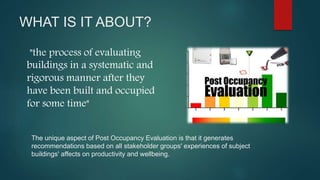
The unique aspect of Post Occupancy Evaluation is that it generates
recommendations based on all stakeholder groups' experiences of subject
buildings' affects on productivity and wellbeing.
"the process of evaluating
buildings in a systematic and
rigorous manner after they
have been built and occupied
for some time"
Purposes of POE
Post Occupancy Evaluations is used to improve the ways that buildings
are used to support productivity and wellbeing. Specifically it is used to:
 Account for building quality.
 Inform planning and briefing (programming) for new buildings and
alteration.
 Troubleshoot building/use problems (such as change management
and new work styles.
WHERE IT COULD BE APPLIED?
 Any built environment accommodating people POE's have been
conducted of facilities for schools, universities, technical institutes,
kindergartens, museums, offices, courts, corrections, military, hospitals,
landscape/civil works, learning environments ,libraries , jails , police
stations, housing, health center's and zoos.
 It would be equally possible to apply POE techniques to ships and
"virtual" environments. POE has been applied to selected parts of
buildings, aspects of buildings and groups of buildings on the same
campus and several site.
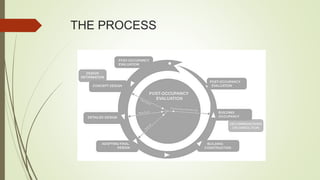
THE PROCESS
Components of POE
 The POE process provides value-neutral prompts to stimulate
stakeholders to make testable observations about their
experiences of buildings' effect on productivity and wellbeing.
 Recommendations are based on complete set of stakeholders'
observations. Most recommendations are to inform planning and
design of future new buildings the operational practices. They also
generate some recommendations for modifications to the subject
buildings and for changes in the ways that they are used. POE
evaluators may recommend monitoring, research, investigation or
project management studies.
Methodology
 Some POE include other building studies. POE incorporate may
include quantitative and qualitative techniques.
 Most POEs will involve seeking feedback from the occupants of the place being
evaluated; this may be achieved through various survey methodology including
I. questionnaire,
II. interview or
III. focus group.
POST OCCUPANCY METHOD
MEAUSURES ADOPTED
 The occupant feedback may be supplemented by environmental monitoring,
such as temperature, noise levels, lighting levels and indoor air quality. More
recently, POEs tend to include sustainable measures such as energy
consumption, waste levels, and water usage.
 Other commonly used quantitative measures include space metrics, for
example occupational density, space utilization and tenant efficiency ratio.
BENEFITS & CHALLENGES
BENEFITS CHALLENGES
Helps building operators to manage their
building effectively
Making sure it forms part of procurement
and roles and responsibilities
Provides the end users the opportunity to
express their views
Have to look beyond the standard 12
month defects period
Could be fed back into the design brief for
the future projects
Try to avoid POE being too “energy focus”
–occupant and FM team experience also
critical –all feed into each other
Helps to achieve BREEAM credits for
minimum Excellent rating
How will be the information be fed back
to client –what does client need, how
quickly and how to keep them
engaged?
EXAMPLE:-
THANK YOU
SUBMITTED BY:-
SNIGDHA SAKSHI
MAHAT PANDEY
MD SARWAR AZAD
SAGNIK DAS
SHRIYASHREE PATTNAIK

Post Occupancy Evaluation

  • 1.
    D E SI G N C O M M U N I C A T I O N
  • 2.
    WHAT IS ITABOUT? The unique aspect of Post Occupancy Evaluation is that it generates recommendations based on all stakeholder groups' experiences of subject buildings' affects on productivity and wellbeing. "the process of evaluating buildings in a systematic and rigorous manner after they have been built and occupied for some time"
  • 3.
    Purposes of POE PostOccupancy Evaluations is used to improve the ways that buildings are used to support productivity and wellbeing. Specifically it is used to:  Account for building quality.  Inform planning and briefing (programming) for new buildings and alteration.  Troubleshoot building/use problems (such as change management and new work styles.
  • 4.
    WHERE IT COULDBE APPLIED?  Any built environment accommodating people POE's have been conducted of facilities for schools, universities, technical institutes, kindergartens, museums, offices, courts, corrections, military, hospitals, landscape/civil works, learning environments ,libraries , jails , police stations, housing, health center's and zoos.  It would be equally possible to apply POE techniques to ships and "virtual" environments. POE has been applied to selected parts of buildings, aspects of buildings and groups of buildings on the same campus and several site.
  • 5.
  • 6.
    Components of POE The POE process provides value-neutral prompts to stimulate stakeholders to make testable observations about their experiences of buildings' effect on productivity and wellbeing.  Recommendations are based on complete set of stakeholders' observations. Most recommendations are to inform planning and design of future new buildings the operational practices. They also generate some recommendations for modifications to the subject buildings and for changes in the ways that they are used. POE evaluators may recommend monitoring, research, investigation or project management studies.
  • 7.
    Methodology  Some POEinclude other building studies. POE incorporate may include quantitative and qualitative techniques.  Most POEs will involve seeking feedback from the occupants of the place being evaluated; this may be achieved through various survey methodology including I. questionnaire, II. interview or III. focus group.
  • 8.
  • 9.
    MEAUSURES ADOPTED  Theoccupant feedback may be supplemented by environmental monitoring, such as temperature, noise levels, lighting levels and indoor air quality. More recently, POEs tend to include sustainable measures such as energy consumption, waste levels, and water usage.  Other commonly used quantitative measures include space metrics, for example occupational density, space utilization and tenant efficiency ratio.
  • 10.
    BENEFITS & CHALLENGES BENEFITSCHALLENGES Helps building operators to manage their building effectively Making sure it forms part of procurement and roles and responsibilities Provides the end users the opportunity to express their views Have to look beyond the standard 12 month defects period Could be fed back into the design brief for the future projects Try to avoid POE being too “energy focus” –occupant and FM team experience also critical –all feed into each other Helps to achieve BREEAM credits for minimum Excellent rating How will be the information be fed back to client –what does client need, how quickly and how to keep them engaged?
  • 11.
  • 12.
    THANK YOU SUBMITTED BY:- SNIGDHASAKSHI MAHAT PANDEY MD SARWAR AZAD SAGNIK DAS SHRIYASHREE PATTNAIK