
DUST MONITORING
16/2/2018© TSI Incorporated
AGENDA
6/2/2018 2© TSI Incorporated
+ Part I: Particles basics and the need of
measuring dust
+ Part II: Measuring methodology and
instruments
+ Part III: Dust and the selection and use of RPE
+ Part IV: Fields of use and applications
PARTICLES BASICS AND THE NEED OF
MEASURING DUST
36/2/2018© TSI Incorporated
Alan Gilbert, BSRIA Instrument Solutions General Manager
E : alan.gilbert@bsria.co.uk
T : 01344 459314
AGENDA
6/2/2018 4© TSI Incorporated
+ What are particles
+ Why do we need to measure dust
• Health protection
• Environmental protection
• Product protection
• Process protection
• Protection from compensation claims
• Regulations & legal obligations
6/2/2018© TSI Incorporated 5
ARE ALL PARTICLES SPHERES?
10 µm
7 µm
5 µm
3 µm
2 µm
1 µm
0.7 µm
0.5 µm
0.3 µm
0.2 µm0.1 µm
6/2/2018© TSI Incorporated 6
REAL PARTICLES ARE NOT
SPHERES
+ Liquid droplets (clouds and fog) are spheres
+ Generated aerosols are often formed as spherical
droplets
• When dried into solid particles they are not true spheres
+ Dust
+ Fly Ash
+ Milled Flour
+ Spores
+ Bacteria
+ Coal Dust
+ Fibers
Hollow spheres
NaCl particles dried from VOAG
droplets
Real Life AerosolsSoot particle
6/2/2018© TSI Incorporated 7
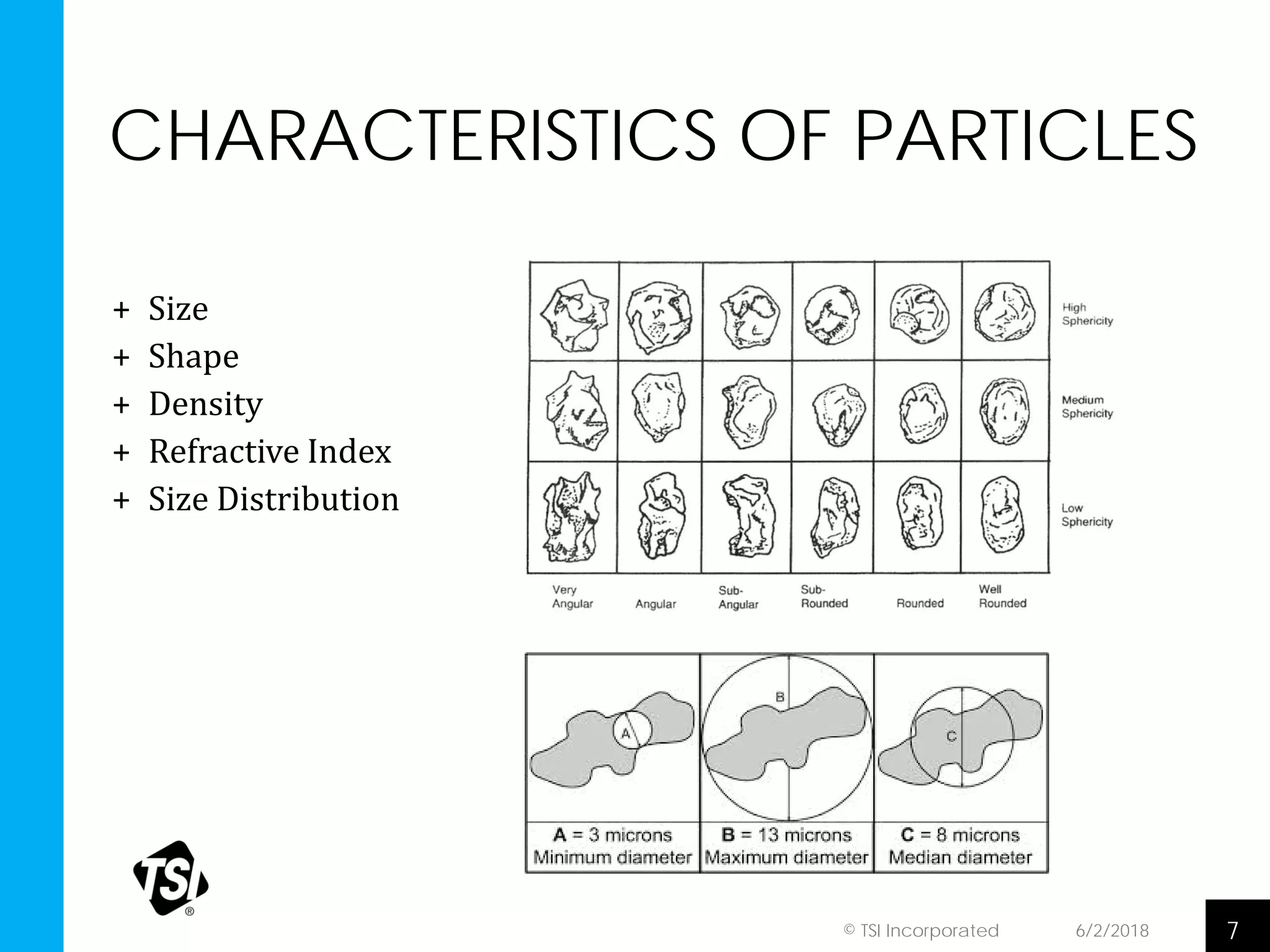
CHARACTERISTICS OF PARTICLES
+ Size
+ Shape
+ Density
+ Refractive Index
+ Size Distribution
6/2/2018© TSI Incorporated 8
PARTICLE SIZE CONCEPT
The diameter of particle varies depending on the
measurement method (all are right – all are wrong)
Real Particle
Stokes diameter
Aerodynamic
diameter
Optical diameter
Bulk density
Unit density
Optical properties
+ Mobility diameter
Charging, electric field
SEM picture
6/2/2018© TSI Incorporated 9
PARTICLE SIZES
6/2/2018© TSI Incorporated 10
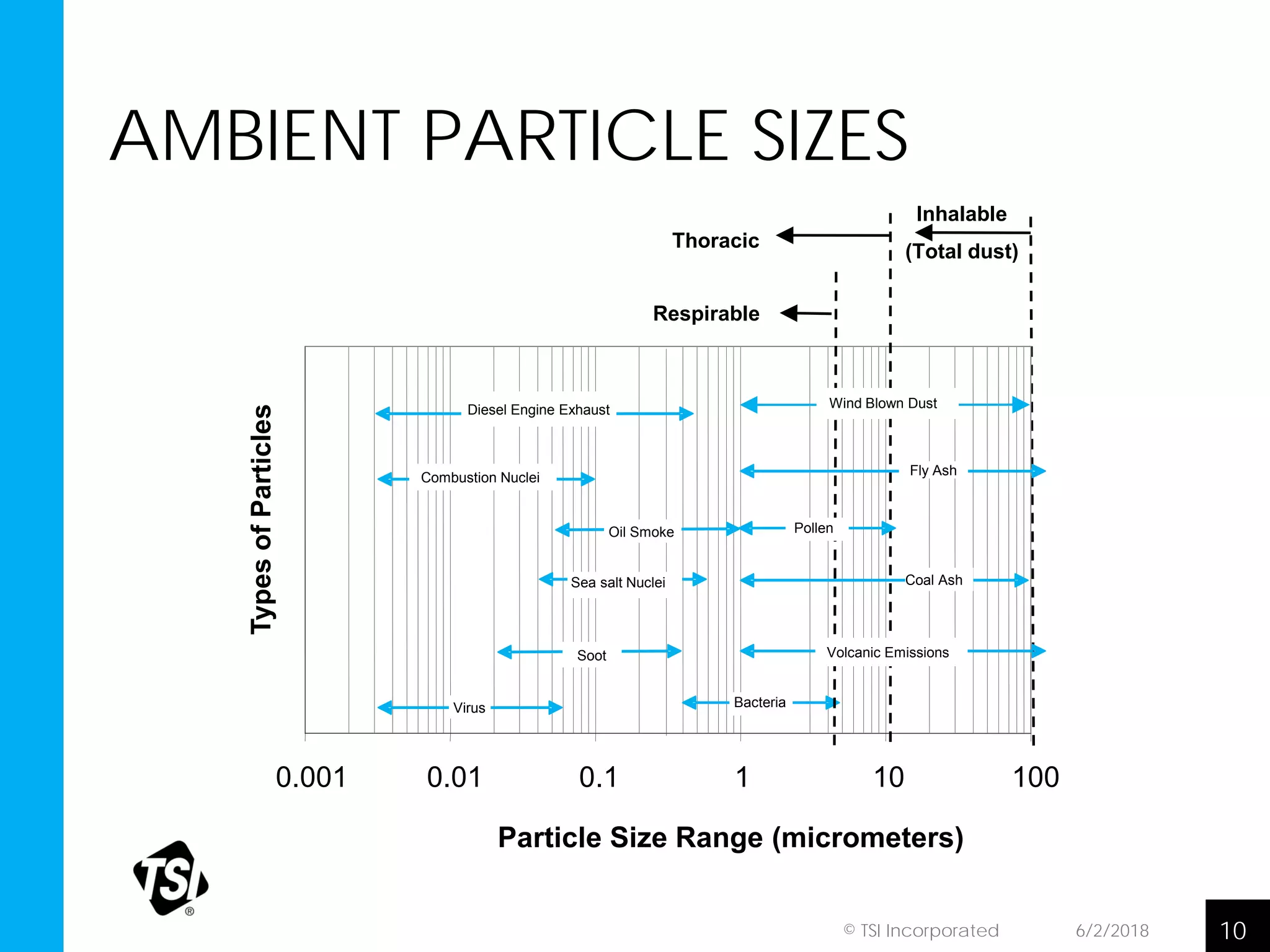
AMBIENT PARTICLE SIZES
0.001 0.01 0.1 1 10 100
Particle Size Range (micrometers)
TypesofParticles
BacteriaVirus
Oil Smoke
Sea salt Nuclei
Diesel Engine Exhaust
Combustion Nuclei
Soot
Wind Blown Dust
Volcanic Emissions
Coal Ash
Fly Ash
Inhalable
(Total dust)
Respirable
Thoracic
Pollen
6/2/2018© TSI Incorporated 11
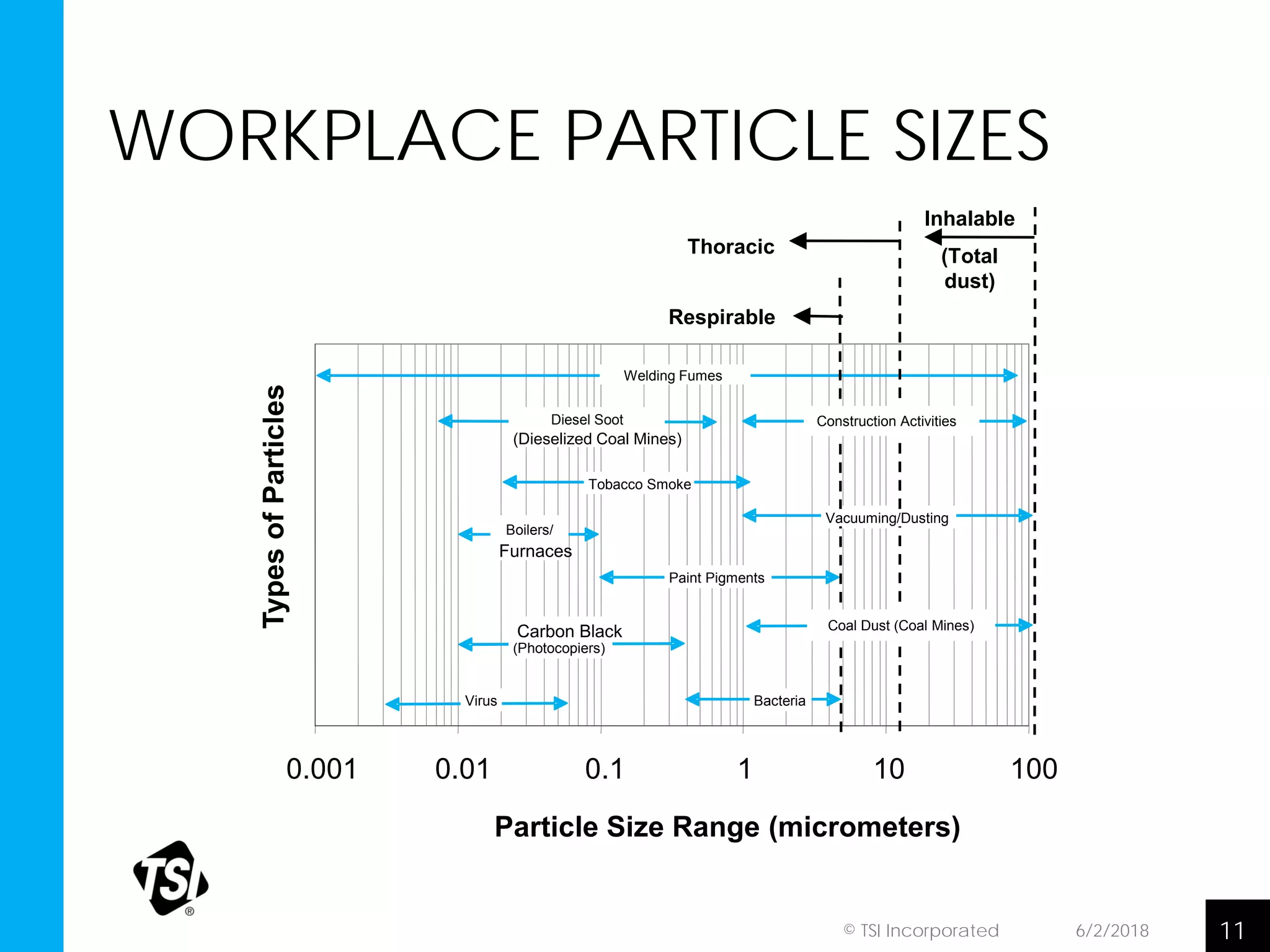
WORKPLACE PARTICLE SIZES
0.001 0.01 0.1 1 10 100
Particle Size Range (micrometers)
TypesofParticles
Welding Fumes
BacteriaVirus
Paint Pigments
Diesel Soot
(Dieselized Coal Mines)
Boilers/
Furnaces
Virus
Carbon Black
(Photocopiers)
Coal Dust (Coal Mines)
Construction Activities
Vacuuming/Dusting
Tobacco Smoke
Inhalable
(Total
dust)
Respirable
Thoracic
6/2/2018© TSI Incorporated 12
SIZE FRACTIONS BASED ON
AERODYNAMIC SIZE
6/2/2018© TSI Incorporated 13
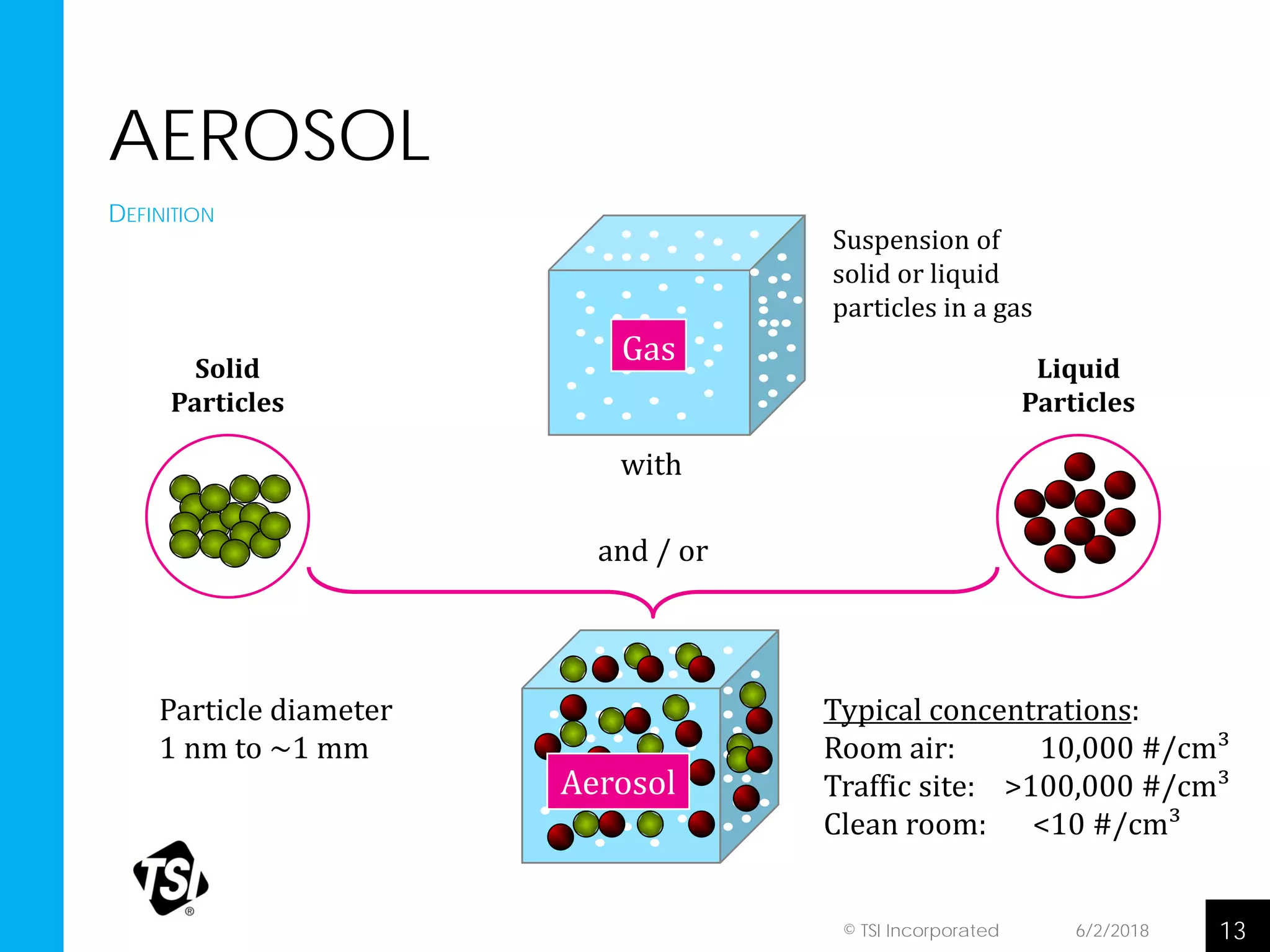
AEROSOL
with
Solid
Particles
Gas
Aerosol
Particle diameter
1 nm to ~1 mm
Typical concentrations:
Room air: 10,000 #/cm³
Traffic site: >100,000 #/cm³
Clean room: <10 #/cm³
Suspension of
solid or liquid
particles in a gas
Liquid
Particles
and / or
DEFINITION
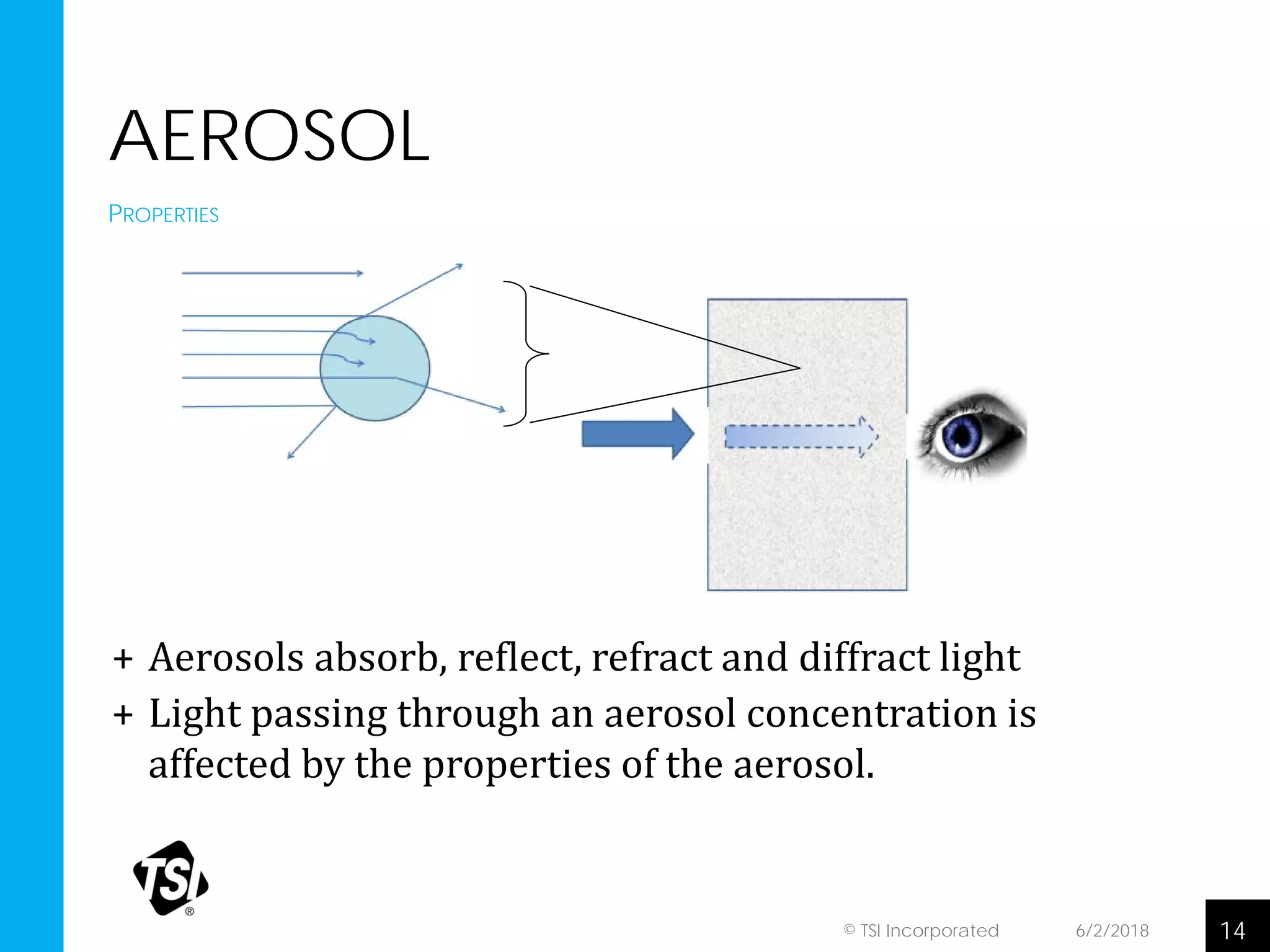
AEROSOL
+ Aerosols absorb, reflect, refract and diffract light
+ Light passing through an aerosol concentration is
affected by the properties of the aerosol.
6/2/2018 14© TSI Incorporated
PROPERTIES
6/2/2018© TSI Incorporated 15
DEFINITIONS DUST, FUME, MIST,
VAPOUR
+ Dust is a suspension of solid particles in air, formed by mechanical
processes or blown up
+ Fume is a suspension of solid particles in air, formed by thermal
and/or chemical processes
+ Mist is a suspension of liquid particles in air, formed by
condensation or dispersion
+ Vapour is a suspension of gases or substances in gas phase in air
Dust, Fume and Mist are also called particulate matter
16
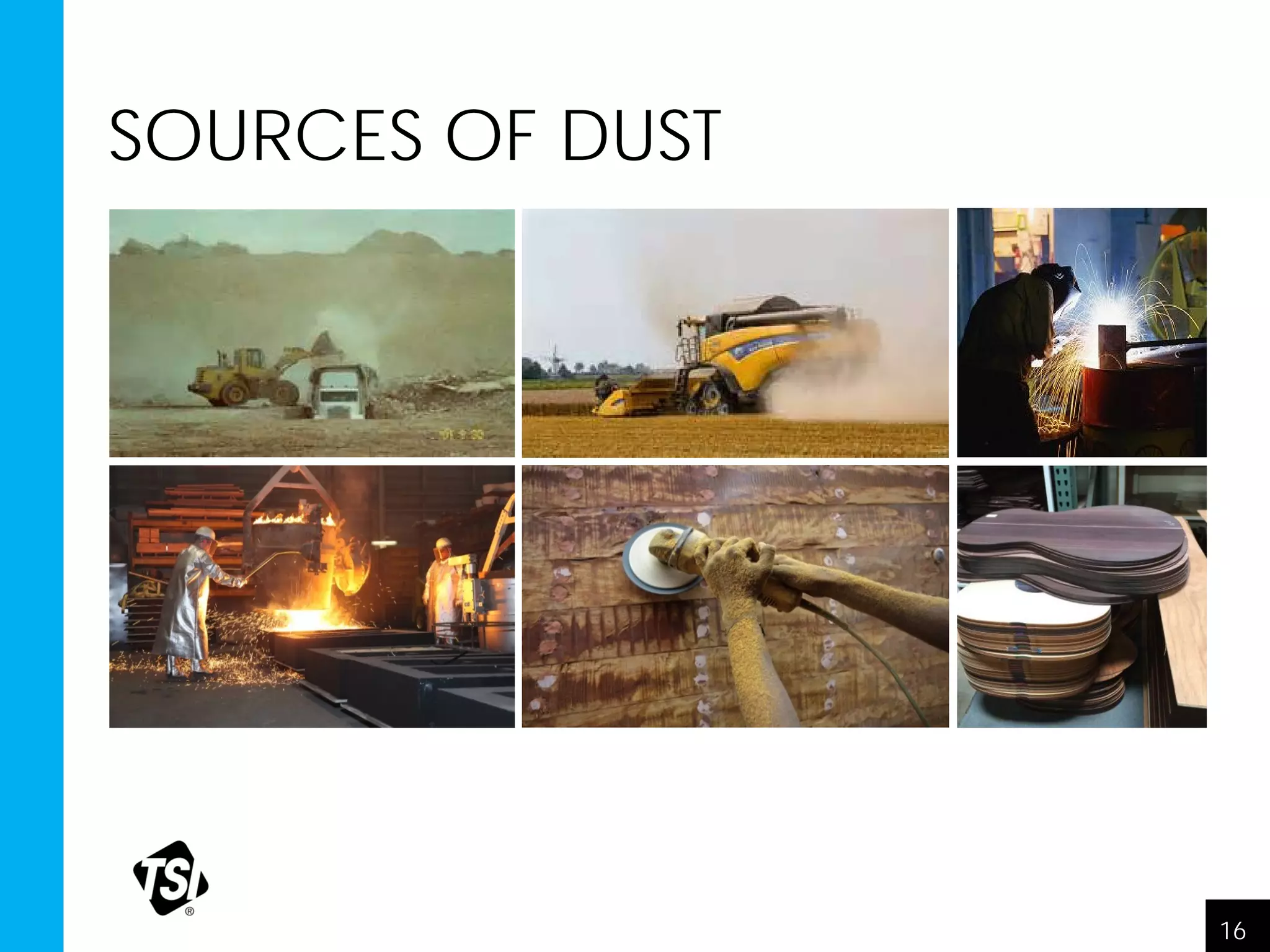
SOURCES OF DUST
PARTICLES BASICS AND THE NEED
OF MEASURING DUST
6/2/2018 17© TSI Incorporated
+ What are particles
+ Why do we need to measure dust
• Health protection
• Environmental protection
• Product protection
• Process protection
• Protection from compensation claims
• Regulations & legal obligations
HEALTH PROTECTION
+ Health effects from certain particles
and fibres known to cause harm to
human health + environment
+ Some materials cause immediate
impact, other may take many years to
develop
+ Essential to keep exposure of particle
pollution to a minimum (for workers
on site and people living and working
outside the activity boundary)
6/2/2018 18© TSI Incorporated
HEALTH PROTECTION
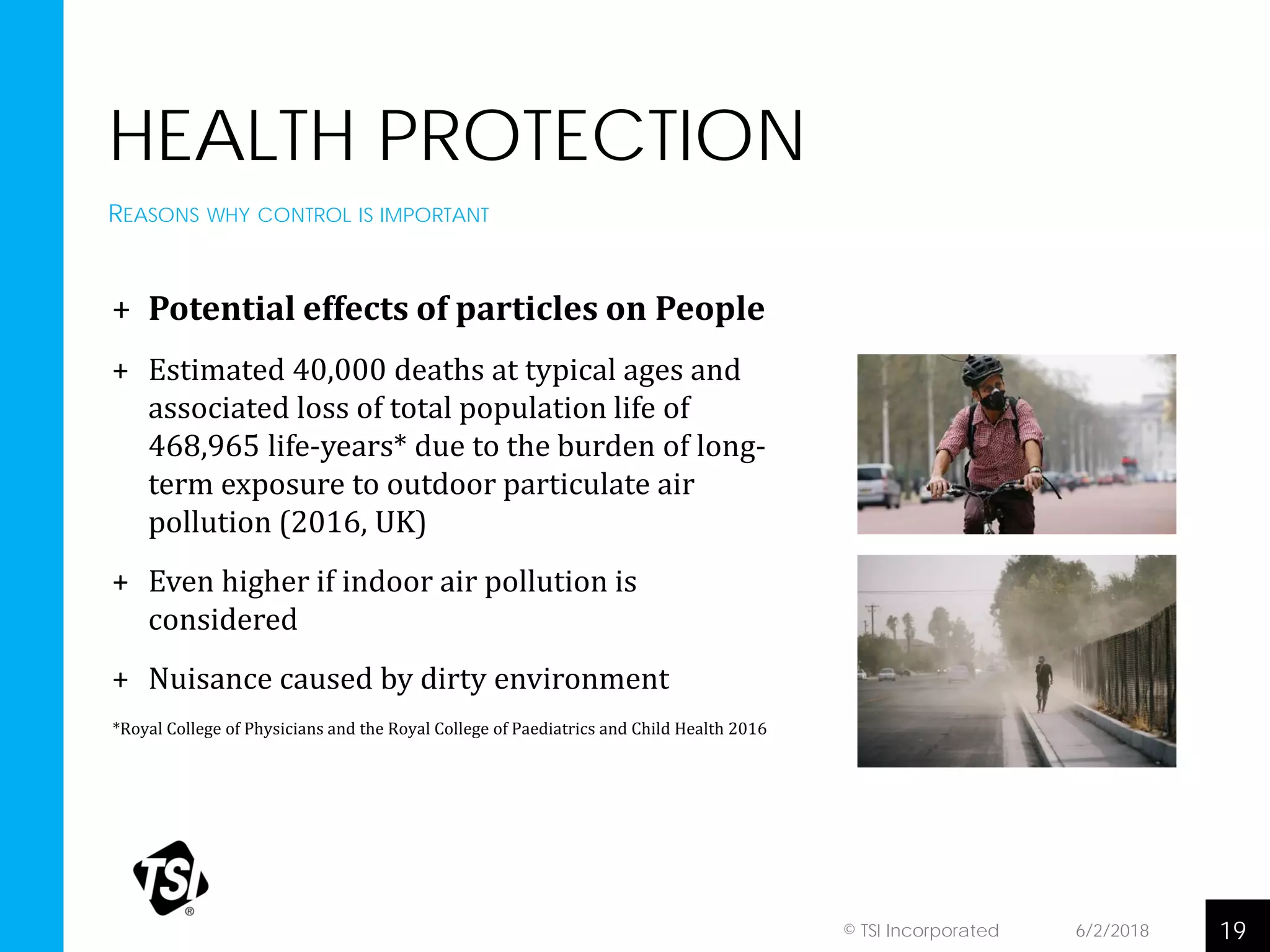
+ Potential effects of particles on People
+ Estimated 40,000 deaths at typical ages and
associated loss of total population life of
468,965 life-years* due to the burden of long-
term exposure to outdoor particulate air
pollution (2016, UK)
+ Even higher if indoor air pollution is
considered
+ Nuisance caused by dirty environment
*Royal College of Physicians and the Royal College of Paediatrics and Child Health 2016
6/2/2018 19© TSI Incorporated
REASONS WHY CONTROL IS IMPORTANT
HEALTH PROTECTION
+ Historically, many of the materials produced during construction/operations
have been subject to investigation and control, mainly with regard to
occupational hygiene and the protection of the workforce
+ Only limited attention to regulating the exposure of the general populace to
these materials when they cross site boundary
+ There are some exceptions to this
generalisation, asbestos for example
is covered by specific regulations
6/2/2018 20© TSI Incorporated
REASONS WHY CONTROL IS IMPORTANT
HEALTH PROTECTION
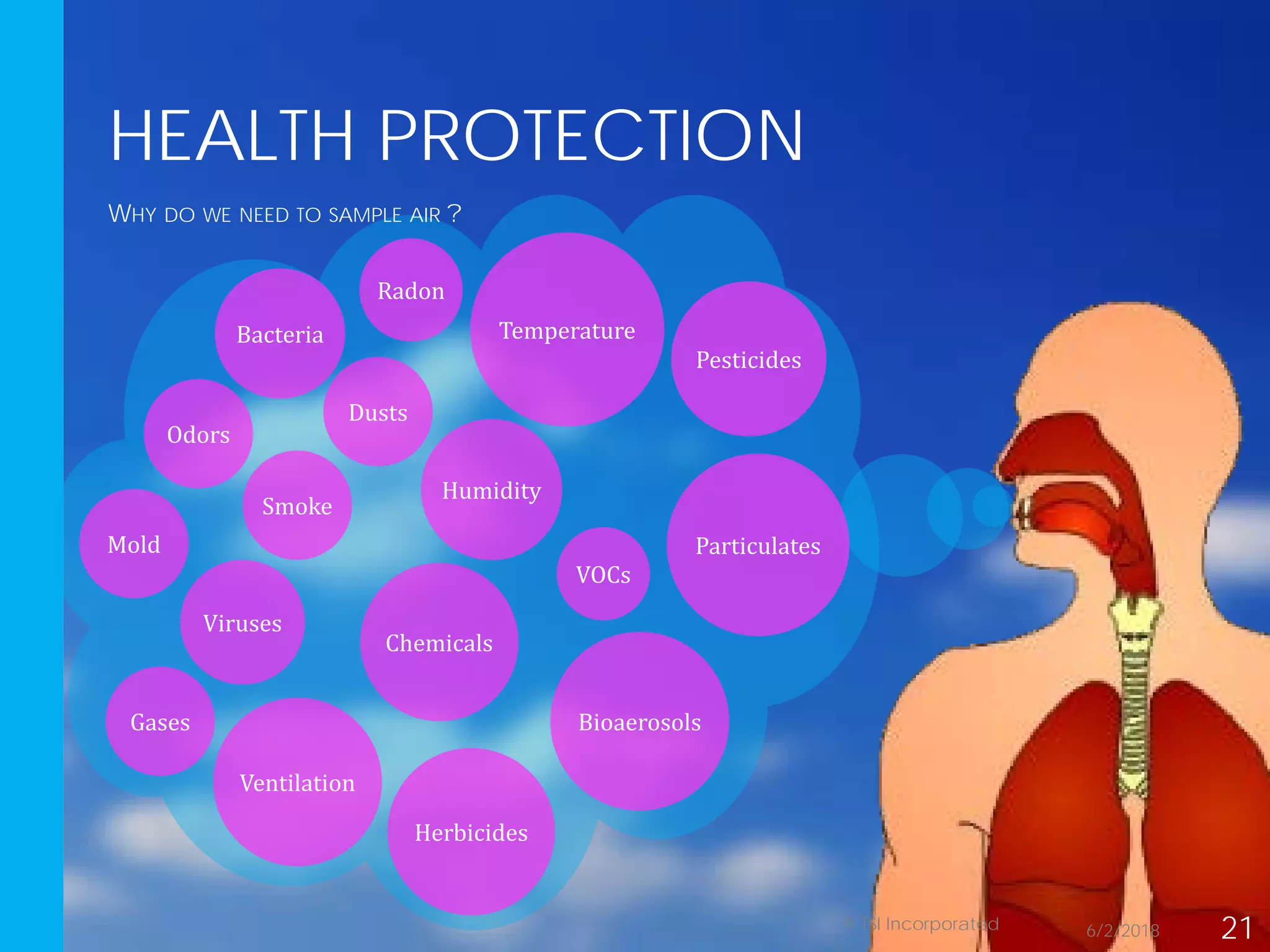
Odors
Dusts
Ventilation
Mold
Gases
Smoke
Viruses
Temperature
Chemicals
Particulates
Herbicides
Bioaerosols
Bacteria
Humidity
Pesticides
Radon
VOCs
6/2/2018 21© TSI Incorporated
WHY DO WE NEED TO SAMPLE AIR ?
HEALTH PROTECTION
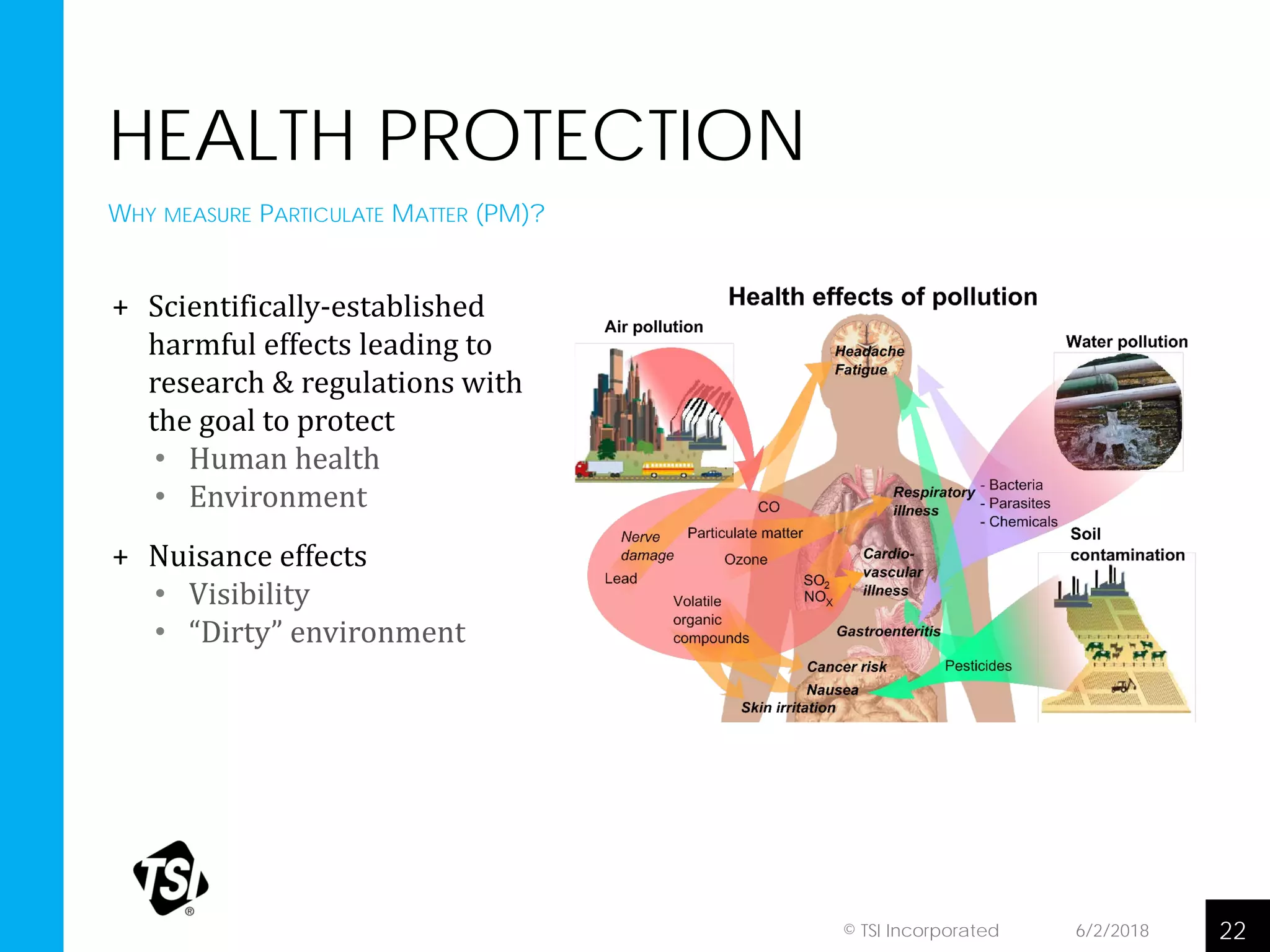
+ Scientifically-established
harmful effects leading to
research & regulations with
the goal to protect
• Human health
• Environment
+ Nuisance effects
• Visibility
• “Dirty” environment
6/2/2018 22© TSI Incorporated
WHY MEASURE PARTICULATE MATTER (PM)?
HEALTH PROTECTION
+ Small particle low in mass
but can cause major health
effects
+ Occupational exposure limits
for aerosols (~0.1-100µm)
are based on mass
+ Occupational hygienists
interested in PM 4 and below
6/2/2018 23© TSI Incorporated
WHY IS PARTICLE SIZE IMPORTANT?
6/2/2018© TSI Incorporated 24
HEALTH PROTECTION
Based on International Commission of Radiological Protection (1994) and U.S. Environmental Protection Agency
(1996a).
Air Quality Criteria for Particulate matter, 2004, p 6-5.
Extrathoracic Area >PM10
PM10-
PM2.5
PM2.5
Tracheobronchiale Area (TB)
Alveolar Area (A)
LUNG DEPOSITION – TRADITIONAL WORKPLACE EXPOSURE LIMITS
PARTICLES BASICS AND THE NEED
OF MEASURING DUST
6/2/2018 25© TSI Incorporated
+ What are particles
+ Why do we need to measure dust
• Health protection
• Environmental protection
• Product protection
• Process protection
• Protection from compensation claims
• Regulations & legal obligations
ENVIRONMENTAL PROTECTION
6/2/2018 26© TSI Incorporated
ENVIRONMENTAL PROTECTION
+ Local Authorities required to work towards achieving national air
quality objectives (Part IV of the Environment Act (1995), UK Air
Quality Strategy)
+ Nuisance dust emissions from construction and other civil
engineering activities are a well-recognised problem
+ Dusts from construction processes contain wide range of particle
sizes and material types (e.g. silica)
+ Can cause minor and serious health problems, also discomfort to the
eyes, nose, mouth, respiratory tract and skin
6/2/2018 27© TSI Incorporated
REASONS WHY CONTROL IS IMPORTANT
ENVIRONMENTAL PROTECTION
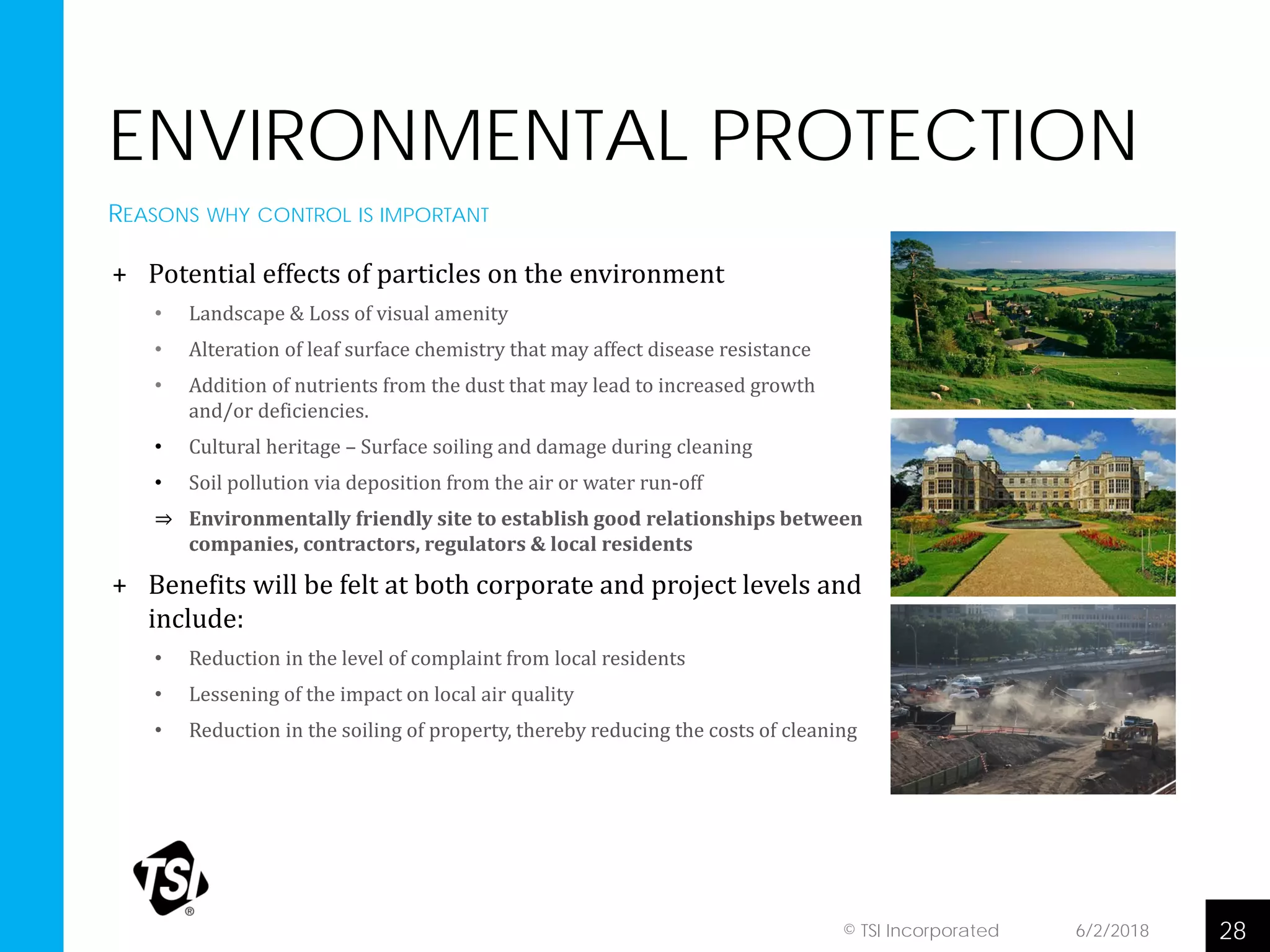
+ Potential effects of particles on the environment
• Landscape & Loss of visual amenity
• Alteration of leaf surface chemistry that may affect disease resistance
• Addition of nutrients from the dust that may lead to increased growth
and/or deficiencies.
• Cultural heritage – Surface soiling and damage during cleaning
• Soil pollution via deposition from the air or water run-off
⇒ Environmentally friendly site to establish good relationships between
companies, contractors, regulators & local residents
+ Benefits will be felt at both corporate and project levels and
include:
• Reduction in the level of complaint from local residents
• Lessening of the impact on local air quality
• Reduction in the soiling of property, thereby reducing the costs of cleaning
6/2/2018 28© TSI Incorporated
REASONS WHY CONTROL IS IMPORTANT
ENVIRONMENTAL PROTECTION
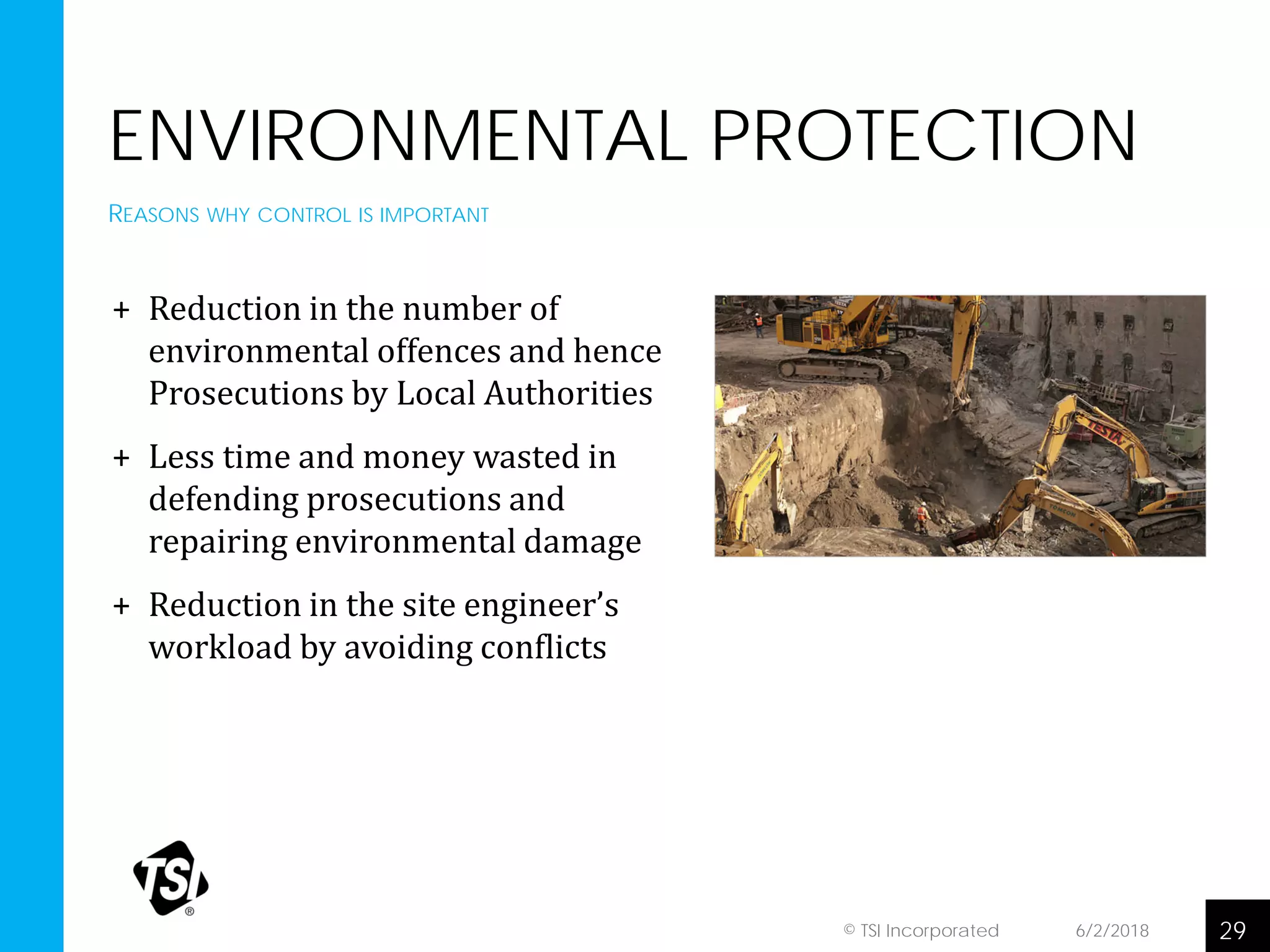
+ Reduction in the number of
environmental offences and hence
Prosecutions by Local Authorities
+ Less time and money wasted in
defending prosecutions and
repairing environmental damage
+ Reduction in the site engineer’s
workload by avoiding conflicts
6/2/2018 29© TSI Incorporated
REASONS WHY CONTROL IS IMPORTANT
PARTICLES BASICS AND THE NEED
OF MEASURING DUST
6/2/2018 30© TSI Incorporated
+ What are particles
+ Why do we need to measure dust
• Health protection
• Environmental protection
• Product protection
• Process protection
• Protection from compensation claims
• Regulations & legal obligations
6/2/2018© TSI Incorporated 31
PRODUCT PROTECTION
+ Customer complaints
+ Health issues
PARTICLES BASICS AND THE NEED
OF MEASURING DUST
6/2/2018 32© TSI Incorporated
+ What are particles
+ Why do we need to measure dust
• Health protection
• Environmental protection
• Product protection
• Process protection
• Protection from compensation claims
• Regulations & legal obligations
PROCESS PROTECTION
+ Effects production
+ Downtime
+ Costs time/money
6/2/2018 33© TSI Incorporated
PARTICLES BASICS AND THE NEED
OF MEASURING DUST
6/2/2018 34© TSI Incorporated
+ What are particles
+ Why do we need to measure dust
• Health protection
• Environmental protection
• Product protection
• Process protection
• Protection from compensation claims
• Regulations & legal obligations
PROTECTION FROM
COMPENSATION CLAIMS
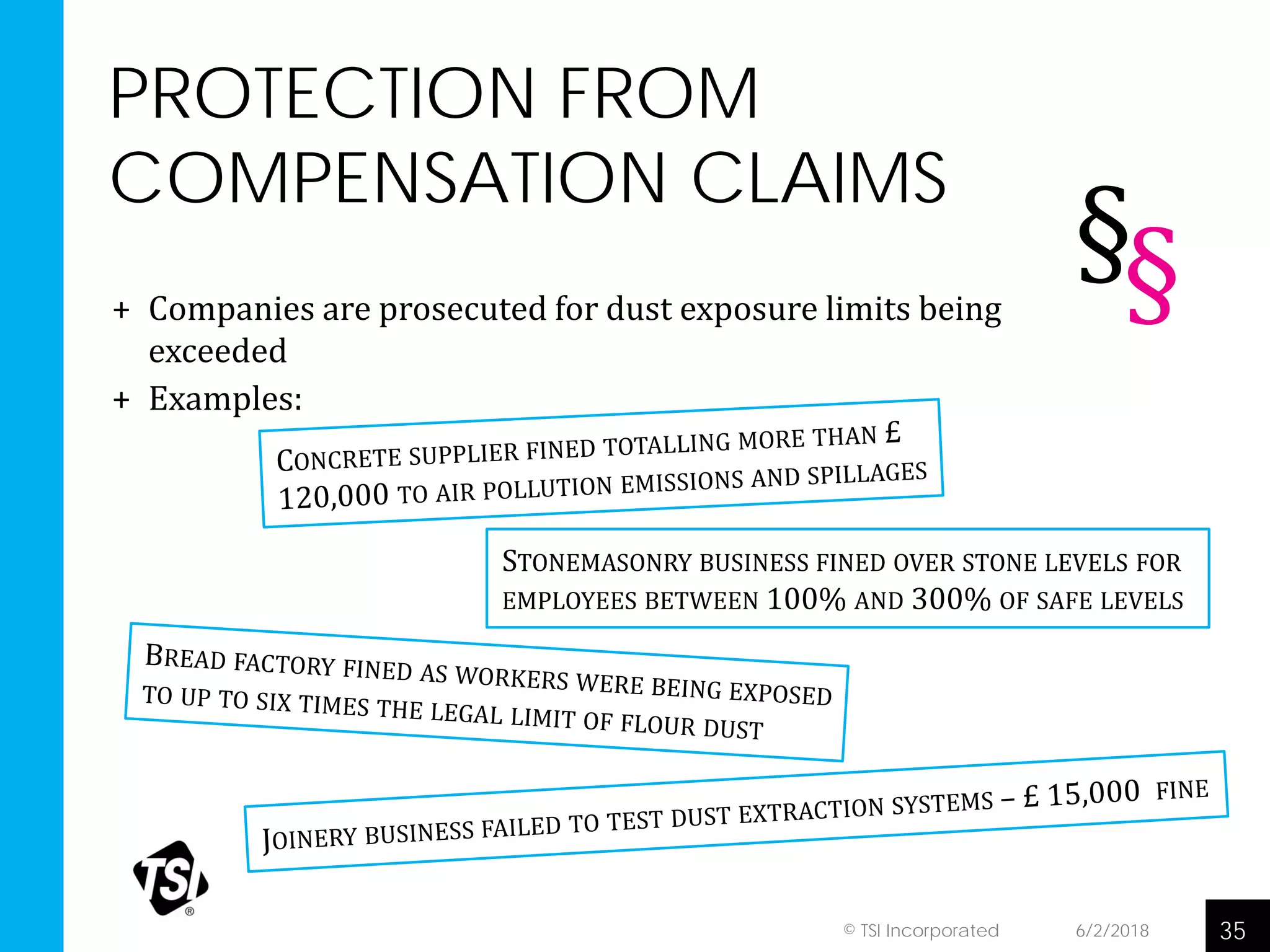
+ Companies are prosecuted for dust exposure limits being
exceeded
+ Examples:
§§
6/2/2018 35© TSI Incorporated
STONEMASONRY BUSINESS FINED OVER STONE LEVELS FOR
EMPLOYEES BETWEEN 100% AND 300% OF SAFE LEVELS
PARTICLES BASICS AND THE NEED
OF MEASURING DUST
6/2/2018 36© TSI Incorporated
+ What are particles
+ Why do we need to measure dust
• Health protection
• Environmental protection
• Product protection
• Process protection
• Protection from compensation claims
• Regulations & legal obligations
REGULATIONS & LEGAL
OBLIGATIONS
+ What are the Legal Obligations?
‘The employer has an overriding duty
and first priority to consider how to
prevent employees being exposed to
substances hazardous to health
by All Routes.’
6/2/2018 37© TSI Incorporated
LEGISLATIONS INVOLVED
REGULATIONS & LEGAL
OBLIGATIONS
+ CEN: EN 481: Workplace atmospheres – Size fraction
definitions for measurement of airborne particles
+ ISO: ISO 7708: Air quality – Particle size fraction
definitions for health related sampling
EN481 and ISO 7708 will be revised and extended.
The committee work has already begun.
INTERNATIONAL STANDARDS ON SIZE FRACTIONS
REGULATIONS & LEGAL
OBLIGATIONS
COSSH: Control of Substances Hazardous to Health
ACoP: Approved Code Of Practice
6/2/2018 39© TSI Incorporated
+ Law which requires employers to control substances
hazardous to health
+ List of industries
+ Specific work tasks
+ Specific substances hazardous to health
+ WEL’s – TWA and STEL
UK IS ONE STEP AHEAD – COSHH WWW.HSE.GOV.UK/COSHH
REGULATIONS & LEGAL
OBLIGATIONS
+ Exposure to a substance is
uptake into the body
+ Occurs by breathing, skin,
swallowing and injection
+ 500 substances have listed WEL in
EH40/2005
+ The only way to know if you are
under the WEL is by monitoring
6/2/2018 40© TSI Incorporated
WORKPLACE EXPOSURE LIMITS (WEL)
REGULATIONS & LEGAL
OBLIGATIONS
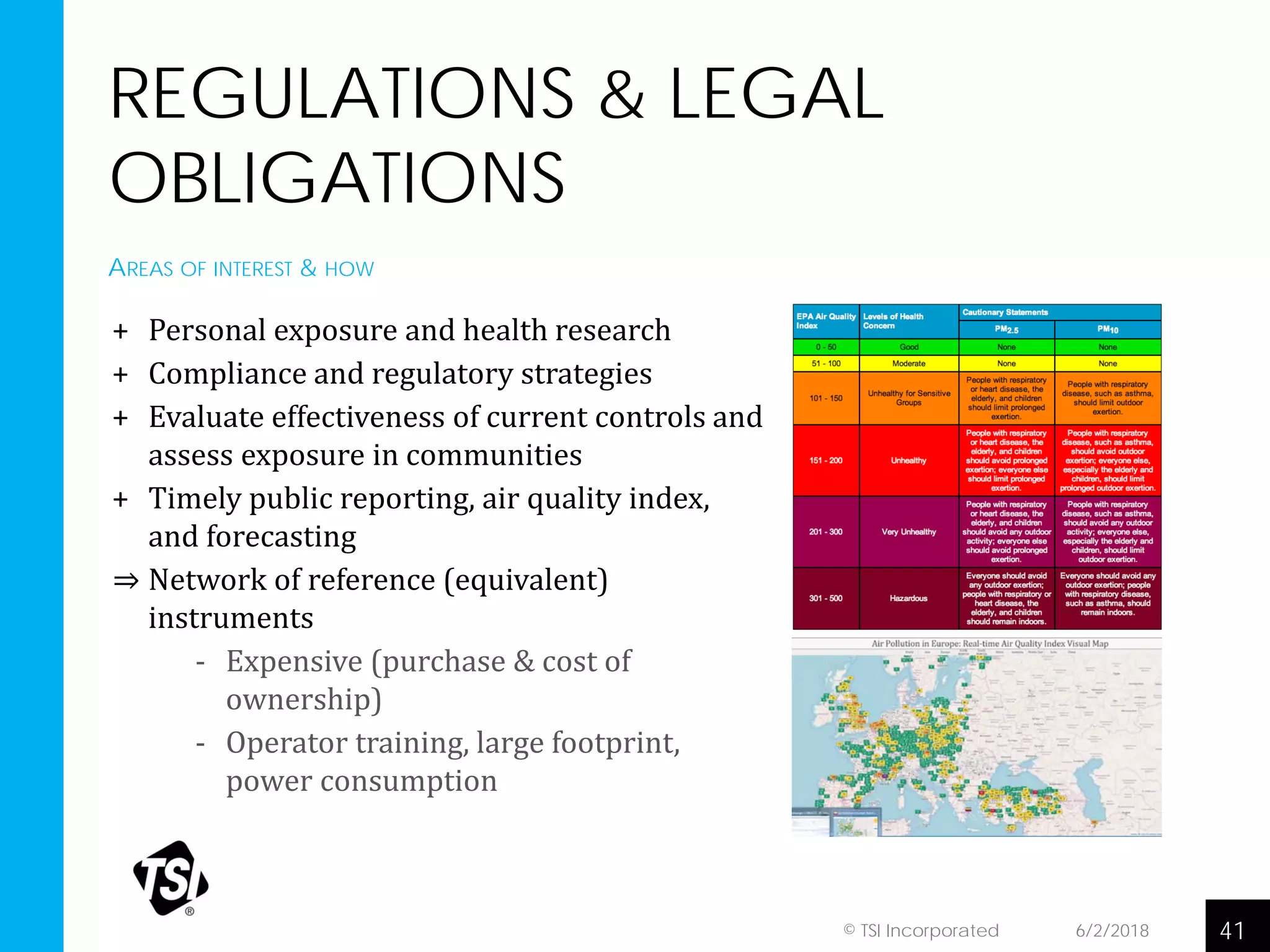
+ Personal exposure and health research
+ Compliance and regulatory strategies
+ Evaluate effectiveness of current controls and
assess exposure in communities
+ Timely public reporting, air quality index,
and forecasting
⇒ Network of reference (equivalent)
instruments
- Expensive (purchase & cost of
ownership)
- Operator training, large footprint,
power consumption
6/2/2018 41© TSI Incorporated
AREAS OF INTEREST & HOW
REGULATIONS & LEGAL
OBLIGATIONS
Source: EU Directive:2008/50/EC “Air Quality Directive”
6/2/2018 42© TSI Incorporated
IMMISSION LIMIT VALUES AND DEADLINES
REGULATIONS & LEGAL
OBLIGATIONS
Source:
https://www.gov.uk/government
/uploads/system/uploads/attach
ment_data/file/1
82392/air-quality-legally-
binding-objective.pdf
6/2/2018 43© TSI Incorporated
NATIONAL AIR QUALITY OBJECTIVES
REGULATIONS & LEGAL
OBLIGATIONS
+ Department of Environment, Food &
Rural Affairs (DEFRA)
+ The government strategy for
improvements in air quality
+ Available at:
https://www.gov.uk/government/p
ublications/2010-to-2015-
government-policy-environmental-
quality/2010-to-2015-government-
policy-environmental-quality
6/2/2018 44© TSI Incorporated
ENVIRONMENTAL QUALITY
REGULATIONS & LEGAL
OBLIGATIONS
MCERTS is the Environment Agency of England & Wales
(EA) Monitoring Certification Scheme. It provides the
framework for businesses to meet quality requirements.
Compliance with MCERTS gives the EA confidence in the
monitoring of emissions to the environment.
6/2/2018 45© TSI Incorporated
MCERTS
REGULATIONS & LEGAL
OBLIGATIONS
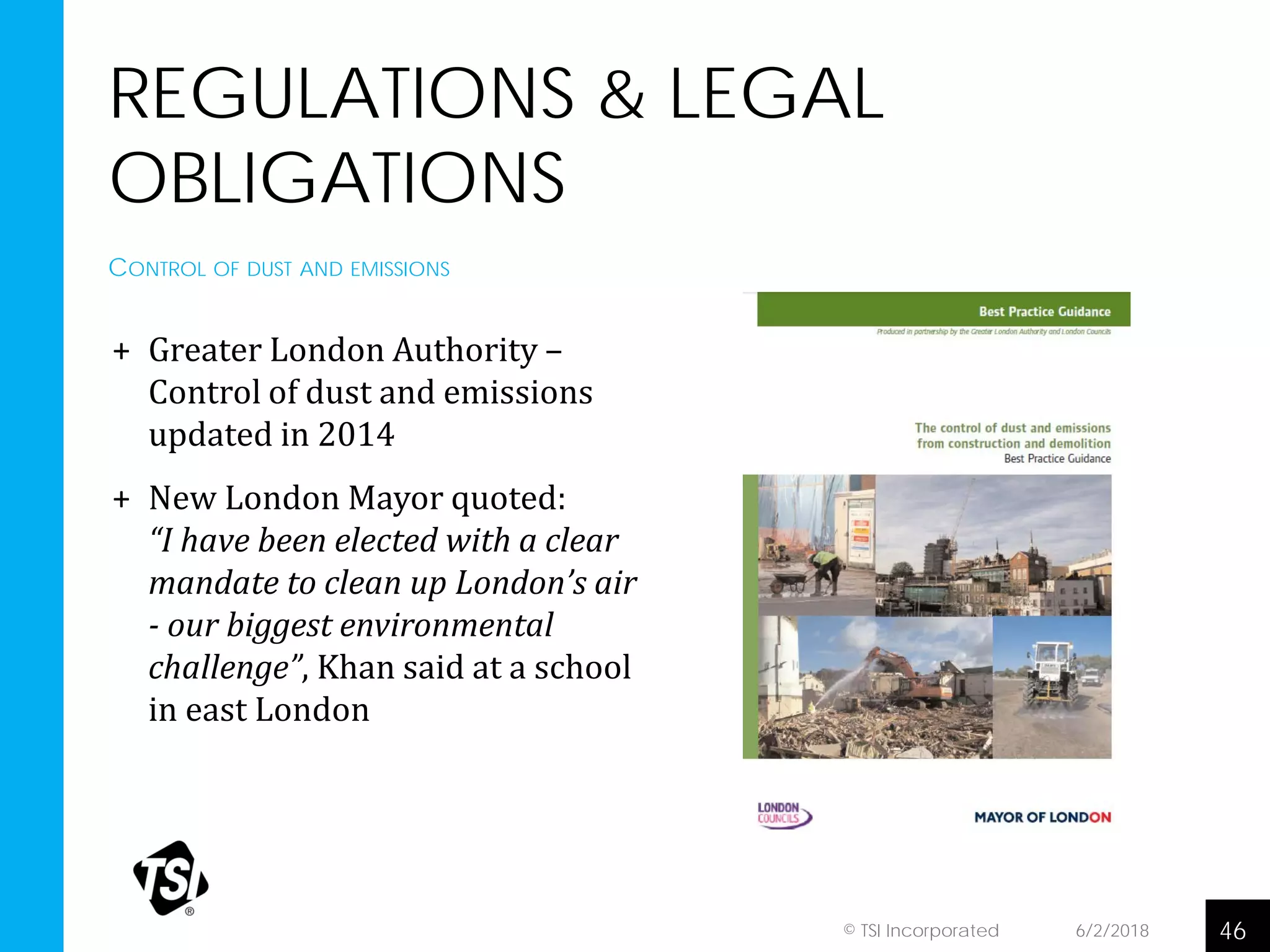
+ Greater London Authority –
Control of dust and emissions
updated in 2014
+ New London Mayor quoted:
“I have been elected with a clear
mandate to clean up London’s air
- our biggest environmental
challenge”, Khan said at a school
in east London
6/2/2018 46© TSI Incorporated
CONTROL OF DUST AND EMISSIONS
REGULATIONS & LEGAL
OBLIGATIONS
+ Institute of Air Quality
management:
The Institute of Air Quality Management
(IAQM) is committed to enhancing the
understanding and development of the
science behind air quality by promoting
knowledge and understanding of best
working practices. Constructing buildings,
roads and other infrastructure can have a
substantial, temporary impact on local air
quality. The most common impacts are
increased particulate matter (PM)
concentrations and dust soiling.
6/2/2018 47© TSI Incorporated
AIR QUALITY PAPERS AND RESEARCH
6/2/2018
REGULATIONS & LEGAL
OBLIGATIONS
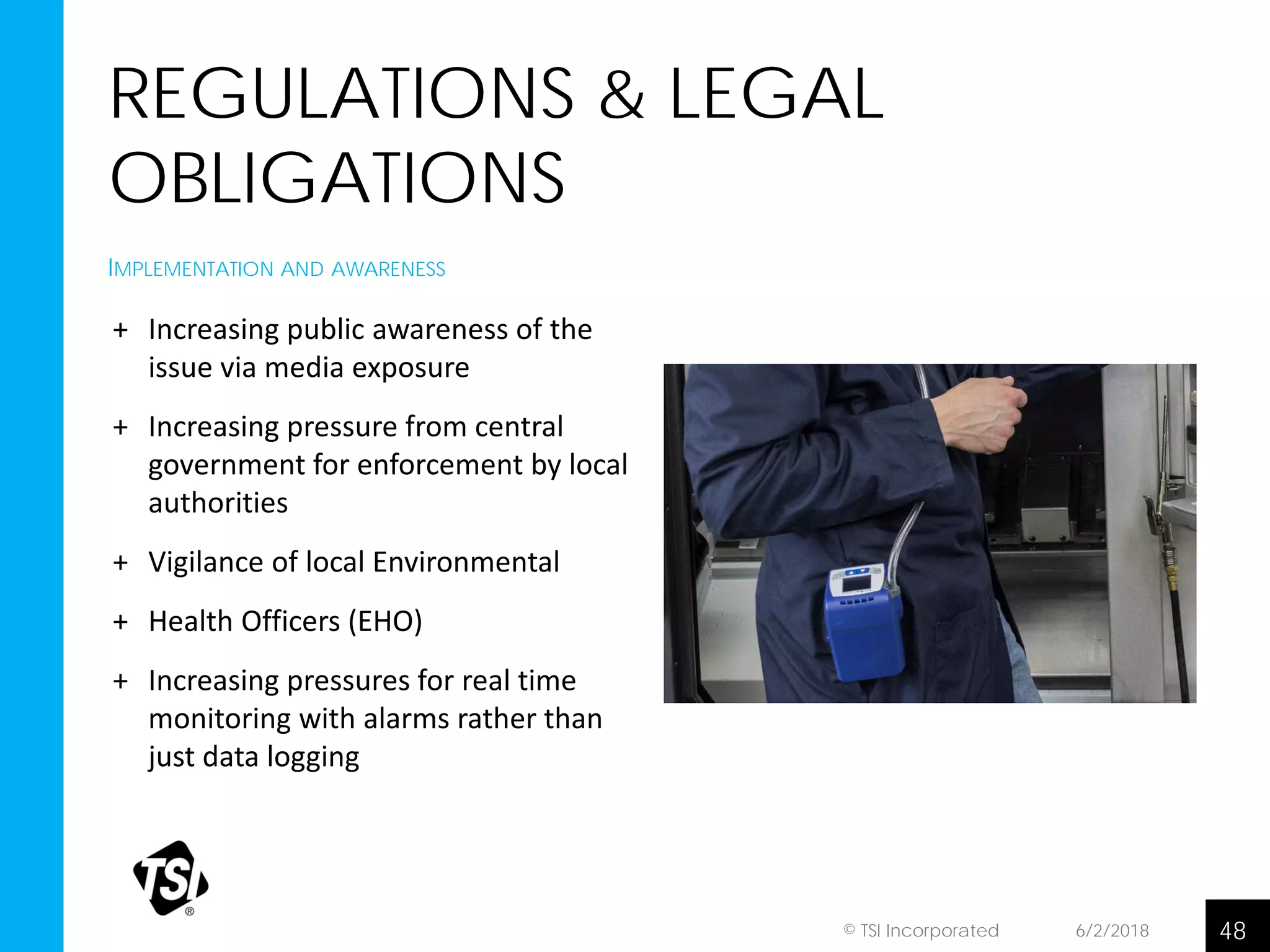
+ Increasing public awareness of the
issue via media exposure
+ Increasing pressure from central
government for enforcement by local
authorities
+ Vigilance of local Environmental
+ Health Officers (EHO)
+ Increasing pressures for real time
monitoring with alarms rather than
just data logging
48© TSI Incorporated
IMPLEMENTATION AND AWARENESS
6/2/2018© TSI Incorporated 49
THINGS WE COVERED
+ Particles sizes and characteristics
+ Aerosols: definition and properties
+ Importance of measuring dust
• Health protection – importance of particle size
• Environmental protection – reasons why control is important
• Product and process protection
• Protection from compensation claims – workplace exposure limits
• Regulations & legal obligations – (inter)national standards and laws
QUESTIONS?
506/2/2018© TSI Incorporated
MEASURING METHODOLOGY
AND INSTRUMENTS
Nick Brown
Senior Regional Sales Manager UK & Ireland
AGENDA
6/2/2018 52© TSI Incorporated
+ Gravimetric sampling
+ Real-time monitoring
+ Photometer
• Theory of operation
• Strenghts and values
GRAVIMETRIC SAMPLING
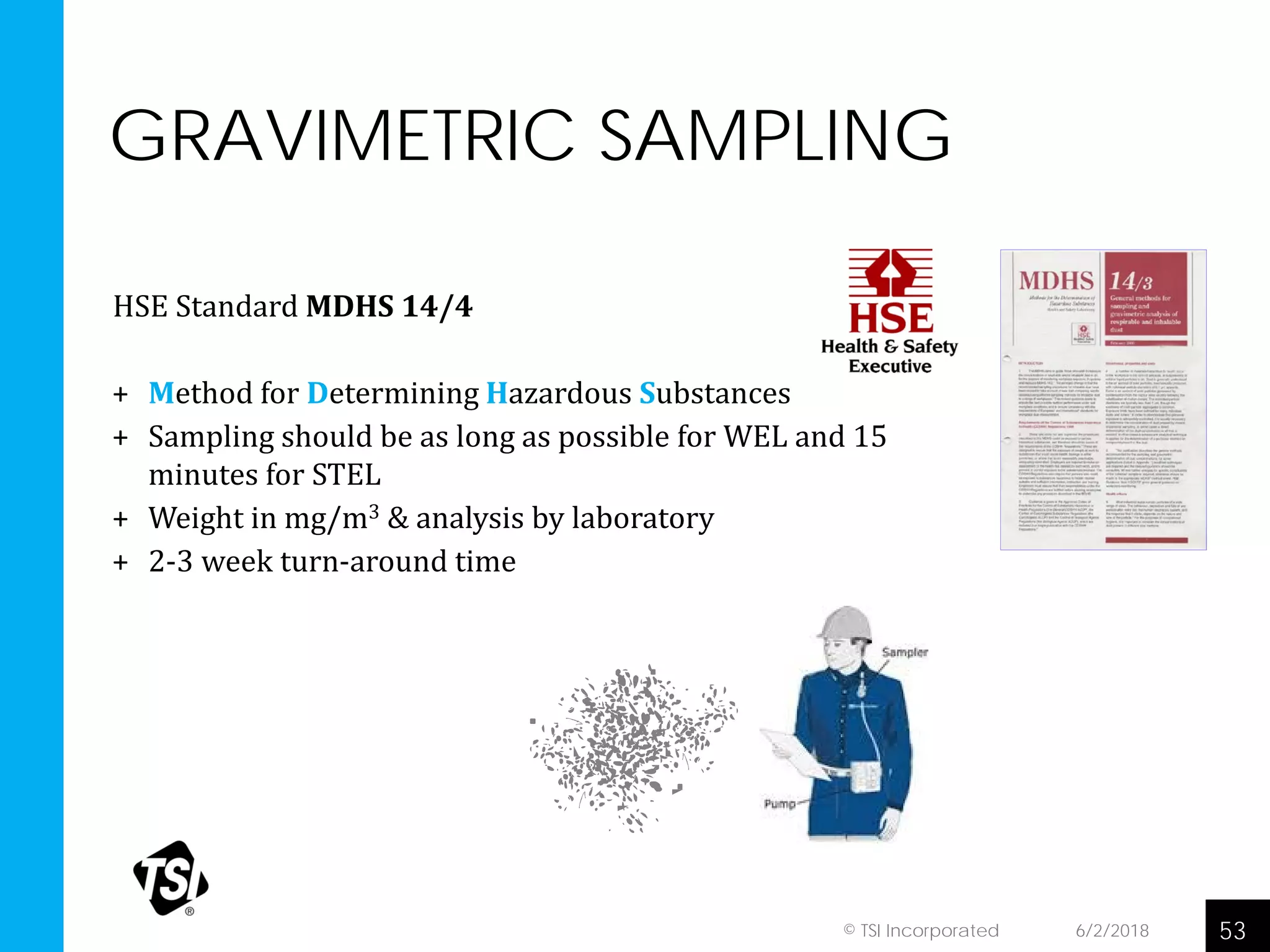
HSE Standard MDHS 14/4
+ Method for Determining Hazardous Substances
+ Sampling should be as long as possible for WEL and 15
minutes for STEL
+ Weight in mg/m3 & analysis by laboratory
+ 2-3 week turn-around time
6/2/2018 53© TSI Incorporated
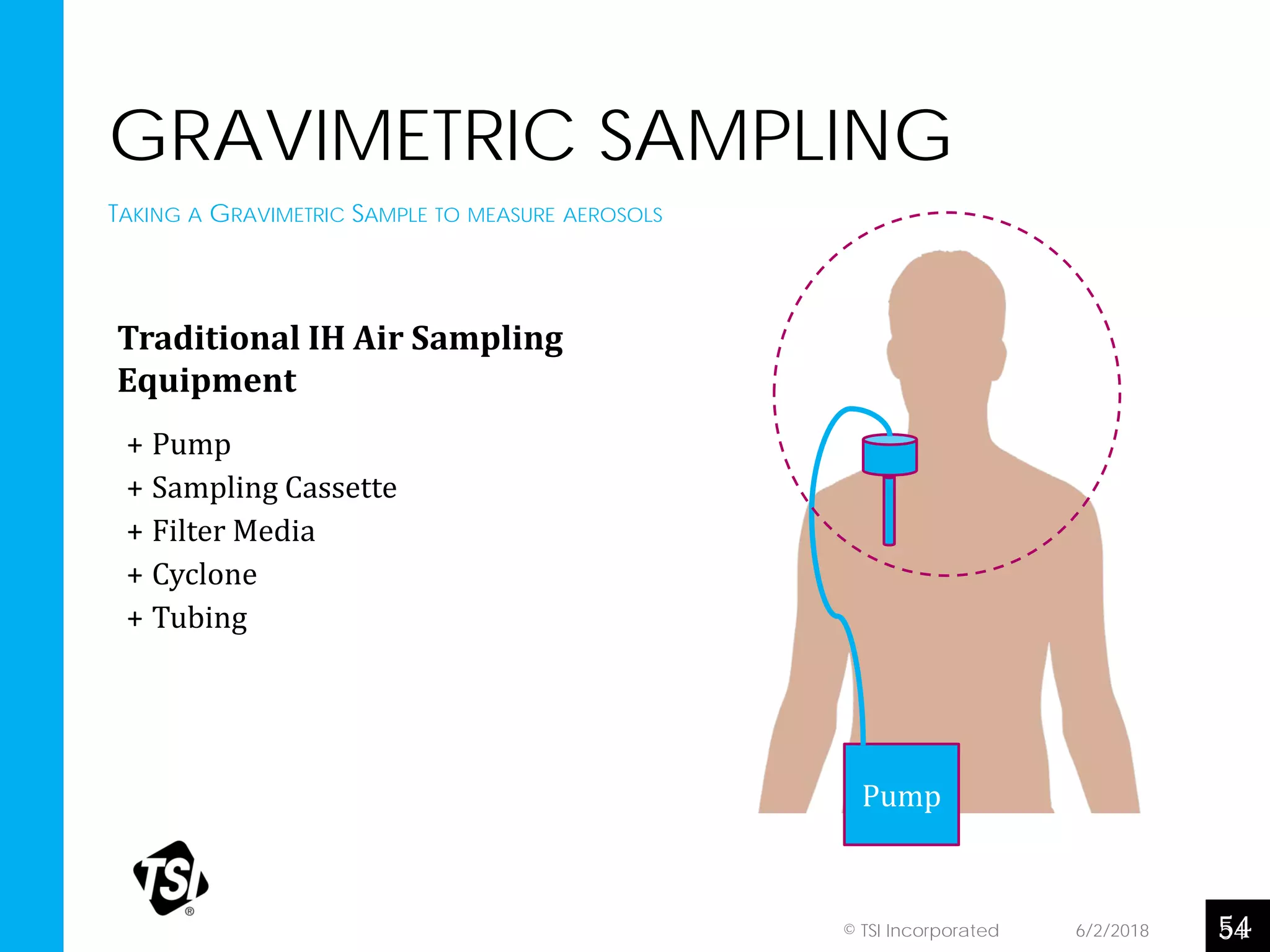
+ Pump
+ Sampling Cassette
+ Filter Media
+ Cyclone
+ Tubing
Pump
Traditional IH Air Sampling
Equipment
6/2/2018
GRAVIMETRIC SAMPLING
54
TAKING A GRAVIMETRIC SAMPLE TO MEASURE AEROSOLS
54© TSI Incorporated
+ Calibrate pump
+ Place on worker, turn on pump
+ Record start time
+ Turn off pump, cap cassette, document time
+ Post-calibrate pump
+ Calculate run time
+ Document run times, calibrations, sample ID
+ Prepare chain of custody form
+ Package for shipping
+ Complete shipping paper work
Traditional IH Air Sampling
Process
6/2/2018
GRAVIMETRIC SAMPLING
55
PROCESS
55© TSI Incorporated
Pump
6/2/2018© TSI Incorporated 56
EXISTING TECHNOLOGIES FOR
MASS MEASUREMENT
+ Direct mass measurement
+ Laborious and time intensive
+ Humidity & dust loading effect
measurement
+ Potential chemical reactions on
filter
+ Poor temporal resolution
+ Costly consumables
+ No size information
REFERENCE METHOD: GRAVIMETRIC SAMPLING
MEASURING METHODOLOGY
AND INSTRUMENTS
6/2/2018 57© TSI Incorporated
+ Gravimetric sampling
+ Real-time monitoring
+ Photometer
• Theory of operation
• Strenghts and values
6/2/2018 58
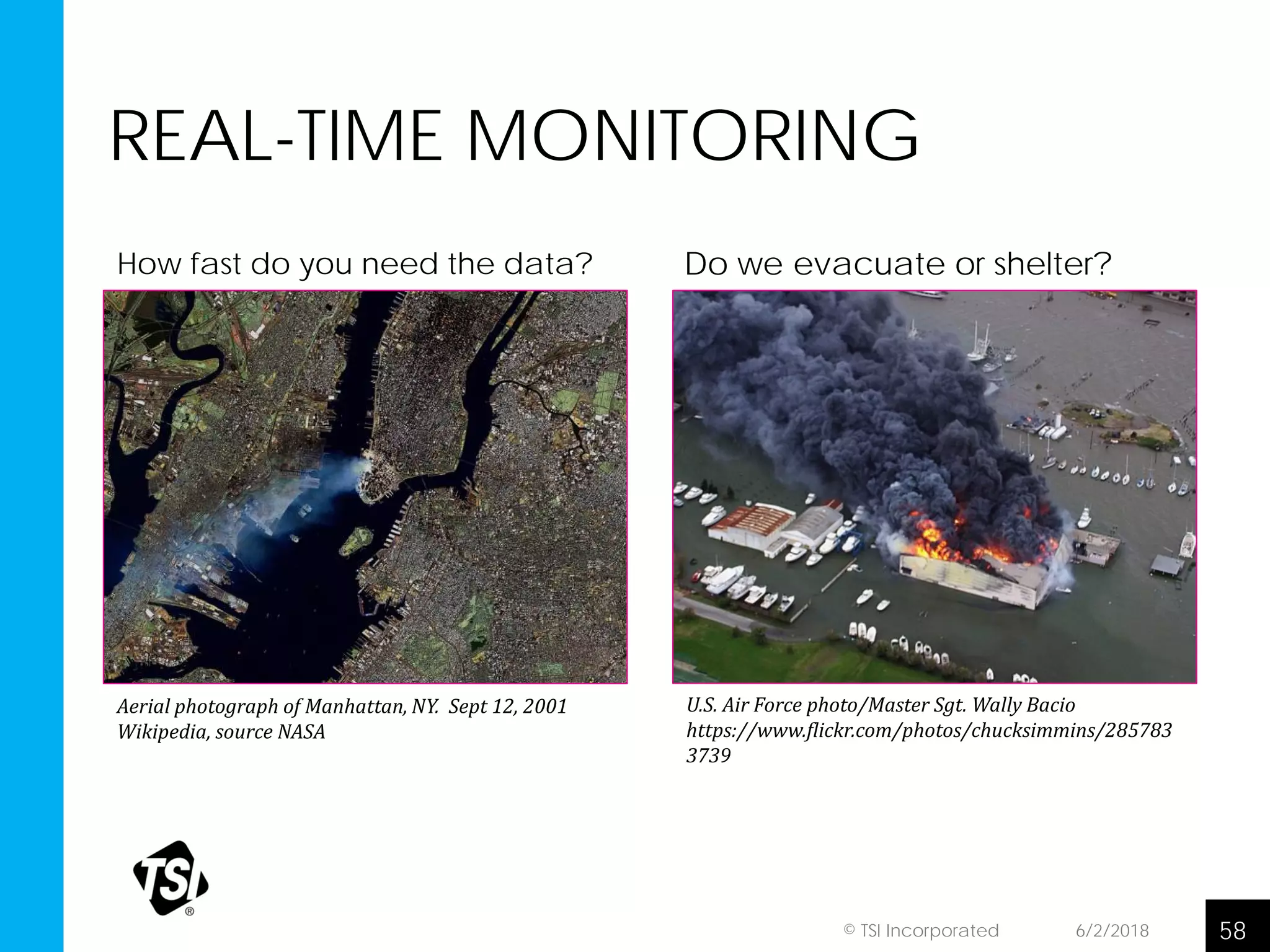
REAL-TIME MONITORING
Aerial photograph of Manhattan, NY. Sept 12, 2001
Wikipedia, source NASA
How fast do you need the data?
© TSI Incorporated
Do we evacuate or shelter?
U.S. Air Force photo/Master Sgt. Wally Bacio
https://www.flickr.com/photos/chucksimmins/285783
3739
REAL-TIME MONITORING
TIME
Diagnostic
Instruments find
problems
6/2/2018 59© TSI Incorporated
MONITORING INSTRUMENTS
+ Beta Attenuation Monitor (BAM)
+ Tapered Element Oscillating Microbalance (TEOM)
+ Differential Mobility Analyzer Spectrometer (DMS)
+ Aerodynamic Particle Sizer (APS)
+ Optical Particle Counters (OPC)
+ Condensation Particle Counters (CPC)
+ Nephelometer (photometer)
6/2/2018 60© TSI Incorporated
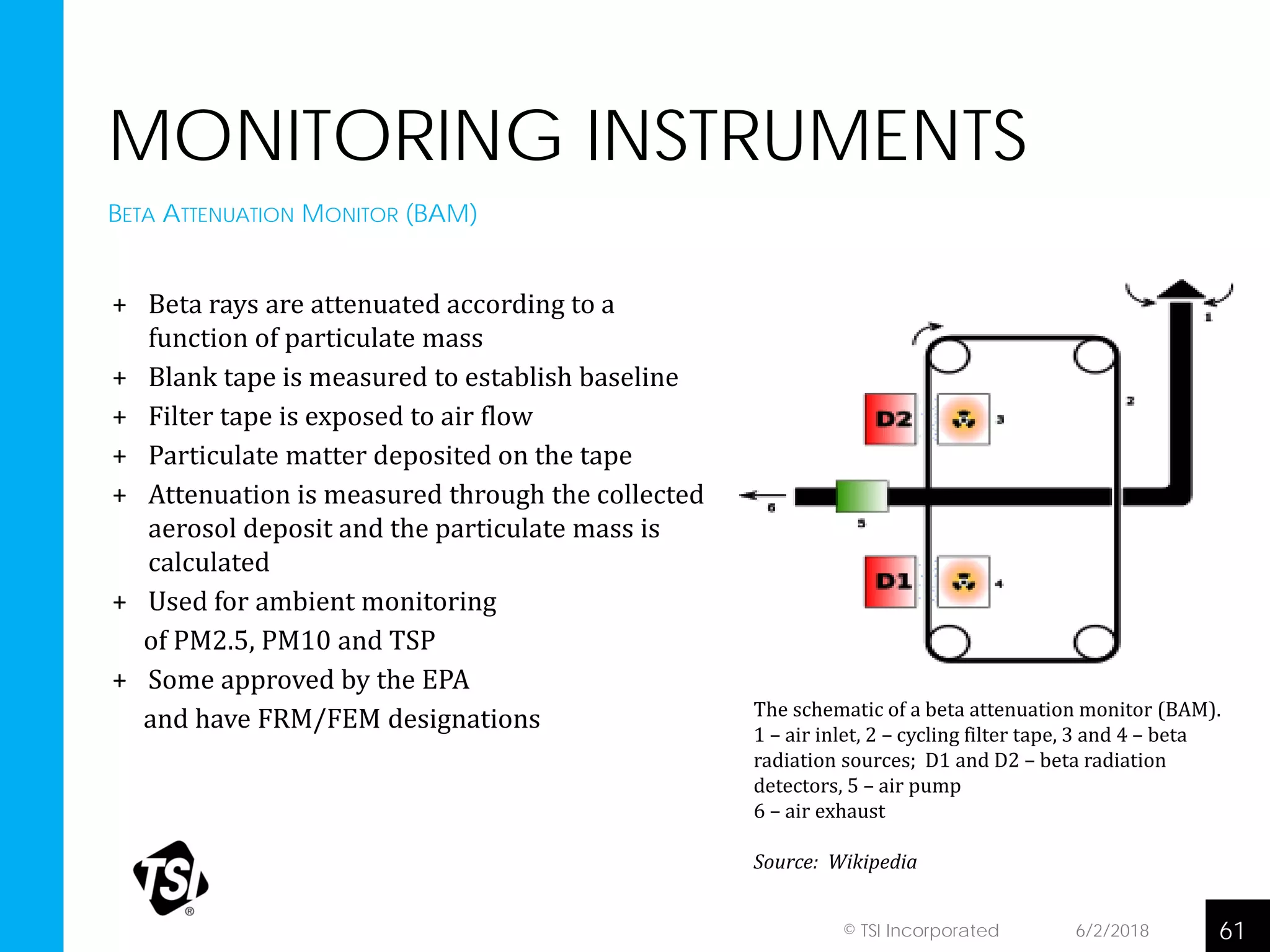
MONITORING INSTRUMENTS
+ Beta rays are attenuated according to a
function of particulate mass
+ Blank tape is measured to establish baseline
+ Filter tape is exposed to air flow
+ Particulate matter deposited on the tape
+ Attenuation is measured through the collected
aerosol deposit and the particulate mass is
calculated
+ Used for ambient monitoring
of PM2.5, PM10 and TSP
+ Some approved by the EPA
and have FRM/FEM designations
BETA ATTENUATION MONITOR (BAM)
6/2/2018 61© TSI Incorporated
The schematic of a beta attenuation monitor (BAM).
1 – air inlet, 2 – cycling filter tape, 3 and 4 – beta
radiation sources; D1 and D2 – beta radiation
detectors, 5 – air pump
6 – air exhaust
Source: Wikipedia
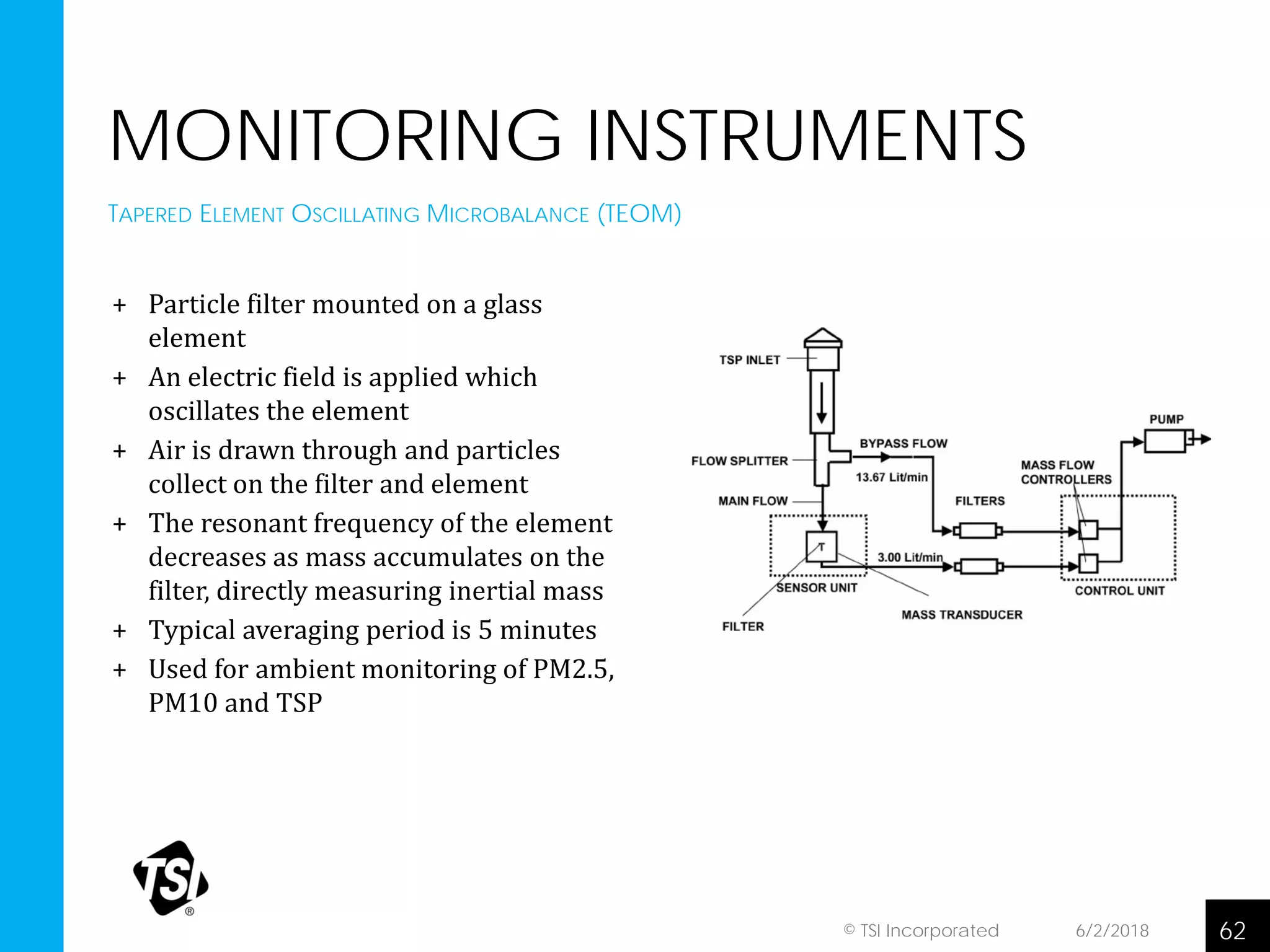
MONITORING INSTRUMENTS
+ Particle filter mounted on a glass
element
+ An electric field is applied which
oscillates the element
+ Air is drawn through and particles
collect on the filter and element
+ The resonant frequency of the element
decreases as mass accumulates on the
filter, directly measuring inertial mass
+ Typical averaging period is 5 minutes
+ Used for ambient monitoring of PM2.5,
PM10 and TSP
TAPERED ELEMENT OSCILLATING MICROBALANCE (TEOM)
6/2/2018 62© TSI Incorporated
+ Particles are classified
according to their mobility in
an electric field, which is a
function of their size
+ A condensation nuclei counter
then counts the population in a
size “bin.”
+ Range 1 nm - 1,000 nm
+ Applications include
• Nanotechnology research
• Atmospheric studies and
environmental monitoring
• Combustion and engine exhaust
studies
• Indoor air quality measurements
MONITORING INSTRUMENTS
DIFFERENTIAL MOBILITY ANALYZER – SPECTROMETER (DMS)
6/2/2018 63© TSI Incorporated
MONITORING INSTRUMENTS
+ Beta Attenuation Monitor (BAM)
+ Tapered Element Oscillating Microbalance (TEOM)
+ Differential Mobility Analyzer Spectrometer (DMS)
+Aerodynamic Particle Sizer (APS)
+Optical Particle Counters (OPC)
+Condensation Particle Counters (CPC)
+Nephelometer (photometer)
6/2/2018 64© TSI Incorporated
0.001 0.01 0.1 1 10 100
Particle Size Range (micrometers)
Inhalable
(Total dust)
TSP
Respirable
Thoracic
Photometer
CPC-alcohol
OPC
Diffusion Charger
CPC - Water
SMPS
Nanoparticle
MONITORING INSTRUMENTS
0.1 to 15 µm
0.3 to 25 µm
0.02 to 1 µm
4
PARTICLE SIZE RANGE FOR AEROSOL INSTRUMENTS
6/2/2018 65© TSI Incorporated
MONITORING INSTRUMENTS
+ Uses parallel laser beams to
measure the velocity lag of
particles suspended in
accelerating air flows.
+ Velocity lag is used to
determine size
+ Particle size range 0.5 to
20 µm
+ Applications include
• Inhalation toxicology
• Drug delivery studies
• Indoor air-quality testing
• Filter and air-cleaner testing
• Test-aerosol characterization
AERODYNAMIC PARTICLE SIZER (APS)
6/2/2018 66© TSI Incorporated
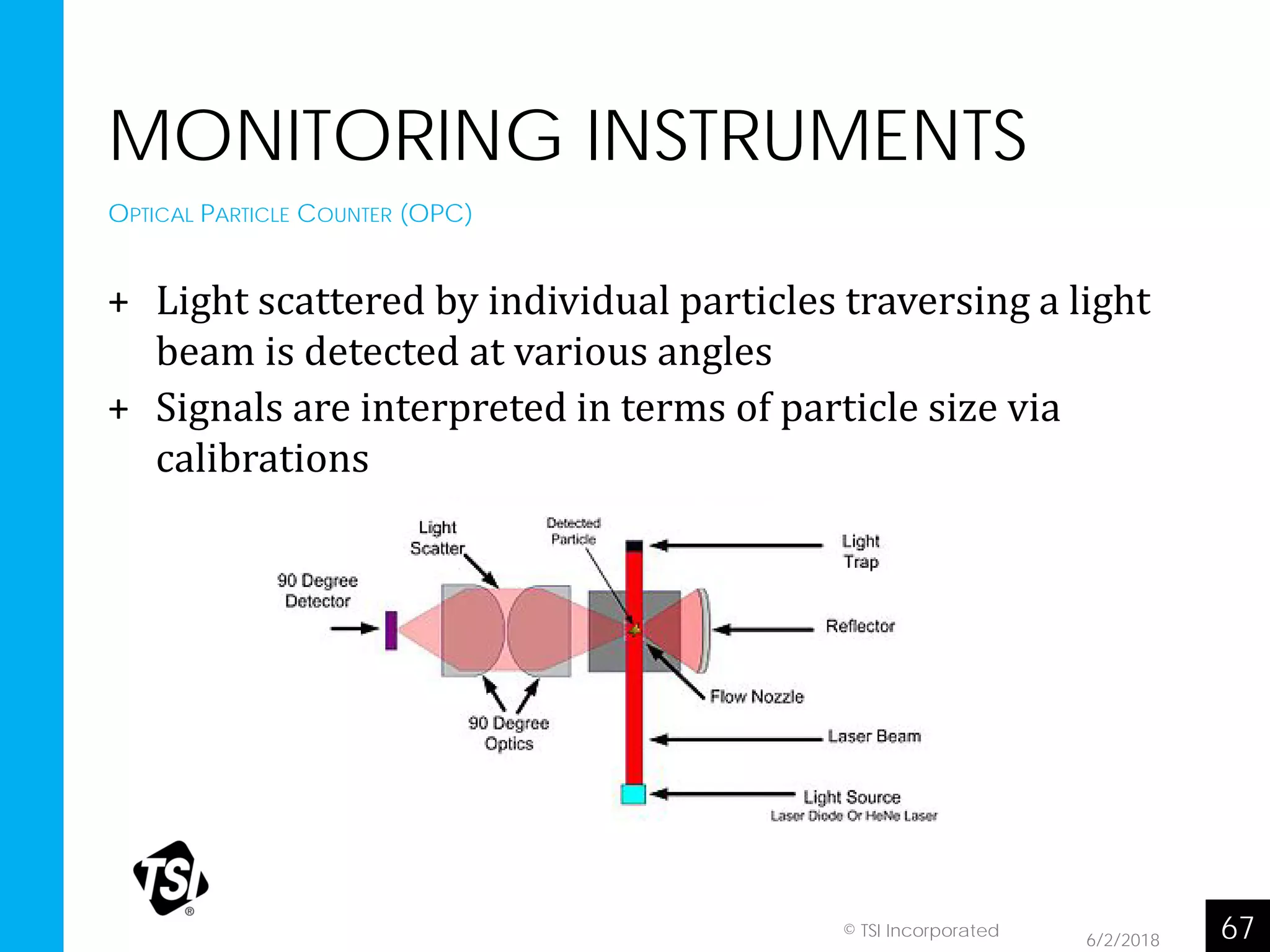
+ Light scattered by individual particles traversing a light
beam is detected at various angles
+ Signals are interpreted in terms of particle size via
calibrations
MONITORING INSTRUMENTS
OPTICAL PARTICLE COUNTER (OPC)
6/2/2018 67© TSI Incorporated
MONITORING INSTRUMENTS
Three Basic Components
• Optics:
- Each particle passes through a laser,
scattering light
- Each light scatter pulse is counted
• Condenser:
- Cooled to condense vapors onto
particles, particles grow
• Saturator:
- Heated to saturate sample with
isopropanol vapor
2
1
3
3
2
1
CONDENSATION PARTICLE COUNTER (CPC)
6/2/2018 68© TSI Incorporated
MONITORING INSTRUMENTS
+ Aerosol focused through an optics chamber
+ Laser is shined at the particles
+ Optical sensor measures the intensity of the light scattered
+ Mass is calculated based on the reflected intensity of a known calibration
aerosol
INTEGRATING NEPHELOMETER
6/2/2018 69© TSI Incorporated
6/2/2018© TSI Incorporated 70
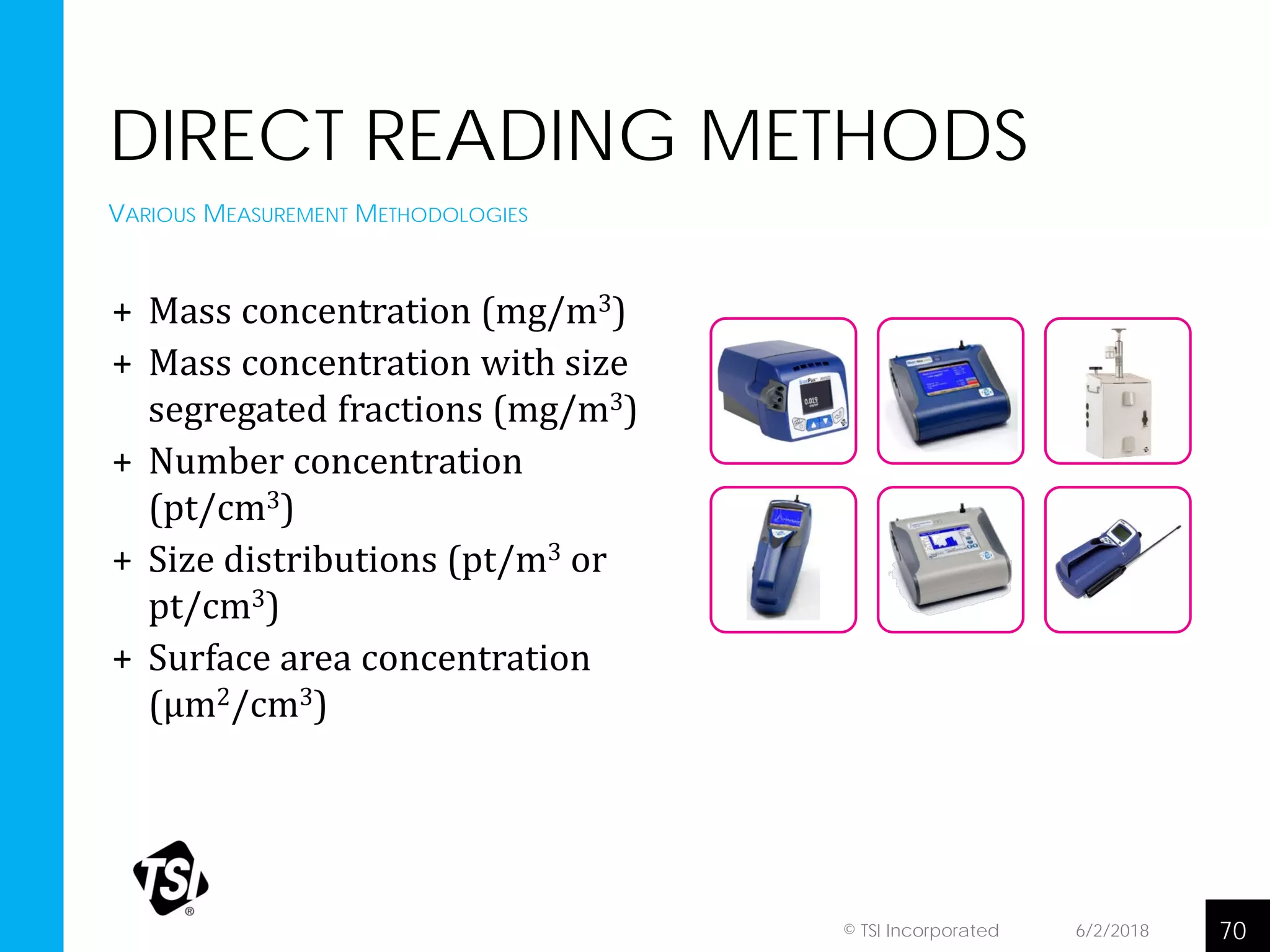
DIRECT READING METHODS
+ Mass concentration (mg/m3)
+ Mass concentration with size
segregated fractions (mg/m3)
+ Number concentration
(pt/cm3)
+ Size distributions (pt/m3 or
pt/cm3)
+ Surface area concentration
(µm2/cm3)
VARIOUS MEASUREMENT METHODOLOGIES
MEASURING METHODOLOGY
AND INSTRUMENTS
6/2/2018 71© TSI Incorporated
+ Gravimetric sampling
+ Real-time monitoring
+ Photometer
• Theory of operation
• Strenghts and values
PHOTOMETER: THEORY OF
OPERATION
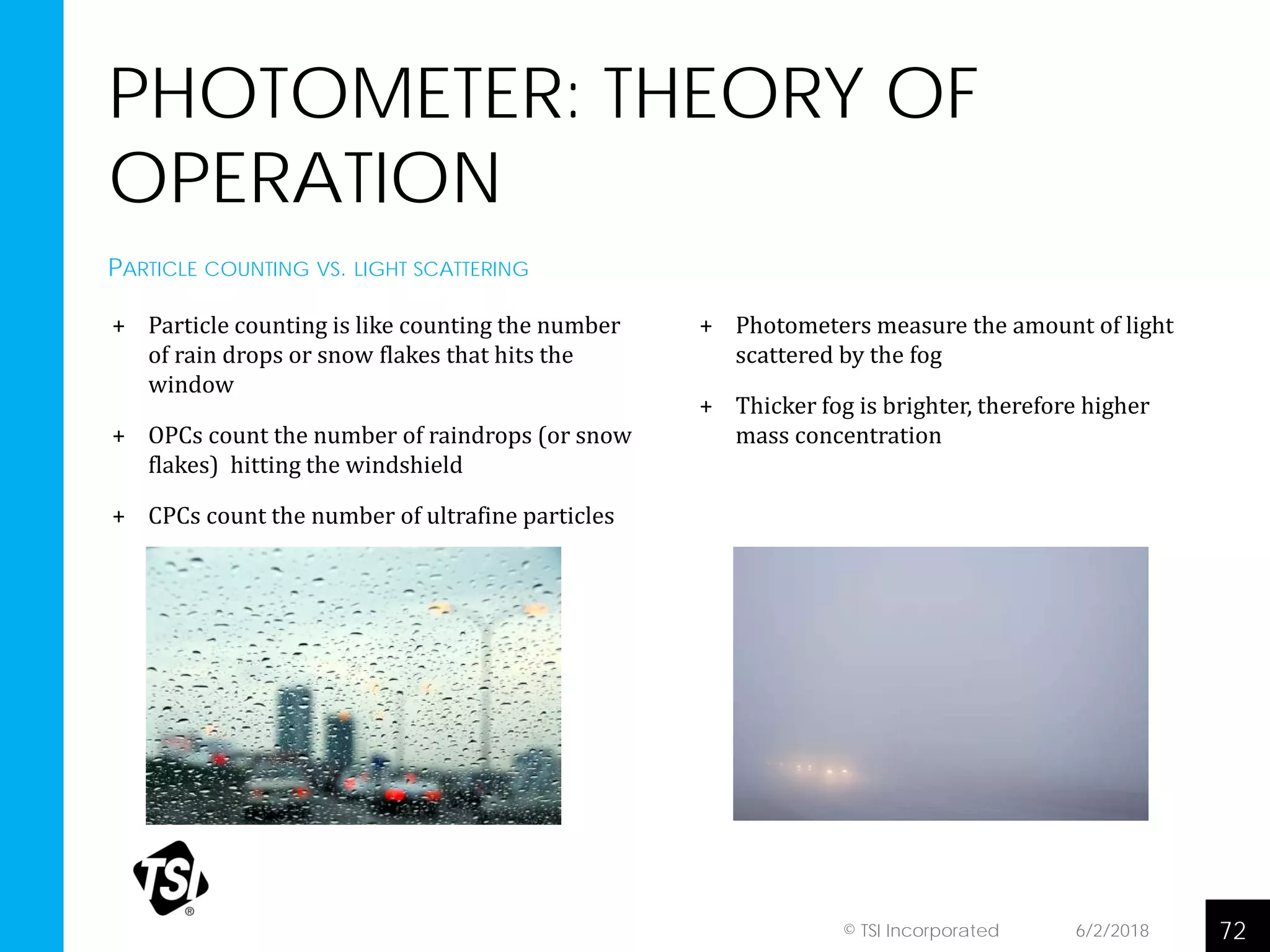
+ Particle counting is like counting the number
of rain drops or snow flakes that hits the
window
+ OPCs count the number of raindrops (or snow
flakes) hitting the windshield
+ CPCs count the number of ultrafine particles
6/2/2018 72© TSI Incorporated
+ Photometers measure the amount of light
scattered by the fog
+ Thicker fog is brighter, therefore higher
mass concentration
PARTICLE COUNTING VS. LIGHT SCATTERING
6/2/2018© TSI Incorporated 73
PHOTOMETER: THEORY OF
OPERATION
+ Photo detector is in line
with light source
+ Lenses focus forward
scatter into detector (10-80
degrees typical)
Photo Detector
Light Stop
Aerosol Inlet
Pump or Blower
Focusing Optics
Collecting Optics
Sheath Air
Pre-filter
Exhaust Filter
Light source
Exhaust
Time
Signal(V)
Signal processing
FORWARD SCATTER OPC
6/2/2018© TSI Incorporated 74
PHOTOMETER: THEORY OF
OPERATION
Photo Detector
Light Stop
Aerosol Inlet
Pump or Blower
Focusing Optics
Collecting Optics
Sheath Air
Pre-filter
Exhaust Filter
Light source
Exhaust
+ Photo detector is set at an
angle to light source
(typically 90 degrees)
+ Mirror focuses side scatter
into detector (30-120
degrees typical)
Signal processing
Time
Signal(V)
FORWARD SCATTER OPC
6/2/2018© TSI Incorporated 75
PHOTOMETER: THEORY OF
OPERATION
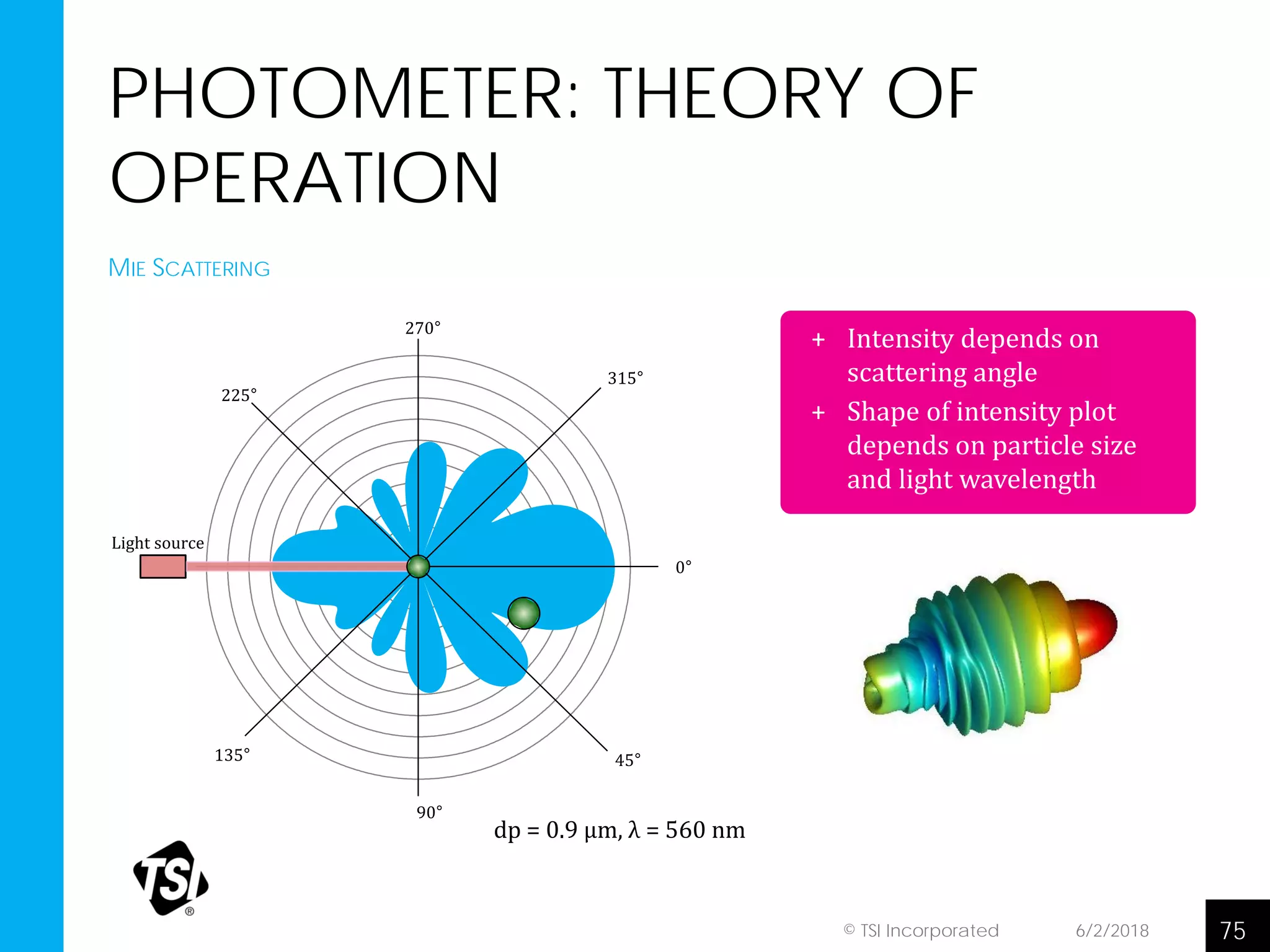
+ Intensity depends on
scattering angle
+ Shape of intensity plot
depends on particle size
and light wavelength
Light source
0°
45°
90°
135°
225°
270°
315°
dp = 0.9 µm, λ = 560 nm
MIE SCATTERING
PHOTOMETER: THEORY OF
OPERATION
+ A photometer ‘sees’ aerosols of all
shapes and sizes
+ The photometer measures the light
scattering of these particles as a
group.
+ Mass is calculated based on the
properties of the calibration
aerosol.
Fly ash – FHWA.dot.gov
6/2/2018 76© TSI Incorporated
AEROSOL SIZE DISTRIBUTION
6/2/2018© TSI Incorporated 77
PHOTOMETER: THEORY OF
OPERATION
SIGNAL VS. PARTICLE SIZE DP
PHOTOMETER: THEORY OF
OPERATION
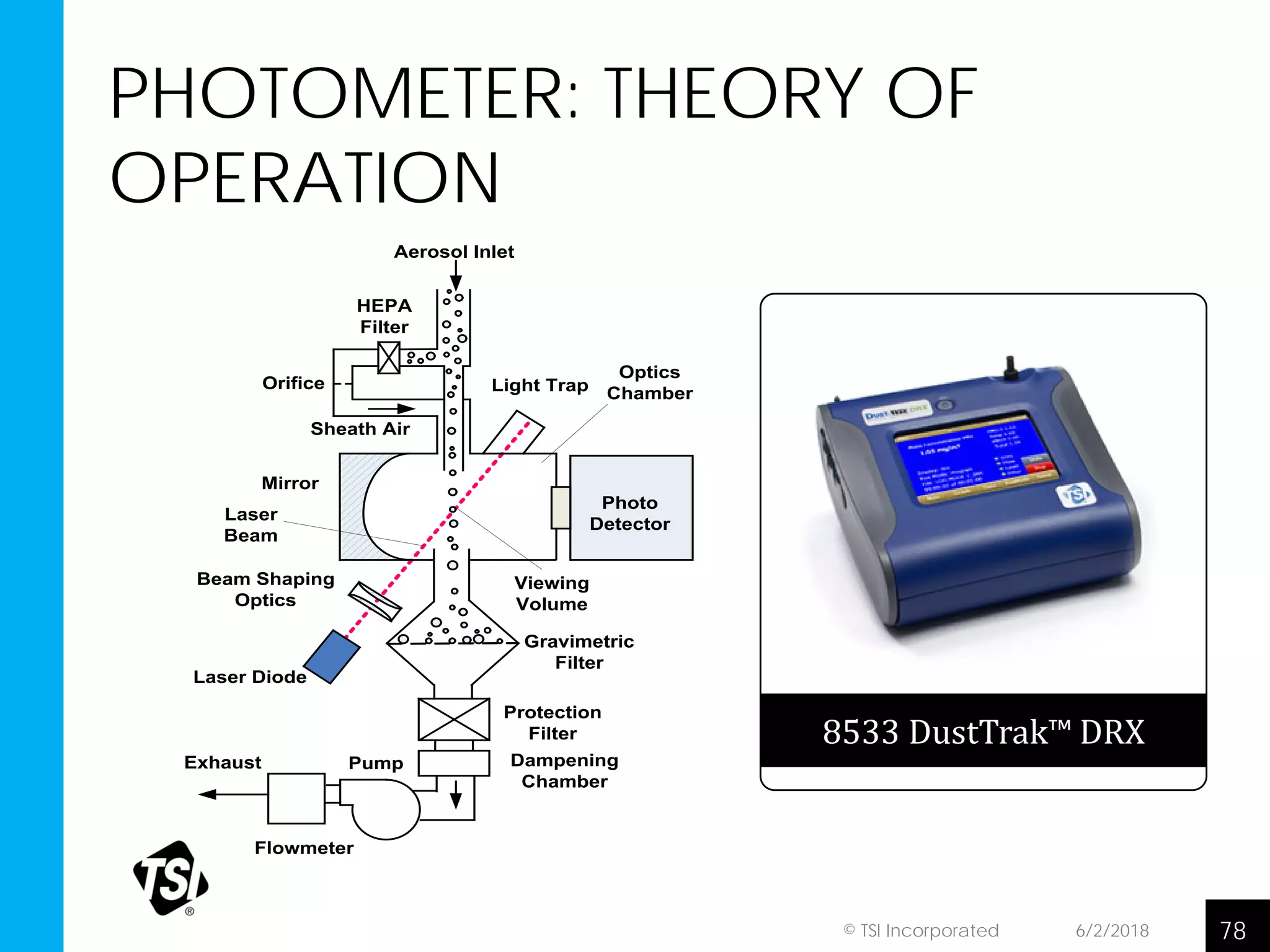
Photo
Detector
Laser Diode
Light Trap
Aerosol Inlet
Sheath Air
Mirror
Gravimetric
Filter
Beam Shaping
Optics
Viewing
Volume
Optics
Chamber
Orifice
HEPA
Filter
Exhaust
Flowmeter
Pump
Protection
Filter
Dampening
Chamber
Laser
Beam
8533 DustTrak™ DRX
6/2/2018 78© TSI Incorporated
6/2/2018© TSI Incorporated 79
PROCESSES TO ENSURE
MAXIMUM ACCURACY
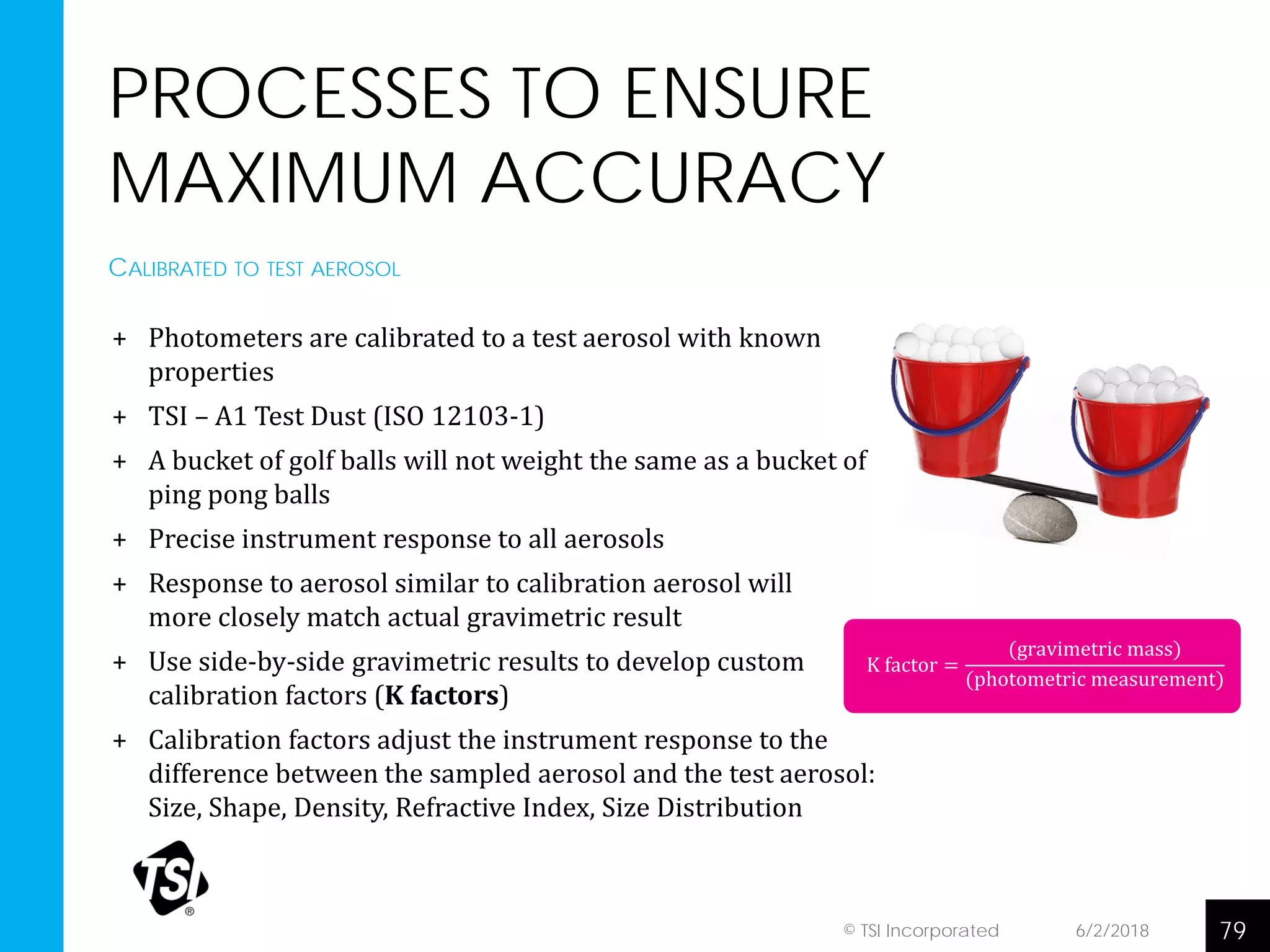
+ Photometers are calibrated to a test aerosol with known
properties
+ TSI – A1 Test Dust (ISO 12103-1)
+ A bucket of golf balls will not weight the same as a bucket of
ping pong balls
+ Precise instrument response to all aerosols
+ Response to aerosol similar to calibration aerosol will
more closely match actual gravimetric result
+ Use side-by-side gravimetric results to develop custom
calibration factors (K factors)
+ Calibration factors adjust the instrument response to the
difference between the sampled aerosol and the test aerosol:
Size, Shape, Density, Refractive Index, Size Distribution
CALIBRATED TO TEST AEROSOL
K factor =
(gravimetric mass)
(photometric measurement)
PROCESSES TO ENSURE
MAXIMUM ACCURACY
+ Aerosols swell as humidity levels increase
+ Photometric instrument readings will be
elevated in humid conditions
+ Inlet conditioners to reduce the effects of
humidity are added to photometric instruments
for long term environmental monitoring
6/2/2018 80© TSI Incorporated
HUMIDITY EFFECTS
PROCESSES TO ENSURE
MAXIMUM ACCURACY
+ High aerosol levels can result in contaminated
optics and measurement drift
+ Zeroing the instrument regularly helps correct
+ Use size selective inlet conditioners to sample
only small size fractions
6/2/2018 81© TSI Incorporated
CONTAMINATED OPTICS
MEASURING METHODOLOGY
AND INSTRUMENTS
6/2/2018 82© TSI Incorporated
+ Gravimetric sampling
+ Real-time monitoring
+ Photometer
• Theory of operation
• Strenghts and values
STRENGTHS AND VALUES
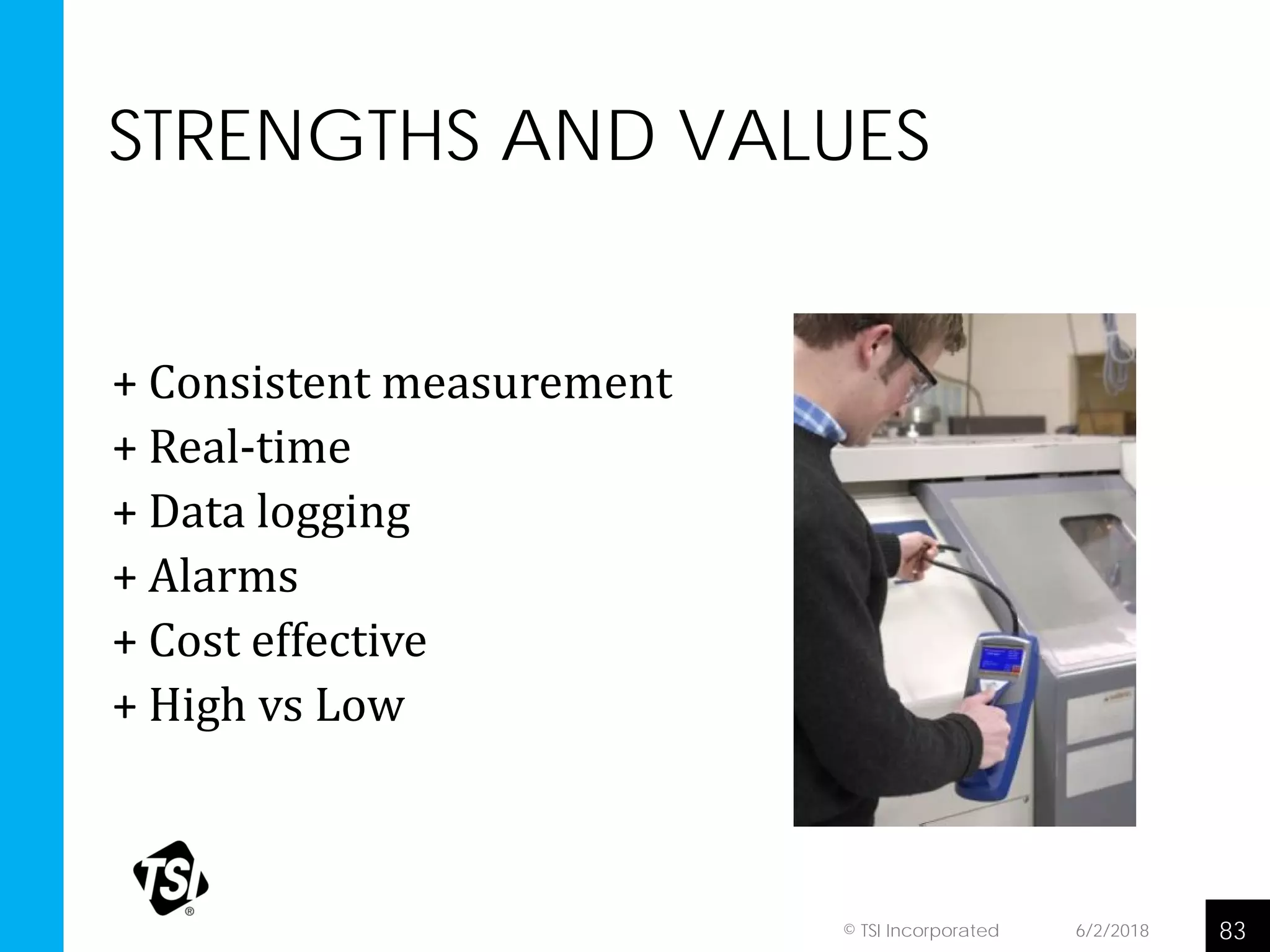
+ Consistent measurement
+ Real-time
+ Data logging
+ Alarms
+ Cost effective
+ High vs Low
6/2/2018 83© TSI Incorporated
STRENGTHS AND VALUES –
CONSISTENT MEASUREMENT
+ Strong correlation to reference instrument during
MCERTS testing
• European Reference Method Samplers PM10 and PM 2.5 SEQ
47/50 by Sven Leckel GmbH
• Testing was conducted during the time period of March 3rd to
June 14th, 2016 in Southwest London
+ The United Kingdom’s environmental agency Monitoring
Certification Scheme (MCERTS)
+ International and European emissions standards
6/2/2018 84© TSI Incorporated
6/2/2018
STRENGTHS AND VALUES –
CONSISTENT MEASUREMENT
85© TSI Incorporated
6/2/2018© TSI Incorporated 86
STRENGTHS + VALUES – THE REAL-
TIME MONITORING ADVANTAGE
EXAMPLE 1: DUST MONITORING PROCESS WITH GRAVIMETRIC SAMPLE PUMPS
Collect
samples
1
Get lab
results
Take
corrective
action
Collect
samples
Get lab
results –
reference
data
2 3 4 5
Steps
i
8 Hours
8 hrs. for a
Representative
Sample of
Breathing Zone
5 Days
Wait …
¼ Day
No Trail of
Sample data
(Source, Time
or Activity of
workers is
UNKNOWN)
8 Hours
8 hrs. for a
Representative
Sample of
Breathing Zone
5 Days
More Waiting …
12+ Days in
Total
Repeat as Needed to Take Further
Action and Validate Results.
Do in hours or days what traditionally takes weeks!
6/2/2018© TSI Incorporated 87
STRENGTHS + VALUES – THE REAL-
TIME MONITORING ADVANTAGE
EXAMPLE 1: DUST MONITORING PROCESS WITH GRAVIMETRIC SAMPLE PUMPS
Collect
samples
1
Get lab
results
Take
corrective
action
Collect
samples
Get lab
results –
reference
data
2 3 4 5
Steps
i
8 Hours
8 hrs. for a
Representative
Sample of
Breathing Zone
5 Days
Wait …
¼ Day
No Trail of
Sample data
(Source, Time
or Activity of
workers is
UNKNOWN)
8 Hours
8 hrs. for a
Representative
Sample of
Breathing Zone
5 Days
More Waiting …
12+ Days in
Total
Repeat as Needed to Take Further
Action and Validate Results.
Do in hours or days what traditionally takes weeks!
AM520 Real-Time Monitoring Cuts Through This Process
 Shorter Sampling Time – Representative measurements quickly
 Immediate data capture – No waiting for lab results!
 Alarms to take immediate ‘Corrective Action’ – Increase worker safety!
 Captures ‘Data Trail’ as basis for Engineering / Process Changes –
Immediate data access allows for pinpointing problem activities!
 Immediate Validation of ‘Corrective Actions’ – Know the corrective
actions have been effective!
 Perform Gravimetric Sampling with confidence for compliance
Wait for
gravimetric
lab results
with
confidence!
6/2/2018© TSI Incorporated 88
STRENGTHS + VALUES – THE REAL-
TIME MONITORING ADVANTAGE
+ Reduced Set-up and Sample Collection Times. Immediately displays and logs representative
measurements in less time.
+ Fast Corrective Action. Achieve results in hours or days that typically takes weeks or even
months to complete using only gravimetric sampling.
ADVANTAGES OF REAL-TIME MONITORING FOR SILICA
+ Instant Alerts and Exposure Data. Immediate data to base decisions and take corrective
actions as well as to validate those actions for effectiveness so further adjustments can be
made.
+ Frequent, Affordable and Repetitive. Allows for efficient sampling that is required by several
sections of the OSHA silica standard.
+ Real-Time Data Logging. Provides exposure data trail silica exposure - data can be analyzed,
reviewed & graphed with easy report generation
+ Increased Confidence & Reduce Risk. Reduce risk to workers, reduce costs per sample and
reduce the risk to companies by way of real-time dust monitoring.
6/2/2018© TSI Incorporated 89
STRENGTHS + VALUES – THE REAL-
TIME MONITORING ADVANTAGE
INITIAL ASSESSMENT USING GRAVIMETRIC SAMPLING:
SIGNIFICANT TIME AND MONEY TO CAPTURE AND PROCESS LAB SAMPLES.
Initial
Gravimetric
Reference
Assessment
Final
Reference
Sample
Measure Measure Measure to
validate
Adjust Controls Adjust Controls
Gravimetric Sampling and Action Points
to Reach Silica Exposure Compliance
Perform Intermediate
Measurements and Actions faster
with Real-time monitoring
6/2/2018© TSI Incorporated 90
STRENGTHS + VALUES – THE REAL-
TIME MONITORING ADVANTAGE
RE-ASSESSMENT OF A TASK USING REAL-TIME MONITORING:
SIGNIFICANTLY COMPRESSES THE TIME AND COSTS NEEDED TO MAINTAIN COMPLIANCE.
Unless change
has occurred –
no need to
repeat initial
Gravimetric
reference
New
Gravimetric
Reference
Sample to show
compliance
Measure in Real-time Measure in Real-time Measure in Real-time
Adjust Controls Adjust Controls
STRENGTHS + VALUES –
DATA LOGGING
Avg = 0.176 mg/m3
Max = 1.11 mg/m3
Customer data
What caused this spike?
6/2/2018 91© TSI Incorporated
PEAKS
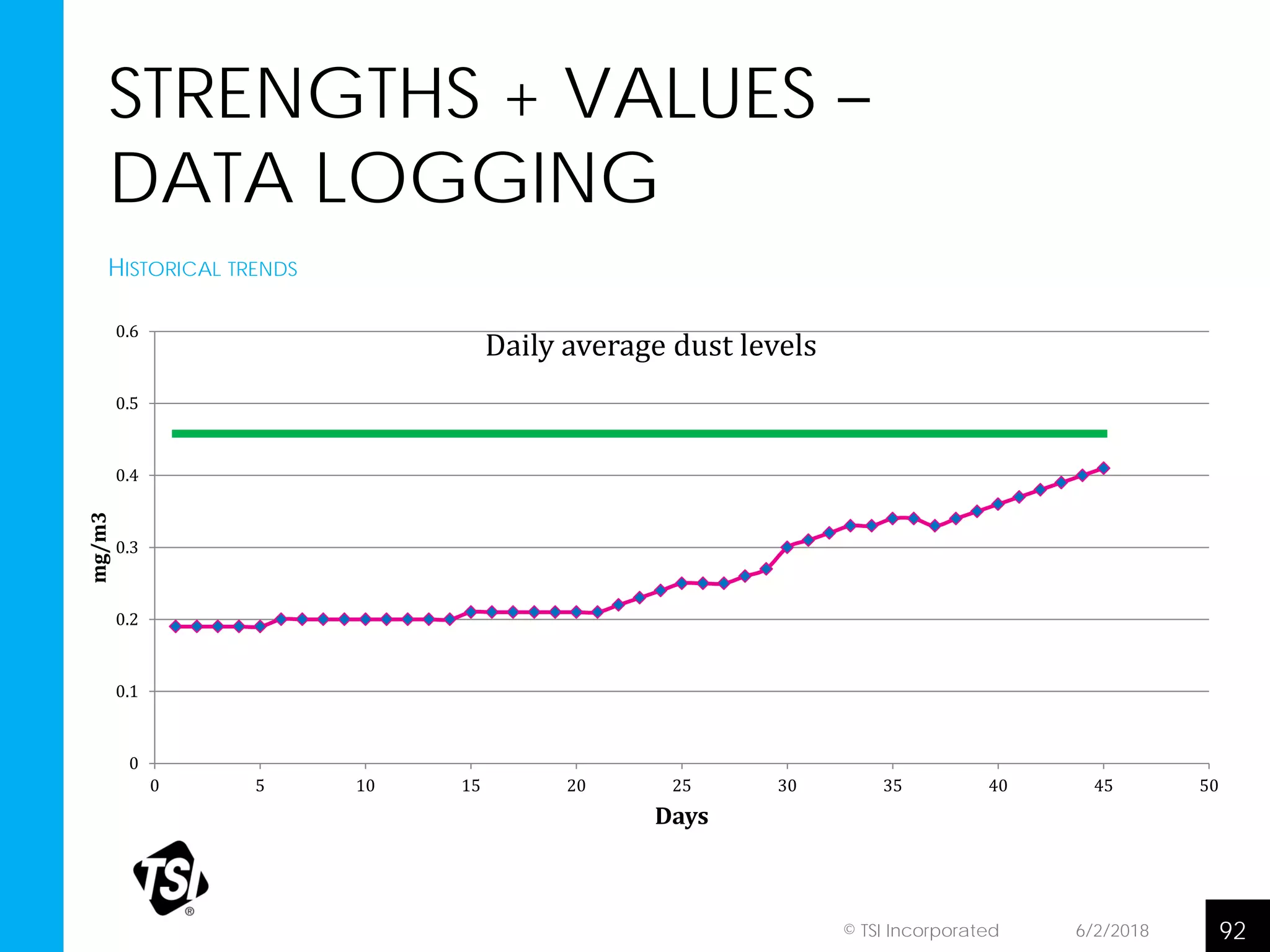
STRENGTHS + VALUES –
DATA LOGGING
0
0.1
0.2
0.3
0.4
0.5
0.6
0 5 10 15 20 25 30 35 40 45 50
mg/m3
Days
Daily average dust levels
6/2/2018 92© TSI Incorporated
HISTORICAL TRENDS
6/2/2018© TSI Incorporated 93
THINGS WE COVERED
+ Gravimetric Sampling – equipment and process
+ Real-time monitoring – methodology and instruments
+ Photometer
• Theory of Operation
• Processes to ensure maximum accuracy
• Strenghts and values of photometers
QUESTIONS?
946/2/2018© TSI Incorporated
Health and Safety
Executive
© Crown Copyright, HSE 2018
Dust and the selection and
use of RPE
31 May 2018
Nick Baxter with a guest appearance
from FFRED
© Crown Copyright, HSE 2018
Who is HSL?:
• Commercial arm of the Health and Safety
Executive, HSE
• Deliver high quality science to meet the
needs of industry and government in the UK
and overseas
• State-of-the- art scientific laboratory in
Buxton, as well as analytical expertise from
other parts of HSE’s science base
• Government scientific laboratory / Civil
Service
• Deliver solutions: Safety; Health;
Productivity
© Crown Copyright, HSE 2018
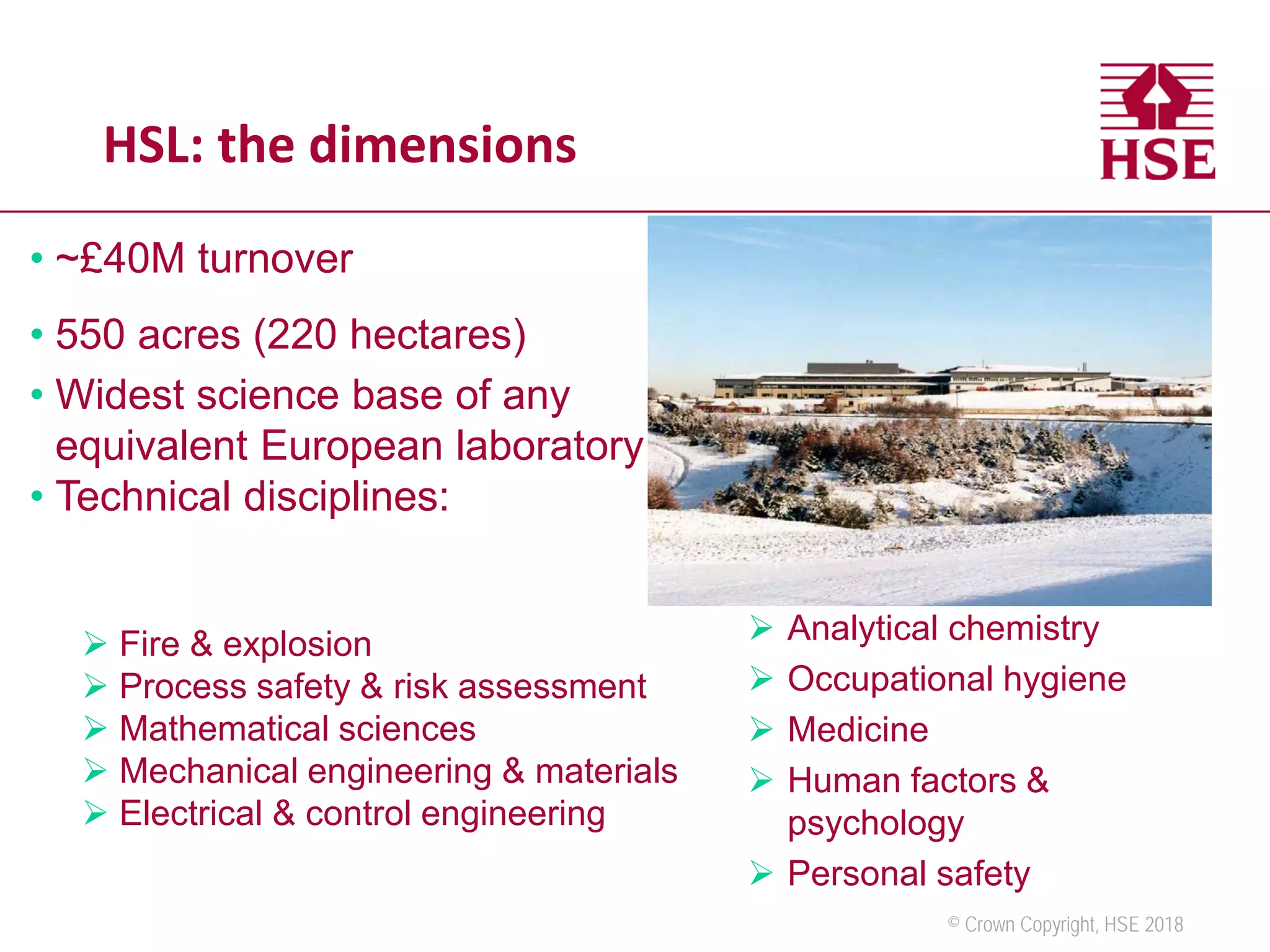
• ~£40M turnover
• 550 acres (220 hectares)
• Widest science base of any
equivalent European laboratory
• Technical disciplines:
 Fire & explosion
 Process safety & risk assessment
 Mathematical sciences
 Mechanical engineering & materials
 Electrical & control engineering
HSL: the dimensions
 Analytical chemistry
 Occupational hygiene
 Medicine
 Human factors &
psychology
 Personal safety
© Crown Copyright, HSE 2018
Overview of PPE activities
• Input to HSE guidance & advice
• Incident investigations
• Research and testing:
– Measuring PPE performance
• Laboratory, simulated and workplace conditions
– Assessing PPE impact on wearer
• PPE training
• Technical input to PPE Standards
© Crown Copyright, HSE 2018
Training at HSL
• Over 50 courses
• Health and wellbeing, human factors, major
hazards and process safety
• PPE and RPE essentials
• Knowledge, understanding, legal
requirements, selection, PPE/RPE programme
• RPE fit testing
• Introduction, advanced, technical and practical
skills
© Crown Copyright, HSE 2018
What types of dust are most
hazardous?
• Some dusts are more harmful than others
• Can develop health problems and
occupational disease
– Asbestos
– Flour
– Grain
– Wood
– Silica
© Crown Copyright, HSE 2018
Respirable crystalline silica (RCS)
• Exposure to RCS occurs in many industries
such as
– Construction and demolition
– Quarrying
– Foundries
– Concrete product manufacturing
– Grit and abrasive blasting
© Crown Copyright, HSE 2018
What is silica dust
Approximate crystalline silica content of different
materials
Sandstone 70-90%
Concrete, mortar 25-70%
Tile 30-45%
Granite 20-45%
Slate 20-40%
Brick Up to 30%
Limestone 2%
Marble 2%
© Crown Copyright, HSE 2018
How can RCS harm your health?
• Silicosis
– Irreversible lung disease
– Difficulty breathing
• Chronic obstructive pulmonary disease (COPD)
– Chronic bronchitis, emphysema with coughing
and phlegm
– Breathlessness, chest tightness
• Lung cancer
– Silicosis increases the risk
© Crown Copyright, HSE 2018
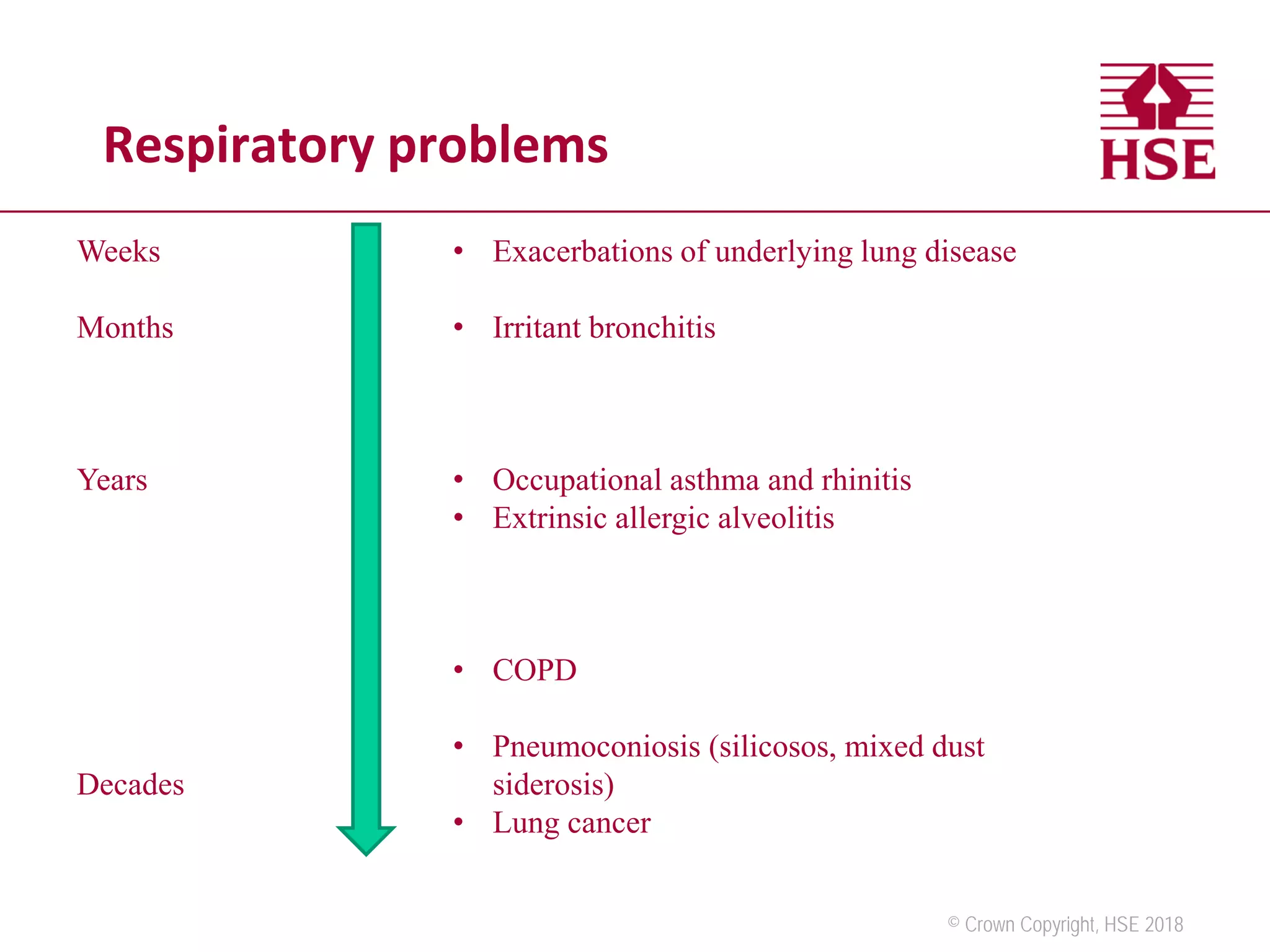
Respiratory problems
• Exacerbations of underlying lung disease
• Irritant bronchitis
• Occupational asthma and rhinitis
• Extrinsic allergic alveolitis
• COPD
• Pneumoconiosis (silicosos, mixed dust
siderosis)
• Lung cancer
Weeks
Months
Years
Decades
© Crown Copyright, HSE 2018
Should your employer protect you?
• Employers must comply with COSHH Regs
2002
– Assess the risks
– Prevent or control exposures
– Substitute
– Communicate risks
– Records
© Crown Copyright, HSE 2018
Regulations specific to RPE
• Be adequate and provide the wearer with
effective protection
• Be suitable for the intended use
• Be ‘CE’ marked
• Be selected, used and maintained by trained
people
• Be correctly stored
The law says that RPE used at work must:
© Crown Copyright, HSE 2018
Adequate RPE
• RPE that is right for the hazard and reduces
exposure to the level required to protect the
wearer’s health
– WEL not exceeded
– Asthmagen or carcinogen ALARP
• If it can provide the necessary level of
protection against the hazard so as to comply
with the law
© Crown Copyright, HSE 2018
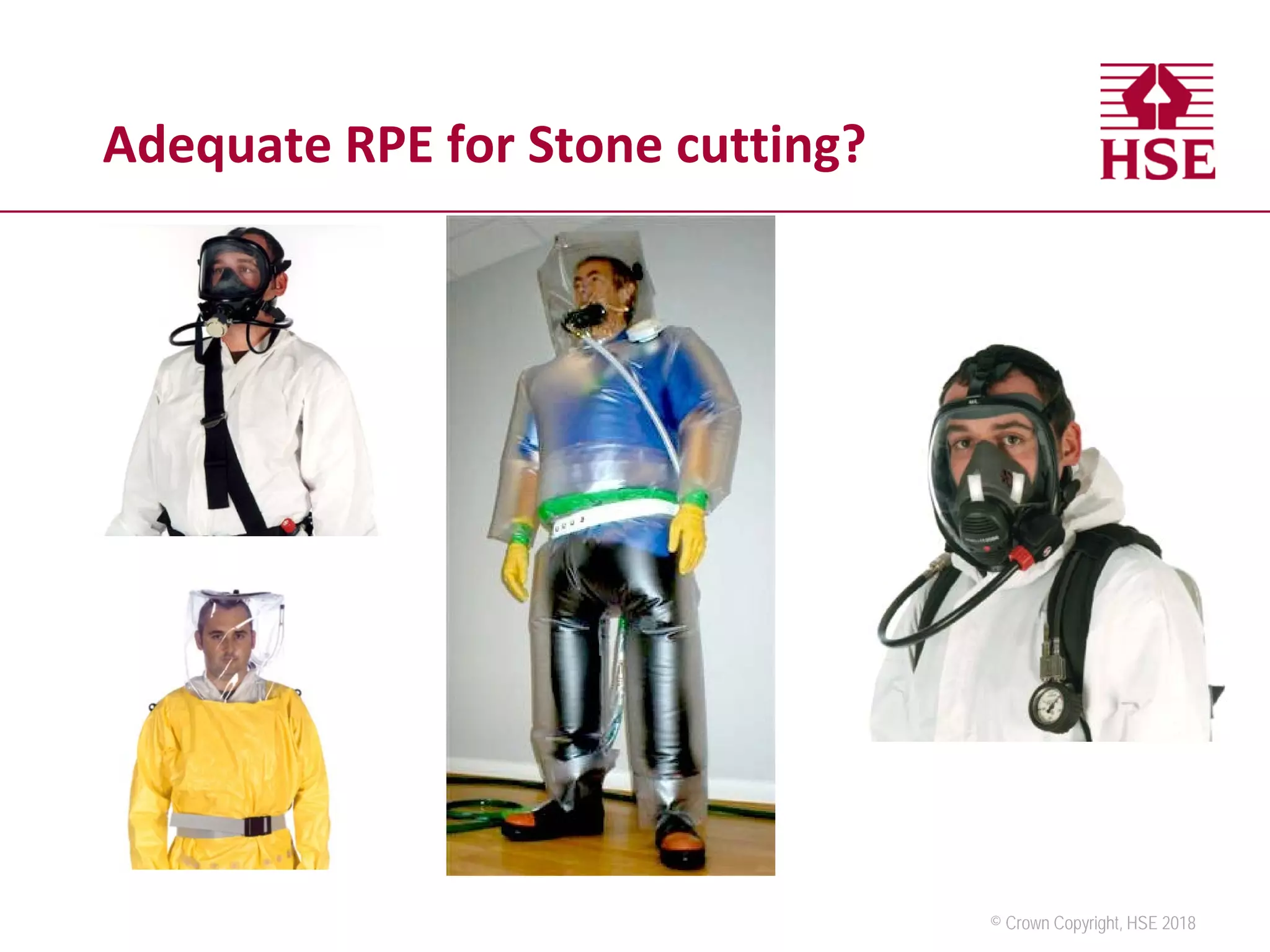
Adequate RPE for Stone cutting?
© Crown Copyright, HSE 2018
Suitable RPE
• RPE that is right for the wearer, task and environment,
such that the wearer can work freely and without
additional risks due to the RPE
• Considers:
– Wearer
• Fit testing, vision, breathing resistance
– Work-task
• Work-rate, vision requirements, other PPE
– Work environment
• Communication, temperature, space to move
– Minimum user impediment
• Weight, heat burden, restricted mobility
– No additional risks
• e.g. trailing hoses, masking of alarms
© Crown Copyright, HSE 2018
Suitable RPE for stone cutting?
© Crown Copyright, HSE 2018
Suitable RPE for stone cutting?
© Crown Copyright, HSE 2018
Suitable RPE for stone cutting?
© Crown Copyright, HSE 2018
‘CE’ - mark
“Product” Directive designed to eliminate barriers to trade
within Europe, while safeguarding health and safety
Identifier of Notified
Body responsible for
ongoing quality of
product (Cat III only)
PPE satisfies the Basic Health and Safety Requirements
of the Directive
European Mark of
Conformity
© Crown Copyright, HSE 2018
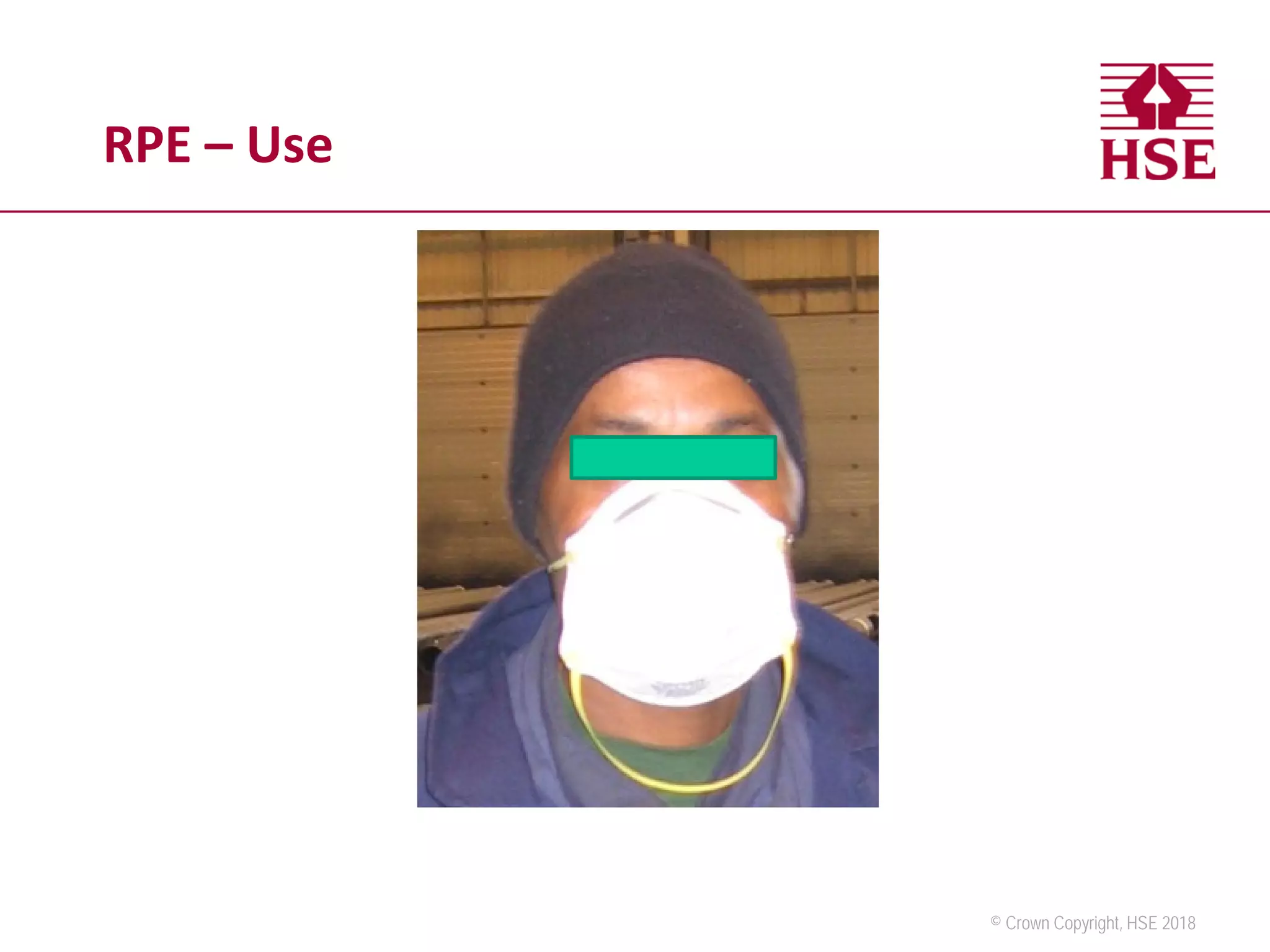
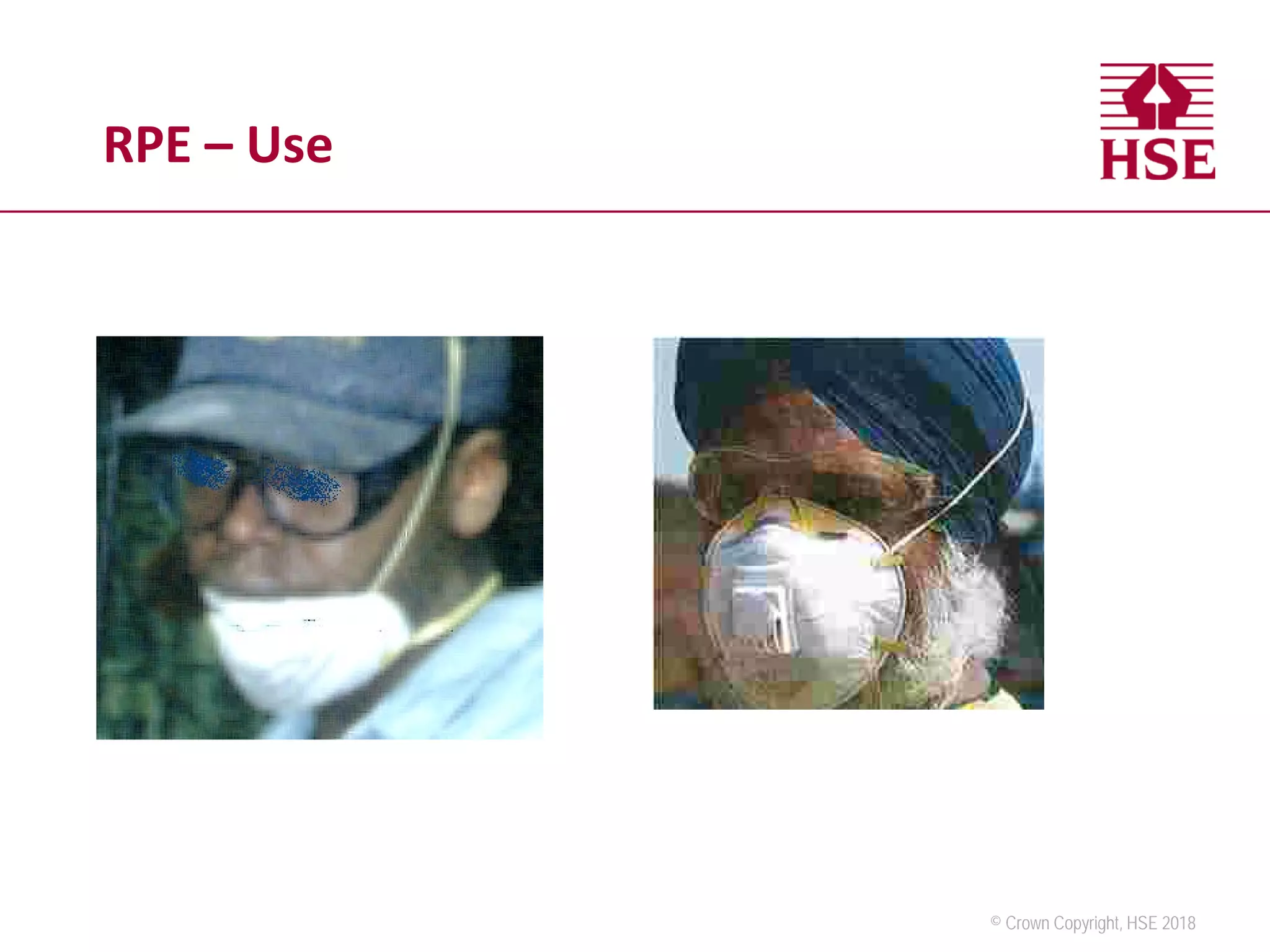
RPE – Use
• Use of control measures
• COSHH Reg 8/CAR Reg 12/IRR Reg 8/PPE@W Reg 9/10/11
• Employer: Ensure correct use
– Training
– Compatibility of PPE
– Observation/supervision
– Remedial actions
• Employee: Correctly use the RPE
– As trained/intended
– Return & stored properly
– Report defects
© Crown Copyright, HSE 2018
RPE – Use
© Crown Copyright, HSE 2018
RPE – Use
© Crown Copyright, HSE 2018
RPE – Use
© Crown Copyright, HSE 2018
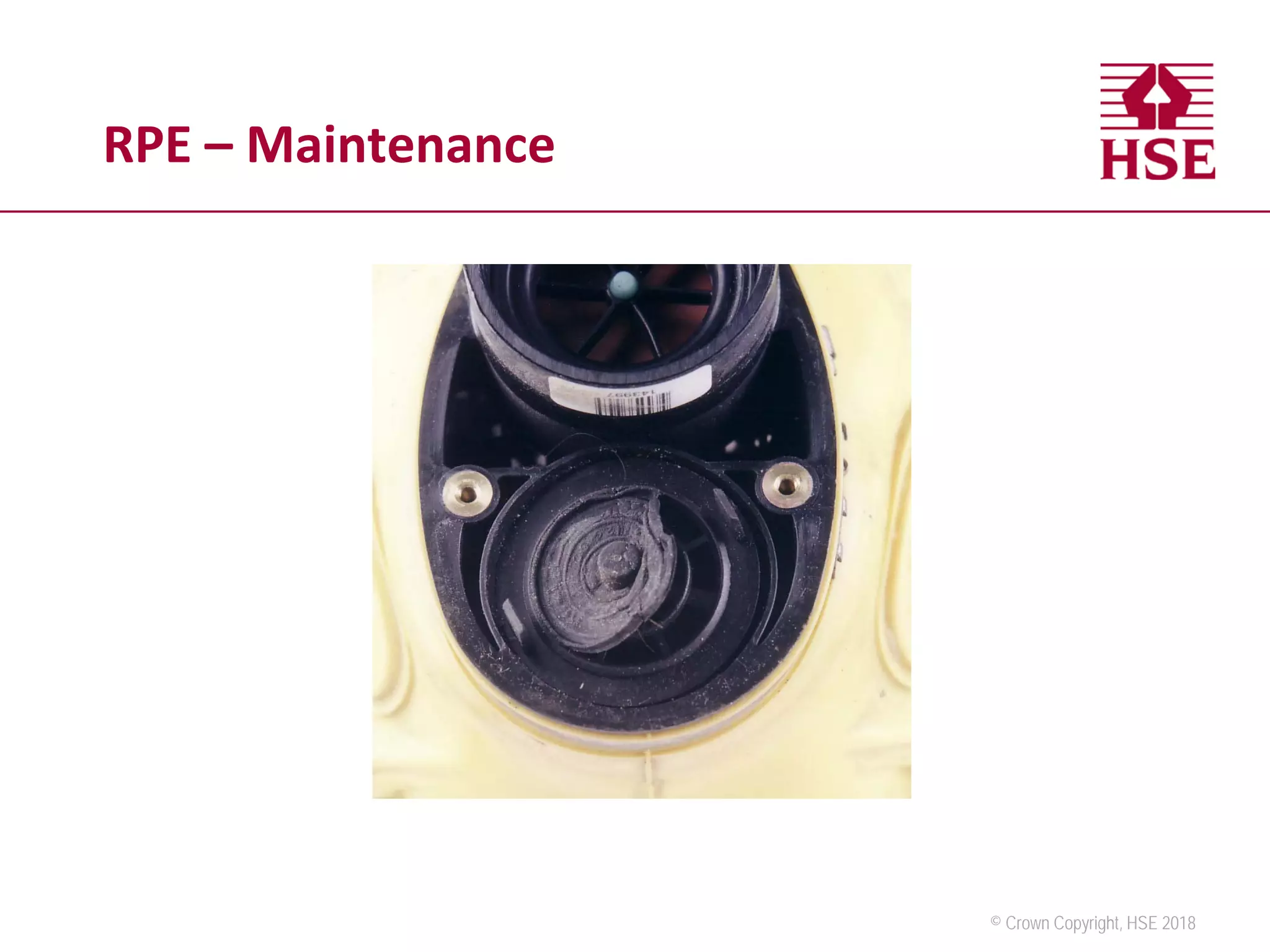
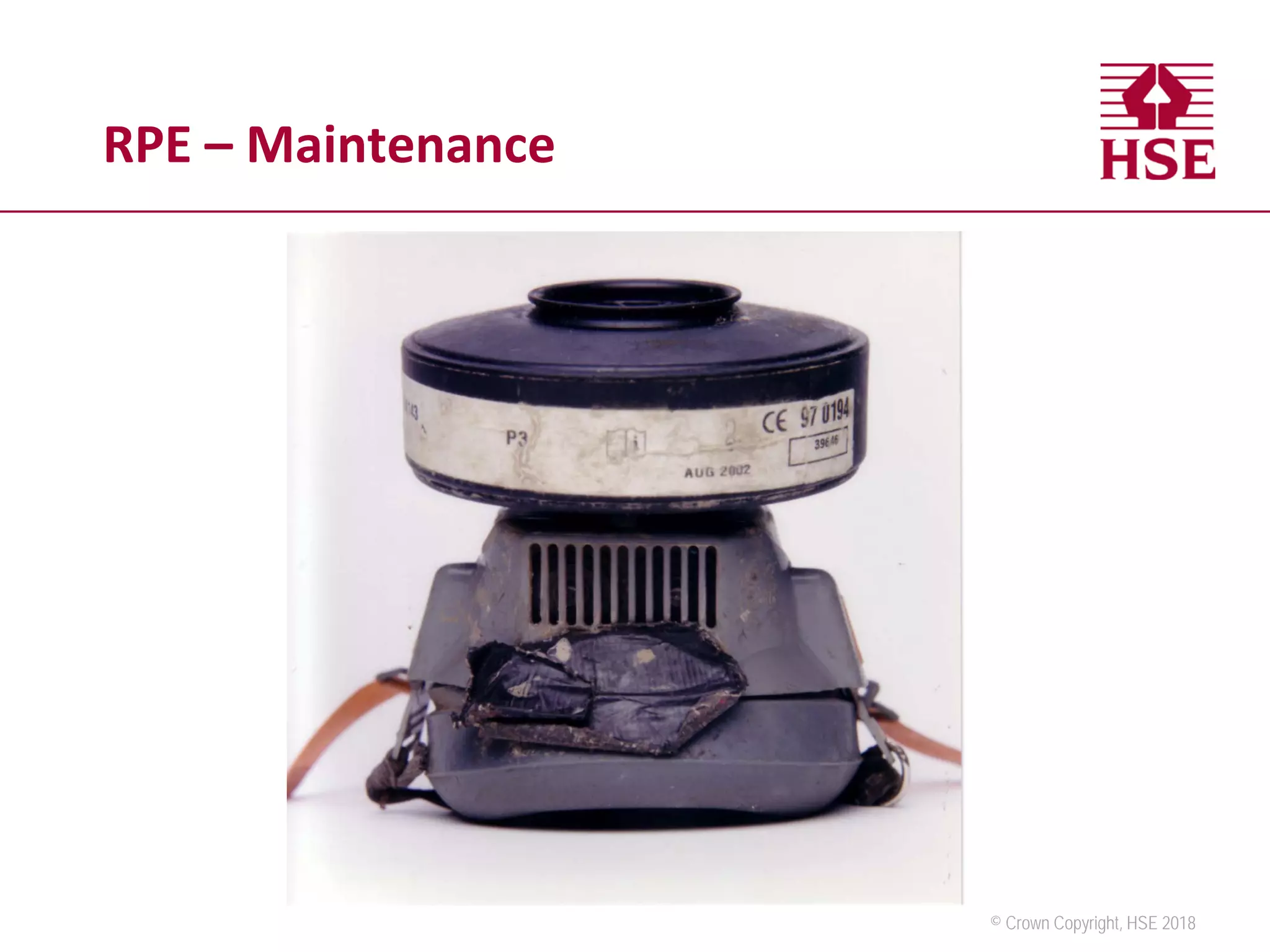
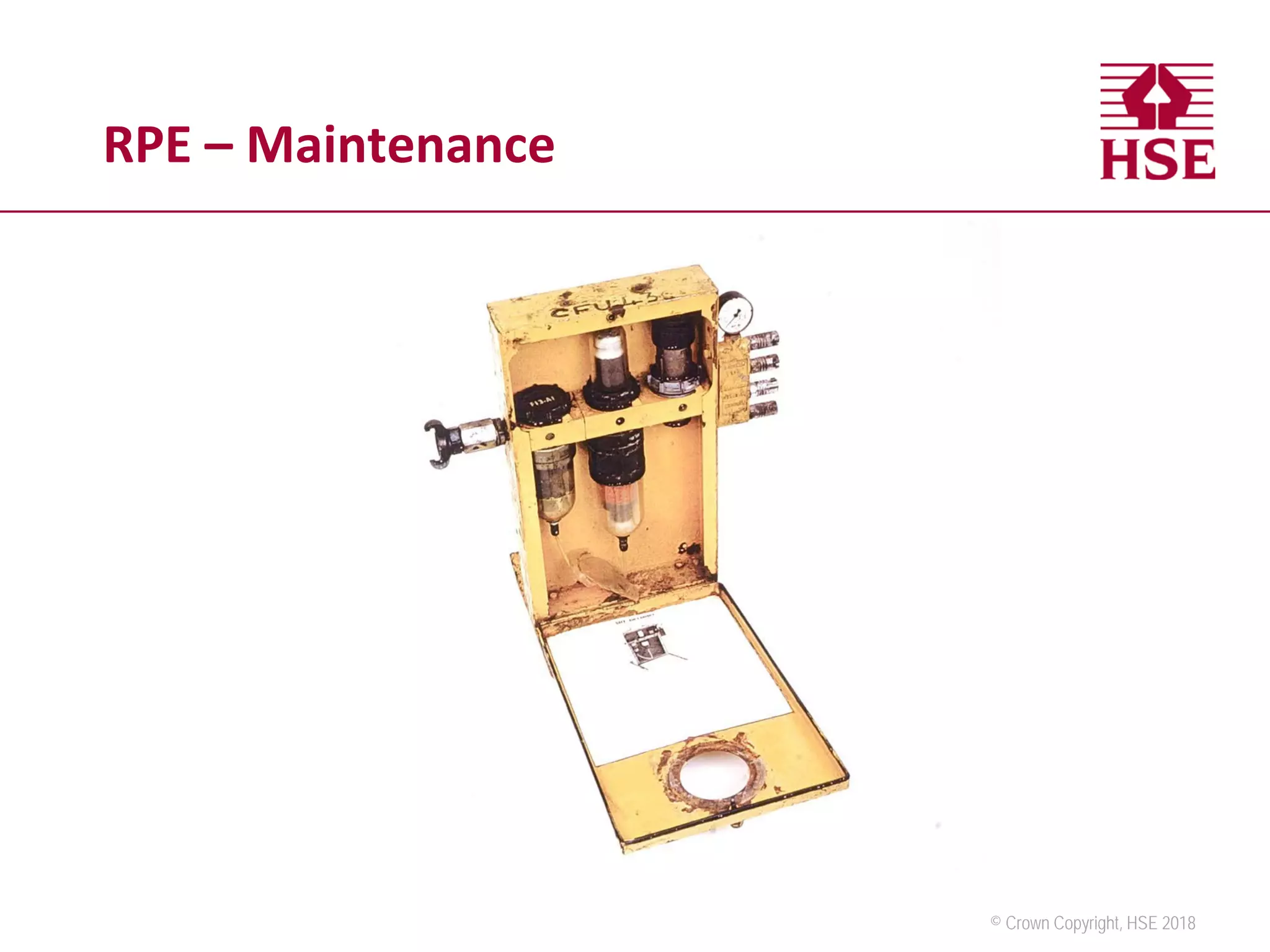
RPE – Maintenance
• Maintenance, examination and testing of
control measures
• COSHH Reg 9/CAR Reg 13/IRR Reg 10/PPE@W Reg 7
• Employer
– Maintained in an efficient state, in good working
order, in good repair and in a clean condition
– Examined & tested at suitable intervals
– Records
Effectively in a condition where it is capable
of providing the level of protection expected
© Crown Copyright, HSE 2018
RPE – Maintenance
© Crown Copyright, HSE 2018
RPE – Maintenance
© Crown Copyright, HSE 2018
RPE – Maintenance
© Crown Copyright, HSE 2018
RPE – Maintenance
© Crown Copyright, HSE 2018
Adequate Storage?
© Crown Copyright, HSE 2018
Adequate Storage?
© Crown Copyright, HSE 2018
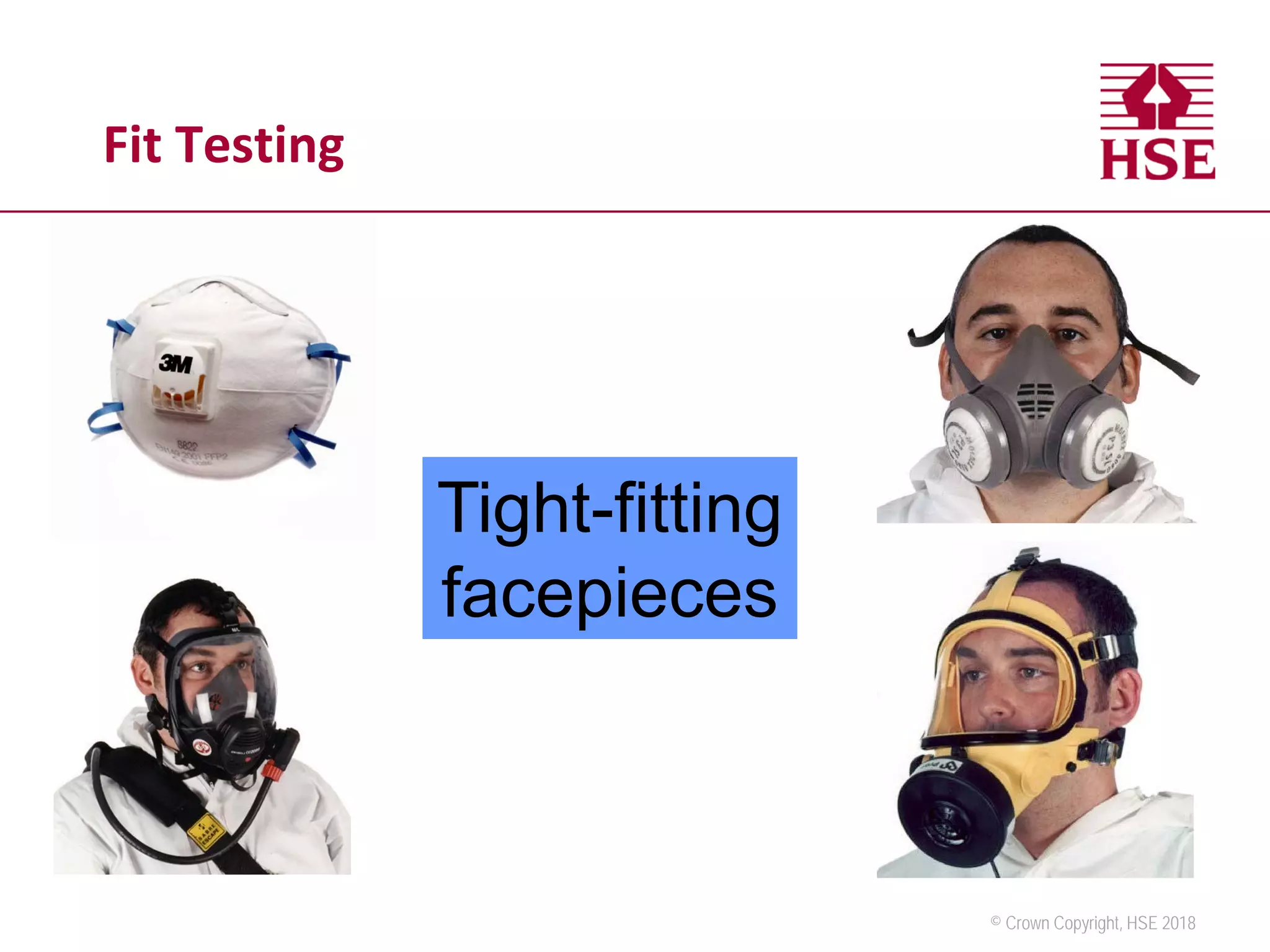
Fit Testing
Tight-fitting
facepieces
© Crown Copyright, HSE 2018
Why do you need to fit test ?
• People have different size
and shape of face
• Unlikely that one single
design & size of facepiece
will fit all users within a
workforce
• No respirator is 100%
leak proof
!! poor fit is a major contributor to reduced
protection
© Crown Copyright, HSE 2018
Aims of fit testing
• To match the facepiece to the wearer
• By selecting the right size and model for the
wearer
– helps to achieve a good fit
– helps to select a comfortable mask
• Leads to enhanced protection hence reduced
ill health
© Crown Copyright, HSE 2018
When to fit test ?
• Initial selection of RPE
• Facepiece not tested previously
• RPE change
• Facial characteristics change
• H&S policy requires it
© Crown Copyright, HSE 2018
Fit Testing Methods
HSE 282/28 – validated methods
Two basic types:
• Qualitative - provides a simple pass/fail based on
the wearer’s subjective assessment
– wearer decides whether it fits or not based on
taste/smell
– an assumed fit factor of 100 is applied to a pass
• Quantitative - provides an independent
objective measure of the fit of the RPE
– a numerical fit factor is generated by the fit testing
device
© Crown Copyright, HSE 2018
Qualitative Fit Testing
Bitrex or Saccharine test agent
Head
© Crown Copyright, HSE 2018
Quantitative Fit Testing
- employs the
ambient air
particles as the
challenge
- fit factors
calculated from
the measured
particle
concentration
TSI PortaCount
© Crown Copyright, HSE 2018
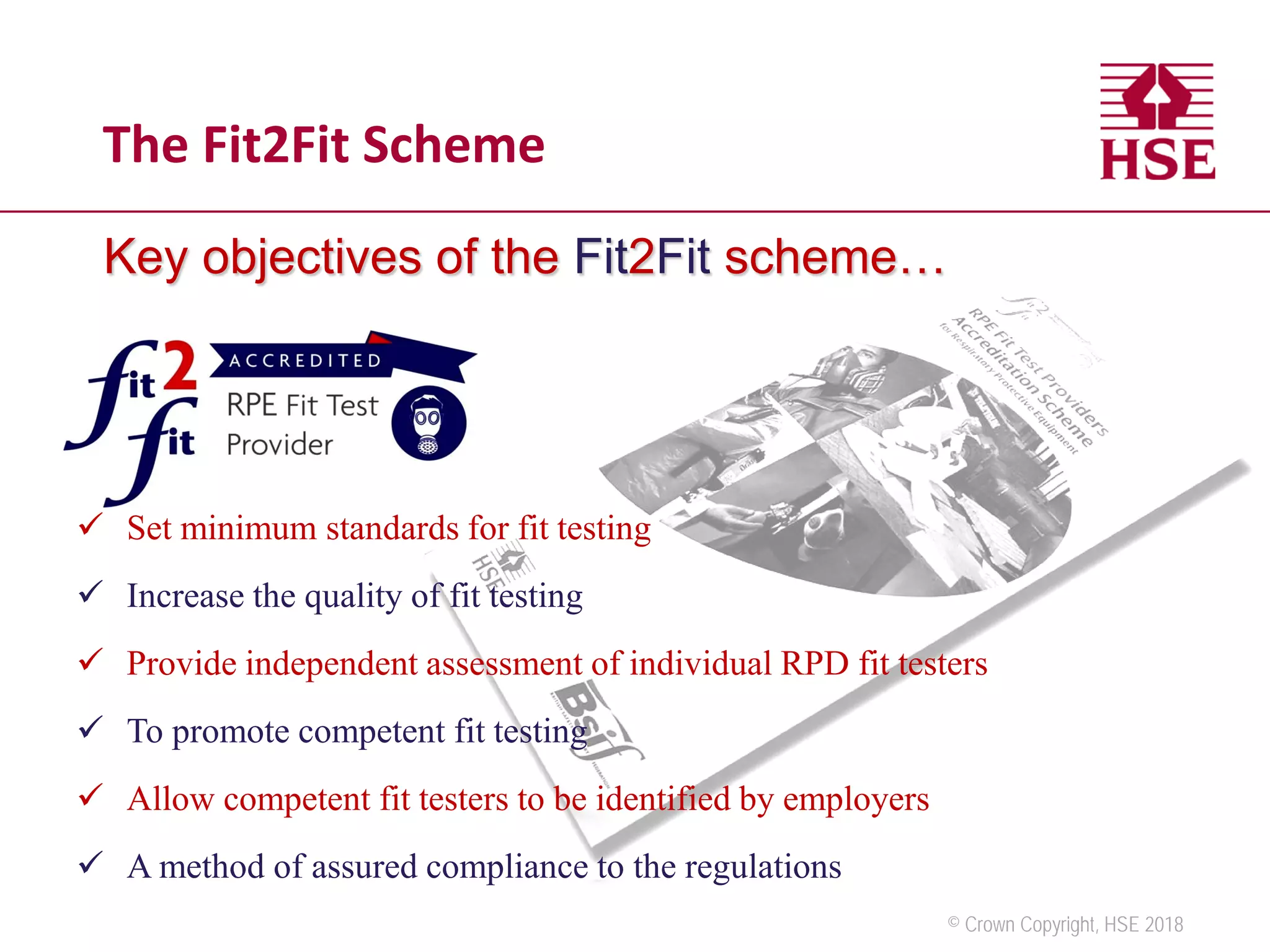
Key objectives of the Fit2Fit scheme…
 Set minimum standards for fit testing
 Increase the quality of fit testing
 Provide independent assessment of individual RPD fit testers
 To promote competent fit testing
 Allow competent fit testers to be identified by employers
 A method of assured compliance to the regulations
The Fit2Fit Scheme
© Crown Copyright, HSE 2018
FFRED
FaceFit REspirator Demonstrator
© Crown Copyright, HSE 2018
QUESTIONS?
nicholas.baxter@hsl.gsi.gov.uk
FIELDS OF USE AND
APPLICATIONS
Nick Brown
Senior Regional Sales Manager UK & Ireland
AGENDA
6/2/2018 96© TSI Incorporated
+ Monitoring methods
+ Fields of use
• Personal monitoring
• Workplace monitoring
• Environmental monitoring
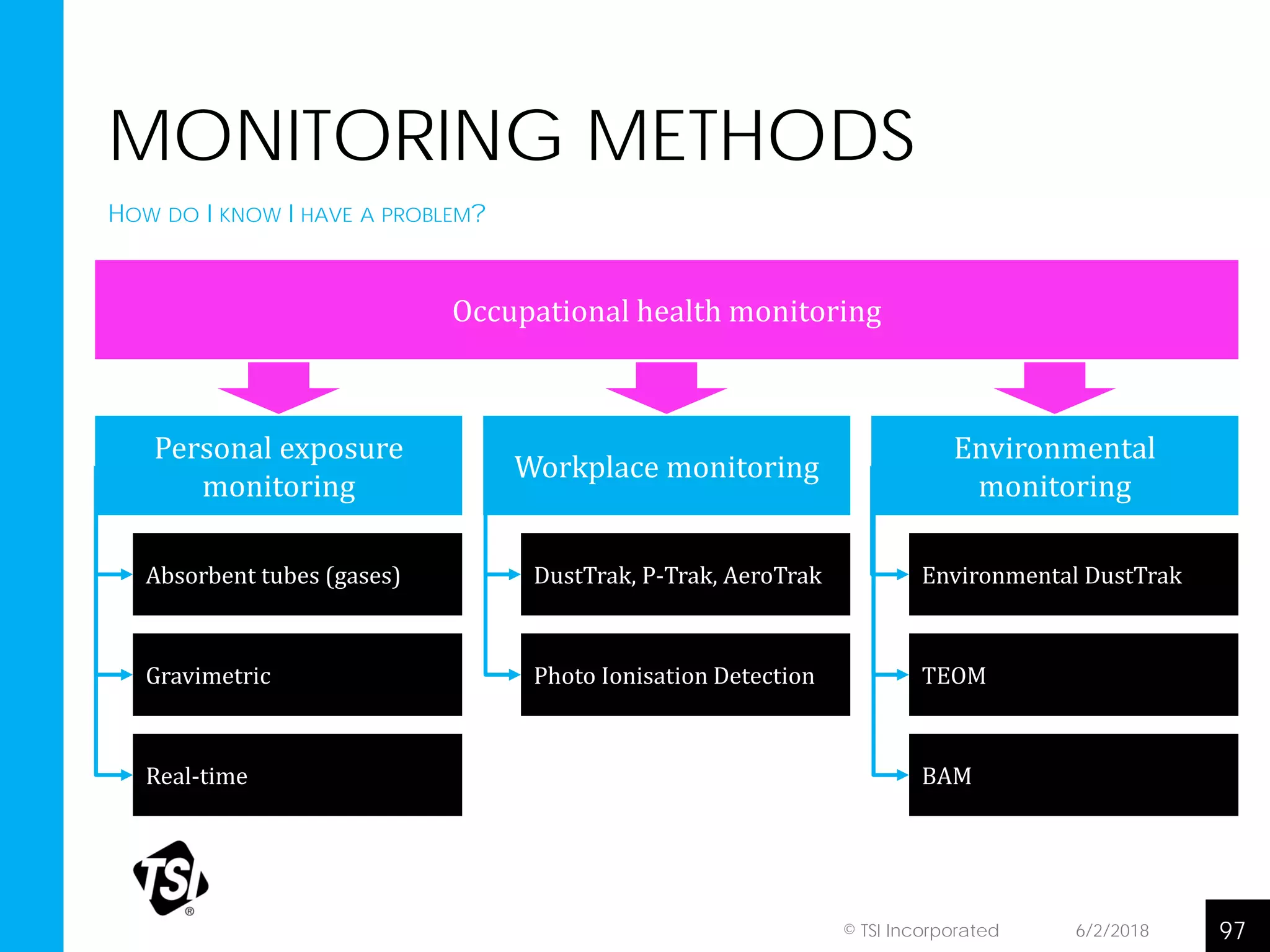
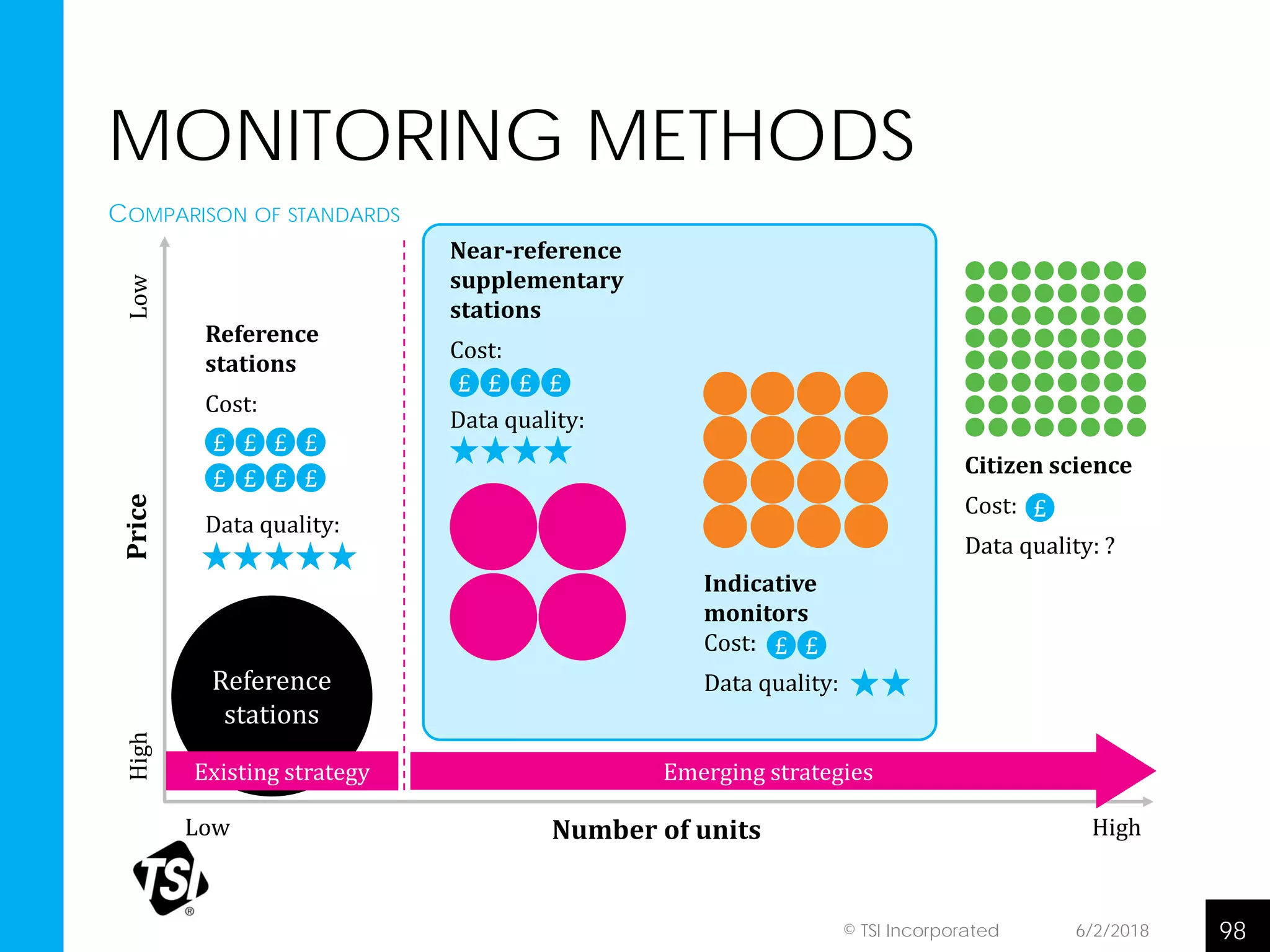
MONITORING METHODS
Occupational health monitoring
Personal exposure
monitoring
Workplace monitoring
Environmental
monitoring
Absorbent tubes (gases)
Gravimetric
Real-time
DustTrak, P-Trak, AeroTrak
Photo Ionisation Detection
Environmental DustTrak
TEOM
BAM
6/2/2018 97© TSI Incorporated
HOW DO I KNOW I HAVE A PROBLEM?
MONITORING METHODS
Reference
stations
Citizen science
Cost:
Data quality: ?
Number of units
Price
HighLow
HighLow
Near-reference
supplementary
stations
Cost:
Data quality:
£ £ £ £
Reference
stations
Cost:
Data quality:
Indicative
monitors
Cost:
Data quality:
£
£ £
£ £ £ £
£ £ £ £
Emerging strategiesExisting strategy
6/2/2018 98© TSI Incorporated
COMPARISON OF STANDARDS
MONITORING METHODS
6/2/2018 99© TSI Incorporated
NEAR REFERENCE
INDICATIVE REFERENCENEAR REFERENCE
1 2 3 4
LOWER £ HIGHER £ £ £
Hot Spot Identification
<30% Error
Supplemental
Monitoring
<20% Error
Personal
Exposure
<30% Error
Regulatory
Monitoring
<10% Error
DUSTTRAK DRX
AEROSOL MONITOR
DUSTTRAK DRX /
ENVIRONMENTAL
AEROSOL MONITORS
ENVIRONMENTAL
PARTICLE COUNTER
ENVIRONMENTAL
DUSTTRAK
AEROSOL MONITORS
Source: U.S. Environmental Protection Agency Air Sensor Guidebook
MONITORING METHODS
+ ‘Sick building Syndrome’
• Dust Monitor for particulate analysis
• Personal Aerosol Monitor for personal
monitoring
• Ultrafine Particle Counter for
nanoparticle count (diesel exhaust)
• Indoor Air Quality Meter for
measurement of
temp/humidity/C02/CO/VOC
6/2/2018 100© TSI Incorporated
INDOOR AIR QUALITY SURVEY TOOLS
FIELDS OF USE AND
APPLICATIONS
6/2/2018
10
1© TSI Incorporated
+ Monitoring methods
+ Fields of use
• Personal monitoring
• Workplace monitoring
• Environmental monitoring
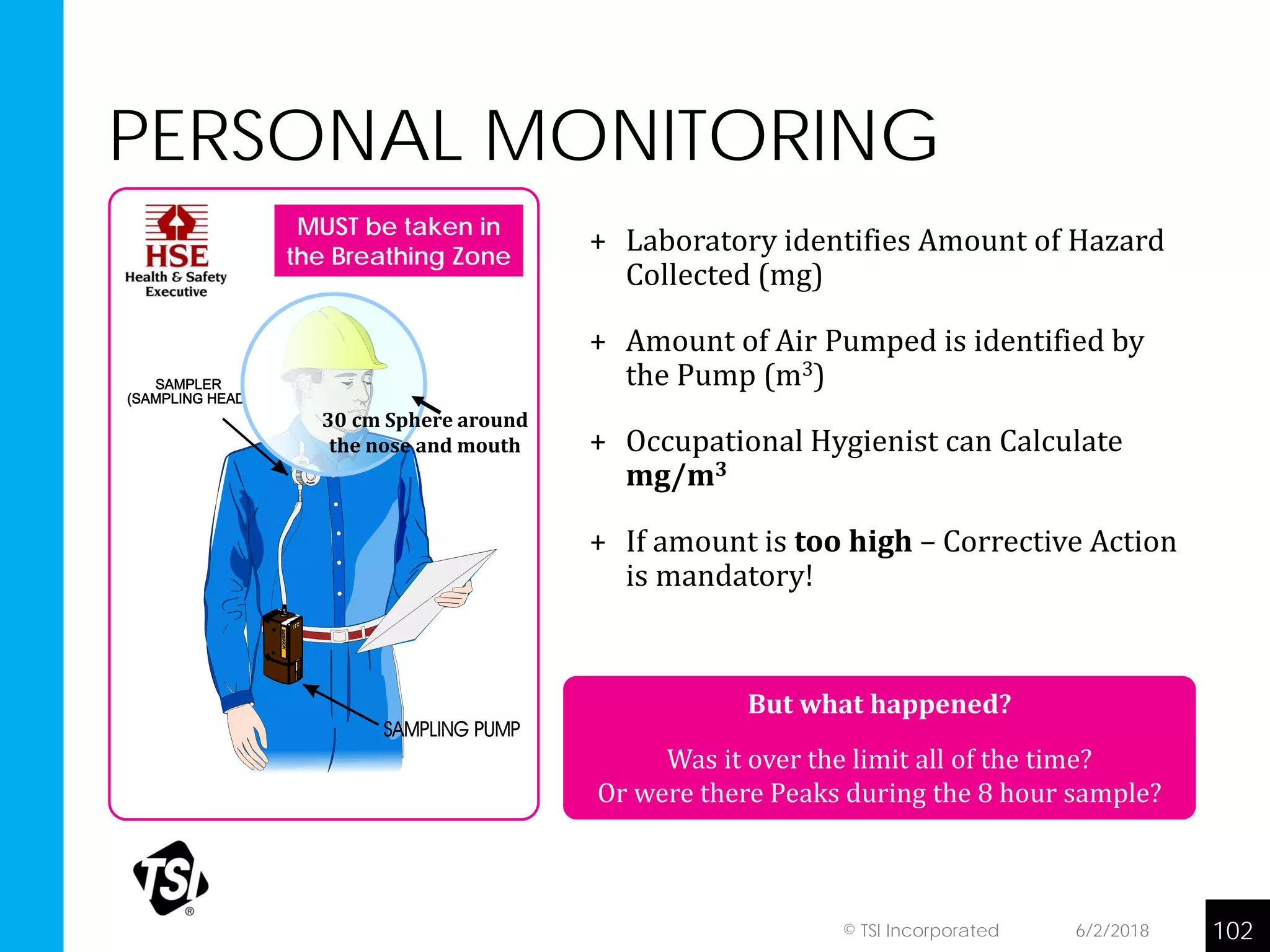
PERSONAL MONITORING
30 cm Sphere around
the nose and mouth
6/2/2018 102© TSI Incorporated
MUST be taken in
the Breathing Zone
+ Laboratory identifies Amount of Hazard
Collected (mg)
+ Amount of Air Pumped is identified by
the Pump (m3)
+ Occupational Hygienist can Calculate
mg/m3
+ If amount is too high – Corrective Action
is mandatory!
But what happened?
Was it over the limit all of the time?
Or were there Peaks during the 8 hour sample?
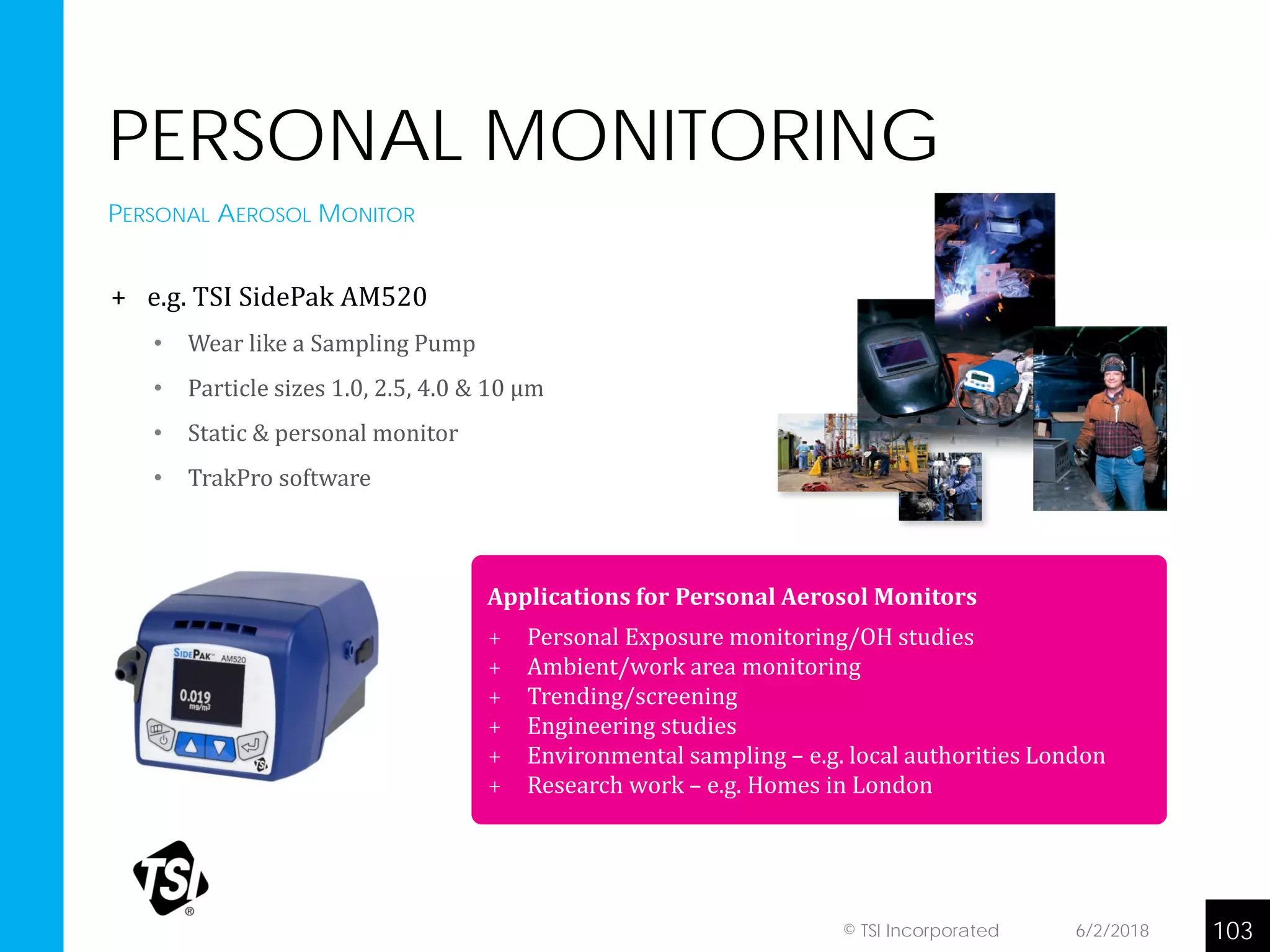
PERSONAL MONITORING
+ e.g. TSI SidePak AM520
• Wear like a Sampling Pump
• Particle sizes 1.0, 2.5, 4.0 & 10 µm
• Static & personal monitor
• TrakPro software
PERSONAL AEROSOL MONITOR
6/2/2018 103© TSI Incorporated
Applications for Personal Aerosol Monitors
+ Personal Exposure monitoring/OH studies
+ Ambient/work area monitoring
+ Trending/screening
+ Engineering studies
+ Environmental sampling – e.g. local authorities London
+ Research work – e.g. Homes in London
PERSONAL MONITORING
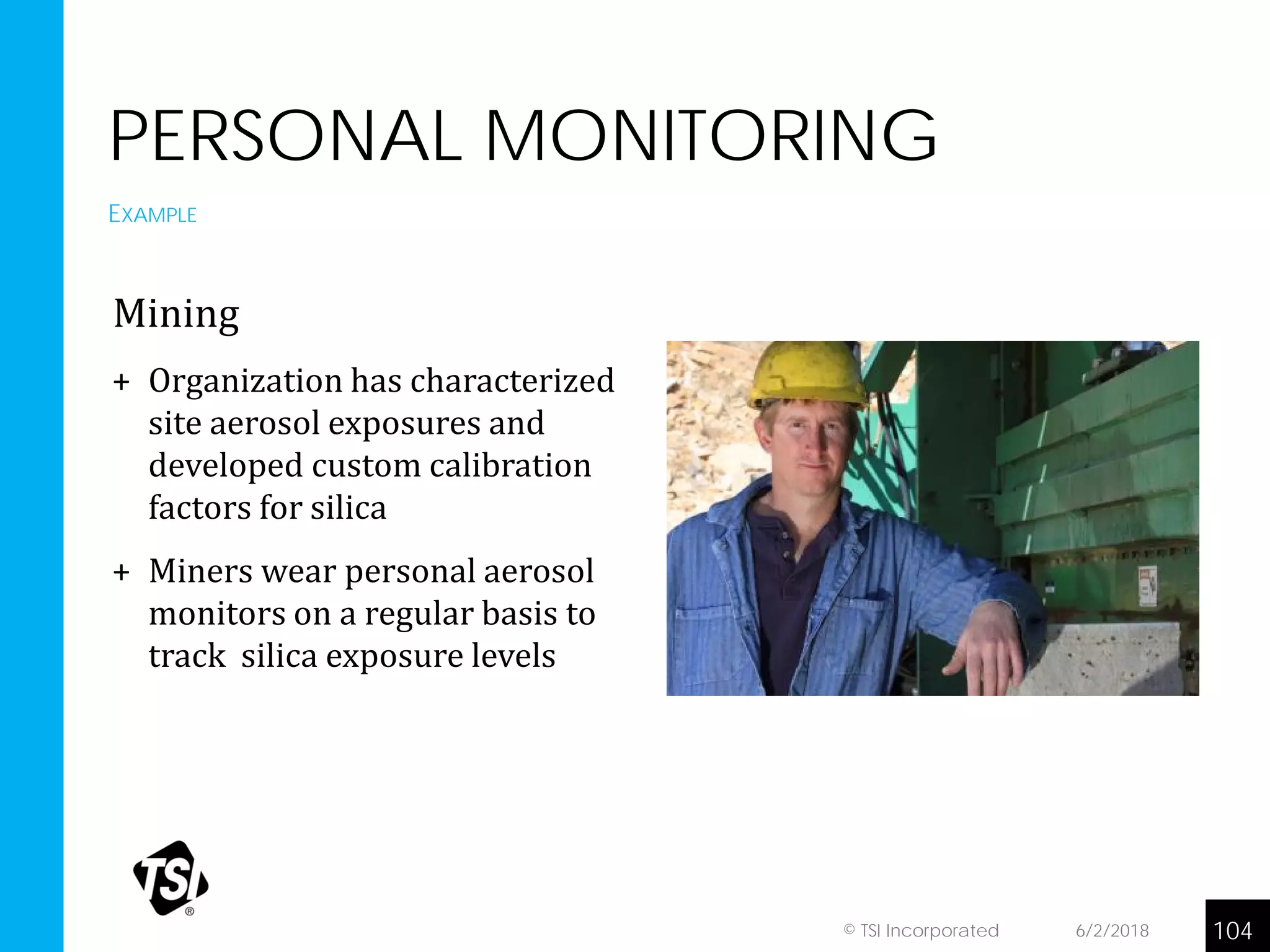
Mining
+ Organization has characterized
site aerosol exposures and
developed custom calibration
factors for silica
+ Miners wear personal aerosol
monitors on a regular basis to
track silica exposure levels
EXAMPLE
6/2/2018 104© TSI Incorporated
FIELDS OF USE AND
APPLICATIONS
6/2/2018
10
5© TSI Incorporated
+ Monitoring methods
+ Fields of use
• Personal monitoring
• Workplace monitoring
• Environmental monitoring
6/2/2018© TSI Incorporated 106
APPLICATIONS
+ Industrial/occupational hygiene
surveys
+ Indoor air quality investigations
+ Baseline trending and screening
+ Point source monitoring
+ Engineering control evaluations
+ Engineering studies
+ Remote monitoring
+ Emissions monitoring
+ Aerosol research studies
+ Environmental (non-regulatory)
monitoring
• Fugitive emissions
• Site perimeter
• Fenceline
• Dust control operations
• Environmental research studies
+ Process monitoring
• Mining industry
• Metal working/machining fluid
monitoring inside enclosures
• Combustion aerosol monitoring with
and without dilution tunnels
• Paper mills
• Grain mills
• Foundry process monitoring
• Paint spray booths
• Paint stripping processes
6/2/2018© TSI Incorporated 107
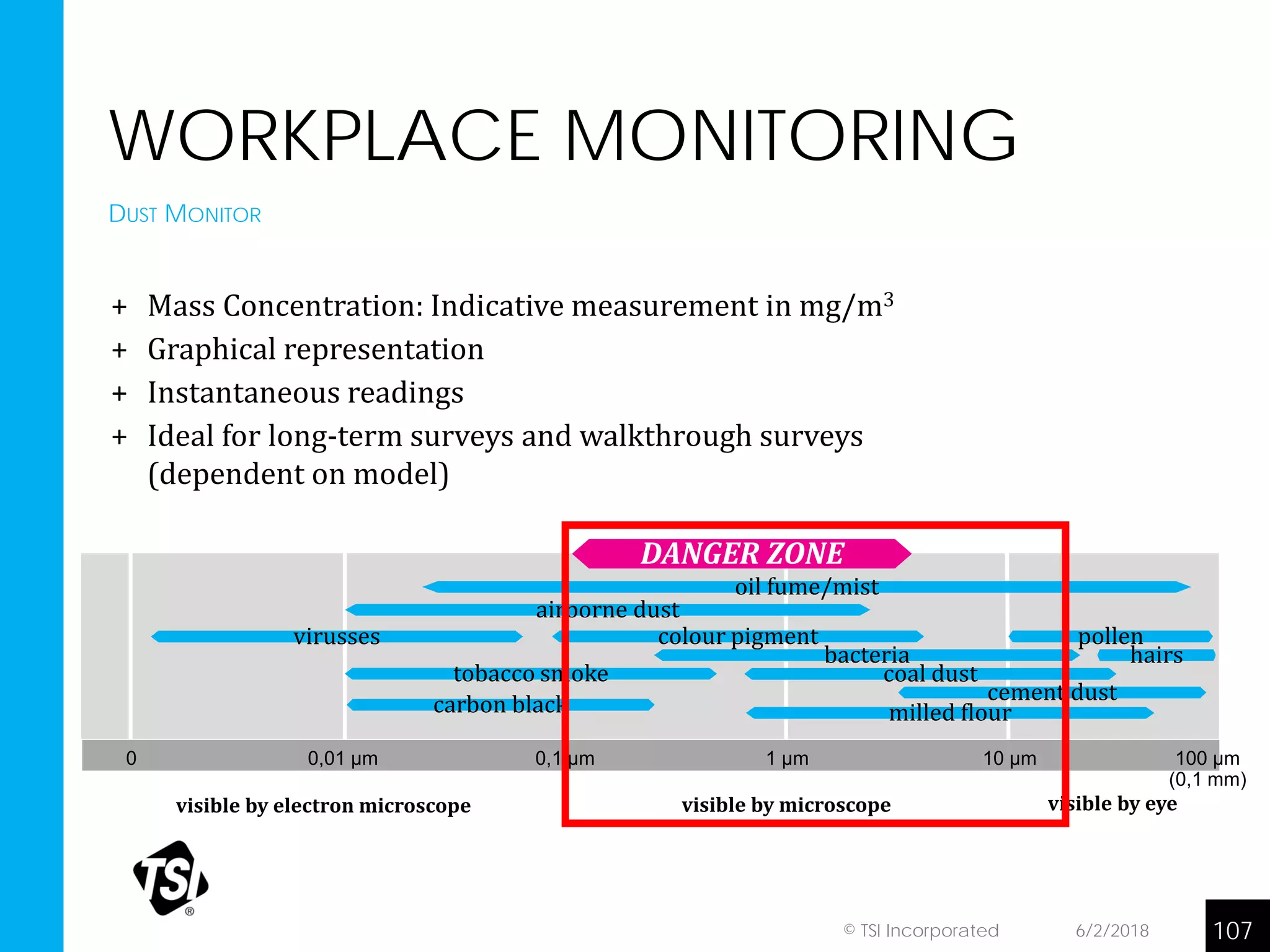
WORKPLACE MONITORING
+ Mass Concentration: Indicative measurement in mg/m3
+ Graphical representation
+ Instantaneous readings
+ Ideal for long-term surveys and walkthrough surveys
(dependent on model)
DANGER ZONE
oil fume/mist
airborne dust
virusses colour pigment pollen
bacteria hairs
tobacco smoke coal dust
carbon black cement dust
milled flour
0 0,01 µm 0,1 µm 1 µm 10 µm 100 µm
(0,1 mm)
visible by electron microscope visible by microscope visible by eye
DUST MONITOR
WORKPLACE MONITORING
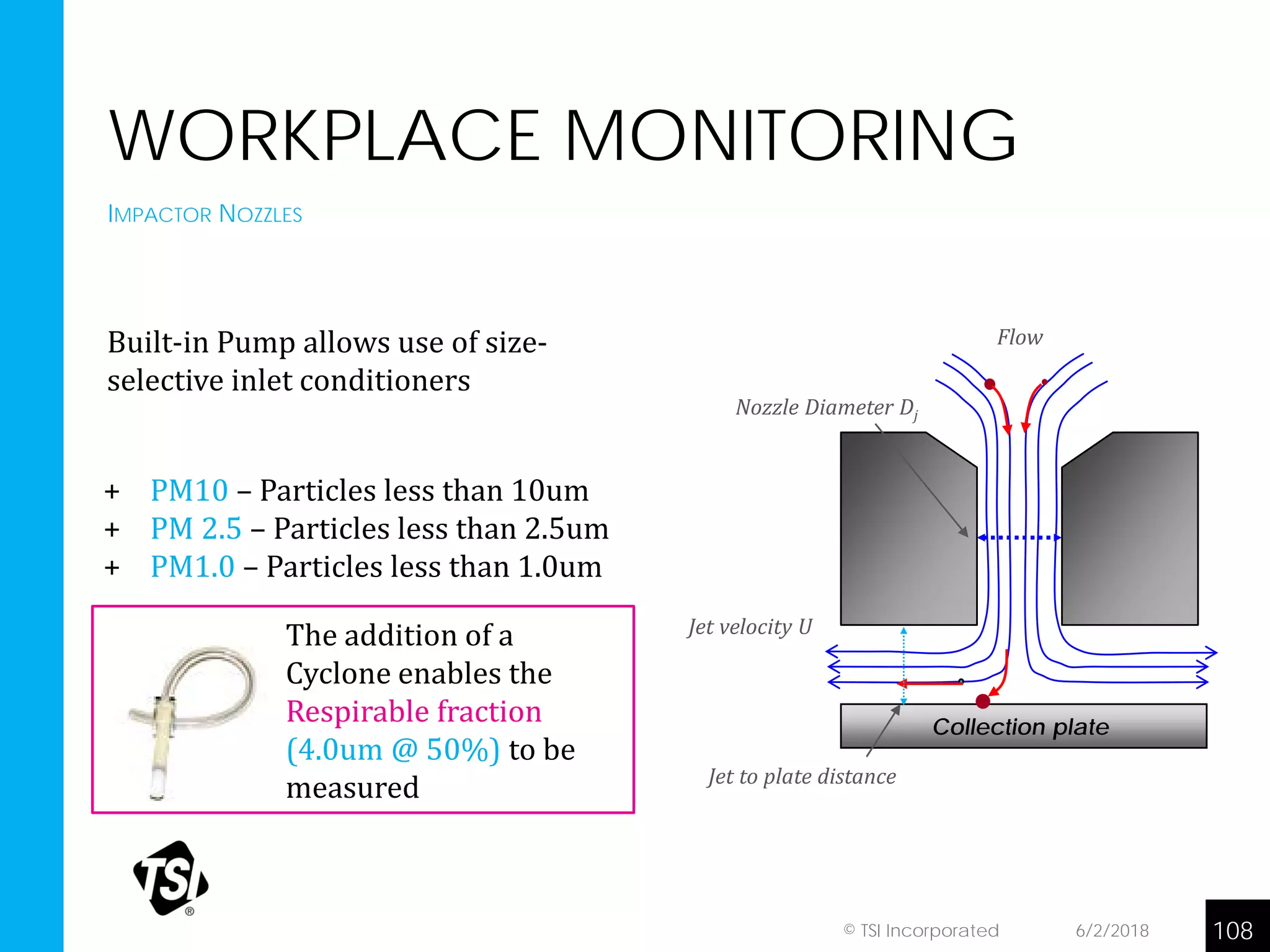
Collection plate
Flow
Nozzle Diameter Dj
Jet to plate distance
Jet velocity U
+ PM10 – Particles less than 10um
+ PM 2.5 – Particles less than 2.5um
+ PM1.0 – Particles less than 1.0um
Built-in Pump allows use of size-
selective inlet conditioners
IMPACTOR NOZZLES
The addition of a
Cyclone enables the
Respirable fraction
(4.0um @ 50%) to be
measured
6/2/2018 108© TSI Incorporated
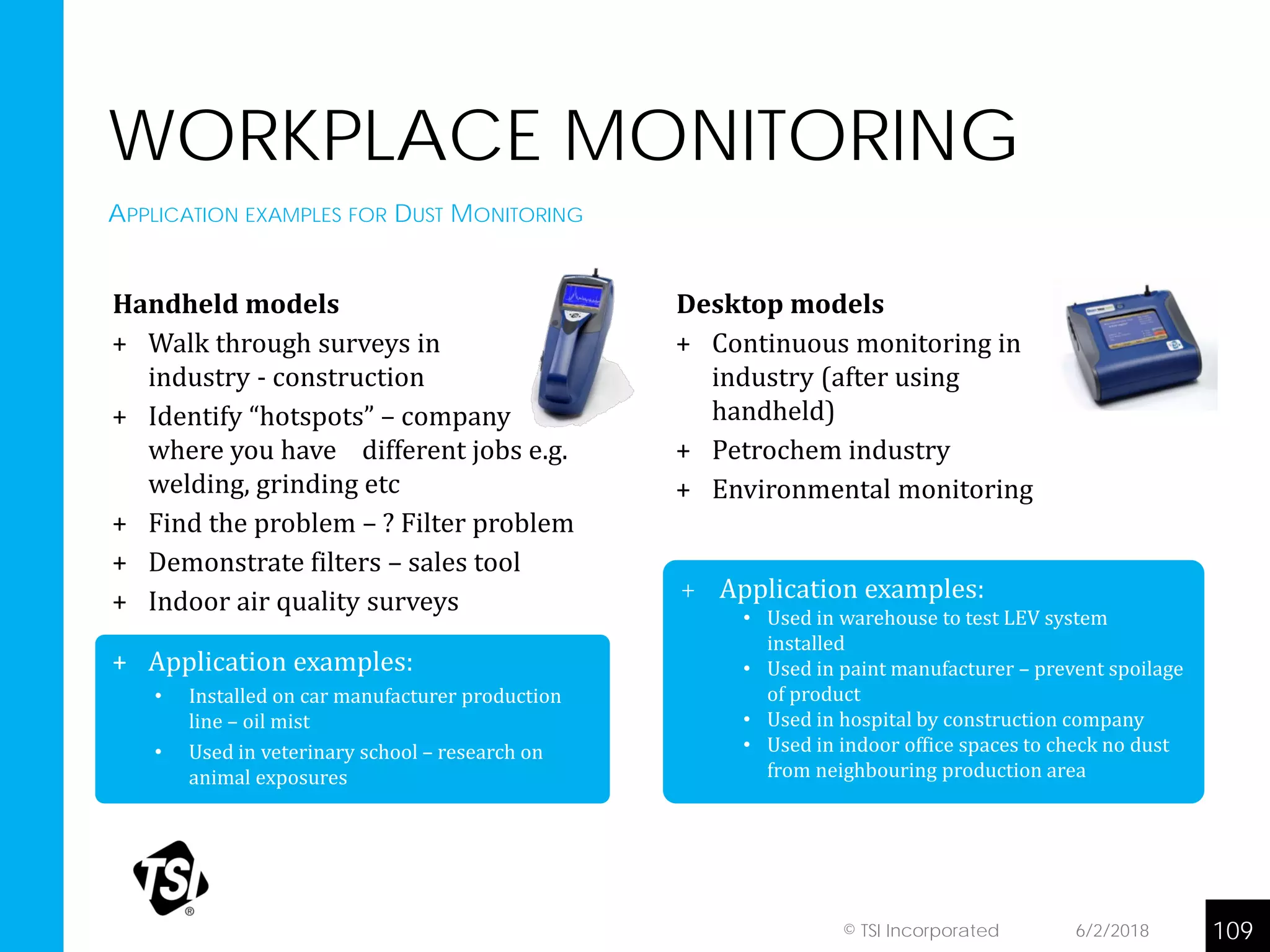
+ Application examples:
• Used in warehouse to test LEV system
installed
• Used in paint manufacturer – prevent spoilage
of product
• Used in hospital by construction company
• Used in indoor office spaces to check no dust
from neighbouring production area
WORKPLACE MONITORING
Handheld models
+ Walk through surveys in
industry - construction
+ Identify “hotspots” – company
where you have different jobs e.g.
welding, grinding etc
+ Find the problem – ? Filter problem
+ Demonstrate filters – sales tool
+ Indoor air quality surveys
+ Application examples:
• Installed on car manufacturer production
line – oil mist
• Used in veterinary school – research on
animal exposures
APPLICATION EXAMPLES FOR DUST MONITORING
6/2/2018 109© TSI Incorporated
Desktop models
+ Continuous monitoring in
industry (after using
handheld)
+ Petrochem industry
+ Environmental monitoring
WORKPLACE MONITORING
Risks of particles/dusts/mists from:
+ Welding – dust from gouging and
abrasive blasting
+ Engineering – dusts from
mechanical cutting, shaping and
abrasive blasting
+ Metal working – mists in metal
working fluids, lubricant oil mists,
machining fluids
+ Vehicle/object paint spraying
+ Paint stripping processes
INDUSTRY
6/2/2018 110© TSI Incorporated
WORKPLACE MONITORING
Risk of exposure to
+ Hardwood and softwood
dusts
+ Dusts from hardboard,
MDF, Plywood
+ Adhesives, paints,
varnishes
WOODWORKING
6/2/2018 111© TSI Incorporated
WORKPLACE MONITORING
ULTRAFINE PARTICLE COUNTER
6/2/2018 112© TSI Incorporated
Features:
+ New concept for air monitoring
Condensation particle counter
+ Particles size range 20nm – 1micron
+ Measured in particles / cc
+ Ultrafine and Nanoparticles
+ Application examples:
• Installed on car manufacturer production
line – oil mist
• Used in veterinary school – research on
animal exposures
Users:
+ Anyone working with nanoparticles
+ Cutting/grinding of nanomaterials
+ Indoor air quality surveys – diesel
exhaust
+ Environmental monitoring –
ultrafine particles
+ Finding “hotspots”
You can’t solve a problem you can’t find!!
WORKPLACE MONITORING
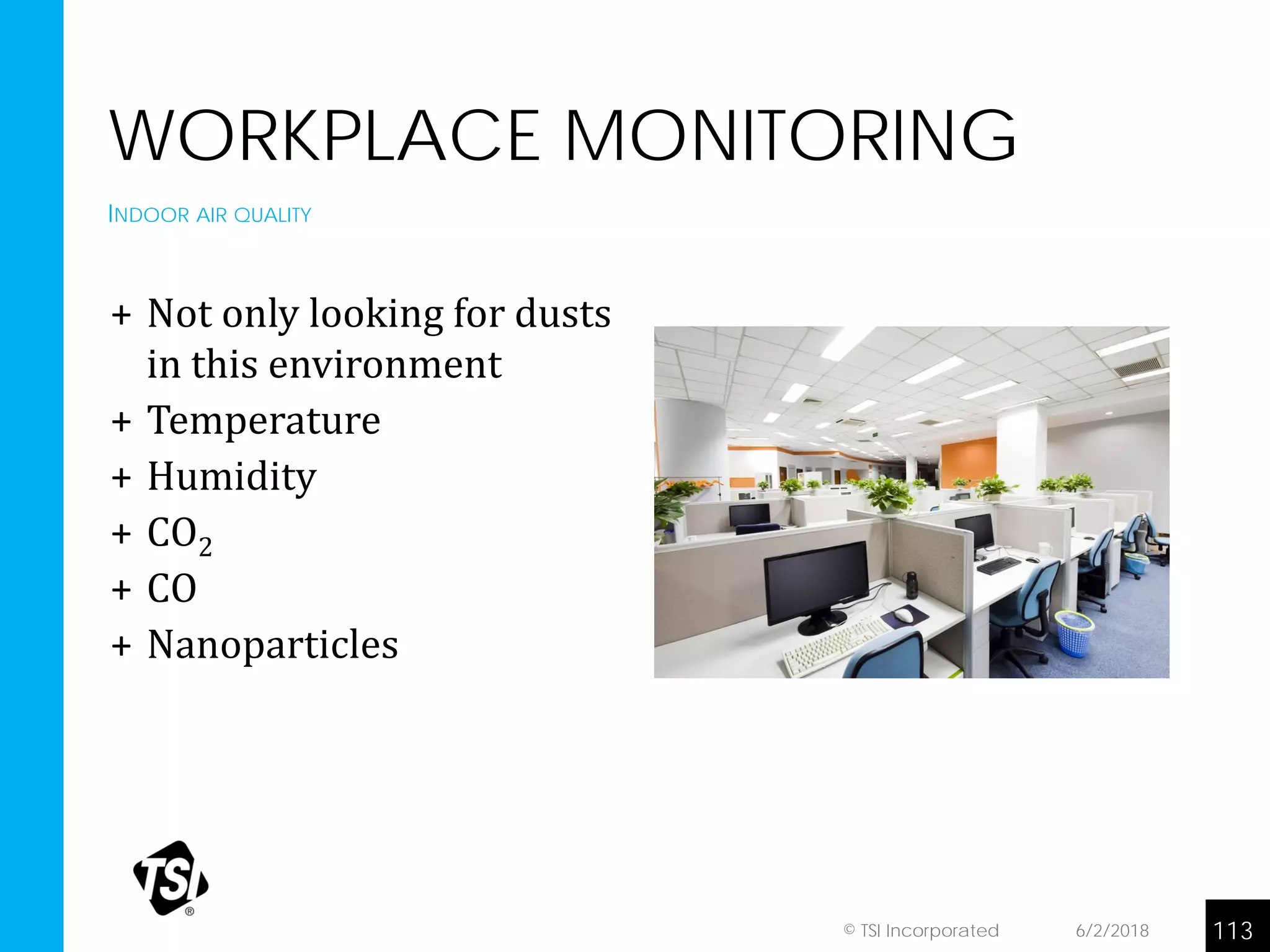
+ Not only looking for dusts
in this environment
+ Temperature
+ Humidity
+ CO2
+ CO
+ Nanoparticles
INDOOR AIR QUALITY
6/2/2018 113© TSI Incorporated
WORKPLACE MONITORING
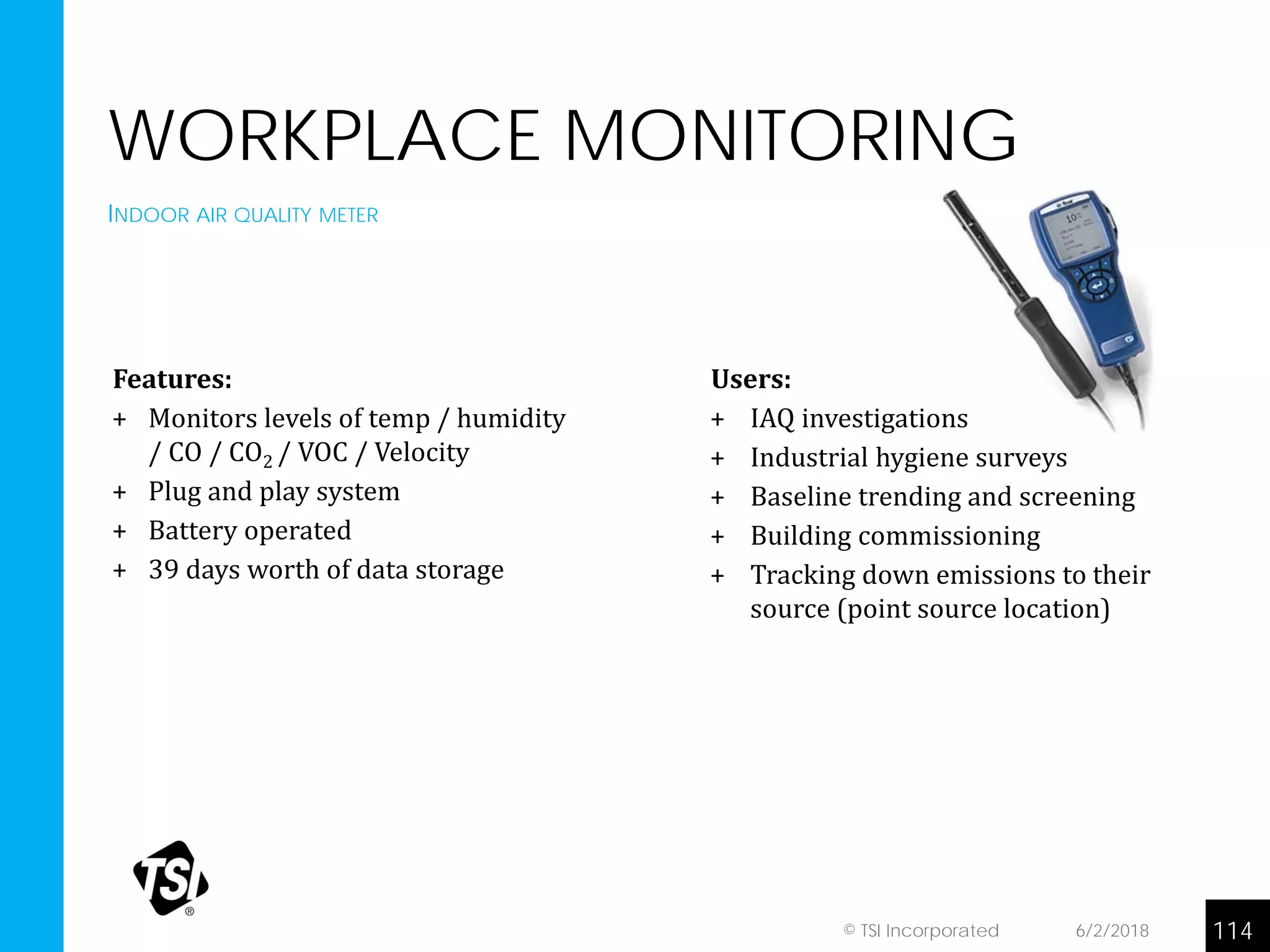
INDOOR AIR QUALITY METER
6/2/2018 114© TSI Incorporated
Features:
+ Monitors levels of temp / humidity
/ CO / CO2 / VOC / Velocity
+ Plug and play system
+ Battery operated
+ 39 days worth of data storage
+ Application examples:
• Installed on car manufacturer production
line – oil mist
• Used in veterinary school – research on
animal exposures
Users:
+ IAQ investigations
+ Industrial hygiene surveys
+ Baseline trending and screening
+ Building commissioning
+ Tracking down emissions to their
source (point source location)
FIELDS OF USE AND
APPLICATIONS
6/2/2018
11
5© TSI Incorporated
+ Monitoring methods
+ Fields of use
• Personal monitoring
• Workplace monitoring
• Environmental monitoring
ENVIRONMENTAL MONITORING
+ Carried out by local
authorities/research
groups/local communities
+ Perform real time monitoring –
results uploaded to central
network via modem link
+ Use environmental accessories
such as enclosures/heated inlet
to achieve accurate results
6/2/2018 116© TSI Incorporated
ENVIRONMENTAL MONITORING
+ Outdoor construction Sites
+ Remote monitoring
+ Agriculture
+ Mining / quarries
+ Engineering studies
• Worker exposure
• Community exposure
• Baseline trending and screening
• Point source monitoring
• Engineering control evaluations
+ Environmental (non-regulatory)
monitoring
• Fugitive emissions
• Site perimeter
• Fence-line
• Dust control operations
• Hazardous waste sites
• Remediation Sites
• Forest Fires
+ Process monitoring
• Mining industry
• Paper mills
• Grain mills
• Foundry process monitoring
MARKET SEGMENTS & APPLICATIONS
6/2/2018 117© TSI Incorporated
ENVIRONMENTAL MONITORING
+ Environmental Dust Monitor (e.g.
Environmental DustTrak):
• provides near reference quality PM data
• Multi Pollutant Platform (VOC, Noise, WS/WD)
• reliable (i.e., up all the time; 24/7)
• provides real-time data quickly to decision
makers
• easy to set up and operate ( <45min vs. 4 hours)
• Built in heated inlet (mitigate humidity effects)
• Automatic zeroing
• Field replaceable longer life pump
• cloud based data management system
EQUIPMENT
6/2/2018 118© TSI Incorporated
ENVIRONMENTAL MONITORING
+ Industrial Fence-line / Industry (outdoor but also indoor)
• Real time monitoring allows immediate response
• Demonstrate impact on local receptors / compliance
• Corporate Social Responsibility
+ Air Quality Consultants / Engineering Offices
• Tools for deployment on multiple client projects
• Increased temporal and spatial analysis
• Baseline EIA studies
+ Municipal Networks
• Supplement or extend the existing reference network
• Mobile and hot spot monitoring
• Special purpose / location monitoring
+ Universities and Research
• Introduce practicalities of air quality cost effectively
• Advance epidemiological research through higher temporal and
spatial resolution
MAIN TARGET CUSTOMER FOCUS
6/2/2018 119© TSI Incorporated
ENVIRONMENTAL MONITORING
Risk of exposure to:
+ Silica dust – created when working on
silica-containing materials like concrete,
mortar and sandstone (also known as
respirable crystalline silica or RCS)
+ Wood dust
+ Lower toxicity dusts
+ Used for OH reasons but also to prove dust
from job is not affecting nearby areas such
as school/hospital etc.
CONSTRUCTION
6/2/2018 120© TSI Incorporated
ENVIRONMENTAL MONITORING
+ Problem: Construction Site – Dust produced by heavy vehicles
on main route past office buildings
+ Project: Long term monitoring project, during construction of
Biomass site
+ Instrument: Environmental DustTrak
+ Greatest benefit: Unmanned monitoring with cloud access
• Staff on site feel happier, knowing that any potential issues can be
recognized and resolved
EXAMPLE: CONSTRUCTION – ASHINGTON CONSTRUCTION, UNITED KINGDOM
6/2/2018 121© TSI Incorporated
ENVIRONMENTAL MONITORING
+ Application: Measuring dust during the construction of a hospital
+ Problem: Time vs cost. If they had bought a portable instrument, it
had cost half the price of a stand-alone instrument but a person had
to measure every day.
+ Instrument: Environmental DustTrak
+ Project: They used the instrument to measure dust that arises from
building and hospital for one hour per day.
The instrument was able to fulfil their requirements on measuring
PM10, so they are very happy with the solution.
+ Greatest benefit: Web Access with Environet
EXAMPLE: CONSTRUCTION – BOUYGUES CONSTRUCTION, FRANCE
6/2/2018 122© TSI Incorporated
ENVIRONMENTAL MONITORING
+ Monitor around a company’s perimeter
+ Real time continuous monitoring
+ Construction sites
+ Environmental pollution (e.g. power stations)
FENCELINE MONITORING & FUGITIVE EMISSIONS
6/2/2018 123© TSI Incorporated
ENVIRONMENTAL MONITORING
+ Most sites will require multiple
monitoring stations
+ Wind speed and direction
+ Wireless / Cloud connectivity
• Real time data
• Quicker decisions
• Saves time
• Saves money
Mine Operation Monitoring Example
X = Operations Office
1 – 8 = monitoring locations
EXAMPLE: FENCELINE MONITORING
6/2/2018 124© TSI Incorporated
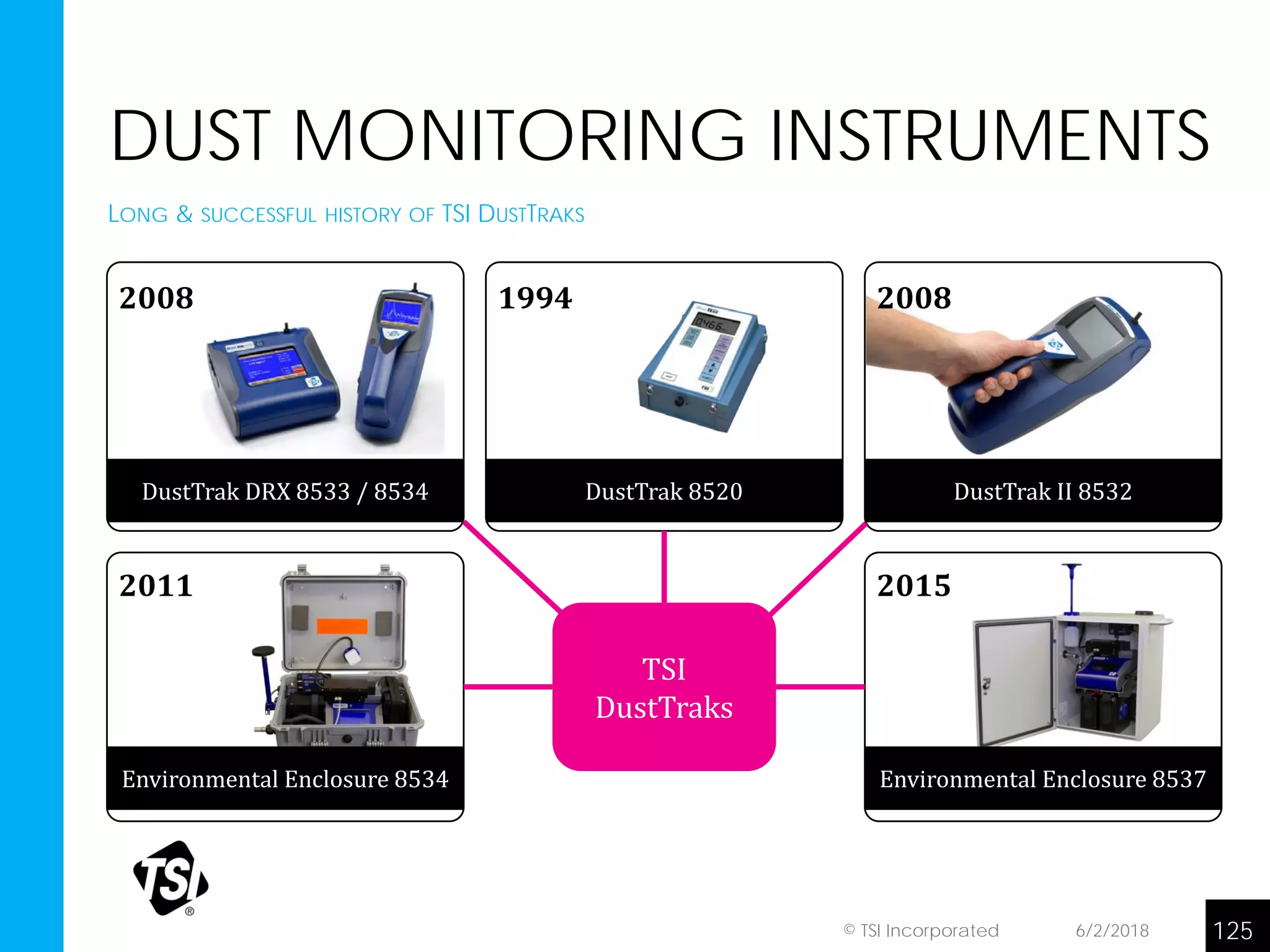
TSI
DustTraks
DUST MONITORING INSTRUMENTS
DustTrak DRX 8533 / 8534
2008
DustTrak 8520
1994
DustTrak II 8532
2008
Environmental Enclosure 8534
2011
Environmental Enclosure 8537
2015
LONG & SUCCESSFUL HISTORY OF TSI DUSTTRAKS
6/2/2018 125© TSI Incorporated
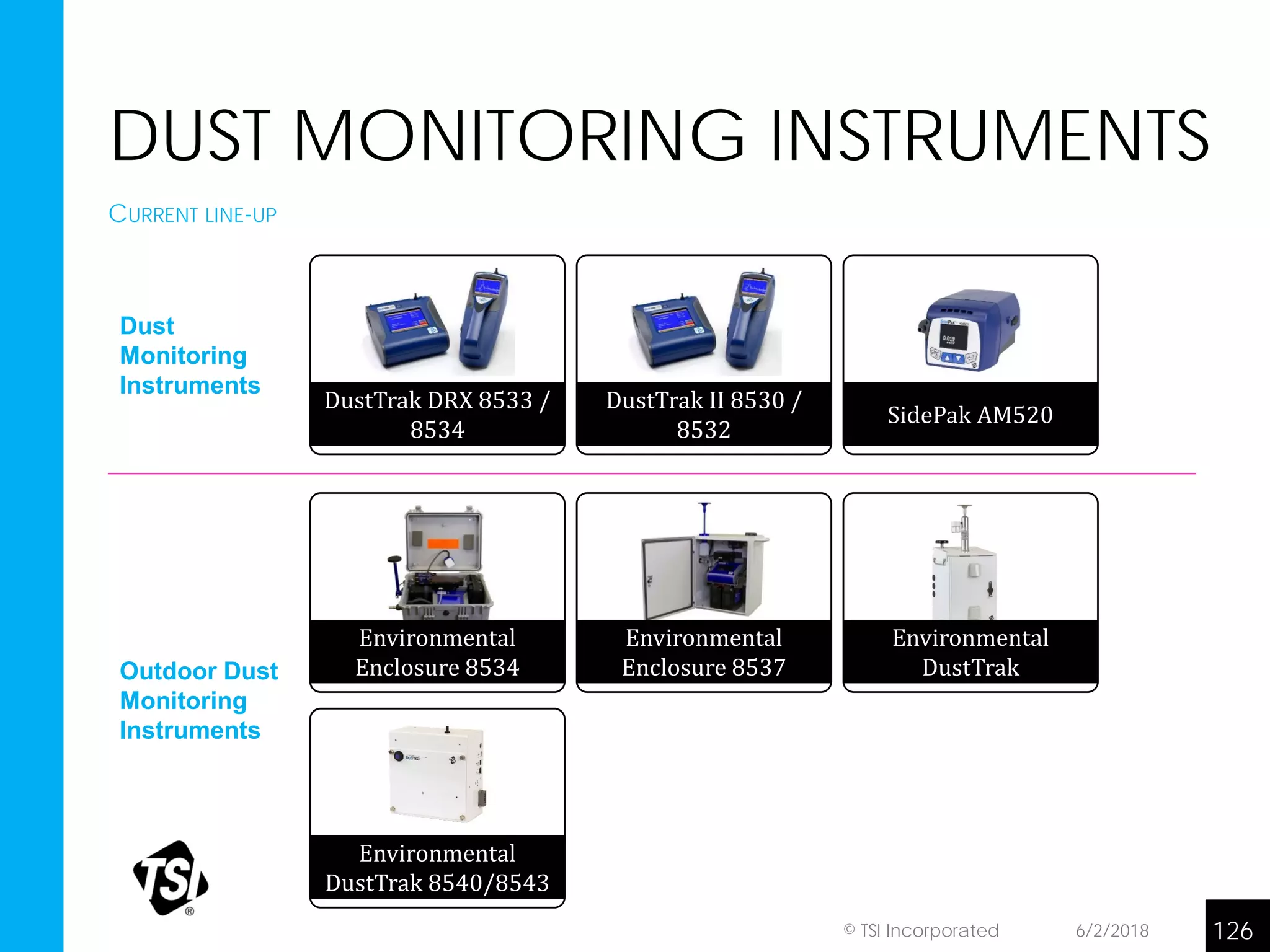
DUST MONITORING INSTRUMENTS
CURRENT LINE-UP
6/2/2018 126© TSI Incorporated
Dust
Monitoring
Instruments
Outdoor Dust
Monitoring
Instruments
DustTrak DRX 8533 /
8534
DustTrak II 8530 /
8532
SidePak AM520
Environmental
DustTrak 8540/8543
Environmental
Enclosure 8534
Environmental
Enclosure 8537
Environmental
DustTrak
6/2/2018© TSI Incorporated 127
THINGS WE COVERED
+ Monitoring methods
+ Different fields of use:
• Personal Monitoring
• Workplace Monitoring
• Environmental Monitoring
QUESTIONS?
1286/2/2018© TSI Incorporated

Workplace and Environmental Dust Monitoring seminar BSRIA and TSI HSE presentations 31-5-18

  • 1.
  • 2.
    AGENDA 6/2/2018 2© TSIIncorporated + Part I: Particles basics and the need of measuring dust + Part II: Measuring methodology and instruments + Part III: Dust and the selection and use of RPE + Part IV: Fields of use and applications
  • 3.
    PARTICLES BASICS ANDTHE NEED OF MEASURING DUST 36/2/2018© TSI Incorporated Alan Gilbert, BSRIA Instrument Solutions General Manager E : alan.gilbert@bsria.co.uk T : 01344 459314
  • 4.
    AGENDA 6/2/2018 4© TSIIncorporated + What are particles + Why do we need to measure dust • Health protection • Environmental protection • Product protection • Process protection • Protection from compensation claims • Regulations & legal obligations
  • 5.
    6/2/2018© TSI Incorporated5 ARE ALL PARTICLES SPHERES? 10 µm 7 µm 5 µm 3 µm 2 µm 1 µm 0.7 µm 0.5 µm 0.3 µm 0.2 µm0.1 µm
  • 6.
    6/2/2018© TSI Incorporated6 REAL PARTICLES ARE NOT SPHERES + Liquid droplets (clouds and fog) are spheres + Generated aerosols are often formed as spherical droplets • When dried into solid particles they are not true spheres + Dust + Fly Ash + Milled Flour + Spores + Bacteria + Coal Dust + Fibers Hollow spheres NaCl particles dried from VOAG droplets Real Life AerosolsSoot particle
  • 7.
    6/2/2018© TSI Incorporated7 CHARACTERISTICS OF PARTICLES + Size + Shape + Density + Refractive Index + Size Distribution
  • 8.
    6/2/2018© TSI Incorporated8 PARTICLE SIZE CONCEPT The diameter of particle varies depending on the measurement method (all are right – all are wrong) Real Particle Stokes diameter Aerodynamic diameter Optical diameter Bulk density Unit density Optical properties + Mobility diameter Charging, electric field SEM picture
  • 9.
  • 10.
    6/2/2018© TSI Incorporated10 AMBIENT PARTICLE SIZES 0.001 0.01 0.1 1 10 100 Particle Size Range (micrometers) TypesofParticles BacteriaVirus Oil Smoke Sea salt Nuclei Diesel Engine Exhaust Combustion Nuclei Soot Wind Blown Dust Volcanic Emissions Coal Ash Fly Ash Inhalable (Total dust) Respirable Thoracic Pollen
  • 11.
    6/2/2018© TSI Incorporated11 WORKPLACE PARTICLE SIZES 0.001 0.01 0.1 1 10 100 Particle Size Range (micrometers) TypesofParticles Welding Fumes BacteriaVirus Paint Pigments Diesel Soot (Dieselized Coal Mines) Boilers/ Furnaces Virus Carbon Black (Photocopiers) Coal Dust (Coal Mines) Construction Activities Vacuuming/Dusting Tobacco Smoke Inhalable (Total dust) Respirable Thoracic
  • 12.
    6/2/2018© TSI Incorporated12 SIZE FRACTIONS BASED ON AERODYNAMIC SIZE
  • 13.
    6/2/2018© TSI Incorporated13 AEROSOL with Solid Particles Gas Aerosol Particle diameter 1 nm to ~1 mm Typical concentrations: Room air: 10,000 #/cm³ Traffic site: >100,000 #/cm³ Clean room: <10 #/cm³ Suspension of solid or liquid particles in a gas Liquid Particles and / or DEFINITION
  • 14.
    AEROSOL + Aerosols absorb,reflect, refract and diffract light + Light passing through an aerosol concentration is affected by the properties of the aerosol. 6/2/2018 14© TSI Incorporated PROPERTIES
  • 15.
    6/2/2018© TSI Incorporated15 DEFINITIONS DUST, FUME, MIST, VAPOUR + Dust is a suspension of solid particles in air, formed by mechanical processes or blown up + Fume is a suspension of solid particles in air, formed by thermal and/or chemical processes + Mist is a suspension of liquid particles in air, formed by condensation or dispersion + Vapour is a suspension of gases or substances in gas phase in air Dust, Fume and Mist are also called particulate matter
  • 16.
  • 17.
    PARTICLES BASICS ANDTHE NEED OF MEASURING DUST 6/2/2018 17© TSI Incorporated + What are particles + Why do we need to measure dust • Health protection • Environmental protection • Product protection • Process protection • Protection from compensation claims • Regulations & legal obligations
  • 18.
    HEALTH PROTECTION + Healtheffects from certain particles and fibres known to cause harm to human health + environment + Some materials cause immediate impact, other may take many years to develop + Essential to keep exposure of particle pollution to a minimum (for workers on site and people living and working outside the activity boundary) 6/2/2018 18© TSI Incorporated
  • 19.
    HEALTH PROTECTION + Potentialeffects of particles on People + Estimated 40,000 deaths at typical ages and associated loss of total population life of 468,965 life-years* due to the burden of long- term exposure to outdoor particulate air pollution (2016, UK) + Even higher if indoor air pollution is considered + Nuisance caused by dirty environment *Royal College of Physicians and the Royal College of Paediatrics and Child Health 2016 6/2/2018 19© TSI Incorporated REASONS WHY CONTROL IS IMPORTANT
  • 20.
    HEALTH PROTECTION + Historically,many of the materials produced during construction/operations have been subject to investigation and control, mainly with regard to occupational hygiene and the protection of the workforce + Only limited attention to regulating the exposure of the general populace to these materials when they cross site boundary + There are some exceptions to this generalisation, asbestos for example is covered by specific regulations 6/2/2018 20© TSI Incorporated REASONS WHY CONTROL IS IMPORTANT
  • 21.
  • 22.
    HEALTH PROTECTION + Scientifically-established harmfuleffects leading to research & regulations with the goal to protect • Human health • Environment + Nuisance effects • Visibility • “Dirty” environment 6/2/2018 22© TSI Incorporated WHY MEASURE PARTICULATE MATTER (PM)?
  • 23.
    HEALTH PROTECTION + Smallparticle low in mass but can cause major health effects + Occupational exposure limits for aerosols (~0.1-100µm) are based on mass + Occupational hygienists interested in PM 4 and below 6/2/2018 23© TSI Incorporated WHY IS PARTICLE SIZE IMPORTANT?
  • 24.
    6/2/2018© TSI Incorporated24 HEALTH PROTECTION Based on International Commission of Radiological Protection (1994) and U.S. Environmental Protection Agency (1996a). Air Quality Criteria for Particulate matter, 2004, p 6-5. Extrathoracic Area >PM10 PM10- PM2.5 PM2.5 Tracheobronchiale Area (TB) Alveolar Area (A) LUNG DEPOSITION – TRADITIONAL WORKPLACE EXPOSURE LIMITS
  • 25.
    PARTICLES BASICS ANDTHE NEED OF MEASURING DUST 6/2/2018 25© TSI Incorporated + What are particles + Why do we need to measure dust • Health protection • Environmental protection • Product protection • Process protection • Protection from compensation claims • Regulations & legal obligations
  • 26.
  • 27.
    ENVIRONMENTAL PROTECTION + LocalAuthorities required to work towards achieving national air quality objectives (Part IV of the Environment Act (1995), UK Air Quality Strategy) + Nuisance dust emissions from construction and other civil engineering activities are a well-recognised problem + Dusts from construction processes contain wide range of particle sizes and material types (e.g. silica) + Can cause minor and serious health problems, also discomfort to the eyes, nose, mouth, respiratory tract and skin 6/2/2018 27© TSI Incorporated REASONS WHY CONTROL IS IMPORTANT
  • 28.
    ENVIRONMENTAL PROTECTION + Potentialeffects of particles on the environment • Landscape & Loss of visual amenity • Alteration of leaf surface chemistry that may affect disease resistance • Addition of nutrients from the dust that may lead to increased growth and/or deficiencies. • Cultural heritage – Surface soiling and damage during cleaning • Soil pollution via deposition from the air or water run-off ⇒ Environmentally friendly site to establish good relationships between companies, contractors, regulators & local residents + Benefits will be felt at both corporate and project levels and include: • Reduction in the level of complaint from local residents • Lessening of the impact on local air quality • Reduction in the soiling of property, thereby reducing the costs of cleaning 6/2/2018 28© TSI Incorporated REASONS WHY CONTROL IS IMPORTANT
  • 29.
    ENVIRONMENTAL PROTECTION + Reductionin the number of environmental offences and hence Prosecutions by Local Authorities + Less time and money wasted in defending prosecutions and repairing environmental damage + Reduction in the site engineer’s workload by avoiding conflicts 6/2/2018 29© TSI Incorporated REASONS WHY CONTROL IS IMPORTANT
  • 30.
    PARTICLES BASICS ANDTHE NEED OF MEASURING DUST 6/2/2018 30© TSI Incorporated + What are particles + Why do we need to measure dust • Health protection • Environmental protection • Product protection • Process protection • Protection from compensation claims • Regulations & legal obligations
  • 31.
    6/2/2018© TSI Incorporated31 PRODUCT PROTECTION + Customer complaints + Health issues
  • 32.
    PARTICLES BASICS ANDTHE NEED OF MEASURING DUST 6/2/2018 32© TSI Incorporated + What are particles + Why do we need to measure dust • Health protection • Environmental protection • Product protection • Process protection • Protection from compensation claims • Regulations & legal obligations
  • 33.
    PROCESS PROTECTION + Effectsproduction + Downtime + Costs time/money 6/2/2018 33© TSI Incorporated
  • 34.
    PARTICLES BASICS ANDTHE NEED OF MEASURING DUST 6/2/2018 34© TSI Incorporated + What are particles + Why do we need to measure dust • Health protection • Environmental protection • Product protection • Process protection • Protection from compensation claims • Regulations & legal obligations
  • 35.
    PROTECTION FROM COMPENSATION CLAIMS +Companies are prosecuted for dust exposure limits being exceeded + Examples: §§ 6/2/2018 35© TSI Incorporated STONEMASONRY BUSINESS FINED OVER STONE LEVELS FOR EMPLOYEES BETWEEN 100% AND 300% OF SAFE LEVELS
  • 36.
    PARTICLES BASICS ANDTHE NEED OF MEASURING DUST 6/2/2018 36© TSI Incorporated + What are particles + Why do we need to measure dust • Health protection • Environmental protection • Product protection • Process protection • Protection from compensation claims • Regulations & legal obligations
  • 37.
    REGULATIONS & LEGAL OBLIGATIONS +What are the Legal Obligations? ‘The employer has an overriding duty and first priority to consider how to prevent employees being exposed to substances hazardous to health by All Routes.’ 6/2/2018 37© TSI Incorporated LEGISLATIONS INVOLVED
  • 38.
    REGULATIONS & LEGAL OBLIGATIONS +CEN: EN 481: Workplace atmospheres – Size fraction definitions for measurement of airborne particles + ISO: ISO 7708: Air quality – Particle size fraction definitions for health related sampling EN481 and ISO 7708 will be revised and extended. The committee work has already begun. INTERNATIONAL STANDARDS ON SIZE FRACTIONS
  • 39.
    REGULATIONS & LEGAL OBLIGATIONS COSSH:Control of Substances Hazardous to Health ACoP: Approved Code Of Practice 6/2/2018 39© TSI Incorporated + Law which requires employers to control substances hazardous to health + List of industries + Specific work tasks + Specific substances hazardous to health + WEL’s – TWA and STEL UK IS ONE STEP AHEAD – COSHH WWW.HSE.GOV.UK/COSHH
  • 40.
    REGULATIONS & LEGAL OBLIGATIONS +Exposure to a substance is uptake into the body + Occurs by breathing, skin, swallowing and injection + 500 substances have listed WEL in EH40/2005 + The only way to know if you are under the WEL is by monitoring 6/2/2018 40© TSI Incorporated WORKPLACE EXPOSURE LIMITS (WEL)
  • 41.
    REGULATIONS & LEGAL OBLIGATIONS +Personal exposure and health research + Compliance and regulatory strategies + Evaluate effectiveness of current controls and assess exposure in communities + Timely public reporting, air quality index, and forecasting ⇒ Network of reference (equivalent) instruments - Expensive (purchase & cost of ownership) - Operator training, large footprint, power consumption 6/2/2018 41© TSI Incorporated AREAS OF INTEREST & HOW
  • 42.
    REGULATIONS & LEGAL OBLIGATIONS Source:EU Directive:2008/50/EC “Air Quality Directive” 6/2/2018 42© TSI Incorporated IMMISSION LIMIT VALUES AND DEADLINES
  • 43.
  • 44.
    REGULATIONS & LEGAL OBLIGATIONS +Department of Environment, Food & Rural Affairs (DEFRA) + The government strategy for improvements in air quality + Available at: https://www.gov.uk/government/p ublications/2010-to-2015- government-policy-environmental- quality/2010-to-2015-government- policy-environmental-quality 6/2/2018 44© TSI Incorporated ENVIRONMENTAL QUALITY
  • 45.
    REGULATIONS & LEGAL OBLIGATIONS MCERTSis the Environment Agency of England & Wales (EA) Monitoring Certification Scheme. It provides the framework for businesses to meet quality requirements. Compliance with MCERTS gives the EA confidence in the monitoring of emissions to the environment. 6/2/2018 45© TSI Incorporated MCERTS
  • 46.
    REGULATIONS & LEGAL OBLIGATIONS +Greater London Authority – Control of dust and emissions updated in 2014 + New London Mayor quoted: “I have been elected with a clear mandate to clean up London’s air - our biggest environmental challenge”, Khan said at a school in east London 6/2/2018 46© TSI Incorporated CONTROL OF DUST AND EMISSIONS
  • 47.
    REGULATIONS & LEGAL OBLIGATIONS +Institute of Air Quality management: The Institute of Air Quality Management (IAQM) is committed to enhancing the understanding and development of the science behind air quality by promoting knowledge and understanding of best working practices. Constructing buildings, roads and other infrastructure can have a substantial, temporary impact on local air quality. The most common impacts are increased particulate matter (PM) concentrations and dust soiling. 6/2/2018 47© TSI Incorporated AIR QUALITY PAPERS AND RESEARCH
  • 48.
    6/2/2018 REGULATIONS & LEGAL OBLIGATIONS +Increasing public awareness of the issue via media exposure + Increasing pressure from central government for enforcement by local authorities + Vigilance of local Environmental + Health Officers (EHO) + Increasing pressures for real time monitoring with alarms rather than just data logging 48© TSI Incorporated IMPLEMENTATION AND AWARENESS
  • 49.
    6/2/2018© TSI Incorporated49 THINGS WE COVERED + Particles sizes and characteristics + Aerosols: definition and properties + Importance of measuring dust • Health protection – importance of particle size • Environmental protection – reasons why control is important • Product and process protection • Protection from compensation claims – workplace exposure limits • Regulations & legal obligations – (inter)national standards and laws
  • 50.
  • 51.
    MEASURING METHODOLOGY AND INSTRUMENTS NickBrown Senior Regional Sales Manager UK & Ireland
  • 52.
    AGENDA 6/2/2018 52© TSIIncorporated + Gravimetric sampling + Real-time monitoring + Photometer • Theory of operation • Strenghts and values
  • 53.
    GRAVIMETRIC SAMPLING HSE StandardMDHS 14/4 + Method for Determining Hazardous Substances + Sampling should be as long as possible for WEL and 15 minutes for STEL + Weight in mg/m3 & analysis by laboratory + 2-3 week turn-around time 6/2/2018 53© TSI Incorporated
  • 54.
    + Pump + SamplingCassette + Filter Media + Cyclone + Tubing Pump Traditional IH Air Sampling Equipment 6/2/2018 GRAVIMETRIC SAMPLING 54 TAKING A GRAVIMETRIC SAMPLE TO MEASURE AEROSOLS 54© TSI Incorporated
  • 55.
    + Calibrate pump +Place on worker, turn on pump + Record start time + Turn off pump, cap cassette, document time + Post-calibrate pump + Calculate run time + Document run times, calibrations, sample ID + Prepare chain of custody form + Package for shipping + Complete shipping paper work Traditional IH Air Sampling Process 6/2/2018 GRAVIMETRIC SAMPLING 55 PROCESS 55© TSI Incorporated Pump
  • 56.
    6/2/2018© TSI Incorporated56 EXISTING TECHNOLOGIES FOR MASS MEASUREMENT + Direct mass measurement + Laborious and time intensive + Humidity & dust loading effect measurement + Potential chemical reactions on filter + Poor temporal resolution + Costly consumables + No size information REFERENCE METHOD: GRAVIMETRIC SAMPLING
  • 57.
    MEASURING METHODOLOGY AND INSTRUMENTS 6/2/201857© TSI Incorporated + Gravimetric sampling + Real-time monitoring + Photometer • Theory of operation • Strenghts and values
  • 58.
    6/2/2018 58 REAL-TIME MONITORING Aerialphotograph of Manhattan, NY. Sept 12, 2001 Wikipedia, source NASA How fast do you need the data? © TSI Incorporated Do we evacuate or shelter? U.S. Air Force photo/Master Sgt. Wally Bacio https://www.flickr.com/photos/chucksimmins/285783 3739
  • 59.
  • 60.
    MONITORING INSTRUMENTS + BetaAttenuation Monitor (BAM) + Tapered Element Oscillating Microbalance (TEOM) + Differential Mobility Analyzer Spectrometer (DMS) + Aerodynamic Particle Sizer (APS) + Optical Particle Counters (OPC) + Condensation Particle Counters (CPC) + Nephelometer (photometer) 6/2/2018 60© TSI Incorporated
  • 61.
    MONITORING INSTRUMENTS + Betarays are attenuated according to a function of particulate mass + Blank tape is measured to establish baseline + Filter tape is exposed to air flow + Particulate matter deposited on the tape + Attenuation is measured through the collected aerosol deposit and the particulate mass is calculated + Used for ambient monitoring of PM2.5, PM10 and TSP + Some approved by the EPA and have FRM/FEM designations BETA ATTENUATION MONITOR (BAM) 6/2/2018 61© TSI Incorporated The schematic of a beta attenuation monitor (BAM). 1 – air inlet, 2 – cycling filter tape, 3 and 4 – beta radiation sources; D1 and D2 – beta radiation detectors, 5 – air pump 6 – air exhaust Source: Wikipedia
  • 62.
    MONITORING INSTRUMENTS + Particlefilter mounted on a glass element + An electric field is applied which oscillates the element + Air is drawn through and particles collect on the filter and element + The resonant frequency of the element decreases as mass accumulates on the filter, directly measuring inertial mass + Typical averaging period is 5 minutes + Used for ambient monitoring of PM2.5, PM10 and TSP TAPERED ELEMENT OSCILLATING MICROBALANCE (TEOM) 6/2/2018 62© TSI Incorporated
  • 63.
    + Particles areclassified according to their mobility in an electric field, which is a function of their size + A condensation nuclei counter then counts the population in a size “bin.” + Range 1 nm - 1,000 nm + Applications include • Nanotechnology research • Atmospheric studies and environmental monitoring • Combustion and engine exhaust studies • Indoor air quality measurements MONITORING INSTRUMENTS DIFFERENTIAL MOBILITY ANALYZER – SPECTROMETER (DMS) 6/2/2018 63© TSI Incorporated
  • 64.
    MONITORING INSTRUMENTS + BetaAttenuation Monitor (BAM) + Tapered Element Oscillating Microbalance (TEOM) + Differential Mobility Analyzer Spectrometer (DMS) +Aerodynamic Particle Sizer (APS) +Optical Particle Counters (OPC) +Condensation Particle Counters (CPC) +Nephelometer (photometer) 6/2/2018 64© TSI Incorporated
  • 65.
    0.001 0.01 0.11 10 100 Particle Size Range (micrometers) Inhalable (Total dust) TSP Respirable Thoracic Photometer CPC-alcohol OPC Diffusion Charger CPC - Water SMPS Nanoparticle MONITORING INSTRUMENTS 0.1 to 15 µm 0.3 to 25 µm 0.02 to 1 µm 4 PARTICLE SIZE RANGE FOR AEROSOL INSTRUMENTS 6/2/2018 65© TSI Incorporated
  • 66.
    MONITORING INSTRUMENTS + Usesparallel laser beams to measure the velocity lag of particles suspended in accelerating air flows. + Velocity lag is used to determine size + Particle size range 0.5 to 20 µm + Applications include • Inhalation toxicology • Drug delivery studies • Indoor air-quality testing • Filter and air-cleaner testing • Test-aerosol characterization AERODYNAMIC PARTICLE SIZER (APS) 6/2/2018 66© TSI Incorporated
  • 67.
    + Light scatteredby individual particles traversing a light beam is detected at various angles + Signals are interpreted in terms of particle size via calibrations MONITORING INSTRUMENTS OPTICAL PARTICLE COUNTER (OPC) 6/2/2018 67© TSI Incorporated
  • 68.
    MONITORING INSTRUMENTS Three BasicComponents • Optics: - Each particle passes through a laser, scattering light - Each light scatter pulse is counted • Condenser: - Cooled to condense vapors onto particles, particles grow • Saturator: - Heated to saturate sample with isopropanol vapor 2 1 3 3 2 1 CONDENSATION PARTICLE COUNTER (CPC) 6/2/2018 68© TSI Incorporated
  • 69.
    MONITORING INSTRUMENTS + Aerosolfocused through an optics chamber + Laser is shined at the particles + Optical sensor measures the intensity of the light scattered + Mass is calculated based on the reflected intensity of a known calibration aerosol INTEGRATING NEPHELOMETER 6/2/2018 69© TSI Incorporated
  • 70.
    6/2/2018© TSI Incorporated70 DIRECT READING METHODS + Mass concentration (mg/m3) + Mass concentration with size segregated fractions (mg/m3) + Number concentration (pt/cm3) + Size distributions (pt/m3 or pt/cm3) + Surface area concentration (µm2/cm3) VARIOUS MEASUREMENT METHODOLOGIES
  • 71.
    MEASURING METHODOLOGY AND INSTRUMENTS 6/2/201871© TSI Incorporated + Gravimetric sampling + Real-time monitoring + Photometer • Theory of operation • Strenghts and values
  • 72.
    PHOTOMETER: THEORY OF OPERATION +Particle counting is like counting the number of rain drops or snow flakes that hits the window + OPCs count the number of raindrops (or snow flakes) hitting the windshield + CPCs count the number of ultrafine particles 6/2/2018 72© TSI Incorporated + Photometers measure the amount of light scattered by the fog + Thicker fog is brighter, therefore higher mass concentration PARTICLE COUNTING VS. LIGHT SCATTERING
  • 73.
    6/2/2018© TSI Incorporated73 PHOTOMETER: THEORY OF OPERATION + Photo detector is in line with light source + Lenses focus forward scatter into detector (10-80 degrees typical) Photo Detector Light Stop Aerosol Inlet Pump or Blower Focusing Optics Collecting Optics Sheath Air Pre-filter Exhaust Filter Light source Exhaust Time Signal(V) Signal processing FORWARD SCATTER OPC
  • 74.
    6/2/2018© TSI Incorporated74 PHOTOMETER: THEORY OF OPERATION Photo Detector Light Stop Aerosol Inlet Pump or Blower Focusing Optics Collecting Optics Sheath Air Pre-filter Exhaust Filter Light source Exhaust + Photo detector is set at an angle to light source (typically 90 degrees) + Mirror focuses side scatter into detector (30-120 degrees typical) Signal processing Time Signal(V) FORWARD SCATTER OPC
  • 75.
    6/2/2018© TSI Incorporated75 PHOTOMETER: THEORY OF OPERATION + Intensity depends on scattering angle + Shape of intensity plot depends on particle size and light wavelength Light source 0° 45° 90° 135° 225° 270° 315° dp = 0.9 µm, λ = 560 nm MIE SCATTERING
  • 76.
    PHOTOMETER: THEORY OF OPERATION +A photometer ‘sees’ aerosols of all shapes and sizes + The photometer measures the light scattering of these particles as a group. + Mass is calculated based on the properties of the calibration aerosol. Fly ash – FHWA.dot.gov 6/2/2018 76© TSI Incorporated AEROSOL SIZE DISTRIBUTION
  • 77.
    6/2/2018© TSI Incorporated77 PHOTOMETER: THEORY OF OPERATION SIGNAL VS. PARTICLE SIZE DP
  • 78.
    PHOTOMETER: THEORY OF OPERATION Photo Detector LaserDiode Light Trap Aerosol Inlet Sheath Air Mirror Gravimetric Filter Beam Shaping Optics Viewing Volume Optics Chamber Orifice HEPA Filter Exhaust Flowmeter Pump Protection Filter Dampening Chamber Laser Beam 8533 DustTrak™ DRX 6/2/2018 78© TSI Incorporated
  • 79.
    6/2/2018© TSI Incorporated79 PROCESSES TO ENSURE MAXIMUM ACCURACY + Photometers are calibrated to a test aerosol with known properties + TSI – A1 Test Dust (ISO 12103-1) + A bucket of golf balls will not weight the same as a bucket of ping pong balls + Precise instrument response to all aerosols + Response to aerosol similar to calibration aerosol will more closely match actual gravimetric result + Use side-by-side gravimetric results to develop custom calibration factors (K factors) + Calibration factors adjust the instrument response to the difference between the sampled aerosol and the test aerosol: Size, Shape, Density, Refractive Index, Size Distribution CALIBRATED TO TEST AEROSOL K factor = (gravimetric mass) (photometric measurement)
  • 80.
    PROCESSES TO ENSURE MAXIMUMACCURACY + Aerosols swell as humidity levels increase + Photometric instrument readings will be elevated in humid conditions + Inlet conditioners to reduce the effects of humidity are added to photometric instruments for long term environmental monitoring 6/2/2018 80© TSI Incorporated HUMIDITY EFFECTS
  • 81.
    PROCESSES TO ENSURE MAXIMUMACCURACY + High aerosol levels can result in contaminated optics and measurement drift + Zeroing the instrument regularly helps correct + Use size selective inlet conditioners to sample only small size fractions 6/2/2018 81© TSI Incorporated CONTAMINATED OPTICS
  • 82.
    MEASURING METHODOLOGY AND INSTRUMENTS 6/2/201882© TSI Incorporated + Gravimetric sampling + Real-time monitoring + Photometer • Theory of operation • Strenghts and values
  • 83.
    STRENGTHS AND VALUES +Consistent measurement + Real-time + Data logging + Alarms + Cost effective + High vs Low 6/2/2018 83© TSI Incorporated
  • 84.
    STRENGTHS AND VALUES– CONSISTENT MEASUREMENT + Strong correlation to reference instrument during MCERTS testing • European Reference Method Samplers PM10 and PM 2.5 SEQ 47/50 by Sven Leckel GmbH • Testing was conducted during the time period of March 3rd to June 14th, 2016 in Southwest London + The United Kingdom’s environmental agency Monitoring Certification Scheme (MCERTS) + International and European emissions standards 6/2/2018 84© TSI Incorporated
  • 85.
    6/2/2018 STRENGTHS AND VALUES– CONSISTENT MEASUREMENT 85© TSI Incorporated
  • 86.
    6/2/2018© TSI Incorporated86 STRENGTHS + VALUES – THE REAL- TIME MONITORING ADVANTAGE EXAMPLE 1: DUST MONITORING PROCESS WITH GRAVIMETRIC SAMPLE PUMPS Collect samples 1 Get lab results Take corrective action Collect samples Get lab results – reference data 2 3 4 5 Steps i 8 Hours 8 hrs. for a Representative Sample of Breathing Zone 5 Days Wait … ¼ Day No Trail of Sample data (Source, Time or Activity of workers is UNKNOWN) 8 Hours 8 hrs. for a Representative Sample of Breathing Zone 5 Days More Waiting … 12+ Days in Total Repeat as Needed to Take Further Action and Validate Results. Do in hours or days what traditionally takes weeks!
  • 87.
    6/2/2018© TSI Incorporated87 STRENGTHS + VALUES – THE REAL- TIME MONITORING ADVANTAGE EXAMPLE 1: DUST MONITORING PROCESS WITH GRAVIMETRIC SAMPLE PUMPS Collect samples 1 Get lab results Take corrective action Collect samples Get lab results – reference data 2 3 4 5 Steps i 8 Hours 8 hrs. for a Representative Sample of Breathing Zone 5 Days Wait … ¼ Day No Trail of Sample data (Source, Time or Activity of workers is UNKNOWN) 8 Hours 8 hrs. for a Representative Sample of Breathing Zone 5 Days More Waiting … 12+ Days in Total Repeat as Needed to Take Further Action and Validate Results. Do in hours or days what traditionally takes weeks! AM520 Real-Time Monitoring Cuts Through This Process  Shorter Sampling Time – Representative measurements quickly  Immediate data capture – No waiting for lab results!  Alarms to take immediate ‘Corrective Action’ – Increase worker safety!  Captures ‘Data Trail’ as basis for Engineering / Process Changes – Immediate data access allows for pinpointing problem activities!  Immediate Validation of ‘Corrective Actions’ – Know the corrective actions have been effective!  Perform Gravimetric Sampling with confidence for compliance Wait for gravimetric lab results with confidence!
  • 88.
    6/2/2018© TSI Incorporated88 STRENGTHS + VALUES – THE REAL- TIME MONITORING ADVANTAGE + Reduced Set-up and Sample Collection Times. Immediately displays and logs representative measurements in less time. + Fast Corrective Action. Achieve results in hours or days that typically takes weeks or even months to complete using only gravimetric sampling. ADVANTAGES OF REAL-TIME MONITORING FOR SILICA + Instant Alerts and Exposure Data. Immediate data to base decisions and take corrective actions as well as to validate those actions for effectiveness so further adjustments can be made. + Frequent, Affordable and Repetitive. Allows for efficient sampling that is required by several sections of the OSHA silica standard. + Real-Time Data Logging. Provides exposure data trail silica exposure - data can be analyzed, reviewed & graphed with easy report generation + Increased Confidence & Reduce Risk. Reduce risk to workers, reduce costs per sample and reduce the risk to companies by way of real-time dust monitoring.
  • 89.
    6/2/2018© TSI Incorporated89 STRENGTHS + VALUES – THE REAL- TIME MONITORING ADVANTAGE INITIAL ASSESSMENT USING GRAVIMETRIC SAMPLING: SIGNIFICANT TIME AND MONEY TO CAPTURE AND PROCESS LAB SAMPLES. Initial Gravimetric Reference Assessment Final Reference Sample Measure Measure Measure to validate Adjust Controls Adjust Controls Gravimetric Sampling and Action Points to Reach Silica Exposure Compliance Perform Intermediate Measurements and Actions faster with Real-time monitoring
  • 90.
    6/2/2018© TSI Incorporated90 STRENGTHS + VALUES – THE REAL- TIME MONITORING ADVANTAGE RE-ASSESSMENT OF A TASK USING REAL-TIME MONITORING: SIGNIFICANTLY COMPRESSES THE TIME AND COSTS NEEDED TO MAINTAIN COMPLIANCE. Unless change has occurred – no need to repeat initial Gravimetric reference New Gravimetric Reference Sample to show compliance Measure in Real-time Measure in Real-time Measure in Real-time Adjust Controls Adjust Controls
  • 91.
    STRENGTHS + VALUES– DATA LOGGING Avg = 0.176 mg/m3 Max = 1.11 mg/m3 Customer data What caused this spike? 6/2/2018 91© TSI Incorporated PEAKS
  • 92.
    STRENGTHS + VALUES– DATA LOGGING 0 0.1 0.2 0.3 0.4 0.5 0.6 0 5 10 15 20 25 30 35 40 45 50 mg/m3 Days Daily average dust levels 6/2/2018 92© TSI Incorporated HISTORICAL TRENDS
  • 93.
    6/2/2018© TSI Incorporated93 THINGS WE COVERED + Gravimetric Sampling – equipment and process + Real-time monitoring – methodology and instruments + Photometer • Theory of Operation • Processes to ensure maximum accuracy • Strenghts and values of photometers
  • 94.
  • 95.
    Health and Safety Executive ©Crown Copyright, HSE 2018 Dust and the selection and use of RPE 31 May 2018 Nick Baxter with a guest appearance from FFRED
  • 96.
    © Crown Copyright,HSE 2018 Who is HSL?: • Commercial arm of the Health and Safety Executive, HSE • Deliver high quality science to meet the needs of industry and government in the UK and overseas • State-of-the- art scientific laboratory in Buxton, as well as analytical expertise from other parts of HSE’s science base • Government scientific laboratory / Civil Service • Deliver solutions: Safety; Health; Productivity
  • 97.
    © Crown Copyright,HSE 2018 • ~£40M turnover • 550 acres (220 hectares) • Widest science base of any equivalent European laboratory • Technical disciplines:  Fire & explosion  Process safety & risk assessment  Mathematical sciences  Mechanical engineering & materials  Electrical & control engineering HSL: the dimensions  Analytical chemistry  Occupational hygiene  Medicine  Human factors & psychology  Personal safety
  • 98.
    © Crown Copyright,HSE 2018 Overview of PPE activities • Input to HSE guidance & advice • Incident investigations • Research and testing: – Measuring PPE performance • Laboratory, simulated and workplace conditions – Assessing PPE impact on wearer • PPE training • Technical input to PPE Standards
  • 99.
    © Crown Copyright,HSE 2018 Training at HSL • Over 50 courses • Health and wellbeing, human factors, major hazards and process safety • PPE and RPE essentials • Knowledge, understanding, legal requirements, selection, PPE/RPE programme • RPE fit testing • Introduction, advanced, technical and practical skills
  • 100.
    © Crown Copyright,HSE 2018 What types of dust are most hazardous? • Some dusts are more harmful than others • Can develop health problems and occupational disease – Asbestos – Flour – Grain – Wood – Silica
  • 101.
    © Crown Copyright,HSE 2018 Respirable crystalline silica (RCS) • Exposure to RCS occurs in many industries such as – Construction and demolition – Quarrying – Foundries – Concrete product manufacturing – Grit and abrasive blasting
  • 102.
    © Crown Copyright,HSE 2018 What is silica dust Approximate crystalline silica content of different materials Sandstone 70-90% Concrete, mortar 25-70% Tile 30-45% Granite 20-45% Slate 20-40% Brick Up to 30% Limestone 2% Marble 2%
  • 103.
    © Crown Copyright,HSE 2018 How can RCS harm your health? • Silicosis – Irreversible lung disease – Difficulty breathing • Chronic obstructive pulmonary disease (COPD) – Chronic bronchitis, emphysema with coughing and phlegm – Breathlessness, chest tightness • Lung cancer – Silicosis increases the risk
  • 104.
    © Crown Copyright,HSE 2018 Respiratory problems • Exacerbations of underlying lung disease • Irritant bronchitis • Occupational asthma and rhinitis • Extrinsic allergic alveolitis • COPD • Pneumoconiosis (silicosos, mixed dust siderosis) • Lung cancer Weeks Months Years Decades
  • 105.
    © Crown Copyright,HSE 2018 Should your employer protect you? • Employers must comply with COSHH Regs 2002 – Assess the risks – Prevent or control exposures – Substitute – Communicate risks – Records
  • 106.
    © Crown Copyright,HSE 2018 Regulations specific to RPE • Be adequate and provide the wearer with effective protection • Be suitable for the intended use • Be ‘CE’ marked • Be selected, used and maintained by trained people • Be correctly stored The law says that RPE used at work must:
  • 107.
    © Crown Copyright,HSE 2018 Adequate RPE • RPE that is right for the hazard and reduces exposure to the level required to protect the wearer’s health – WEL not exceeded – Asthmagen or carcinogen ALARP • If it can provide the necessary level of protection against the hazard so as to comply with the law
  • 108.
    © Crown Copyright,HSE 2018 Adequate RPE for Stone cutting?
  • 109.
    © Crown Copyright,HSE 2018 Suitable RPE • RPE that is right for the wearer, task and environment, such that the wearer can work freely and without additional risks due to the RPE • Considers: – Wearer • Fit testing, vision, breathing resistance – Work-task • Work-rate, vision requirements, other PPE – Work environment • Communication, temperature, space to move – Minimum user impediment • Weight, heat burden, restricted mobility – No additional risks • e.g. trailing hoses, masking of alarms
  • 110.
    © Crown Copyright,HSE 2018 Suitable RPE for stone cutting?
  • 111.
    © Crown Copyright,HSE 2018 Suitable RPE for stone cutting?
  • 112.
    © Crown Copyright,HSE 2018 Suitable RPE for stone cutting?
  • 113.
    © Crown Copyright,HSE 2018 ‘CE’ - mark “Product” Directive designed to eliminate barriers to trade within Europe, while safeguarding health and safety Identifier of Notified Body responsible for ongoing quality of product (Cat III only) PPE satisfies the Basic Health and Safety Requirements of the Directive European Mark of Conformity
  • 114.
    © Crown Copyright,HSE 2018 RPE – Use • Use of control measures • COSHH Reg 8/CAR Reg 12/IRR Reg 8/PPE@W Reg 9/10/11 • Employer: Ensure correct use – Training – Compatibility of PPE – Observation/supervision – Remedial actions • Employee: Correctly use the RPE – As trained/intended – Return & stored properly – Report defects
  • 115.
    © Crown Copyright,HSE 2018 RPE – Use
  • 116.
    © Crown Copyright,HSE 2018 RPE – Use
  • 117.
    © Crown Copyright,HSE 2018 RPE – Use
  • 118.
    © Crown Copyright,HSE 2018 RPE – Maintenance • Maintenance, examination and testing of control measures • COSHH Reg 9/CAR Reg 13/IRR Reg 10/PPE@W Reg 7 • Employer – Maintained in an efficient state, in good working order, in good repair and in a clean condition – Examined & tested at suitable intervals – Records Effectively in a condition where it is capable of providing the level of protection expected
  • 119.
    © Crown Copyright,HSE 2018 RPE – Maintenance
  • 120.
    © Crown Copyright,HSE 2018 RPE – Maintenance
  • 121.
    © Crown Copyright,HSE 2018 RPE – Maintenance
  • 122.
    © Crown Copyright,HSE 2018 RPE – Maintenance
  • 123.
    © Crown Copyright,HSE 2018 Adequate Storage?
  • 124.
    © Crown Copyright,HSE 2018 Adequate Storage?
  • 125.
    © Crown Copyright,HSE 2018 Fit Testing Tight-fitting facepieces
  • 126.
    © Crown Copyright,HSE 2018 Why do you need to fit test ? • People have different size and shape of face • Unlikely that one single design & size of facepiece will fit all users within a workforce • No respirator is 100% leak proof !! poor fit is a major contributor to reduced protection
  • 127.
    © Crown Copyright,HSE 2018 Aims of fit testing • To match the facepiece to the wearer • By selecting the right size and model for the wearer – helps to achieve a good fit – helps to select a comfortable mask • Leads to enhanced protection hence reduced ill health
  • 128.
    © Crown Copyright,HSE 2018 When to fit test ? • Initial selection of RPE • Facepiece not tested previously • RPE change • Facial characteristics change • H&S policy requires it
  • 129.
    © Crown Copyright,HSE 2018 Fit Testing Methods HSE 282/28 – validated methods Two basic types: • Qualitative - provides a simple pass/fail based on the wearer’s subjective assessment – wearer decides whether it fits or not based on taste/smell – an assumed fit factor of 100 is applied to a pass • Quantitative - provides an independent objective measure of the fit of the RPE – a numerical fit factor is generated by the fit testing device
  • 130.
    © Crown Copyright,HSE 2018 Qualitative Fit Testing Bitrex or Saccharine test agent Head
  • 131.
    © Crown Copyright,HSE 2018 Quantitative Fit Testing - employs the ambient air particles as the challenge - fit factors calculated from the measured particle concentration TSI PortaCount
  • 132.
    © Crown Copyright,HSE 2018 Key objectives of the Fit2Fit scheme…  Set minimum standards for fit testing  Increase the quality of fit testing  Provide independent assessment of individual RPD fit testers  To promote competent fit testing  Allow competent fit testers to be identified by employers  A method of assured compliance to the regulations The Fit2Fit Scheme
  • 133.
    © Crown Copyright,HSE 2018 FFRED FaceFit REspirator Demonstrator
  • 134.
    © Crown Copyright,HSE 2018 QUESTIONS? nicholas.baxter@hsl.gsi.gov.uk
  • 135.
    FIELDS OF USEAND APPLICATIONS Nick Brown Senior Regional Sales Manager UK & Ireland
  • 136.
    AGENDA 6/2/2018 96© TSIIncorporated + Monitoring methods + Fields of use • Personal monitoring • Workplace monitoring • Environmental monitoring
  • 137.
    MONITORING METHODS Occupational healthmonitoring Personal exposure monitoring Workplace monitoring Environmental monitoring Absorbent tubes (gases) Gravimetric Real-time DustTrak, P-Trak, AeroTrak Photo Ionisation Detection Environmental DustTrak TEOM BAM 6/2/2018 97© TSI Incorporated HOW DO I KNOW I HAVE A PROBLEM?
  • 138.
    MONITORING METHODS Reference stations Citizen science Cost: Dataquality: ? Number of units Price HighLow HighLow Near-reference supplementary stations Cost: Data quality: £ £ £ £ Reference stations Cost: Data quality: Indicative monitors Cost: Data quality: £ £ £ £ £ £ £ £ £ £ £ Emerging strategiesExisting strategy 6/2/2018 98© TSI Incorporated COMPARISON OF STANDARDS
  • 139.
    MONITORING METHODS 6/2/2018 99©TSI Incorporated NEAR REFERENCE INDICATIVE REFERENCENEAR REFERENCE 1 2 3 4 LOWER £ HIGHER £ £ £ Hot Spot Identification <30% Error Supplemental Monitoring <20% Error Personal Exposure <30% Error Regulatory Monitoring <10% Error DUSTTRAK DRX AEROSOL MONITOR DUSTTRAK DRX / ENVIRONMENTAL AEROSOL MONITORS ENVIRONMENTAL PARTICLE COUNTER ENVIRONMENTAL DUSTTRAK AEROSOL MONITORS Source: U.S. Environmental Protection Agency Air Sensor Guidebook
  • 140.
    MONITORING METHODS + ‘Sickbuilding Syndrome’ • Dust Monitor for particulate analysis • Personal Aerosol Monitor for personal monitoring • Ultrafine Particle Counter for nanoparticle count (diesel exhaust) • Indoor Air Quality Meter for measurement of temp/humidity/C02/CO/VOC 6/2/2018 100© TSI Incorporated INDOOR AIR QUALITY SURVEY TOOLS
  • 141.
    FIELDS OF USEAND APPLICATIONS 6/2/2018 10 1© TSI Incorporated + Monitoring methods + Fields of use • Personal monitoring • Workplace monitoring • Environmental monitoring
  • 142.
    PERSONAL MONITORING 30 cmSphere around the nose and mouth 6/2/2018 102© TSI Incorporated MUST be taken in the Breathing Zone + Laboratory identifies Amount of Hazard Collected (mg) + Amount of Air Pumped is identified by the Pump (m3) + Occupational Hygienist can Calculate mg/m3 + If amount is too high – Corrective Action is mandatory! But what happened? Was it over the limit all of the time? Or were there Peaks during the 8 hour sample?
  • 143.
    PERSONAL MONITORING + e.g.TSI SidePak AM520 • Wear like a Sampling Pump • Particle sizes 1.0, 2.5, 4.0 & 10 µm • Static & personal monitor • TrakPro software PERSONAL AEROSOL MONITOR 6/2/2018 103© TSI Incorporated Applications for Personal Aerosol Monitors + Personal Exposure monitoring/OH studies + Ambient/work area monitoring + Trending/screening + Engineering studies + Environmental sampling – e.g. local authorities London + Research work – e.g. Homes in London
  • 144.
    PERSONAL MONITORING Mining + Organizationhas characterized site aerosol exposures and developed custom calibration factors for silica + Miners wear personal aerosol monitors on a regular basis to track silica exposure levels EXAMPLE 6/2/2018 104© TSI Incorporated
  • 145.
    FIELDS OF USEAND APPLICATIONS 6/2/2018 10 5© TSI Incorporated + Monitoring methods + Fields of use • Personal monitoring • Workplace monitoring • Environmental monitoring
  • 146.
    6/2/2018© TSI Incorporated106 APPLICATIONS + Industrial/occupational hygiene surveys + Indoor air quality investigations + Baseline trending and screening + Point source monitoring + Engineering control evaluations + Engineering studies + Remote monitoring + Emissions monitoring + Aerosol research studies + Environmental (non-regulatory) monitoring • Fugitive emissions • Site perimeter • Fenceline • Dust control operations • Environmental research studies + Process monitoring • Mining industry • Metal working/machining fluid monitoring inside enclosures • Combustion aerosol monitoring with and without dilution tunnels • Paper mills • Grain mills • Foundry process monitoring • Paint spray booths • Paint stripping processes
  • 147.
    6/2/2018© TSI Incorporated107 WORKPLACE MONITORING + Mass Concentration: Indicative measurement in mg/m3 + Graphical representation + Instantaneous readings + Ideal for long-term surveys and walkthrough surveys (dependent on model) DANGER ZONE oil fume/mist airborne dust virusses colour pigment pollen bacteria hairs tobacco smoke coal dust carbon black cement dust milled flour 0 0,01 µm 0,1 µm 1 µm 10 µm 100 µm (0,1 mm) visible by electron microscope visible by microscope visible by eye DUST MONITOR
  • 148.
    WORKPLACE MONITORING Collection plate Flow NozzleDiameter Dj Jet to plate distance Jet velocity U + PM10 – Particles less than 10um + PM 2.5 – Particles less than 2.5um + PM1.0 – Particles less than 1.0um Built-in Pump allows use of size- selective inlet conditioners IMPACTOR NOZZLES The addition of a Cyclone enables the Respirable fraction (4.0um @ 50%) to be measured 6/2/2018 108© TSI Incorporated
  • 149.
    + Application examples: •Used in warehouse to test LEV system installed • Used in paint manufacturer – prevent spoilage of product • Used in hospital by construction company • Used in indoor office spaces to check no dust from neighbouring production area WORKPLACE MONITORING Handheld models + Walk through surveys in industry - construction + Identify “hotspots” – company where you have different jobs e.g. welding, grinding etc + Find the problem – ? Filter problem + Demonstrate filters – sales tool + Indoor air quality surveys + Application examples: • Installed on car manufacturer production line – oil mist • Used in veterinary school – research on animal exposures APPLICATION EXAMPLES FOR DUST MONITORING 6/2/2018 109© TSI Incorporated Desktop models + Continuous monitoring in industry (after using handheld) + Petrochem industry + Environmental monitoring
  • 150.
    WORKPLACE MONITORING Risks ofparticles/dusts/mists from: + Welding – dust from gouging and abrasive blasting + Engineering – dusts from mechanical cutting, shaping and abrasive blasting + Metal working – mists in metal working fluids, lubricant oil mists, machining fluids + Vehicle/object paint spraying + Paint stripping processes INDUSTRY 6/2/2018 110© TSI Incorporated
  • 151.
    WORKPLACE MONITORING Risk ofexposure to + Hardwood and softwood dusts + Dusts from hardboard, MDF, Plywood + Adhesives, paints, varnishes WOODWORKING 6/2/2018 111© TSI Incorporated
  • 152.
    WORKPLACE MONITORING ULTRAFINE PARTICLECOUNTER 6/2/2018 112© TSI Incorporated Features: + New concept for air monitoring Condensation particle counter + Particles size range 20nm – 1micron + Measured in particles / cc + Ultrafine and Nanoparticles + Application examples: • Installed on car manufacturer production line – oil mist • Used in veterinary school – research on animal exposures Users: + Anyone working with nanoparticles + Cutting/grinding of nanomaterials + Indoor air quality surveys – diesel exhaust + Environmental monitoring – ultrafine particles + Finding “hotspots” You can’t solve a problem you can’t find!!
  • 153.
    WORKPLACE MONITORING + Notonly looking for dusts in this environment + Temperature + Humidity + CO2 + CO + Nanoparticles INDOOR AIR QUALITY 6/2/2018 113© TSI Incorporated
  • 154.
    WORKPLACE MONITORING INDOOR AIRQUALITY METER 6/2/2018 114© TSI Incorporated Features: + Monitors levels of temp / humidity / CO / CO2 / VOC / Velocity + Plug and play system + Battery operated + 39 days worth of data storage + Application examples: • Installed on car manufacturer production line – oil mist • Used in veterinary school – research on animal exposures Users: + IAQ investigations + Industrial hygiene surveys + Baseline trending and screening + Building commissioning + Tracking down emissions to their source (point source location)
  • 155.
    FIELDS OF USEAND APPLICATIONS 6/2/2018 11 5© TSI Incorporated + Monitoring methods + Fields of use • Personal monitoring • Workplace monitoring • Environmental monitoring
  • 156.
    ENVIRONMENTAL MONITORING + Carriedout by local authorities/research groups/local communities + Perform real time monitoring – results uploaded to central network via modem link + Use environmental accessories such as enclosures/heated inlet to achieve accurate results 6/2/2018 116© TSI Incorporated
  • 157.
    ENVIRONMENTAL MONITORING + Outdoorconstruction Sites + Remote monitoring + Agriculture + Mining / quarries + Engineering studies • Worker exposure • Community exposure • Baseline trending and screening • Point source monitoring • Engineering control evaluations + Environmental (non-regulatory) monitoring • Fugitive emissions • Site perimeter • Fence-line • Dust control operations • Hazardous waste sites • Remediation Sites • Forest Fires + Process monitoring • Mining industry • Paper mills • Grain mills • Foundry process monitoring MARKET SEGMENTS & APPLICATIONS 6/2/2018 117© TSI Incorporated
  • 158.
    ENVIRONMENTAL MONITORING + EnvironmentalDust Monitor (e.g. Environmental DustTrak): • provides near reference quality PM data • Multi Pollutant Platform (VOC, Noise, WS/WD) • reliable (i.e., up all the time; 24/7) • provides real-time data quickly to decision makers • easy to set up and operate ( <45min vs. 4 hours) • Built in heated inlet (mitigate humidity effects) • Automatic zeroing • Field replaceable longer life pump • cloud based data management system EQUIPMENT 6/2/2018 118© TSI Incorporated
  • 159.
    ENVIRONMENTAL MONITORING + IndustrialFence-line / Industry (outdoor but also indoor) • Real time monitoring allows immediate response • Demonstrate impact on local receptors / compliance • Corporate Social Responsibility + Air Quality Consultants / Engineering Offices • Tools for deployment on multiple client projects • Increased temporal and spatial analysis • Baseline EIA studies + Municipal Networks • Supplement or extend the existing reference network • Mobile and hot spot monitoring • Special purpose / location monitoring + Universities and Research • Introduce practicalities of air quality cost effectively • Advance epidemiological research through higher temporal and spatial resolution MAIN TARGET CUSTOMER FOCUS 6/2/2018 119© TSI Incorporated
  • 160.
    ENVIRONMENTAL MONITORING Risk ofexposure to: + Silica dust – created when working on silica-containing materials like concrete, mortar and sandstone (also known as respirable crystalline silica or RCS) + Wood dust + Lower toxicity dusts + Used for OH reasons but also to prove dust from job is not affecting nearby areas such as school/hospital etc. CONSTRUCTION 6/2/2018 120© TSI Incorporated
  • 161.
    ENVIRONMENTAL MONITORING + Problem:Construction Site – Dust produced by heavy vehicles on main route past office buildings + Project: Long term monitoring project, during construction of Biomass site + Instrument: Environmental DustTrak + Greatest benefit: Unmanned monitoring with cloud access • Staff on site feel happier, knowing that any potential issues can be recognized and resolved EXAMPLE: CONSTRUCTION – ASHINGTON CONSTRUCTION, UNITED KINGDOM 6/2/2018 121© TSI Incorporated
  • 162.
    ENVIRONMENTAL MONITORING + Application:Measuring dust during the construction of a hospital + Problem: Time vs cost. If they had bought a portable instrument, it had cost half the price of a stand-alone instrument but a person had to measure every day. + Instrument: Environmental DustTrak + Project: They used the instrument to measure dust that arises from building and hospital for one hour per day. The instrument was able to fulfil their requirements on measuring PM10, so they are very happy with the solution. + Greatest benefit: Web Access with Environet EXAMPLE: CONSTRUCTION – BOUYGUES CONSTRUCTION, FRANCE 6/2/2018 122© TSI Incorporated
  • 163.
    ENVIRONMENTAL MONITORING + Monitoraround a company’s perimeter + Real time continuous monitoring + Construction sites + Environmental pollution (e.g. power stations) FENCELINE MONITORING & FUGITIVE EMISSIONS 6/2/2018 123© TSI Incorporated
  • 164.
    ENVIRONMENTAL MONITORING + Mostsites will require multiple monitoring stations + Wind speed and direction + Wireless / Cloud connectivity • Real time data • Quicker decisions • Saves time • Saves money Mine Operation Monitoring Example X = Operations Office 1 – 8 = monitoring locations EXAMPLE: FENCELINE MONITORING 6/2/2018 124© TSI Incorporated
  • 165.
    TSI DustTraks DUST MONITORING INSTRUMENTS DustTrakDRX 8533 / 8534 2008 DustTrak 8520 1994 DustTrak II 8532 2008 Environmental Enclosure 8534 2011 Environmental Enclosure 8537 2015 LONG & SUCCESSFUL HISTORY OF TSI DUSTTRAKS 6/2/2018 125© TSI Incorporated
  • 166.
    DUST MONITORING INSTRUMENTS CURRENTLINE-UP 6/2/2018 126© TSI Incorporated Dust Monitoring Instruments Outdoor Dust Monitoring Instruments DustTrak DRX 8533 / 8534 DustTrak II 8530 / 8532 SidePak AM520 Environmental DustTrak 8540/8543 Environmental Enclosure 8534 Environmental Enclosure 8537 Environmental DustTrak
  • 167.
    6/2/2018© TSI Incorporated127 THINGS WE COVERED + Monitoring methods + Different fields of use: • Personal Monitoring • Workplace Monitoring • Environmental Monitoring
  • 168.