‹#›
Making buildings better
How education estates can benefit from better
information management
Jo Harris
Sustainable Construction Group - BSRIA
‹#›
Making buildings better
“In god we trust.
All others must
bring data.”
W. Edwards Deming
‹#›
Making buildings better
Contents
• What BIM is and why are we interested
• How BIM relates to FM
• How BIM can make you more efficient
• How BIM and Soft Landings work together
• What you should do next
‹#›
Making buildings better
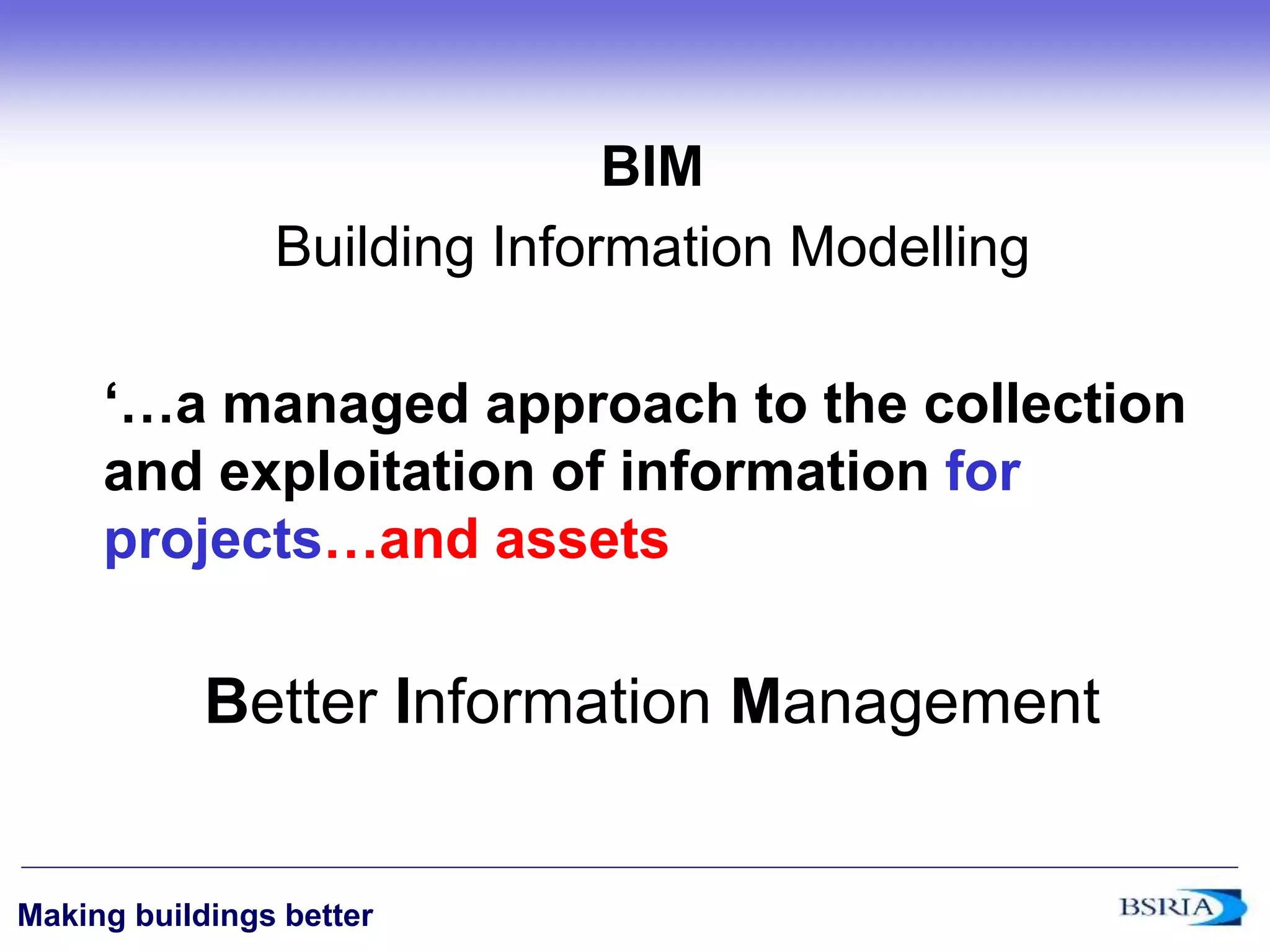
BIM
Building Information Modelling
‘…a managed approach to the collection
and exploitation of information for
projects…and assets
Better Information Management
‹#›
Making buildings better
A report for the UK Government
Construction Client Group – Building
Information Modelling (BIM) Working
Party Strategy Paper
March 2011
Hypothesis
“Government as a client can derive significant
improvements in cost, value and carbon performance
through the use of open sharable asset information”
‹#›
Making buildings better
UK Government Construction
Strategy
May 2011
Reduce - cost: construction & WLC
Reduce - overall time for delivery
Reduce - greenhouse gas emissions
‹#›
Making buildings better
Information management
The purpose of information management:
‘…generate a single piece of information
which can be used 100 times…’
• A trusted source of information
• In the right format
• Verified and validated
‹#›
Making buildings better
Information to understand BIM Level 2
1. BS 1192:2007+A1:2015 (Collaborative production of AEC information)
2. PAS 1192-2:2013 (Information management for projects)
3. PAS 1192-3:2014 (Information management for assets)
4. BS 1192-4:2014 (Information exchange)
5. PAS 1192-5:2015 (Security-minded information management)
6. GSL (Government Soft Landings) and BS 8536-1:2015 (Briefing for design and
construction for FM)
7. BIM Protocol (Contractual amendments)
8. Digital plan of work (Client tool)
9. Classification (Uniclass 2015)
http://bim-level2.org/en/
Technology
Process
People
‹#›
Making buildings better
HOW BIM RELATES TO FM
‹#›
Making buildings better
What FMs need
• Design criteria
• Design strategy
• Control strategy
• Systems interactions (risks)
• Asset lists
• Maintenance tasks
• Performance metrics
• Costs
‹#›
Making buildings better
Relating PAS 1192-2 and 1192-3
PAS 1192-3 Asset
PAS 1192-2
Project
ModelsRequirements
‹#›
Making buildings better
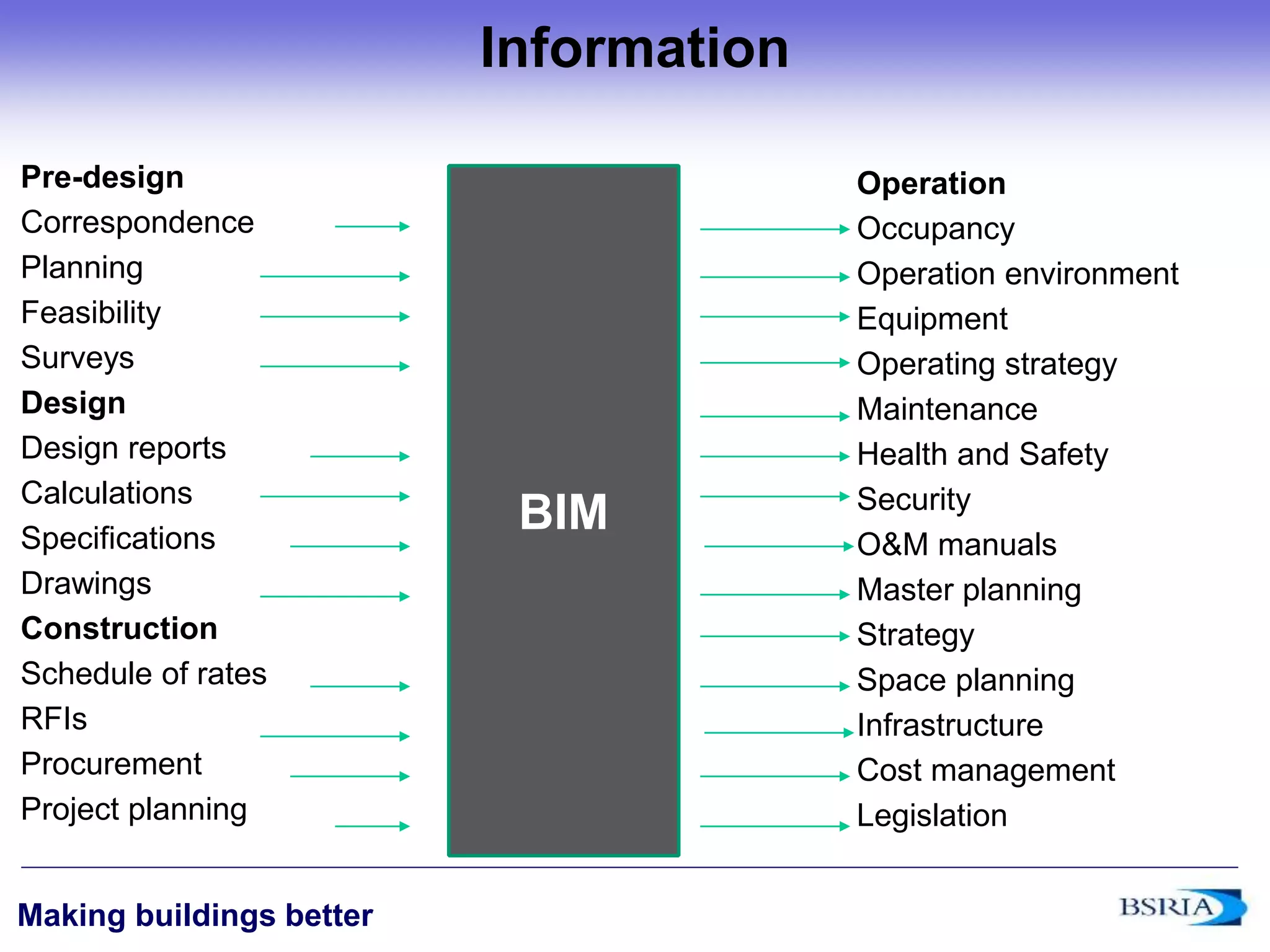
Information
Pre-design
Correspondence
Planning
Feasibility
Surveys
Design
Design reports
Calculations
Specifications
Drawings
Construction
Schedule of rates
RFIs
Procurement
Project planning
Operation
Occupancy
Operation environment
Equipment
Operating strategy
Maintenance
Health and Safety
Security
O&M manuals
Master planning
Strategy
Space planning
Infrastructure
Cost management
Legislation
BIM
‹#›
Making buildings better
PAS 55/ISO 55000
Standards Compliant
Defined Organisational
Information Requirements
Project Supply
Information
Service Supply
Information
Asset Information
Model (AIM)
Enterprise
System
Integration
Integrated Information
Reporting
Asset information flow
PAS 1192-3
‹#›
Making buildings better
‹#›
Making buildings better
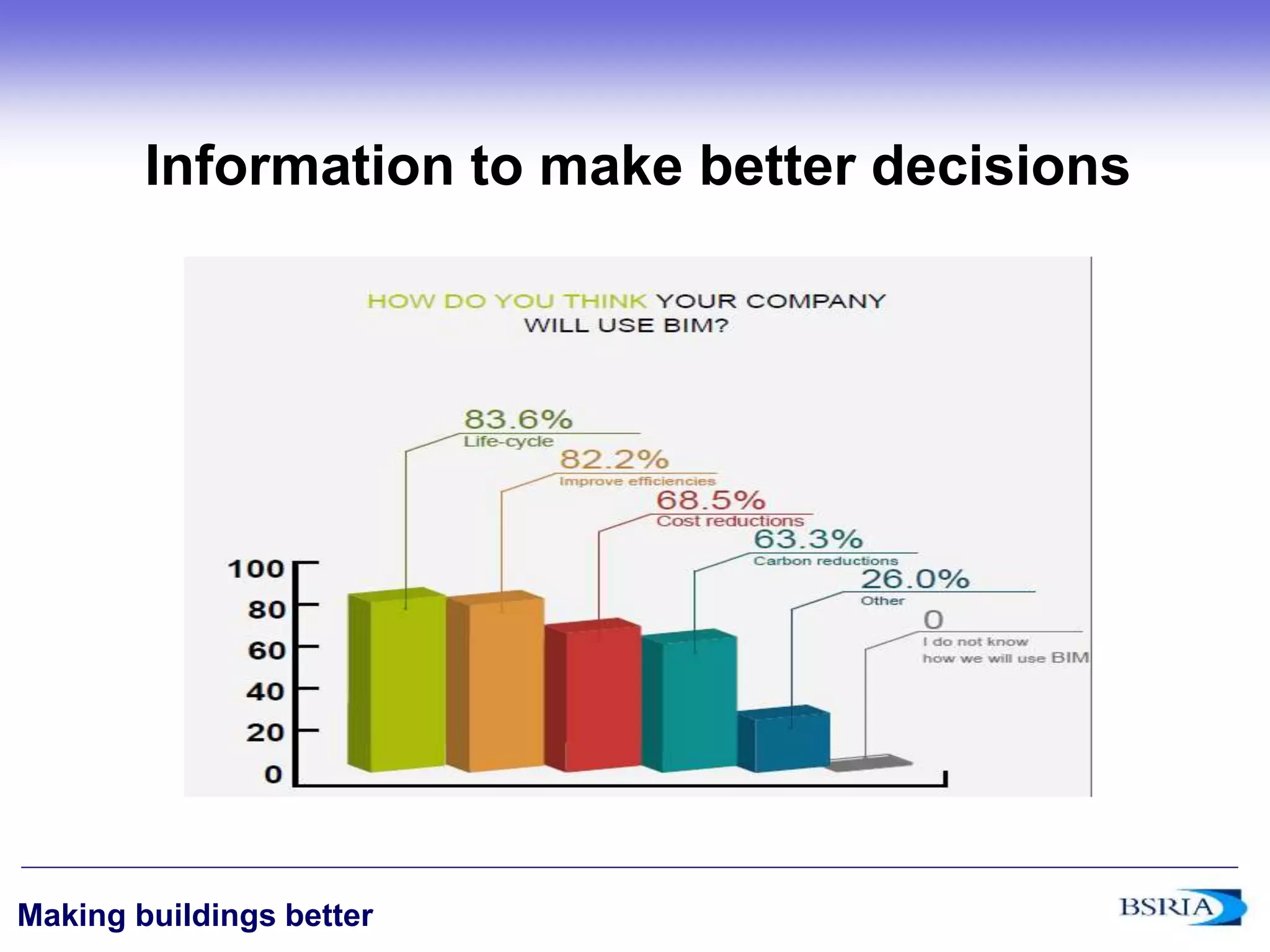
Information to make better decisions
‹#›
Making buildings better
CAN BIM MAKE YOU
MORE EFFICIENT?
‹#›
Making buildings better
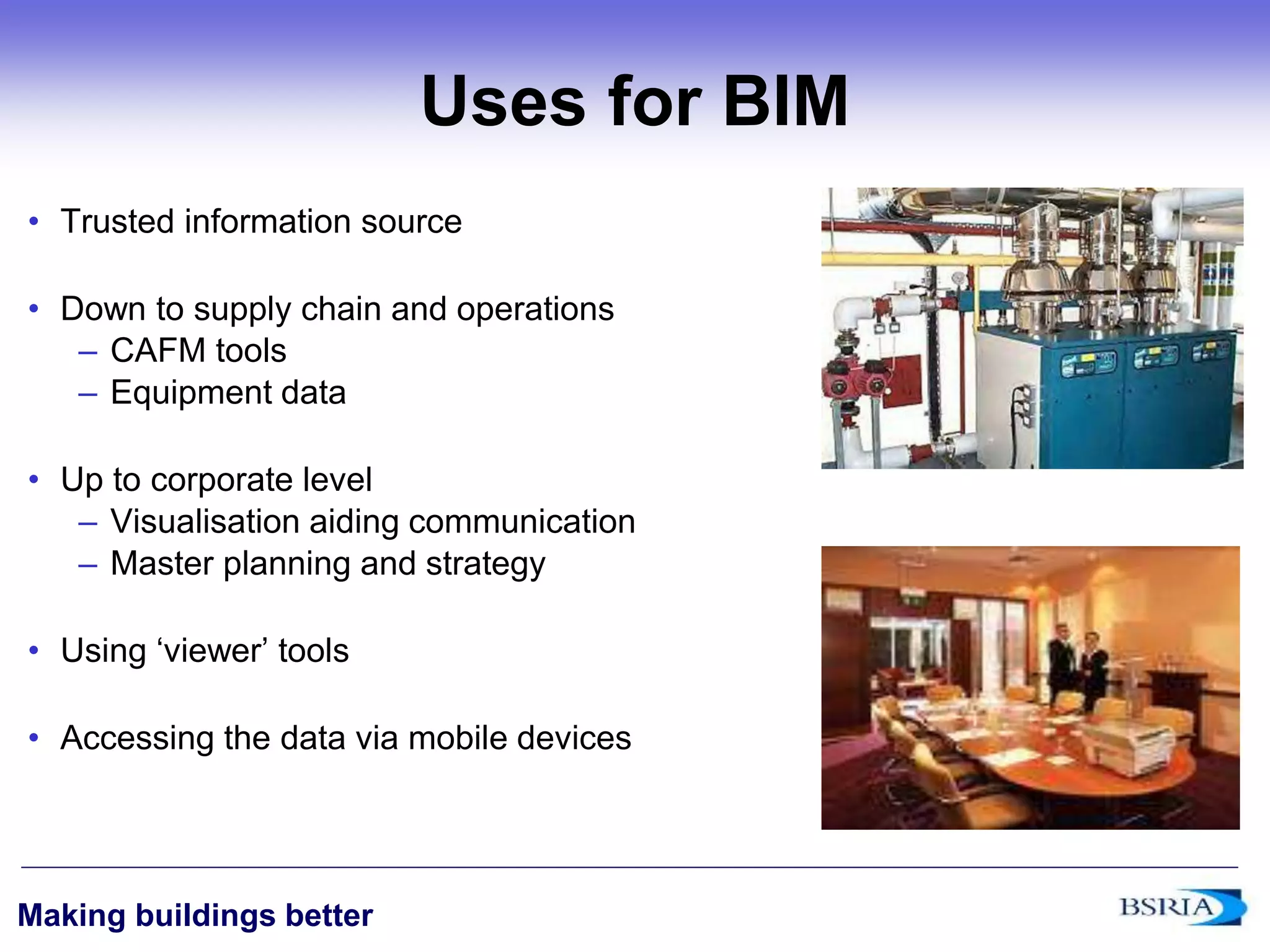
Uses for BIM
• Trusted information source
• Down to supply chain and operations
– CAFM tools
– Equipment data
• Up to corporate level
– Visualisation aiding communication
– Master planning and strategy
• Using ‘viewer’ tools
• Accessing the data via mobile devices
‹#›
Making buildings better
Information management
• Aim is to capture all data/information about an asset
for use throughout its life
• Types of information
– 3D models
– Reports
– Surveys
– 2D Drawings
– Specifications
– ……..
‹#›
Making buildings better
What's NOT in the Model
• Correspondence
• Feasibility studies
• Site survey reports
• Technical specifications
• Contract conditions/forms of contract
• Design calculations
• Manufacturer’s data
• Quotations
• Tender documentation
These must all be captured in the wider ‘information model’
‹#›
Making buildings better
Case Study
BIM-FM
Manchester Town Hall Complex (MTHC)
Research Report
by Ricardo Codinhoto, Arto Kiviniemi, Sergio Kemmer
Ubon Martin Essiet, Vincenzo Donato, Lais Guerle Tonso
November 2013
‹#›
Making buildings better
MTHC Findings - Advantages
• Consensus regarding taxonomy
• Universal access to online manual and guidance
• Reduction in the time used to access information
• Space saved from storage of physical documentation
• Identification and streamlining of inefficient process
• Information for statutory audits and maintenance
• Errors reduction in the maintenance of identical rooms
• Support to the measurement of KPIs
‹#›
Making buildings better
MTHC Findings - Disadvantages
• Lack of team familiarisation with the IT system
• Reliance on a online system
• Lack in interoperability between software
• Dependency on external expert for production and
update of information
‹#›
Making buildings better
MTHC Barriers and Enablers
• Technical expertise to generate and operate BIM
• Lack of organisational buy in
• Separation between project team and FM
• Model not completed before handover
• IT (software) that allows for the digitalisation and
integration of processes
• Increased interoperability
• Team spirit
• Good will
‹#›
Making buildings better
MTHC Conclusion
• A lesson learnt is that the expected utilisation of BIM
from design and construction in FM activities is not a
straightforward exercise.
• In general the BIM used for design and construction
practice did not contain all, or even a significant part
of, the necessary information for FM (soft and hard)
practice nor were its assemblies created in a way that
would benefit FM.
• For that, a champion that is capable of managing
BIM and also an FM expert is necessary.
‹#›
Making buildings better
BIM AND SOFT LANDINGS
‹#›
Making buildings better
Soft Landings
Challenges and
opportunities
A evolution in the way projects are delivered
1. A small change in the way you do things
2. A big change in the way project teams think, behave and interact
3. An extended handover process is introduced
4. Success judged on operational outcomes (success criteria), not meeting
design specifications
5. Everyone in the project team takes custody of building performance
BIM and Soft Landings
‹#›
Making buildings better
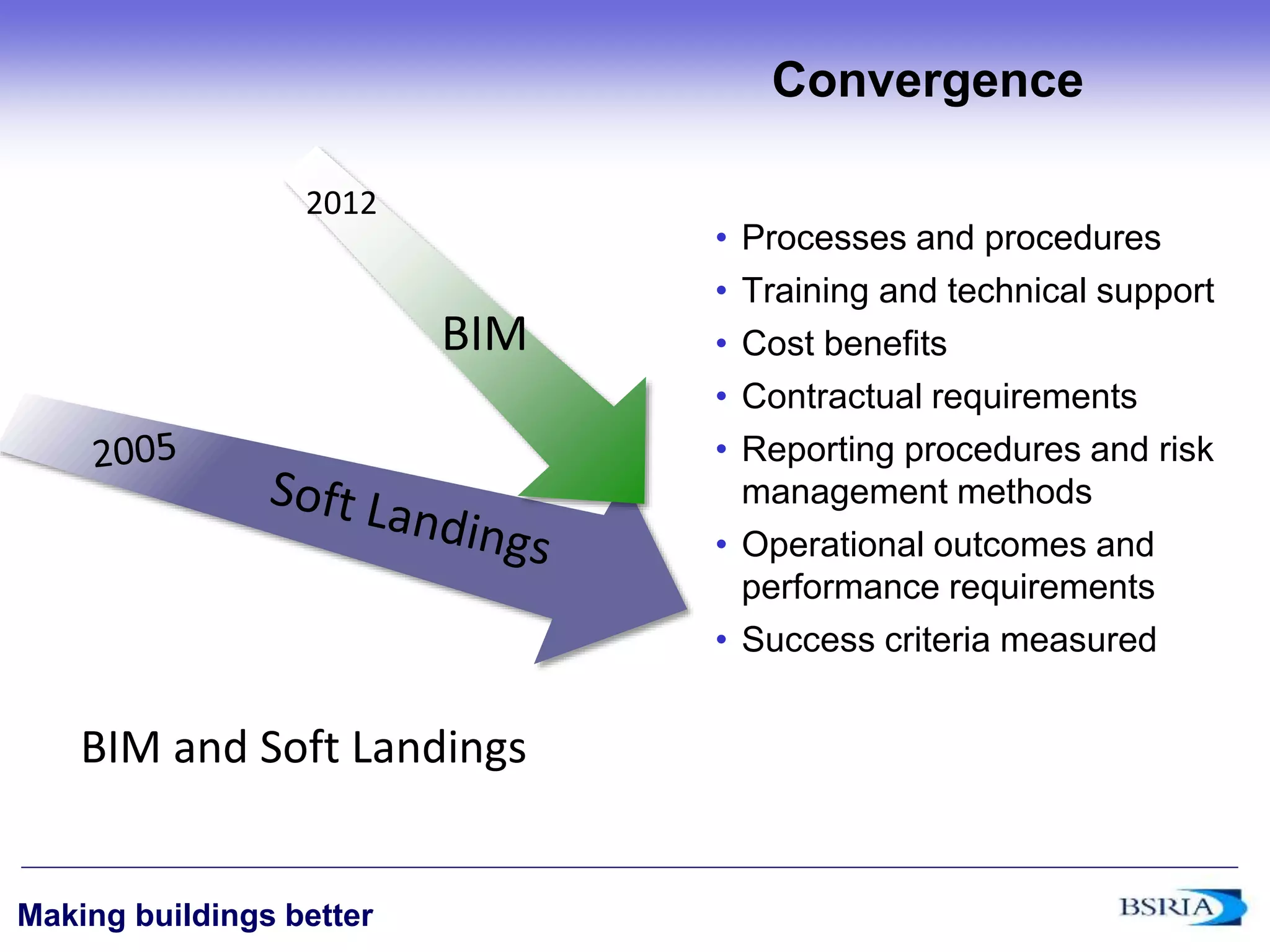
Convergence
• Processes and procedures
• Training and technical support
• Cost benefits
• Contractual requirements
• Reporting procedures and risk
management methods
• Operational outcomes and
performance requirements
• Success criteria measured
BIM
2012
BIM and Soft Landings
‹#›
Making buildings better
Potential for Estates teams
• FM engaged at start of construction projects
• Clear understanding of operational risk
• User focus during the project
• Success criteria met
https://www.bsria.co.uk/services/design/soft-landings/
‹#›
Making buildings better
Naming conventions
• Entity - a building, a bridge, a tunnel
• Complex (a group of entities) - airports,
hospitals, universities
• Space - office, canteen, parking area, lecture
theatre
• Product - boiler, door, drain pipe
• Facilities - combines the space with an activity
e.g. operating theatre
‹#›
Making buildings better
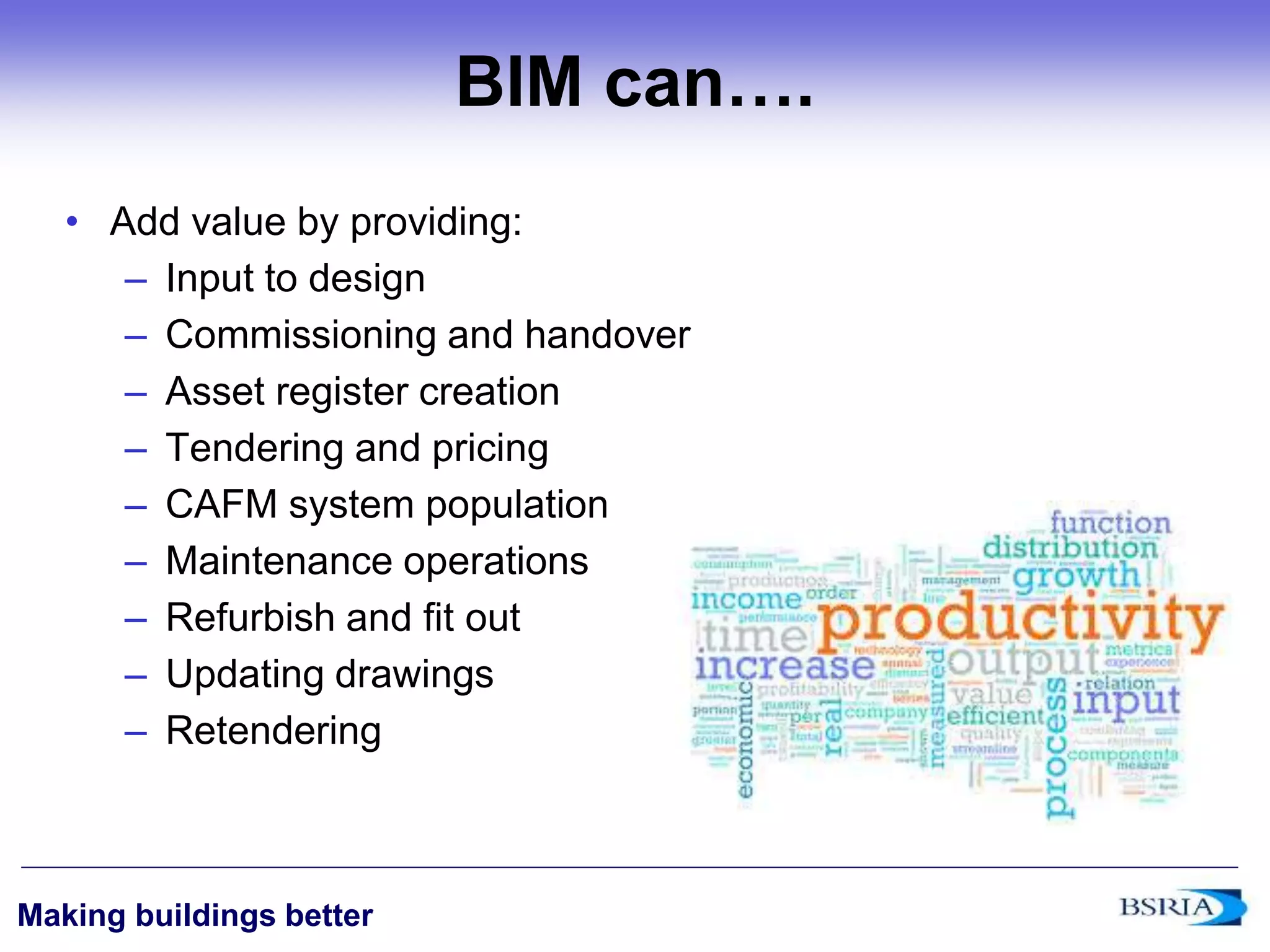
BIM can….
• Add value by providing:
– Input to design
– Commissioning and handover
– Asset register creation
– Tendering and pricing
– CAFM system population
– Maintenance operations
– Refurbish and fit out
– Updating drawings
– Retendering
‹#›
Making buildings better
What does the information provide?
• Increased transparency
• Early decisions
• Improve predictability
• Manage procurement
• Improve aftercare
• Improve maintenance efficiency
• Better relationships
• Success criteria met
‹#›
Making buildings better
WHAT SHOULD YOU
DO NEXT?
‹#›
Making buildings better
Develop a plan
• Your asset management
strategy and plan
• Define your Organizational
Information Requirements
(OIRs)
‹#›
Making buildings better
Work out what information you need…
A.3 Specific asset information requirements:
1. Legal
2. Commercial
3. Financial
4. Technical
5. Managerial
From PAS 1192-3, ISO 55000
and BS 8587
‹#›
Making buildings better
Summary
• BIM is about information management and it improves
cost, time, resources
• FM benefits from the information - Makes us more
efficient
• BIM and Soft Landings work together to deliver success
criteria
• Next – Determine what information you need to help you
do what you do?
‹#›
Making buildings better
Thank you
jo.harris@bsria.co.uk
01344 465568
Questions…….

How education estates can benefit from better information management

  • 1.
    ‹#› Making buildings better Howeducation estates can benefit from better information management Jo Harris Sustainable Construction Group - BSRIA
  • 2.
    ‹#› Making buildings better “Ingod we trust. All others must bring data.” W. Edwards Deming
  • 3.
    ‹#› Making buildings better Contents •What BIM is and why are we interested • How BIM relates to FM • How BIM can make you more efficient • How BIM and Soft Landings work together • What you should do next
  • 4.
    ‹#› Making buildings better BIM BuildingInformation Modelling ‘…a managed approach to the collection and exploitation of information for projects…and assets Better Information Management
  • 5.
    ‹#› Making buildings better Areport for the UK Government Construction Client Group – Building Information Modelling (BIM) Working Party Strategy Paper March 2011 Hypothesis “Government as a client can derive significant improvements in cost, value and carbon performance through the use of open sharable asset information”
  • 6.
    ‹#› Making buildings better UKGovernment Construction Strategy May 2011 Reduce - cost: construction & WLC Reduce - overall time for delivery Reduce - greenhouse gas emissions
  • 7.
    ‹#› Making buildings better Informationmanagement The purpose of information management: ‘…generate a single piece of information which can be used 100 times…’ • A trusted source of information • In the right format • Verified and validated
  • 8.
    ‹#› Making buildings better Informationto understand BIM Level 2 1. BS 1192:2007+A1:2015 (Collaborative production of AEC information) 2. PAS 1192-2:2013 (Information management for projects) 3. PAS 1192-3:2014 (Information management for assets) 4. BS 1192-4:2014 (Information exchange) 5. PAS 1192-5:2015 (Security-minded information management) 6. GSL (Government Soft Landings) and BS 8536-1:2015 (Briefing for design and construction for FM) 7. BIM Protocol (Contractual amendments) 8. Digital plan of work (Client tool) 9. Classification (Uniclass 2015) http://bim-level2.org/en/ Technology Process People
  • 9.
  • 10.
    ‹#› Making buildings better WhatFMs need • Design criteria • Design strategy • Control strategy • Systems interactions (risks) • Asset lists • Maintenance tasks • Performance metrics • Costs
  • 11.
    ‹#› Making buildings better RelatingPAS 1192-2 and 1192-3 PAS 1192-3 Asset PAS 1192-2 Project ModelsRequirements
  • 12.
    ‹#› Making buildings better Information Pre-design Correspondence Planning Feasibility Surveys Design Designreports Calculations Specifications Drawings Construction Schedule of rates RFIs Procurement Project planning Operation Occupancy Operation environment Equipment Operating strategy Maintenance Health and Safety Security O&M manuals Master planning Strategy Space planning Infrastructure Cost management Legislation BIM
  • 13.
    ‹#› Making buildings better PAS55/ISO 55000 Standards Compliant Defined Organisational Information Requirements Project Supply Information Service Supply Information Asset Information Model (AIM) Enterprise System Integration Integrated Information Reporting Asset information flow PAS 1192-3
  • 14.
  • 15.
  • 16.
    ‹#› Making buildings better CANBIM MAKE YOU MORE EFFICIENT?
  • 17.
    ‹#› Making buildings better Usesfor BIM • Trusted information source • Down to supply chain and operations – CAFM tools – Equipment data • Up to corporate level – Visualisation aiding communication – Master planning and strategy • Using ‘viewer’ tools • Accessing the data via mobile devices
  • 18.
    ‹#› Making buildings better Informationmanagement • Aim is to capture all data/information about an asset for use throughout its life • Types of information – 3D models – Reports – Surveys – 2D Drawings – Specifications – ……..
  • 19.
    ‹#› Making buildings better What'sNOT in the Model • Correspondence • Feasibility studies • Site survey reports • Technical specifications • Contract conditions/forms of contract • Design calculations • Manufacturer’s data • Quotations • Tender documentation These must all be captured in the wider ‘information model’
  • 20.
    ‹#› Making buildings better CaseStudy BIM-FM Manchester Town Hall Complex (MTHC) Research Report by Ricardo Codinhoto, Arto Kiviniemi, Sergio Kemmer Ubon Martin Essiet, Vincenzo Donato, Lais Guerle Tonso November 2013
  • 21.
    ‹#› Making buildings better MTHCFindings - Advantages • Consensus regarding taxonomy • Universal access to online manual and guidance • Reduction in the time used to access information • Space saved from storage of physical documentation • Identification and streamlining of inefficient process • Information for statutory audits and maintenance • Errors reduction in the maintenance of identical rooms • Support to the measurement of KPIs
  • 22.
    ‹#› Making buildings better MTHCFindings - Disadvantages • Lack of team familiarisation with the IT system • Reliance on a online system • Lack in interoperability between software • Dependency on external expert for production and update of information
  • 23.
    ‹#› Making buildings better MTHCBarriers and Enablers • Technical expertise to generate and operate BIM • Lack of organisational buy in • Separation between project team and FM • Model not completed before handover • IT (software) that allows for the digitalisation and integration of processes • Increased interoperability • Team spirit • Good will
  • 24.
    ‹#› Making buildings better MTHCConclusion • A lesson learnt is that the expected utilisation of BIM from design and construction in FM activities is not a straightforward exercise. • In general the BIM used for design and construction practice did not contain all, or even a significant part of, the necessary information for FM (soft and hard) practice nor were its assemblies created in a way that would benefit FM. • For that, a champion that is capable of managing BIM and also an FM expert is necessary.
  • 25.
  • 26.
    ‹#› Making buildings better SoftLandings Challenges and opportunities A evolution in the way projects are delivered 1. A small change in the way you do things 2. A big change in the way project teams think, behave and interact 3. An extended handover process is introduced 4. Success judged on operational outcomes (success criteria), not meeting design specifications 5. Everyone in the project team takes custody of building performance BIM and Soft Landings
  • 27.
    ‹#› Making buildings better Convergence •Processes and procedures • Training and technical support • Cost benefits • Contractual requirements • Reporting procedures and risk management methods • Operational outcomes and performance requirements • Success criteria measured BIM 2012 BIM and Soft Landings
  • 28.
    ‹#› Making buildings better Potentialfor Estates teams • FM engaged at start of construction projects • Clear understanding of operational risk • User focus during the project • Success criteria met https://www.bsria.co.uk/services/design/soft-landings/
  • 29.
    ‹#› Making buildings better Namingconventions • Entity - a building, a bridge, a tunnel • Complex (a group of entities) - airports, hospitals, universities • Space - office, canteen, parking area, lecture theatre • Product - boiler, door, drain pipe • Facilities - combines the space with an activity e.g. operating theatre
  • 30.
    ‹#› Making buildings better BIMcan…. • Add value by providing: – Input to design – Commissioning and handover – Asset register creation – Tendering and pricing – CAFM system population – Maintenance operations – Refurbish and fit out – Updating drawings – Retendering
  • 31.
    ‹#› Making buildings better Whatdoes the information provide? • Increased transparency • Early decisions • Improve predictability • Manage procurement • Improve aftercare • Improve maintenance efficiency • Better relationships • Success criteria met
  • 32.
  • 33.
    ‹#› Making buildings better Developa plan • Your asset management strategy and plan • Define your Organizational Information Requirements (OIRs)
  • 34.
    ‹#› Making buildings better Workout what information you need… A.3 Specific asset information requirements: 1. Legal 2. Commercial 3. Financial 4. Technical 5. Managerial From PAS 1192-3, ISO 55000 and BS 8587
  • 35.
    ‹#› Making buildings better Summary •BIM is about information management and it improves cost, time, resources • FM benefits from the information - Makes us more efficient • BIM and Soft Landings work together to deliver success criteria • Next – Determine what information you need to help you do what you do?
  • 36.
    ‹#› Making buildings better Thankyou jo.harris@bsria.co.uk 01344 465568 Questions…….

Editor's Notes

  • #3 Deming is attributed with giving birth to quality management and plan do check act cycle
  • #5 Almost every course you attend or article you read has a different definition of what BIM is, many focusing on the 3D model produced in Revit or other proprietary software products. However, I think most parties will agree that, at its core, BIM can be described as: ‘…a managed approach to the collection and exploitation of information’ Actually in this raw form BIM isn’t new. This philosophy has been in use since the 1980s on a number of high profile projects. It really is about capturing, validating and using information. If we take this one step further BIM is focused on construction projects and what is being slightly neglected is the operational phase of buildings which is where my interests lies and I think we have a great opportunity to be better at creating an environment where we are better at information management.
  • #6 As part of the drive to reduce costs and carbon in the public construction sector, in March 2011 the UK Government published ‘A report for the Government Construction Client Group – Building Information Modelling (BIM) Working Party Strategy Paper’. It outlined the Working Group’s recommended strategy for the use of BIM as a structure for making key information available in the right format at the appropriate times during the procurement process. The idea is that information is produced in a form that can be used throughout the life of an asset, be that building or rail network for example, and that information is transferred throughout the various phases – from client to designers to contractors to FMs – without having to reproduce it at each stage. Other countries such as the US are also moving along this path and the rest of the world’s interest levels are rising. France had its first BIM conference just earlier this year to start pushing the concept there.
  • #7 This strategy was outlined in the ‘UK’s Cabinet office Government Construction Strategy’ document, published in May 2011. The cabinet office supports the UK’s Prime Minister define and deliver the Government’s objectives, implement political and constitutional reform, and drive forward cross-departmental priority issues such as BIM Their role is to ensure the civil service is organised effectively and efficiently and has the capability in terms of skills, values and leadership to deliver the Government's objectives, including ensuring value for money to the taxpayer. This also includes working with the Treasury to drive efficiency and reform across the public sector. In this strategy document they identify BIM as having the potential to save money on construction costs, operational costs and deliver better buildings to the Central Government departments.
  • #8 So we need to zero in on the information management part of BIM which adds value to what we are trying to do when operating estates. the purpose is for us in FM to get better at generating a single piece of information which can be used a 100 times which is trusted, in the right format and validated. This gives us confidence that the information we are using is right and will helps us make the right decisions or improve our processes
  • #9 PAS 1192-2:2013 builds on the processes described in BS 1192:2007, and introduces new concepts such as employer’s information requirements (EIR) – the employer’s expression what information they require from the project and the format it should be in, and BIM execution plans (BEP) – the supply chain’s response to the EIR showing how it will meet its requirements. PAS 1192-3:2014 takes the processes described in earlier 1192 publications and develops them for use in the operational life of assets. In turn, this leads to the use of new concepts such as organizational information requirements (OIR) – the information which the organisation needs to know in order to run the business, the asset information requirements (AIR) – the information the organisation needs about the asset it is responsible for, and the asset information model (AIM) – the information or data set which describes the asset. This is an important document for the FM industry as it sets out the need for comprehensive and accurate information, the AIM, which can be used as the basis for all asset-related decision making. However, it also requires that the AIM is kept up-to-date to accurately reflect the status of the asset. BS 1192-4 will define expectations for the exchange of information throughout the lifecycle of an asset, and will include requirements for reviewing and checking for compliance, continuity and completeness. COBie is the UK Government’s chosen information exchange schema for federated BIM Level 2, alongside graphical BIM models and PDF documents. PAS 1192-5 companion document to PAS 1192-2, 1192-3 and BS 1192-4, dealing with security of information/cyber security. BIM Protocol identifies Building Information Models that are required to be produced by members of the Project Team and puts in place specific obligations, liabilities and associated limitations on the use of the models. The Protocol can also be used by clients to require the adoption of particular ways of working – such as the adoption of a common naming standard. GSL taken the principles of Soft Landings and developed it for use within its own procurement strategy. Differences – the use of metrics to demonstrate compliance with the stated project outcomes The dPoW should define the deliverables required at each stage of the design, construction, maintenance and operation of built assets. The dPoW should be made available digitally to enable simple access to all stakeholders to make use of the system to give clear definition as to what geometry, data and other information should be delivered at each of the eight stages of a project (APM 0-7). Essentially it is about the data and information needed at what work stage and from who. A standardised classification system should be developed to ensure that data is able to be indexed and structured to make it easily accessible in a common format. The classification system should be digitally-enabled, so that it integrates with the Digital Plan of Work. This should include digital capabilities including extensive search and analytics to assist classification and to identify Digital Plan of Work activities and deliverables as well as more traditional functions such as taking off, costing and benchmarking.
  • #11 In order to operate an asset effectively, the FM needs access to a whole range of information. And all of these can be delivered in a BIM project we just need ask.
  • #13 When you look at information that is generated during a project then BIM as a methodology helps capturing all sorts of information about that asset, and makes it available for use during operation. It helps you to not having to recreate information every time you need it. Sometimes information produced in one phase may be able to be used in another phase for a completely different purpose. This saves time in reproducing it, and also reduces the chance of introducing errors. We can take a simple example to illustrate the point. During design and construction the size and cooling duty of fan coil units is determined. What needs to happen next is that the cost to maintain and the tasks needed to maintain the desired environment are required by the operations team. In this new age of BIM we don’t have to review drawings or O&M manuals we can just get the asset list and duties from the electronic information generated. And later in life when these fan coils start going wrong we don’t have to get above the ceiling to look what parts we need to order you can get that from the asset information captured during the BIM process. So the benefit to operations is the richness of the information they receive – but I shall remind you again you do have to ask for it or you’ll be given what they think is useful and if we look at our O&M manauls from the past it doesn’t really hit the mail on the head.
  • #14 I know this is a busy slide but you can find this in Pas 1192-3 This is all about the flow of asset information and if I start with the triangle at the top This comes from ISO 55000 – which is a standard that defines an asset management system – This is the work that all operational teams should be doing. OIR – operational information requirements – that’s the point at which the owner / client / operator defines what information the need to make the right decisions. Then we have external sources of information and that’s our BIM projects And our services reports and surveys from suppliers Which in the BIM environment which is the stuff inside the dotted line box all going to create this asset information model There is one complication in Level 2 BIM which this diagram is trying to show and that is the input from the right – enterprise system data – so that’s information on things like the HR database, the accounts packages which captures all the non building related information the the organisation needs to run effectively and that in turn is the information that gets fed back into the organisation in the OIR. So you can see BIM is all about feeding the information and organisation needs to make informed decisions.
  • #15 As a member of the BIM4FM group that was supporting the BIMtask group to understand our requirements we initiated a survey in 2012 targeted at the FM industry – overwhelmingly 67% agreed that BIM would support them in the delivery of facilities management. And when you drill down a bit further….
  • #16 It was about making better decisions around life cycle management of assets, improving efficiencies, cost reductions and even carbon reductions.
  • #17 So can BIM make us more efficient…..
  • #18 We have a very wide ranging role in FM and we can be having conversations in the boiler room or the boardroom and once we have this source of information in the CDE, it can be used for as many things as you can think of. It can be the source of asset information into your CAFM system or asset register It can provide detailed information on individual items or plant or equipment The model can be used for familiarisation training or health and safety awareness But it can also be used as an information source for strategic planning, acting as a visual communication aid
  • #20 The thing to be aware of is that the model doesn’t contain everything you need – during the project these information sources will have been developed and if we’re going to run our operations effectively we’ll need this information and we need to storage it, manage it and put it to good use.
  • #21 aim of this research is to better understand the uses and implementation process of BIM for hard and soft FM services. The objectives of this research included mapping different hard and soft FM services and their overall processes, investigating advantages and disadvantages that information models can bring to FM, assessing the application of BIM maturity models for FM purposes and identifying enablers and barriers to BIM-based FM.
  • #22 FM services within MCC THC were organised in 4 main areas: FM support, Building support, Housekeeping and Customer Support. IT is not part of FM, even though it contributes considerably to the organisation; Advantages and Disadvantages Using Information Models in FM: several advantages were identified as related to the adoption of BIM:,, considerable relevant documentation related to the design, fabric and equipment in the building, and .
  • #23 Amongst the identified disadvantages
  • #24 Barriers and Enablers: many where the barriers and enablers identified that hindered the implementation of BIM in the THC project.
  • #25 This is the last line of the 90 page report which I think sums it up for me/
  • #29 But the potential is there. If we can get FM’s engaged at the start of projects we can ensure the information we need is provided and we can understand the users needs and operational risks that are going to be inherent in our projects. Unfortunately every building we build is a prototype and we don’t get the luxury of a sea trial with no occupants. So the more information we have the better equipped we will be to do a good job. What has been developed to ensure we keep the focus on operational outcomes is a process called soft landings. That’s a whole presentation in itself but I’ve included a link in the slides to the resources that can support you. And the last point I’d make on this is that those who can have an understanding of BIM I believe will have a competitve edge on their competitors – Clients will ask for it and we need to ready to help them.
  • #30 We must communicate with those we are working with to make sure that the solution suits all of us, and moreover that it is suitable for the whole life of the asset and not just the design, or the construction phase.
  • #34 So to start you off you’ll need to understand you asset management strategy and plan – that triangle form the earlier slide. Define the information your organisation needs To help you we have a guide published by BSRIA which gets you on this road to implementing BIM in your organisation. But remember when you’re sitting on all this wonderful data you have to ensure you have a plan to keep it maintained and up to date.
  • #35 There is also help with defining your information requirements in 1192 part 3, ISO 55000 and BS 8587 which is a British standard about facility information. These 5 areas are extracted from 1192 -3 and are the headline areas of information you should be capturing.
  • #37 So thank you – I hope this has be a useful webinar and I look forward to answering some of your questions.