• Pattern strabismus is present when a horizontal deviation
change in magnitude between up gaze and down gaze.
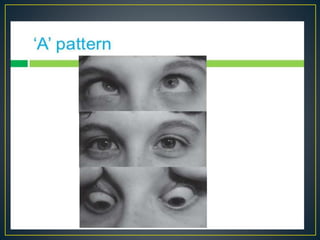
• Most common types of pattern strabismus is A and V
pattern so commonly called AV pattern strabismus
• Types of pattern strabismus
1. V pattern 5. Lambda
2. A pattern 6.
3. X pattern
4. Y pattern
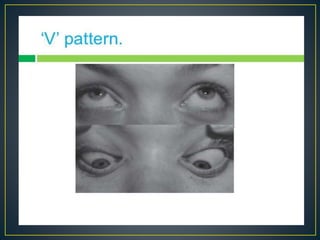
• Most common type
• Relative divergence on up gaze and relative convergence
on down gaze
• Minimum 15 PD difference b/w up gaze and down gaze
• Slight physiological divergence on up gaze
• It occur most frequently in pt with infantile esotropia
• V pattern also may occur in pt with S.O palsy particulary
if they are bilateral
• In pt with craniofacial malformation
• Second most common type
• Relative convergence on up gaze and relative divergence
on down gaze
• Minimum of 10 PD difference b/w up gaze and down
gaze
• Occur most frequently in pt with exotropia
• More common than V pattern in pt with infantile
strabismus associated with craniofacial malformation ,
Down syndrome and myelomenigocele.
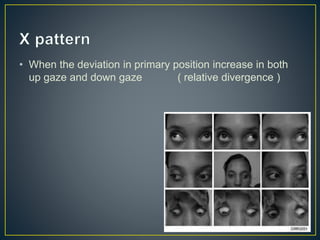
• When the deviation in primary position increase in both
up gaze and down gaze ( relative divergence )
• Commonly seen in pt with large angle exotropia
• Overaction of all four oblique muscle may produce the
increase of exodeviation seen in up gaze and down gaze
( Jampolsky)
• LR muscle contracture could produce a mechanical leash
effect , resulting in the x pattern
• When there is relative divergence on up gaze but no
significant change in angle from primary position to down
gaze
• Psuedo overaction of I.O
• But there is no fundus torsion , negative head tilt test , no
S.O underaction
• Its due to abberant innervation of LR in up gaze
• There is relative divergence on down gaze but no
significant change from primary position to up gaze
• Variant of A pattern exotropia
• There is relative convergence on both up gaze and down
gaze compared with primary position
A and V pattern
A pattern esotropia
A pattern exotropia
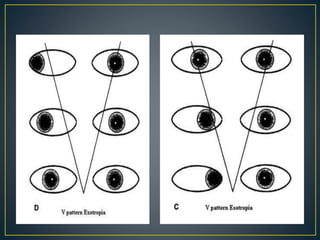
V pattern
V pattern esotropia
V pattern exotropia
1. Abnormalities of vertical or horizontal muscles action.
2. Anatomical anomalies.
3. Disorder of muscle innervation.
4. Anomalous insertion of muscle tendon.
5. Sensory torsion .
• The horizontal angle of deviation is changed on up gaze
and down gaze by the secondary abducting and
adducting action of vertically acting muscle.
• Underaction of one or more commonly both S.O muscle
either congenital or acquired
Down gaze
decrease abduction by u/a S.O
increase adduction by o/a I.R
Up gaze
increase abduction by o/a I.O
decrease adduction by inhibited S.R
* underaction of one or usually both S.R
Down gaze
decrease abd by inhibited S.O
increase add by o/a I.R
Up gaze
increase abd by o/a I.O
decrease add by u/a S.R
* underaction of one or more often both I.O
Down gaze
increase abd by o/a S.O
decrease add by inhibited I.R
Up gaze
decrease abd by u/a I.O
increase add by o/a S.R
• Underaction of one or both I.R u/a
Down gaze
decrease add by u/a I.R
increase abd by o/a S.O
Up gaze
decrease abd by inhibited I.O
increase add by o/a S.R
• According to Urist the MR act more effectively on down
gaze and LR are more effective on up gaze , therefore
underaction and overaction of these muscle can
influence the angle of deviation on up gaze and down
gaze.
• V eso ______ o/a of MR
• V exo_______o/a of LR
• A eso _______u/a of LR
• A exo________u/a of MR
* In craniosynostosis a shallow orbit result in proptosis and
cyclotropia of both globes. This can alter the relationship
b/w the vertically acting muscle , in particular S.O
underaction from shallow orbit and change in rectus
muscles alignment from torsion giving rise to V pattern
• In spina bifidia , incyclorotated orbit may explain common
occurrence of A pattern strabismus.
• Mongoloid fissure favoured production of A pattern eso
and V pattern exo and anti mongoloid fissure vice versa.
• Bilateral displacement of LR pulley inferiorly would
weaken their action on down gaze and strengthen on up
gaze, resulting in V pattern strabismus.
• A small unilateral inferiorly displacement of LR pulley
mimic clinical pic of I.O overaction in the contralateral eye
.
• Bilateral superior displacement of LR pulley give A
pattern.
• A small unilateral displacement of LR pulley superiorly
mimic clinical pic of S.O overaction in the contralateral
eye .
* 5. Muscle innervation disorder.
Duane’s retraction syndrome
*6. Sensory torsion.
Intorsion and extorsion ___ change plane of action of
rectus muscles leads to pattern strabismus
Aim
• To detect and measure the pattern
• To determine the reason for pattern if possible
• To asses it significant in the management of strabismus
AHP
May adopt to get gid of symptom.
*V eso and A exo _______chin depressed .
* V exo and A eso_______chin elevated .
• Cover test
• Ocular movement
• Measurement of deviation with PCT
• Investigation of binocular function
• Hess chart .
•Surgical management
Aim of surgery
* to restore or improve BSV
* uncomfortable AHP
* achieve better ocular alignment ( cosmesis)
General principle for pattern
strabismus surgery
• Pt with pattern associated apparent o/a of oblique
muscles, weakening of the oblique muscles is performed.
• No apparent o/a of oblique muscles then vertical
transposition of horizontal muscles according to MALE
• Surgery on vertical muscles.
• V pattern
*when oblique dysfunction is present then weakening of
I.O and strengthening of S.O muscles.
* without oblique dysfuntion
V pattern eso _____ B/L MR recession and downward
transposition of the tendon.
V pattern exo______B/L LR recession and upward
transposition of tendon.
• A pattern
* with oblique dysfunction S.O posterior tenotomy (
weakening procedure).
* without oblique dysfunction.
A eso ____ B/L MR recession and upward transposition of
tendon.
A exo ____ B/L LR recession and downward transposition
of tendon.
• Y pattern ___ superior transposition of LR
• X pattern ____ recession of LR alone
• Lambda ______ appropriate S.O weakening
• For underaction (u/a)
• Superior ( SR and SO) V pattern
• Inferior ( IR and IO) A pattern
• Olique eso pattern
• Recti exo pattern
• Eg SO palsy
• superior its must be V pattern but oblique so its will be
eso i.e V eso.
References :
*M Anson and Helen Davis.
*American academy of pediatric
ophthalmology and strabismus.
*A K Khurana.
* Kanski.

Pattern Strabismus | A.V Pattern

  • 2.
    • Pattern strabismusis present when a horizontal deviation change in magnitude between up gaze and down gaze.
  • 4.
    • Most commontypes of pattern strabismus is A and V pattern so commonly called AV pattern strabismus • Types of pattern strabismus 1. V pattern 5. Lambda 2. A pattern 6. 3. X pattern 4. Y pattern
  • 5.
    • Most commontype • Relative divergence on up gaze and relative convergence on down gaze • Minimum 15 PD difference b/w up gaze and down gaze • Slight physiological divergence on up gaze
  • 7.
    • It occurmost frequently in pt with infantile esotropia • V pattern also may occur in pt with S.O palsy particulary if they are bilateral • In pt with craniofacial malformation
  • 8.
    • Second mostcommon type • Relative convergence on up gaze and relative divergence on down gaze • Minimum of 10 PD difference b/w up gaze and down gaze
  • 10.
    • Occur mostfrequently in pt with exotropia • More common than V pattern in pt with infantile strabismus associated with craniofacial malformation , Down syndrome and myelomenigocele.
  • 11.
    • When thedeviation in primary position increase in both up gaze and down gaze ( relative divergence )
  • 12.
    • Commonly seenin pt with large angle exotropia • Overaction of all four oblique muscle may produce the increase of exodeviation seen in up gaze and down gaze ( Jampolsky) • LR muscle contracture could produce a mechanical leash effect , resulting in the x pattern
  • 13.
    • When thereis relative divergence on up gaze but no significant change in angle from primary position to down gaze
  • 14.
    • Psuedo overactionof I.O • But there is no fundus torsion , negative head tilt test , no S.O underaction • Its due to abberant innervation of LR in up gaze
  • 15.
    • There isrelative divergence on down gaze but no significant change from primary position to up gaze • Variant of A pattern exotropia
  • 16.
    • There isrelative convergence on both up gaze and down gaze compared with primary position
  • 17.
    A and Vpattern
  • 18.
    A pattern esotropia Apattern exotropia V pattern V pattern esotropia V pattern exotropia
  • 19.
    1. Abnormalities ofvertical or horizontal muscles action. 2. Anatomical anomalies. 3. Disorder of muscle innervation. 4. Anomalous insertion of muscle tendon. 5. Sensory torsion .
  • 20.
    • The horizontalangle of deviation is changed on up gaze and down gaze by the secondary abducting and adducting action of vertically acting muscle.
  • 21.
    • Underaction ofone or more commonly both S.O muscle either congenital or acquired Down gaze decrease abduction by u/a S.O increase adduction by o/a I.R Up gaze increase abduction by o/a I.O decrease adduction by inhibited S.R
  • 22.
    * underaction ofone or usually both S.R Down gaze decrease abd by inhibited S.O increase add by o/a I.R Up gaze increase abd by o/a I.O decrease add by u/a S.R
  • 23.
    * underaction ofone or more often both I.O Down gaze increase abd by o/a S.O decrease add by inhibited I.R Up gaze decrease abd by u/a I.O increase add by o/a S.R
  • 24.
    • Underaction ofone or both I.R u/a Down gaze decrease add by u/a I.R increase abd by o/a S.O Up gaze decrease abd by inhibited I.O increase add by o/a S.R
  • 25.
    • According toUrist the MR act more effectively on down gaze and LR are more effective on up gaze , therefore underaction and overaction of these muscle can influence the angle of deviation on up gaze and down gaze.
  • 26.
    • V eso______ o/a of MR • V exo_______o/a of LR • A eso _______u/a of LR • A exo________u/a of MR
  • 27.
    * In craniosynostosisa shallow orbit result in proptosis and cyclotropia of both globes. This can alter the relationship b/w the vertically acting muscle , in particular S.O underaction from shallow orbit and change in rectus muscles alignment from torsion giving rise to V pattern
  • 28.
    • In spinabifidia , incyclorotated orbit may explain common occurrence of A pattern strabismus. • Mongoloid fissure favoured production of A pattern eso and V pattern exo and anti mongoloid fissure vice versa.
  • 29.
    • Bilateral displacementof LR pulley inferiorly would weaken their action on down gaze and strengthen on up gaze, resulting in V pattern strabismus. • A small unilateral inferiorly displacement of LR pulley mimic clinical pic of I.O overaction in the contralateral eye .
  • 30.
    • Bilateral superiordisplacement of LR pulley give A pattern. • A small unilateral displacement of LR pulley superiorly mimic clinical pic of S.O overaction in the contralateral eye .
  • 31.
    * 5. Muscleinnervation disorder. Duane’s retraction syndrome *6. Sensory torsion. Intorsion and extorsion ___ change plane of action of rectus muscles leads to pattern strabismus
  • 32.
    Aim • To detectand measure the pattern • To determine the reason for pattern if possible • To asses it significant in the management of strabismus
  • 33.
    AHP May adopt toget gid of symptom. *V eso and A exo _______chin depressed . * V exo and A eso_______chin elevated .
  • 34.
    • Cover test •Ocular movement • Measurement of deviation with PCT • Investigation of binocular function • Hess chart .
  • 37.
    •Surgical management Aim ofsurgery * to restore or improve BSV * uncomfortable AHP * achieve better ocular alignment ( cosmesis)
  • 38.
    General principle forpattern strabismus surgery • Pt with pattern associated apparent o/a of oblique muscles, weakening of the oblique muscles is performed. • No apparent o/a of oblique muscles then vertical transposition of horizontal muscles according to MALE • Surgery on vertical muscles.
  • 39.
    • V pattern *whenoblique dysfunction is present then weakening of I.O and strengthening of S.O muscles. * without oblique dysfuntion V pattern eso _____ B/L MR recession and downward transposition of the tendon. V pattern exo______B/L LR recession and upward transposition of tendon.
  • 40.
    • A pattern *with oblique dysfunction S.O posterior tenotomy ( weakening procedure). * without oblique dysfunction. A eso ____ B/L MR recession and upward transposition of tendon. A exo ____ B/L LR recession and downward transposition of tendon.
  • 41.
    • Y pattern___ superior transposition of LR • X pattern ____ recession of LR alone • Lambda ______ appropriate S.O weakening
  • 42.
    • For underaction(u/a) • Superior ( SR and SO) V pattern • Inferior ( IR and IO) A pattern • Olique eso pattern • Recti exo pattern • Eg SO palsy • superior its must be V pattern but oblique so its will be eso i.e V eso.
  • 43.
    References : *M Ansonand Helen Davis. *American academy of pediatric ophthalmology and strabismus. *A K Khurana. * Kanski.