Alphabet Patterns
By
Dr Alshymaa Moustafa
Ophthalmology Specialist
Introduction
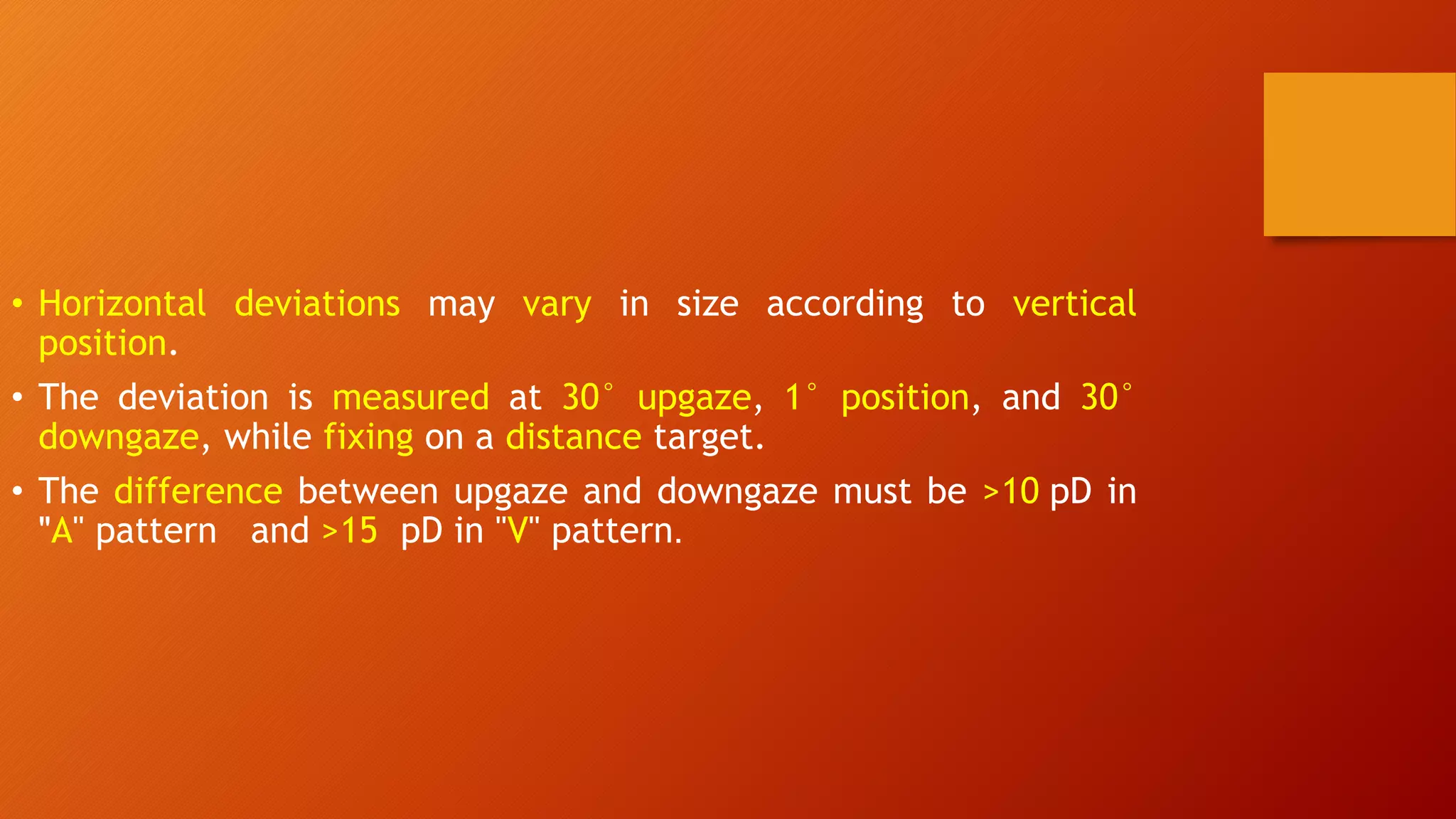
• Horizontal deviations may vary in size according to vertical
position.
• The deviation is measured at 30° upgaze, 1° position, and 30°
downgaze, while fixing on a distance target.
• The difference between upgaze and downgaze must be >10 pD in
"A" pattern and >15 pD in "V" pattern.
Causes
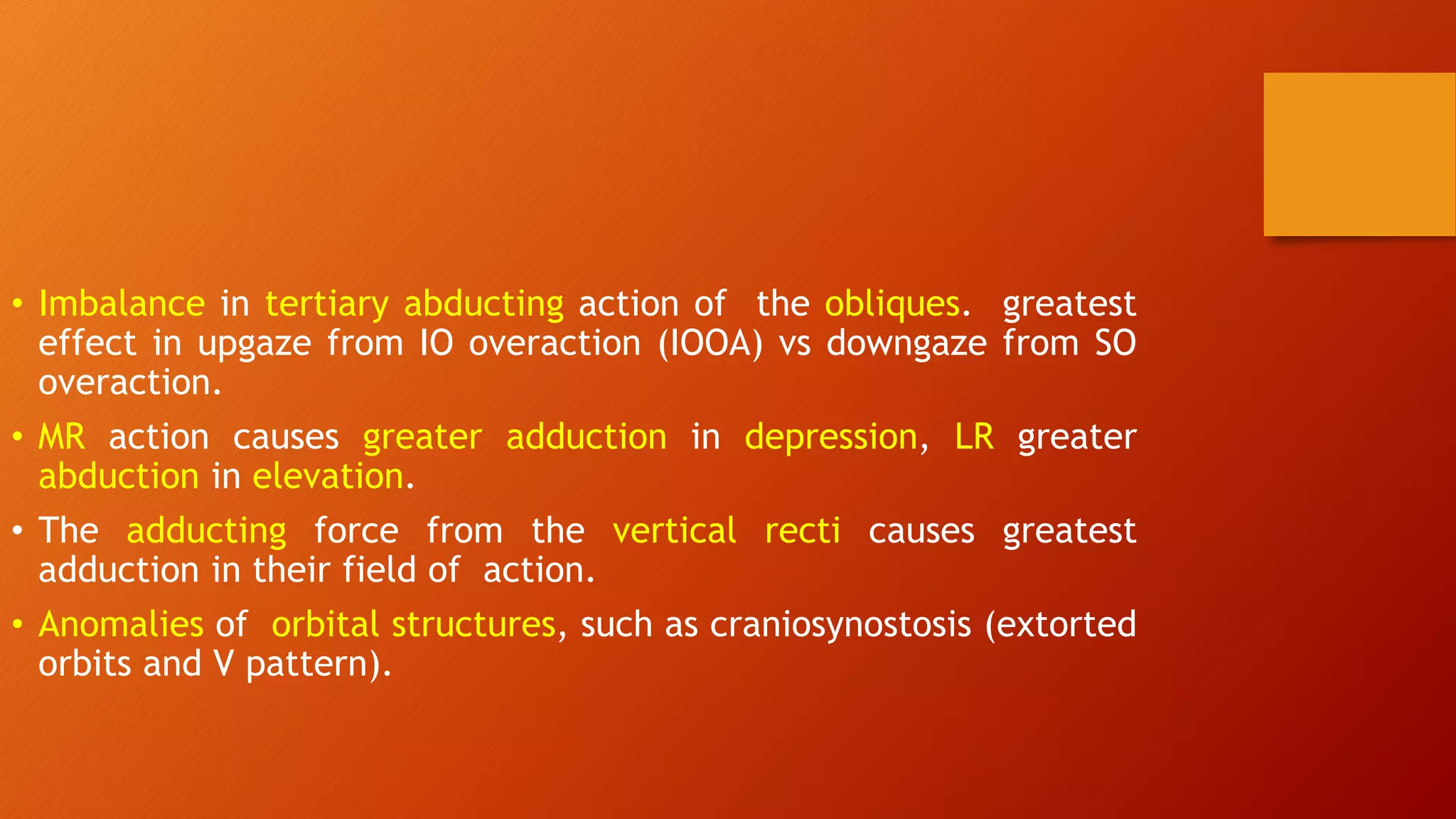
• Imbalance in tertiary abducting action of the obliques. greatest
effect in upgaze from IO overaction (IOOA) vs downgaze from SO
overaction.
• MR action causes greater adduction in depression, LR greater
abduction in elevation.
• The adducting force from the vertical recti causes greatest
adduction in their field of action.
• Anomalies of orbital structures, such as craniosynostosis (extorted
orbits and V pattern).
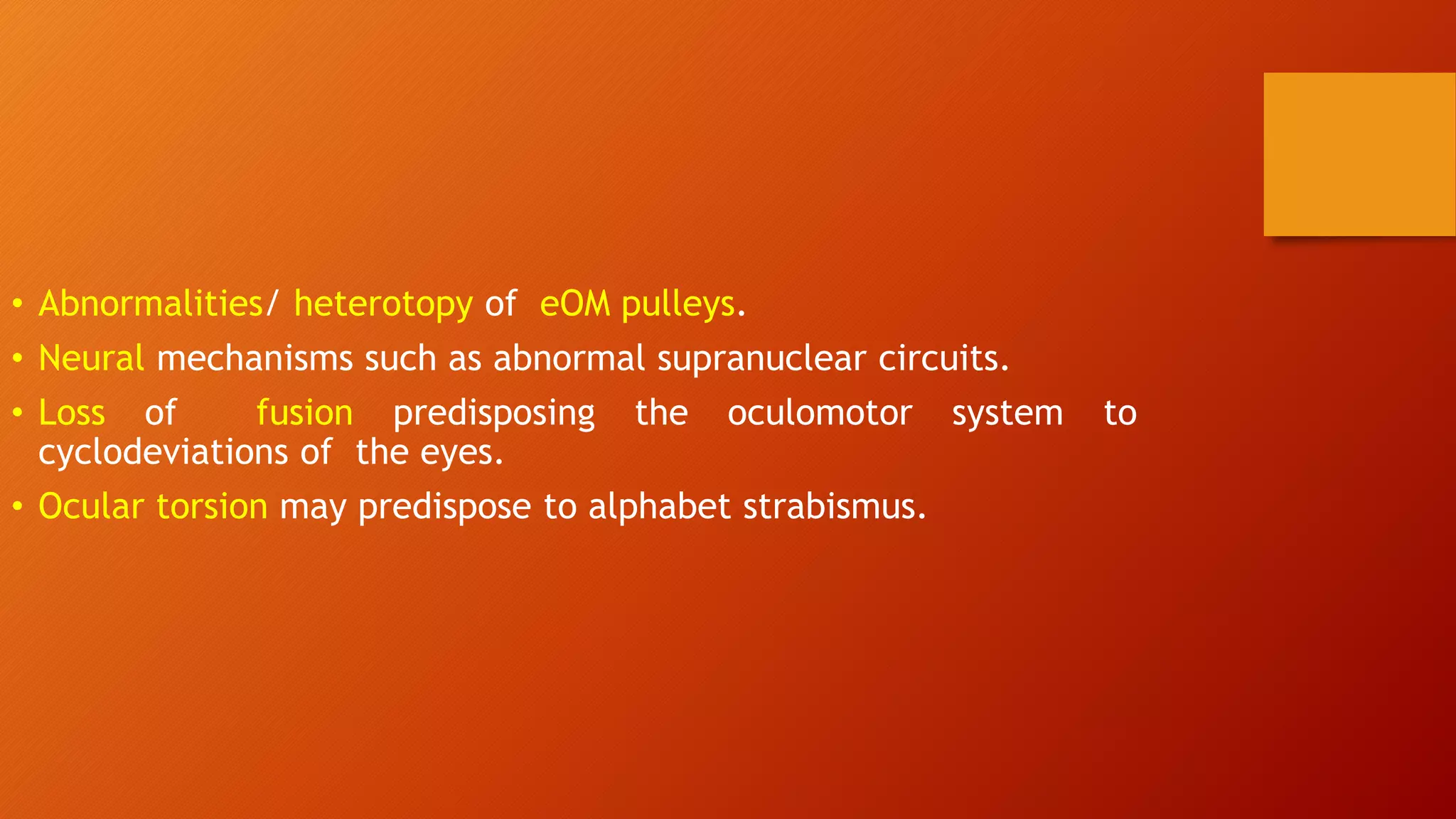
• Abnormalities/ heterotopy of eOM pulleys.
• Neural mechanisms such as abnormal supranuclear circuits.
• Loss of fusion predisposing the oculomotor system to
cyclodeviations of the eyes.
• Ocular torsion may predispose to alphabet strabismus.
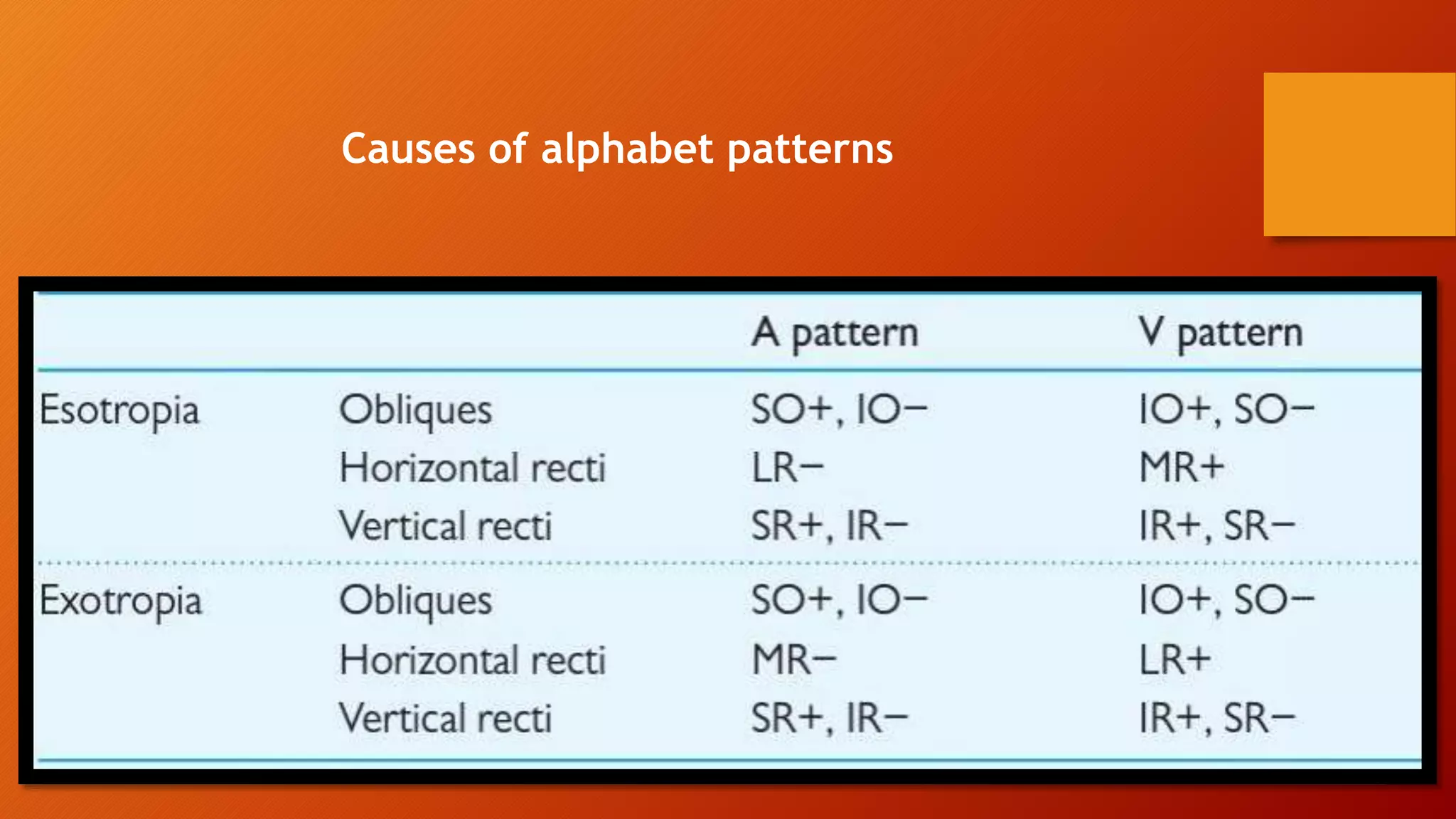
Causes of alphabet patterns
V pattern
Definition
• this is defined as a horizontal deviation, which is more divergent
(or less convergent) in upgaze than in downgaze.
Clinical features
• V-pattern esotropia: usually arises from IOOA or SO palsy; it is
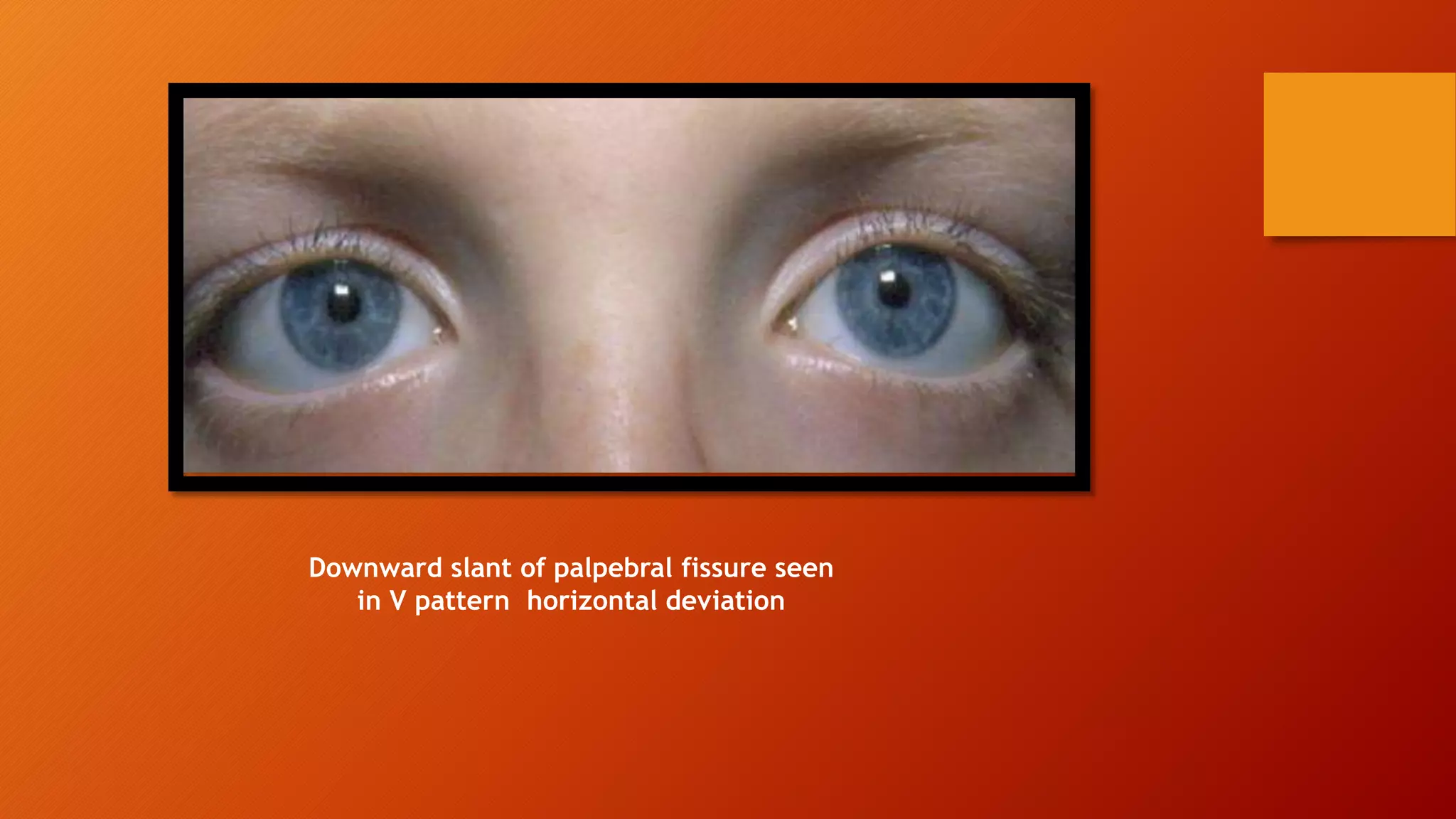
also associated with antimongoloid palpebral fissures (perhaps
altering the recti insertions). patients may adopt a chin down
posture.
• V-pattern exotropia: usually arises from IOOA. patients adopt a
chin up posture.
Downward slant of palpebral fissure seen
in V pattern horizontal deviation
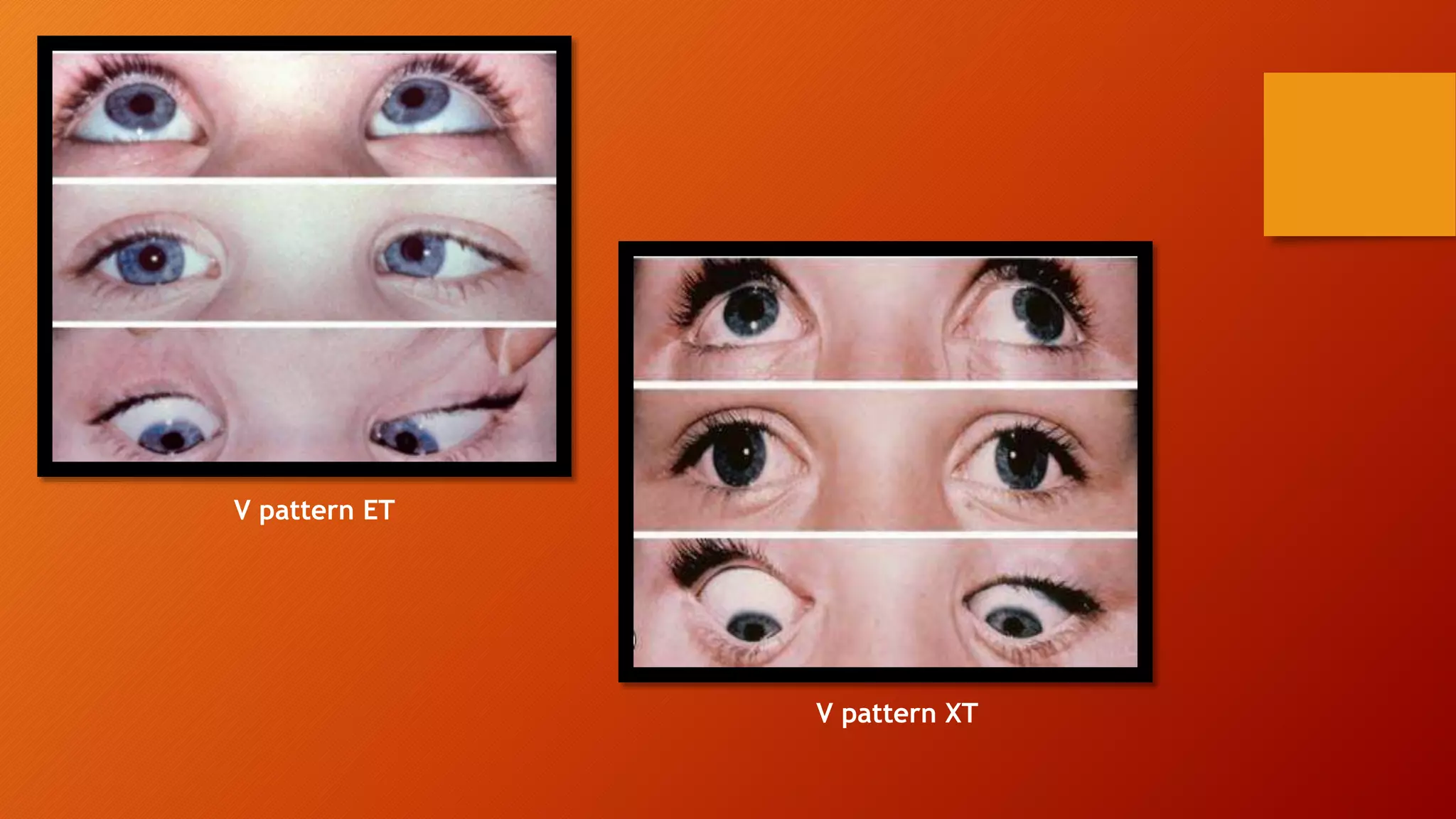
V pattern ET
V pattern XT
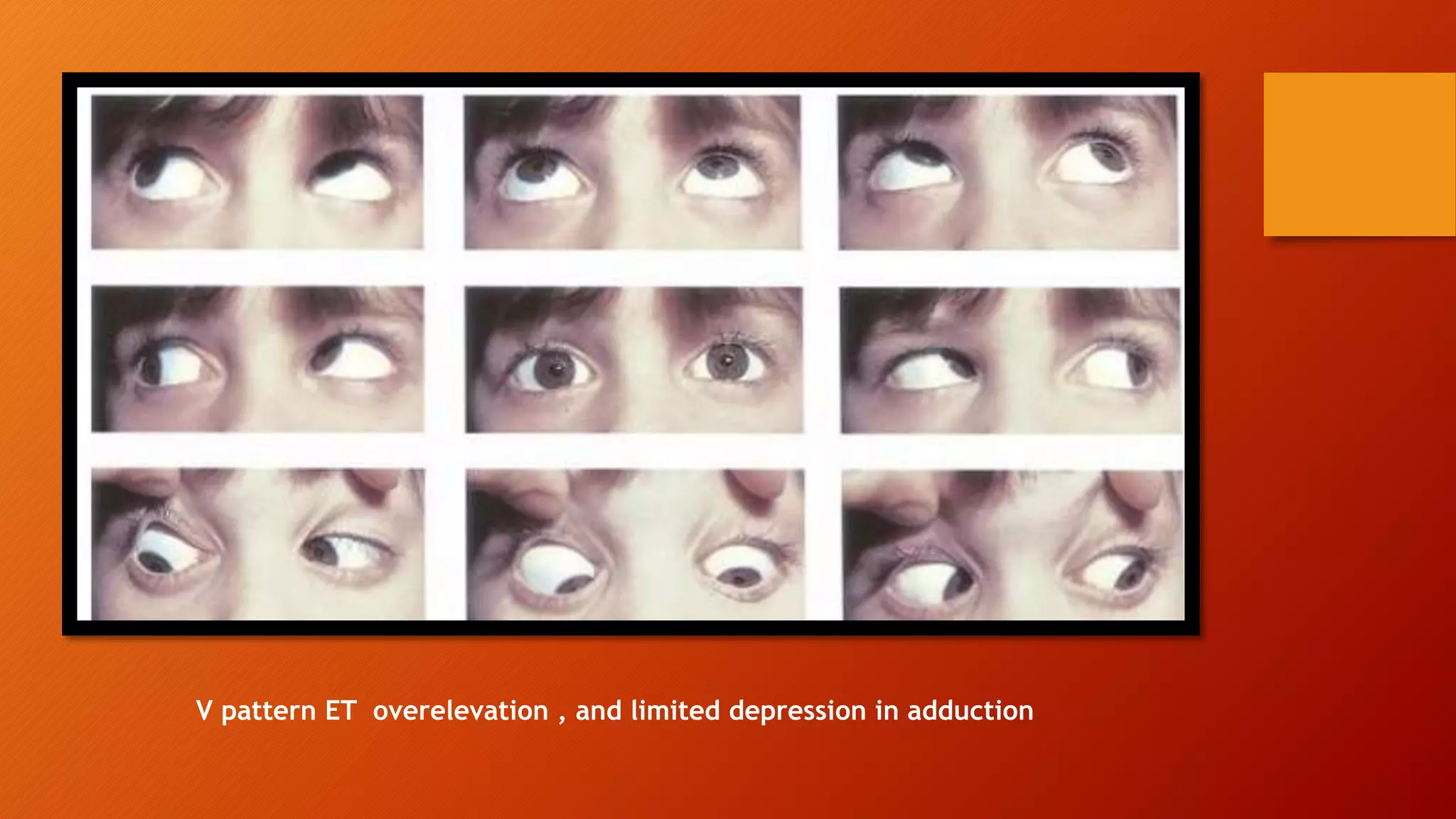
V pattern ET overelevation , and limited depression in adduction
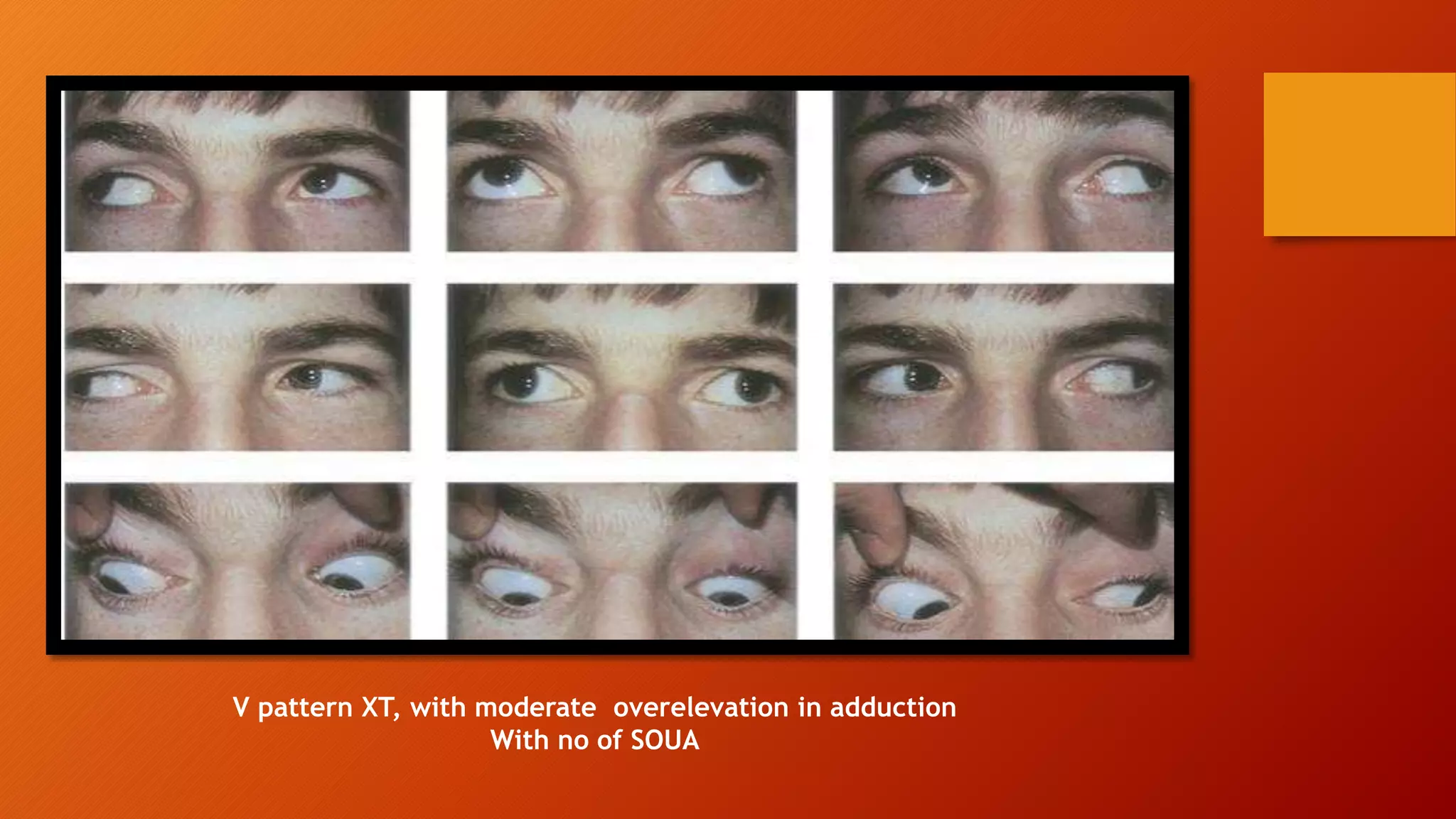
V pattern XT, with moderate overelevation in adduction
With no of SOUA
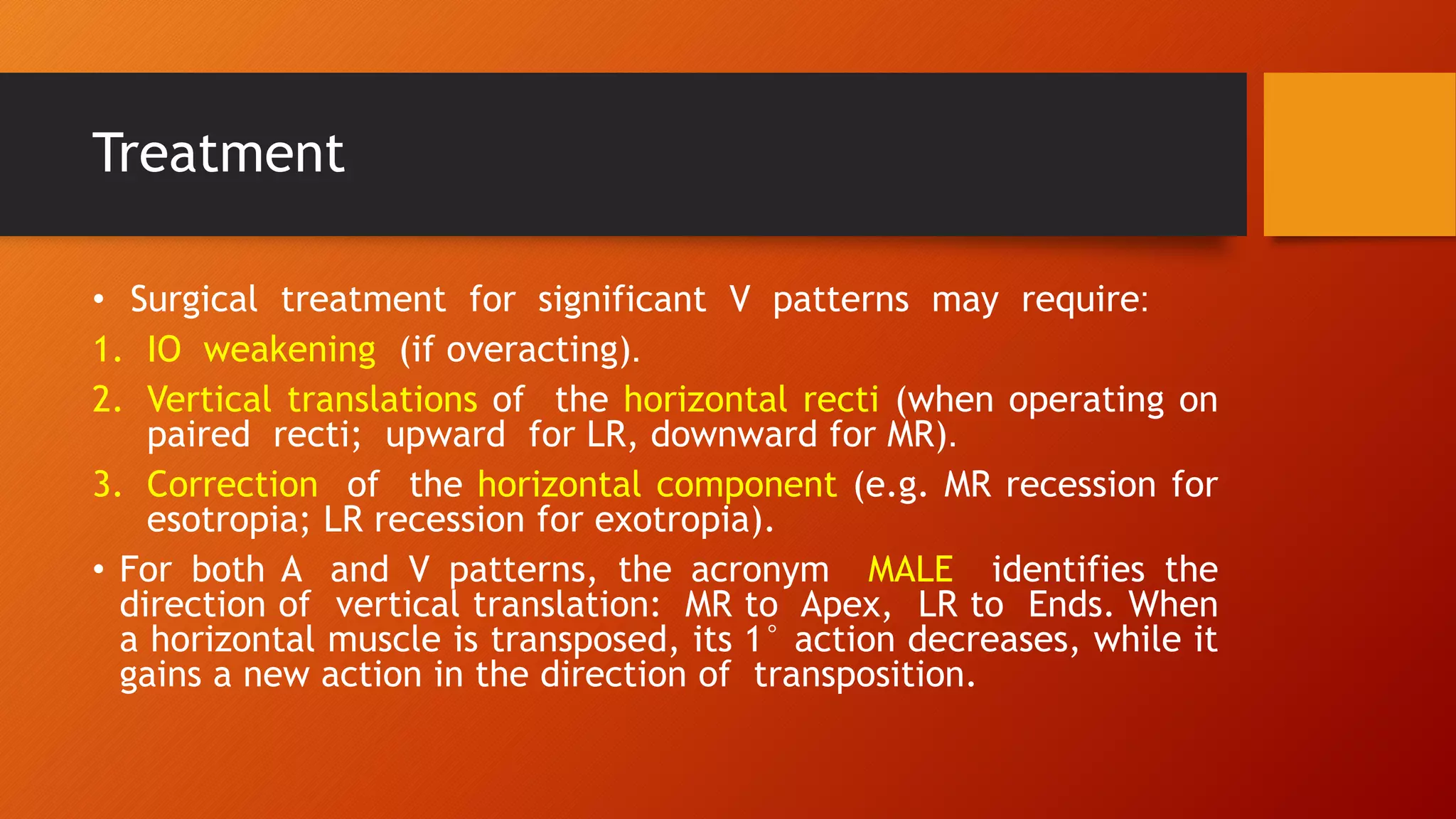
Treatment
• Surgical treatment for significant V patterns may require:
1. IO weakening (if overacting).
2. Vertical translations of the horizontal recti (when operating on
paired recti; upward for LR, downward for MR).
3. Correction of the horizontal component (e.g. MR recession for
esotropia; LR recession for exotropia).
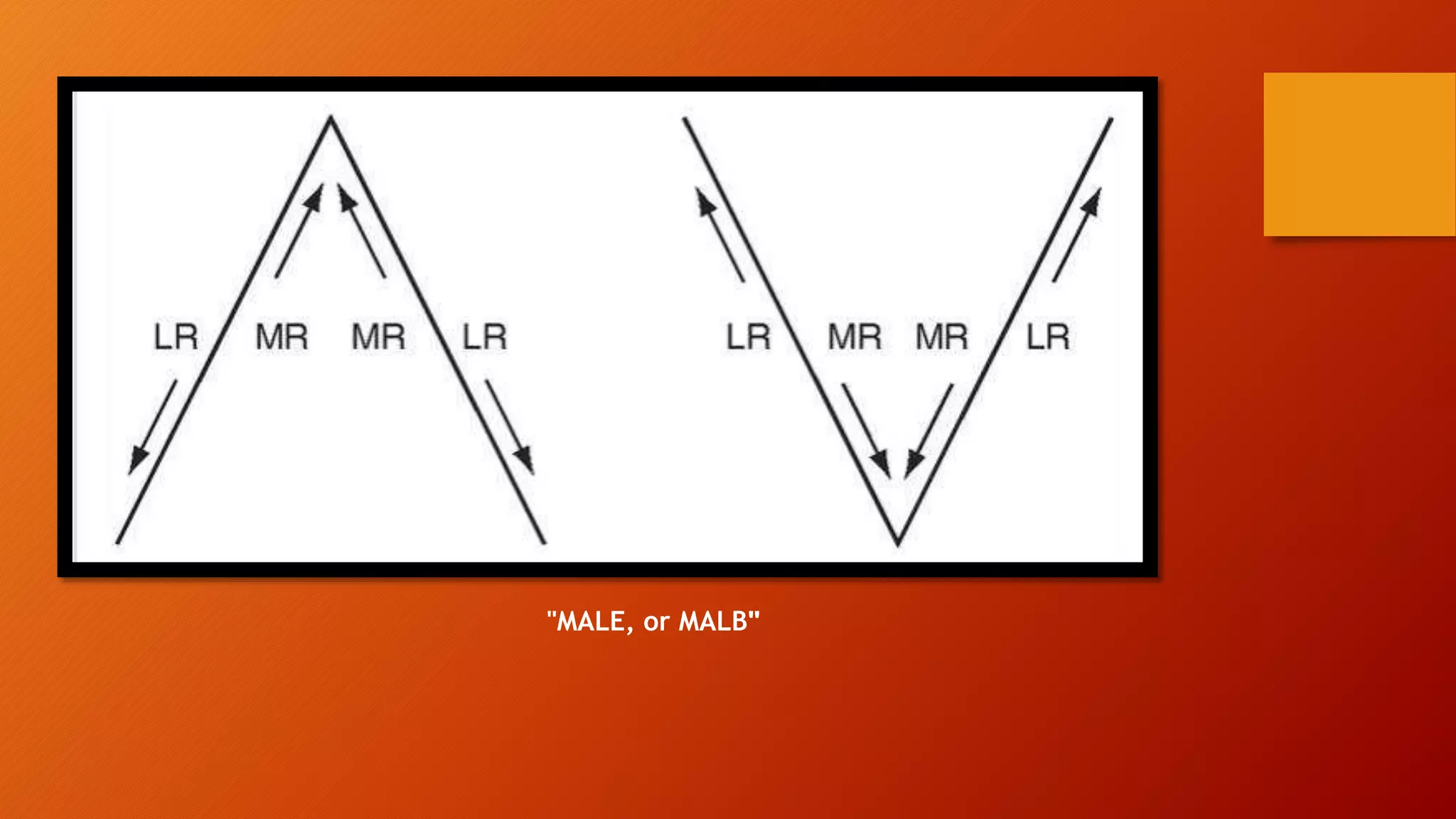
• For both A and V patterns, the acronym MALE identifies the
direction of vertical translation: MR to Apex, LR to Ends. When
a horizontal muscle is transposed, its 1° action decreases, while it
gains a new action in the direction of transposition.
"MALE, or MALB"
A pattern
Definition
• This is defined as a horizontal deviation, which is less divergent
(or more convergent) in upgaze than in downgaze.
Clinical features
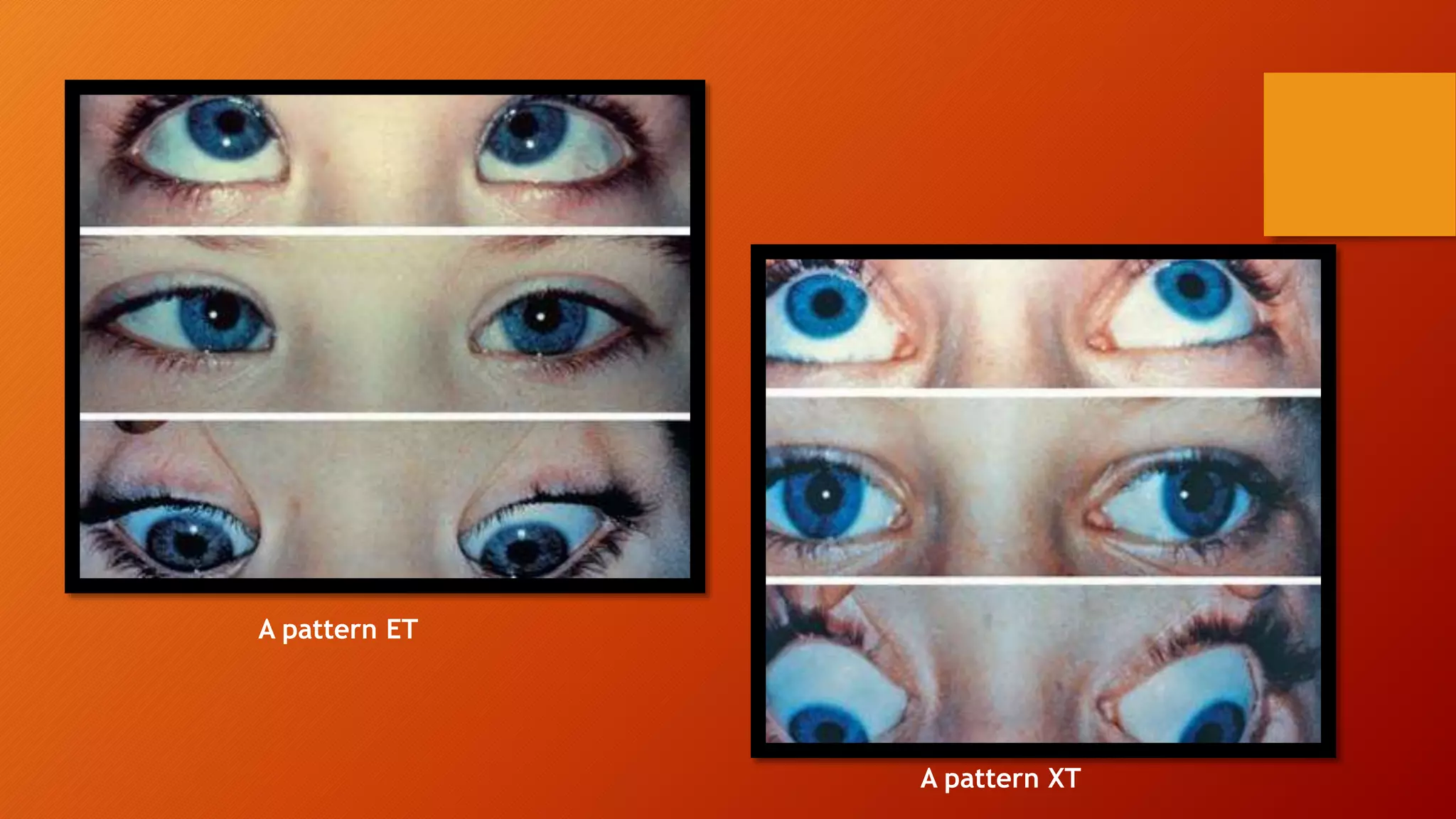
• A-pattern esotropia: usually arises from SO overaction; it may
also be associated with mongoloid palpebral fissures. patients may
adopt a chin up posture.
• A-pattern exotropia: usually arises from SO overaction. patients
adopt a chin down posture.
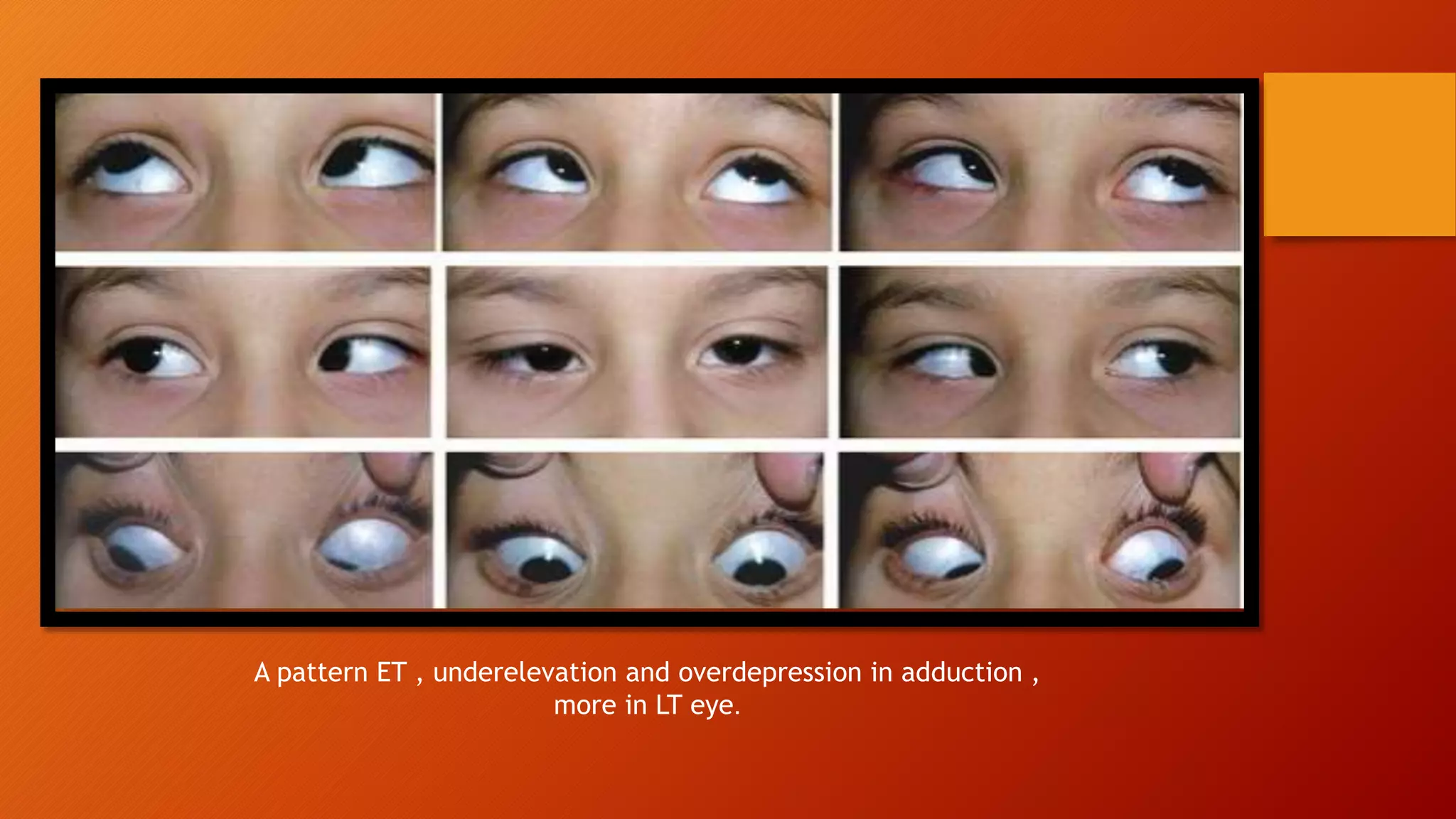
A pattern ET
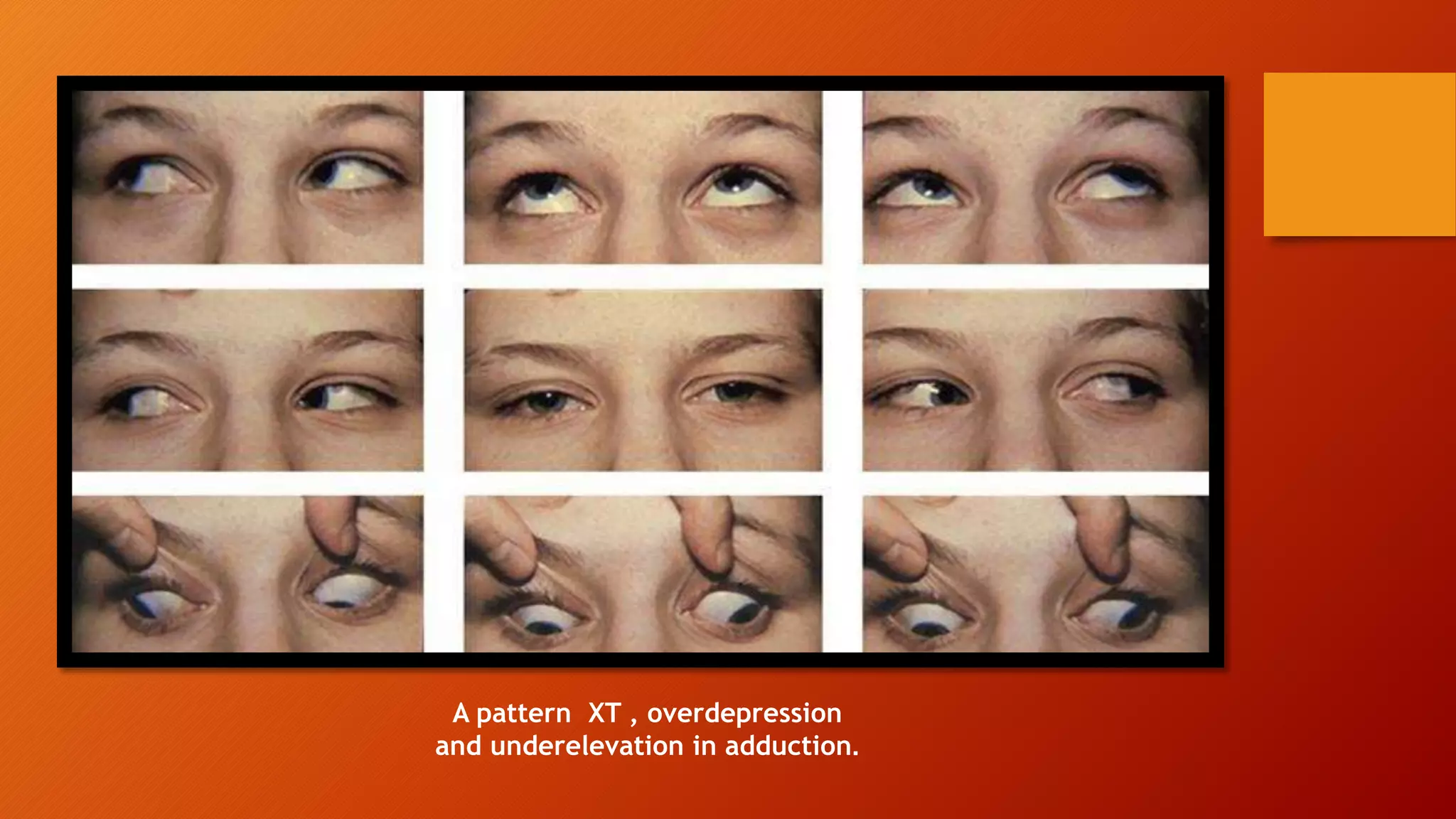
A pattern XT
A pattern ET , underelevation and overdepression in adduction ,
more in LT eye.
A pattern XT , overdepression
and underelevation in adduction.
Treatment
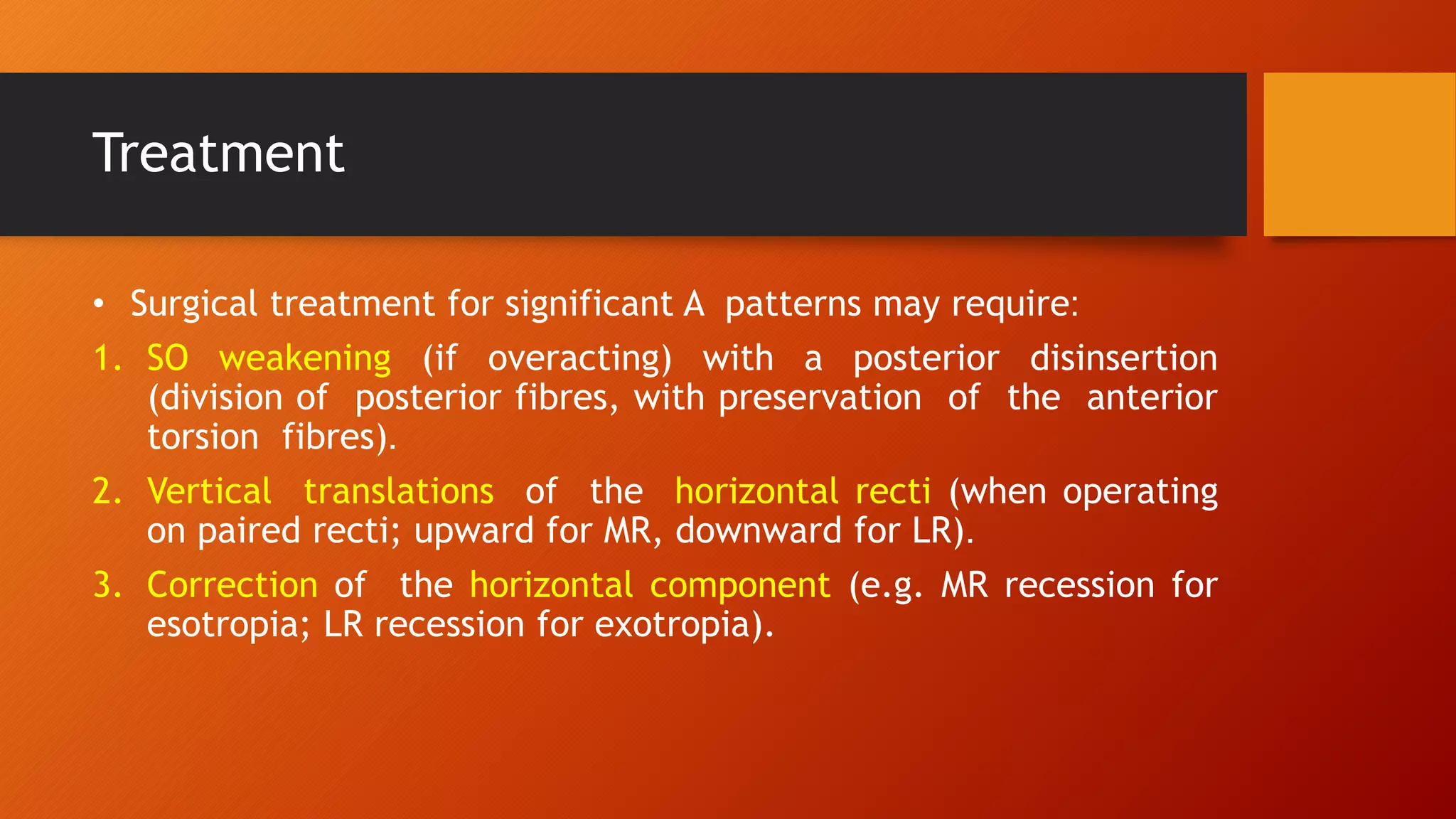
• Surgical treatment for significant A patterns may require:
1. SO weakening (if overacting) with a posterior disinsertion
(division of posterior fibres, with preservation of the anterior
torsion fibres).
2. Vertical translations of the horizontal recti (when operating
on paired recti; upward for MR, downward for LR).
3. Correction of the horizontal component (e.g. MR recession for
esotropia; LR recession for exotropia).
Other Patterns
Y pattern
• Exotropia in upgaze only.
• It is usually due to bilateral IOOA (seen in congenital esotropia or
exotropia).
• It can be treated by IO weakening alone.
λ pattern
• Exotropia in downgaze only, seen with bilateral SO overaction or
IR under action.
• It may be treated by downward translation of both LR.
X pattern
• Exotropia in upgaze and downgaze, but straight in the 1°
position.
• It usually arises in long standing exotropia with overaction of
all four oblique muscles or is iatrogenic.
“
”
Thanks

Alphabet patterns

  • 1.
    Alphabet Patterns By Dr AlshymaaMoustafa Ophthalmology Specialist
  • 2.
  • 3.
    • Horizontal deviationsmay vary in size according to vertical position. • The deviation is measured at 30° upgaze, 1° position, and 30° downgaze, while fixing on a distance target. • The difference between upgaze and downgaze must be >10 pD in "A" pattern and >15 pD in "V" pattern.
  • 4.
  • 5.
    • Imbalance intertiary abducting action of the obliques. greatest effect in upgaze from IO overaction (IOOA) vs downgaze from SO overaction. • MR action causes greater adduction in depression, LR greater abduction in elevation. • The adducting force from the vertical recti causes greatest adduction in their field of action. • Anomalies of orbital structures, such as craniosynostosis (extorted orbits and V pattern).
  • 6.
    • Abnormalities/ heterotopyof eOM pulleys. • Neural mechanisms such as abnormal supranuclear circuits. • Loss of fusion predisposing the oculomotor system to cyclodeviations of the eyes. • Ocular torsion may predispose to alphabet strabismus.
  • 7.
  • 8.
  • 9.
    Definition • this isdefined as a horizontal deviation, which is more divergent (or less convergent) in upgaze than in downgaze.
  • 10.
    Clinical features • V-patternesotropia: usually arises from IOOA or SO palsy; it is also associated with antimongoloid palpebral fissures (perhaps altering the recti insertions). patients may adopt a chin down posture. • V-pattern exotropia: usually arises from IOOA. patients adopt a chin up posture.
  • 11.
    Downward slant ofpalpebral fissure seen in V pattern horizontal deviation
  • 12.
    V pattern ET Vpattern XT
  • 13.
    V pattern EToverelevation , and limited depression in adduction
  • 14.
    V pattern XT,with moderate overelevation in adduction With no of SOUA
  • 15.
    Treatment • Surgical treatmentfor significant V patterns may require: 1. IO weakening (if overacting). 2. Vertical translations of the horizontal recti (when operating on paired recti; upward for LR, downward for MR). 3. Correction of the horizontal component (e.g. MR recession for esotropia; LR recession for exotropia). • For both A and V patterns, the acronym MALE identifies the direction of vertical translation: MR to Apex, LR to Ends. When a horizontal muscle is transposed, its 1° action decreases, while it gains a new action in the direction of transposition.
  • 16.
  • 17.
  • 18.
    Definition • This isdefined as a horizontal deviation, which is less divergent (or more convergent) in upgaze than in downgaze.
  • 19.
    Clinical features • A-patternesotropia: usually arises from SO overaction; it may also be associated with mongoloid palpebral fissures. patients may adopt a chin up posture. • A-pattern exotropia: usually arises from SO overaction. patients adopt a chin down posture.
  • 20.
    A pattern ET Apattern XT
  • 21.
    A pattern ET, underelevation and overdepression in adduction , more in LT eye.
  • 22.
    A pattern XT, overdepression and underelevation in adduction.
  • 23.
    Treatment • Surgical treatmentfor significant A patterns may require: 1. SO weakening (if overacting) with a posterior disinsertion (division of posterior fibres, with preservation of the anterior torsion fibres). 2. Vertical translations of the horizontal recti (when operating on paired recti; upward for MR, downward for LR). 3. Correction of the horizontal component (e.g. MR recession for esotropia; LR recession for exotropia).
  • 24.
  • 25.
    Y pattern • Exotropiain upgaze only. • It is usually due to bilateral IOOA (seen in congenital esotropia or exotropia). • It can be treated by IO weakening alone.
  • 26.
    λ pattern • Exotropiain downgaze only, seen with bilateral SO overaction or IR under action. • It may be treated by downward translation of both LR.
  • 27.
    X pattern • Exotropiain upgaze and downgaze, but straight in the 1° position. • It usually arises in long standing exotropia with overaction of all four oblique muscles or is iatrogenic.
  • 28.