Nanoemulsions
From Roll No 7-12
MPhil Pharmaceutics
University of Central Punjab
Definition
Nanoemulsions are novel drug delivery systems
consisting of emulsified oil and water systems
with average droplet size of 10-200 nm.
Introduction
• It is thermodynamically stable, optically clear and
transparent.
• The Nanoemulsion is formed readily and sometimes
spontaneously, generally without high-energy input. In
many cases a co-surfactant or co-solvent is used in
addition to the surfactant
• Now-a-day’s nanoemulsions are frequently used for
various purpose like delivery of vaccine, DNA encoded
drug, antibiotics, cosmetic and topical preparations and
can be administrated via various routes like oral,
pulmonary, ocular and transdermal etc.
Difference between Nanoemulsions
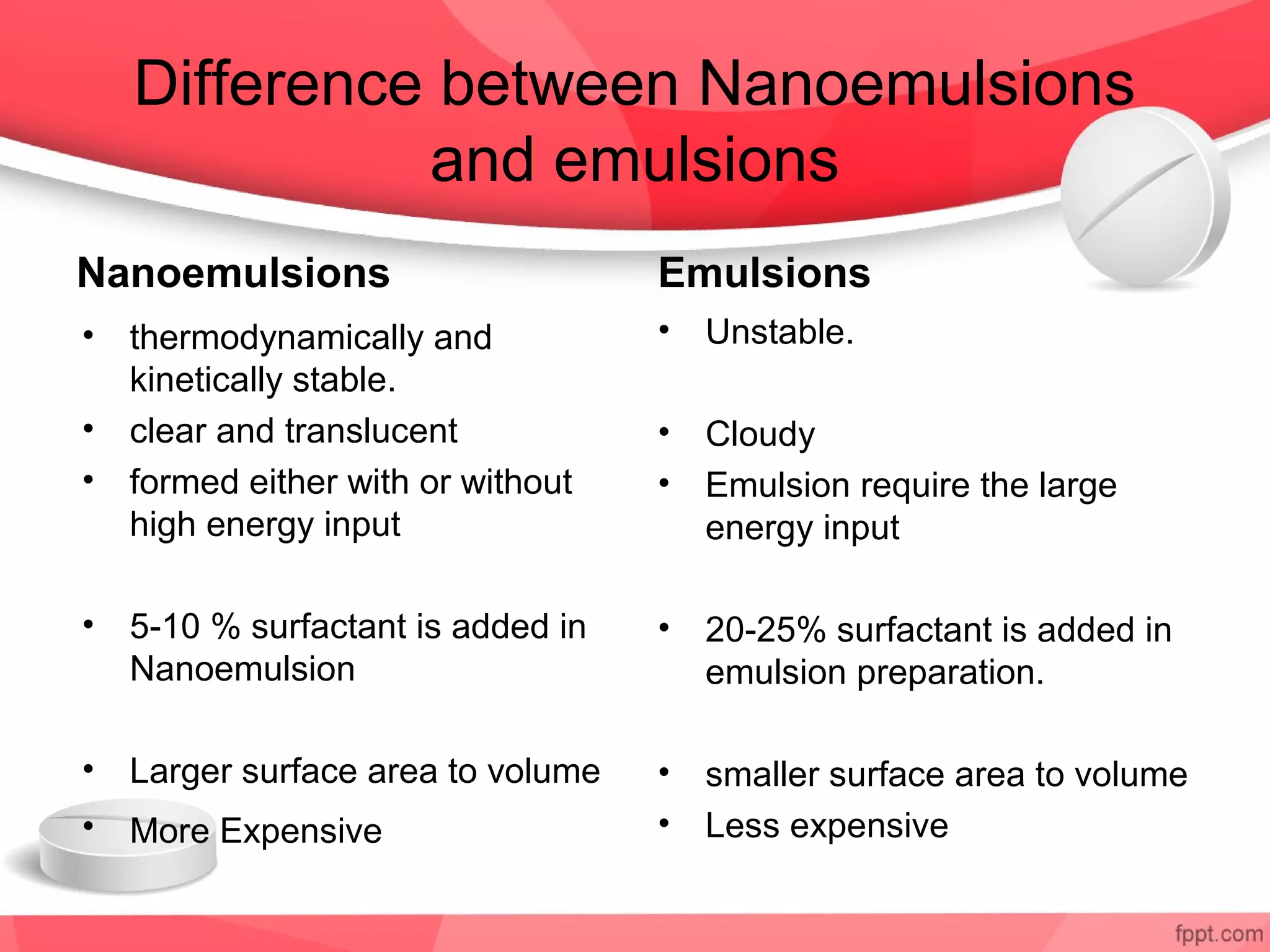
and emulsions
Nanoemulsions
• thermodynamically and
kinetically stable.
• clear and translucent
• formed either with or without
high energy input
• 5-10 % surfactant is added in
Nanoemulsion
• Larger surface area to volume
• More Expensive
Emulsions
• Unstable.
• Cloudy
• Emulsion require the large
energy input
• 20-25% surfactant is added in
emulsion preparation.
• smaller surface area to volume
• Less expensive
Formulation Additives
Types of Nanoemulsions
• oil in water
• water in oil
• Bi-continuous Nanoemulsion
wherein micro domains of oil and water are inter dispersed within
the system.
Advantages of Nanoemulsions
• Thermodynamically and kinetically stable therefore flocculation, aggregation,
creaming and coalescence do not occur.
• non toxic and non-irritant.
• Taste masking
• Administered by various routes, such as oral, topical, parentral and transdermal etc.
• Can deliver both hydrophilic and lipophilic drugs.
• Droplet size are nano, so surface area is higher thus increases the rate of absorption
and enhances bioavailability of drug.
• It protects the drug from hydrolysis and oxidation due to encapsulation in oil-droplet.
• Enhances permeation of drug through skin.
Characterization Techniques of Nanoemulsion
• Nano-emulsions characteristics will depend on particle size,
viscosity, density, phase inversion, turbidity, refractive index, skin
permeation studies. Techniques used are:
• 1. Thermal Conductivity Technique
• 2. Dynamic Light Scattering Spectrophotometer
• 3. Zeta Potential
• 4. Transmission Electron Microscopy (TEM)
• 5. Drug Content
• 6. Viscosity Measurement
• 7. Phase Analysis Technique
Method of Preparation of
Nanoemulsion
Methods of Preparation
High-Energy (for lab & industrial preparation)
For o/w &w/o emulsions
1. High pressure homogenization
2. Microfludization
3. Ultrasound emulsification
Low-Energy (for lab preparation)
1. Solvent-diffusion
2. Phase inversion
1. High Pressure Homogenization
• In a high-pressure homogenizer, the dispersion
of two liquids (oily phase and aqueous phase) is
achieved by forcing their mixture through a small
inlet orifice at very high pressure (500 to 5000
psi), which subjects the product to intense
turbulence and hydraulic shear resulting in
extremely fine particles of emulsion .
1.High Pressure Homogenizer
Aqueous phase + oleaginous phase (Heated and pH adjustment)
(Heated and filtration)
Add emulsifying agent
Rapid cooling
High pressure homogenizer (500-20000psi)
Formation of droplet very small size (nano size)
1. Continued
2. Microfluidization
• This device uses a high-pressure positive
displacement pump (500 to 20000psi), which
forces the product through the interaction
chamber, which consists of small channels
called ‘microchannels’.
• The product flows through the microchannels on
to an impingement area resulting in very fine
particles of sub-micron range.
2. Microfluidization
3. Ultrasound emulsification
• In this method, a probe emits ultrasonic waves (20 kHz)
to disintegrate the macroemulsion by means of cavitation
forces. By varying the ultrasonic energy input and time,
the nanoemulsions with desired properties can be
obtained.
• Undesirable for thermolabile drugs and macromolecules
(retinoids, proteins, enzymes and nucleic acids)
Low Energy Methods of
Preparation
1. Solvent diffusion method
• oily phase is dissolved in water-miscible organic
solvents, such as acetone, ethanol and ethyl
methyl ketone. The organic phase is poured into
an aqueous phase containing surfactant to yield
spontaneous nanoemulsion by rapid diffusion of
organic solvent. The organic solvent is removed
from the nanoemulsion by a suitable means,
such as vacuum evaporation.
2. Phase Inversion
• In this method the fine dispersions are
produced as the phase inversion occurs
which is caused by varying the
composition and keeping the temperature
constant or vice versa
Applications of Nanoemulsion
1. In cosmetics. Due to their lipohilic interior, nanoemulsions are more suitable for the
transport of lipophilic compounds .High skin penetration due to small size
2. Antimicrobial Nanoemulsion.
3. As Non-toxic disinfectant cleaner.
4. In cell culture technology.
5. As a vehicle for Transdermal drug delivery.
6. In cancer therapy and targeted drug delivery.
7. As a mucosal vaccines, nasal route, Alzheimer’s disease, migraine, depression,
schizophrenia, Parkinson’s diseases, meningitis
8. As a vehicle for a occular delivery
9. Use of Nanoemulsions in Cosmetics
10. Improved oral delivery of poorly soluble drugs
11. Percutaneous Route
12. Pulmonary Delivery
Commercial Nanoemulsions
Nanoemulsions

Nanoemulsions

  • 1.
    Nanoemulsions From Roll No7-12 MPhil Pharmaceutics University of Central Punjab
  • 2.
    Definition Nanoemulsions are noveldrug delivery systems consisting of emulsified oil and water systems with average droplet size of 10-200 nm.
  • 3.
    Introduction • It isthermodynamically stable, optically clear and transparent. • The Nanoemulsion is formed readily and sometimes spontaneously, generally without high-energy input. In many cases a co-surfactant or co-solvent is used in addition to the surfactant • Now-a-day’s nanoemulsions are frequently used for various purpose like delivery of vaccine, DNA encoded drug, antibiotics, cosmetic and topical preparations and can be administrated via various routes like oral, pulmonary, ocular and transdermal etc.
  • 4.
    Difference between Nanoemulsions andemulsions Nanoemulsions • thermodynamically and kinetically stable. • clear and translucent • formed either with or without high energy input • 5-10 % surfactant is added in Nanoemulsion • Larger surface area to volume • More Expensive Emulsions • Unstable. • Cloudy • Emulsion require the large energy input • 20-25% surfactant is added in emulsion preparation. • smaller surface area to volume • Less expensive
  • 5.
  • 6.
    Types of Nanoemulsions •oil in water • water in oil • Bi-continuous Nanoemulsion wherein micro domains of oil and water are inter dispersed within the system.
  • 7.
    Advantages of Nanoemulsions •Thermodynamically and kinetically stable therefore flocculation, aggregation, creaming and coalescence do not occur. • non toxic and non-irritant. • Taste masking • Administered by various routes, such as oral, topical, parentral and transdermal etc. • Can deliver both hydrophilic and lipophilic drugs. • Droplet size are nano, so surface area is higher thus increases the rate of absorption and enhances bioavailability of drug. • It protects the drug from hydrolysis and oxidation due to encapsulation in oil-droplet. • Enhances permeation of drug through skin.
  • 8.
    Characterization Techniques ofNanoemulsion • Nano-emulsions characteristics will depend on particle size, viscosity, density, phase inversion, turbidity, refractive index, skin permeation studies. Techniques used are: • 1. Thermal Conductivity Technique • 2. Dynamic Light Scattering Spectrophotometer • 3. Zeta Potential • 4. Transmission Electron Microscopy (TEM) • 5. Drug Content • 6. Viscosity Measurement • 7. Phase Analysis Technique
  • 9.
    Method of Preparationof Nanoemulsion
  • 10.
    Methods of Preparation High-Energy(for lab & industrial preparation) For o/w &w/o emulsions 1. High pressure homogenization 2. Microfludization 3. Ultrasound emulsification Low-Energy (for lab preparation) 1. Solvent-diffusion 2. Phase inversion
  • 11.
    1. High PressureHomogenization • In a high-pressure homogenizer, the dispersion of two liquids (oily phase and aqueous phase) is achieved by forcing their mixture through a small inlet orifice at very high pressure (500 to 5000 psi), which subjects the product to intense turbulence and hydraulic shear resulting in extremely fine particles of emulsion .
  • 12.
    1.High Pressure Homogenizer Aqueousphase + oleaginous phase (Heated and pH adjustment) (Heated and filtration) Add emulsifying agent Rapid cooling High pressure homogenizer (500-20000psi) Formation of droplet very small size (nano size)
  • 13.
  • 14.
    2. Microfluidization • Thisdevice uses a high-pressure positive displacement pump (500 to 20000psi), which forces the product through the interaction chamber, which consists of small channels called ‘microchannels’. • The product flows through the microchannels on to an impingement area resulting in very fine particles of sub-micron range.
  • 15.
  • 16.
    3. Ultrasound emulsification •In this method, a probe emits ultrasonic waves (20 kHz) to disintegrate the macroemulsion by means of cavitation forces. By varying the ultrasonic energy input and time, the nanoemulsions with desired properties can be obtained. • Undesirable for thermolabile drugs and macromolecules (retinoids, proteins, enzymes and nucleic acids)
  • 17.
    Low Energy Methodsof Preparation
  • 18.
    1. Solvent diffusionmethod • oily phase is dissolved in water-miscible organic solvents, such as acetone, ethanol and ethyl methyl ketone. The organic phase is poured into an aqueous phase containing surfactant to yield spontaneous nanoemulsion by rapid diffusion of organic solvent. The organic solvent is removed from the nanoemulsion by a suitable means, such as vacuum evaporation.
  • 19.
    2. Phase Inversion •In this method the fine dispersions are produced as the phase inversion occurs which is caused by varying the composition and keeping the temperature constant or vice versa
  • 20.
    Applications of Nanoemulsion 1.In cosmetics. Due to their lipohilic interior, nanoemulsions are more suitable for the transport of lipophilic compounds .High skin penetration due to small size 2. Antimicrobial Nanoemulsion. 3. As Non-toxic disinfectant cleaner. 4. In cell culture technology. 5. As a vehicle for Transdermal drug delivery. 6. In cancer therapy and targeted drug delivery. 7. As a mucosal vaccines, nasal route, Alzheimer’s disease, migraine, depression, schizophrenia, Parkinson’s diseases, meningitis 8. As a vehicle for a occular delivery 9. Use of Nanoemulsions in Cosmetics 10. Improved oral delivery of poorly soluble drugs 11. Percutaneous Route 12. Pulmonary Delivery
  • 21.

Editor's Notes

  • #9 Characterization Technique of Nanoemulsion: Nano-emulsions characteristics will depend on particle size, viscosity, density, phase inversion, turbidity, refractive index, skin permeation studies and these characteristics are measured by the various technique discuss below[1].   Thermal Conductivity Technique: In this technique, named 3 -wire method wasdeveloped to measured nanoemulsion by the thermal conductometer. In this method, the temperature of the metal wire is measured in the time domain [12]. O/W Nanoemulsion where the external phase is water are highly conducting [4].   Dynamic Light Scattering Spectrophotometer: Dynamic light scattering measurements are done at 90° using a neon laser of wavelength 632nm. The particle size and particle size distribution is determined by dynamic light scattering spectrophotometer [13,4].   Zeta Potential: Zeta potential measures the surface charge of nanoemulsion with the help of a mini electrode [14].     Transmission Electron Microscopy (TEM): It is a very simple method to determine the size, number, weight and structure (morphology characteristic). O/w nanoemulsion is stain with uranyl acetate and placed on a grid, coated with monolayer polymer, then water is evaporated and observation is done using TEM [3, 8,15].   Drug Content: Western Blot method is used to measured amount of drug present [7,16].   Viscosity Measurement: Viscosity of nanoemulsion should be measured by using the rotary viscometer at different rate and temperature. Nanoemulsions have very low viscosity [4,17, 18].   Phase Analysis Technique: It is done for nanoemulsion generally prepared by phase inversion method and self emulsification method to measures the dispersibility of nanoemulsion [3,19].
  • #20 Phase inversion temperature (PIT) method employs temperature-dependent solubility of nonionic surfactants, such as polyethoxylated surfactants, to modify their affinities for water and oil as a function of the temperature. polyethoxylated surfactants tend to become lipophilic on heating owing to dehydration of polyoxyethylene groups. oil, water and nonionic surfactants are mixed together at room temperature. This mixture typically comprises o/w microemulsions coexisting with excess oil, and the surfactant monolayer exhibits positive curvature. When this macroemulsion is heated gradually, the polyethoxylated surfactant becomes lipophilic and at higher temperatures, the surfactant gets completely solubilized in the oily phase and the initial o/w emulsion undergoes phase inversion to w/o emulsion. The surfactant monolayer has negative curvature at this stage. difficult to incorporate thermolabile drugs,e.g.tretinoin and peptides