TRACHEOSTOMY TUBES
DR.ASHWIN MENON
INTRODUCTION
• Increasingly tracheostomies are being used for the
long-term management of a wide variety of
conditions.
• This topic will discuss the components and functions
of tracheostomy tubes currently available and offer
information on how to select the most appropriate
tube.
• This topic will also identify the associated
complications of the use of an inappropriate tube.
Functions of a tracheostomy include:
• To allow prolonged positive pressure
ventilation.
• To protect from aspiration.
• To bypass an upper airway obstruction.
• To allow access to aspirate secretions.
THE TRACHEOSTOMY TUBE
• The ideal tracheostomy tube should be rigid enough
to maintain an airway and yet flexible to limit tissue
damage and maximise patient comfort.
• The tube shape is designed to allow correct entry
angle into the trachea to facilitate ventilation and
clearance of secretions.
• A tracheostomy tube entering the trachea at an
incorrect angle may endanger the positioning
for safe ventilation via the tracheostomy. It
may also cause irritation and trauma to the
tracheal mucosa.
• The tracheostomy tube is arc shaped, which is
referred to as the Jackson Curve.
• Tracheostomy tubes are available in a variety
of lengths and diameters and available with
attachments to meet the needs of each patient.
• The tube sizes are often defined according to
the age group they serve, i.e. neonate,
paediatric and adult.
• The varying styles of tubes to be discussed
include: cuffed, uncuffed, fenestrated, variable
length, single lumen and double lumen tubes.
Parts of a tracheostomy tube
1. Outer cannula– This is the main body of the tube
which passes into the trachea.
2. Inner cannula– An inner cannula is a removable tube
which passes into the outer cannula and can be
removed/replaced to promote a clear airway.
• Inner cannula are available in re-usable, disposable,
plain (2a) and fenestrated (2b) styles. Fenestrated
inner cannula are often coloured to ensure easy
identification prior to suction or ventilation.
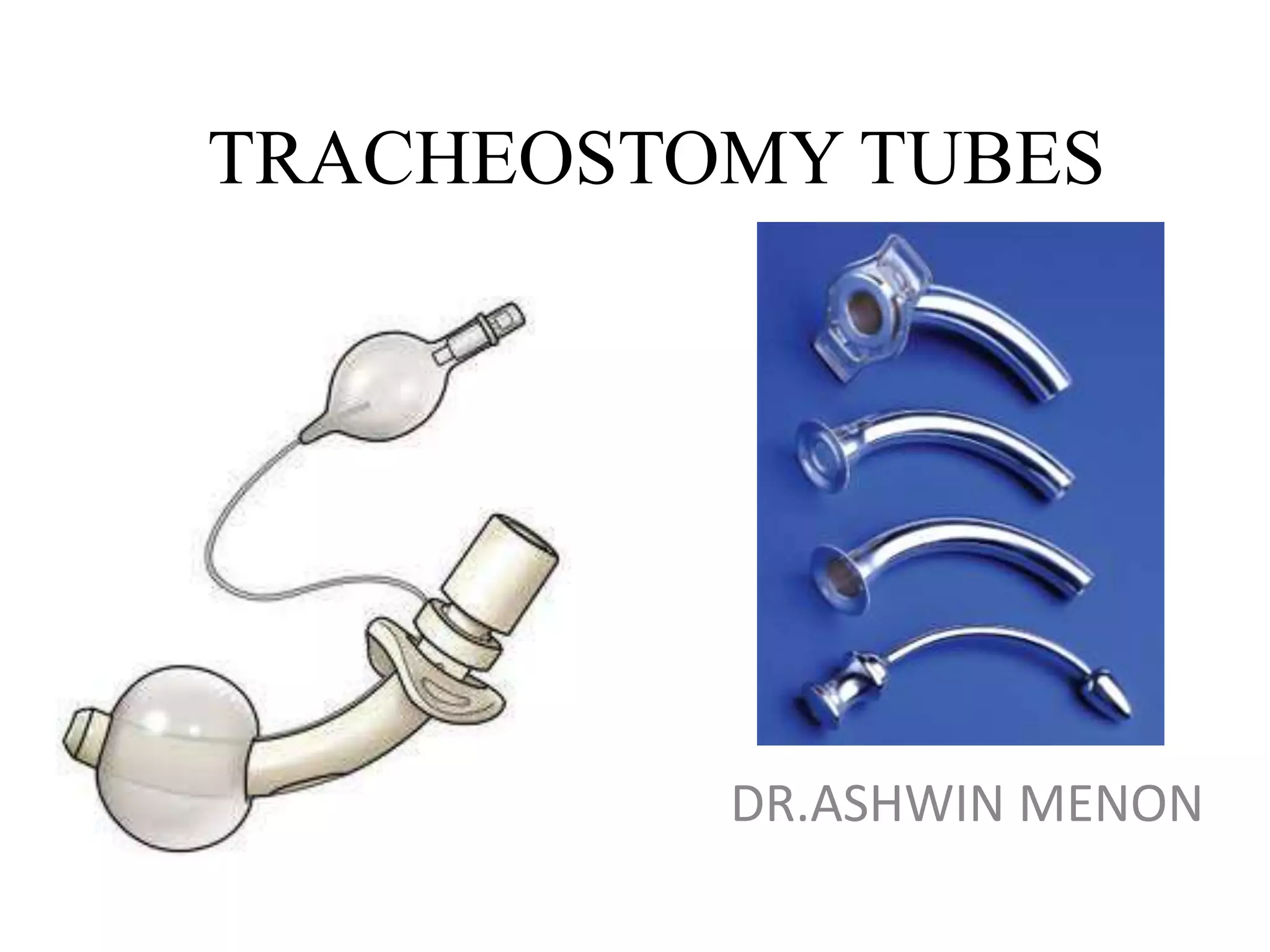
3. Cuff– A balloon at the distal end of the tube which,
when inflated, can provide a seal between the tube
and tracheal wall. The cuff can be deflated, as on
insertion, or inflated to protect from aspiration and
allow positive pressure ventilation.
4. Pilot balloon– An external balloon connected by an
inflation line to the internal cuff. When the internal
cuff is inflated the pilot balloon is also inflated, and
vice versa.
5. Flange/neck plate– The neck plate supports the main
tube structure, preventing it from descending into the
trachea and allowing the tube to be secured with
tapes/ties/sutures. The tube code, size or type is often
demonstrated on the neck plate.
• Most neck plates in adult size tubes are a straight
strip, however neonatal and some paediatric tubes
have an angled neck plate to accommodate the
shorter, developing neck.
• Other variations include adjustable flange tubes
which allow variable tube lengths to be used. These
may be useful for patients with larger necks or
increased pre-tracheal space.
6. Introducer/obturator – A bevel tipped shaft, which is
placed inside the outer cannula of the tube during
tube insertion. It provides a smooth rounded dilating
tip, which will reduce the trauma of tube insertion. It
is removed once the tube has been inserted to allow
air entry and exit and assessment of correct tube
placement.
7. Fenestrations– Single or multiple holes are
positioned on the superior curvature of the shaft.
• Fenestrations permit airflow through these holes,
which in addition to the air flow around the tube,
allows the patient to speak and cough more
effectively.
8. 15 mm adaptor– In order to allow attachment to
ventilation equipment, the majority of tracheostomy
tubes used in the hospital setting will have a
universally sized 15 mm hub to allow attachment to
ventilators, re-breath bags, humidification circuits and
closed circuit suction units.
TUBE SELECTION
• The properties of a tracheostomy tube are selected to
best suit the individual patient’s anatomy and clinical
needs. The aim of the tracheostomy tube is to allow
adequate airflow without causing complications
associated with the placement of too large a
tracheostomy tube.
• It is recommended that the external diameter of the
tracheostomy tube is no larger than two-thirds to
three-quarters of the tracheal lumen. This will reduce
the contact on the tracheal walls which can cause
damage from repeated shearing forces.
• Other criteria will include the depth of tissue
between skin and trachea which affects the required
length of the proximal aspect of the tube (neck plate
to curve). A longer tube may be indicated for patients
with an enlarged thyroid or in the obese.
• A tube that is too short or lies at the wrong angle will
hold the risk of misplacement, a potentially fatal
complication in the early stages following a
tracheostomy.
• In certain instances a longer tube length may be
needed, e.g. tracheal malacia, stenosis or obesity in
order to provide safe ventilation.
TYPES OF TRACHEOSTOMY TUBE
1. Cuffed tube
2. Un cuffed tubes
CUFFED TUBE
 The initial tube inserted at
time of tracheostomy should be
a cuffed tube. It provides a safe
airway until a patient is weaned
from the ventilator, the wound
site has stabilised and the
patient can control his/her own
secretions.
 The cuff or balloon at the
distal end of the tube can be
inflated or deflated depending
on the patient’s needs.
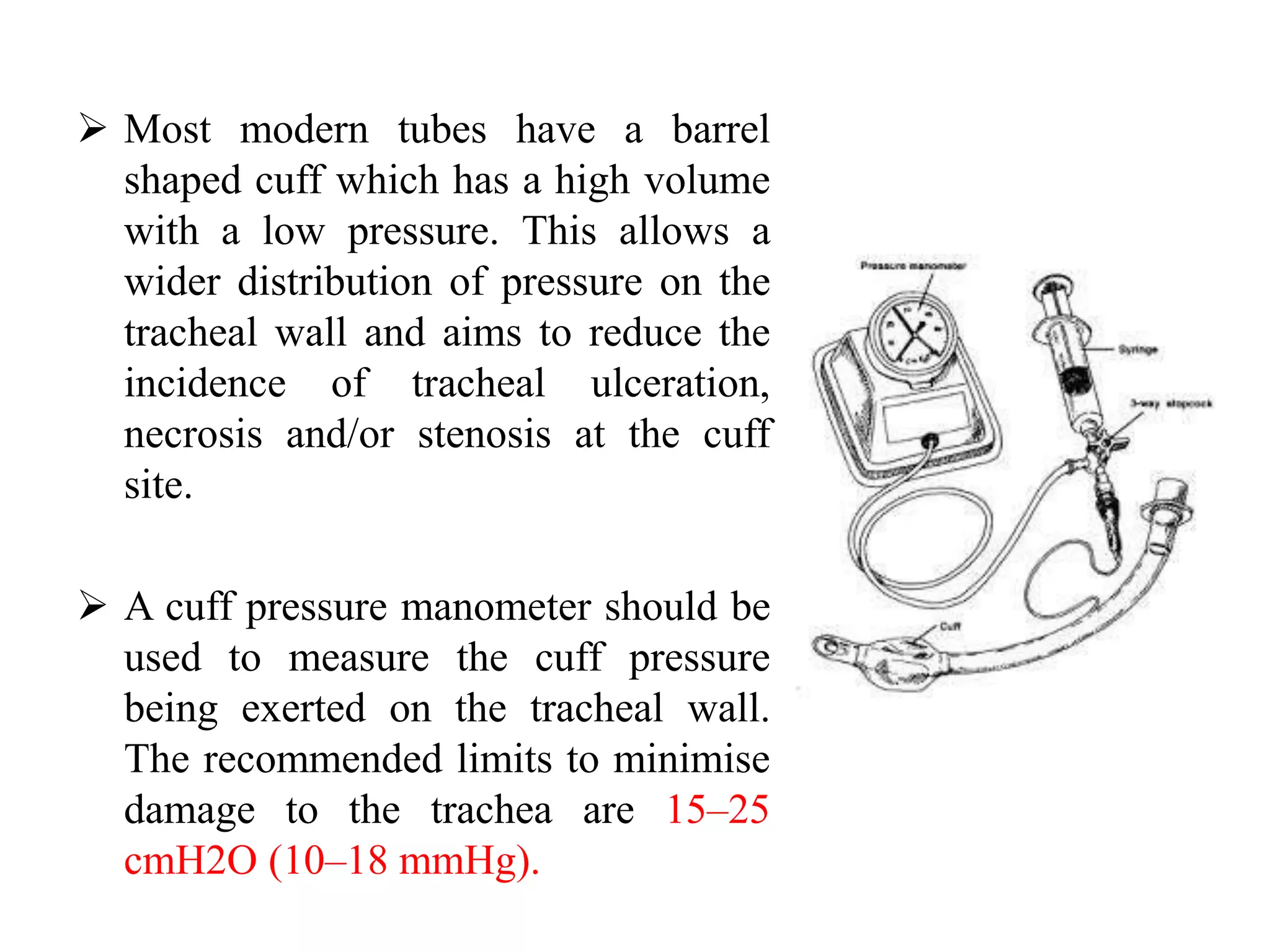
 Most modern tubes have a barrel
shaped cuff which has a high volume
with a low pressure. This allows a
wider distribution of pressure on the
tracheal wall and aims to reduce the
incidence of tracheal ulceration,
necrosis and/or stenosis at the cuff
site.
 A cuff pressure manometer should be
used to measure the cuff pressure
being exerted on the tracheal wall.
The recommended limits to minimise
damage to the trachea are 15–25
cmH2O (10–18 mmHg).
Tracheal capillary pressure lies
between 20 and 30 mmHg. It suffers
impairment at 22 mmHg and total
obstruction at 37 mmHg.
Complications of continued cuff over
inflation include:
1)Tracheal stenosis.
2)Tracheal malacia.
3)Tracheosophageal or
tracheoinominate fistula.
4)Desensitisation of the larynx and
potential loss of the cough reflex.
• If a cuff pressure above the recommended limit is
required for a patient in order to provide an adequate
seal then a tube of a larger diameter may be indicated.
This may necessitate a surgical revision of the
tracheostomy to allow the atraumatic insertion of a
larger tube.
Indications for a cuffed tube:
 Risk of aspiration
 Newly formed stoma (adult)
 Positive pressure ventilation
 Unstable condition
Contra-indications for a cuffed tube:
 Child less than 12 years of age
 Significant risk of tracheal tissue damage from cuff.
• In the paediatric and neonatal patient, it is unusual to
have a cuffed tube due to the risk of tracheal damage
of the developing tracheal membranes. Children
under the age of 12 years have a narrow trachea
particularly around the cricoid ring and therefore air
leaks are minimal.
SPECIALIST CUFFED TUBES
1. Foam cuffs –
 A foam cuff spontaneously inflates on insertion and
will then conform to the patients trachea.
 Remains consistently inflated, therefore eliminating
the risk of over inflation.
 Due to the spontaneous inflation of the cuff the use of
a standard speaking valve or occlusion cap are contra-
indicated. These tubes are available with a ‘talk
attachment’.
E.g. Fome-Cuf, Bivona.
2. Tight to shaft cuff –
 Tight to shaft tubes have a cuff which when deflated
has the profile of an un cuffed tube. This allows a less
traumatic tube insertion and withdrawal compared to
a standard cuffed tube.
E.g. TTS™, Bivona.
3. Suction ports -
The cuff minimises but does not
necessarily prevent aspiration. The
suction port above the cuff allows
regular removal of secretions
thereby reducing the risk of
aspiration and also the associated
infection risks.
E.g. Blueline Ultra Suctionaid™
Portex.
• Double cuffs -
Double cuffed tubes use the
alternation of the cuff
inflation to allow pressure
relief on high risk tracheal
mucosa, e.g. tracheomalacia.
E.g. Double cuff, Portex.
• Lanz™ system -
This cuff system
automatically controls and
limits cuff pressure for the
entire duration of intubation.
E.g. Tracheosoft Lanz™,
Mallinckrodt.
Cuffed talking tubes -
– Where a patient cannot tolerate the use of a speaking
valve and/or cuff deflation alternative tubes may be
used.
– These tubes have an additional airflow line attached
to the outer cannula.
– It will deliver air from an external source above the
cuff which can then pass through the vocal cords to
potentially allow phonation.
E.g.
1. Fome-Cuf® tracheostomy tube with talk attachment Bivona,
2. Aire-Cuf® tracheostomy tube with talk attachment Bivona,
Vocalaid Portex and TracheoSoft Pitt™ Mallinckrodt
UN CUFFED TUBES
• An un cuffed or cuff less tube refers to a tube which
does not have a cuff at the distal end of the tube.
• This type of tube is useful when the patient no longer
needs positive pressure ventilation and has no
significant aspiration risk and has tolerated the cuff
being deflated continually. The tracheostomy is still
required for access to chest secretions or to bypass an
upper airway obstruction.
• These tubes can be recognised by the absence of a
pilot balloon.
• Uncuffed tubes are available in most adult,
paediatric and neonatal tubes.
• Un cuffed tubes offer a variety of
specifications:
– Plain
– Fenestrated
– with speaking valves attached
– with or without a 15 mm hub.
Indications for an un cuffed tube:
 Vocal cord palsy
 Head and neck tumour
 Respiratory insufficiency
 Neuromuscular disorders
 Paediatric or neonatal tracheostomy
Contra-indications for an un cuffed tube:
 Dependent on positive pressure ventilation
 Significant risk of aspiration
 Newly formed tracheostomy
JACKSONS TRACHEOSTOMY TUBE
Fenestrated tubes
• Fenestrated tubes have a single or multiple holes on
the outer curvature of the tube. If the tube has an
inner cannula then the tube will be supplied with a
plain and a fenestrated inner cannula.
• A patient with a small trachea or marginal respiratory
status may benefit from a fenestrated tube. The
additional airflow through the fenestrations in the
tube can increase the tolerance of a speaking valve
and/or occlusion cap thereby aiding weaning.
FULLERS TRACHEOSTOMY TUBE
• It is inadvisable to suction via a fenestrated single
lumen tube as the suction catheter can pass through
the fenestration and cause tracheal damage which will
increase the risk of granulation tissue at the site of the
fenestration.
• In a dual cannula system, the plain (un fenestrated)
inner cannula should be inserted prior to suctioning to
avoid this problem.
• Fenestrated tubes are contra-indicated for use with
patients requiring positive pressure ventilation as a
significant air leakage through the outer cannula
fenestrations may occur and compromise the
effectiveness of the ventilation.
Extra long/adjustable flange
• Standard tracheostomy tubes have a standard curve,
referred to as the Jackson Curve.
• The standard tube lengths are-
– 60–90 mm (adult)
– 39–45 mm (paediatric)
– 30–36 mm (neo-natal).
These tubes may not be safe for patients with an increased
tracheo cutaneous layer or an enlarged thyroid gland. For
these patients, a standard length tube may not enter the
trachea or enter at an angle which will make ventilation and
clearance of secretions difficult. They may cause posterior
wall erosion by resting on and/or shearing at the tracheal
wall.
Indications for an extra long tube:
Increased distal length-
• Tracheal obstruction, e.g. tumour growth
• Tracheomalacia
• Low level tracheal stenosis
Examples:
1. Moore, Boston Medical (uncuffed silastic tube
which can be trimmed to fit an individual patient)
2. Tracoe Comfort™ Extra Long, Bivona (an uncuffed
tube range which can be plain or fenestrated)
3. Traceosoft™ XLT Distal, cuffed, un cuffed
Increased proximal length-
• Increased pre-tracheal space from obesity or
oedema
• Enlarged thyroid
• Kypholordosis
• To allow easier wound care around stoma
Examples:
1. Traceosoft XLT/Shiley
2. Adjustable flange tube, Portex
Adult single lumen tubes
• A single lumen tube has
only one cannula that stays
in situ throughout its use.
• Single lumen tubes made
of silicone or a mixture of
silicone and PVC have an
increased resistance to
secretions adhering to the
tube.
Double lumen tubes/inner cannula tube systems
• The use of an inner cannula will assist the cleaning of
the tube, particularly if the patient has copious
secretions. This reduces the risk of tube occlusion and
the frequency of tube changes which causes the
patient discomfort and trauma to the stoma site.
• The presence of an inner cannula will reduce the
lumen by approximately 1 to 1.5 mm
Neonatal and paediatric tubes
• These ranges of tubes are from 2.5 to 5.5 mm in
internal diameter and have lengths from 30–36 mm
(neonates) and 39–56 mm (paediatrics). The age and
weight will be a guide for the surgeon when choosing
the size of tube.
• Due to the small size of the tracheostomy tube lumen
a paediatric tube and neo-natal tube will not have an
inner cannula.
• To avoid a build up of secretions causing respiratory
difficulties, the tube should be changed every week.
• To help prevent the build up of secretions, a silicone
tube is recommended as it allows mucus to pass more
effectively through the tube and reduce the adherence
of secretions and bacteria to the tube surface.
• The ideal length of a paediatric tube is recommended
to be 1 cm above the carina, this position can be
checked using a small diameter paediatric flexible
endoscope.
• Due to the delicate developing tracheal tissue and the
narrow cricoid ring a cuffed tube is not recommended
and seldom necessary.
TRACHEOSTOMY TUBE ACCESSORIES
Speaking valve
• These are one-way valves which can be placed on the
exposed (distal) end of the tracheostomy tube when
the patient is clinically suitable to attempt phonation
(speaking) trials. The speaking valve can be used as
an aid to communication.
• With the valve in place the patient will inhale through
the tracheostomy and as they exhale, the valve is
forced shut and air has to pass around the tube,
passing through the vocal cords and then exiting
through the nose and mouth.
• The cuff must be fully deflated in order to use a
speaking valve! (otherwise the patient will be unable
to exhale) .
Occlusion cap
• This is a solid piece of plastic
which is placed on the end of a
15 mm tracheostomy tube. It
blocks all airflow via the
tracheostomy and is used as a
tool in the end stages of weaning
a patient from their tracheostomy
tube. It can beeasily removed if
the patient needs suctioning or
has become fatigued by the
increased respiratory workload.
Disconnection wedge
• This wedge facilitates the disconnection of a circuit,
occlusion cap or speaking valve from the
tracheostomy tube.
Mini tracheostomy
• This 16 Fg single lumen PVC tube is most commonly
used to provide an airway in the emergency situation
until the patient improves or a more permanent
airway can be established.
Contraindications to the use of a speaking valve
ƒ
1. Severe tracheal/laryngeal stenosis
2. ƒAirway obstruction
3. ƒInability to tolerate cuff deflation
4. ƒEnd stage pulmonary disease
5. ƒUnstable medical/pulmonary status
6. ƒAnarthria
7. ƒLaryngectomy
8. ƒSevere anxiety or severe cognitive dysfunction
WHAT ARE TUBES MADE OF?
The various materials used to manufacture
tracheostomy tubes include:
1. Polyvinylchloride (PVC)
2. Silicone
3. Siliconised polyvinylchloride (PVC)
4. Silver
5. Silastic
Armoured tubes
• These tubes have embedded within the main shaft of
the tube, a spiral or rings of stainless steel which
assists in keeping the shape of the tube. This prevents
kinking or compression of the tube.
E.g. Rusch, Tracheoflex
COMPLICATIONS OF A TRACHEOSTOMY
TUBE
Mainly caused due to:
a. Complications of a tracheostomy tube
b. Complications caused by tube length
c. Complications caused by tube width
d. Complications from cuffs
Choosing the right tube
• The width of the tube should be guided by the height,
age and weight of the patient and in particular the
diameter of the patient’s trachea.
• The tube is recommended to be no larger than two-
thirds the diameter of the trachea. This will allow
adequate ventilation and minimise tissue abrasion
from the shearing effect of the tube.
• The correct placement of the tube can be confirmed
with a chest X-ray. This should be between 6–20 mm
above the carina to prevent mucosal damage and
coughing.
• The correct length of tube will ensure safe entry into
the trachea and will reduce the risk of tube
misplacement with patient movement.
Tracheostomy tubes by Dr.Ashwin Menon

Tracheostomy tubes by Dr.Ashwin Menon

  • 1.
  • 2.
    INTRODUCTION • Increasingly tracheostomiesare being used for the long-term management of a wide variety of conditions. • This topic will discuss the components and functions of tracheostomy tubes currently available and offer information on how to select the most appropriate tube. • This topic will also identify the associated complications of the use of an inappropriate tube.
  • 3.
    Functions of atracheostomy include: • To allow prolonged positive pressure ventilation. • To protect from aspiration. • To bypass an upper airway obstruction. • To allow access to aspirate secretions.
  • 4.
    THE TRACHEOSTOMY TUBE •The ideal tracheostomy tube should be rigid enough to maintain an airway and yet flexible to limit tissue damage and maximise patient comfort. • The tube shape is designed to allow correct entry angle into the trachea to facilitate ventilation and clearance of secretions.
  • 5.
    • A tracheostomytube entering the trachea at an incorrect angle may endanger the positioning for safe ventilation via the tracheostomy. It may also cause irritation and trauma to the tracheal mucosa. • The tracheostomy tube is arc shaped, which is referred to as the Jackson Curve.
  • 8.
    • Tracheostomy tubesare available in a variety of lengths and diameters and available with attachments to meet the needs of each patient. • The tube sizes are often defined according to the age group they serve, i.e. neonate, paediatric and adult. • The varying styles of tubes to be discussed include: cuffed, uncuffed, fenestrated, variable length, single lumen and double lumen tubes.
  • 9.
    Parts of atracheostomy tube 1. Outer cannula– This is the main body of the tube which passes into the trachea. 2. Inner cannula– An inner cannula is a removable tube which passes into the outer cannula and can be removed/replaced to promote a clear airway. • Inner cannula are available in re-usable, disposable, plain (2a) and fenestrated (2b) styles. Fenestrated inner cannula are often coloured to ensure easy identification prior to suction or ventilation.
  • 11.
    3. Cuff– Aballoon at the distal end of the tube which, when inflated, can provide a seal between the tube and tracheal wall. The cuff can be deflated, as on insertion, or inflated to protect from aspiration and allow positive pressure ventilation. 4. Pilot balloon– An external balloon connected by an inflation line to the internal cuff. When the internal cuff is inflated the pilot balloon is also inflated, and vice versa.
  • 13.
    5. Flange/neck plate–The neck plate supports the main tube structure, preventing it from descending into the trachea and allowing the tube to be secured with tapes/ties/sutures. The tube code, size or type is often demonstrated on the neck plate. • Most neck plates in adult size tubes are a straight strip, however neonatal and some paediatric tubes have an angled neck plate to accommodate the shorter, developing neck. • Other variations include adjustable flange tubes which allow variable tube lengths to be used. These may be useful for patients with larger necks or increased pre-tracheal space.
  • 15.
    6. Introducer/obturator –A bevel tipped shaft, which is placed inside the outer cannula of the tube during tube insertion. It provides a smooth rounded dilating tip, which will reduce the trauma of tube insertion. It is removed once the tube has been inserted to allow air entry and exit and assessment of correct tube placement.
  • 17.
    7. Fenestrations– Singleor multiple holes are positioned on the superior curvature of the shaft. • Fenestrations permit airflow through these holes, which in addition to the air flow around the tube, allows the patient to speak and cough more effectively.
  • 19.
    8. 15 mmadaptor– In order to allow attachment to ventilation equipment, the majority of tracheostomy tubes used in the hospital setting will have a universally sized 15 mm hub to allow attachment to ventilators, re-breath bags, humidification circuits and closed circuit suction units.
  • 20.
    TUBE SELECTION • Theproperties of a tracheostomy tube are selected to best suit the individual patient’s anatomy and clinical needs. The aim of the tracheostomy tube is to allow adequate airflow without causing complications associated with the placement of too large a tracheostomy tube. • It is recommended that the external diameter of the tracheostomy tube is no larger than two-thirds to three-quarters of the tracheal lumen. This will reduce the contact on the tracheal walls which can cause damage from repeated shearing forces.
  • 21.
    • Other criteriawill include the depth of tissue between skin and trachea which affects the required length of the proximal aspect of the tube (neck plate to curve). A longer tube may be indicated for patients with an enlarged thyroid or in the obese. • A tube that is too short or lies at the wrong angle will hold the risk of misplacement, a potentially fatal complication in the early stages following a tracheostomy. • In certain instances a longer tube length may be needed, e.g. tracheal malacia, stenosis or obesity in order to provide safe ventilation.
  • 22.
    TYPES OF TRACHEOSTOMYTUBE 1. Cuffed tube 2. Un cuffed tubes
  • 23.
    CUFFED TUBE  Theinitial tube inserted at time of tracheostomy should be a cuffed tube. It provides a safe airway until a patient is weaned from the ventilator, the wound site has stabilised and the patient can control his/her own secretions.  The cuff or balloon at the distal end of the tube can be inflated or deflated depending on the patient’s needs.
  • 24.
     Most moderntubes have a barrel shaped cuff which has a high volume with a low pressure. This allows a wider distribution of pressure on the tracheal wall and aims to reduce the incidence of tracheal ulceration, necrosis and/or stenosis at the cuff site.  A cuff pressure manometer should be used to measure the cuff pressure being exerted on the tracheal wall. The recommended limits to minimise damage to the trachea are 15–25 cmH2O (10–18 mmHg).
  • 25.
    Tracheal capillary pressurelies between 20 and 30 mmHg. It suffers impairment at 22 mmHg and total obstruction at 37 mmHg. Complications of continued cuff over inflation include: 1)Tracheal stenosis. 2)Tracheal malacia. 3)Tracheosophageal or tracheoinominate fistula. 4)Desensitisation of the larynx and potential loss of the cough reflex.
  • 26.
    • If acuff pressure above the recommended limit is required for a patient in order to provide an adequate seal then a tube of a larger diameter may be indicated. This may necessitate a surgical revision of the tracheostomy to allow the atraumatic insertion of a larger tube. Indications for a cuffed tube:  Risk of aspiration  Newly formed stoma (adult)  Positive pressure ventilation  Unstable condition
  • 27.
    Contra-indications for acuffed tube:  Child less than 12 years of age  Significant risk of tracheal tissue damage from cuff. • In the paediatric and neonatal patient, it is unusual to have a cuffed tube due to the risk of tracheal damage of the developing tracheal membranes. Children under the age of 12 years have a narrow trachea particularly around the cricoid ring and therefore air leaks are minimal.
  • 28.
    SPECIALIST CUFFED TUBES 1.Foam cuffs –  A foam cuff spontaneously inflates on insertion and will then conform to the patients trachea.  Remains consistently inflated, therefore eliminating the risk of over inflation.  Due to the spontaneous inflation of the cuff the use of a standard speaking valve or occlusion cap are contra- indicated. These tubes are available with a ‘talk attachment’. E.g. Fome-Cuf, Bivona.
  • 30.
    2. Tight toshaft cuff –  Tight to shaft tubes have a cuff which when deflated has the profile of an un cuffed tube. This allows a less traumatic tube insertion and withdrawal compared to a standard cuffed tube. E.g. TTS™, Bivona.
  • 31.
    3. Suction ports- The cuff minimises but does not necessarily prevent aspiration. The suction port above the cuff allows regular removal of secretions thereby reducing the risk of aspiration and also the associated infection risks. E.g. Blueline Ultra Suctionaid™ Portex.
  • 32.
    • Double cuffs- Double cuffed tubes use the alternation of the cuff inflation to allow pressure relief on high risk tracheal mucosa, e.g. tracheomalacia. E.g. Double cuff, Portex. • Lanz™ system - This cuff system automatically controls and limits cuff pressure for the entire duration of intubation. E.g. Tracheosoft Lanz™, Mallinckrodt.
  • 33.
    Cuffed talking tubes- – Where a patient cannot tolerate the use of a speaking valve and/or cuff deflation alternative tubes may be used. – These tubes have an additional airflow line attached to the outer cannula. – It will deliver air from an external source above the cuff which can then pass through the vocal cords to potentially allow phonation. E.g. 1. Fome-Cuf® tracheostomy tube with talk attachment Bivona, 2. Aire-Cuf® tracheostomy tube with talk attachment Bivona, Vocalaid Portex and TracheoSoft Pitt™ Mallinckrodt
  • 35.
    UN CUFFED TUBES •An un cuffed or cuff less tube refers to a tube which does not have a cuff at the distal end of the tube. • This type of tube is useful when the patient no longer needs positive pressure ventilation and has no significant aspiration risk and has tolerated the cuff being deflated continually. The tracheostomy is still required for access to chest secretions or to bypass an upper airway obstruction. • These tubes can be recognised by the absence of a pilot balloon.
  • 36.
    • Uncuffed tubesare available in most adult, paediatric and neonatal tubes. • Un cuffed tubes offer a variety of specifications: – Plain – Fenestrated – with speaking valves attached – with or without a 15 mm hub.
  • 37.
    Indications for anun cuffed tube:  Vocal cord palsy  Head and neck tumour  Respiratory insufficiency  Neuromuscular disorders  Paediatric or neonatal tracheostomy Contra-indications for an un cuffed tube:  Dependent on positive pressure ventilation  Significant risk of aspiration  Newly formed tracheostomy
  • 38.
  • 39.
    Fenestrated tubes • Fenestratedtubes have a single or multiple holes on the outer curvature of the tube. If the tube has an inner cannula then the tube will be supplied with a plain and a fenestrated inner cannula. • A patient with a small trachea or marginal respiratory status may benefit from a fenestrated tube. The additional airflow through the fenestrations in the tube can increase the tolerance of a speaking valve and/or occlusion cap thereby aiding weaning.
  • 40.
  • 41.
    • It isinadvisable to suction via a fenestrated single lumen tube as the suction catheter can pass through the fenestration and cause tracheal damage which will increase the risk of granulation tissue at the site of the fenestration. • In a dual cannula system, the plain (un fenestrated) inner cannula should be inserted prior to suctioning to avoid this problem. • Fenestrated tubes are contra-indicated for use with patients requiring positive pressure ventilation as a significant air leakage through the outer cannula fenestrations may occur and compromise the effectiveness of the ventilation.
  • 43.
    Extra long/adjustable flange •Standard tracheostomy tubes have a standard curve, referred to as the Jackson Curve. • The standard tube lengths are- – 60–90 mm (adult) – 39–45 mm (paediatric) – 30–36 mm (neo-natal). These tubes may not be safe for patients with an increased tracheo cutaneous layer or an enlarged thyroid gland. For these patients, a standard length tube may not enter the trachea or enter at an angle which will make ventilation and clearance of secretions difficult. They may cause posterior wall erosion by resting on and/or shearing at the tracheal wall.
  • 45.
    Indications for anextra long tube: Increased distal length- • Tracheal obstruction, e.g. tumour growth • Tracheomalacia • Low level tracheal stenosis Examples: 1. Moore, Boston Medical (uncuffed silastic tube which can be trimmed to fit an individual patient) 2. Tracoe Comfort™ Extra Long, Bivona (an uncuffed tube range which can be plain or fenestrated) 3. Traceosoft™ XLT Distal, cuffed, un cuffed
  • 46.
    Increased proximal length- •Increased pre-tracheal space from obesity or oedema • Enlarged thyroid • Kypholordosis • To allow easier wound care around stoma Examples: 1. Traceosoft XLT/Shiley 2. Adjustable flange tube, Portex
  • 47.
    Adult single lumentubes • A single lumen tube has only one cannula that stays in situ throughout its use. • Single lumen tubes made of silicone or a mixture of silicone and PVC have an increased resistance to secretions adhering to the tube.
  • 48.
    Double lumen tubes/innercannula tube systems • The use of an inner cannula will assist the cleaning of the tube, particularly if the patient has copious secretions. This reduces the risk of tube occlusion and the frequency of tube changes which causes the patient discomfort and trauma to the stoma site. • The presence of an inner cannula will reduce the lumen by approximately 1 to 1.5 mm
  • 50.
    Neonatal and paediatrictubes • These ranges of tubes are from 2.5 to 5.5 mm in internal diameter and have lengths from 30–36 mm (neonates) and 39–56 mm (paediatrics). The age and weight will be a guide for the surgeon when choosing the size of tube. • Due to the small size of the tracheostomy tube lumen a paediatric tube and neo-natal tube will not have an inner cannula. • To avoid a build up of secretions causing respiratory difficulties, the tube should be changed every week.
  • 51.
    • To helpprevent the build up of secretions, a silicone tube is recommended as it allows mucus to pass more effectively through the tube and reduce the adherence of secretions and bacteria to the tube surface. • The ideal length of a paediatric tube is recommended to be 1 cm above the carina, this position can be checked using a small diameter paediatric flexible endoscope. • Due to the delicate developing tracheal tissue and the narrow cricoid ring a cuffed tube is not recommended and seldom necessary.
  • 54.
    TRACHEOSTOMY TUBE ACCESSORIES Speakingvalve • These are one-way valves which can be placed on the exposed (distal) end of the tracheostomy tube when the patient is clinically suitable to attempt phonation (speaking) trials. The speaking valve can be used as an aid to communication.
  • 55.
    • With thevalve in place the patient will inhale through the tracheostomy and as they exhale, the valve is forced shut and air has to pass around the tube, passing through the vocal cords and then exiting through the nose and mouth. • The cuff must be fully deflated in order to use a speaking valve! (otherwise the patient will be unable to exhale) .
  • 56.
    Occlusion cap • Thisis a solid piece of plastic which is placed on the end of a 15 mm tracheostomy tube. It blocks all airflow via the tracheostomy and is used as a tool in the end stages of weaning a patient from their tracheostomy tube. It can beeasily removed if the patient needs suctioning or has become fatigued by the increased respiratory workload.
  • 57.
    Disconnection wedge • Thiswedge facilitates the disconnection of a circuit, occlusion cap or speaking valve from the tracheostomy tube. Mini tracheostomy • This 16 Fg single lumen PVC tube is most commonly used to provide an airway in the emergency situation until the patient improves or a more permanent airway can be established.
  • 59.
    Contraindications to theuse of a speaking valve ƒ 1. Severe tracheal/laryngeal stenosis 2. ƒAirway obstruction 3. ƒInability to tolerate cuff deflation 4. ƒEnd stage pulmonary disease 5. ƒUnstable medical/pulmonary status 6. ƒAnarthria 7. ƒLaryngectomy 8. ƒSevere anxiety or severe cognitive dysfunction
  • 60.
    WHAT ARE TUBESMADE OF? The various materials used to manufacture tracheostomy tubes include: 1. Polyvinylchloride (PVC) 2. Silicone 3. Siliconised polyvinylchloride (PVC) 4. Silver 5. Silastic
  • 61.
    Armoured tubes • Thesetubes have embedded within the main shaft of the tube, a spiral or rings of stainless steel which assists in keeping the shape of the tube. This prevents kinking or compression of the tube. E.g. Rusch, Tracheoflex
  • 62.
    COMPLICATIONS OF ATRACHEOSTOMY TUBE Mainly caused due to: a. Complications of a tracheostomy tube b. Complications caused by tube length c. Complications caused by tube width d. Complications from cuffs
  • 67.
    Choosing the righttube • The width of the tube should be guided by the height, age and weight of the patient and in particular the diameter of the patient’s trachea. • The tube is recommended to be no larger than two- thirds the diameter of the trachea. This will allow adequate ventilation and minimise tissue abrasion from the shearing effect of the tube.
  • 68.
    • The correctplacement of the tube can be confirmed with a chest X-ray. This should be between 6–20 mm above the carina to prevent mucosal damage and coughing. • The correct length of tube will ensure safe entry into the trachea and will reduce the risk of tube misplacement with patient movement.