What is Encryption?
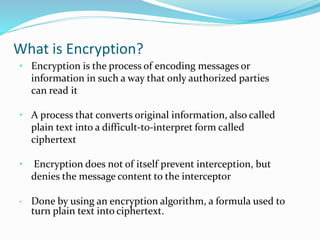
• Encryption is the process of encoding messages or
information in such a way that only authorized parties
can read it
• A process that converts original information, also called
plain text into a difficult-to-interpret form called
ciphertext
• Encryption does not of itself prevent interception, but
denies the message content to the interceptor
• Done by using an encryption algorithm, a formula used to
turn plain text into ciphertext.
What is Encryption?
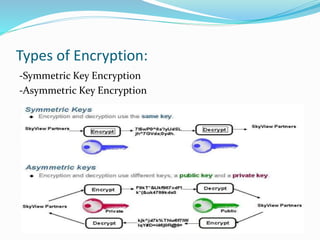
Types of Encryption:
-Symmetric Key Encryption
-Asymmetric Key Encryption
Symmetric Key Encryption
• A secret key, is applied to the text of a message to change the
content in a particular way
• uses the same keys for both encryption of plaintext and
decryption of ciphertext.
• The keys may be identical or there may be a simple
transformation to go between the two keys.
• The keys, in practice, represent a shared secret between two
or more parties that can be used to maintain a private
information link
• both parties have access to the secret key which is one of the
main drawbacks of symmetric key encryption, in comparison
to asymmetric key encryption
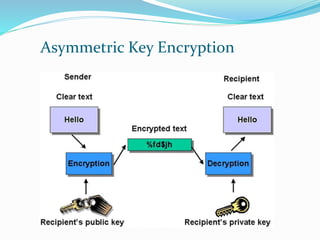
Asymmetric Key Encryption
 Known as public-private key or public key encryption
 Uses key pairs for encrypting or decrypting data
 Public key is used to encrypt the data and private key is used
to decrypt the data
 Any message that is encrypted by using the private key can
only be decrypted by using the matching public key.
 It has ability to share secret data without sharing the same
encryption key
Asymmetric Key Encryption
Which one is better?
 Although, symmetric encryption is fast, it is not as safe as
asymmetric encryption because someone could steal the key
and decode the messages. But because of its speed, it's
commonly used for e-commerce transactions
 Asymmetric key encryption requires far more computation
to both encrypt and decrypt the content of the message. So,
the process takes longer. It has the ability to share the data
without sharing the same encryption key
Why use encryption?
• Authentication
• Protects personal data such as passwords.
• Privacy
• Provides for confidentiality of private information.
• Integrity
• Ensures that a document or file has not been altered.
• Accountability
• Prevents denial or plagiarism.
How prevalent is it?
 According to InformationWeek Research:
 Of 500 sites surveyed, two-thirds report using encryption to
protect company data.
 Of 500 companies surveyed, 43% use encryption on both
stored and transmitted data. More than three out of five
companies encrypt due to the threat of outsiders intercepting
sensitive data.
 Of 28% of sites surveyed, government regulation requires
encryption of stored and transmitted data.
 For 38% of companies, the complexity of the technology is an
obstacle.
Thank You

Encryption ppt

  • 2.
  • 3.
    • Encryption isthe process of encoding messages or information in such a way that only authorized parties can read it • A process that converts original information, also called plain text into a difficult-to-interpret form called ciphertext • Encryption does not of itself prevent interception, but denies the message content to the interceptor • Done by using an encryption algorithm, a formula used to turn plain text into ciphertext. What is Encryption?
  • 4.
    Types of Encryption: -SymmetricKey Encryption -Asymmetric Key Encryption
  • 5.
    Symmetric Key Encryption •A secret key, is applied to the text of a message to change the content in a particular way • uses the same keys for both encryption of plaintext and decryption of ciphertext. • The keys may be identical or there may be a simple transformation to go between the two keys. • The keys, in practice, represent a shared secret between two or more parties that can be used to maintain a private information link • both parties have access to the secret key which is one of the main drawbacks of symmetric key encryption, in comparison to asymmetric key encryption
  • 6.
    Asymmetric Key Encryption Known as public-private key or public key encryption  Uses key pairs for encrypting or decrypting data  Public key is used to encrypt the data and private key is used to decrypt the data  Any message that is encrypted by using the private key can only be decrypted by using the matching public key.  It has ability to share secret data without sharing the same encryption key
  • 7.
  • 8.
    Which one isbetter?  Although, symmetric encryption is fast, it is not as safe as asymmetric encryption because someone could steal the key and decode the messages. But because of its speed, it's commonly used for e-commerce transactions  Asymmetric key encryption requires far more computation to both encrypt and decrypt the content of the message. So, the process takes longer. It has the ability to share the data without sharing the same encryption key
  • 9.
    Why use encryption? •Authentication • Protects personal data such as passwords. • Privacy • Provides for confidentiality of private information. • Integrity • Ensures that a document or file has not been altered. • Accountability • Prevents denial or plagiarism.
  • 10.
    How prevalent isit?  According to InformationWeek Research:  Of 500 sites surveyed, two-thirds report using encryption to protect company data.  Of 500 companies surveyed, 43% use encryption on both stored and transmitted data. More than three out of five companies encrypt due to the threat of outsiders intercepting sensitive data.  Of 28% of sites surveyed, government regulation requires encryption of stored and transmitted data.  For 38% of companies, the complexity of the technology is an obstacle.
  • 11.