Machine Learning &
Big Data @
Andy Sloane
@a1k0n
http://a1k0n.net
Madison Big Data Meetup
Jan 27, 2015
Big data?
60M Monthly Active Users (MAU)
50M tracks in our catalog
...But many are identical copies from different
releases (e.g. US and UK releases of the same
album)
...and only 4M unique songs have been listened to
>500 times
Big data?
Raw material: application logs, delivered via Apache
Kafka
Wake Me Up by Avicii has been played 330M times, by
~6M different users
"EndSong": 500GB / day
...But aggregated per-user play counts for a whole
year fit in ~60GB ("medium data")
Hadoop @ Spotify
900 nodes (all in London datacenter)
34 TB RAM total
~16000 typical concurrent tasks (mappers/reducers)
2GB RAM per mapper/reducer slot
What do we need ML for?
Recommendations
Related Artists
Radio
Recommendations
The Discover page
4M tracks x 60M active users, rebuilt daily
The Discover page
Okay, but how do we come up with recommendations?
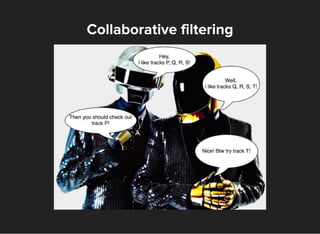
Collaborative filtering!
Collaborative filtering
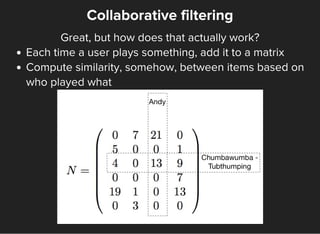
Great, but how does that actually work?
Each time a user plays something, add it to a matrix
Compute similarity, somehow, between items based on
who played what
Collaborative filtering
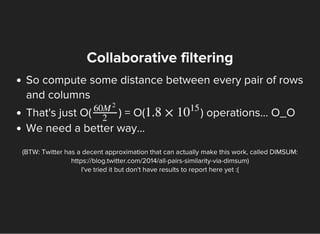
So compute some distance between every pair of rows
and columns
That's just O( ) = O( ) operations... O_O
We need a better way...
60M
2
2
1.8 × 10
15
(BTW: Twitter has a decent approximation that can actually make this work, called DIMSUM:
https://blog.twitter.com/2014/all-pairs-similarity-via-dimsum)
I've tried it but don't have results to report here yet :(
Collaborative filtering
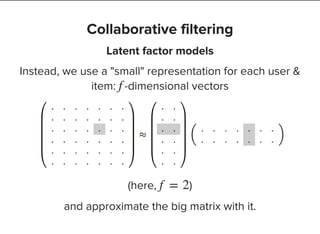
Latent factor models
Instead, we use a "small" representation for each user &
item: -dimensional vectorsf
(here, )f = 2
and approximate the big matrix with it.
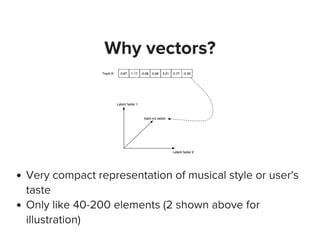
Why vectors?
Very compact representation of musical style or user's
taste
Only like 40-200 elements (2 shown above for
illustration)
Why vectors?
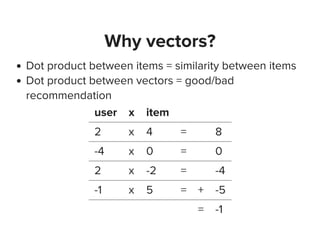
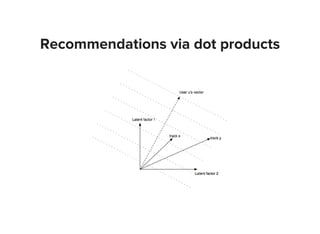
Dot product between items = similarity between items
Dot product between vectors = good/bad
recommendation
user x item
2 x 4 = 8
-4 x 0 = 0
2 x -2 = -4
-1 x 5 = + -5
= -1
Recommendations via dot products
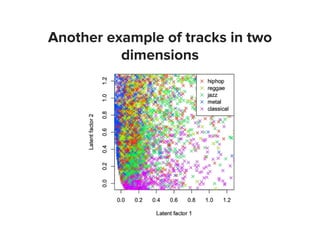
Another example of tracks in two
dimensions
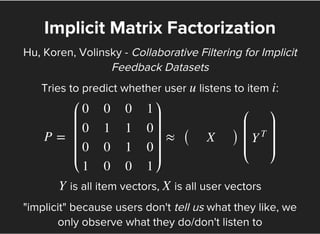
Implicit Matrix Factorization
Hu, Koren, Volinsky - Collaborative Filtering for Implicit
Feedback Datasets
Tries to predict whether user listens to item :u i
P = ≈ ( )
⎛
⎝
⎜
⎜
⎜
⎜
0
0
0
1
0
1
0
0
0
1
1
0
1
0
0
1
⎞
⎠
⎟
⎟
⎟
⎟
X
⎛
⎝
⎜
⎜
⎜
Y
T
⎞
⎠
⎟
⎟
⎟
is all item vectors, is all user vectorsY X
"implicit" because users don't tell us what they like, we
only observe what they do/don't listen to
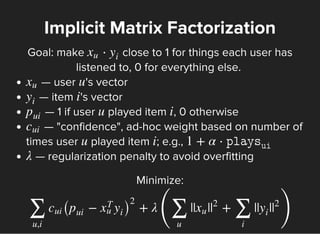
Goal: make close to 1 for things each user has
listened to, 0 for everything else.
Implicit Matrix Factorization
⋅xu y
i
— user 's vector
— item 's vector
— 1 if user played item , 0 otherwise
— "confidence", ad-hoc weight based on number of
times user played item ; e.g.,
— regularization penalty to avoid overfitting
xu u
y
i
i
p
ui
u i
cui
u i 1 + α ⋅
λ
Minimize:
+ λ
(
|| | + || |
)
∑
u,i
cui ( − )p
ui
x
T
u y
i
2
∑
u
xu |
2
∑
i
y
i
|
2
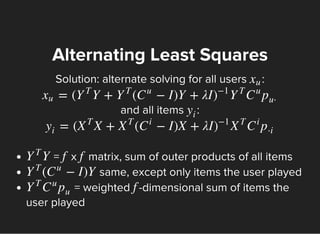
Solution: alternate solving for all users :
and all items :
Alternating Least Squares
xu
= ( Y + ( − I)Y + λIxu Y
T
Y
T
C
u
)
−1
Y
T
C
u
p
u⋅
y
i
= ( X + ( − I)X + λIy
i
X
T
X
T
C
i
)
−1
X
T
C
i
p
⋅i
= x matrix, sum of outer products of all items
same, except only items the user played
= weighted -dimensional sum of items the
user played
YY
T
f f
( − I)YY
T
C
u
Y
T
C
u
p
u
f
Alternating Least Squares
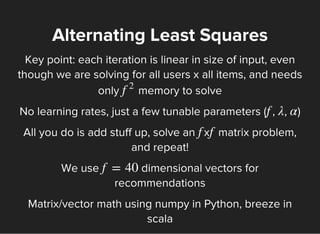
Key point: each iteration is linear in size of input, even
though we are solving for all users x all items, and needs
only memory to solvef
2
No learning rates, just a few tunable parameters ( , , )f λ α
All you do is add stuff up, solve an x matrix problem,
and repeat!
f f
We use dimensional vectors for
recommendations
f = 40
Matrix/vector math using numpy in Python, breeze in
scala
Alternating Least Squares
Adding lots of stuff up
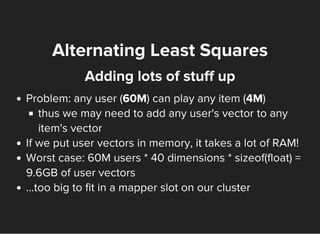
Problem: any user (60M) can play any item (4M)
thus we may need to add any user's vector to any
item's vector
If we put user vectors in memory, it takes a lot of RAM!
Worst case: 60M users * 40 dimensions * sizeof(float) =
9.6GB of user vectors
...too big to fit in a mapper slot on our cluster
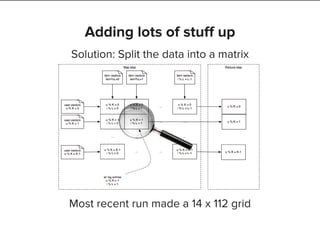
Solution: Split the data into a matrix
Most recent run made a 14 x 112 grid
Adding lots of stuff up
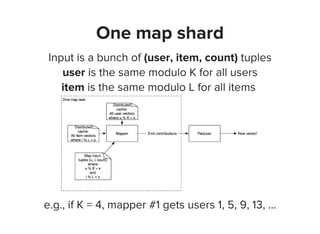
Input is a bunch of tuples
is the same modulo K for all users
is the same modulo L for all items
e.g., if K = 4, mapper #1 gets users 1, 5, 9, 13, ...
One map shard
(user, item, count)
user
item
Add up vectors from every data point
Then flip users ↔items and repeat!
Adding stuff up
(user, item, count)
def mapper(self, input): # Luigi-style python job
user, item, count = parse(input)
conf = AdHocConfidenceFunction(count) # e.g. 1 + alpha*count
# add up user vectors from previous iteration
term1 = conf * self.user_vectors[user]
term2 = np.outer(user_vectors[user], user_vectors[user])
* (conf - 1)
yield item, np.array([term1, term2])
def reducer(self, item, terms):
term1, term2 = sum(terms)
item_vector = np.solve(
self.YTY + term2 + self.l2penalty * np.identity(self.dim),
term1)
yield item, item_vector
Alternating Least Squares
Implemented in Java Map-Reduce framework which
runs other models, too
After about 20 iterations, we converge
Each iteration takes about 20 minutes, so about 7-8
hours total
Recomputed from scratch weekly
User vectors recomputed daily, keeping items fixed
So we have vectors, now what?
60M users x 4M recommendable items
Finding Recommendations
For each user, how do we find the best items given
their vector?
Brute force is O(60M x 4M x 40) = O(9 peta-operations)!
Instead, use an approximation based on locality
sensitive hashing (LSH)
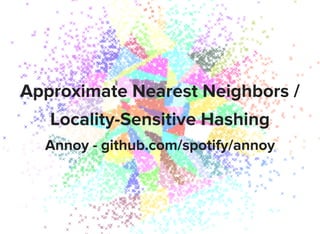
Approximate Nearest Neighbors /
Locality-Sensitive Hashing
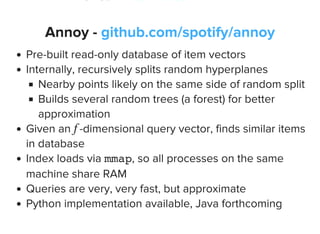
Annoy - github.com/spotify/annoy
Pre-built read-only database of item vectors
Internally, recursively splits random hyperplanes
Nearby points likely on the same side of random split
Builds several random trees (a forest) for better
approximation
Given an -dimensional query vector, finds similar items
in database
Index loads via mmap, so all processes on the same
machine share RAM
Queries are very, very fast, but approximate
Python implementation available, Java forthcoming
f
Generating recommendations
Annoy index for all items is only 1.2GB
I have one on my laptop... Live demo!
Could serve up nearest neighbors at load time, but we
precompute Discover on Hadoop
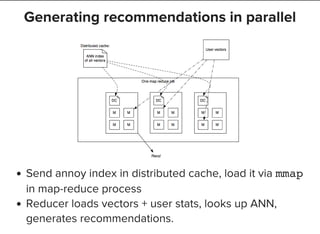
Generating recommendations in parallel
Send annoy index in distributed cache, load it via mmap
in map-reduce process
Reducer loads vectors + user stats, looks up ANN,
generates recommendations.
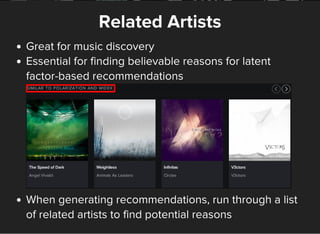
Related Artists
Related Artists
Great for music discovery
Essential for finding believable reasons for latent
factor-based recommendations
When generating recommendations, run through a list
of related artists to find potential reasons
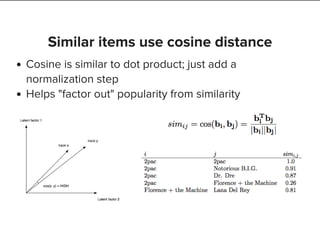
Similar items use cosine distance
Cosine is similar to dot product; just add a
normalization step
Helps "factor out" popularity from similarity
Related Artists
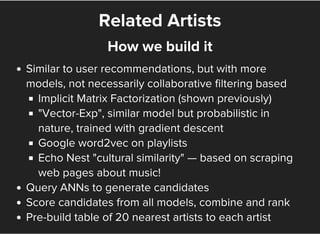
How we build it
Similar to user recommendations, but with more
models, not necessarily collaborative filtering based
Implicit Matrix Factorization (shown previously)
"Vector-Exp", similar model but probabilistic in
nature, trained with gradient descent
Google word2vec on playlists
Echo Nest "cultural similarity" — based on scraping
web pages about music!
Query ANNs to generate candidates
Score candidates from all models, combine and rank
Pre-build table of 20 nearest artists to each artist
Radio
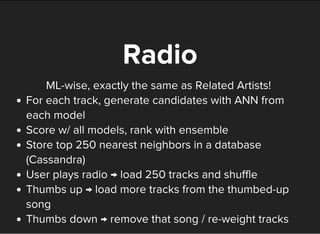
ML-wise, exactly the same as Related Artists!
Radio
For each track, generate candidates with ANN from
each model
Score w/ all models, rank with ensemble
Store top 250 nearest neighbors in a database
(Cassandra)
User plays radio → load 250 tracks and shuffle
Thumbs up → load more tracks from the thumbed-up
song
Thumbs down → remove that song / re-weight tracks
Upcoming work
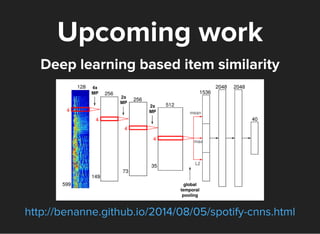
Deep learning based item similarity
http://benanne.github.io/2014/08/05/spotify-cnns.html
Upcoming work
Audio fingerprint based
content deduplication
~1500 Echo Nest Musical Fingerprints per track
based matching to accelerate all-pairs
similarity
Fast connected components using Hash-to-Min
algorithm - mapreduce steps
Min-Hash
O(log d)
http://arxiv.org/pdf/1203.5387.pdf
Thanks!
I can be reached here:
Andy Sloane
Email:
Twitter:
Special thanks to , whose slides I
plagiarized mercilessly
andy@a1k0n.net
@a1k0n
http://a1k0n.net
Erik Bernhardsson

Machine learning @ Spotify - Madison Big Data Meetup

  • 1.
    Machine Learning & BigData @ Andy Sloane @a1k0n http://a1k0n.net Madison Big Data Meetup Jan 27, 2015
  • 2.
    Big data? 60M MonthlyActive Users (MAU) 50M tracks in our catalog ...But many are identical copies from different releases (e.g. US and UK releases of the same album) ...and only 4M unique songs have been listened to >500 times
  • 3.
    Big data? Raw material:application logs, delivered via Apache Kafka Wake Me Up by Avicii has been played 330M times, by ~6M different users "EndSong": 500GB / day ...But aggregated per-user play counts for a whole year fit in ~60GB ("medium data")
  • 4.
    Hadoop @ Spotify 900nodes (all in London datacenter) 34 TB RAM total ~16000 typical concurrent tasks (mappers/reducers) 2GB RAM per mapper/reducer slot
  • 5.
    What do weneed ML for? Recommendations Related Artists Radio
  • 6.
  • 7.
    The Discover page 4Mtracks x 60M active users, rebuilt daily
  • 8.
    The Discover page Okay,but how do we come up with recommendations? Collaborative filtering!
  • 9.
  • 10.
    Collaborative filtering Great, buthow does that actually work? Each time a user plays something, add it to a matrix Compute similarity, somehow, between items based on who played what
  • 11.
    Collaborative filtering So computesome distance between every pair of rows and columns That's just O( ) = O( ) operations... O_O We need a better way... 60M 2 2 1.8 × 10 15 (BTW: Twitter has a decent approximation that can actually make this work, called DIMSUM: https://blog.twitter.com/2014/all-pairs-similarity-via-dimsum) I've tried it but don't have results to report here yet :(
  • 12.
    Collaborative filtering Latent factormodels Instead, we use a "small" representation for each user & item: -dimensional vectorsf (here, )f = 2 and approximate the big matrix with it.
  • 13.
    Why vectors? Very compactrepresentation of musical style or user's taste Only like 40-200 elements (2 shown above for illustration)
  • 14.
    Why vectors? Dot productbetween items = similarity between items Dot product between vectors = good/bad recommendation user x item 2 x 4 = 8 -4 x 0 = 0 2 x -2 = -4 -1 x 5 = + -5 = -1
  • 15.
  • 16.
    Another example oftracks in two dimensions
  • 17.
    Implicit Matrix Factorization Hu,Koren, Volinsky - Collaborative Filtering for Implicit Feedback Datasets Tries to predict whether user listens to item :u i P = ≈ ( ) ⎛ ⎝ ⎜ ⎜ ⎜ ⎜ 0 0 0 1 0 1 0 0 0 1 1 0 1 0 0 1 ⎞ ⎠ ⎟ ⎟ ⎟ ⎟ X ⎛ ⎝ ⎜ ⎜ ⎜ Y T ⎞ ⎠ ⎟ ⎟ ⎟ is all item vectors, is all user vectorsY X "implicit" because users don't tell us what they like, we only observe what they do/don't listen to
  • 18.
    Goal: make closeto 1 for things each user has listened to, 0 for everything else. Implicit Matrix Factorization ⋅xu y i — user 's vector — item 's vector — 1 if user played item , 0 otherwise — "confidence", ad-hoc weight based on number of times user played item ; e.g., — regularization penalty to avoid overfitting xu u y i i p ui u i cui u i 1 + α ⋅ λ Minimize: + λ ( || | + || | ) ∑ u,i cui ( − )p ui x T u y i 2 ∑ u xu | 2 ∑ i y i | 2
  • 19.
    Solution: alternate solvingfor all users : and all items : Alternating Least Squares xu = ( Y + ( − I)Y + λIxu Y T Y T C u ) −1 Y T C u p u⋅ y i = ( X + ( − I)X + λIy i X T X T C i ) −1 X T C i p ⋅i = x matrix, sum of outer products of all items same, except only items the user played = weighted -dimensional sum of items the user played YY T f f ( − I)YY T C u Y T C u p u f
  • 20.
    Alternating Least Squares Keypoint: each iteration is linear in size of input, even though we are solving for all users x all items, and needs only memory to solvef 2 No learning rates, just a few tunable parameters ( , , )f λ α All you do is add stuff up, solve an x matrix problem, and repeat! f f We use dimensional vectors for recommendations f = 40 Matrix/vector math using numpy in Python, breeze in scala
  • 21.
    Alternating Least Squares Addinglots of stuff up Problem: any user (60M) can play any item (4M) thus we may need to add any user's vector to any item's vector If we put user vectors in memory, it takes a lot of RAM! Worst case: 60M users * 40 dimensions * sizeof(float) = 9.6GB of user vectors ...too big to fit in a mapper slot on our cluster
  • 22.
    Solution: Split thedata into a matrix Most recent run made a 14 x 112 grid Adding lots of stuff up
  • 23.
    Input is abunch of tuples is the same modulo K for all users is the same modulo L for all items e.g., if K = 4, mapper #1 gets users 1, 5, 9, 13, ... One map shard (user, item, count) user item
  • 24.
    Add up vectorsfrom every data point Then flip users ↔items and repeat! Adding stuff up (user, item, count) def mapper(self, input): # Luigi-style python job user, item, count = parse(input) conf = AdHocConfidenceFunction(count) # e.g. 1 + alpha*count # add up user vectors from previous iteration term1 = conf * self.user_vectors[user] term2 = np.outer(user_vectors[user], user_vectors[user]) * (conf - 1) yield item, np.array([term1, term2]) def reducer(self, item, terms): term1, term2 = sum(terms) item_vector = np.solve( self.YTY + term2 + self.l2penalty * np.identity(self.dim), term1) yield item, item_vector
  • 25.
    Alternating Least Squares Implementedin Java Map-Reduce framework which runs other models, too After about 20 iterations, we converge Each iteration takes about 20 minutes, so about 7-8 hours total Recomputed from scratch weekly User vectors recomputed daily, keeping items fixed So we have vectors, now what?
  • 26.
    60M users x4M recommendable items Finding Recommendations For each user, how do we find the best items given their vector? Brute force is O(60M x 4M x 40) = O(9 peta-operations)! Instead, use an approximation based on locality sensitive hashing (LSH)
  • 27.
    Approximate Nearest Neighbors/ Locality-Sensitive Hashing Annoy - github.com/spotify/annoy
  • 28.
    Annoy - github.com/spotify/annoy Pre-builtread-only database of item vectors Internally, recursively splits random hyperplanes Nearby points likely on the same side of random split Builds several random trees (a forest) for better approximation Given an -dimensional query vector, finds similar items in database Index loads via mmap, so all processes on the same machine share RAM Queries are very, very fast, but approximate Python implementation available, Java forthcoming f
  • 29.
    Generating recommendations Annoy indexfor all items is only 1.2GB I have one on my laptop... Live demo! Could serve up nearest neighbors at load time, but we precompute Discover on Hadoop
  • 30.
    Generating recommendations inparallel Send annoy index in distributed cache, load it via mmap in map-reduce process Reducer loads vectors + user stats, looks up ANN, generates recommendations.
  • 31.
  • 32.
    Related Artists Great formusic discovery Essential for finding believable reasons for latent factor-based recommendations When generating recommendations, run through a list of related artists to find potential reasons
  • 33.
    Similar items usecosine distance Cosine is similar to dot product; just add a normalization step Helps "factor out" popularity from similarity
  • 34.
    Related Artists How webuild it Similar to user recommendations, but with more models, not necessarily collaborative filtering based Implicit Matrix Factorization (shown previously) "Vector-Exp", similar model but probabilistic in nature, trained with gradient descent Google word2vec on playlists Echo Nest "cultural similarity" — based on scraping web pages about music! Query ANNs to generate candidates Score candidates from all models, combine and rank Pre-build table of 20 nearest artists to each artist
  • 35.
  • 36.
    ML-wise, exactly thesame as Related Artists! Radio For each track, generate candidates with ANN from each model Score w/ all models, rank with ensemble Store top 250 nearest neighbors in a database (Cassandra) User plays radio → load 250 tracks and shuffle Thumbs up → load more tracks from the thumbed-up song Thumbs down → remove that song / re-weight tracks
  • 37.
    Upcoming work Deep learningbased item similarity http://benanne.github.io/2014/08/05/spotify-cnns.html
  • 38.
    Upcoming work Audio fingerprintbased content deduplication ~1500 Echo Nest Musical Fingerprints per track based matching to accelerate all-pairs similarity Fast connected components using Hash-to-Min algorithm - mapreduce steps Min-Hash O(log d) http://arxiv.org/pdf/1203.5387.pdf
  • 39.
    Thanks! I can bereached here: Andy Sloane Email: Twitter: Special thanks to , whose slides I plagiarized mercilessly andy@a1k0n.net @a1k0n http://a1k0n.net Erik Bernhardsson