




Music recommendations at Spotify


                                   Erik Bernhardsson

                        erikbern@spotify.com
Recommendation stuff at Spotify
Collaborative filtering

Idea:
- If two movies x, y get similar ratings then they are probably similar
- If a lot of users all listen to tracks x, y, z, then those tracks are
    probably similar
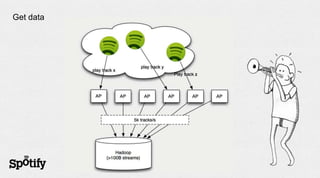
Get data
… lots of data
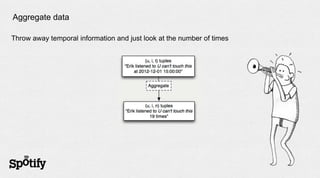
Aggregate data

Throw away temporal information and just look at the number of times
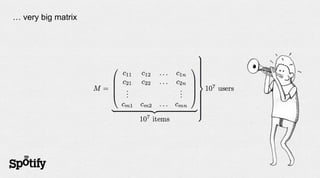
OK, so now we have a big matrix
… very big matrix
Supervised collaborative filtering is pretty much matrix completion
Supervised learning: Matrix completion
Supervised: evaluating rec quality
Unsupervised learning

-   Trying to estimate the density
-   i.e. predict probability of future events
Try to predict the future given the past
How can we find similar items
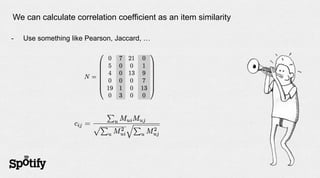
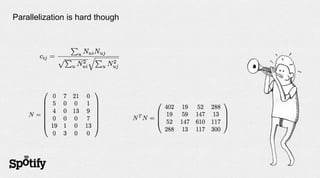
We can calculate correlation coefficient as an item similarity

-   Use something like Pearson, Jaccard, …
Amazon did this for “customers who bought this also bought”

-   US patent 7113917
Parallelization is hard though
Can speed this up using various LSH tricks

-   Twitter: Dimension Independent Similarity Computation (DISCO)
Are there other approaches?
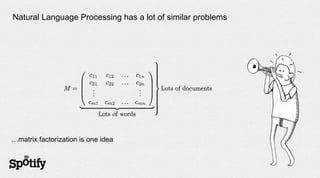
Natural Language Processing has a lot of similar problems


…matrix factorization is one idea
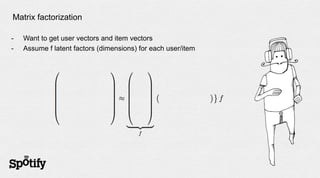
Matrix factorization

-   Want to get user vectors and item vectors
-   Assume f latent factors (dimensions) for each user/item
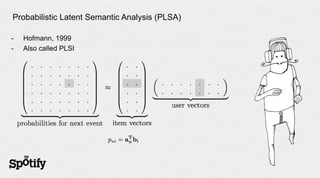
Probabilistic Latent Semantic Analysis (PLSA)

-   Hofmann, 1999
-   Also called PLSI
PLSA, cont.


+ a bunch of constraints:
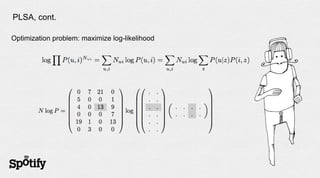
PLSA, cont.

Optimization problem: maximize log-likelihood
PLSA, cont.
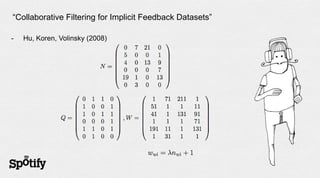
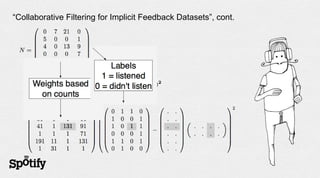
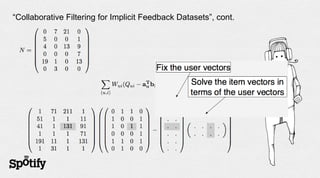
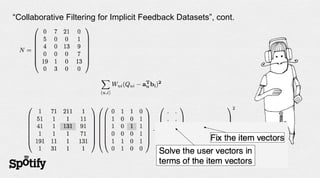
“Collaborative Filtering for Implicit Feedback Datasets”

-   Hu, Koren, Volinsky (2008)
“Collaborative Filtering for Implicit Feedback Datasets”, cont.
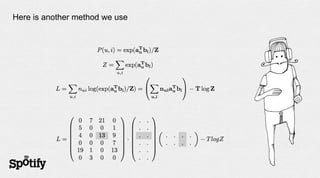
Here is another method we use
What happens each iteration


-   Assign all latent vectors small random values
-   Perform gradient ascent to optimize log-likelihood
What happens each iteration


-   Assign all latent vectors small random values
-   Perform gradient ascent to optimize log-likelihood
What happens each iteration


-   Assign all latent vectors small random values
-   Perform gradient ascent to optimize log-likelihood
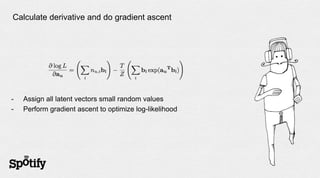
Calculate derivative and do gradient ascent


-   Assign all latent vectors small random values
-   Perform gradient ascent to optimize log-likelihood
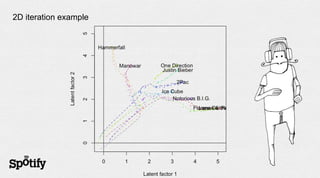
2D iteration example
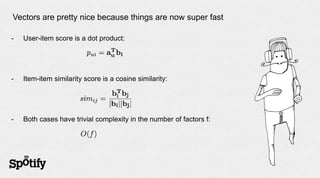
Vectors are pretty nice because things are now super fast

-   User-item score is a dot product:


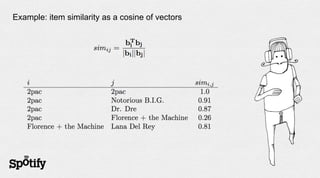
-   Item-item similarity score is a cosine similarity:


-   Both cases have trivial complexity in the number of factors f:
Example: item similarity as a cosine of vectors
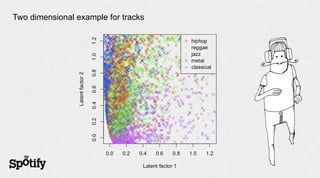
Two dimensional example for tracks
We can rank all tracks by the user’s vector
So how do we implement this?
One iteration of a matrix factorization algorithm

“Google News personalization: scalable online collaborative filtering”
So now we solved the problem of recommendations right?
Actually what we really want is to apply it to other domains
Radio

-   Artist radio: find related tracks
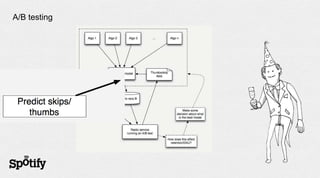
-   Optimize ensemble model based on skip/thumbs data
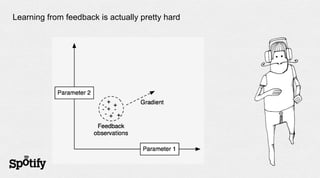
Learning from feedback is actually pretty hard
A/B testing
A/B testing
A/B testing
A/B testing
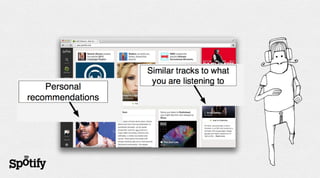
More applications!!!
Last but not least: we’re hiring!
Thank you

Collaborative Filtering at Spotify