Scalable Similarity-Based Neighborhood
       Methods with MapReduce
          6th ACM Conference on Recommender Systems, Dublin, 2012


Sebastian Schelter, Christoph Boden, Volker Markl

Database Systems and Information Management Group
Technische Universität Berlin
motivation
• with rapid growth in data sizes, the processing efficiency,
  scalability and fault tolerance of recommender systems in
  production become a major concern

• run data-intensive computations
  in parallel on a large number of
  commodity machines
  → need to rephrase algorithms

• our work: rephrase and scale-out the similarity-based
  neighborhood methods on MapReduce

• proposed solution forms the core of the
  distributed recommender of Apache Mahout
                                                                2
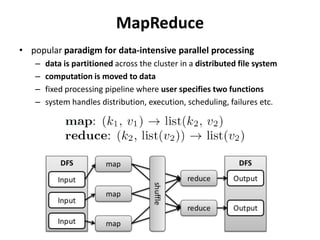
MapReduce
• popular paradigm for data-intensive parallel processing
   –   data is partitioned across the cluster in a distributed file system
   –   computation is moved to data
   –   fixed processing pipeline where user specifies two functions
   –   system handles distribution, execution, scheduling, failures etc.


                                                                             3
cooccurrences
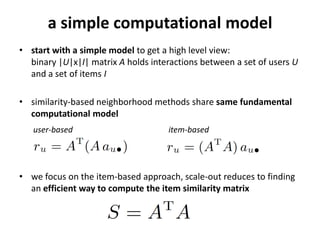
• start with a simplified view:
  binary |U|x|I| matrix A holds interactions
  between users U and of items I

• neighborhood methods share same
  fundamental computational model

   user-based                       item-based


• we focus on the item-based approach, its scale-out reduces to
  finding an efficient way to compute the item similarity matrix


                                                                   4
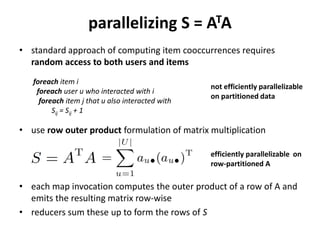
parallelizing S = ATA
• standard approach of computing item cooccurrences requires
  random access to both users and items
   foreach item i
                                                  not efficiently parallelizable
    foreach user u who interacted with i
                                                  on partitioned data
     foreach item j that u also interacted with
         Sij = Sij + 1

• row outer product formulation of matrix multiplication
  is efficiently parallelizable on a row-partitioned A


• each map invocation computes the outer product of a row of A,
  emits the resulting matrix row-wise
• reducers sum these up to form S                                             5
parallel similarity computation
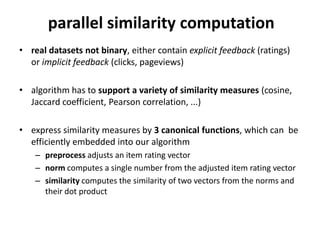
• real datasets not binary, either contain explicit feedback (ratings)
  or implicit feedback (clicks, pageviews)

• algorithm computes dot products, these are not enough,
  we want to use a variety of similarity measures (cosine, Jaccard
  coefficient, Pearson correlation, ...)

• express similarity measures by 3 canonical functions, which can be
  efficiently embedded into our algorithm
    – preprocess adjusts an item rating vector
    – norm computes a single number from the adjusted item rating vector
    – similarity computes the similarity of two vectors from the norms and
      their dot product

                                                                             6
example: Jaccard coefficient
• preprocess binarizes the rating vectors


• norm computes the number of users that rated each item


• similarity finally computes the jaccard coefficient from the
  norms and the dot product of the vectors


                                                                 7
cost of the algorithm
• determined by the amount of data that has to be sent over the
  network in the matrix multiplication step

• for each user, we have to process the square of the number of his
  interactions → cost is dominated by the densest rows of A

• distribution of interactions per user is usually heavy tailed
  → small number of power users with an unproportionally high
  amount of interactions drastically increase the runtime

• apply ‘interaction-cut’
   – if a user has more than p interactions, only use a random sample of
     size p of his interactions
   – saw negligible effect on prediction quality for moderately sized p
                                                                           8
scalability experiments
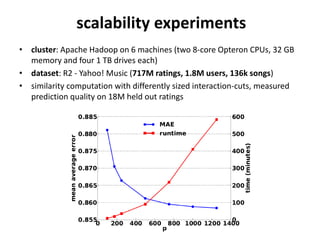
• cluster: Apache Hadoop on 6 machines (two 8-core Opteron CPUs, 32 GB
  memory and four 1 TB drives each)
• dataset: R2 - Yahoo! Music (717M ratings, 1.8M users, 136k songs)
• similarity computation with differently sized interaction-cuts, measured
  prediction quality on 18M held out ratings


                                                                             9
scalability experiments
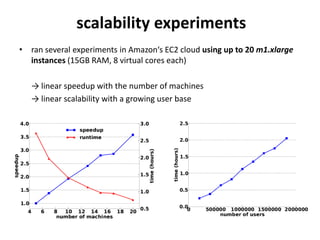
• ran several experiments in Amazon‘s EC2 cloud using up to 20 m1.xlarge
  instances (15GB RAM, 8 virtual cores each)

   → linear speedup with the number of machines
   → linear scalability with a growing user base


                                                                           10
thank you.

                                 Questions?

Sebastian Schelter, Christoph Boden, Volker Markl
Database Systems and Information Management Group (DIMA), TU Berlin

mail: ssc@apache.org       twitter: @sscdotopen

code to reproduce our experiments is available at:
https://github.com/dima-tuberlin/publications-ssnmm

The research leading to these results has received funding from the European Union (EU)
in the course of the project ‚ROBUST‘ (EU grant no. 257859) and used data provided by
‚Yahoo Academic Relations‘.
                                                                                          11

Scalable Similarity-Based Neighborhood Methods with MapReduce

  • 1.
    Scalable Similarity-Based Neighborhood Methods with MapReduce 6th ACM Conference on Recommender Systems, Dublin, 2012 Sebastian Schelter, Christoph Boden, Volker Markl Database Systems and Information Management Group Technische Universität Berlin
  • 2.
    motivation • with rapidgrowth in data sizes, the processing efficiency, scalability and fault tolerance of recommender systems in production become a major concern • run data-intensive computations in parallel on a large number of commodity machines → need to rephrase algorithms • our work: rephrase and scale-out the similarity-based neighborhood methods on MapReduce • proposed solution forms the core of the distributed recommender of Apache Mahout 2
  • 3.
    MapReduce • popular paradigmfor data-intensive parallel processing – data is partitioned across the cluster in a distributed file system – computation is moved to data – fixed processing pipeline where user specifies two functions – system handles distribution, execution, scheduling, failures etc. 3
  • 4.
    cooccurrences • start witha simplified view: binary |U|x|I| matrix A holds interactions between users U and of items I • neighborhood methods share same fundamental computational model user-based item-based • we focus on the item-based approach, its scale-out reduces to finding an efficient way to compute the item similarity matrix 4
  • 5.
    parallelizing S =ATA • standard approach of computing item cooccurrences requires random access to both users and items foreach item i not efficiently parallelizable foreach user u who interacted with i on partitioned data foreach item j that u also interacted with Sij = Sij + 1 • row outer product formulation of matrix multiplication is efficiently parallelizable on a row-partitioned A • each map invocation computes the outer product of a row of A, emits the resulting matrix row-wise • reducers sum these up to form S 5
  • 6.
    parallel similarity computation •real datasets not binary, either contain explicit feedback (ratings) or implicit feedback (clicks, pageviews) • algorithm computes dot products, these are not enough, we want to use a variety of similarity measures (cosine, Jaccard coefficient, Pearson correlation, ...) • express similarity measures by 3 canonical functions, which can be efficiently embedded into our algorithm – preprocess adjusts an item rating vector – norm computes a single number from the adjusted item rating vector – similarity computes the similarity of two vectors from the norms and their dot product 6
  • 7.
    example: Jaccard coefficient •preprocess binarizes the rating vectors • norm computes the number of users that rated each item • similarity finally computes the jaccard coefficient from the norms and the dot product of the vectors 7
  • 8.
    cost of thealgorithm • determined by the amount of data that has to be sent over the network in the matrix multiplication step • for each user, we have to process the square of the number of his interactions → cost is dominated by the densest rows of A • distribution of interactions per user is usually heavy tailed → small number of power users with an unproportionally high amount of interactions drastically increase the runtime • apply ‘interaction-cut’ – if a user has more than p interactions, only use a random sample of size p of his interactions – saw negligible effect on prediction quality for moderately sized p 8
  • 9.
    scalability experiments • cluster:Apache Hadoop on 6 machines (two 8-core Opteron CPUs, 32 GB memory and four 1 TB drives each) • dataset: R2 - Yahoo! Music (717M ratings, 1.8M users, 136k songs) • similarity computation with differently sized interaction-cuts, measured prediction quality on 18M held out ratings 9
  • 10.
    scalability experiments • ranseveral experiments in Amazon‘s EC2 cloud using up to 20 m1.xlarge instances (15GB RAM, 8 virtual cores each) → linear speedup with the number of machines → linear scalability with a growing user base 10
  • 11.
    thank you. Questions? Sebastian Schelter, Christoph Boden, Volker Markl Database Systems and Information Management Group (DIMA), TU Berlin mail: ssc@apache.org twitter: @sscdotopen code to reproduce our experiments is available at: https://github.com/dima-tuberlin/publications-ssnmm The research leading to these results has received funding from the European Union (EU) in the course of the project ‚ROBUST‘ (EU grant no. 257859) and used data provided by ‚Yahoo Academic Relations‘. 11