Spotify Playlist Recommender
Table of Contents
1. The task
2. The dataset
3. Metrics
4. Proposed Solutions
5. EDA
6. Result
The task
The goal of the challenge is to develop a system for the task of
automatic playlist continuation. Given a set of playlist features,
participants' systems shall generate a list of recommended tracks
that can be added to that playlist, thereby 'continuing' the playlist.
We define the task formally as follows
Input
Given N incomplete playlists
Output
A list of 500 recommended candidate tracks, ordered by
relevance in decreasing order.
The dataset
The Million Playlist Dataset (MPD) contains 1,000,000 playlists
created by users on the Spotify platform. These playlists were
created during the period of January 2010 through October 2017.
Test set
In order to replicate competition's test set, we remove some
playlists from original playlists such that
All tracks in the challenge set appear in the MPD
All holdout tracks appear in the MPD
Test set size: 1000 playlists
Train set
Train set will be the original set subtracts tracks in test sets
Metrics
G: the ground truth set of tracks
R: and the ordered list of recommended tracks by R.
The size of a set or list is denoted by | â‹… |
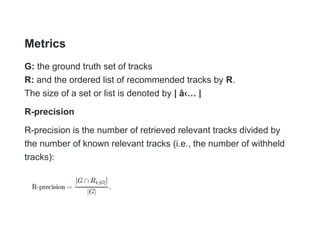
R-precision
R-precision is the number of retrieved relevant tracks divided by
the number of known relevant tracks (i.e., the number of withheld
tracks):
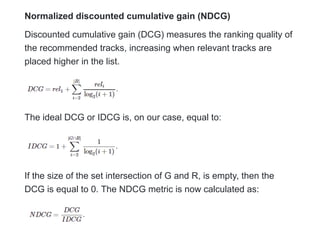
Normalized discounted cumulative gain (NDCG)
Discounted cumulative gain (DCG) measures the ranking quality of
the recommended tracks, increasing when relevant tracks are
placed higher in the list.
The ideal DCG or IDCG is, on our case, equal to:
If the size of the set intersection of G and R, is empty, then the
DCG is equal to 0. The NDCG metric is now calculated as:
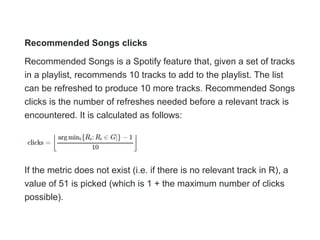
Recommended Songs clicks
Recommended Songs is a Spotify feature that, given a set of tracks
in a playlist, recommends 10 tracks to add to the playlist. The list
can be refreshed to produce 10 more tracks. Recommended Songs
clicks is the number of refreshes needed before a relevant track is
encountered. It is calculated as follows:
If the metric does not exist (i.e. if there is no relevant track in R), a
value of 51 is picked (which is 1 + the maximum number of clicks
possible).
Proposed Solutions
For our problem, we treat "user" as "playlist" and "item" as "song".
Because the dataset don't provide much information about each
song so we won't use content-based filtering. Therefore we would
only focus on
KNN
Collaborative Filtering
Frequent Pattern Growth
Matrix Factorization
Collaborative Filtering (CF)
Playlist based CF: From similarity between each playlist and
how other playlists "rate" (include or not) a track, I can infer the
current "rate".
Song based CF: From similarity between each songs and how
current playlist "rate" other songs, I can infer the current "rate".
Advantage:
easier to implementation
new data can be added easily and incrementally
don't need content of items
scales well with correlated items
Disadvantage:
are dependent on human ratings
cold start problem for new user and item
sparsity problem of rating matrix
limited scalability for large datasets
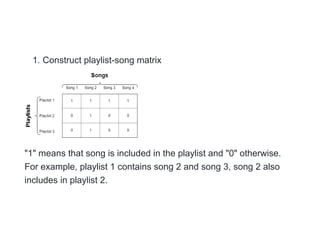
1. Construct playlist-song matrix
"1" means that song is included in the playlist and "0" otherwise.
For example, playlist 1 contains song 2 and song 3, song 2 also
includes in playlist 2.
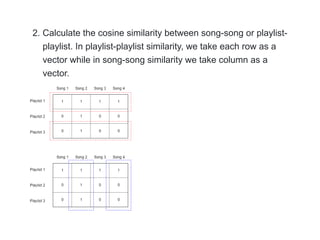
2. Calculate the cosine similarity between song-song or playlist-
playlist. In playlist-playlist similarity, we take each row as a
vector while in song-song similarity we take column as a
vector.
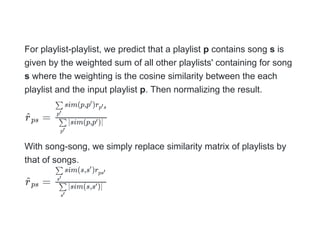
For playlist-playlist, we predict that a playlist p contains song s is
given by the weighted sum of all other playlists' containing for song
s where the weighting is the cosine similarity between the each
playlist and the input playlist p. Then normalizing the result.
=
With song-song, we simply replace similarity matrix of playlists by
that of songs.
=
r
^ps ∣sim(p,p )∣
p′
∑ ′
sim(p,p )r
p′
∑ ′
p s
′
r
^ps ∣sim(s,s )∣
s′
∑ ′
sim(s,s )r
s′
∑ ′
ps′
KNN
Playlist-based: Find most similar playlist with current playlist
and add all non-duplicate songs.
Song-based: Find most similar songs with current songs in
playlist and add them to the playlist.
Advantage:
Same as Collaborative Filtering
Disadvantage:
Need to mantain the large matrix of similarity
Cold start problem
Frequent Pattern Growth
I have a number of current tracks, I will look at other playlists to find
common tracks associated with currents tracks and add them.
Advantage:
Scalability
Don't have problem with sparsity
Disadvantage:
Expensive model building
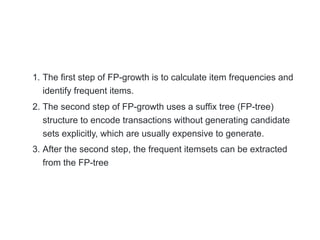
1. The first step of FP-growth is to calculate item frequencies and
identify frequent items.
2. The second step of FP-growth uses a suffix tree (FP-tree)
structure to encode transactions without generating candidate
sets explicitly, which are usually expensive to generate.
3. After the second step, the frequent itemsets can be extracted
from the FP-tree
Matrix Factorization
Decompose the playlist-songs matrix into dot product of many
matrix and use these matrix to make inference.
Matrix factorization can be done with orthogonal factorization
(SVD), probabilistic factorization (PMF) or Non-Negative
factorization (NMF).
Advantage:
Better addresses the sparsity and scalabity problem.
Improve prediction performance
Disadvantage:
Expensive model building
Trade-off between prediction performance and scalability
Loss of information in dimension reduction technique
Due to the large memory use when compute smaller matrix, I will
not implement Matrix Factorization.
Word2vec
We can use Word2vec to reduce the dimension of matrix and
perform KNN on the new dimension
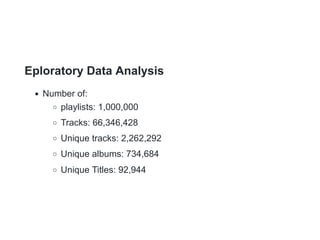
Eploratory Data Analysis
Number of:
playlists: 1,000,000
Tracks: 66,346,428
Unique tracks: 2,262,292
Unique albums: 734,684
Unique Titles: 92,944
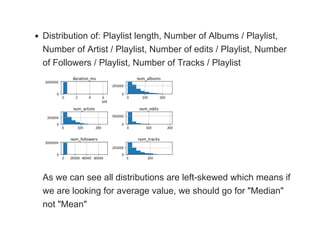
Distribution of: Playlist length, Number of Albums / Playlist,
Number of Artist / Playlist, Number of edits / Playlist, Number
of Followers / Playlist, Number of Tracks / Playlist
As we can see all distributions are left-skewed which means if
we are looking for average value, we should go for "Median"
not "Mean"
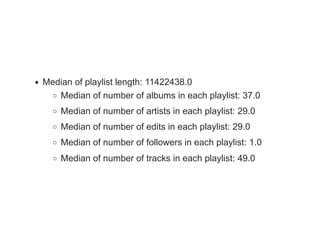
Median of playlist length: 11422438.0
Median of number of albums in each playlist: 37.0
Median of number of artists in each playlist: 29.0
Median of number of edits in each playlist: 29.0
Median of number of followers in each playlist: 1.0
Median of number of tracks in each playlist: 49.0
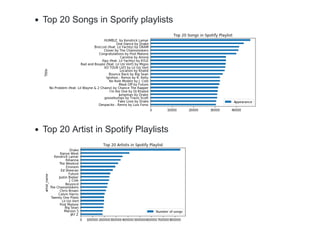
Top 20 Songs in Sporify playlists
Top 20 Artist in Spotify Playlists
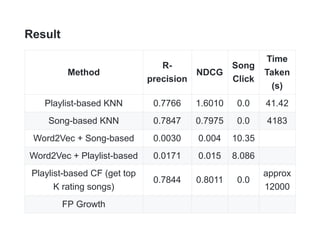
Result
Method
R-
precision
NDCG
Song
Click
Time
Taken
(s)
Playlist-based KNN 0.7766 1.6010 0.0 41.42
Song-based KNN 0.7847 0.7975 0.0 4183
Word2Vec + Song-based 0.0030 0.004 10.35
Word2Vec + Playlist-based 0.0171 0.015 8.086
Playlist-based CF (get top
K rating songs)
0.7844 0.8011 0.0
approx
12000
FP Growth
Conclusion
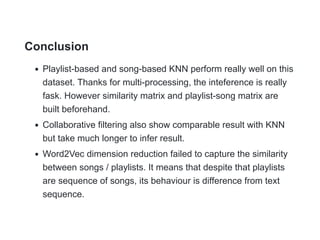
Playlist-based and song-based KNN perform really well on this
dataset. Thanks for multi-processing, the inteference is really
fask. However similarity matrix and playlist-song matrix are
built beforehand.
Collaborative filtering also show comparable result with KNN
but take much longer to infer result.
Word2Vec dimension reduction failed to capture the similarity
between songs / playlists. It means that despite that playlists
are sequence of songs, its behaviour is difference from text
sequence.
Further improvement
Implement FP-growth in Spark and compare with current
solutions
Matrix Factorization

Hsjs.pdf

  • 1.
    Spotify Playlist Recommender Tableof Contents 1. The task 2. The dataset 3. Metrics 4. Proposed Solutions 5. EDA 6. Result
  • 2.
    The task The goalof the challenge is to develop a system for the task of automatic playlist continuation. Given a set of playlist features, participants' systems shall generate a list of recommended tracks that can be added to that playlist, thereby 'continuing' the playlist. We define the task formally as follows Input Given N incomplete playlists Output A list of 500 recommended candidate tracks, ordered by relevance in decreasing order.
  • 3.
    The dataset The MillionPlaylist Dataset (MPD) contains 1,000,000 playlists created by users on the Spotify platform. These playlists were created during the period of January 2010 through October 2017. Test set In order to replicate competition's test set, we remove some playlists from original playlists such that All tracks in the challenge set appear in the MPD All holdout tracks appear in the MPD Test set size: 1000 playlists Train set Train set will be the original set subtracts tracks in test sets
  • 4.
    Metrics G: the groundtruth set of tracks R: and the ordered list of recommended tracks by R. The size of a set or list is denoted by | â‹… | R-precision R-precision is the number of retrieved relevant tracks divided by the number of known relevant tracks (i.e., the number of withheld tracks):
  • 5.
    Normalized discounted cumulativegain (NDCG) Discounted cumulative gain (DCG) measures the ranking quality of the recommended tracks, increasing when relevant tracks are placed higher in the list. The ideal DCG or IDCG is, on our case, equal to: If the size of the set intersection of G and R, is empty, then the DCG is equal to 0. The NDCG metric is now calculated as:
  • 6.
    Recommended Songs clicks RecommendedSongs is a Spotify feature that, given a set of tracks in a playlist, recommends 10 tracks to add to the playlist. The list can be refreshed to produce 10 more tracks. Recommended Songs clicks is the number of refreshes needed before a relevant track is encountered. It is calculated as follows: If the metric does not exist (i.e. if there is no relevant track in R), a value of 51 is picked (which is 1 + the maximum number of clicks possible).
  • 7.
    Proposed Solutions For ourproblem, we treat "user" as "playlist" and "item" as "song". Because the dataset don't provide much information about each song so we won't use content-based filtering. Therefore we would only focus on KNN Collaborative Filtering Frequent Pattern Growth Matrix Factorization
  • 8.
    Collaborative Filtering (CF) Playlistbased CF: From similarity between each playlist and how other playlists "rate" (include or not) a track, I can infer the current "rate". Song based CF: From similarity between each songs and how current playlist "rate" other songs, I can infer the current "rate".
  • 9.
    Advantage: easier to implementation newdata can be added easily and incrementally don't need content of items scales well with correlated items Disadvantage: are dependent on human ratings cold start problem for new user and item sparsity problem of rating matrix limited scalability for large datasets
  • 10.
    1. Construct playlist-songmatrix "1" means that song is included in the playlist and "0" otherwise. For example, playlist 1 contains song 2 and song 3, song 2 also includes in playlist 2.
  • 11.
    2. Calculate thecosine similarity between song-song or playlist- playlist. In playlist-playlist similarity, we take each row as a vector while in song-song similarity we take column as a vector.
  • 12.
    For playlist-playlist, wepredict that a playlist p contains song s is given by the weighted sum of all other playlists' containing for song s where the weighting is the cosine similarity between the each playlist and the input playlist p. Then normalizing the result. = With song-song, we simply replace similarity matrix of playlists by that of songs. = r ^ps ∣sim(p,p )∣ p′ ∑ ′ sim(p,p )r p′ ∑ ′ p s ′ r ^ps ∣sim(s,s )∣ s′ ∑ ′ sim(s,s )r s′ ∑ ′ ps′
  • 13.
    KNN Playlist-based: Find mostsimilar playlist with current playlist and add all non-duplicate songs. Song-based: Find most similar songs with current songs in playlist and add them to the playlist.
  • 14.
    Advantage: Same as CollaborativeFiltering Disadvantage: Need to mantain the large matrix of similarity Cold start problem
  • 15.
    Frequent Pattern Growth Ihave a number of current tracks, I will look at other playlists to find common tracks associated with currents tracks and add them.
  • 16.
    Advantage: Scalability Don't have problemwith sparsity Disadvantage: Expensive model building
  • 17.
    1. The firststep of FP-growth is to calculate item frequencies and identify frequent items. 2. The second step of FP-growth uses a suffix tree (FP-tree) structure to encode transactions without generating candidate sets explicitly, which are usually expensive to generate. 3. After the second step, the frequent itemsets can be extracted from the FP-tree
  • 18.
    Matrix Factorization Decompose theplaylist-songs matrix into dot product of many matrix and use these matrix to make inference. Matrix factorization can be done with orthogonal factorization (SVD), probabilistic factorization (PMF) or Non-Negative factorization (NMF).
  • 19.
    Advantage: Better addresses thesparsity and scalabity problem. Improve prediction performance Disadvantage: Expensive model building Trade-off between prediction performance and scalability Loss of information in dimension reduction technique Due to the large memory use when compute smaller matrix, I will not implement Matrix Factorization.
  • 20.
    Word2vec We can useWord2vec to reduce the dimension of matrix and perform KNN on the new dimension
  • 21.
    Eploratory Data Analysis Numberof: playlists: 1,000,000 Tracks: 66,346,428 Unique tracks: 2,262,292 Unique albums: 734,684 Unique Titles: 92,944
  • 22.
    Distribution of: Playlistlength, Number of Albums / Playlist, Number of Artist / Playlist, Number of edits / Playlist, Number of Followers / Playlist, Number of Tracks / Playlist As we can see all distributions are left-skewed which means if we are looking for average value, we should go for "Median" not "Mean"
  • 23.
    Median of playlistlength: 11422438.0 Median of number of albums in each playlist: 37.0 Median of number of artists in each playlist: 29.0 Median of number of edits in each playlist: 29.0 Median of number of followers in each playlist: 1.0 Median of number of tracks in each playlist: 49.0
  • 24.
    Top 20 Songsin Sporify playlists Top 20 Artist in Spotify Playlists
  • 25.
    Result Method R- precision NDCG Song Click Time Taken (s) Playlist-based KNN 0.77661.6010 0.0 41.42 Song-based KNN 0.7847 0.7975 0.0 4183 Word2Vec + Song-based 0.0030 0.004 10.35 Word2Vec + Playlist-based 0.0171 0.015 8.086 Playlist-based CF (get top K rating songs) 0.7844 0.8011 0.0 approx 12000 FP Growth
  • 26.
    Conclusion Playlist-based and song-basedKNN perform really well on this dataset. Thanks for multi-processing, the inteference is really fask. However similarity matrix and playlist-song matrix are built beforehand. Collaborative filtering also show comparable result with KNN but take much longer to infer result. Word2Vec dimension reduction failed to capture the similarity between songs / playlists. It means that despite that playlists are sequence of songs, its behaviour is difference from text sequence.
  • 27.
    Further improvement Implement FP-growthin Spark and compare with current solutions Matrix Factorization