Personalized Playlists
@
Spotify
Rohan Agrawal
RE-WORK Machine Intelligence Summit
• New York
• Nov 2, 2016
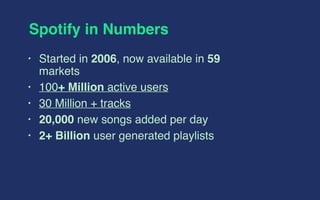
Spotify in Numbers
• Started in 2006, now available in 59
markets
• 100+ Million active users
• 30 Million + tracks
• 20,000 new songs added per day
• 2+ Billion user generated playlists
What to recommend?
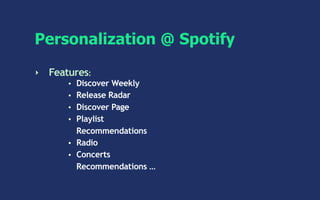
Personalization @ Spotify
‣ Features:
• Discover Weekly
• Release Radar
• Discover Page
• Playlist
Recommendations
• Radio
• Concerts
Recommendations …
Focus on track recommendations
‣Discover Weekly
‣Release Radar
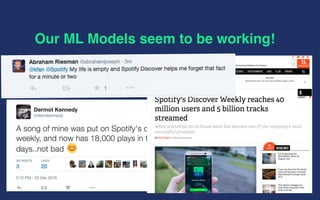
Our ML Models seem to be working!
Today, we’ll talk about 3 types of models
‣ Latent Factor Models
‣ Deep Learning Audio models
‣ NLP models (which are also latent factor models …)
Lets start off with Latent Factor Models
“Compact” representation for each user and items(songs): f-dimensional
vectors
Rohan
Track a
.. . . . .
.. . . . .
.. . . . .
.. . . . .
.. . . . .
.. .
.. .
.. .
.. .
. .
...
...
...
...
..
mUsers
Songs
User Vector Matrix: X: (m x f) Song Vector Matrix: Y: (n x f)
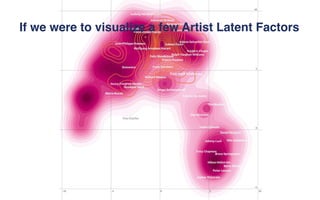
If we were to visualize a few Artist Latent Factors
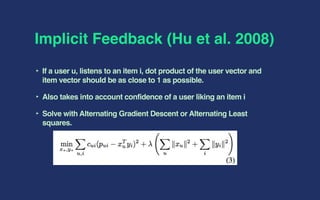
Implicit Feedback (Hu et al. 2008)
‣ If a user u, listens to an item i, dot product of the user vector and
item vector should be as close to 1 as possible.
‣ Also takes into account confidence of a user liking an item i
‣ Solve with Alternating Gradient Descent or Alternating Least
squares.
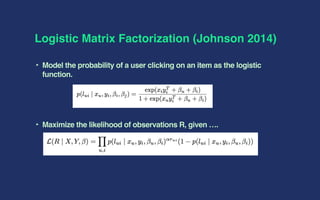
Logistic Matrix Factorization (Johnson 2014)
‣ Model the probability of a user clicking on an item as the logistic
function.
‣ Maximize the likelihood of observations R, given ….
Recent Advances in MF
‣ Different loss functions (rank loss)
‣ Use of side information (demographics, metadata)
‣ Use of context (where, when)
‣ Deep Learning CF models
Deep Learning on Audio
http://benanne.github.io/2014/08/05/spotify-cnns.html
Document : User Session
Word : Song
NLP Models For Recommendations
Word2Vec (Mikolov et al. 2013)
‣ Each word / track has an input
and output vector
representation.
‣ Output is a vector space with
similar items living close to each
other in cosine distance. (and
awesome vector algebra
property)
Softmax
skipgram
Sequential Data? RNN ?
‣ Output layer is same as word2vec, softmax. Make a prediction of
the next item based on hidden state
‣ Recurrent connection
‣ Learning output weights and b’s for each item
https://erikbern.com/2014/06/28/recurrent-neural-networks-for-collaborative-filtering/
User Representations?
‣ Word2vec can output word / track representation but what about user
representations.
‣ Simple Aggregation (Bag of words) ?
Averaging problems
‣ Doc2Vec ?
Retrain every time there is new user activity
‣ Clustering?
Losing vector addition information
‣ Learn user vector through RNN ?
Another RNN approach
‣ Assume item vectors are fixed
‣ Try to learn the next item vector in the sequence
‣ Long term intents, train RNN to predict longer ahead in the future
Challenges, what lies ahead
Side information in embedding models, remove regional
biases, external genre information, lyrics, Facebook /
Twitter account data, [ cover art, who knows :) ]
Deep Learning
Transfer Learning
Outlier Detection
Thank You!
You can reach me @
Email: rohanag@spotify.com
Twitter: @rohanag
20

Personalized Playlists at Spotify

  • 1.
    Personalized Playlists @ Spotify Rohan Agrawal RE-WORKMachine Intelligence Summit • New York • Nov 2, 2016
  • 2.
    Spotify in Numbers •Started in 2006, now available in 59 markets • 100+ Million active users • 30 Million + tracks • 20,000 new songs added per day • 2+ Billion user generated playlists
  • 3.
  • 4.
    Personalization @ Spotify ‣Features: • Discover Weekly • Release Radar • Discover Page • Playlist Recommendations • Radio • Concerts Recommendations …
  • 5.
    Focus on trackrecommendations ‣Discover Weekly ‣Release Radar
  • 6.
    Our ML Modelsseem to be working!
  • 7.
    Today, we’ll talkabout 3 types of models ‣ Latent Factor Models ‣ Deep Learning Audio models ‣ NLP models (which are also latent factor models …)
  • 8.
    Lets start offwith Latent Factor Models “Compact” representation for each user and items(songs): f-dimensional vectors Rohan Track a .. . . . . .. . . . . .. . . . . .. . . . . .. . . . . .. . .. . .. . .. . . . ... ... ... ... .. mUsers Songs User Vector Matrix: X: (m x f) Song Vector Matrix: Y: (n x f)
  • 9.
    If we wereto visualize a few Artist Latent Factors
  • 10.
    Implicit Feedback (Huet al. 2008) ‣ If a user u, listens to an item i, dot product of the user vector and item vector should be as close to 1 as possible. ‣ Also takes into account confidence of a user liking an item i ‣ Solve with Alternating Gradient Descent or Alternating Least squares.
  • 11.
    Logistic Matrix Factorization(Johnson 2014) ‣ Model the probability of a user clicking on an item as the logistic function. ‣ Maximize the likelihood of observations R, given ….
  • 12.
    Recent Advances inMF ‣ Different loss functions (rank loss) ‣ Use of side information (demographics, metadata) ‣ Use of context (where, when) ‣ Deep Learning CF models
  • 13.
    Deep Learning onAudio http://benanne.github.io/2014/08/05/spotify-cnns.html
  • 14.
    Document : UserSession Word : Song NLP Models For Recommendations
  • 15.
    Word2Vec (Mikolov etal. 2013) ‣ Each word / track has an input and output vector representation. ‣ Output is a vector space with similar items living close to each other in cosine distance. (and awesome vector algebra property) Softmax skipgram
  • 16.
    Sequential Data? RNN? ‣ Output layer is same as word2vec, softmax. Make a prediction of the next item based on hidden state ‣ Recurrent connection ‣ Learning output weights and b’s for each item https://erikbern.com/2014/06/28/recurrent-neural-networks-for-collaborative-filtering/
  • 17.
    User Representations? ‣ Word2veccan output word / track representation but what about user representations. ‣ Simple Aggregation (Bag of words) ? Averaging problems ‣ Doc2Vec ? Retrain every time there is new user activity ‣ Clustering? Losing vector addition information ‣ Learn user vector through RNN ?
  • 18.
    Another RNN approach ‣Assume item vectors are fixed ‣ Try to learn the next item vector in the sequence ‣ Long term intents, train RNN to predict longer ahead in the future
  • 19.
    Challenges, what liesahead Side information in embedding models, remove regional biases, external genre information, lyrics, Facebook / Twitter account data, [ cover art, who knows :) ] Deep Learning Transfer Learning Outlier Detection
  • 20.
    Thank You! You canreach me @ Email: rohanag@spotify.com Twitter: @rohanag 20