Community
language
learning
• Developed by Charles A. Curran.
• Counseling and professor of
psychology
• Community language learning
represents the use of counselling-
learning theory to teach
languages
• Humanistic approach
A group of learners sit in a circle, the
student whispers a message in the L1
and the teacher translates it into the L2.
The student repeats the message in the
L2, all students will compose messages
with the teacher help, after that
students reflect about their feelings.
In lay terms, counseling is one
person giving advice, assistance,
and support to another who has a
problem or is in some way in
need. CLL draws on the
counselling metaphor to redefine
the roles of the teacher
(counselor) and learners (clients)
“Language as social process”
Communication is more than just a
message transmitted from a speaker to a
listener.The speaker is both subject and
object. It is an incomplete exchange without a
feedback reaction from the addressee of the
message
Theory of language:
The social process is elaborated in
terms of six qualities:
1.The whole-person process
2.The educational process
3.The interpersonal process
4.The developmental process
5.The communicative process
6.The cultural process
CLL interactions are of two kinds
Interactions between learners: it is
unpredictable in content, but they
involve exchanges of affect
Interactions between learners and
knowers: It is dependent, the learner
tells the knower what he wishes to say
and the knower tells him how to say it
Theory of learning:
• Techniques of counselling can be applied to learning
in general and to language teaching in particular.
• CLL advocates a holistic approach to language
learning, since “true” human learning is both cognitive
and affective.
• Whole-person learning: takes place in a
communicative situation
• The process is divided into five stages and compared
to the development of a child.
In the first → feeling of security and belonging are
established.
In the second → the learner begins to achieve a
sense of independence from the teacher.
By the third→ the learner speaks independently.
The fourth→ sees the learner as secure enough to
take criticism.
By the last→ the learner merely works upon
improving style and knowledge of linguistic
appropriateness.
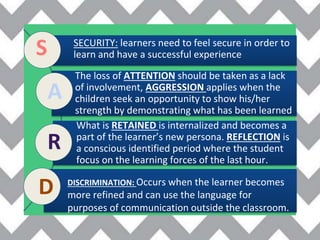
SECURITY: learners need to feel secure in order to
learn and have a successful experience
The loss of ATTENTION should be taken as a lack
of involvement, AGGRESSION applies when the
children seek an opportunity to show his/her
strength by demonstrating what has been learned
What is RETAINED is internalized and becomes a
part of the learner’s new persona. REFLECTION is
a conscious identified period where the student
focus on the learning forces of the last hour.
S
R
DISCRIMINATION: Occurs when the learner becomes
more refined and can use the language for
purposes of communication outside the classroom.
A
D
OBJECTIVES: through a method, the teacher
can successfully transfer his knowledge and
proficiency in the target language to the
learners
DESIGN
SYLLABUS:
• CLL does not use a conventional language
syllabus.
• The course progression is topic based
• It emerges from the interaction between
the learner´s expressed communicative
intentions and the teacher´s reformulation
of this into suitable target language
utterances
Types of learning and teaching activities:
1. Translation
2. Group work
3. Recording
4. Transcription
5. Analysis
6. Reflection and observation
7. Listening
8. Free conversation
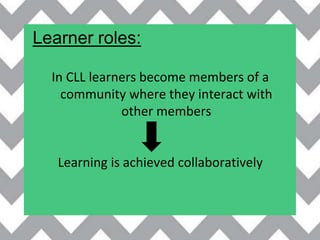
Learner roles:
In CLL learners become members of a
community where they interact with
other members
Learning is achieved collaboratively
Learner roles are divided into five stages
• STAGE 1: the learner is dependent on
the knower for linguistic content
• STAGE 2: The child achieves a measure
of independence from the parent
• STAGE 3: learners begin to understand
others directly in the target language
• STAGE 4: the learner functions
independently
• STAGE 5: learners may become
counselors to less advanced students
Teacher Roles:
• Plays the role of counselor.
• Respond calmly and non-judgmentally.
• Having a supportive manner.
• Help the client to understand the
problems better.
• Provide a safe environment .
Role of instructional materials:
• In CLL a textbook is not considered a
necessary component
• Materials may be developed by the
teacher as the course develops
• Learners may work in groups to
produce their own materials
Procedure:
• Students sitting in a circle .
• Students have visual contact with
each other .
• Teacher is out of the circle .
• Teacher walks behind the students
to provide assistance .
Conclusion:
CLL places unusual demands on language
teachers. They must:
• be highly proficient and they should be
familiar with the role of counselor
• resist the pressure “to reach” in the
traditional senses
• be prepared to design the language
class into more culturally compatible
organizational forms
•Critics: the lack of a syllabus makes
objectives unclear and evaluation
difficult to accomplish
•Supports: positive benefits of a
method that centers on the learner
and stresses the humanistic side of a
language learning

Community language learning

  • 1.
  • 2.
    • Developed byCharles A. Curran. • Counseling and professor of psychology • Community language learning represents the use of counselling- learning theory to teach languages • Humanistic approach
  • 3.
    A group oflearners sit in a circle, the student whispers a message in the L1 and the teacher translates it into the L2. The student repeats the message in the L2, all students will compose messages with the teacher help, after that students reflect about their feelings.
  • 4.
    In lay terms,counseling is one person giving advice, assistance, and support to another who has a problem or is in some way in need. CLL draws on the counselling metaphor to redefine the roles of the teacher (counselor) and learners (clients)
  • 5.
    “Language as socialprocess” Communication is more than just a message transmitted from a speaker to a listener.The speaker is both subject and object. It is an incomplete exchange without a feedback reaction from the addressee of the message Theory of language:
  • 6.
    The social processis elaborated in terms of six qualities: 1.The whole-person process 2.The educational process 3.The interpersonal process 4.The developmental process 5.The communicative process 6.The cultural process
  • 7.
    CLL interactions areof two kinds Interactions between learners: it is unpredictable in content, but they involve exchanges of affect Interactions between learners and knowers: It is dependent, the learner tells the knower what he wishes to say and the knower tells him how to say it
  • 8.
    Theory of learning: •Techniques of counselling can be applied to learning in general and to language teaching in particular. • CLL advocates a holistic approach to language learning, since “true” human learning is both cognitive and affective. • Whole-person learning: takes place in a communicative situation • The process is divided into five stages and compared to the development of a child.
  • 9.
    In the first→ feeling of security and belonging are established. In the second → the learner begins to achieve a sense of independence from the teacher. By the third→ the learner speaks independently. The fourth→ sees the learner as secure enough to take criticism. By the last→ the learner merely works upon improving style and knowledge of linguistic appropriateness.
  • 10.
    SECURITY: learners needto feel secure in order to learn and have a successful experience The loss of ATTENTION should be taken as a lack of involvement, AGGRESSION applies when the children seek an opportunity to show his/her strength by demonstrating what has been learned What is RETAINED is internalized and becomes a part of the learner’s new persona. REFLECTION is a conscious identified period where the student focus on the learning forces of the last hour. S R DISCRIMINATION: Occurs when the learner becomes more refined and can use the language for purposes of communication outside the classroom. A D
  • 11.
    OBJECTIVES: through amethod, the teacher can successfully transfer his knowledge and proficiency in the target language to the learners DESIGN
  • 12.
    SYLLABUS: • CLL doesnot use a conventional language syllabus. • The course progression is topic based • It emerges from the interaction between the learner´s expressed communicative intentions and the teacher´s reformulation of this into suitable target language utterances
  • 13.
    Types of learningand teaching activities: 1. Translation 2. Group work 3. Recording 4. Transcription 5. Analysis 6. Reflection and observation 7. Listening 8. Free conversation
  • 14.
    Learner roles: In CLLlearners become members of a community where they interact with other members Learning is achieved collaboratively
  • 15.
    Learner roles aredivided into five stages • STAGE 1: the learner is dependent on the knower for linguistic content • STAGE 2: The child achieves a measure of independence from the parent • STAGE 3: learners begin to understand others directly in the target language • STAGE 4: the learner functions independently • STAGE 5: learners may become counselors to less advanced students
  • 16.
    Teacher Roles: • Playsthe role of counselor. • Respond calmly and non-judgmentally. • Having a supportive manner. • Help the client to understand the problems better. • Provide a safe environment .
  • 17.
    Role of instructionalmaterials: • In CLL a textbook is not considered a necessary component • Materials may be developed by the teacher as the course develops • Learners may work in groups to produce their own materials
  • 18.
    Procedure: • Students sittingin a circle . • Students have visual contact with each other . • Teacher is out of the circle . • Teacher walks behind the students to provide assistance .
  • 19.
    Conclusion: CLL places unusualdemands on language teachers. They must: • be highly proficient and they should be familiar with the role of counselor • resist the pressure “to reach” in the traditional senses • be prepared to design the language class into more culturally compatible organizational forms
  • 20.
    •Critics: the lackof a syllabus makes objectives unclear and evaluation difficult to accomplish •Supports: positive benefits of a method that centers on the learner and stresses the humanistic side of a language learning