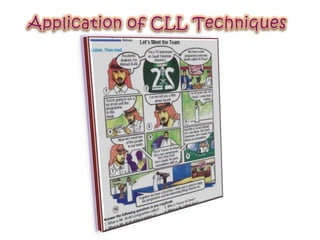
What does this picture imply?
Community Language
    Learning
      (CLL)
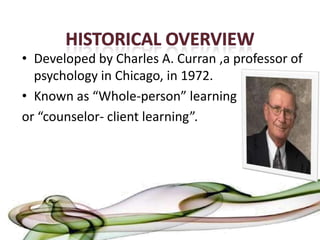
• Developed by Charles A. Curran ,a professor of
  psychology in Chicago, in 1972.
• Known as “Whole-person” learning
or “counselor- client learning”.
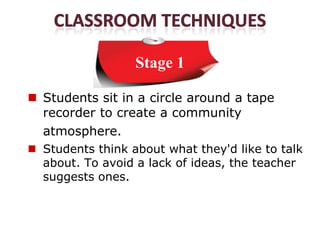
Stage 1

 Students sit in a circle around a tape
  recorder to create a community
  atmosphere.
 Students think about what they'd like to talk
  about. To avoid a lack of ideas, the teacher
  suggests ones.
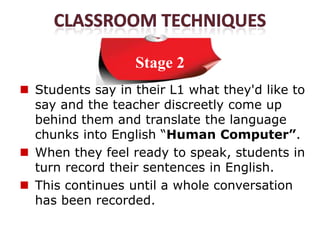
Stage 2
 Students say in their L1 what they'd like to
  say and the teacher discreetly come up
  behind them and translate the language
  chunks into English “Human Computer”.
 When they feel ready to speak, students in
  turn record their sentences in English.
 This continues until a whole conversation
  has been recorded.
Stage 3
 Next the students discuss how they think
  the conversation went. They can discuss
  how they felt about recording and whether
  they felt more comfortable speaking aloud
  than they might do normally.
 This part is not recorded.
Stage 4
 Next they listen to the tape and transcribe
  their conversation. Teacher only intervenes
  when they ask for help.
 Teacher reads the transcription many times
  asking for equivalents.
 Teacher aims to distance himself from the
  whole process in terms of leading and
  pushes them to do it themselves.
Stage 5
 Teacher gets students to analyze the
  language. This involves looking at the form
  of tenses and vocabulary used and why
  certain ones were chosen.
 With higher levels, students can decide what
  parts of conversation they would like to
  analyze. With lower levels, teacher can
  guide the analysis by choosing the common
  problems noted in the recording or the
  transcription.
Using a list, analyze the
previous techniques of CLL to
elicit its main principles..
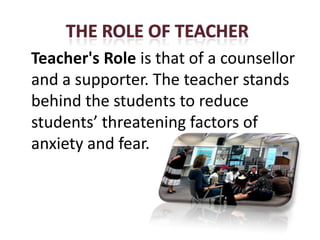
Teacher's RoleStage 5 of a counsellor
               is that
and a supporter. The teacher stands
behind the students to reduce
students’ threatening factors of
anxiety and fear.
Stage 5
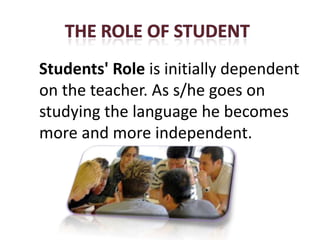
Students' Role is initially dependent
on the teacher. As s/he goes on
studying the language he becomes
more and more independent.
Stage 5
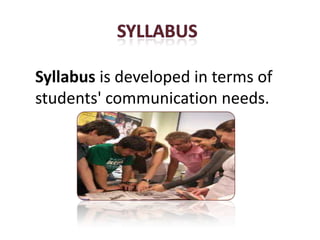
Syllabus is developed in terms of
students' communication needs.
An integrative test where Students are
                Stage 5
asked to write a paragraph or they can
be given an oral interview.
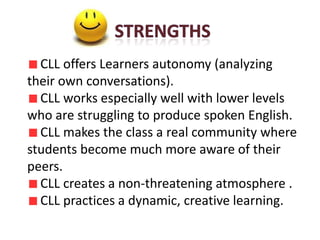
CLL offers Learners autonomy (analyzing
their own conversations).
  CLL works especially well with lower levels
who are struggling to produce spoken English.
  CLL makes the class a real community where
students become much more aware of their
peers.
  CLL creates a non-threatening atmosphere .
  CLL practices a dynamic, creative learning.
Lack of Spontaneity.
Time Consuming.
Poor Translation.
Large Classes.
No syllabus specification.
With your partner, tick the
appropriate completion.
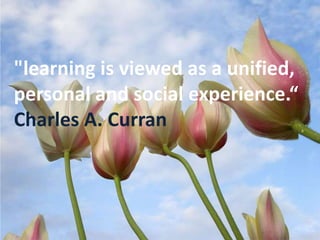
"learning is viewed as a unified,
personal and social experience.“
Charles A. Curran
Thanks for Listening
- Larsen-Freeman, Diane, Anderson, Marti. Techniques
& Principles in Language Teaching. Oxford University
Press, 2011.
  - Larsen-Freeman, Diane. Techniques & Principles in
  Language Teaching. Oxford University Press, 2000.
    - Richardson, Jack C, Rogers, Theodore S. Approaches
    and Methods In Language Teaching. Cambridge
    University Press, 1986.
       -http://www.britishcouncil.org

        - http://www.iteslj.org

         - http://www.aub.edu.lb/main/Pages/index.aspx

Advanced methodology for tesol 2

  • 2.
    What does thispicture imply?
  • 3.
    Community Language Learning (CLL)
  • 4.
    • Developed byCharles A. Curran ,a professor of psychology in Chicago, in 1972. • Known as “Whole-person” learning or “counselor- client learning”.
  • 8.
    Stage 1  Studentssit in a circle around a tape recorder to create a community atmosphere.  Students think about what they'd like to talk about. To avoid a lack of ideas, the teacher suggests ones.
  • 9.
    Stage 2  Studentssay in their L1 what they'd like to say and the teacher discreetly come up behind them and translate the language chunks into English “Human Computer”.  When they feel ready to speak, students in turn record their sentences in English.  This continues until a whole conversation has been recorded.
  • 10.
    Stage 3  Nextthe students discuss how they think the conversation went. They can discuss how they felt about recording and whether they felt more comfortable speaking aloud than they might do normally.  This part is not recorded.
  • 11.
    Stage 4  Nextthey listen to the tape and transcribe their conversation. Teacher only intervenes when they ask for help.  Teacher reads the transcription many times asking for equivalents.  Teacher aims to distance himself from the whole process in terms of leading and pushes them to do it themselves.
  • 12.
    Stage 5  Teachergets students to analyze the language. This involves looking at the form of tenses and vocabulary used and why certain ones were chosen.  With higher levels, students can decide what parts of conversation they would like to analyze. With lower levels, teacher can guide the analysis by choosing the common problems noted in the recording or the transcription.
  • 13.
    Using a list,analyze the previous techniques of CLL to elicit its main principles..
  • 14.
    Teacher's RoleStage 5of a counsellor is that and a supporter. The teacher stands behind the students to reduce students’ threatening factors of anxiety and fear.
  • 15.
    Stage 5 Students' Roleis initially dependent on the teacher. As s/he goes on studying the language he becomes more and more independent.
  • 16.
    Stage 5 Syllabus isdeveloped in terms of students' communication needs.
  • 17.
    An integrative testwhere Students are Stage 5 asked to write a paragraph or they can be given an oral interview.
  • 19.
    CLL offers Learnersautonomy (analyzing their own conversations). CLL works especially well with lower levels who are struggling to produce spoken English. CLL makes the class a real community where students become much more aware of their peers. CLL creates a non-threatening atmosphere . CLL practices a dynamic, creative learning.
  • 20.
    Lack of Spontaneity. TimeConsuming. Poor Translation. Large Classes. No syllabus specification.
  • 21.
    With your partner,tick the appropriate completion.
  • 22.
    "learning is viewedas a unified, personal and social experience.“ Charles A. Curran
  • 23.
  • 24.
    - Larsen-Freeman, Diane,Anderson, Marti. Techniques & Principles in Language Teaching. Oxford University Press, 2011. - Larsen-Freeman, Diane. Techniques & Principles in Language Teaching. Oxford University Press, 2000. - Richardson, Jack C, Rogers, Theodore S. Approaches and Methods In Language Teaching. Cambridge University Press, 1986. -http://www.britishcouncil.org - http://www.iteslj.org - http://www.aub.edu.lb/main/Pages/index.aspx