BASICS OF BIOMEDICAL
BIO-
AMPLIFIERS
Prepared by Atheena Pandian
TODAY'S GUIDE
WHAT WE'LL TALK ABOUT
What is Amplifiers?
Bio-Amplfiers
Types
Instrumentation
Isolation
1.
2.
3.
4.
5.
What is Amplifiers?
An amplifier, electronic
amplifier or
(informally) amp is an
electronic device that can
increase the power of
a signal (a time-
varying voltage or current).
WHAT IS BIO-
AMPLIFIERS?
It is an electrophysiological device, a variation of
the instrumentation amplifier, used to gather and
increase the signal integrity
of physiologic electrical activity for output to
various sources. It may be an independent unit, or
integrated into the electrodes.
WHY IS BIO AMPLIFIER
REQUIRED?
Generally, biological/bioelectric
signals have low amplitude and
low frequency. Therefore, to
increase the amplitude level of
biosignals amplifiers are
designed.
Types of Bio-
Amplifiers
Differential Amplifier
Operational Amplifier
Instrumentation Amplifier
Chopper Amplifier
Isolation Amplifier
1.
2.
3.
4.
5.
The biological amplifier should have a high input
impedance value.
The range of value lies between 2 MΩ and 10 MΩ
depending on the applications. Higher impedance
value reduces distortion of the signal.
When electrodes pick up biopotentials from the
human body, the input circuit should be protected.
Every bio-amplifier should consist of isolation and
protection circuits, to prevent the patients
from electrical shocks.
1.
2.
3.
4.
BASIC REQUIREMENTS FOR
BIOLOGICAL AMPLIFIERS
Mostly used bio-Amplifiers
Instrumentation Amplifier
Isolation Amplifier
1.
2.
INSTRUMENTATION
AMPLIFIER
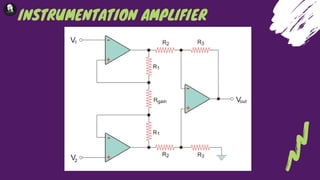
In biomedical applications, high gain and the high
input impedance are attained with an
instrumentation amplifier.
Usually, a 3-amplifier setup forms the
instrumentation amplifier circuit.
The output from the transducer is given as input to
the instrumentation amplifier.
Before the signal goes to the next stage, a special
amplifier is required with high CMRR, high input
impedance and to avoid loading effects. Such a
special amplifier is an instrumentation amplifier,
which does all the required process.
1.
2.
3.
4.
INSTRUMENTATION AMPLIFIER
ISOLATION
AMPLIFIER
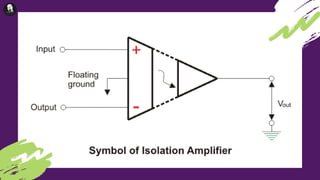
Isolation amplifiers are known as Pre-
amplifier isolation circuits.
An isolation amplifier increases the input
impedance of a patient monitoring system.
It also helps to isolate the patient from the
device.
Using the isolation amplifier prevents
accidental internal cardiac shock.
It provides up to 1012 Ω insulation between
the patient and the power line in the
hospital.
1.
2.
3.
4.
5.
ISOLATION
AMPLIFIER
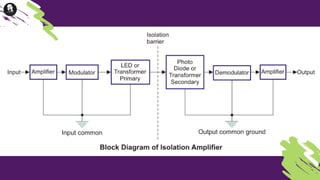
The electrical signals are
obtained with electrodes.
The signals received goes to
the amplifier block, where
signals amplification occurs.
After amplification, the signal
enters the modulation block.
When either it goes to the
isolation barrier, optical cable
or transformer can be used.
Isolation Amplifier
If in case of optical cable, modulator output
travels to LED.
The LED converts electrical signals into light
energy.
If the transformer acts an isolation barrier,
modulator output connects the primary winding of
the transformer.
Energy from primary transfers to the secondary
winding based on the mutual induction principle.
At the next stage, secondary output enters the
demodulation block.
Finally, the amplified demodulated signal is
obtained.
Isolation Amplifier
THANK YOU

Bio amplifiers - basics

  • 1.
  • 2.
    TODAY'S GUIDE WHAT WE'LLTALK ABOUT What is Amplifiers? Bio-Amplfiers Types Instrumentation Isolation 1. 2. 3. 4. 5.
  • 3.
    What is Amplifiers? An amplifier, electronic amplifier or (informally) amp isan electronic device that can increase the power of a signal (a time- varying voltage or current).
  • 4.
    WHAT IS BIO- AMPLIFIERS? Itis an electrophysiological device, a variation of the instrumentation amplifier, used to gather and increase the signal integrity of physiologic electrical activity for output to various sources. It may be an independent unit, or integrated into the electrodes.
  • 5.
    WHY IS BIOAMPLIFIER REQUIRED? Generally, biological/bioelectric signals have low amplitude and low frequency. Therefore, to increase the amplitude level of biosignals amplifiers are designed.
  • 6.
    Types of Bio- Amplifiers DifferentialAmplifier Operational Amplifier Instrumentation Amplifier Chopper Amplifier Isolation Amplifier 1. 2. 3. 4. 5.
  • 7.
    The biological amplifier should havea high input impedance value. The range of value lies between 2 MΩ and 10 MΩ depending on the applications. Higher impedance value reduces distortion of the signal. When electrodes pick up biopotentials from the human body, the input circuit should be protected. Every bio-amplifier should consist of isolation and protection circuits, to prevent the patients from electrical shocks. 1. 2. 3. 4. BASIC REQUIREMENTS FOR BIOLOGICAL AMPLIFIERS
  • 8.
    Mostly used bio-Amplifiers InstrumentationAmplifier Isolation Amplifier 1. 2.
  • 9.
    INSTRUMENTATION AMPLIFIER In biomedical applications,high gain and the high input impedance are attained with an instrumentation amplifier. Usually, a 3-amplifier setup forms the instrumentation amplifier circuit. The output from the transducer is given as input to the instrumentation amplifier. Before the signal goes to the next stage, a special amplifier is required with high CMRR, high input impedance and to avoid loading effects. Such a special amplifier is an instrumentation amplifier, which does all the required process. 1. 2. 3. 4.
  • 10.
  • 11.
  • 12.
    Isolation amplifiers areknown as Pre- amplifier isolation circuits. An isolation amplifier increases the input impedance of a patient monitoring system. It also helps to isolate the patient from the device. Using the isolation amplifier prevents accidental internal cardiac shock. It provides up to 1012 Ω insulation between the patient and the power line in the hospital. 1. 2. 3. 4. 5. ISOLATION AMPLIFIER
  • 15.
    The electrical signalsare obtained with electrodes. The signals received goes to the amplifier block, where signals amplification occurs. After amplification, the signal enters the modulation block. When either it goes to the isolation barrier, optical cable or transformer can be used. Isolation Amplifier
  • 16.
    If in caseof optical cable, modulator output travels to LED. The LED converts electrical signals into light energy. If the transformer acts an isolation barrier, modulator output connects the primary winding of the transformer. Energy from primary transfers to the secondary winding based on the mutual induction principle. At the next stage, secondary output enters the demodulation block. Finally, the amplified demodulated signal is obtained. Isolation Amplifier
  • 17.