UNIT III - SIGNAL CONDITIONING
CIRCUITS
PART – A
Answers
1. What are the requirements of amplifiers used
in biomedical recorders?
• High power gain to activate the pen motor in
the display
• An ideal non inverting amplifier to avoid cross
over distortion
• Excellent frequency response in the sub audio
frequency range
• To avoid noise, limited high frequency noise is
used
2. Give some of the amplifiers used with
recorders.
• Differential amplifier
• AC coupled amplifier
• Carrier amplifier
• Bio-amplifier
3. What is meant by Bio-amplifiers?
Amplifiers are used to increase (or) boost
the strength of the signals. Because bio signals
are having low amplitude and low frequency.
Amplifiers is an electronic device that amplifies a
weak signal. Output of this amplifier is displayed
as EEG (or) ECG waveform according to the bio-
signal input so it is also called as Bio-amplifiers.
4. What is preamplifier? State its
functional requirements.
• Preamplifier is an electronic amplifier that
prepares a small electrical signal for further
amplification (or) processing. Preamplifier is
often placed close to the sensor to reduce the
effects of noise and interference.
• It is used to boost the signal strength to drive
the cable to the main instrument without
significantly degrading the SNR (signal – to –
Noise ratio).
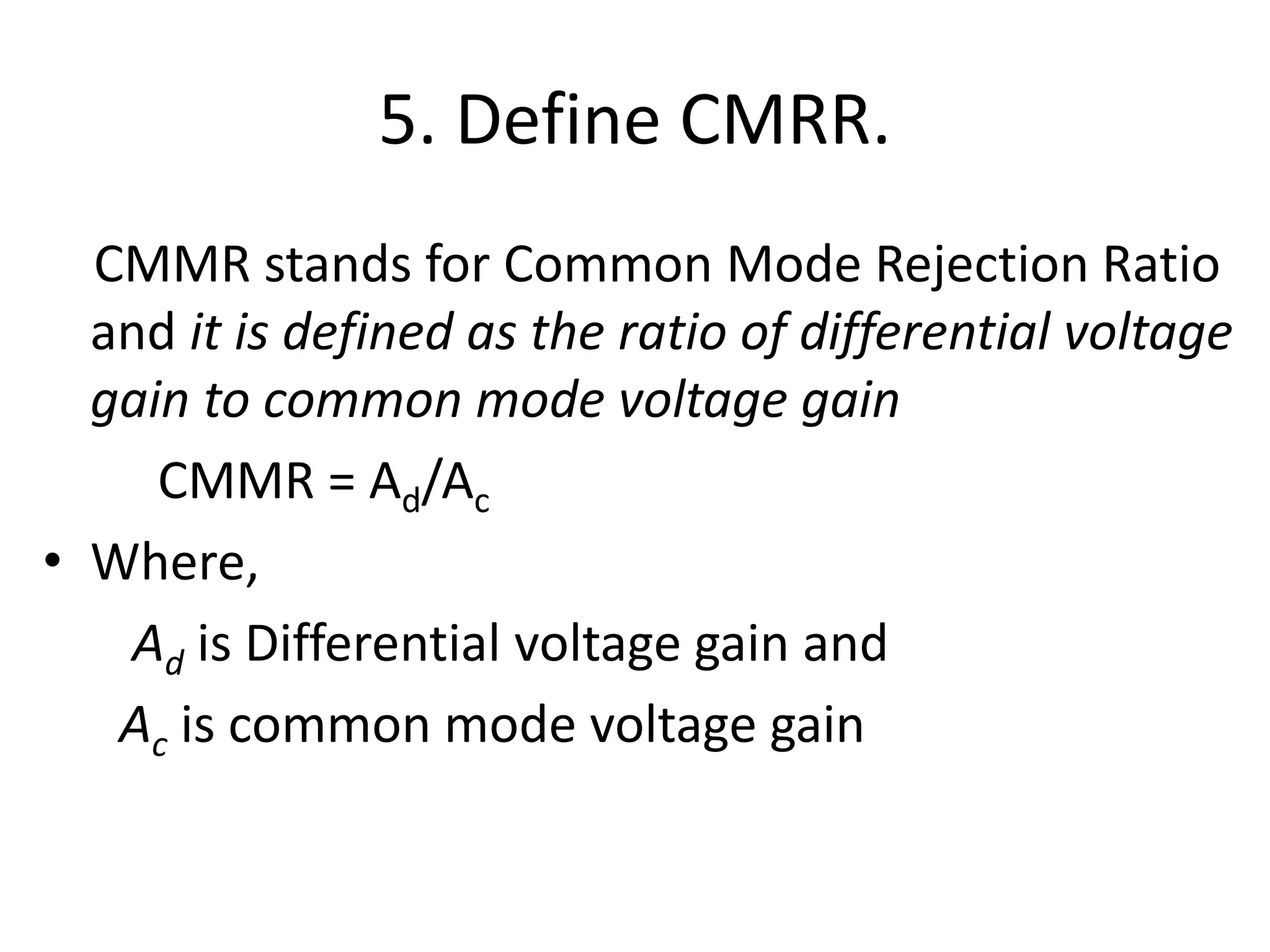
5. Define CMRR.
CMMR stands for Common Mode Rejection Ratio
and it is defined as the ratio of differential voltage
gain to common mode voltage gain
CMMR = Ad/Ac
• Where,
Ad is Differential voltage gain and
Ac is common mode voltage gain
6. Write the purpose of isolation
amplifiers.
Generally isolation amplifiers are called
pre-amplifier isolation circuits. These are used
to increase the input impedance of the
monitoring system in order to isolate the
patient from the biomedical instrument. The
patient must be isolated because most
monitors are line operated.
7. Mention the different methods of
isolation amplifier.
There are three methods used for the design of
isolation amplifiers they are
• Transformer isolation
• Optical isolation
• Capacitive isolation
8. List the advantages of transformer
type isolation amplifier.
• Transformer isolation is more popular and
amplifiers the signal while passing low
leakage current to prevent shock.
• More compatible to reducing the Noise
• Isolation resistance levels are the order of
1010, 1011 and 1012 ohms respectively
• Gain stability and linearity are best, isolation
voltage is 1200 V.
9. Why isolated preamplifier is used
for bioelectric signal acquisition.
Isolation amplifiers are a form of differential
amplifier that allow measurement of small
signals in the presence of a high common
mode voltage by providing electrical
isolation and an electrical safety barrier. They
protect data acquisition components
from common mode voltages, which are
potential differences between instrument
ground and signal ground.
10. What are the characteristics of a
DC amplifier?
• It may lead balanced differential inputs to
giving a high common mode rejection ratio
(CMRR).
• It should have extremely good thermal and
long term stability.
11.What is a filter?
A filter is a circuit which can be designed to
modify, reshape or reject all the undesired
frequencies of an electrical signal and pass
only the desired signals.
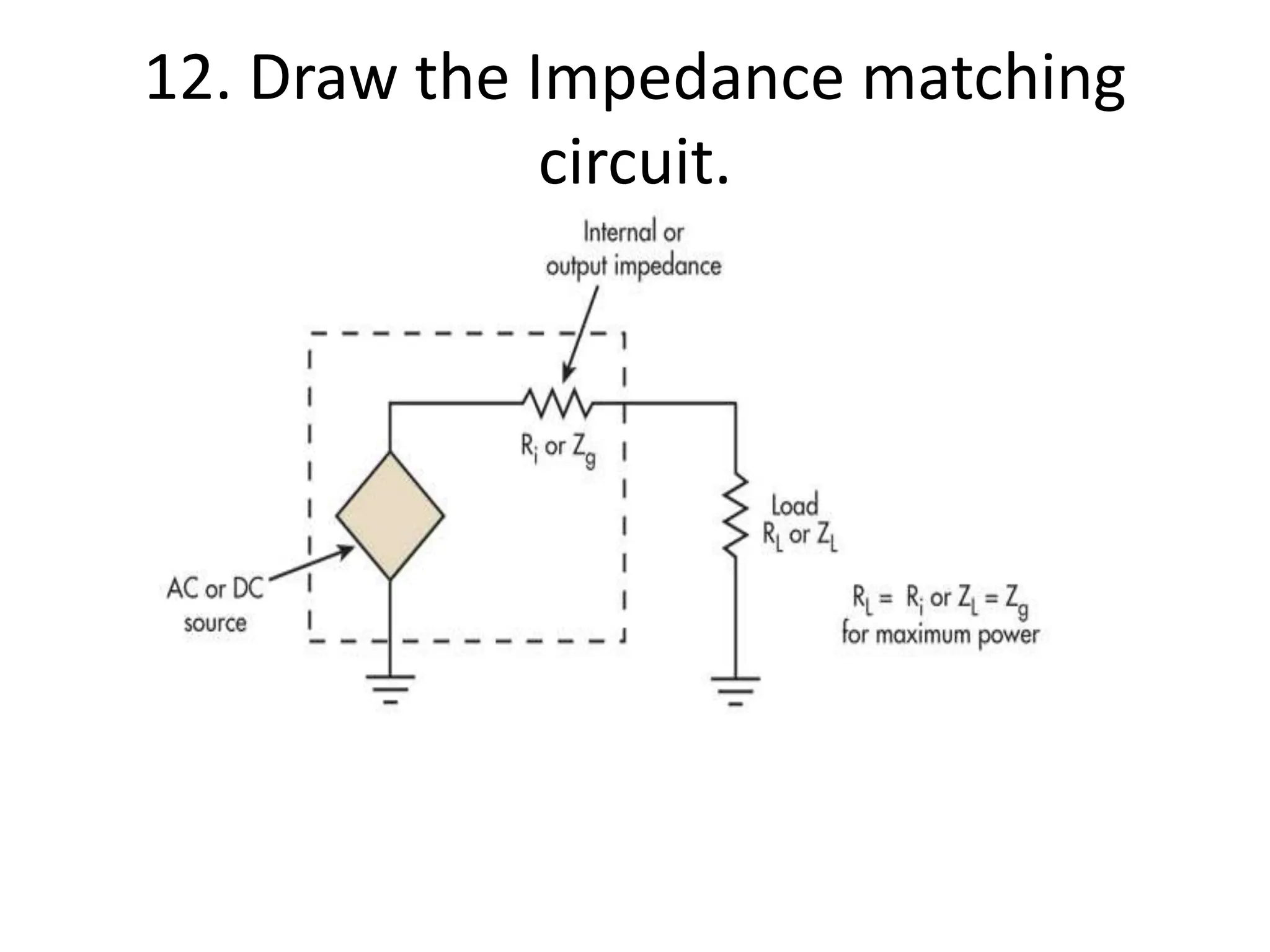
12. Draw the Impedance matching
circuit.
13. Why Power line interference study
is needed for analysis of biosignals?
The power line interference of 50/60 Hz is the source of
interference and it corrupts the recordings of Bio signals (Eg.
ECG) which are extremely important for the diagnosis of
patients.
The interference is caused by:
a. Electromagnetic interference by power line
b. Electromagnetic field (EMF) by the machinery which is placed
nearby.
c. Stray effect of the alternating current fields due to loops in the
cables
d. Improper grounding of ECG machine or the patient.
e. Electrical equipments such as air conditioner, elevators and X-ray
units draw heavy power line current, which induce 50 Hz signals in
the input circuits of the ECG machine.
14. Mention the amplifier used to measure Right
leg in ECG measurement.
• Differential amplifiers
• Isolation amplifiers
15. What is meant by band pass
filtering?
A bandpass filter is an electronic device or
circuit that allows signals between two specific
frequencies to pass, but that discriminates against
signals at other frequencies. Some bandpass filters
require an external source of power and employ
active components such as transistors and
integrated circuits; these are known as active
bandpass filters. Other bandpass filters use no
external source of power and consist only of
passive components such as capacitors and
inductors; these are called passive bandpass
filters.
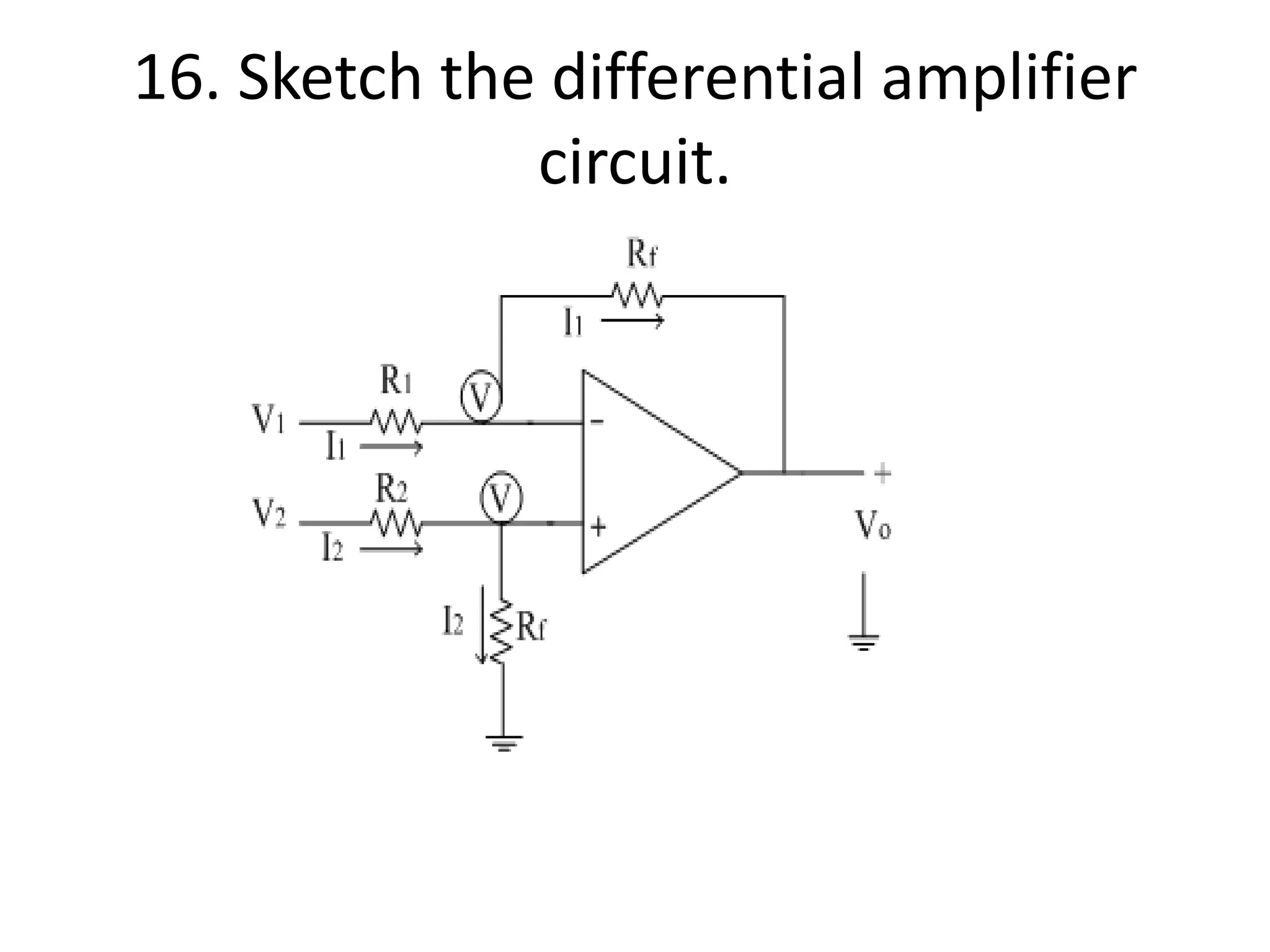
16. Sketch the differential amplifier
circuit.
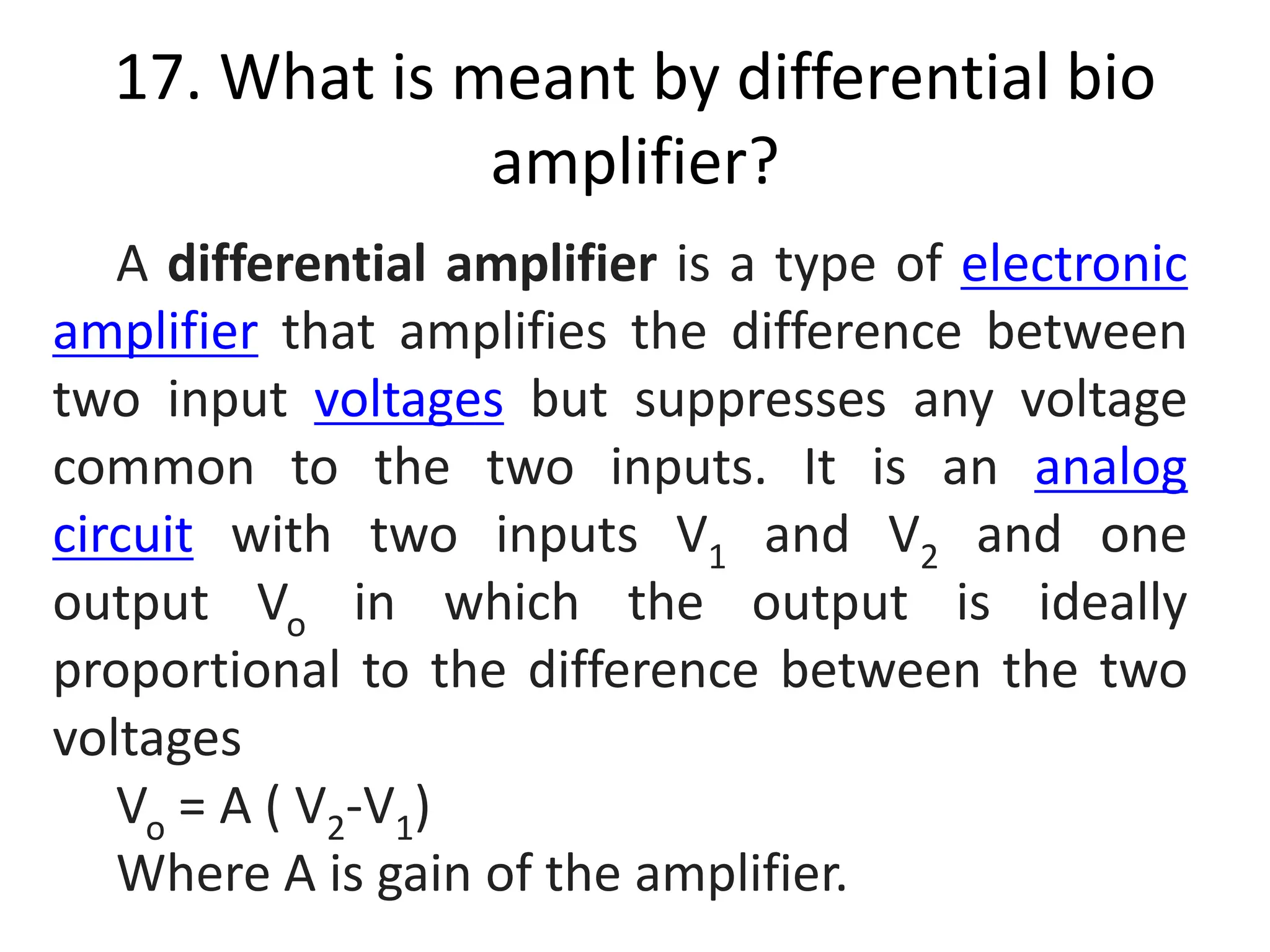
17. What is meant by differential bio
amplifier?
A differential amplifier is a type of electronic
amplifier that amplifies the difference between
two input voltages but suppresses any voltage
common to the two inputs. It is an analog
circuit with two inputs V1 and V2 and one
output Vo in which the output is ideally
proportional to the difference between the two
voltages
Vo = A ( V2-V1)
Where A is gain of the amplifier.
18. Write the purpose of impedance
matching circuit.
Impedance matching becomes very
important at high frequencies. If the
impedance of the source and load are not
matched, the signal is partially reflected back
down the line from the load to the source. The
resultant waveform is the algebraic sum of the
transmitted waveform and the reflected
waveform.
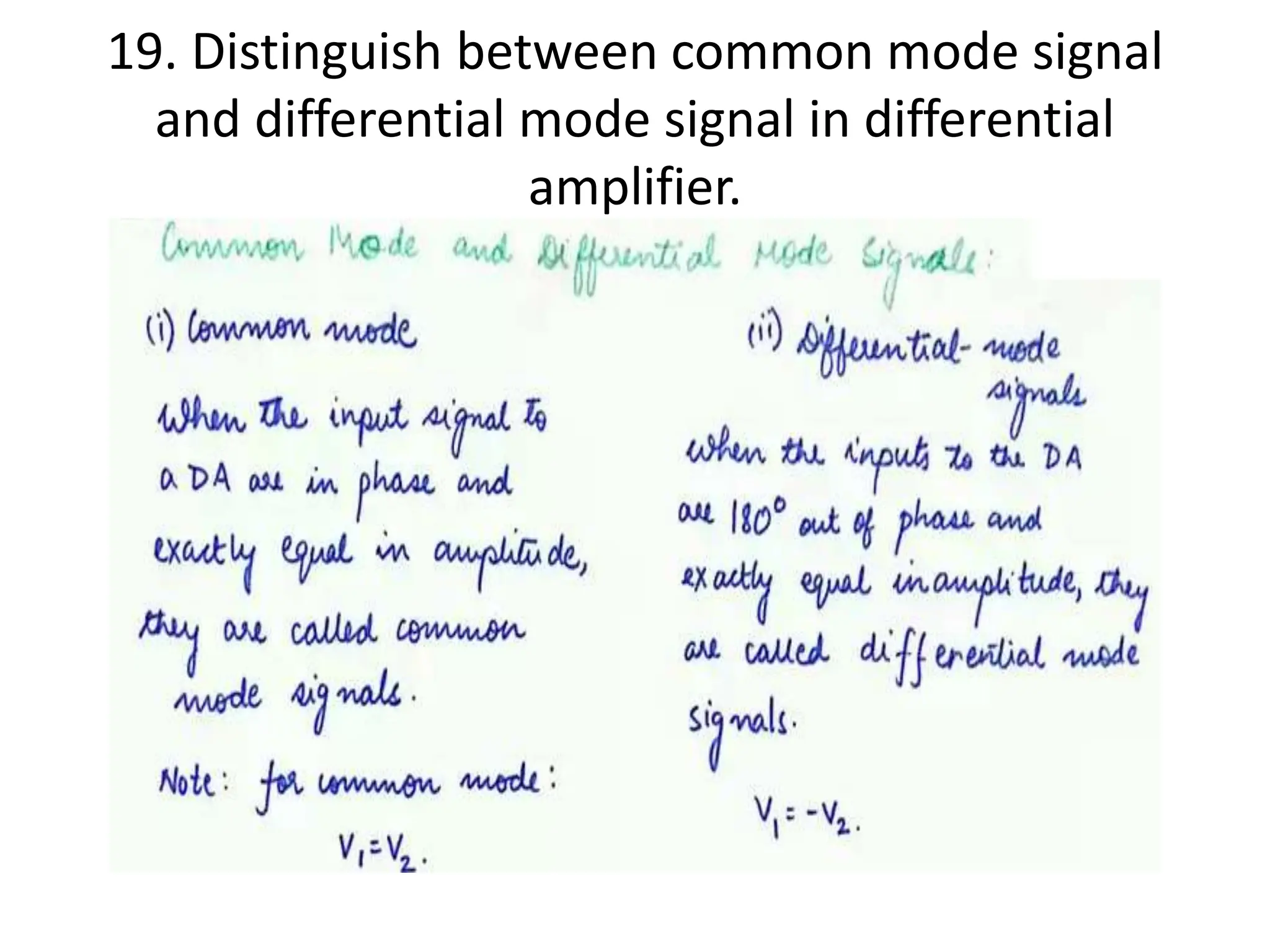
19. Distinguish between common mode signal
and differential mode signal in differential
amplifier.
20. What is the need for Band pass
filter in bio amplifier circuits?
A bandpass filter is an electronic
device or circuit that allows signals between
two specific frequencies to pass, but that
discriminates against signals at other
frequencies.

UNIT III - SIGNAL CONDITIONING CIRCUITS.pptx

  • 1.
    UNIT III -SIGNAL CONDITIONING CIRCUITS PART – A Answers
  • 2.
    1. What arethe requirements of amplifiers used in biomedical recorders? • High power gain to activate the pen motor in the display • An ideal non inverting amplifier to avoid cross over distortion • Excellent frequency response in the sub audio frequency range • To avoid noise, limited high frequency noise is used
  • 3.
    2. Give someof the amplifiers used with recorders. • Differential amplifier • AC coupled amplifier • Carrier amplifier • Bio-amplifier
  • 4.
    3. What ismeant by Bio-amplifiers? Amplifiers are used to increase (or) boost the strength of the signals. Because bio signals are having low amplitude and low frequency. Amplifiers is an electronic device that amplifies a weak signal. Output of this amplifier is displayed as EEG (or) ECG waveform according to the bio- signal input so it is also called as Bio-amplifiers.
  • 5.
    4. What ispreamplifier? State its functional requirements. • Preamplifier is an electronic amplifier that prepares a small electrical signal for further amplification (or) processing. Preamplifier is often placed close to the sensor to reduce the effects of noise and interference. • It is used to boost the signal strength to drive the cable to the main instrument without significantly degrading the SNR (signal – to – Noise ratio).
  • 6.
    5. Define CMRR. CMMRstands for Common Mode Rejection Ratio and it is defined as the ratio of differential voltage gain to common mode voltage gain CMMR = Ad/Ac • Where, Ad is Differential voltage gain and Ac is common mode voltage gain
  • 7.
    6. Write thepurpose of isolation amplifiers. Generally isolation amplifiers are called pre-amplifier isolation circuits. These are used to increase the input impedance of the monitoring system in order to isolate the patient from the biomedical instrument. The patient must be isolated because most monitors are line operated.
  • 8.
    7. Mention thedifferent methods of isolation amplifier. There are three methods used for the design of isolation amplifiers they are • Transformer isolation • Optical isolation • Capacitive isolation
  • 9.
    8. List theadvantages of transformer type isolation amplifier. • Transformer isolation is more popular and amplifiers the signal while passing low leakage current to prevent shock. • More compatible to reducing the Noise • Isolation resistance levels are the order of 1010, 1011 and 1012 ohms respectively • Gain stability and linearity are best, isolation voltage is 1200 V.
  • 10.
    9. Why isolatedpreamplifier is used for bioelectric signal acquisition. Isolation amplifiers are a form of differential amplifier that allow measurement of small signals in the presence of a high common mode voltage by providing electrical isolation and an electrical safety barrier. They protect data acquisition components from common mode voltages, which are potential differences between instrument ground and signal ground.
  • 11.
    10. What arethe characteristics of a DC amplifier? • It may lead balanced differential inputs to giving a high common mode rejection ratio (CMRR). • It should have extremely good thermal and long term stability.
  • 12.
    11.What is afilter? A filter is a circuit which can be designed to modify, reshape or reject all the undesired frequencies of an electrical signal and pass only the desired signals.
  • 13.
    12. Draw theImpedance matching circuit.
  • 14.
    13. Why Powerline interference study is needed for analysis of biosignals? The power line interference of 50/60 Hz is the source of interference and it corrupts the recordings of Bio signals (Eg. ECG) which are extremely important for the diagnosis of patients. The interference is caused by: a. Electromagnetic interference by power line b. Electromagnetic field (EMF) by the machinery which is placed nearby. c. Stray effect of the alternating current fields due to loops in the cables d. Improper grounding of ECG machine or the patient. e. Electrical equipments such as air conditioner, elevators and X-ray units draw heavy power line current, which induce 50 Hz signals in the input circuits of the ECG machine.
  • 15.
    14. Mention theamplifier used to measure Right leg in ECG measurement. • Differential amplifiers • Isolation amplifiers
  • 16.
    15. What ismeant by band pass filtering? A bandpass filter is an electronic device or circuit that allows signals between two specific frequencies to pass, but that discriminates against signals at other frequencies. Some bandpass filters require an external source of power and employ active components such as transistors and integrated circuits; these are known as active bandpass filters. Other bandpass filters use no external source of power and consist only of passive components such as capacitors and inductors; these are called passive bandpass filters.
  • 17.
    16. Sketch thedifferential amplifier circuit.
  • 18.
    17. What ismeant by differential bio amplifier? A differential amplifier is a type of electronic amplifier that amplifies the difference between two input voltages but suppresses any voltage common to the two inputs. It is an analog circuit with two inputs V1 and V2 and one output Vo in which the output is ideally proportional to the difference between the two voltages Vo = A ( V2-V1) Where A is gain of the amplifier.
  • 19.
    18. Write thepurpose of impedance matching circuit. Impedance matching becomes very important at high frequencies. If the impedance of the source and load are not matched, the signal is partially reflected back down the line from the load to the source. The resultant waveform is the algebraic sum of the transmitted waveform and the reflected waveform.
  • 20.
    19. Distinguish betweencommon mode signal and differential mode signal in differential amplifier.
  • 21.
    20. What isthe need for Band pass filter in bio amplifier circuits? A bandpass filter is an electronic device or circuit that allows signals between two specific frequencies to pass, but that discriminates against signals at other frequencies.