HYDROPHOBIC INTERACTION
)
By
KAUSHAL KUMAR SAHU
Assistant Professor (Ad Hoc)
Department of Biotechnology
Govt. Digvijay Autonomous P. G. College
Raj-Nandgaon ( C. G. )
•SYNOPSSIS
 Introduction
 History
 Definition
 Types of interaction.
o Hydrophobic interaction
o Vander Waals interaction
o London dispersion forces
o Hydrogen bonds
o Charge .charge interaction
 Example of hydrophobic interaction
o Sodium oleate micelle
o protein stability
o Ligand binding specificity
 Conclusion.
 References.
•INTRODUCTION
• Water is needed not only for biochemical reactions
but also for transporting substances across
membranes maintaining body temperature
dissolving waste products for excretion and
producing digestive fluids.
• Many of the weak interactions within and between
biomolecules are strongly influenced by the solvent
properties of water .
•HISTORY
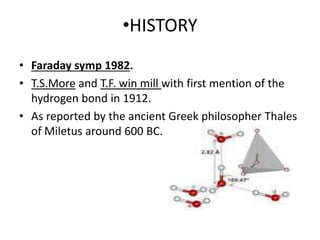
• Faraday symp 1982.
• T.S.More and T.F. win mill with first mention of the
hydrogen bond in 1912.
• As reported by the ancient Greek philosopher Thales
of Miletus around 600 BC.
•DEFINATION
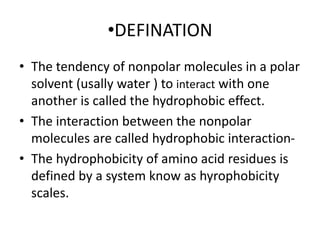
• The tendency of nonpolar molecules in a polar
solvent (usally water ) to interact with one
another is called the hydrophobic effect.
• The interaction between the nonpolar
molecules are called hydrophobic interaction-
• The hydrophobicity of amino acid residues is
defined by a system know as hyrophobicity
scales.
TYPES OF INTERACTION
HYDROPHOBIC INTERACTION.
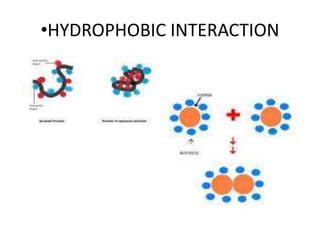
• Hydrophobic interaction describe the relation
between water and hydrophobic .
• Hydrophobic are nonpolar molecules and usually
have along chain of carbons that do not with water
molecules the mixing of fat and water is a forces that
are acting upon both water and fat molecules are too
weak however this is not the case the behavior of fat
droplet in water has more to do with the enthalpy
and entropy of the reaction than its intermoleculas
forces .
•HYDROPHOBIC INTERACTION
•EXAMPLE OF HYDROPHOBIC
INTERACTION
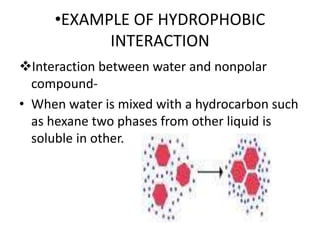
Interaction between water and nonpolar
compound-
• When water is mixed with a hydrocarbon such
as hexane two phases from other liquid is
soluble in other.
Amphipathic compound
• Contain regions that are polar and regions
that are nonpolar when amphipathic
compounds are mixed with water the two
regions of the solute molecule experience
conflicting tendencies.
Sodium oleate micelle
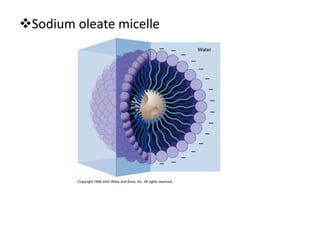
• An example of and amphipathic bimolecule that ends
to from micelles is the sodium salt of the long chain
fatty acid oleic acid .
• This molecule has a single carboxyl group which is
polar and thus tends to hydrate readily and a long
hydrocarbon tail
• Which is nonpolar and intersically insoluble in water
because of this long hydrophobic tail there is very
little tendency for sodium oleate to dissolve in water
to yeild a true ionic solution however.
Sodium oleate micelle
Protein stability
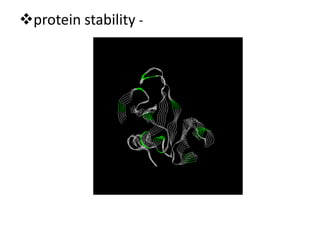
• Protein stability is just the differences in free energy
between the correctly folded structure of a protein
and the unfolded denatured from.
• The more stable the protein the larger the free
energy differences between the unfolded from and
the native structure.
protein stability -
Ligand binding specificity
• Both the protein and the ligand are solvated
by water when they are separated as the two
surfaces interact water is excuded hydrogen
bond are broken and formed hydrophobic
interaction occur and protein and ligand stick
to each other.
•VANDER WALLS INTERACTION
• Vander Waals forces include attraction and
repulsions .
• Atom molecules and surfaces as well as other
interaction forces .
• They difficult from covalent and ionic bonding
in that they are caused by correlations in the
fluctuating pal creations of near by particle .
•LONDON DISPERSON FORCES
• Named offer the German, American physicist .
• Fritz laden are weak intermolecular forces that
arise from the interactive forces between
instantaneous multiples in molecules without
permanent multiple moments .
• London dispersion forces are also know as
disposition forces ,London forces or
instantaneous dipolar induced dipole forces .
•HYDROGEN BONDS
• A hydrogen bond is the attraction interaction
between polar molecules in which hydrogen is bound
to highly electronegative atom such nitrogen
,oxygen, fluorine.
• The hydrogen bond is something of a misnomer as it
not a true bond but a particularly strong dipole-
dipole in attraction and should not be confused with
a covalent bond.
•STRUCTURE OF HYDROGEN BOND
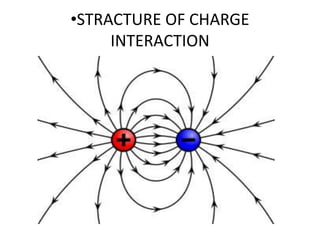
•CHARGE- CHARGE INTERACTION
• Electric charge the physical property of matter that
causes if to experience a force when close electrically
charged matter.
• There are two types of electric charges called
positive and negative.
• The electric charge is a conserved property of some
subatomic particles which determines their
electromagnetic interaction.
•STRACTURE OF CHARGE
INTERACTION
•CONCLUSION
• Hydrophobic interaction are similarly weak and ionic
interaction and hydrogen bonds are only a little
stronger.
• A typical hydrogen bond can be broken by the input
of about 20kj/mol .
• In aqueous solvent at 250C .
• The available thermal energy is of the same order as
the strength of these weak interaction .
• Consequently hydrogen bonds and ionic hydrogen
and Vander Waals interaction are continuously
formed and broken.
•REFREANCE
• J.L. JAIN (sixth revised and enlarged edition)
• NELSON &Cox-(principles of biochemistry 5th
edition)
• ALBERT L. LEHNINGER-(biochemistry 2nd
edition)
• FROM NET-(Wikipedia ./Wiki/hydrophobic –effect .)
• Date and time (10.30am,14/8/2013)

hydrophobic interaction

  • 1.
    HYDROPHOBIC INTERACTION ) By KAUSHAL KUMARSAHU Assistant Professor (Ad Hoc) Department of Biotechnology Govt. Digvijay Autonomous P. G. College Raj-Nandgaon ( C. G. )
  • 2.
    •SYNOPSSIS  Introduction  History Definition  Types of interaction. o Hydrophobic interaction o Vander Waals interaction o London dispersion forces o Hydrogen bonds o Charge .charge interaction  Example of hydrophobic interaction o Sodium oleate micelle o protein stability o Ligand binding specificity  Conclusion.  References.
  • 3.
    •INTRODUCTION • Water isneeded not only for biochemical reactions but also for transporting substances across membranes maintaining body temperature dissolving waste products for excretion and producing digestive fluids. • Many of the weak interactions within and between biomolecules are strongly influenced by the solvent properties of water .
  • 4.
    •HISTORY • Faraday symp1982. • T.S.More and T.F. win mill with first mention of the hydrogen bond in 1912. • As reported by the ancient Greek philosopher Thales of Miletus around 600 BC.
  • 5.
    •DEFINATION • The tendencyof nonpolar molecules in a polar solvent (usally water ) to interact with one another is called the hydrophobic effect. • The interaction between the nonpolar molecules are called hydrophobic interaction- • The hydrophobicity of amino acid residues is defined by a system know as hyrophobicity scales.
  • 6.
    TYPES OF INTERACTION HYDROPHOBICINTERACTION. • Hydrophobic interaction describe the relation between water and hydrophobic . • Hydrophobic are nonpolar molecules and usually have along chain of carbons that do not with water molecules the mixing of fat and water is a forces that are acting upon both water and fat molecules are too weak however this is not the case the behavior of fat droplet in water has more to do with the enthalpy and entropy of the reaction than its intermoleculas forces .
  • 7.
  • 8.
    •EXAMPLE OF HYDROPHOBIC INTERACTION Interactionbetween water and nonpolar compound- • When water is mixed with a hydrocarbon such as hexane two phases from other liquid is soluble in other.
  • 9.
    Amphipathic compound • Containregions that are polar and regions that are nonpolar when amphipathic compounds are mixed with water the two regions of the solute molecule experience conflicting tendencies.
  • 10.
    Sodium oleate micelle •An example of and amphipathic bimolecule that ends to from micelles is the sodium salt of the long chain fatty acid oleic acid . • This molecule has a single carboxyl group which is polar and thus tends to hydrate readily and a long hydrocarbon tail • Which is nonpolar and intersically insoluble in water because of this long hydrophobic tail there is very little tendency for sodium oleate to dissolve in water to yeild a true ionic solution however.
  • 11.
  • 12.
    Protein stability • Proteinstability is just the differences in free energy between the correctly folded structure of a protein and the unfolded denatured from. • The more stable the protein the larger the free energy differences between the unfolded from and the native structure.
  • 13.
  • 14.
    Ligand binding specificity •Both the protein and the ligand are solvated by water when they are separated as the two surfaces interact water is excuded hydrogen bond are broken and formed hydrophobic interaction occur and protein and ligand stick to each other.
  • 15.
    •VANDER WALLS INTERACTION •Vander Waals forces include attraction and repulsions . • Atom molecules and surfaces as well as other interaction forces . • They difficult from covalent and ionic bonding in that they are caused by correlations in the fluctuating pal creations of near by particle .
  • 16.
    •LONDON DISPERSON FORCES •Named offer the German, American physicist . • Fritz laden are weak intermolecular forces that arise from the interactive forces between instantaneous multiples in molecules without permanent multiple moments . • London dispersion forces are also know as disposition forces ,London forces or instantaneous dipolar induced dipole forces .
  • 17.
    •HYDROGEN BONDS • Ahydrogen bond is the attraction interaction between polar molecules in which hydrogen is bound to highly electronegative atom such nitrogen ,oxygen, fluorine. • The hydrogen bond is something of a misnomer as it not a true bond but a particularly strong dipole- dipole in attraction and should not be confused with a covalent bond.
  • 18.
  • 19.
    •CHARGE- CHARGE INTERACTION •Electric charge the physical property of matter that causes if to experience a force when close electrically charged matter. • There are two types of electric charges called positive and negative. • The electric charge is a conserved property of some subatomic particles which determines their electromagnetic interaction.
  • 20.
  • 21.
    •CONCLUSION • Hydrophobic interactionare similarly weak and ionic interaction and hydrogen bonds are only a little stronger. • A typical hydrogen bond can be broken by the input of about 20kj/mol . • In aqueous solvent at 250C . • The available thermal energy is of the same order as the strength of these weak interaction . • Consequently hydrogen bonds and ionic hydrogen and Vander Waals interaction are continuously formed and broken.
  • 22.
    •REFREANCE • J.L. JAIN(sixth revised and enlarged edition) • NELSON &Cox-(principles of biochemistry 5th edition) • ALBERT L. LEHNINGER-(biochemistry 2nd edition) • FROM NET-(Wikipedia ./Wiki/hydrophobic –effect .) • Date and time (10.30am,14/8/2013)