Neural Networks - Part2
Venkat Reddy
Statinfer.com
Data Science Training and R&D
statinfer.com
2
Corporate Training
Classroom Training
Online Training
Contact us
info@statinfer.com
venkat@statinfer.com
Note
•This presentation is just my class notes. The course notes for data
science training is written by me, as an aid for myself.
•The best way to treat this is as a high-level summary; the actual
session went more in depth and contained detailed information and
examples
•Most of this material was written as informal notes, not intended for
publication
•Please send questions/comments/corrections to info@statinfer.com
•Please check our website statinfer.com for latest version of this
document
-Venkata Reddy Konasani
(Cofounder statinfer.com)
statinfer.com
3
Contents
• Overfitting
• Regularization
• Activation Functions
• Learning Rate
4
The problem of Overfitting
5
The problem of Overfitting
•Neural networks are very powerful. They have capacity to learn any
type of pattern.
•With high number of hidden layers, we can fit to training data with
any level of non-linearity
•Too many hidden layers might be fitting the model for random pattern
or noise in the data
•Throughout the neural network algorithm we were trying optimise
weights to make the error zero. This might lead to overfitting
6
Cost function regularization
7
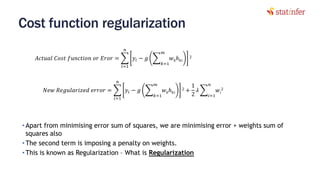
𝐴𝑐𝑡𝑢𝑎𝑙 𝐶𝑜𝑠𝑡 𝑓𝑢𝑛𝑐𝑡𝑖𝑜𝑛 𝑜𝑟 𝐸𝑟𝑜𝑟 = ෍
𝑖=1
𝑛
𝑦𝑖 − 𝑔 ෍
𝑘=1
𝑚
𝑤 𝑘ℎ 𝑘𝑖
2
𝑁𝑒𝑤 𝑅𝑒𝑔𝑢𝑙𝑎𝑟𝑖𝑧𝑒𝑑 𝑒𝑟𝑟𝑜𝑟 = ෍
𝑖=1
𝑛
𝑦𝑖 − 𝑔 ෍
𝑘=1
𝑚
𝑤 𝑘ℎ 𝑘𝑖
2 +
1
2
𝜆 ෍
𝑖=1
𝑛
𝑤𝑖
2
• Apart from minimising error sum of squares, we are minimising error + weights sum of
squares also
• The second term is imposing a penalty on weights.
• This is known as Regularization – What is Regularization
What is Regularization?
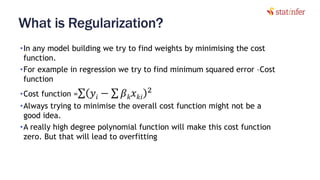
•In any model building we try to find weights by minimising the cost
function.
•For example in regression we try to find minimum squared error –Cost
function
•Cost function =σ 𝑦𝑖 − σ 𝛽 𝑘 𝑥 𝑘𝑖
2
•Always trying to minimise the overall cost function might not be a
good idea.
•A really high degree polynomial function will make this cost function
zero. But that will lead to overfitting
8
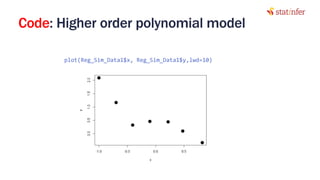
LAB: Higher order polynomial model
•Data: Regular/Reg_Sim_Data1.csv
•Plot the points X vs Y
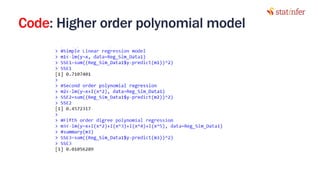
•Build three regression models m1, m2 and m3 and calculate SSE
• m1: simple linear model – Calculate SSE
• m2: Second order polynomial model – Calculate SSE
• m3: Fifth order polynomial model – Calculate SSE
•Which model is the best based on SSE.
9
Code: Higher order polynomial model
10
plot(Reg_Sim_Data1$x, Reg_Sim_Data1$y,lwd=10)
Code: Higher order polynomial model
11
Reduce Overfitting
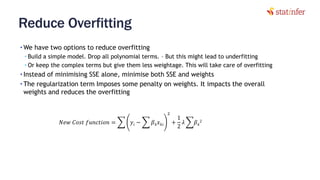
• We have two options to reduce overfitting
• Build a simple model. Drop all polynomial terms. – But this might lead to underfitting
• Or keep the complex terms but give them less weightage. This will take care of overfitting
• Instead of minimising SSE alone, minimise both SSE and weights
• The regularization term Imposes some penalty on weights. It impacts the overall
weights and reduces the overfitting
12
𝑁𝑒𝑤 𝐶𝑜𝑠𝑡 𝑓𝑢𝑛𝑐𝑡𝑖𝑜𝑛 = ෍ 𝑦𝑖 − ෍ 𝛽 𝑘 𝑥 𝑘𝑖
2
+
1
2
𝜆 ෍𝛽 𝑘
2
Regularization comments
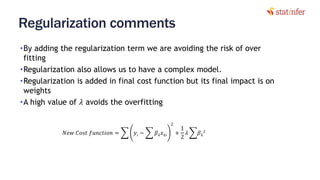
•By adding the regularization term we are avoiding the risk of over
fitting
•Regularization also allows us to have a complex model.
•Regularization is added in final cost function but its final impact is on
weights
•A high value of 𝜆 avoids the overfitting
13
𝑁𝑒𝑤 𝐶𝑜𝑠𝑡 𝑓𝑢𝑛𝑐𝑡𝑖𝑜𝑛 = ෍ 𝑦𝑖 − ෍ 𝛽 𝑘 𝑥 𝑘𝑖
2
+
1
2
𝜆 ෍𝛽 𝑘
2
LAB: Regularization
•Build a fifth order polynomial function.
•consider new regularized cost function.
•Recalculate the weights. Build three models
• 𝜆 =0
• 𝜆=1
• 𝜆=10
•Plot the models. Which model is more generalised (less over fitted)
•If you have to choose one model with high degree polynomials what
will be your 𝜆 value?
14
Code: Regularization
15
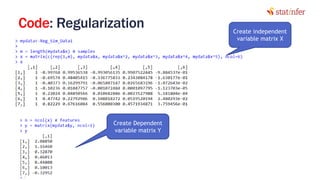
Create independent
variable matrix X
Create Dependent
variable matrix Y
Code: Regularization
16
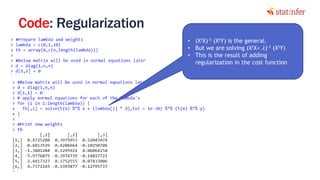
• (XtX)-1 (XtY) is the general.
• But we are solving (XtX+ 𝜆)-1 (XtY)
• This is the result of adding
regularization in the cost function
Code: Regularization
17
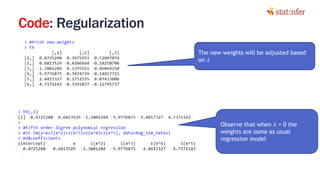
The new weights will be adjusted based
on 𝜆
Observe that when 𝜆 = 0 the
weights are same as usual
regression model
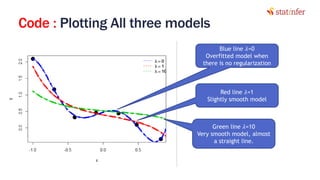
Code : Plotting All three models
# plot
plot(mydata,lwd=10)
# lets create many points
nwx = seq(-1, 1, len=50);
x = matrix(c(rep(1,length(nwx)), nwx, nwx^2, nwx^3, nwx^4, nwx^5),
ncol=6)
lines(nwx, x %*% th[,1], col="blue", lty=2)
lines(nwx, x %*% th[,2], col="red", lty=2)
lines(nwx, x %*% th[,3], col="green3", lty=2)
legend("topright", c(expression(lambda==0),
expression(lambda==1),expression(lambda==10)), lty=2,col=c("blue",
"red", "green3"), bty="n")
18
Code : Plotting All three models
19
Red line 𝜆=1
Slightly smooth model
Blue line 𝜆=0
Overfitted model when
there is no regularization
Green line 𝜆=10
Very smooth model, almost
a straight line.
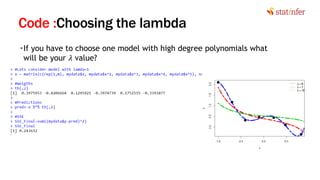
Code :Choosing the lambda
•If you have to choose one model with high degree polynomials what
will be your 𝜆 value?
20
How Regularization works in Neural Nets
•In linear regression having higher order polynomial terms lead to
overfitting.
•Did we reduce the polynomial terms?
•We added regularization term in the cost function recalculated the
weights.
•In neural networks having too many hidden layers might lead to
overfitting.
•Shall we reduce the number of hidden layers?
21
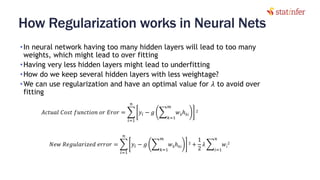
How Regularization works in Neural Nets
•In neural network having too many hidden layers will lead to too many
weights, which might lead to over fitting
•Having very less hidden layers might lead to underfitting
•How do we keep several hidden layers with less weightage?
•We can use regularization and have an optimal value for 𝜆 to avoid over
fitting
22
𝐴𝑐𝑡𝑢𝑎𝑙 𝐶𝑜𝑠𝑡 𝑓𝑢𝑛𝑐𝑡𝑖𝑜𝑛 𝑜𝑟 𝐸𝑟𝑜𝑟 = ෍
𝑖=1
𝑛
𝑦𝑖 − 𝑔 ෍
𝑘=1
𝑚
𝑤 𝑘ℎ 𝑘𝑖
2
𝑁𝑒𝑤 𝑅𝑒𝑔𝑢𝑙𝑎𝑟𝑖𝑧𝑒𝑑 𝑒𝑟𝑟𝑜𝑟 = ෍
𝑖=1
𝑛
𝑦𝑖 − 𝑔 ෍
𝑘=1
𝑚
𝑤 𝑘ℎ 𝑘𝑖
2 +
1
2
𝜆 ෍
𝑖=1
𝑛
𝑤𝑖
2
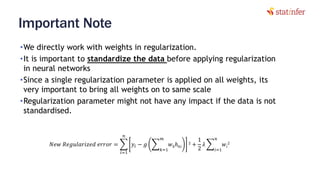
Important Note
•We directly work with weights in regularization.
•It is important to standardize the data before applying regularization
in neural networks
•Since a single regularization parameter is applied on all weights, its
very important to bring all weights on to same scale
•Regularization parameter might not have any impact if the data is not
standardised.
23
𝑁𝑒𝑤 𝑅𝑒𝑔𝑢𝑙𝑎𝑟𝑖𝑧𝑒𝑑 𝑒𝑟𝑟𝑜𝑟 = ෍
𝑖=1
𝑛
𝑦𝑖 − 𝑔 ෍
𝑘=1
𝑚
𝑤 𝑘ℎ 𝑘𝑖
2 +
1
2
𝜆 ෍
𝑖=1
𝑛
𝑤𝑖
2
Demo: Regularization
24
• Lot of hidden layers
• Overfitted model
• No Regularization
playground.tensorflow.org
Demo: Regularization
25
• Lot of hidden layers
Model is not
overfitted
• With Regularization
Lab: Regularization in Neural Nets
•Import Credit risk data
•The data has class-imbalance problem. Prepare balance sample for the
model building
•Standardise the data
•Try to build a neural network with 15 hidden nodes
•Set the decay parameter as 0.5
26
Lab: Regularization in Neural Nets
library(clusterSim)
risk_train_strd<-data.Normalization (risk_train[,-1],type="n1",normalization="column")
head(risk_train_strd)
risk_train_strd$SeriousDlqin2yrs<-risk_train$SeriousDlqin2yrs
# x vector, matrix or dataset type ;type of normalization: n0 - without normalization
# n1 - standardization ((x-mean)/sd)
# n2 - positional standardization ((x-median)/mad)
# n3 - unitization ((x-mean)/range)
27
Normalize the data
Lab: Regularization in Neural Nets
library(nnet)
set.seed(35)
mod1<-nnet(as.factor(SeriousDlqin2yrs)~., data=risk_train,
size=15,
maxit=500)
####Results and Intime validation
actual_values<-risk_train$SeriousDlqin2yrs
Predicted<-predict(mod1, type="class")
cm<-table(actual_values,Predicted)
cm
acc<-(cm[1,1]+cm[2,2])/(cm[1,1]+cm[1,2]+cm[2,1]+cm[2,2])
acc
####Results on test data
actual_values_test<-risk_test$SeriousDlqin2yrs
Predicted_test<-predict(mod1, risk_test[,-1], type="class")
cm_test<-table(actual_values_test,Predicted_test)
cm_test
acc_test<-(cm_test[1,1]+cm_test[2,2])/(cm_test[1,1]+cm_test[1,2]+cm_test[2,1]+cm_test[2,2])
acc_test
28
Lab: Regularization in Neural Nets
library(nnet)
set.seed(35)
mod1<-nnet(as.factor(SeriousDlqin2yrs)~., data=risk_train,
size=15,
maxit=500,
decay = 0.5)
####Results and Intime validation
actual_values<-risk_train$SeriousDlqin2yrs
Predicted<-predict(mod1, type="class")
cm<-table(actual_values,Predicted)
cm
acc<-(cm[1,1]+cm[2,2])/(cm[1,1]+cm[1,2]+cm[2,1]+cm[2,2])
acc
####Results on test data
actual_values_test<-risk_test$SeriousDlqin2yrs
Predicted_test<-predict(mod1, risk_test[,-1], type="class")
cm_test<-table(actual_values_test,Predicted_test)
cm_test
acc_test<-(cm_test[1,1]+cm_test[2,2])/(cm_test[1,1]+cm_test[1,2]+cm_test[2,1]+cm_test[2,2])
acc_test 29
Finetuning neural network
models
30
Major Parameters for finetuning NN
•Two major parameters
• Number of hidden nodes/ layers
• The decay parameter
•If number of hidden nodes are high they decay should be high to
regularize.
•If the decay is too high then the model might be underfitted.
•We need to choose an optimal pair of hidden nodes and decay
31
Activation Functions
32
Activation Functions - Sigmoid
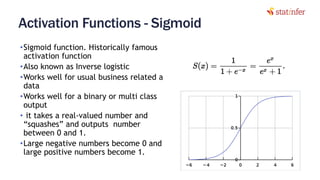
•Sigmoid function. Historically famous
activation function
•Also known as Inverse logistic
•Works well for usual business related a
data
•Works well for a binary or multi class
output
• it takes a real-valued number and
“squashes” and outputs number
between 0 and 1.
•Large negative numbers become 0 and
large positive numbers become 1. 33
Sigmoid- Drawbacks
•Sigmoid output not zero-centered.
• The middle value is 0.5
• Most of the times we normalise the data(zero-centered) before building the neural
network model.
•Vanishing Gradients
• Computationally sigmoid values and gradient values and their multiplications are
very small
• For a deep network with many hidden layers sigmoid gradients vanish very quickly
•We need a different activation function which is zero-centered for
better results.
34
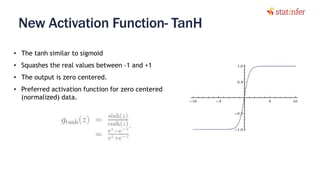
New Activation Function- TanH
35
• The tanh similar to sigmoid
• Squashes the real values between -1 and +1
• The output is zero centered.
• Preferred activation function for zero centered
(normalized) data.
Demo: Sigmoid vs TanH
36
• Sigmoid takes 275
steps
Demo: Sigmoid vs TanH
37
• TahH takes less steps
Demo: Sigmoid vs TanH
38
• Sigmoid takes 1,604
steps
• Error is still 15%
Demo: Sigmoid vs TanH
39
• TanH takes 600
steps
• Error is less than %
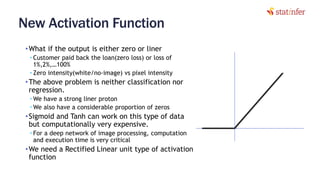
New Activation Function
•What if the output is either zero or liner
• Customer paid back the loan(zero loss) or loss of
1%,2%,…100%
• Zero intensity(white/no-image) vs pixel intensity
•The above problem is neither classification nor
regression.
• We have a strong liner proton
• We also have a considerable proportion of zeros
•Sigmoid and Tanh can work on this type of data
but computationally very expensive.
• For a deep network of image processing, computation
and execution time is very critical
•We need a Rectified Linear unit type of activation
function
40
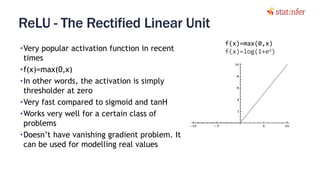
ReLU - The Rectified Linear Unit
•Very popular activation function in recent
times
•f(x)=max(0,x)
•In other words, the activation is simply
thresholder at zero
•Very fast compared to sigmoid and tanH
•Works very well for a certain class of
problems
•Doesn’t have vanishing gradient problem. It
can be used for modelling real values
41
f(x)=max(0,x)
f(x)=log(1+ex)
Demo: ThnH vs ReLu
42
• TanH takes 1,000
steps
Demo: ThnH vs ReLU
43
• ReLU takes less
steps
Learning rate
44
Learning rate
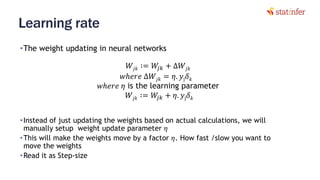
•The weight updating in neural networks
45
𝑊𝑗𝑘 ∶= 𝑊𝑗𝑘 + ∆𝑊𝑗𝑘
𝑤ℎ𝑒𝑟𝑒 ∆𝑊𝑗𝑘 = 𝜂. 𝑦j 𝛿 𝑘
𝑤ℎ𝑒𝑟𝑒 𝜂 is the learning parameter
𝑊𝑗𝑘 ∶= 𝑊𝑗𝑘 + 𝜂. 𝑦j 𝛿 𝑘
•Instead of just updating the weights based on actual calculations, we will
manually setup weight update parameter 𝜂
•This will make the weights move by a factor 𝜂. How fast /slow you want to
move the weights
•Read it as Step-size
Learning Rate tuning
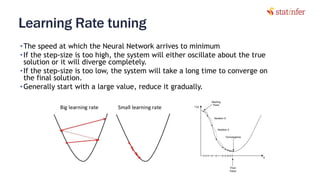
•The speed at which the Neural Network arrives to minimum
•If the step-size is too high, the system will either oscillate about the true
solution or it will diverge completely.
•If the step-size is too low, the system will take a long time to converge on
the final solution.
•Generally start with a large value, reduce it gradually.
46
Learning Rate is Important
47
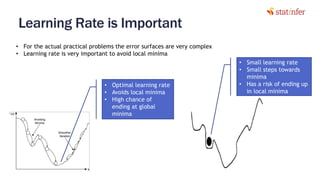
• Small learning rate
• Small steps towards
minima
• Has a risk of ending up
in local minima
• Optimal learning rate
• Avoids local minima
• High chance of
ending at global
minima
• For the actual practical problems the error surfaces are very complex
• Learning rate is very important to avoid local minima
Demo: Learning rate
48
• High learning rate
• High error
Demo: Learning rate
49
• Very low learning rate
• Too many steps
• Takes a lot of time to
converge
Demo: Learning rate
50
• Optimal learning rate
• Low error
• Less steps
Thank you
51
Our Course is Available on Udemy now
52
https://www.udemy.com/machine-learning-made-easy-beginner-to-advance-using-r/
Statinfer.com
Data Science Training and R&D
statinfer.com
53
Corporate Training
Classroom Training
Online Training
Contact us
info@statinfer.com
venkat@statinfer.com

Neural Network Part-2

  • 1.
    Neural Networks -Part2 Venkat Reddy
  • 2.
    Statinfer.com Data Science Trainingand R&D statinfer.com 2 Corporate Training Classroom Training Online Training Contact us info@statinfer.com venkat@statinfer.com
  • 3.
    Note •This presentation isjust my class notes. The course notes for data science training is written by me, as an aid for myself. •The best way to treat this is as a high-level summary; the actual session went more in depth and contained detailed information and examples •Most of this material was written as informal notes, not intended for publication •Please send questions/comments/corrections to info@statinfer.com •Please check our website statinfer.com for latest version of this document -Venkata Reddy Konasani (Cofounder statinfer.com) statinfer.com 3
  • 4.
    Contents • Overfitting • Regularization •Activation Functions • Learning Rate 4
  • 5.
    The problem ofOverfitting 5
  • 6.
    The problem ofOverfitting •Neural networks are very powerful. They have capacity to learn any type of pattern. •With high number of hidden layers, we can fit to training data with any level of non-linearity •Too many hidden layers might be fitting the model for random pattern or noise in the data •Throughout the neural network algorithm we were trying optimise weights to make the error zero. This might lead to overfitting 6
  • 7.
    Cost function regularization 7 𝐴𝑐𝑡𝑢𝑎𝑙𝐶𝑜𝑠𝑡 𝑓𝑢𝑛𝑐𝑡𝑖𝑜𝑛 𝑜𝑟 𝐸𝑟𝑜𝑟 = ෍ 𝑖=1 𝑛 𝑦𝑖 − 𝑔 ෍ 𝑘=1 𝑚 𝑤 𝑘ℎ 𝑘𝑖 2 𝑁𝑒𝑤 𝑅𝑒𝑔𝑢𝑙𝑎𝑟𝑖𝑧𝑒𝑑 𝑒𝑟𝑟𝑜𝑟 = ෍ 𝑖=1 𝑛 𝑦𝑖 − 𝑔 ෍ 𝑘=1 𝑚 𝑤 𝑘ℎ 𝑘𝑖 2 + 1 2 𝜆 ෍ 𝑖=1 𝑛 𝑤𝑖 2 • Apart from minimising error sum of squares, we are minimising error + weights sum of squares also • The second term is imposing a penalty on weights. • This is known as Regularization – What is Regularization
  • 8.
    What is Regularization? •Inany model building we try to find weights by minimising the cost function. •For example in regression we try to find minimum squared error –Cost function •Cost function =σ 𝑦𝑖 − σ 𝛽 𝑘 𝑥 𝑘𝑖 2 •Always trying to minimise the overall cost function might not be a good idea. •A really high degree polynomial function will make this cost function zero. But that will lead to overfitting 8
  • 9.
    LAB: Higher orderpolynomial model •Data: Regular/Reg_Sim_Data1.csv •Plot the points X vs Y •Build three regression models m1, m2 and m3 and calculate SSE • m1: simple linear model – Calculate SSE • m2: Second order polynomial model – Calculate SSE • m3: Fifth order polynomial model – Calculate SSE •Which model is the best based on SSE. 9
  • 10.
    Code: Higher orderpolynomial model 10 plot(Reg_Sim_Data1$x, Reg_Sim_Data1$y,lwd=10)
  • 11.
    Code: Higher orderpolynomial model 11
  • 12.
    Reduce Overfitting • Wehave two options to reduce overfitting • Build a simple model. Drop all polynomial terms. – But this might lead to underfitting • Or keep the complex terms but give them less weightage. This will take care of overfitting • Instead of minimising SSE alone, minimise both SSE and weights • The regularization term Imposes some penalty on weights. It impacts the overall weights and reduces the overfitting 12 𝑁𝑒𝑤 𝐶𝑜𝑠𝑡 𝑓𝑢𝑛𝑐𝑡𝑖𝑜𝑛 = ෍ 𝑦𝑖 − ෍ 𝛽 𝑘 𝑥 𝑘𝑖 2 + 1 2 𝜆 ෍𝛽 𝑘 2
  • 13.
    Regularization comments •By addingthe regularization term we are avoiding the risk of over fitting •Regularization also allows us to have a complex model. •Regularization is added in final cost function but its final impact is on weights •A high value of 𝜆 avoids the overfitting 13 𝑁𝑒𝑤 𝐶𝑜𝑠𝑡 𝑓𝑢𝑛𝑐𝑡𝑖𝑜𝑛 = ෍ 𝑦𝑖 − ෍ 𝛽 𝑘 𝑥 𝑘𝑖 2 + 1 2 𝜆 ෍𝛽 𝑘 2
  • 14.
    LAB: Regularization •Build afifth order polynomial function. •consider new regularized cost function. •Recalculate the weights. Build three models • 𝜆 =0 • 𝜆=1 • 𝜆=10 •Plot the models. Which model is more generalised (less over fitted) •If you have to choose one model with high degree polynomials what will be your 𝜆 value? 14
  • 15.
    Code: Regularization 15 Create independent variablematrix X Create Dependent variable matrix Y
  • 16.
    Code: Regularization 16 • (XtX)-1(XtY) is the general. • But we are solving (XtX+ 𝜆)-1 (XtY) • This is the result of adding regularization in the cost function
  • 17.
    Code: Regularization 17 The newweights will be adjusted based on 𝜆 Observe that when 𝜆 = 0 the weights are same as usual regression model
  • 18.
    Code : PlottingAll three models # plot plot(mydata,lwd=10) # lets create many points nwx = seq(-1, 1, len=50); x = matrix(c(rep(1,length(nwx)), nwx, nwx^2, nwx^3, nwx^4, nwx^5), ncol=6) lines(nwx, x %*% th[,1], col="blue", lty=2) lines(nwx, x %*% th[,2], col="red", lty=2) lines(nwx, x %*% th[,3], col="green3", lty=2) legend("topright", c(expression(lambda==0), expression(lambda==1),expression(lambda==10)), lty=2,col=c("blue", "red", "green3"), bty="n") 18
  • 19.
    Code : PlottingAll three models 19 Red line 𝜆=1 Slightly smooth model Blue line 𝜆=0 Overfitted model when there is no regularization Green line 𝜆=10 Very smooth model, almost a straight line.
  • 20.
    Code :Choosing thelambda •If you have to choose one model with high degree polynomials what will be your 𝜆 value? 20
  • 21.
    How Regularization worksin Neural Nets •In linear regression having higher order polynomial terms lead to overfitting. •Did we reduce the polynomial terms? •We added regularization term in the cost function recalculated the weights. •In neural networks having too many hidden layers might lead to overfitting. •Shall we reduce the number of hidden layers? 21
  • 22.
    How Regularization worksin Neural Nets •In neural network having too many hidden layers will lead to too many weights, which might lead to over fitting •Having very less hidden layers might lead to underfitting •How do we keep several hidden layers with less weightage? •We can use regularization and have an optimal value for 𝜆 to avoid over fitting 22 𝐴𝑐𝑡𝑢𝑎𝑙 𝐶𝑜𝑠𝑡 𝑓𝑢𝑛𝑐𝑡𝑖𝑜𝑛 𝑜𝑟 𝐸𝑟𝑜𝑟 = ෍ 𝑖=1 𝑛 𝑦𝑖 − 𝑔 ෍ 𝑘=1 𝑚 𝑤 𝑘ℎ 𝑘𝑖 2 𝑁𝑒𝑤 𝑅𝑒𝑔𝑢𝑙𝑎𝑟𝑖𝑧𝑒𝑑 𝑒𝑟𝑟𝑜𝑟 = ෍ 𝑖=1 𝑛 𝑦𝑖 − 𝑔 ෍ 𝑘=1 𝑚 𝑤 𝑘ℎ 𝑘𝑖 2 + 1 2 𝜆 ෍ 𝑖=1 𝑛 𝑤𝑖 2
  • 23.
    Important Note •We directlywork with weights in regularization. •It is important to standardize the data before applying regularization in neural networks •Since a single regularization parameter is applied on all weights, its very important to bring all weights on to same scale •Regularization parameter might not have any impact if the data is not standardised. 23 𝑁𝑒𝑤 𝑅𝑒𝑔𝑢𝑙𝑎𝑟𝑖𝑧𝑒𝑑 𝑒𝑟𝑟𝑜𝑟 = ෍ 𝑖=1 𝑛 𝑦𝑖 − 𝑔 ෍ 𝑘=1 𝑚 𝑤 𝑘ℎ 𝑘𝑖 2 + 1 2 𝜆 ෍ 𝑖=1 𝑛 𝑤𝑖 2
  • 24.
    Demo: Regularization 24 • Lotof hidden layers • Overfitted model • No Regularization playground.tensorflow.org
  • 25.
    Demo: Regularization 25 • Lotof hidden layers Model is not overfitted • With Regularization
  • 26.
    Lab: Regularization inNeural Nets •Import Credit risk data •The data has class-imbalance problem. Prepare balance sample for the model building •Standardise the data •Try to build a neural network with 15 hidden nodes •Set the decay parameter as 0.5 26
  • 27.
    Lab: Regularization inNeural Nets library(clusterSim) risk_train_strd<-data.Normalization (risk_train[,-1],type="n1",normalization="column") head(risk_train_strd) risk_train_strd$SeriousDlqin2yrs<-risk_train$SeriousDlqin2yrs # x vector, matrix or dataset type ;type of normalization: n0 - without normalization # n1 - standardization ((x-mean)/sd) # n2 - positional standardization ((x-median)/mad) # n3 - unitization ((x-mean)/range) 27 Normalize the data
  • 28.
    Lab: Regularization inNeural Nets library(nnet) set.seed(35) mod1<-nnet(as.factor(SeriousDlqin2yrs)~., data=risk_train, size=15, maxit=500) ####Results and Intime validation actual_values<-risk_train$SeriousDlqin2yrs Predicted<-predict(mod1, type="class") cm<-table(actual_values,Predicted) cm acc<-(cm[1,1]+cm[2,2])/(cm[1,1]+cm[1,2]+cm[2,1]+cm[2,2]) acc ####Results on test data actual_values_test<-risk_test$SeriousDlqin2yrs Predicted_test<-predict(mod1, risk_test[,-1], type="class") cm_test<-table(actual_values_test,Predicted_test) cm_test acc_test<-(cm_test[1,1]+cm_test[2,2])/(cm_test[1,1]+cm_test[1,2]+cm_test[2,1]+cm_test[2,2]) acc_test 28
  • 29.
    Lab: Regularization inNeural Nets library(nnet) set.seed(35) mod1<-nnet(as.factor(SeriousDlqin2yrs)~., data=risk_train, size=15, maxit=500, decay = 0.5) ####Results and Intime validation actual_values<-risk_train$SeriousDlqin2yrs Predicted<-predict(mod1, type="class") cm<-table(actual_values,Predicted) cm acc<-(cm[1,1]+cm[2,2])/(cm[1,1]+cm[1,2]+cm[2,1]+cm[2,2]) acc ####Results on test data actual_values_test<-risk_test$SeriousDlqin2yrs Predicted_test<-predict(mod1, risk_test[,-1], type="class") cm_test<-table(actual_values_test,Predicted_test) cm_test acc_test<-(cm_test[1,1]+cm_test[2,2])/(cm_test[1,1]+cm_test[1,2]+cm_test[2,1]+cm_test[2,2]) acc_test 29
  • 30.
  • 31.
    Major Parameters forfinetuning NN •Two major parameters • Number of hidden nodes/ layers • The decay parameter •If number of hidden nodes are high they decay should be high to regularize. •If the decay is too high then the model might be underfitted. •We need to choose an optimal pair of hidden nodes and decay 31
  • 32.
  • 33.
    Activation Functions -Sigmoid •Sigmoid function. Historically famous activation function •Also known as Inverse logistic •Works well for usual business related a data •Works well for a binary or multi class output • it takes a real-valued number and “squashes” and outputs number between 0 and 1. •Large negative numbers become 0 and large positive numbers become 1. 33
  • 34.
    Sigmoid- Drawbacks •Sigmoid outputnot zero-centered. • The middle value is 0.5 • Most of the times we normalise the data(zero-centered) before building the neural network model. •Vanishing Gradients • Computationally sigmoid values and gradient values and their multiplications are very small • For a deep network with many hidden layers sigmoid gradients vanish very quickly •We need a different activation function which is zero-centered for better results. 34
  • 35.
    New Activation Function-TanH 35 • The tanh similar to sigmoid • Squashes the real values between -1 and +1 • The output is zero centered. • Preferred activation function for zero centered (normalized) data.
  • 36.
    Demo: Sigmoid vsTanH 36 • Sigmoid takes 275 steps
  • 37.
    Demo: Sigmoid vsTanH 37 • TahH takes less steps
  • 38.
    Demo: Sigmoid vsTanH 38 • Sigmoid takes 1,604 steps • Error is still 15%
  • 39.
    Demo: Sigmoid vsTanH 39 • TanH takes 600 steps • Error is less than %
  • 40.
    New Activation Function •Whatif the output is either zero or liner • Customer paid back the loan(zero loss) or loss of 1%,2%,…100% • Zero intensity(white/no-image) vs pixel intensity •The above problem is neither classification nor regression. • We have a strong liner proton • We also have a considerable proportion of zeros •Sigmoid and Tanh can work on this type of data but computationally very expensive. • For a deep network of image processing, computation and execution time is very critical •We need a Rectified Linear unit type of activation function 40
  • 41.
    ReLU - TheRectified Linear Unit •Very popular activation function in recent times •f(x)=max(0,x) •In other words, the activation is simply thresholder at zero •Very fast compared to sigmoid and tanH •Works very well for a certain class of problems •Doesn’t have vanishing gradient problem. It can be used for modelling real values 41 f(x)=max(0,x) f(x)=log(1+ex)
  • 42.
    Demo: ThnH vsReLu 42 • TanH takes 1,000 steps
  • 43.
    Demo: ThnH vsReLU 43 • ReLU takes less steps
  • 44.
  • 45.
    Learning rate •The weightupdating in neural networks 45 𝑊𝑗𝑘 ∶= 𝑊𝑗𝑘 + ∆𝑊𝑗𝑘 𝑤ℎ𝑒𝑟𝑒 ∆𝑊𝑗𝑘 = 𝜂. 𝑦j 𝛿 𝑘 𝑤ℎ𝑒𝑟𝑒 𝜂 is the learning parameter 𝑊𝑗𝑘 ∶= 𝑊𝑗𝑘 + 𝜂. 𝑦j 𝛿 𝑘 •Instead of just updating the weights based on actual calculations, we will manually setup weight update parameter 𝜂 •This will make the weights move by a factor 𝜂. How fast /slow you want to move the weights •Read it as Step-size
  • 46.
    Learning Rate tuning •Thespeed at which the Neural Network arrives to minimum •If the step-size is too high, the system will either oscillate about the true solution or it will diverge completely. •If the step-size is too low, the system will take a long time to converge on the final solution. •Generally start with a large value, reduce it gradually. 46
  • 47.
    Learning Rate isImportant 47 • Small learning rate • Small steps towards minima • Has a risk of ending up in local minima • Optimal learning rate • Avoids local minima • High chance of ending at global minima • For the actual practical problems the error surfaces are very complex • Learning rate is very important to avoid local minima
  • 48.
    Demo: Learning rate 48 •High learning rate • High error
  • 49.
    Demo: Learning rate 49 •Very low learning rate • Too many steps • Takes a lot of time to converge
  • 50.
    Demo: Learning rate 50 •Optimal learning rate • Low error • Less steps
  • 51.
  • 52.
    Our Course isAvailable on Udemy now 52 https://www.udemy.com/machine-learning-made-easy-beginner-to-advance-using-r/
  • 53.
    Statinfer.com Data Science Trainingand R&D statinfer.com 53 Corporate Training Classroom Training Online Training Contact us info@statinfer.com venkat@statinfer.com