GOVERNMENT COLLEGE OF ENGINEERING &
TEXTILE TECHNOLOGY, SERAMPORE
NAME-MUKTARUL HOQUE
STREAM-INFORMATION TECHNOLOGY
ROLL-11000220015
SUBJECT-ARTIFICIAL INTELLIGENCE
BEST FIRST SEARCH ALGORITHM
Guided By Mr. Biplab Mahapatra(State Aided College Teacher,IT
Depaerment)
Defination:
Best first search is a traversal technique that decides which node is to be
visited next by checking which node is the most promising one and then
check it. For this it uses an evaluation function to decide the traversal.
This best first search technique of tree traversal comes under the category
of heuristic search or informed search technique.
The cost of nodes is stored in a priority queue. This makes implementation
of best-first search is same as that of breadth First search. We will use the
priorityqueue just like we use a queue for BFS
PROCESS
We have studied two uninformed search algorithms such
as Breadth First search (BFS) and Depth First
search(DFS) Algorithm.
DFS is good because it allows a solution to be found
without all competing branches having to be expanded
BFS is good because it does not get branches on
dead-end paths
One way of combining the two is to follow a single path
at a time, but switch paths whenever some competing
path looks more promising than the current one does.
At each step of the BFS search process, we select
the most promising of the nodes we have
generated so far
.
This is done by applying an appropriate heuristic
function to each of them.
We then expand the chosen node by using the rules
to generate its successors
It proceeds in steps, expanding one node at each
step until it generates a node that corresponds to a
goal state.
At each step, it picks the most promising of the nodes
that have so far been generated but not expanded.
It generates the successors of the chosen node,
applies the heuristic function to them, and adds
them to the list of open nodes, after checking to see
if any of them have been generated before.
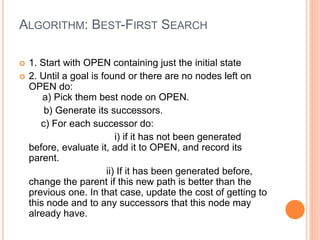
ALGORITHM: BEST-FIRST SEARCH
 1. Start with OPEN containing just the initial state
 2. Until a goal is found or there are no nodes left on
OPEN do:
a) Pick them best node on OPEN.
b) Generate its successors.
c) For each successor do:
i) if it has not been generated
before, evaluate it, add it to OPEN, and record its
parent.
ii) If it has been generated before,
change the parent if this new path is better than the
previous one. In that case, update the cost of getting to
this node and to any successors that this node may
already have.
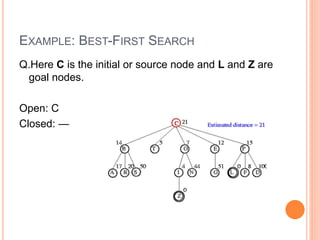
EXAMPLE: BEST-FIRST SEARCH
Q.Here C is the initial or source node and L and Z are
goal nodes.
Open: C
Closed: —
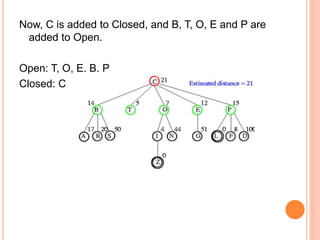
Now, C is added to Closed, and B, T, O, E and P are
added to Open.
Open: T, O, E, B, P
Closed: C
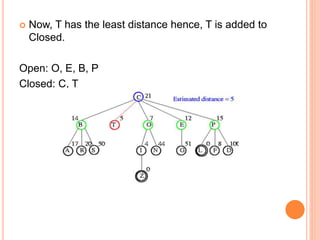
 Now, T has the least distance hence, T is added to
Closed.
Open: O, E, B, P
Closed: C, T
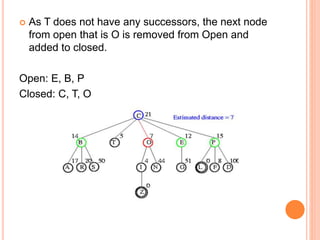
 As T does not have any successors, the next node
from open that is O is removed from Open and
added to closed.
Open: E, B, P
Closed: C, T, O
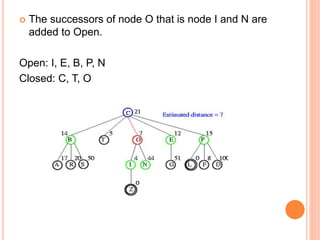
 The successors of node O that is node I and N are
added to Open.
Open: I, E, B, P, N
Closed: C, T, O
 Now, node I is removed from Open and added to
closed.
Open: E, B, P, N
Closed: C, T, O, I
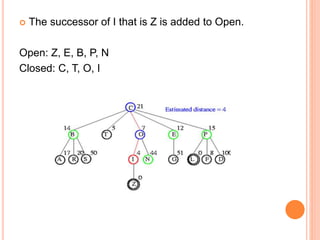
 The successor of I that is Z is added to Open.
Open: Z, E, B, P, N
Closed: C, T, O, I
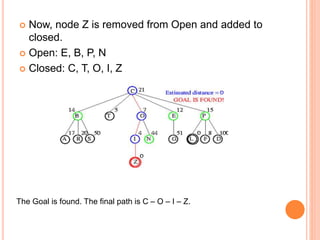
 Now, node Z is removed from Open and added to
closed.
 Open: E, B, P, N
 Closed: C, T, O, I, Z
The Goal is found. The final path is C – O – I – Z.
CONCLUSION
1. Can switch between BFS and DFS, thus gaining
the advantages of both.
2. More efficient when compared to DFS.
REFERENCES
https://www.tutorialspoint.com/best-first-search-
informed-search
https://www.geeksforgeeks.org/best-first-search-
informed-search/
https://www.javatpoint.com/ai-informed-search-
algorithms
THANK YOU

Best First Search.pptx

  • 1.
    GOVERNMENT COLLEGE OFENGINEERING & TEXTILE TECHNOLOGY, SERAMPORE NAME-MUKTARUL HOQUE STREAM-INFORMATION TECHNOLOGY ROLL-11000220015 SUBJECT-ARTIFICIAL INTELLIGENCE
  • 2.
    BEST FIRST SEARCHALGORITHM Guided By Mr. Biplab Mahapatra(State Aided College Teacher,IT Depaerment) Defination: Best first search is a traversal technique that decides which node is to be visited next by checking which node is the most promising one and then check it. For this it uses an evaluation function to decide the traversal. This best first search technique of tree traversal comes under the category of heuristic search or informed search technique. The cost of nodes is stored in a priority queue. This makes implementation of best-first search is same as that of breadth First search. We will use the priorityqueue just like we use a queue for BFS
  • 3.
    PROCESS We have studiedtwo uninformed search algorithms such as Breadth First search (BFS) and Depth First search(DFS) Algorithm. DFS is good because it allows a solution to be found without all competing branches having to be expanded BFS is good because it does not get branches on dead-end paths One way of combining the two is to follow a single path at a time, but switch paths whenever some competing path looks more promising than the current one does.
  • 4.
    At each stepof the BFS search process, we select the most promising of the nodes we have generated so far . This is done by applying an appropriate heuristic function to each of them. We then expand the chosen node by using the rules to generate its successors It proceeds in steps, expanding one node at each step until it generates a node that corresponds to a goal state.
  • 5.
    At each step,it picks the most promising of the nodes that have so far been generated but not expanded. It generates the successors of the chosen node, applies the heuristic function to them, and adds them to the list of open nodes, after checking to see if any of them have been generated before.
  • 6.
    ALGORITHM: BEST-FIRST SEARCH 1. Start with OPEN containing just the initial state  2. Until a goal is found or there are no nodes left on OPEN do: a) Pick them best node on OPEN. b) Generate its successors. c) For each successor do: i) if it has not been generated before, evaluate it, add it to OPEN, and record its parent. ii) If it has been generated before, change the parent if this new path is better than the previous one. In that case, update the cost of getting to this node and to any successors that this node may already have.
  • 7.
    EXAMPLE: BEST-FIRST SEARCH Q.HereC is the initial or source node and L and Z are goal nodes. Open: C Closed: —
  • 8.
    Now, C isadded to Closed, and B, T, O, E and P are added to Open. Open: T, O, E, B, P Closed: C
  • 9.
     Now, Thas the least distance hence, T is added to Closed. Open: O, E, B, P Closed: C, T
  • 10.
     As Tdoes not have any successors, the next node from open that is O is removed from Open and added to closed. Open: E, B, P Closed: C, T, O
  • 11.
     The successorsof node O that is node I and N are added to Open. Open: I, E, B, P, N Closed: C, T, O
  • 12.
     Now, nodeI is removed from Open and added to closed. Open: E, B, P, N Closed: C, T, O, I
  • 13.
     The successorof I that is Z is added to Open. Open: Z, E, B, P, N Closed: C, T, O, I
  • 14.
     Now, nodeZ is removed from Open and added to closed.  Open: E, B, P, N  Closed: C, T, O, I, Z The Goal is found. The final path is C – O – I – Z.
  • 15.
    CONCLUSION 1. Can switchbetween BFS and DFS, thus gaining the advantages of both. 2. More efficient when compared to DFS.
  • 16.
  • 17.