Learning Sparse Neural Networks using
L0 Regularization
- Varun Reddy G
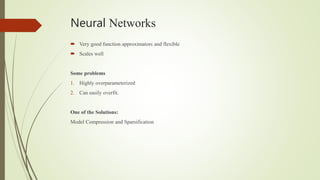
Neural Networks
 Very good function approximators and flexible
 Scales well
Some problems
1. Highly overparameterized
2. Can easily overfit.
One of the Solutions:
Model Compression and Sparsification
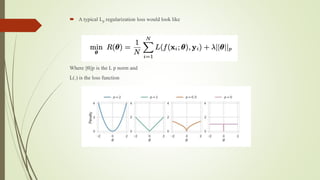
 A typical Lp regularization loss would look like
Where ||θ||p is the L p norm and
L(.) is the loss function
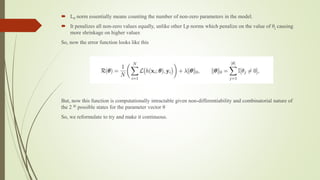
 L0 norm essentially means counting the number of non-zero parameters in the model.
 It penalizes all non-zero values equally, unlike other Lp norms which penalize on the value of θj causing
more shrinkage on higher values
So, now the error function looks like this
But, now this function is computationally intractable given non-differentiability and combinatorial nature of
the 2 |θ| possible states for the parameter vector θ
So, we reformulate to try and make it continuous.
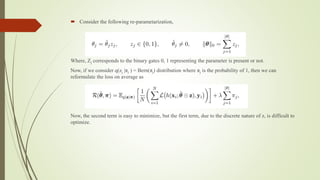
 Consider the following re-parametarization,
Where, Zj corresponds to the binary gates 0, 1 representing the parameter is present or not.
Now, if we consider q(zj |πj ) = Bern(πj) distribution where πj is the probability of 1, then we can
reformulate the loss on average as
Now, the second term is easy to minimize, but the first term, due to the discrete nature of z, is difficult to
optimize.
Let s be a continuous random variable with a distribution q(s) and let the z’s be given by a hard-sigmoid
rectification of s
Hard-sigmoid
f(.) = min(1, max(0, .))
So, now z is given by
z = min(1, max(0, s))
This is equivalent to
z =
0 𝑖𝑓 𝑠 ≤ 0
1 𝑖𝑓 𝑠 ≥ 1
𝑠 𝑖𝑓 0 < 𝑠 < 1
So, if we look at the loss function, we have to penalize all the non-zero θ, so, the second term is
essentially the probability of s < 0, which is given out by the CDF Q(s)
Substituting these
 Our loss function becomes
where g(s) is our hard-sigmoid function.
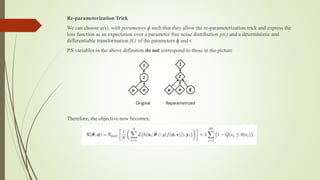
Re-parameterization Trick
We can choose q(s), with parameters ɸ such that they allow the re-parameterization trick and express the
loss function as an expectation over a parameter free noise distribution p(ϵ) and a deterministic and
differentiable transformation f(.) of the parameters ɸ and ϵ
P.S variables in the above definition do not correspond to those in the picture
Therefore, the objective now becomes,
Choosing the q(s)
We are free to choose the q(s) and something that worked well in practice is a binary concrete random
variable distributed in (0, 1) with probability density qs (s| ɸ) and cumulative density Qs (s | ɸ).
The parameters of this distribution are ɸ = (log ⍺, β) where, log ⍺ is location and β is temperature.
We stretch this distribution to an interval (ɣ, 𝛿) such that ɣ < 0 and 𝛿 > 0 and apply hard-sigmoid on its
random samples
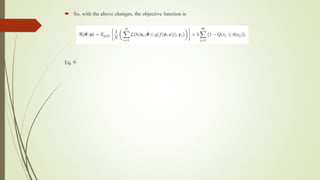
 So, with the above changes, the objective function is
Eq. 9
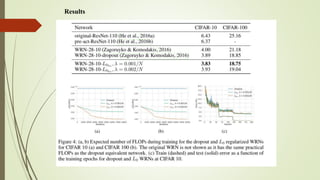
Results
Summary
1. Force the network weights to become absolute 0’s
2. To remove non-differentiability, re-parameterize
3. Now, to make the objective function continuous and to keep the sampling step out of the main network,
use the re-parameterization trick.
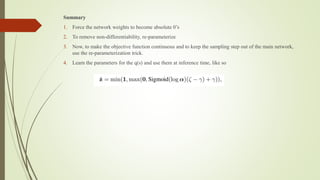
4. Learn the parameters for the q(s) and use them at inference time, like so
Resources
 Numenta Journal Club https://www.youtube.com/watch?v=HD2uvsAEZFM
 Original Paper https://arxiv.org/abs/1712.01312

Learning sparse Neural Networks using L0 Regularization

  • 1.
    Learning Sparse NeuralNetworks using L0 Regularization - Varun Reddy G
  • 2.
    Neural Networks  Verygood function approximators and flexible  Scales well Some problems 1. Highly overparameterized 2. Can easily overfit. One of the Solutions: Model Compression and Sparsification
  • 3.
     A typicalLp regularization loss would look like Where ||θ||p is the L p norm and L(.) is the loss function
  • 4.
     L0 normessentially means counting the number of non-zero parameters in the model.  It penalizes all non-zero values equally, unlike other Lp norms which penalize on the value of θj causing more shrinkage on higher values So, now the error function looks like this But, now this function is computationally intractable given non-differentiability and combinatorial nature of the 2 |θ| possible states for the parameter vector θ So, we reformulate to try and make it continuous.
  • 5.
     Consider thefollowing re-parametarization, Where, Zj corresponds to the binary gates 0, 1 representing the parameter is present or not. Now, if we consider q(zj |πj ) = Bern(πj) distribution where πj is the probability of 1, then we can reformulate the loss on average as Now, the second term is easy to minimize, but the first term, due to the discrete nature of z, is difficult to optimize.
  • 6.
    Let s bea continuous random variable with a distribution q(s) and let the z’s be given by a hard-sigmoid rectification of s Hard-sigmoid f(.) = min(1, max(0, .)) So, now z is given by z = min(1, max(0, s)) This is equivalent to z = 0 𝑖𝑓 𝑠 ≤ 0 1 𝑖𝑓 𝑠 ≥ 1 𝑠 𝑖𝑓 0 < 𝑠 < 1 So, if we look at the loss function, we have to penalize all the non-zero θ, so, the second term is essentially the probability of s < 0, which is given out by the CDF Q(s) Substituting these
  • 7.
     Our lossfunction becomes where g(s) is our hard-sigmoid function.
  • 8.
    Re-parameterization Trick We canchoose q(s), with parameters ɸ such that they allow the re-parameterization trick and express the loss function as an expectation over a parameter free noise distribution p(ϵ) and a deterministic and differentiable transformation f(.) of the parameters ɸ and ϵ P.S variables in the above definition do not correspond to those in the picture Therefore, the objective now becomes,
  • 9.
    Choosing the q(s) Weare free to choose the q(s) and something that worked well in practice is a binary concrete random variable distributed in (0, 1) with probability density qs (s| ɸ) and cumulative density Qs (s | ɸ). The parameters of this distribution are ɸ = (log ⍺, β) where, log ⍺ is location and β is temperature. We stretch this distribution to an interval (ɣ, 𝛿) such that ɣ < 0 and 𝛿 > 0 and apply hard-sigmoid on its random samples
  • 10.
     So, withthe above changes, the objective function is Eq. 9
  • 11.
  • 12.
    Summary 1. Force thenetwork weights to become absolute 0’s 2. To remove non-differentiability, re-parameterize 3. Now, to make the objective function continuous and to keep the sampling step out of the main network, use the re-parameterization trick. 4. Learn the parameters for the q(s) and use them at inference time, like so
  • 13.
    Resources  Numenta JournalClub https://www.youtube.com/watch?v=HD2uvsAEZFM  Original Paper https://arxiv.org/abs/1712.01312