Dynamics of Fluid Flow in Open Channel
Flow: Concept of open channel, Chezy’s and
Manning’s equations for open channel and their
application.
1
Fluid Mechanics
Dr. Mohsin Siddique
Assistant Professor
Outcome of Today’s Lecture
2
After completing this lecture…
The students should be able to:
Understand the concepts and basic equations used in open
channel flow
Determine the velocity and discharge using Chezy’s and
Manning’s equation
Understand the concept of most economical sections
Open Channel Flow
3
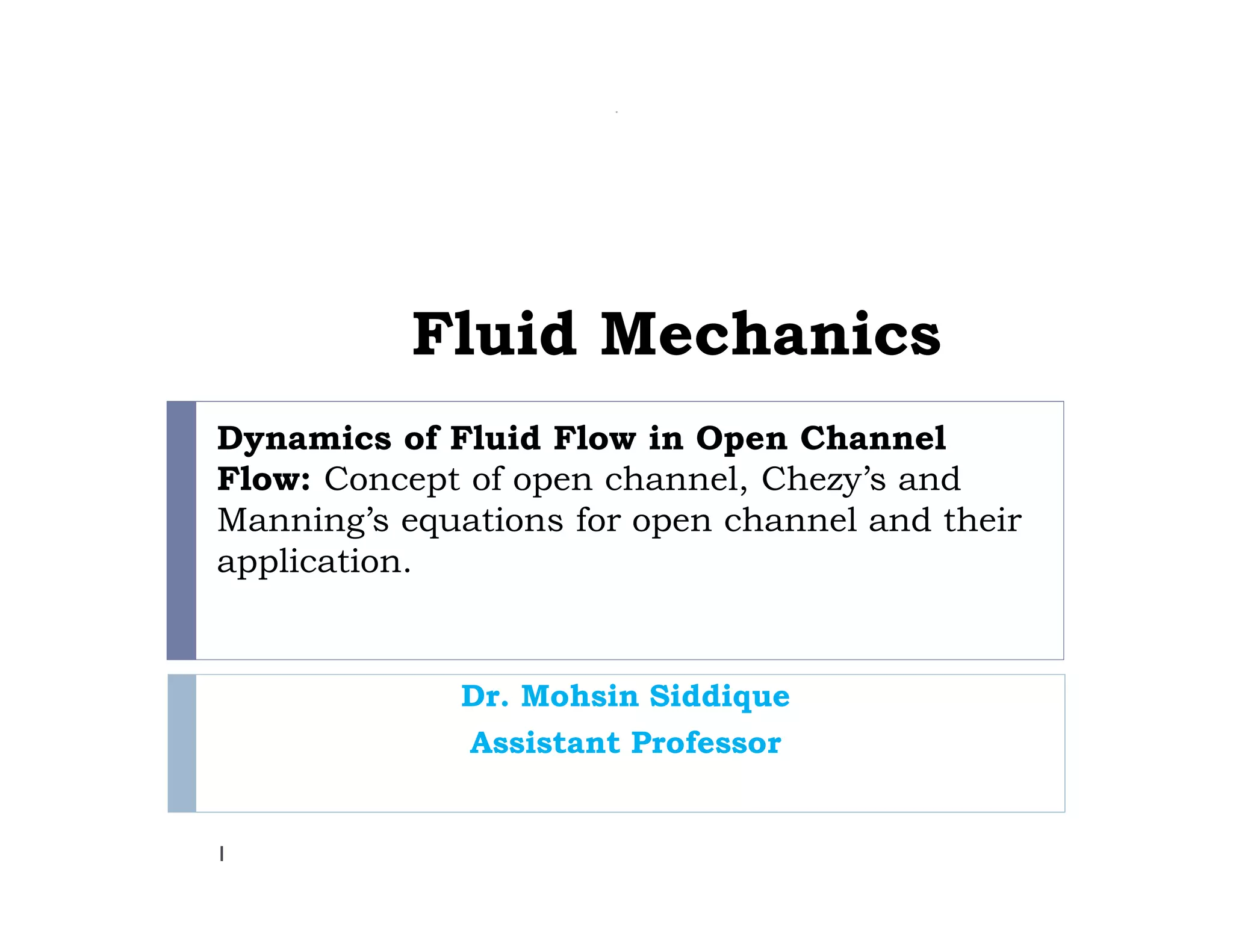
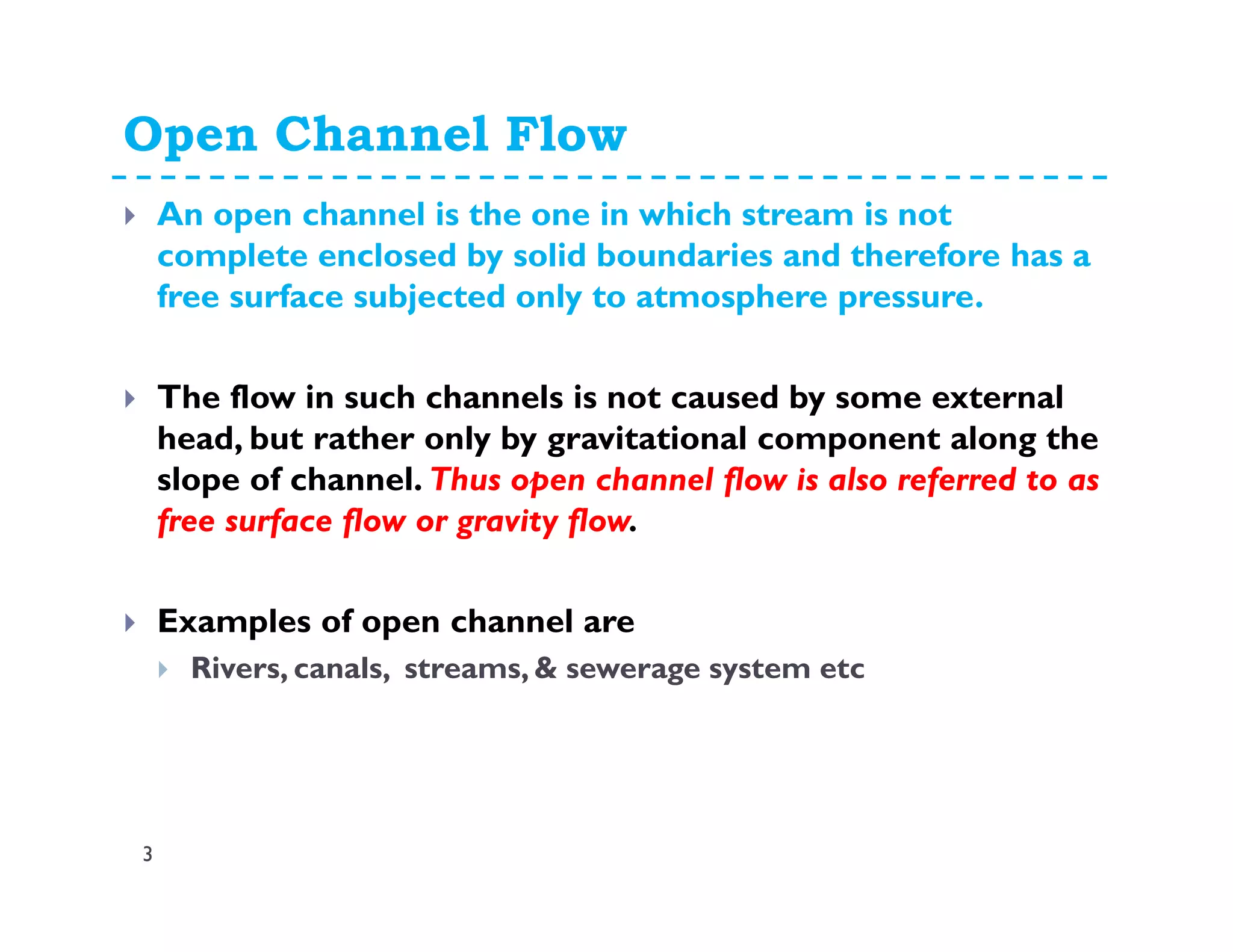
An open channel is the one in which stream is not
complete enclosed by solid boundaries and therefore has a
free surface subjected only to atmosphere pressure.
The flow in such channels is not caused by some external
head, but rather only by gravitational component along the
slope of channel. Thus open channel flow is also referred to as
free surface flow or gravity flow.
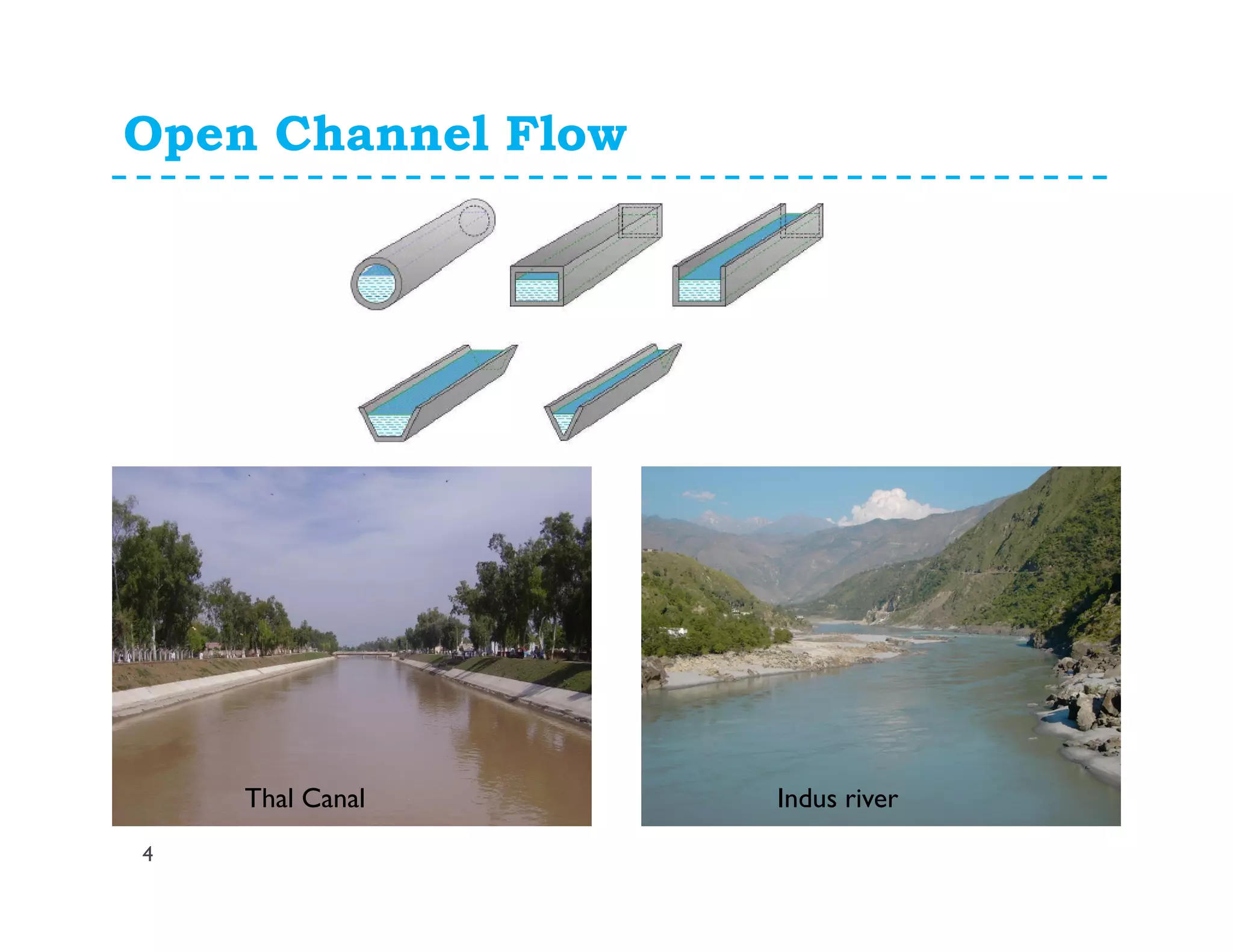
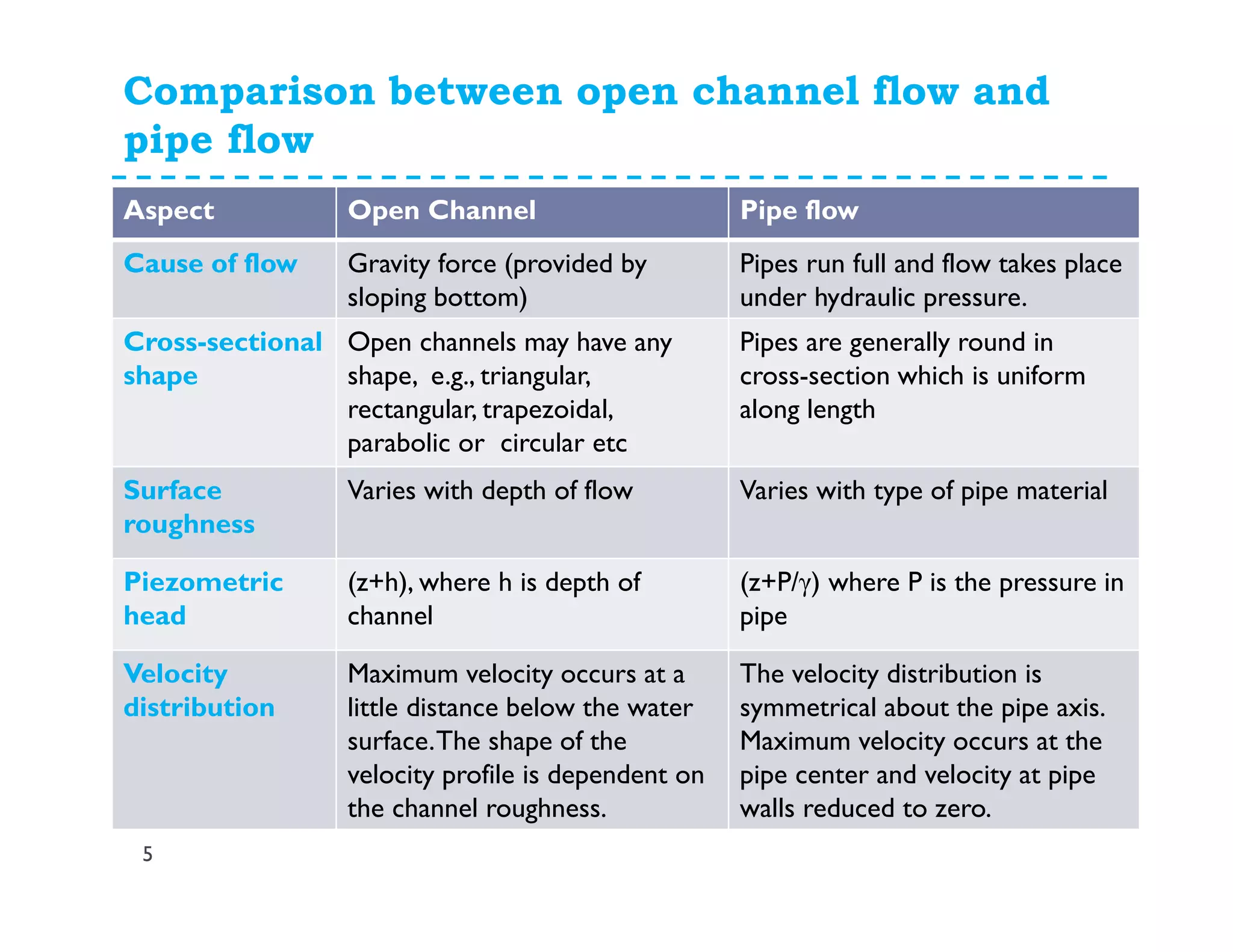
Examples of open channel are
Rivers, canals, streams, & sewerage system etc
Open Channel Flow
4
Thal Canal Indus river
Comparison between open channel flow and
pipe flow
5
Aspect Open Channel Pipe flow
Cause of flow Gravity force (provided by
sloping bottom)
Pipes run full and flow takes place
under hydraulic pressure.
Cross-sectional
shape
Open channels may have any
shape, e.g., triangular,
rectangular, trapezoidal,
parabolic or circular etc
Pipes are generally round in
cross-section which is uniform
along length
Surface
roughness
Varies with depth of flow Varies with type of pipe material
Piezometric
head
(z+h), where h is depth of
channel
(z+P/γ) where P is the pressure in
pipe
Velocity
distribution
Maximum velocity occurs at a
little distance below the water
surface.The shape of the
velocity profile is dependent on
the channel roughness.
The velocity distribution is
symmetrical about the pipe axis.
Maximum velocity occurs at the
pipe center and velocity at pipe
walls reduced to zero.
Types of Channels
6
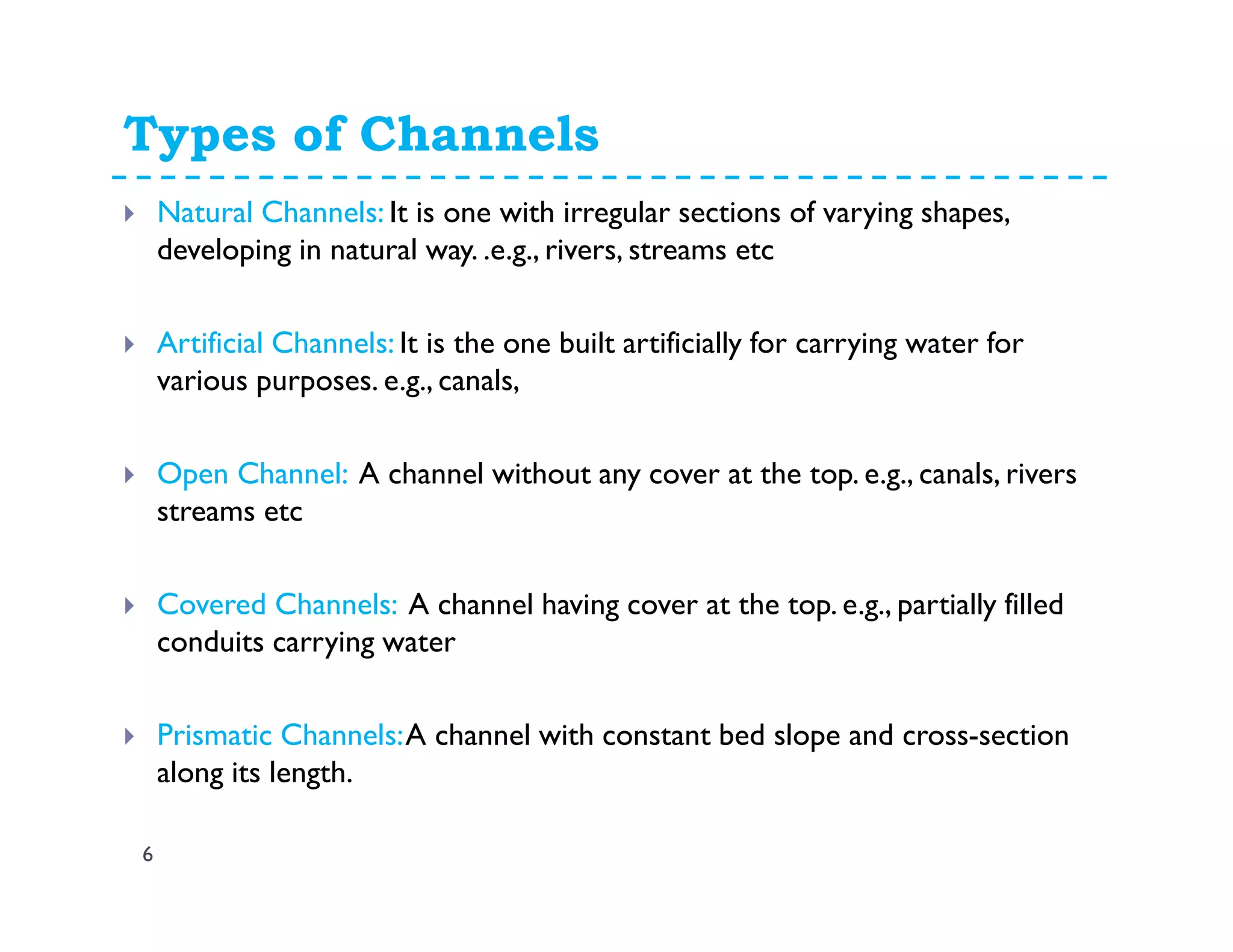
Natural Channels: It is one with irregular sections of varying shapes,
developing in natural way. .e.g., rivers, streams etc
Artificial Channels: It is the one built artificially for carrying water for
various purposes. e.g., canals,
Open Channel: A channel without any cover at the top. e.g., canals, rivers
streams etc
Covered Channels: A channel having cover at the top. e.g., partially filled
conduits carrying water
Prismatic Channels:A channel with constant bed slope and cross-section
along its length.
Types of flow in open channels
7
Steady and unsteady flow
Uniform and non-uniform flow
Laminar andTurbulent flow
Subcritical, critical and supercritical flow
Same definition
with pipe flows
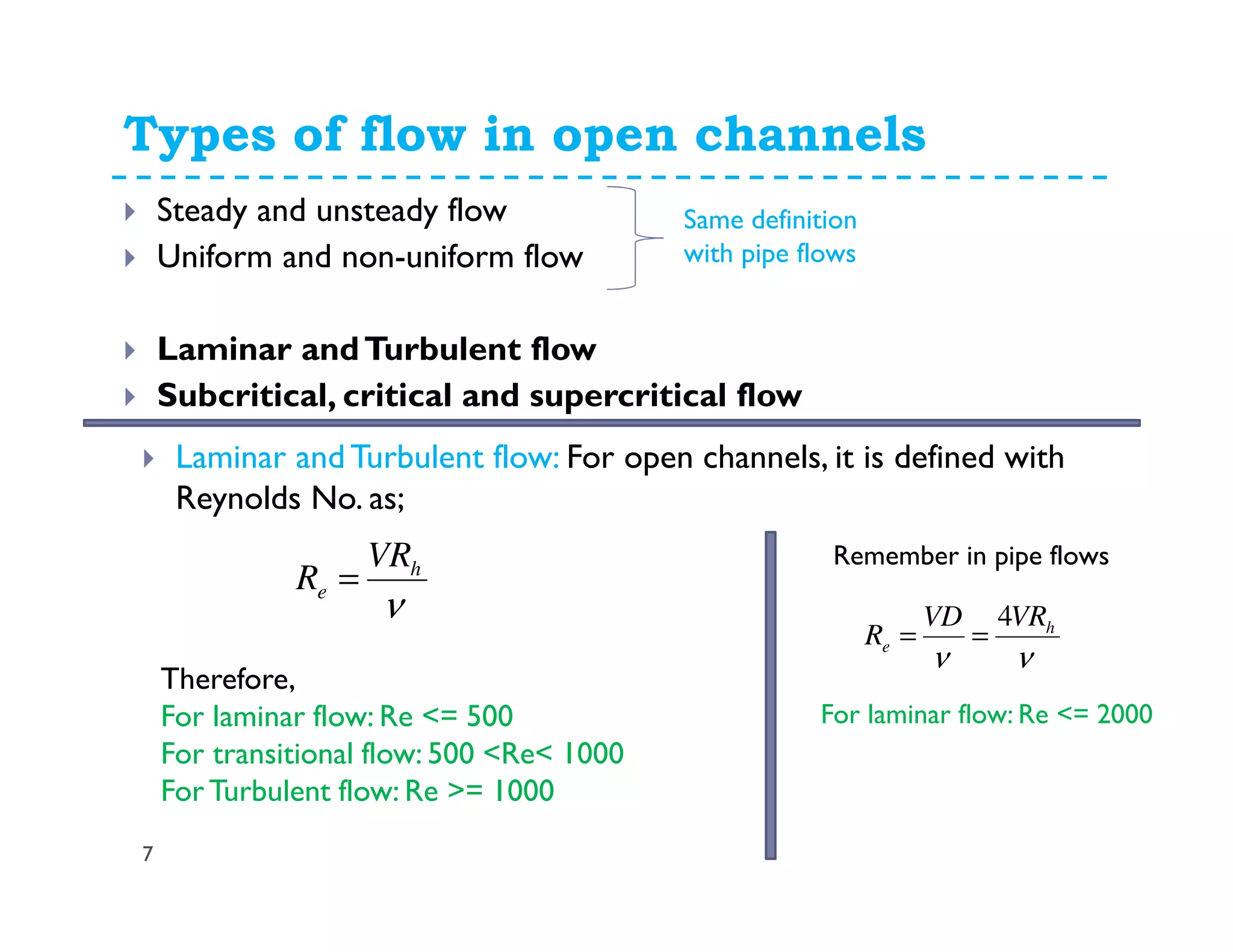
Laminar and Turbulent flow: For open channels, it is defined with
Reynolds No. as;
ν
h
e
VR
R =
νν
h
e
VRVD
R
4
==
Remember in pipe flows
Therefore,
For laminar flow: Re <= 500
For transitional flow: 500 <Re< 1000
ForTurbulent flow: Re >= 1000
For laminar flow: Re <= 2000
Types of flow in open channels
8
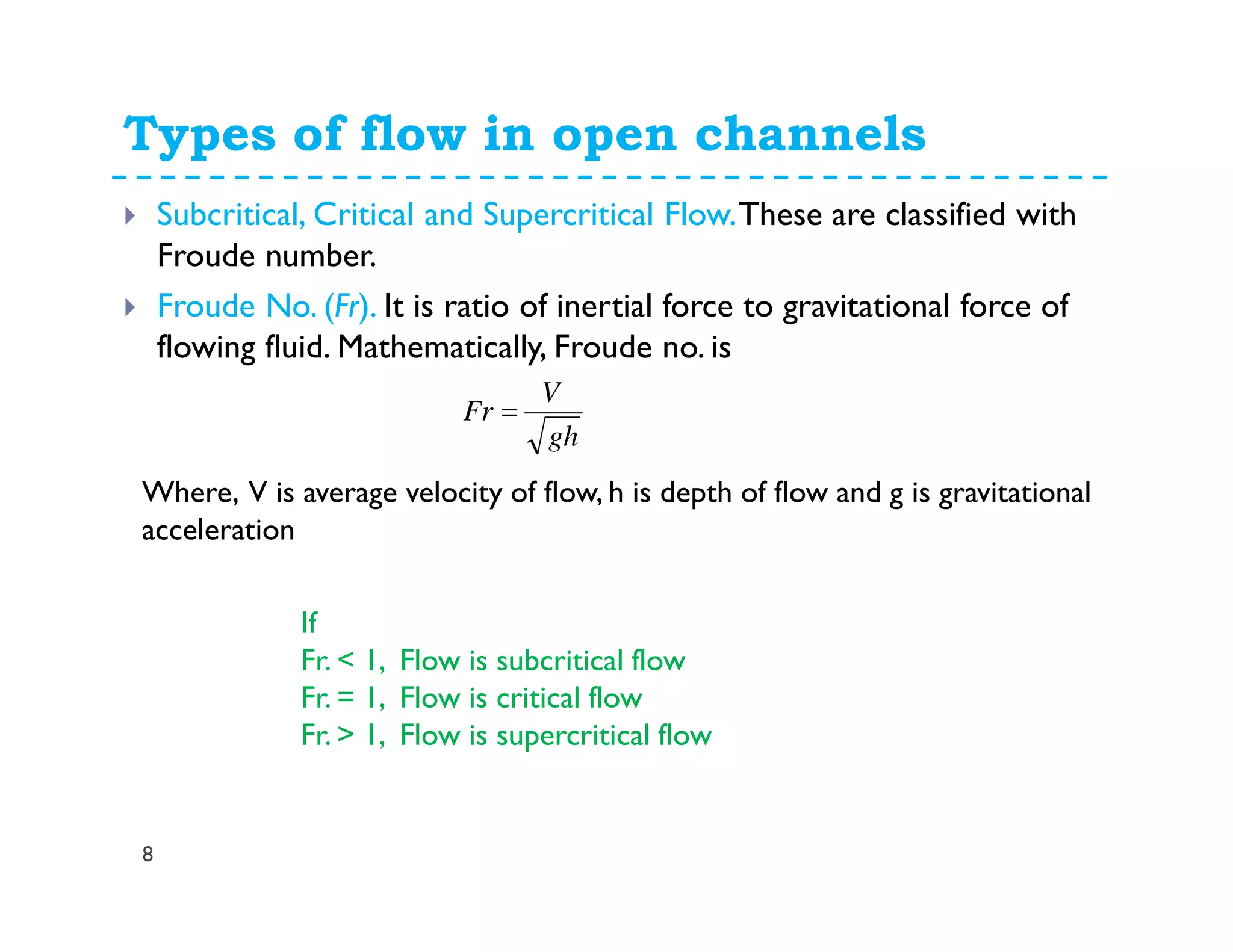
Subcritical, Critical and Supercritical Flow.These are classified with
Froude number.
Froude No. (Fr). It is ratio of inertial force to gravitational force of
flowing fluid. Mathematically, Froude no. is
If
Fr. < 1, Flow is subcritical flow
Fr. = 1, Flow is critical flow
Fr. > 1, Flow is supercritical flow
gh
V
Fr =
Where, V is average velocity of flow, h is depth of flow and g is gravitational
acceleration
Definitions
9
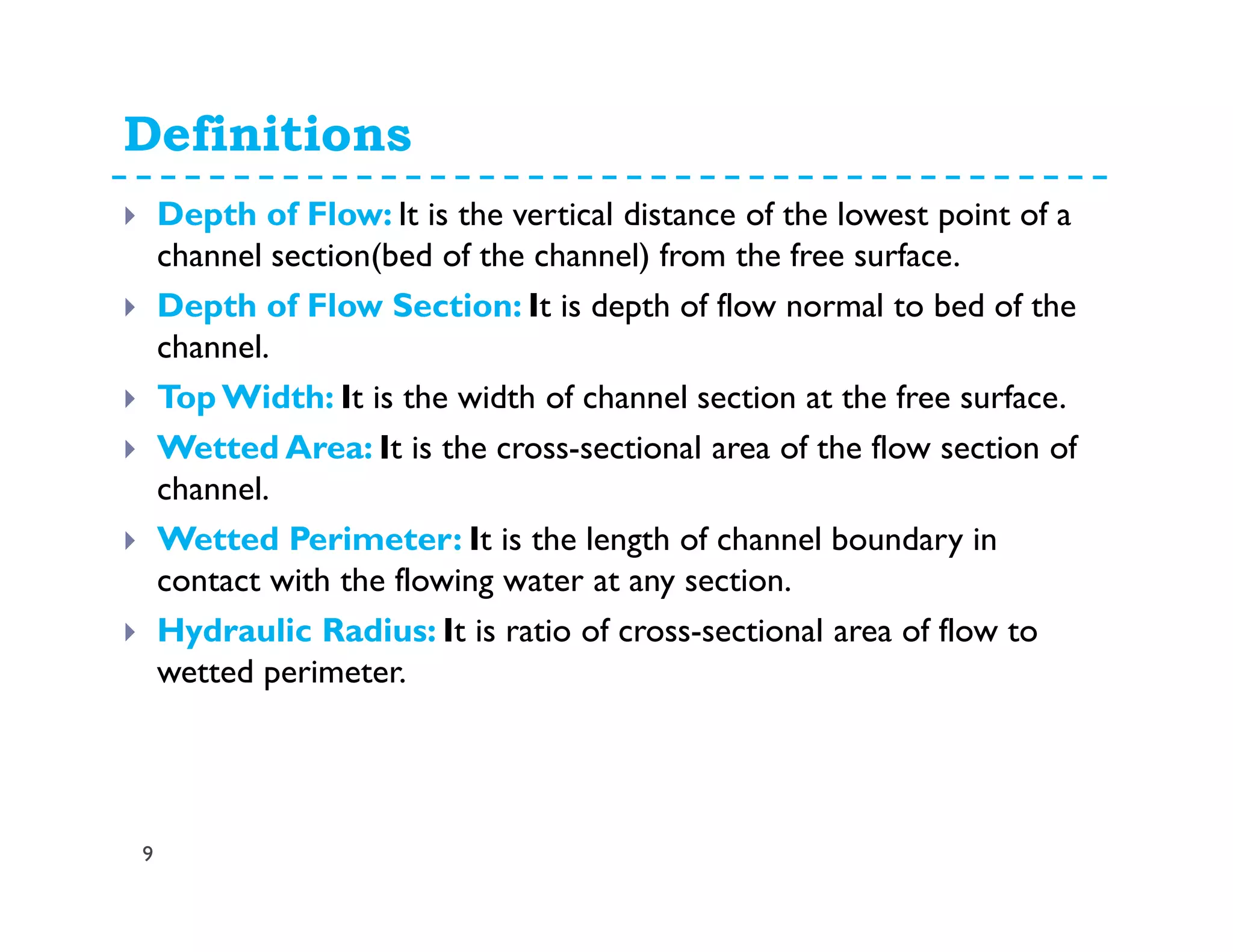
Depth of Flow: It is the vertical distance of the lowest point of a
channel section(bed of the channel) from the free surface.
Depth of Flow Section: It is depth of flow normal to bed of the
channel.
Top Width: It is the width of channel section at the free surface.
Wetted Area: It is the cross-sectional area of the flow section of
channel.
Wetted Perimeter: It is the length of channel boundary in
contact with the flowing water at any section.
Hydraulic Radius: It is ratio of cross-sectional area of flow to
wetted perimeter.
Open channel formulae for uniform flow
10
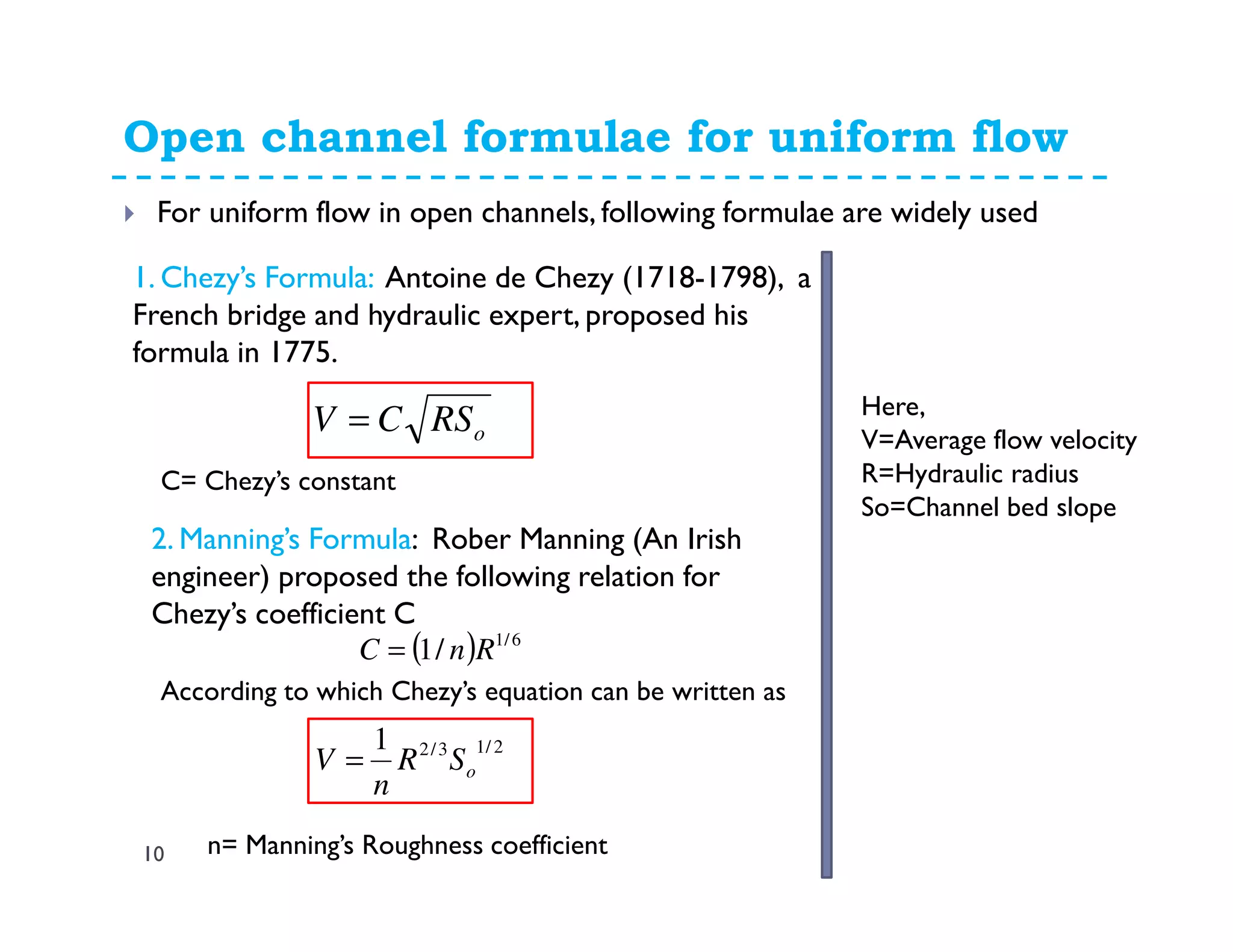
For uniform flow in open channels, following formulae are widely used
oRSCV =
2/13/21
oSR
n
V =
Here,
V=Average flow velocity
R=Hydraulic radius
So=Channel bed slope
C= Chezy’s constant
n= Manning’s Roughness coefficient
1. Chezy’s Formula: Antoine de Chezy (1718-1798), a
French bridge and hydraulic expert, proposed his
formula in 1775.
2. Manning’s Formula: Rober Manning (An Irish
engineer) proposed the following relation for
Chezy’s coefficient C
( ) 6/1
/1 RnC =
According to which Chezy’s equation can be written as
Derivation of Chezy’s formula
11
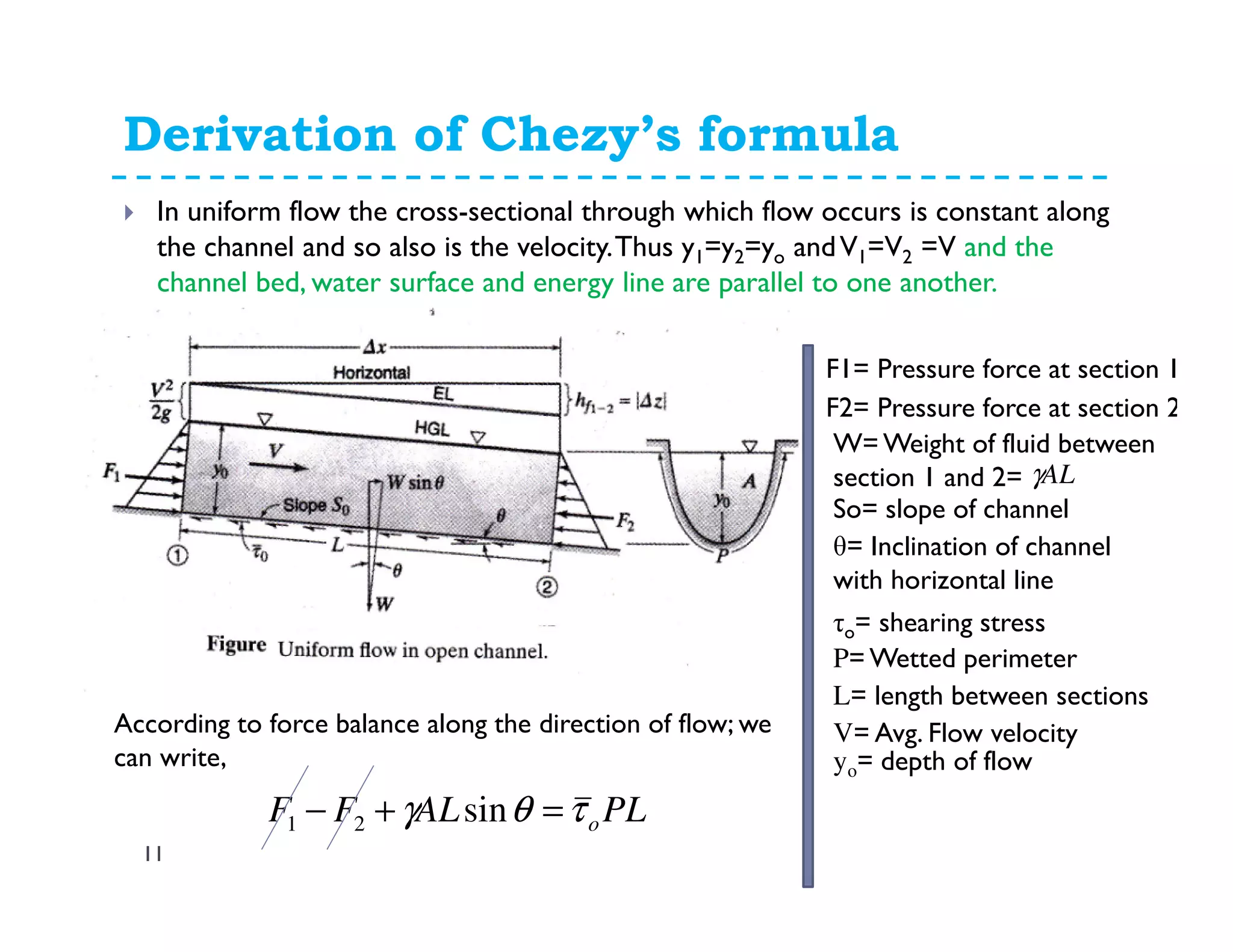
In uniform flow the cross-sectional through which flow occurs is constant along
the channel and so also is the velocity.Thus y1=y2=yo andV1=V2 =V and the
channel bed, water surface and energy line are parallel to one another.
According to force balance along the direction of flow; we
can write,
PLALFF oτθγ =+− sin21
F1= Pressure force at section 1
F2= Pressure force at section 2
W= Weight of fluid between
section 1 and 2=
So= slope of channel
θ= Inclination of channel
with horizontal line
τo= shearing stress
P= Wetted perimeter
L= length between sections
V= Avg. Flow velocity
yo= depth of flow
ALγ
Derivation of Chezy’s formula
12
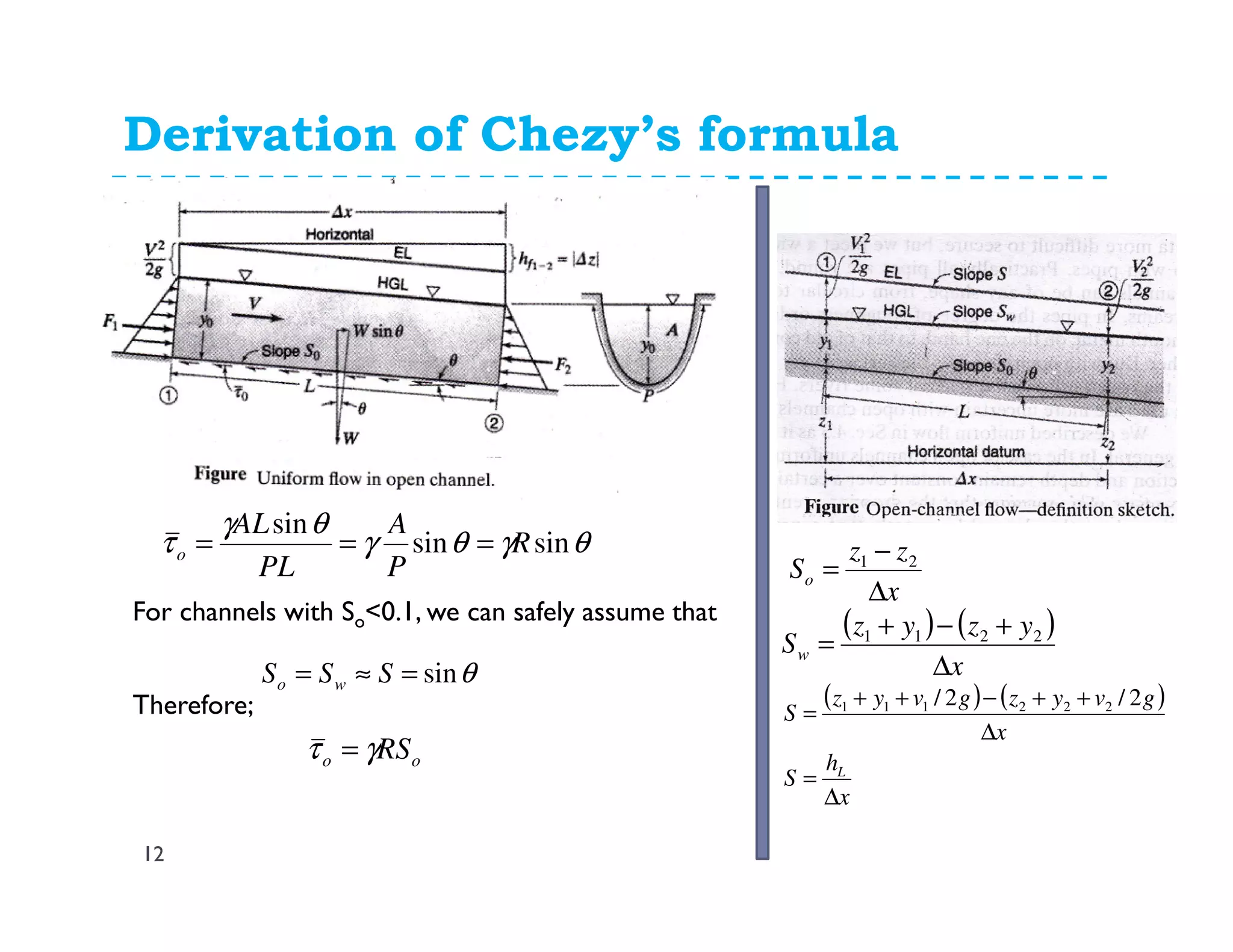
θγθγ
θγ
τ sinsin
sin
R
P
A
PL
AL
o ===
x
zz
So
∆
−
= 21
( ) ( )
x
yzyz
Sw
∆
+−+
= 2211
( ) ( )
x
h
S
x
gvyzgvyz
S
L
∆
=
∆
++−++
=
2/2/ 222111
θsin=≈= SSS wo
For channels with So<0.1, we can safely assume that
oo RSγτ =
Therefore;
Derivation of Chezy’s formula
13
τo (shearing stress) can also be expressed as (already discussed)
2
2
V
Cfo ρτ =
Comparing both equations of τo we get;
o
foo
f
of
RSCV
fCRS
f
g
RS
C
g
V
RS
V
C
=
===
=
4/
82
2
2
Q
γρ
Where C is Chezy’s Constant whose value depend upon the type of
channel surface
f
g
C
8
=Q
Relation b/w f and C
14
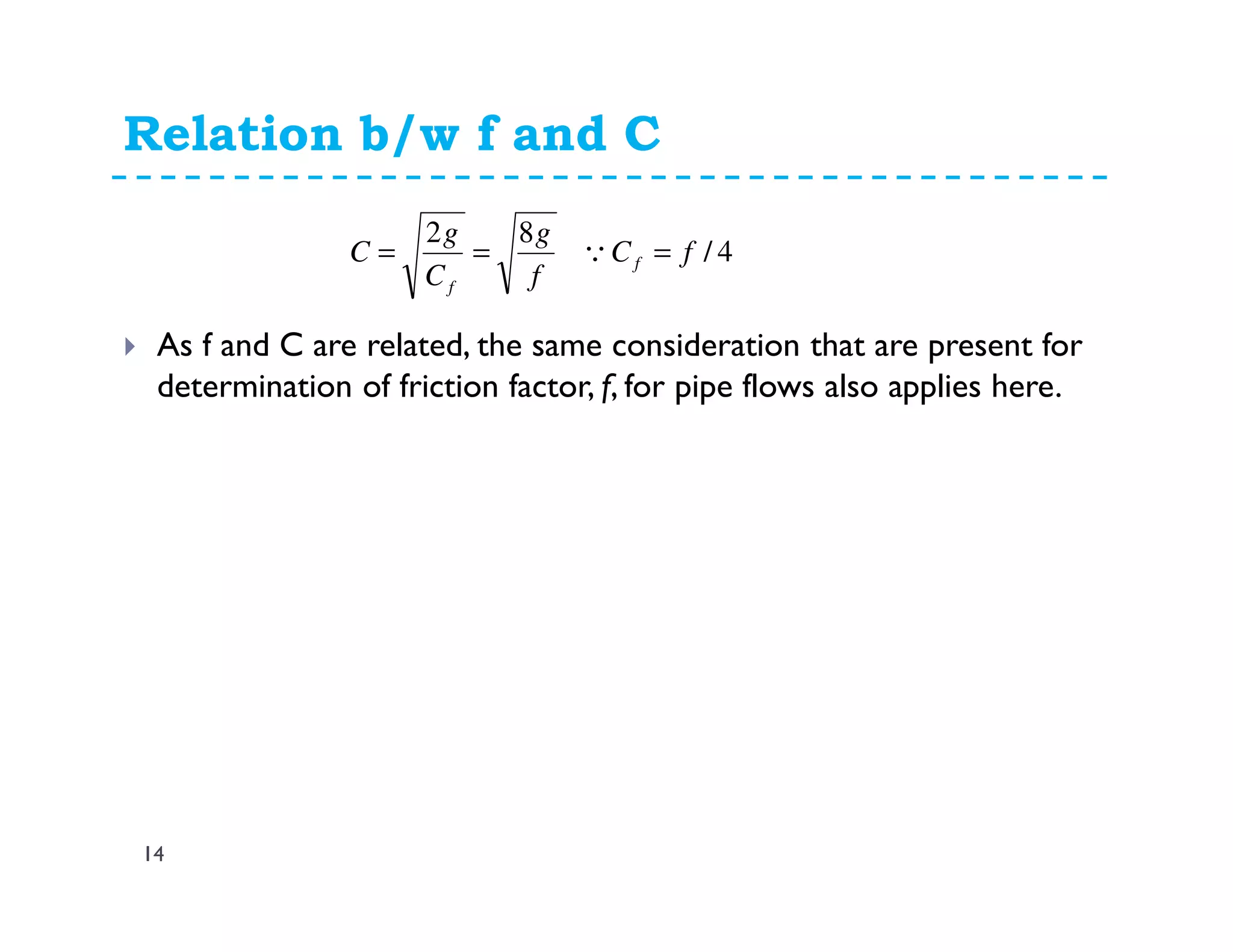
As f and C are related, the same consideration that are present for
determination of friction factor, f, for pipe flows also applies here.
4/
82
fC
f
g
C
g
C f
f
=== Q
Empirical Relations for Chezy’s Constant, C
15
Although Chezy’s equation is quite simple, the selection of a correct value
of C is rather difficult. Some of the important formulae developed for
Chezy’s Constant C are;
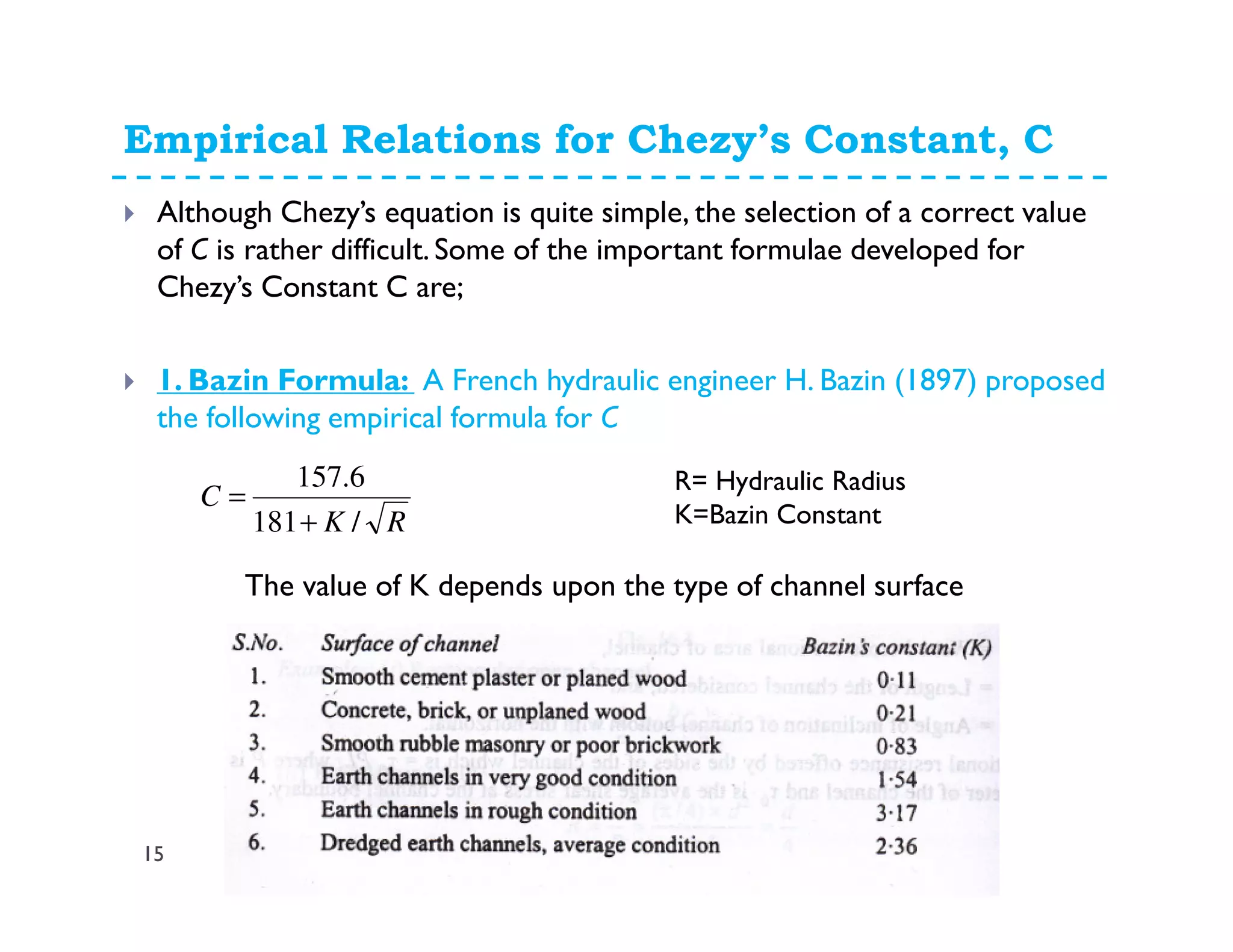
1. Bazin Formula: A French hydraulic engineer H. Bazin (1897) proposed
the following empirical formula for C
RK
C
/181
6.157
+
=
R= Hydraulic Radius
K=Bazin Constant
The value of K depends upon the type of channel surface
Empirical Relations for Chezy’s Constant, C
16
2. Kutter’s Formula: Two Swiss engineers Ganguillet and Kutter
proposed following formula for determination of C
R= Hydraulic Radius
n=Manning’s roughness
coefficient
3. Manning’s Formula: Rober Manning (An Irish engineer) proposed the
following relation for Chezy’s coefficient C
2/13/21
oSR
n
V =
n= Manning’s Roughness coefficient
( ) 6/1
/1 RnC =
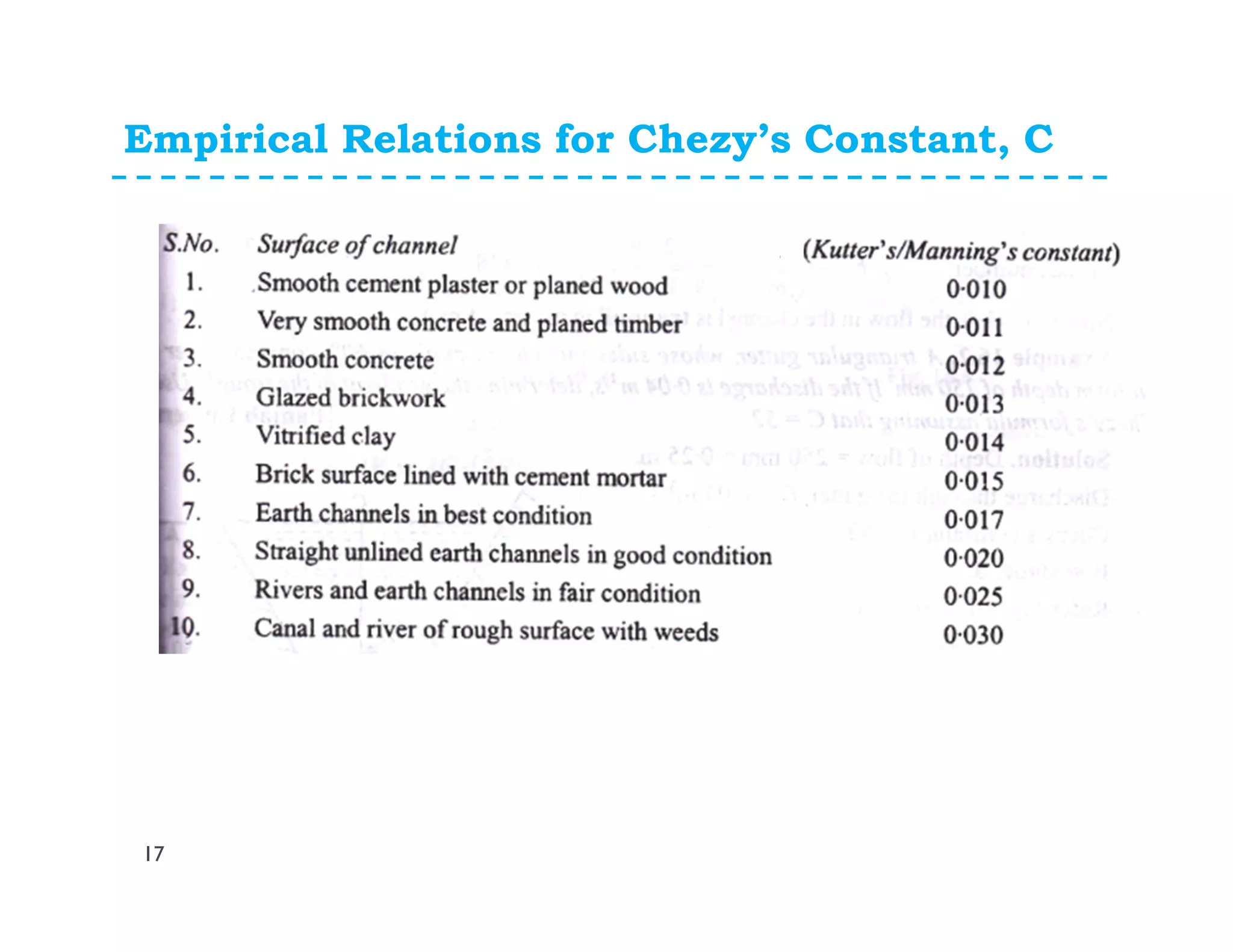
The values of n depends upon nature of channel surface
BG units SI units
Empirical Relations for Chezy’s Constant, C
17
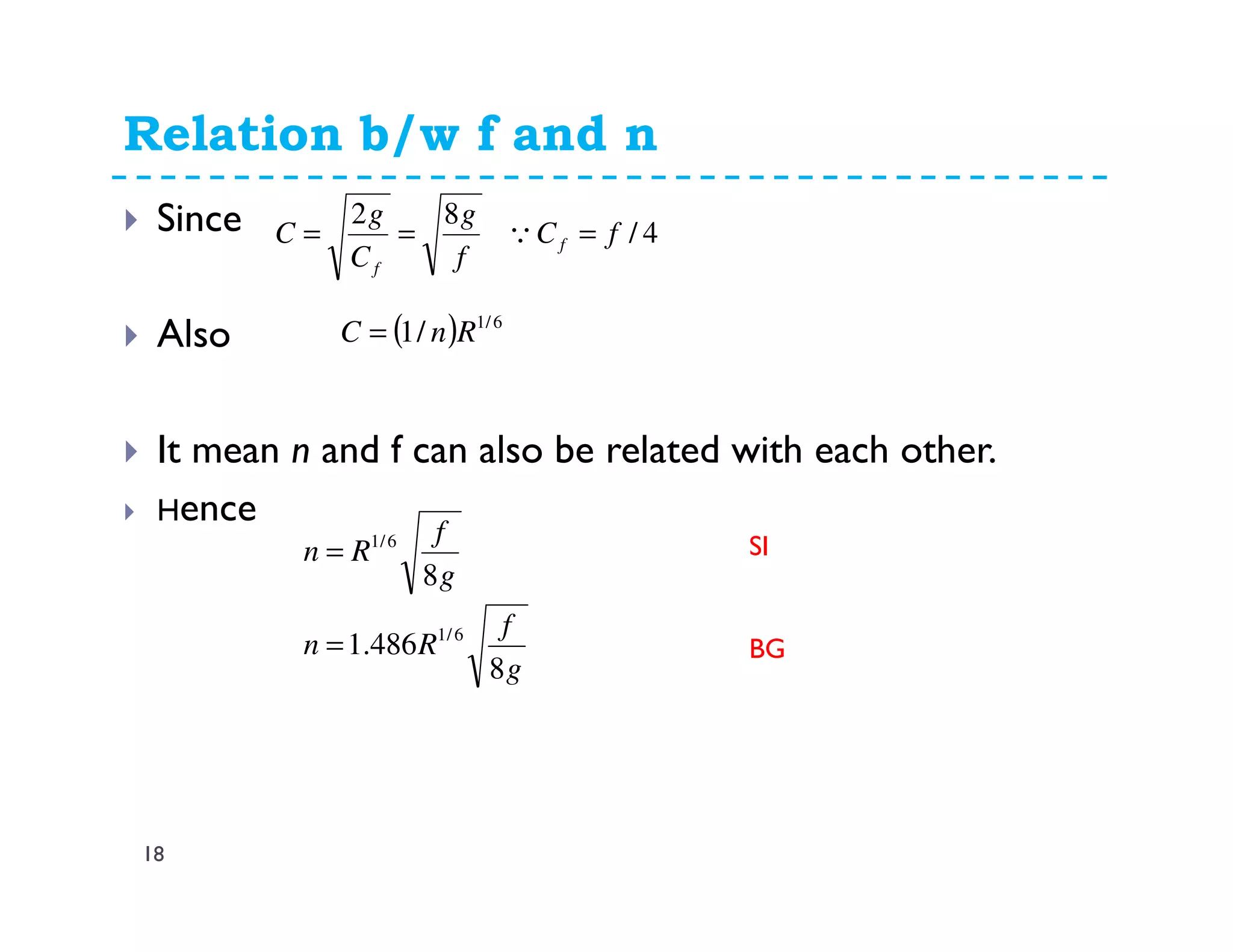
Relation b/w f and n
18
Since
Also
It mean n and f can also be related with each other.
Hence
4/
82
fC
f
g
C
g
C f
f
=== Q
( ) 6/1
/1 RnC =
g
f
Rn
8
486.1 6/1
=
g
f
Rn
8
6/1
= SI
BG
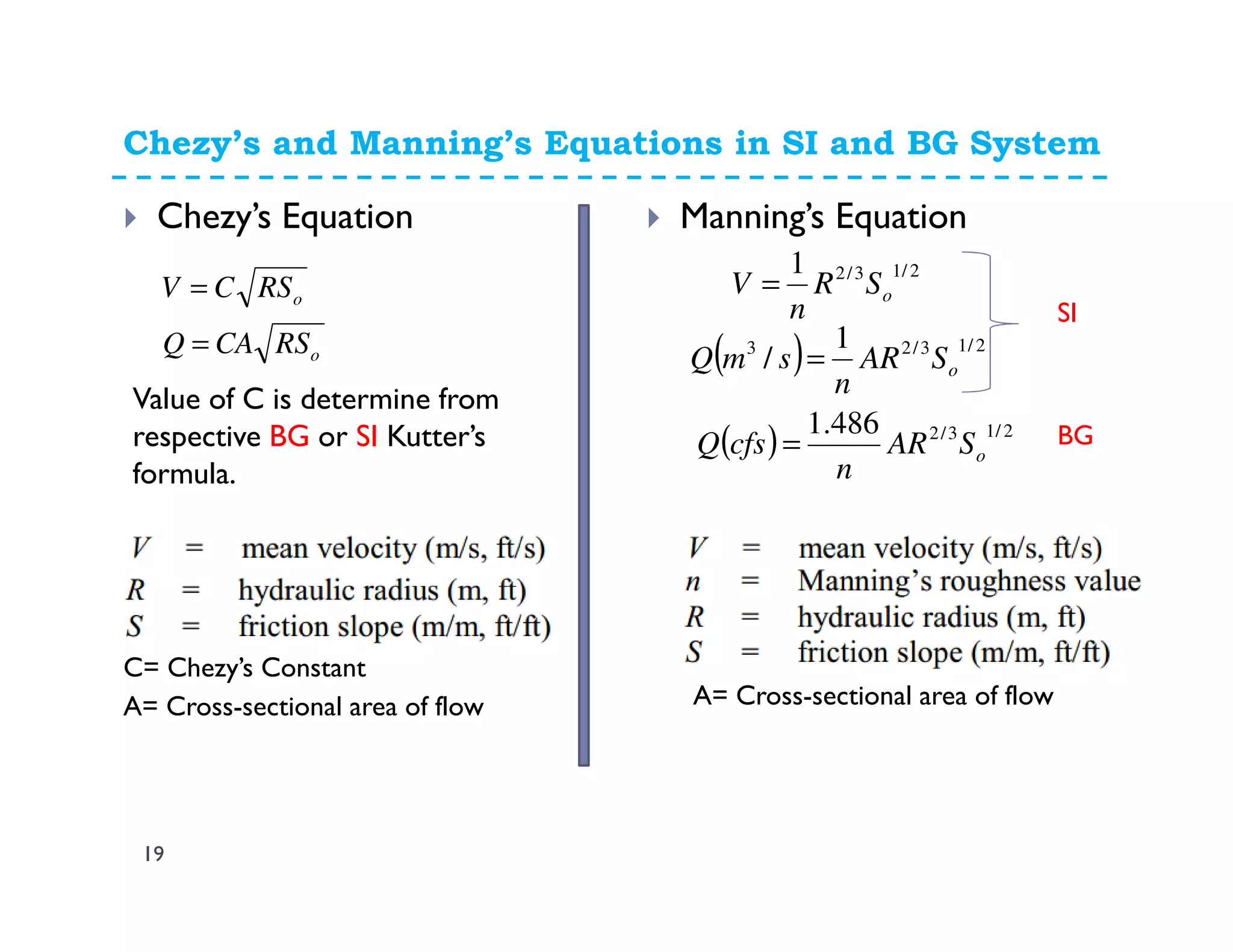
Chezy’s and Manning’s Equations in SI and BG System
19
Chezy’s Equation Manning’s Equation
2/13/21
oSR
n
V =
( ) 2/13/23 1
/ oSAR
n
smQ =
( ) 2/13/2486.1
oSAR
n
cfsQ =
SI
BG
oRSCV =
oRSCAQ =
Value of C is determine from
respective BG or SI Kutter’s
formula.
C= Chezy’s Constant
A= Cross-sectional area of flow A= Cross-sectional area of flow
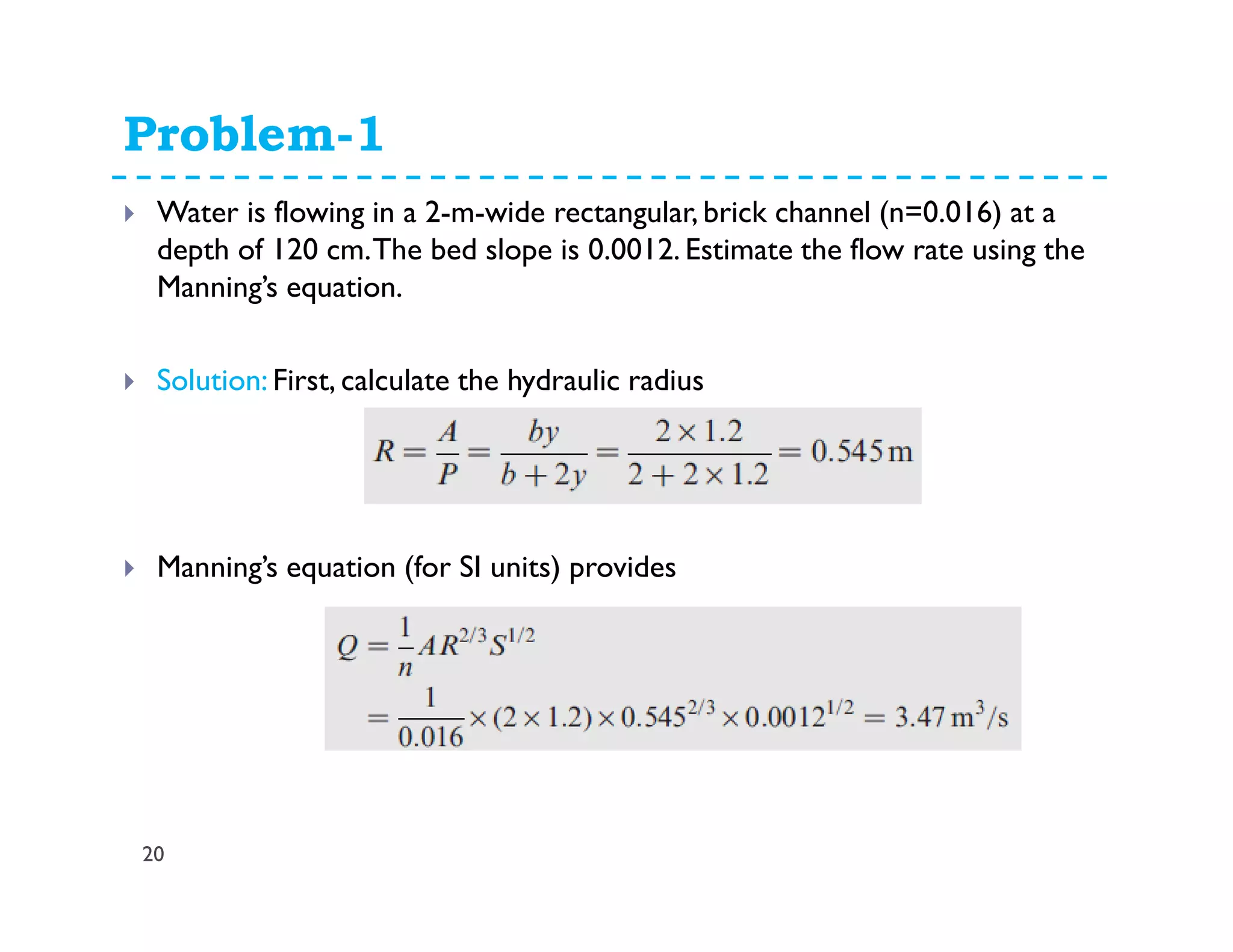
Problem-1
20
Water is flowing in a 2-m-wide rectangular, brick channel (n=0.016) at a
depth of 120 cm.The bed slope is 0.0012. Estimate the flow rate using the
Manning’s equation.
Solution: First, calculate the hydraulic radius
Manning’s equation (for SI units) provides
Problem-2
21
Compute the flow rate for a depth of 2, 4, 6 and 8ft.
( ) 2/13/2486.1
oSAR
n
cfsQ =
For BG units
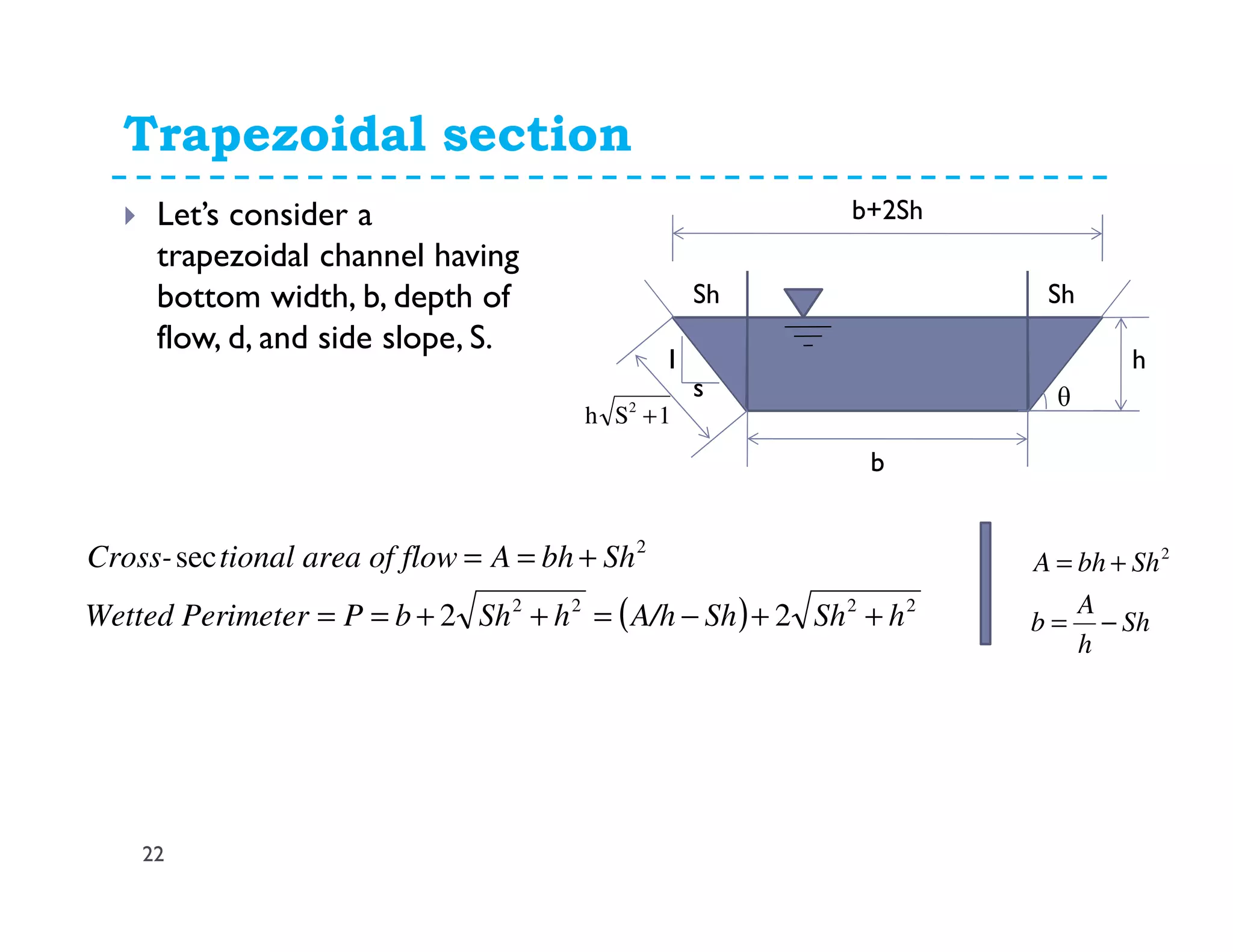
22
Let’s consider a
trapezoidal channel having
bottom width, b, depth of
flow, d, and side slope, S.
Trapezoidal section
h
b
s
Sh Sh
1
( ) 2222
2
22
sec
hShShA/hhShbPimeterWetted Per
ShbhAa of flowtional areCross-
++−=++==
+==
Sh
h
A
b
ShbhA
−=
+= 2
b+2Sh
1Sh 2
+
θ
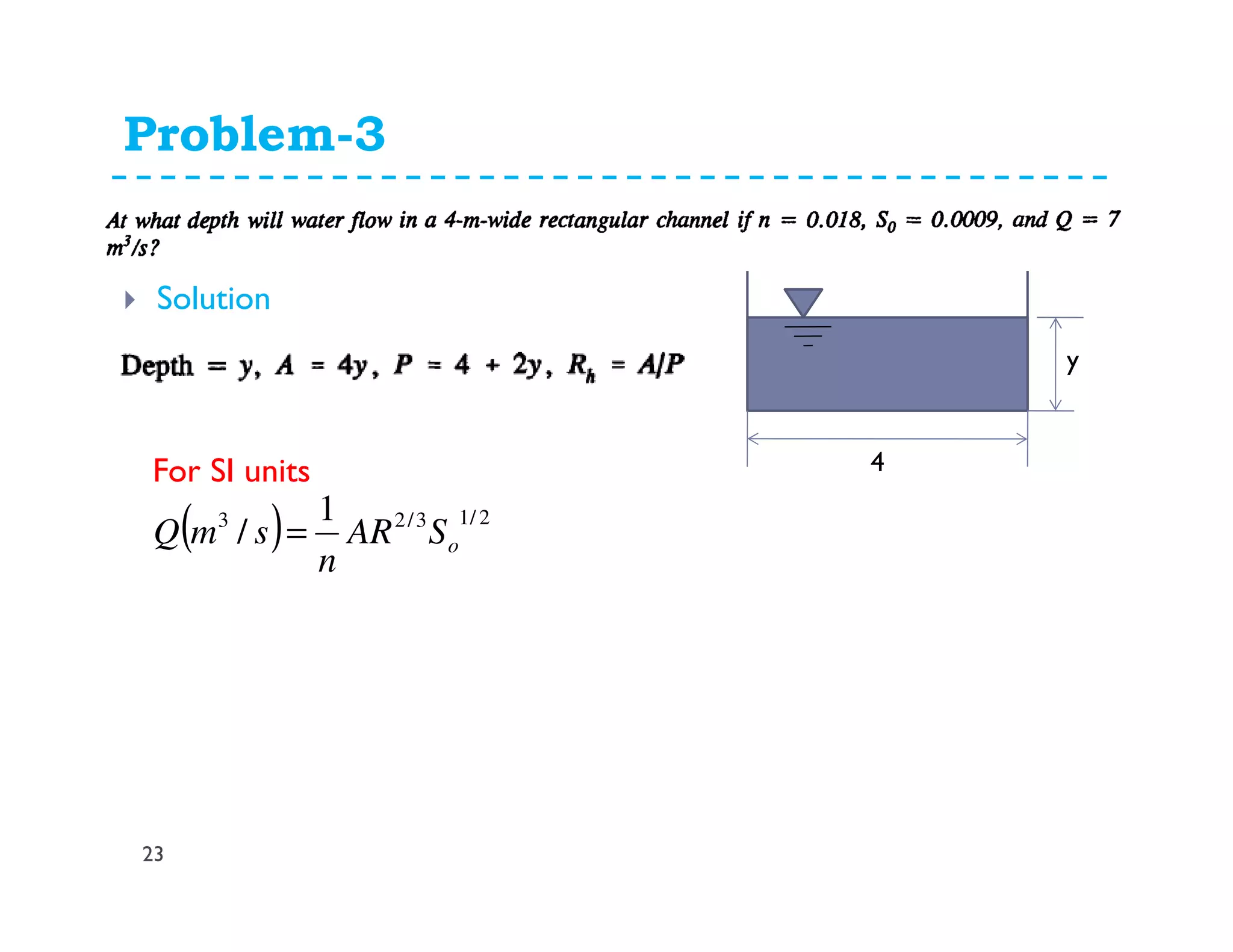
Problem-3
23
Solution
( ) 2/13/23 1
/ oSAR
n
smQ =
For SI units 4
y
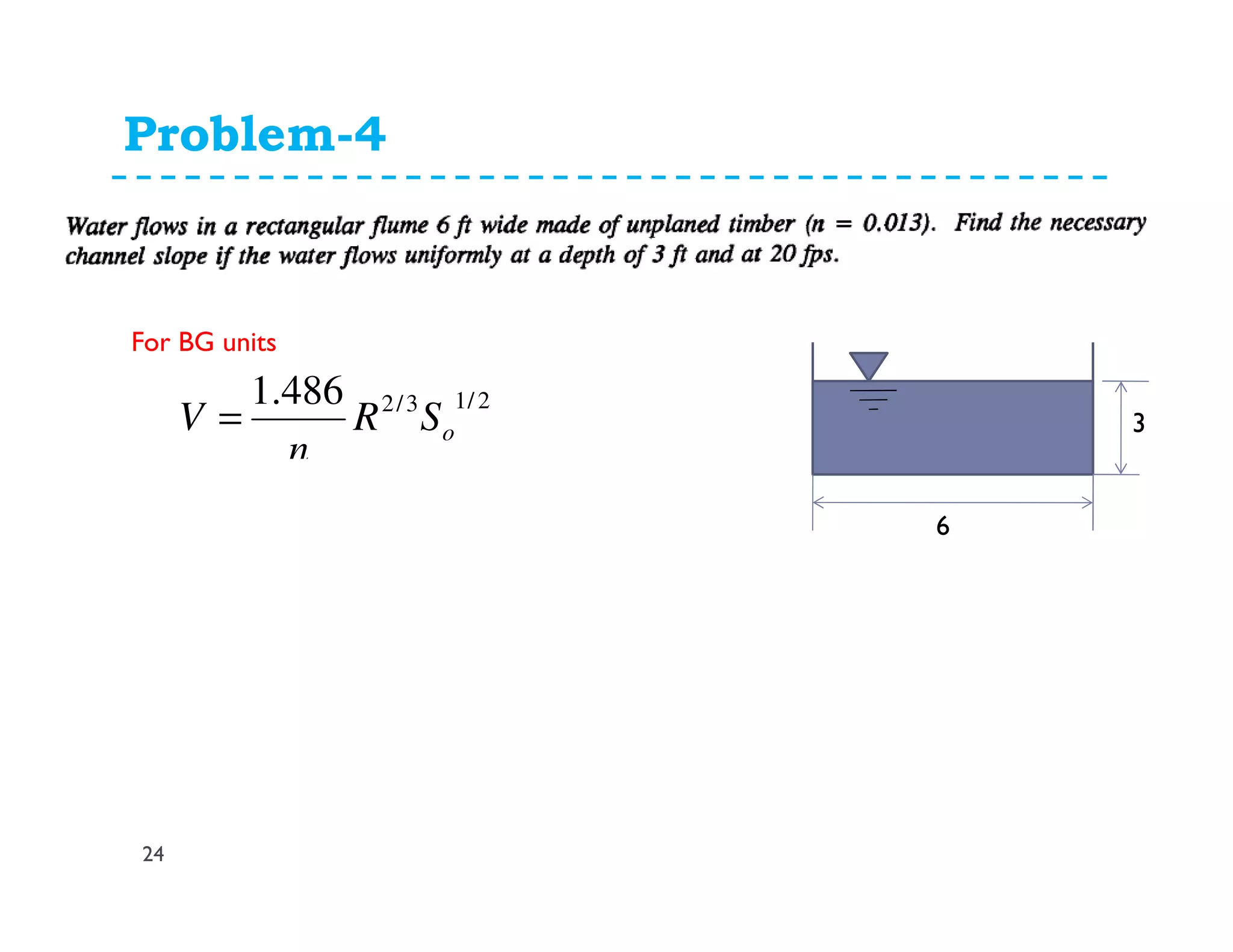
Problem-4
24
2/13/2486.1
oSR
n
V =
For BG units
6
3
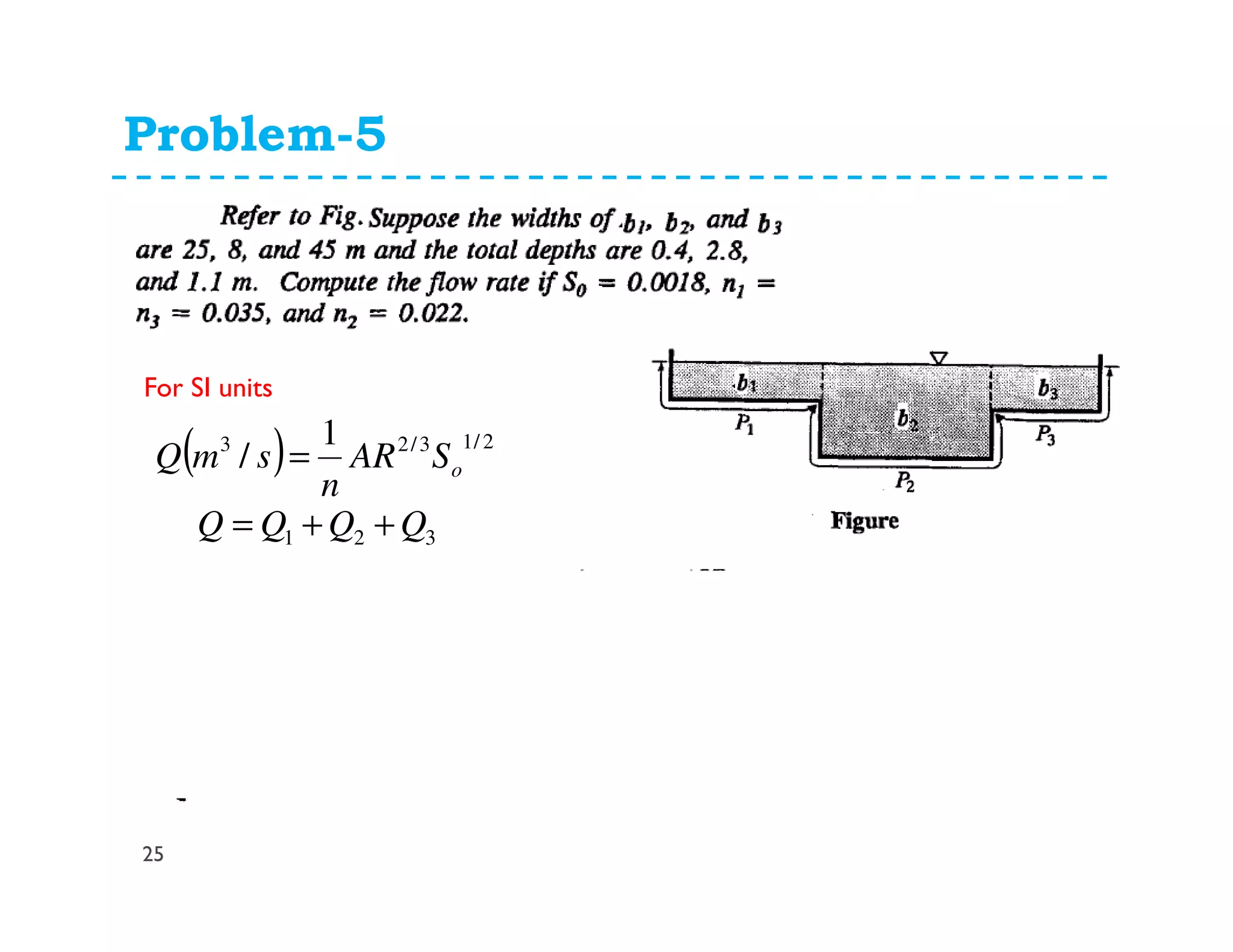
Problem-5
25
( ) 2/13/23 1
/ oSAR
n
smQ =
For SI units
321 QQQQ ++=
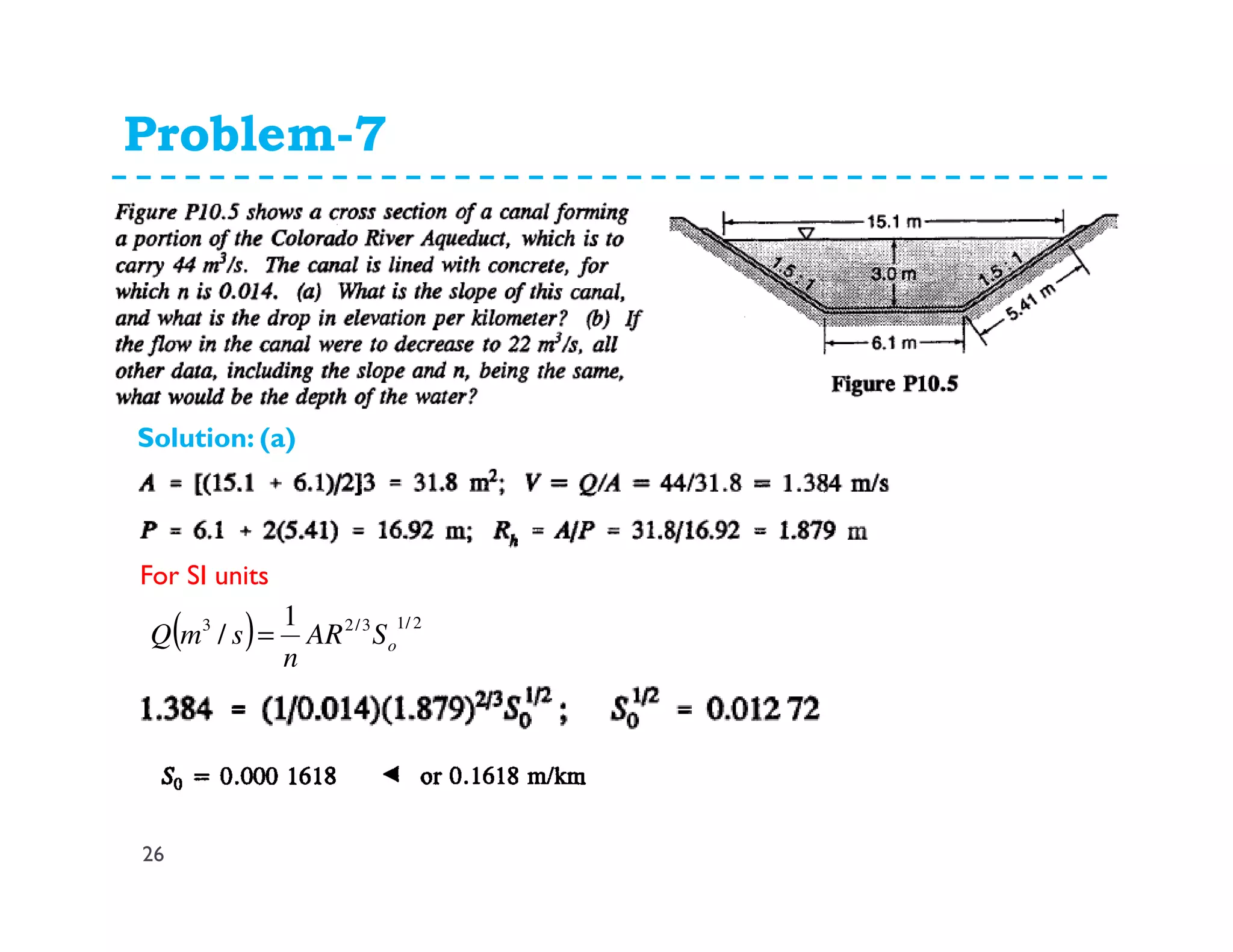
Problem-7
26
( ) 2/13/23 1
/ oSAR
n
smQ =
For SI units
Solution: (a)
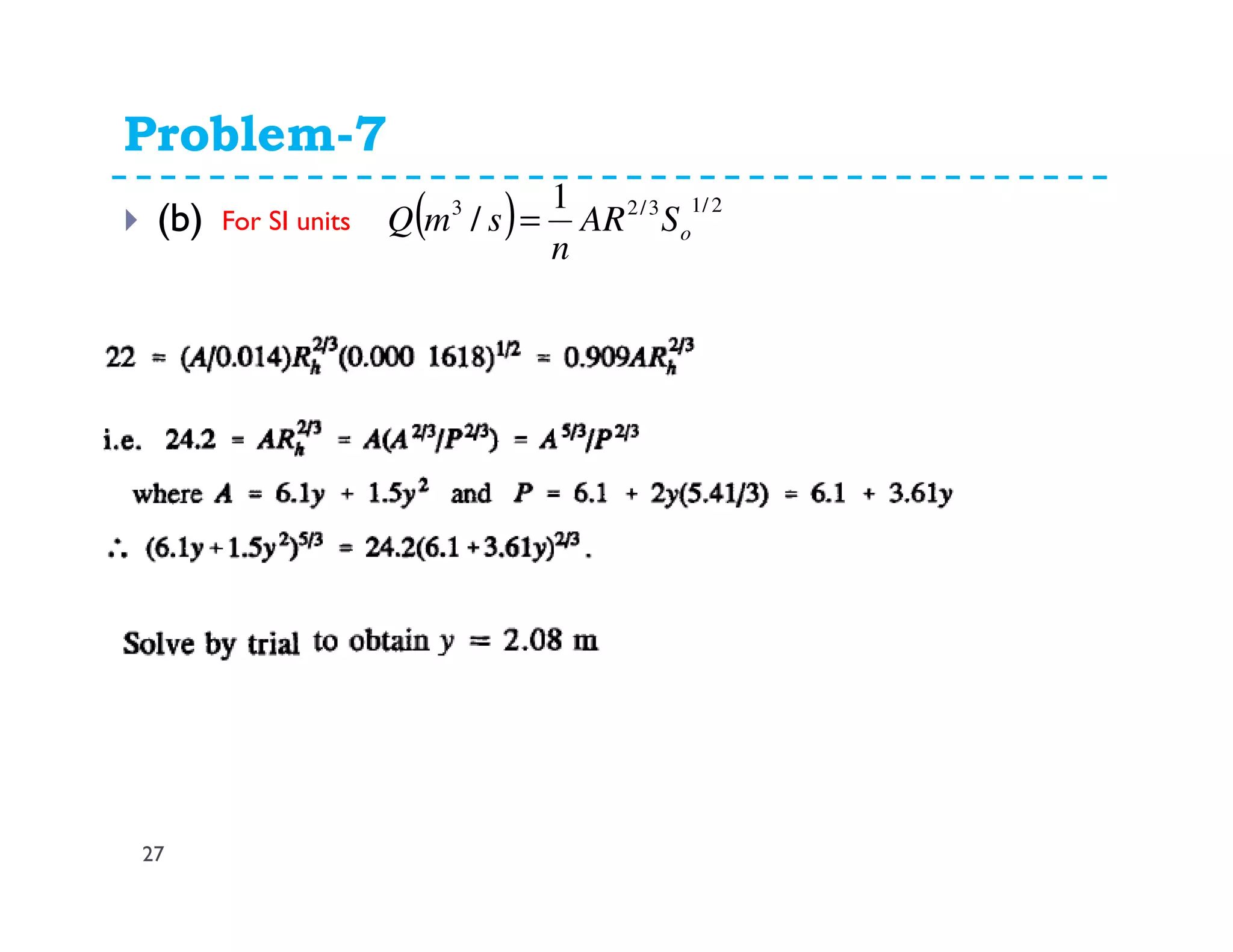
Problem-7
27
(b) ( ) 2/13/23 1
/ oSAR
n
smQ =For SI units
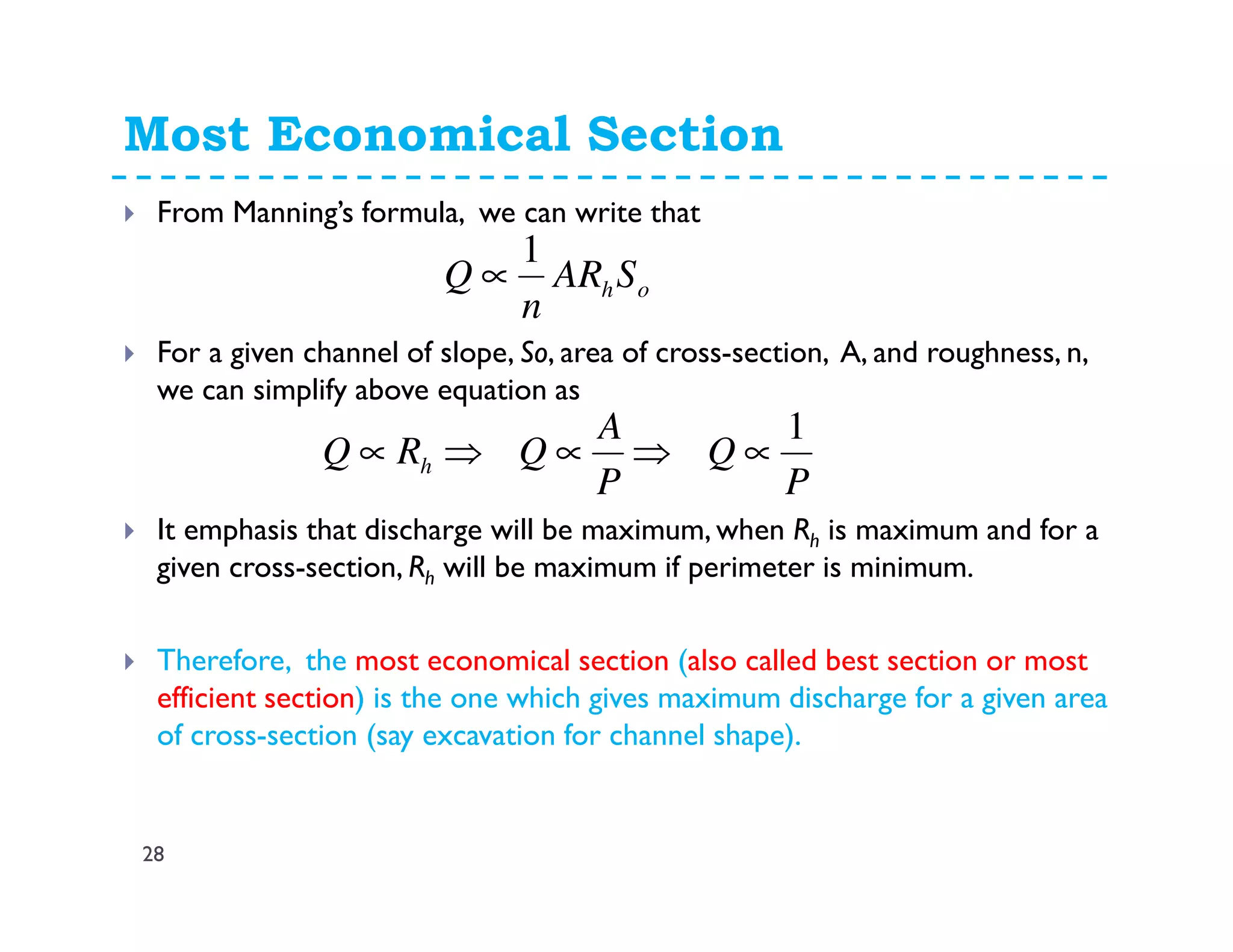
Most Economical Section
28
From Manning’s formula, we can write that
For a given channel of slope, So, area of cross-section, A, and roughness, n,
we can simplify above equation as
It emphasis that discharge will be maximum, when Rh is maximum and for a
given cross-section, Rh will be maximum if perimeter is minimum.
Therefore, the most economical section (also called best section or most
efficient section) is the one which gives maximum discharge for a given area
of cross-section (say excavation for channel shape).
ohSAR
n
Q
1
∝
P
Q
P
A
QRQ h
1
∝⇒∝⇒∝
Most economical rectangular section
29
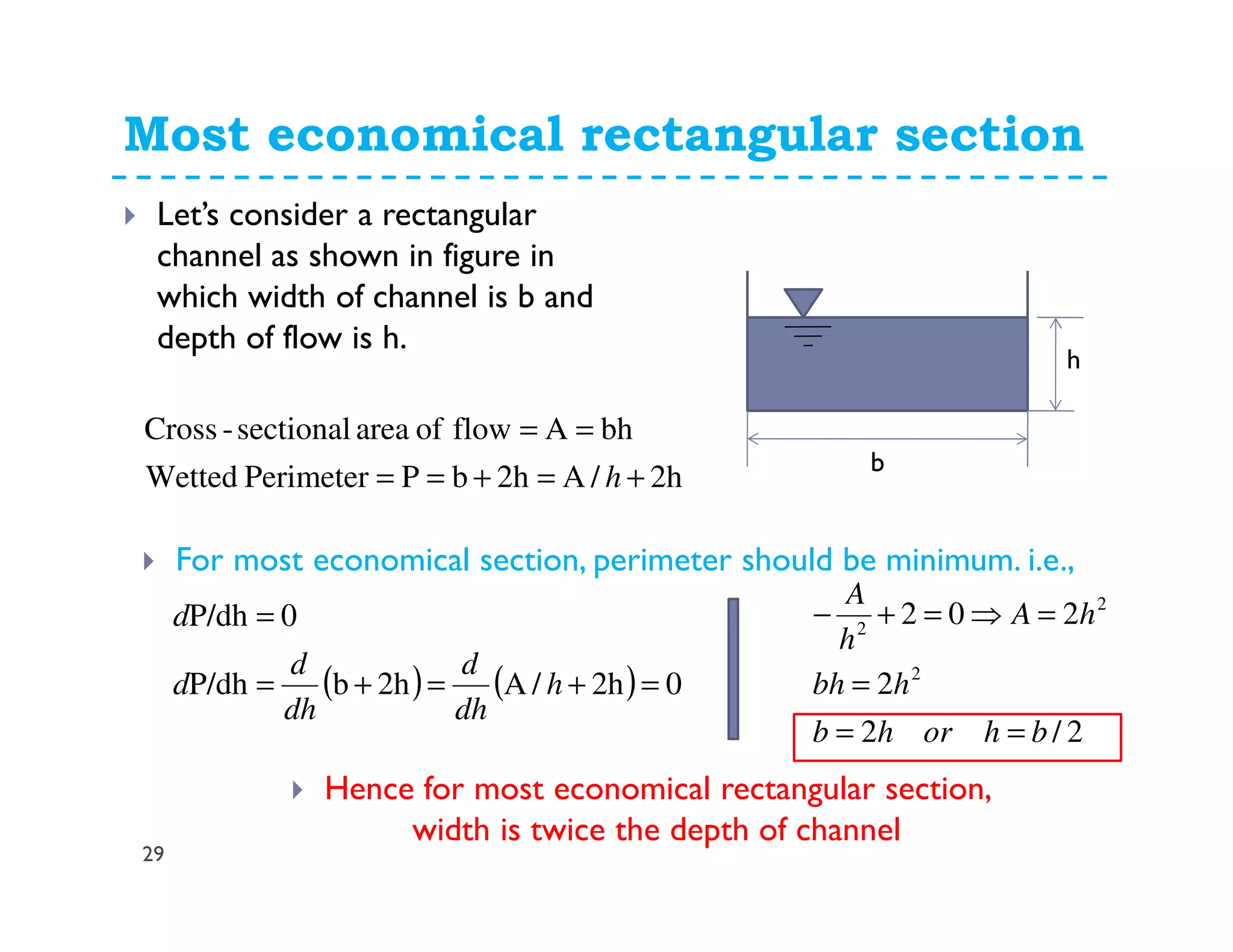
Let’s consider a rectangular
channel as shown in figure in
which width of channel is b and
depth of flow is h.
b
h
2h/A2hbPPerimeterWetted
bhAflowofareasectional-Cross
+=+==
==
h
For most economical section, perimeter should be minimum. i.e.,
( ) ( ) 02h/A2hbP/dh
0P/dh
=+=+=
=
h
dh
d
dh
d
d
d
2/2
2
202
2
2
2
bhorhb
hbh
hA
h
A
==
=
=⇒=+−
Hence for most economical rectangular section,
width is twice the depth of channel
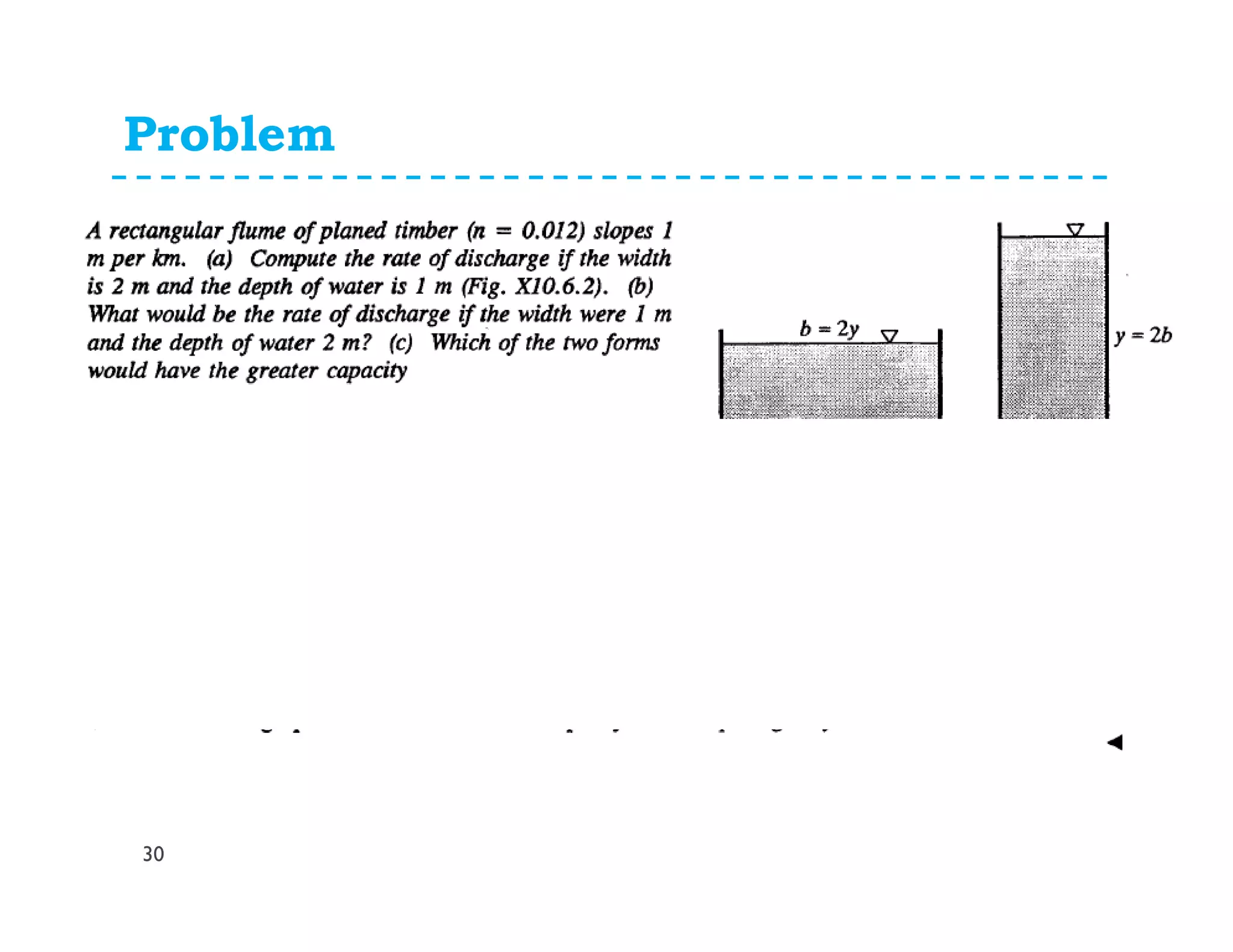
Problem
30
31
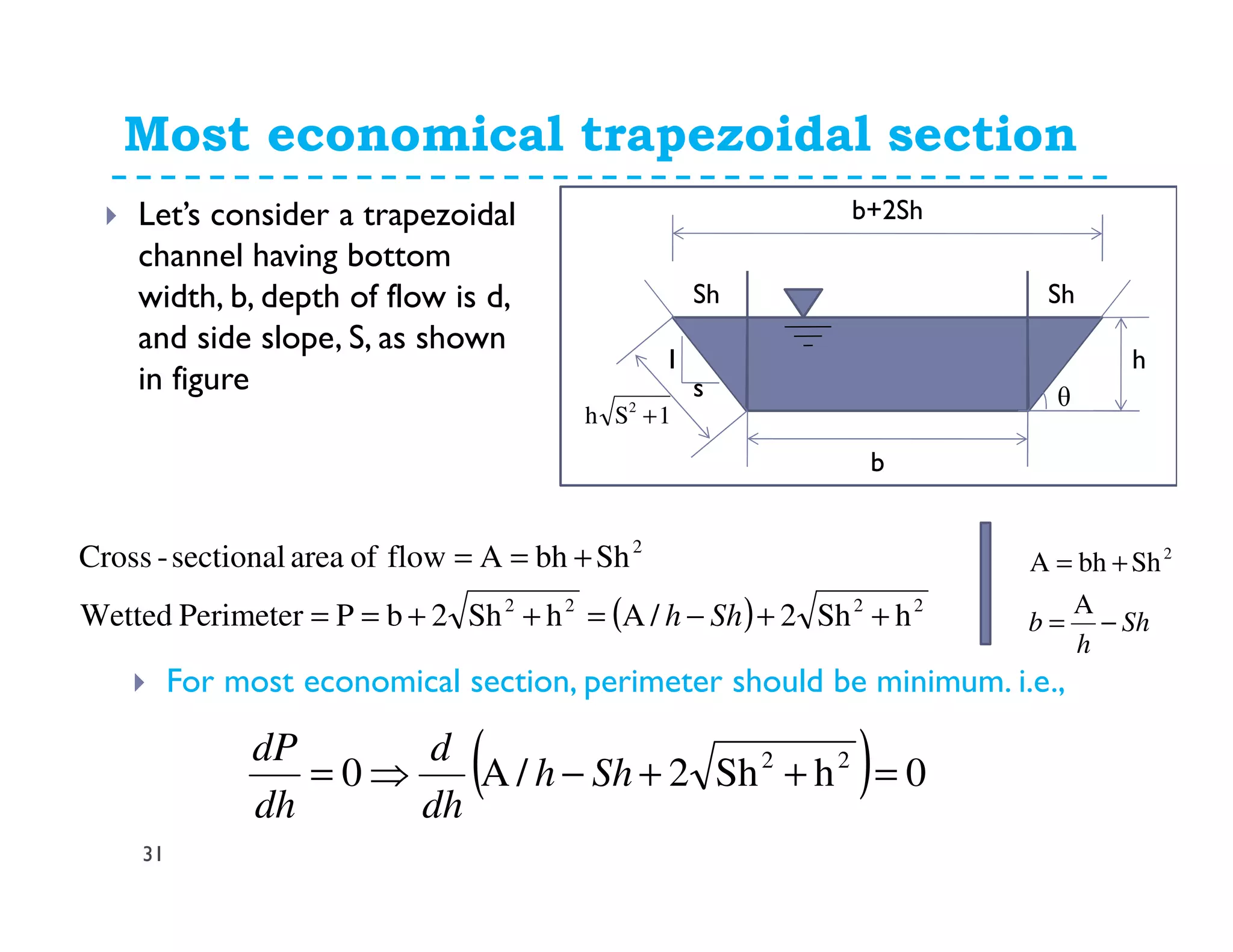
Let’s consider a trapezoidal
channel having bottom
width, b, depth of flow is d,
and side slope, S, as shown
in figure
Most economical trapezoidal section
h
b
s
Sh Sh
1
( ) 2222
2
hSh2/AhSh2bPPerimeterWetted
ShbhAflowofareasectional-Cross
++−=++==
+==
Shh
For most economical section, perimeter should be minimum. i.e.,
( ) 0hSh2/A0 22
=++−⇒= Shh
dh
d
dh
dP
Sh
h
b −=
+=
A
ShbhA 2
b+2Sh
1Sh 2
+
θ
Most economical trapezoidal section
32
Hence for most economical trapezoidal section, top
width is twice the length of one sloping side or half of
top width is equal to length of one sloping side
( ) 01S201S2h/A 2
2
2
=++−−⇒=++− S
h
A
Shh
dh
d
1Sh2Sh2b1Sh
2
Sh2b
1S2
Sh2b
1S2
Shb
1S2
Shb
1S2
Shbh
1S2
22
2
22
2
2
2
2
2
+=+⇒+=
+
+=
+
+=+
+
⇒+=+
+
+=+
+
⇒+=+
h
h
Sh
h
S
h
S
h
S
h
A
Most economical trapezoidal section
33
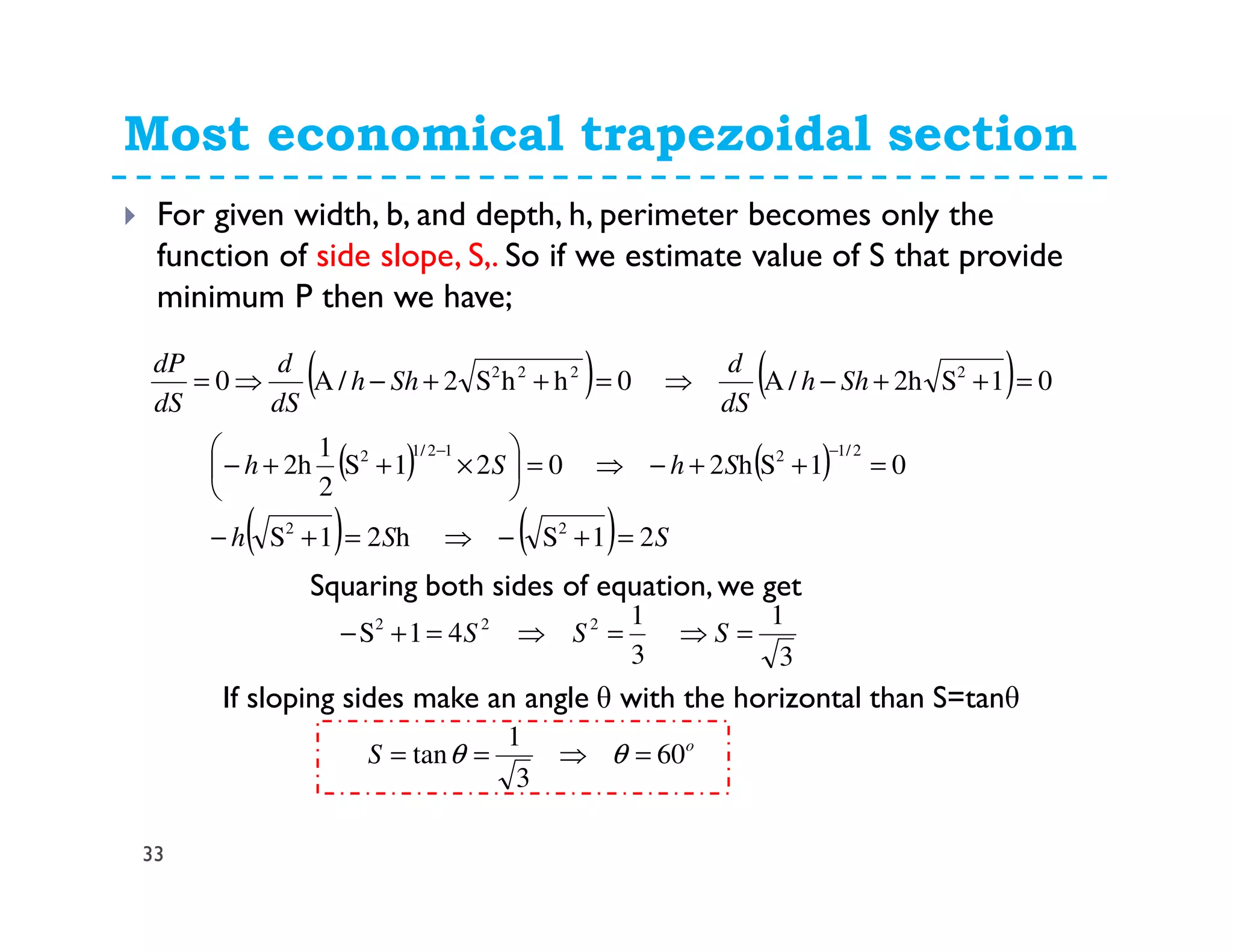
For given width, b, and depth, h, perimeter becomes only the
function of side slope, S,. So if we estimate value of S that provide
minimum P then we have;
( ) ( ) 01S2h/A0hhS2/A0 2222
=++−⇒=++−⇒= Shh
dS
d
Shh
dS
d
dS
dP
( ) ( )
( ) ( ) SSh
ShSh
21Sh21S
01Sh2021S
2
1
2h
22
2/1212/12
=+−⇒=+−
=++−⇒=





×++−
−−
Squaring both sides of equation, we get
3
1
3
1
41S 222
=⇒=⇒=+− SSS
If sloping sides make an angle θ with the horizontal than S=tanθ
o
S 60
3
1
tan =⇒== θθ
Thank you
Questions….
Feel free to contact:
34

Dymanics of open channel flow

  • 1.
    Dynamics of FluidFlow in Open Channel Flow: Concept of open channel, Chezy’s and Manning’s equations for open channel and their application. 1 Fluid Mechanics Dr. Mohsin Siddique Assistant Professor
  • 2.
    Outcome of Today’sLecture 2 After completing this lecture… The students should be able to: Understand the concepts and basic equations used in open channel flow Determine the velocity and discharge using Chezy’s and Manning’s equation Understand the concept of most economical sections
  • 3.
    Open Channel Flow 3 Anopen channel is the one in which stream is not complete enclosed by solid boundaries and therefore has a free surface subjected only to atmosphere pressure. The flow in such channels is not caused by some external head, but rather only by gravitational component along the slope of channel. Thus open channel flow is also referred to as free surface flow or gravity flow. Examples of open channel are Rivers, canals, streams, & sewerage system etc
  • 4.
    Open Channel Flow 4 ThalCanal Indus river
  • 5.
    Comparison between openchannel flow and pipe flow 5 Aspect Open Channel Pipe flow Cause of flow Gravity force (provided by sloping bottom) Pipes run full and flow takes place under hydraulic pressure. Cross-sectional shape Open channels may have any shape, e.g., triangular, rectangular, trapezoidal, parabolic or circular etc Pipes are generally round in cross-section which is uniform along length Surface roughness Varies with depth of flow Varies with type of pipe material Piezometric head (z+h), where h is depth of channel (z+P/γ) where P is the pressure in pipe Velocity distribution Maximum velocity occurs at a little distance below the water surface.The shape of the velocity profile is dependent on the channel roughness. The velocity distribution is symmetrical about the pipe axis. Maximum velocity occurs at the pipe center and velocity at pipe walls reduced to zero.
  • 6.
    Types of Channels 6 NaturalChannels: It is one with irregular sections of varying shapes, developing in natural way. .e.g., rivers, streams etc Artificial Channels: It is the one built artificially for carrying water for various purposes. e.g., canals, Open Channel: A channel without any cover at the top. e.g., canals, rivers streams etc Covered Channels: A channel having cover at the top. e.g., partially filled conduits carrying water Prismatic Channels:A channel with constant bed slope and cross-section along its length.
  • 7.
    Types of flowin open channels 7 Steady and unsteady flow Uniform and non-uniform flow Laminar andTurbulent flow Subcritical, critical and supercritical flow Same definition with pipe flows Laminar and Turbulent flow: For open channels, it is defined with Reynolds No. as; ν h e VR R = νν h e VRVD R 4 == Remember in pipe flows Therefore, For laminar flow: Re <= 500 For transitional flow: 500 <Re< 1000 ForTurbulent flow: Re >= 1000 For laminar flow: Re <= 2000
  • 8.
    Types of flowin open channels 8 Subcritical, Critical and Supercritical Flow.These are classified with Froude number. Froude No. (Fr). It is ratio of inertial force to gravitational force of flowing fluid. Mathematically, Froude no. is If Fr. < 1, Flow is subcritical flow Fr. = 1, Flow is critical flow Fr. > 1, Flow is supercritical flow gh V Fr = Where, V is average velocity of flow, h is depth of flow and g is gravitational acceleration
  • 9.
    Definitions 9 Depth of Flow:It is the vertical distance of the lowest point of a channel section(bed of the channel) from the free surface. Depth of Flow Section: It is depth of flow normal to bed of the channel. Top Width: It is the width of channel section at the free surface. Wetted Area: It is the cross-sectional area of the flow section of channel. Wetted Perimeter: It is the length of channel boundary in contact with the flowing water at any section. Hydraulic Radius: It is ratio of cross-sectional area of flow to wetted perimeter.
  • 10.
    Open channel formulaefor uniform flow 10 For uniform flow in open channels, following formulae are widely used oRSCV = 2/13/21 oSR n V = Here, V=Average flow velocity R=Hydraulic radius So=Channel bed slope C= Chezy’s constant n= Manning’s Roughness coefficient 1. Chezy’s Formula: Antoine de Chezy (1718-1798), a French bridge and hydraulic expert, proposed his formula in 1775. 2. Manning’s Formula: Rober Manning (An Irish engineer) proposed the following relation for Chezy’s coefficient C ( ) 6/1 /1 RnC = According to which Chezy’s equation can be written as
  • 11.
    Derivation of Chezy’sformula 11 In uniform flow the cross-sectional through which flow occurs is constant along the channel and so also is the velocity.Thus y1=y2=yo andV1=V2 =V and the channel bed, water surface and energy line are parallel to one another. According to force balance along the direction of flow; we can write, PLALFF oτθγ =+− sin21 F1= Pressure force at section 1 F2= Pressure force at section 2 W= Weight of fluid between section 1 and 2= So= slope of channel θ= Inclination of channel with horizontal line τo= shearing stress P= Wetted perimeter L= length between sections V= Avg. Flow velocity yo= depth of flow ALγ
  • 12.
    Derivation of Chezy’sformula 12 θγθγ θγ τ sinsin sin R P A PL AL o === x zz So ∆ − = 21 ( ) ( ) x yzyz Sw ∆ +−+ = 2211 ( ) ( ) x h S x gvyzgvyz S L ∆ = ∆ ++−++ = 2/2/ 222111 θsin=≈= SSS wo For channels with So<0.1, we can safely assume that oo RSγτ = Therefore;
  • 13.
    Derivation of Chezy’sformula 13 τo (shearing stress) can also be expressed as (already discussed) 2 2 V Cfo ρτ = Comparing both equations of τo we get; o foo f of RSCV fCRS f g RS C g V RS V C = === = 4/ 82 2 2 Q γρ Where C is Chezy’s Constant whose value depend upon the type of channel surface f g C 8 =Q
  • 14.
    Relation b/w fand C 14 As f and C are related, the same consideration that are present for determination of friction factor, f, for pipe flows also applies here. 4/ 82 fC f g C g C f f === Q
  • 15.
    Empirical Relations forChezy’s Constant, C 15 Although Chezy’s equation is quite simple, the selection of a correct value of C is rather difficult. Some of the important formulae developed for Chezy’s Constant C are; 1. Bazin Formula: A French hydraulic engineer H. Bazin (1897) proposed the following empirical formula for C RK C /181 6.157 + = R= Hydraulic Radius K=Bazin Constant The value of K depends upon the type of channel surface
  • 16.
    Empirical Relations forChezy’s Constant, C 16 2. Kutter’s Formula: Two Swiss engineers Ganguillet and Kutter proposed following formula for determination of C R= Hydraulic Radius n=Manning’s roughness coefficient 3. Manning’s Formula: Rober Manning (An Irish engineer) proposed the following relation for Chezy’s coefficient C 2/13/21 oSR n V = n= Manning’s Roughness coefficient ( ) 6/1 /1 RnC = The values of n depends upon nature of channel surface BG units SI units
  • 17.
    Empirical Relations forChezy’s Constant, C 17
  • 18.
    Relation b/w fand n 18 Since Also It mean n and f can also be related with each other. Hence 4/ 82 fC f g C g C f f === Q ( ) 6/1 /1 RnC = g f Rn 8 486.1 6/1 = g f Rn 8 6/1 = SI BG
  • 19.
    Chezy’s and Manning’sEquations in SI and BG System 19 Chezy’s Equation Manning’s Equation 2/13/21 oSR n V = ( ) 2/13/23 1 / oSAR n smQ = ( ) 2/13/2486.1 oSAR n cfsQ = SI BG oRSCV = oRSCAQ = Value of C is determine from respective BG or SI Kutter’s formula. C= Chezy’s Constant A= Cross-sectional area of flow A= Cross-sectional area of flow
  • 20.
    Problem-1 20 Water is flowingin a 2-m-wide rectangular, brick channel (n=0.016) at a depth of 120 cm.The bed slope is 0.0012. Estimate the flow rate using the Manning’s equation. Solution: First, calculate the hydraulic radius Manning’s equation (for SI units) provides
  • 21.
    Problem-2 21 Compute the flowrate for a depth of 2, 4, 6 and 8ft. ( ) 2/13/2486.1 oSAR n cfsQ = For BG units
  • 22.
    22 Let’s consider a trapezoidalchannel having bottom width, b, depth of flow, d, and side slope, S. Trapezoidal section h b s Sh Sh 1 ( ) 2222 2 22 sec hShShA/hhShbPimeterWetted Per ShbhAa of flowtional areCross- ++−=++== +== Sh h A b ShbhA −= += 2 b+2Sh 1Sh 2 + θ
  • 23.
    Problem-3 23 Solution ( ) 2/13/231 / oSAR n smQ = For SI units 4 y
  • 24.
  • 25.
    Problem-5 25 ( ) 2/13/231 / oSAR n smQ = For SI units 321 QQQQ ++=
  • 26.
    Problem-7 26 ( ) 2/13/231 / oSAR n smQ = For SI units Solution: (a)
  • 27.
    Problem-7 27 (b) ( )2/13/23 1 / oSAR n smQ =For SI units
  • 28.
    Most Economical Section 28 FromManning’s formula, we can write that For a given channel of slope, So, area of cross-section, A, and roughness, n, we can simplify above equation as It emphasis that discharge will be maximum, when Rh is maximum and for a given cross-section, Rh will be maximum if perimeter is minimum. Therefore, the most economical section (also called best section or most efficient section) is the one which gives maximum discharge for a given area of cross-section (say excavation for channel shape). ohSAR n Q 1 ∝ P Q P A QRQ h 1 ∝⇒∝⇒∝
  • 29.
    Most economical rectangularsection 29 Let’s consider a rectangular channel as shown in figure in which width of channel is b and depth of flow is h. b h 2h/A2hbPPerimeterWetted bhAflowofareasectional-Cross +=+== == h For most economical section, perimeter should be minimum. i.e., ( ) ( ) 02h/A2hbP/dh 0P/dh =+=+= = h dh d dh d d d 2/2 2 202 2 2 2 bhorhb hbh hA h A == = =⇒=+− Hence for most economical rectangular section, width is twice the depth of channel
  • 30.
  • 31.
    31 Let’s consider atrapezoidal channel having bottom width, b, depth of flow is d, and side slope, S, as shown in figure Most economical trapezoidal section h b s Sh Sh 1 ( ) 2222 2 hSh2/AhSh2bPPerimeterWetted ShbhAflowofareasectional-Cross ++−=++== +== Shh For most economical section, perimeter should be minimum. i.e., ( ) 0hSh2/A0 22 =++−⇒= Shh dh d dh dP Sh h b −= += A ShbhA 2 b+2Sh 1Sh 2 + θ
  • 32.
    Most economical trapezoidalsection 32 Hence for most economical trapezoidal section, top width is twice the length of one sloping side or half of top width is equal to length of one sloping side ( ) 01S201S2h/A 2 2 2 =++−−⇒=++− S h A Shh dh d 1Sh2Sh2b1Sh 2 Sh2b 1S2 Sh2b 1S2 Shb 1S2 Shb 1S2 Shbh 1S2 22 2 22 2 2 2 2 2 +=+⇒+= + += + +=+ + ⇒+=+ + +=+ + ⇒+=+ h h Sh h S h S h S h A
  • 33.
    Most economical trapezoidalsection 33 For given width, b, and depth, h, perimeter becomes only the function of side slope, S,. So if we estimate value of S that provide minimum P then we have; ( ) ( ) 01S2h/A0hhS2/A0 2222 =++−⇒=++−⇒= Shh dS d Shh dS d dS dP ( ) ( ) ( ) ( ) SSh ShSh 21Sh21S 01Sh2021S 2 1 2h 22 2/1212/12 =+−⇒=+− =++−⇒=      ×++− −− Squaring both sides of equation, we get 3 1 3 1 41S 222 =⇒=⇒=+− SSS If sloping sides make an angle θ with the horizontal than S=tanθ o S 60 3 1 tan =⇒== θθ
  • 34.