HYDRAULICS
UNIFORM FLOW IN OPEN CHANNELS
By
Erni Syuhada Bt Mazwil Ishan
HYDRAULICS ENGINEERING
• A scientific fluid flow particularly in water
thoroughly in pipe, open channel, orifice and
embankment, including the problem related
to energy and pressure.
• Related to water or fluid in dynamic condition.
CONTENT
 What is Open Channel
 Types of Open Channel
Types of flowing water and control
Solution of uniform flow in Open Channel
OPEN CHANNEL
An open channel :
a)The stream not completely enclosed by solid
boundaries
b)It has free surface subjected only to
atmospheric pressure.
c)Referred as free-surface flow or gravity flow
Open Channel
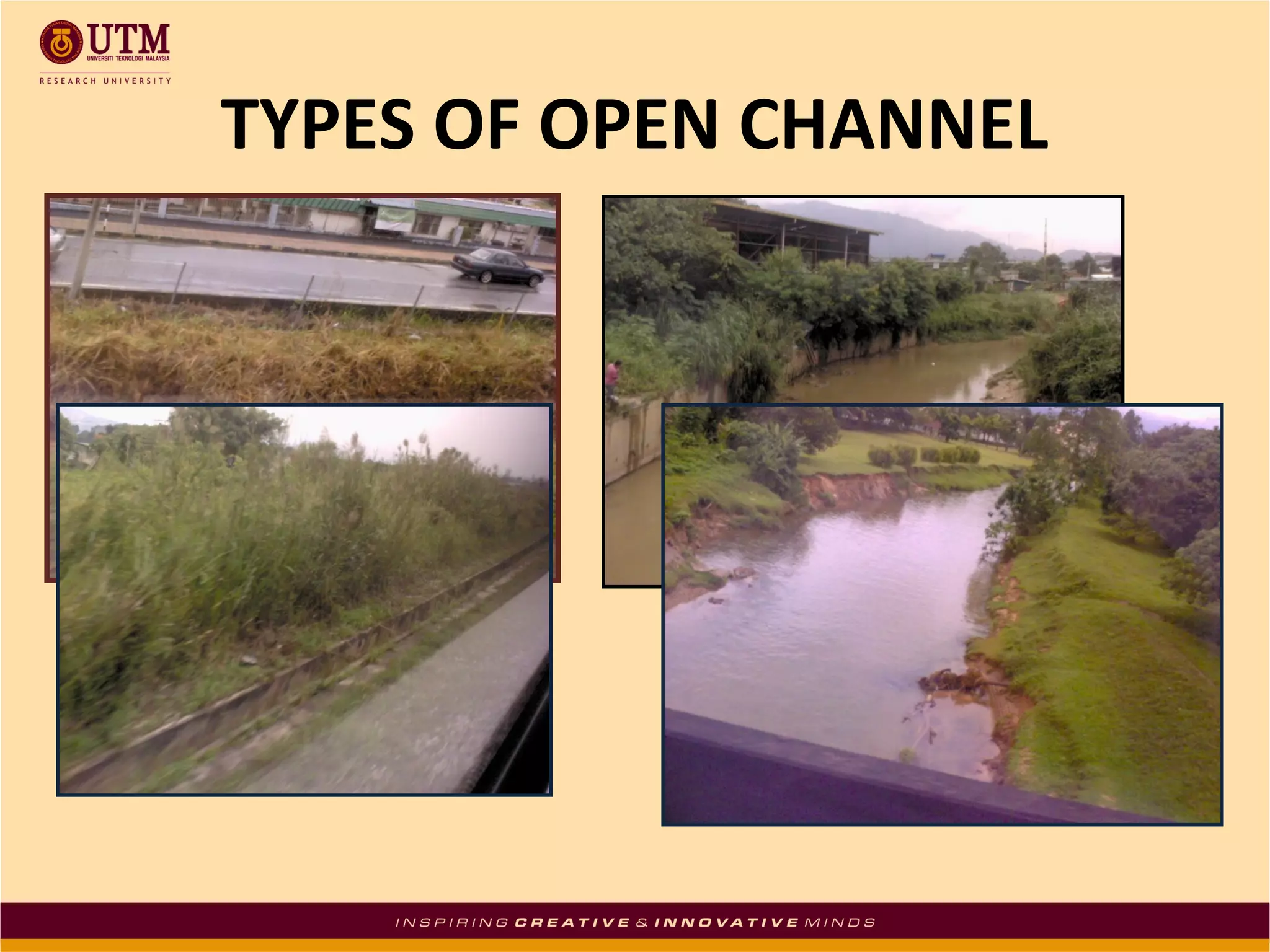
TYPES OF OPEN CHANNEL
Natural Channel
Irregular shape
i.e : river, hillsides
rivulets, tidal etuaries
Artificial Channel
Regular shape
i.e : drains, culverts,
sewer, tunnels
TYPES OF OPEN CHANNEL
TYPES OF FLOWING WATER AND ITS
CONTROL
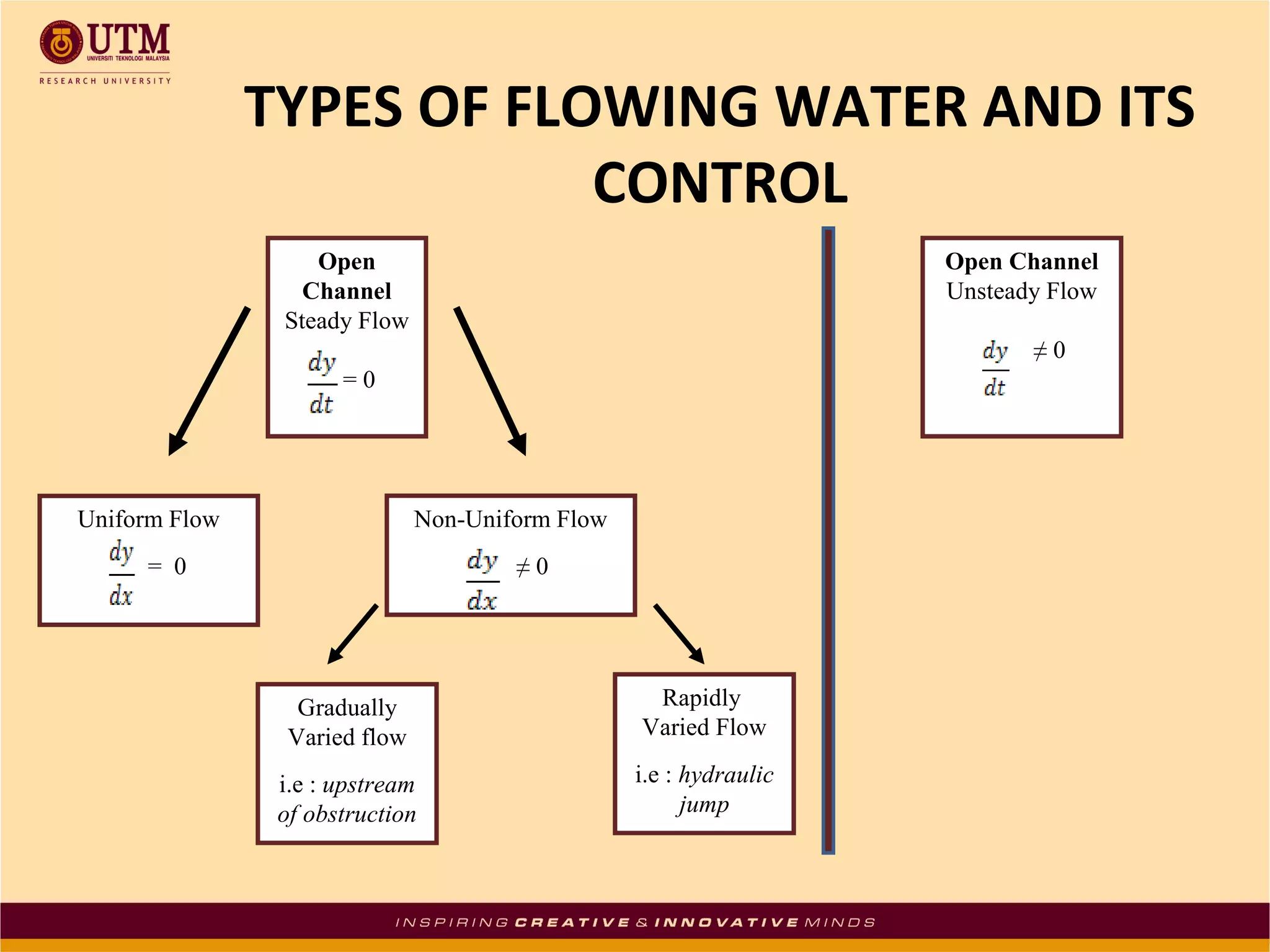
Rapidly
Varied Flow
i.e : hydraulic
jump
Non-Uniform Flow
≠ 0
Uniform Flow
= 0
Gradually
Varied flow
i.e : upstream
of obstruction
Open
Channel
Steady Flow
= 0
Open Channel
Unsteady Flow
≠ 0
TYPES OF FLOWING WATER AND ITS
CONTROL
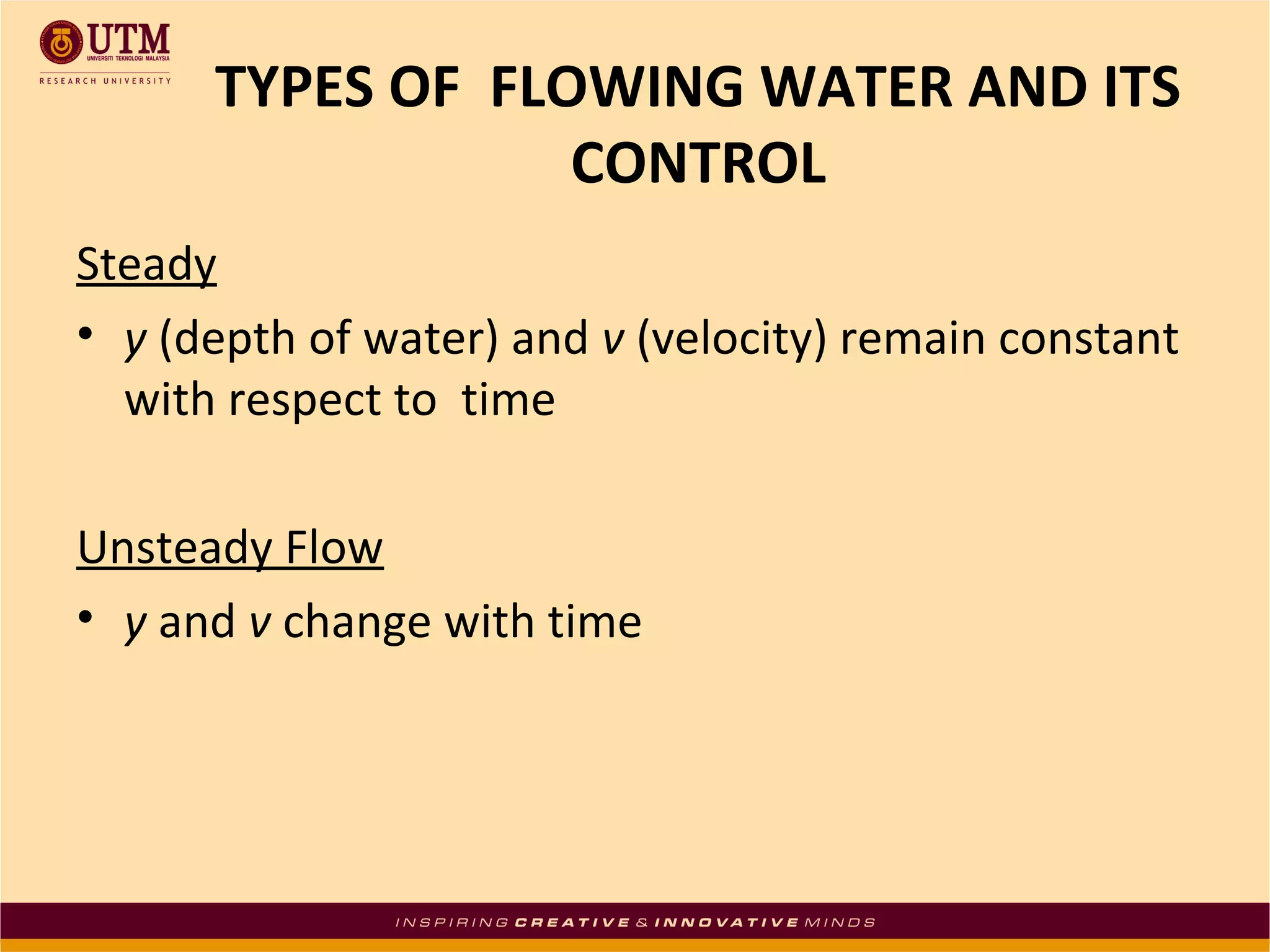
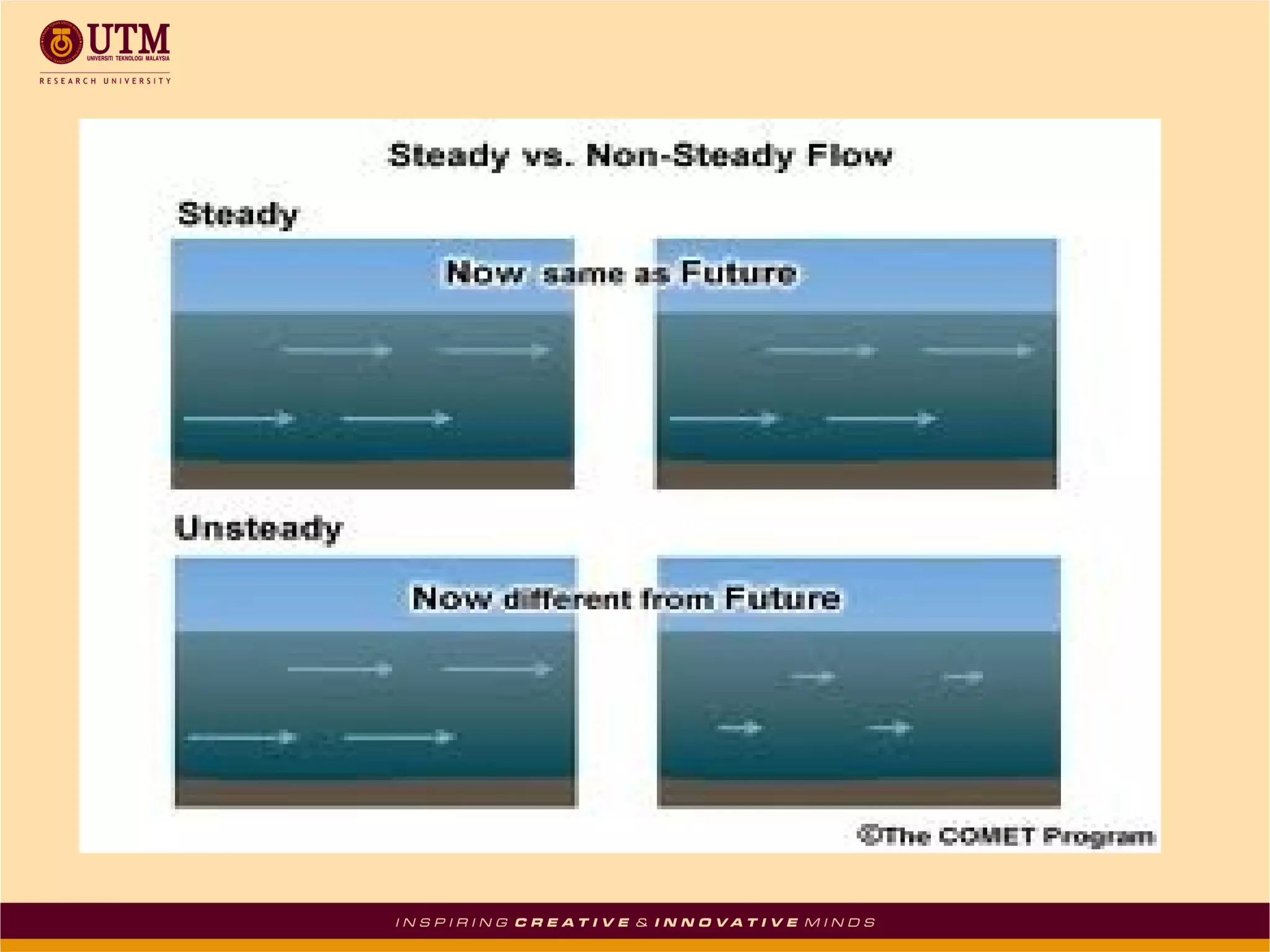
Steady
• y (depth of water) and v (velocity) remain constant
with respect to time
Unsteady Flow
• y and v change with time
TYPES OF FLOWING WATER AND ITS
CONTROL
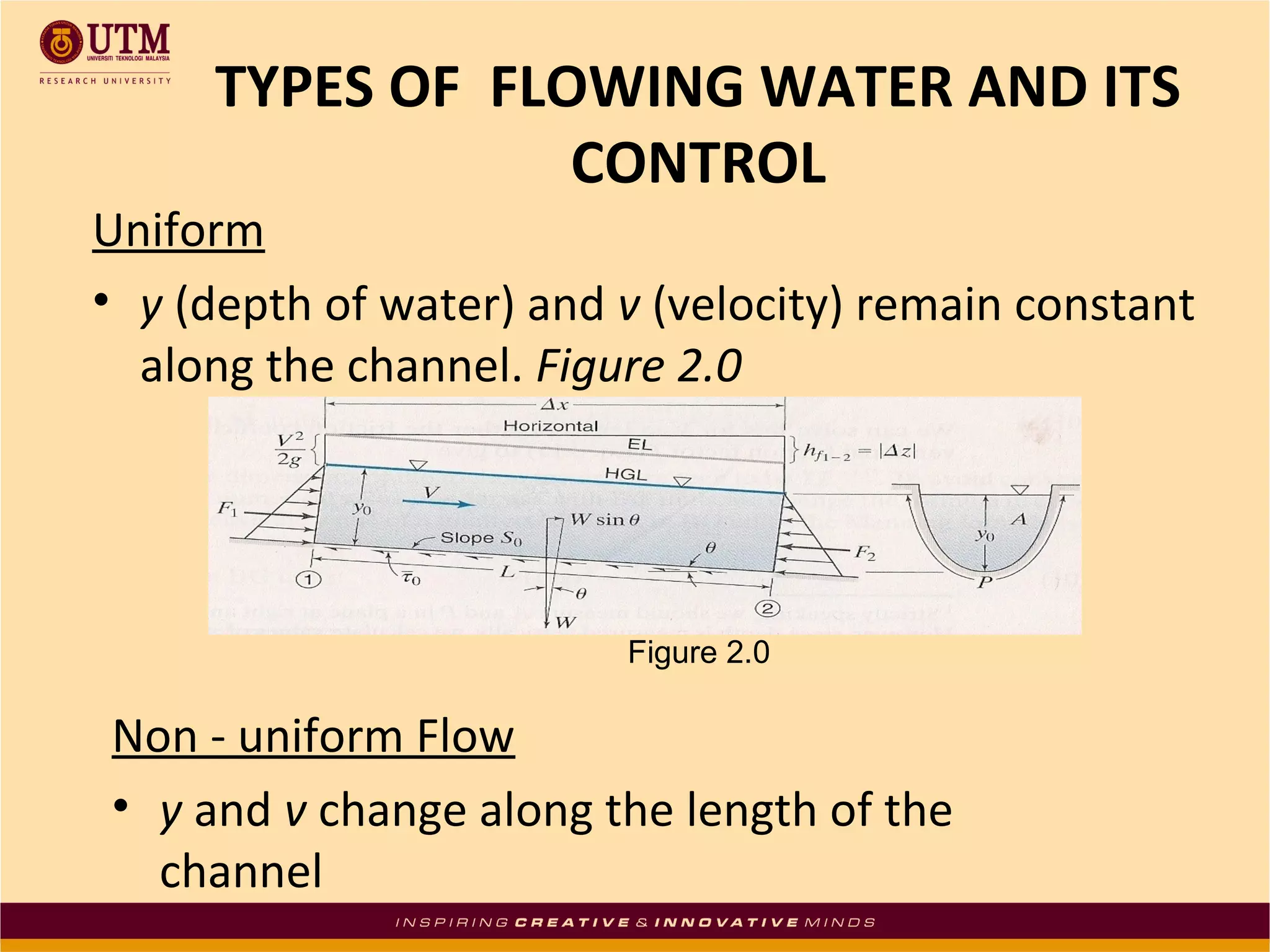
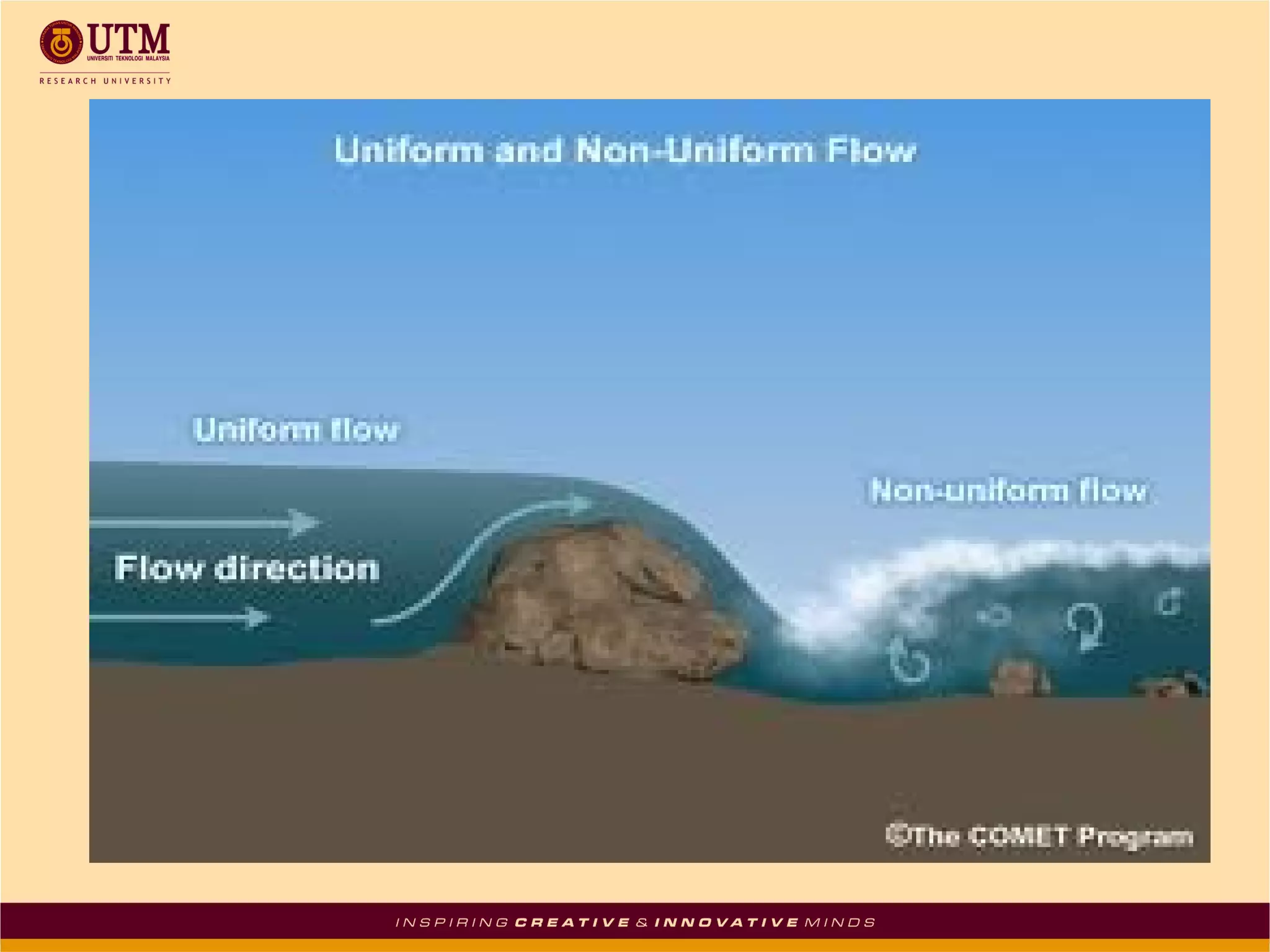
Uniform
• y (depth of water) and v (velocity) remain constant
along the channel. Figure 2.0
Non - uniform Flow
• y and v change along the length of the
channel
Figure 2.0
• Flow Classifications
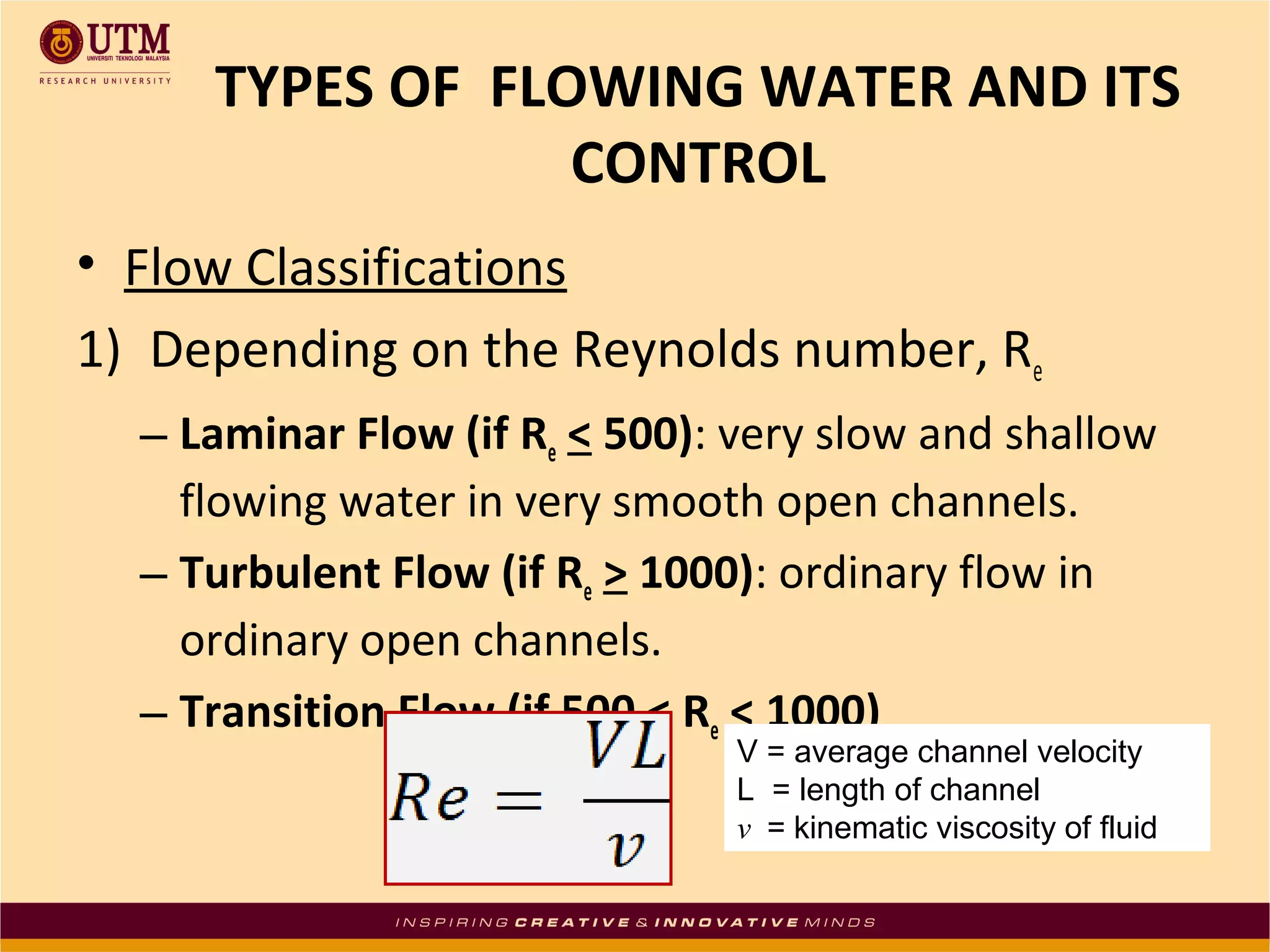
1) Depending on the Reynolds number, Re
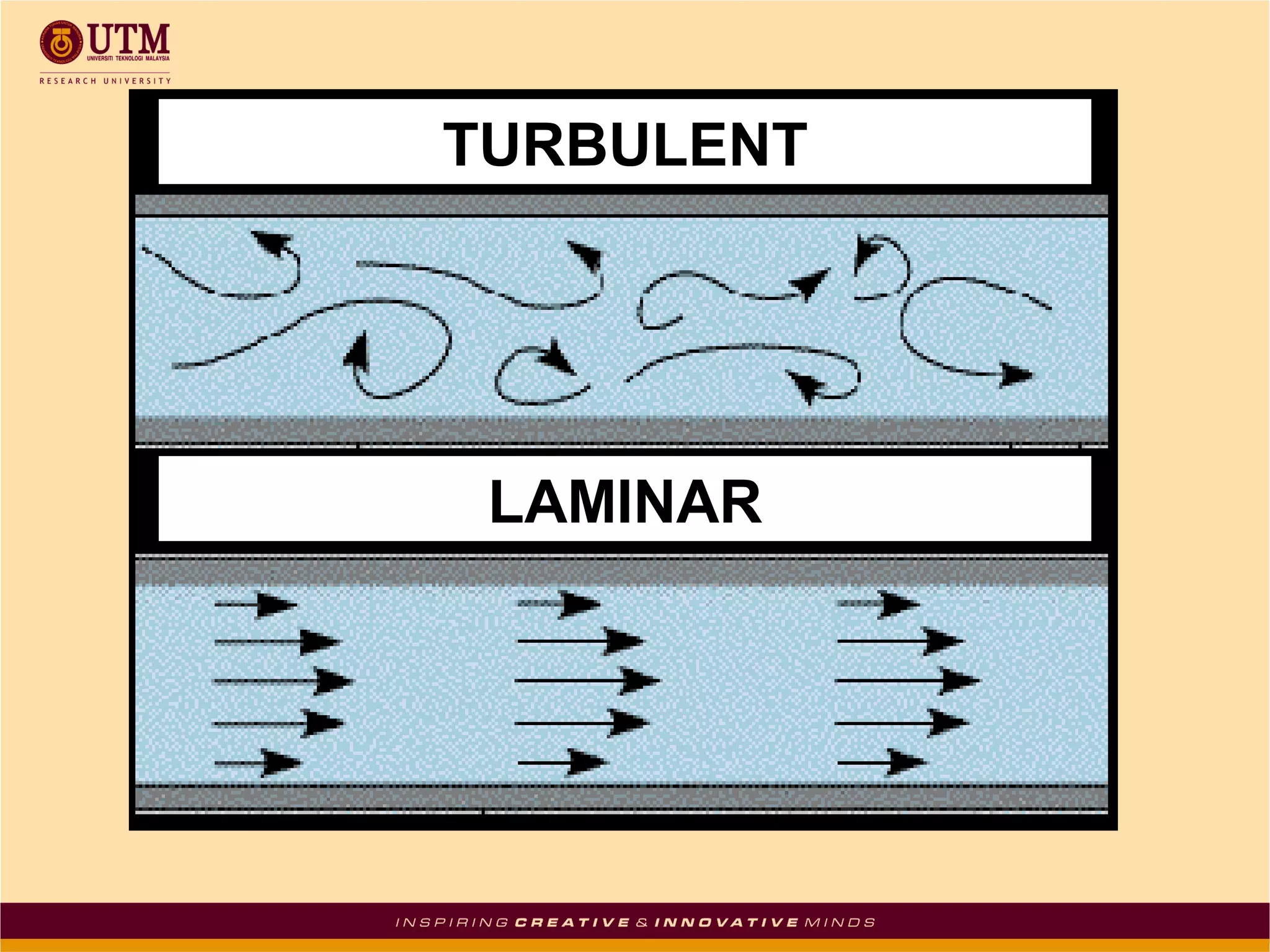
– Laminar Flow (if Re < 500): very slow and shallow
flowing water in very smooth open channels.
– Turbulent Flow (if Re > 1000): ordinary flow in
ordinary open channels.
– Transition Flow (if 500 < Re < 1000)
TYPES OF FLOWING WATER AND ITS
CONTROL
V = average channel velocity
L = length of channel
v = kinematic viscosity of fluid
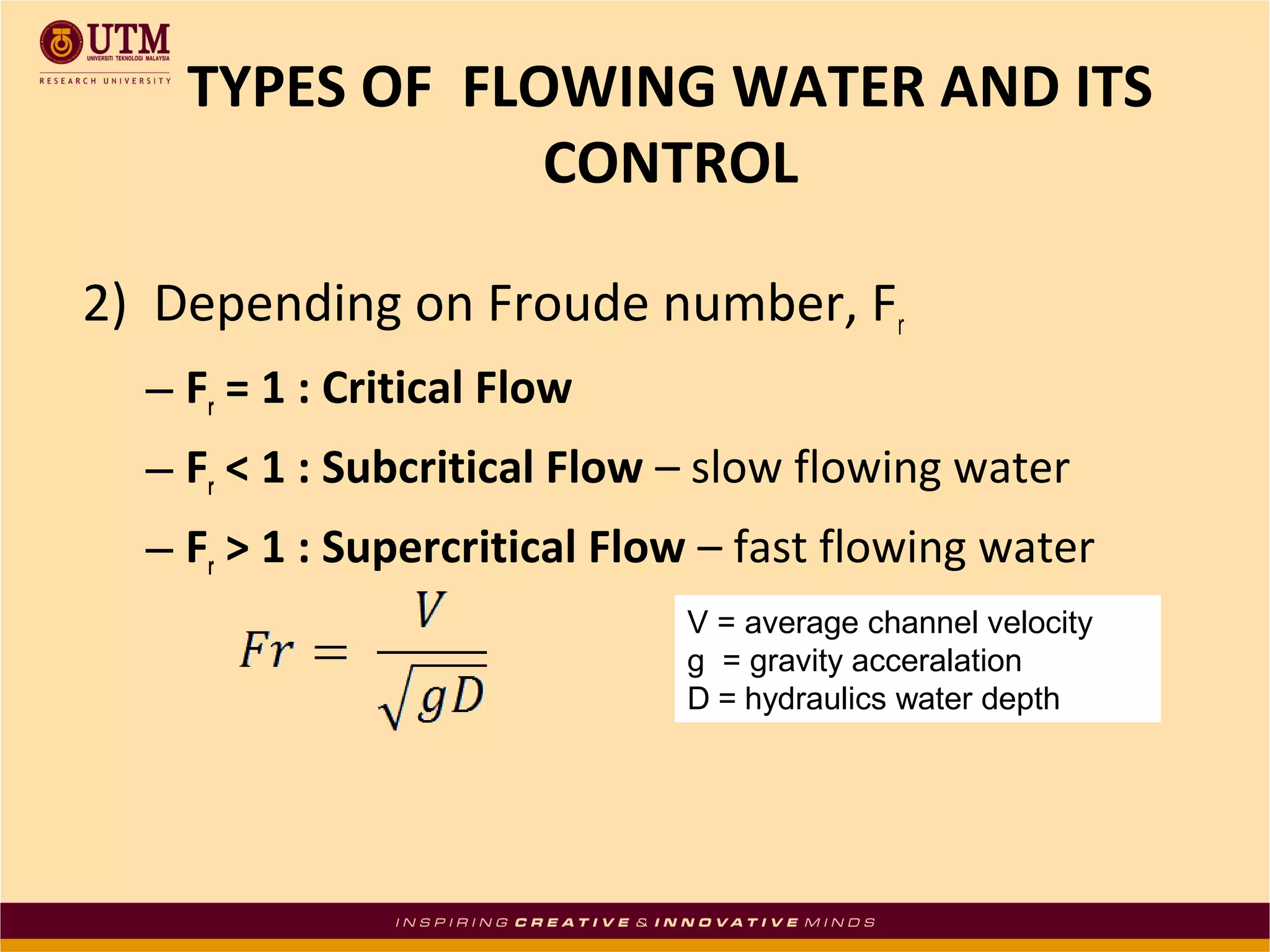
2) Depending on Froude number, Fr
– Fr = 1 : Critical Flow
– Fr < 1 : Subcritical Flow – slow flowing water
– Fr > 1 : Supercritical Flow – fast flowing water
TYPES OF FLOWING WATER AND ITS
CONTROL
V = average channel velocity
g = gravity acceralation
D = hydraulics water depth
TURBULENT
LAMINAR
TYPES OF FLOWING WATER AND ITS
CONTROL
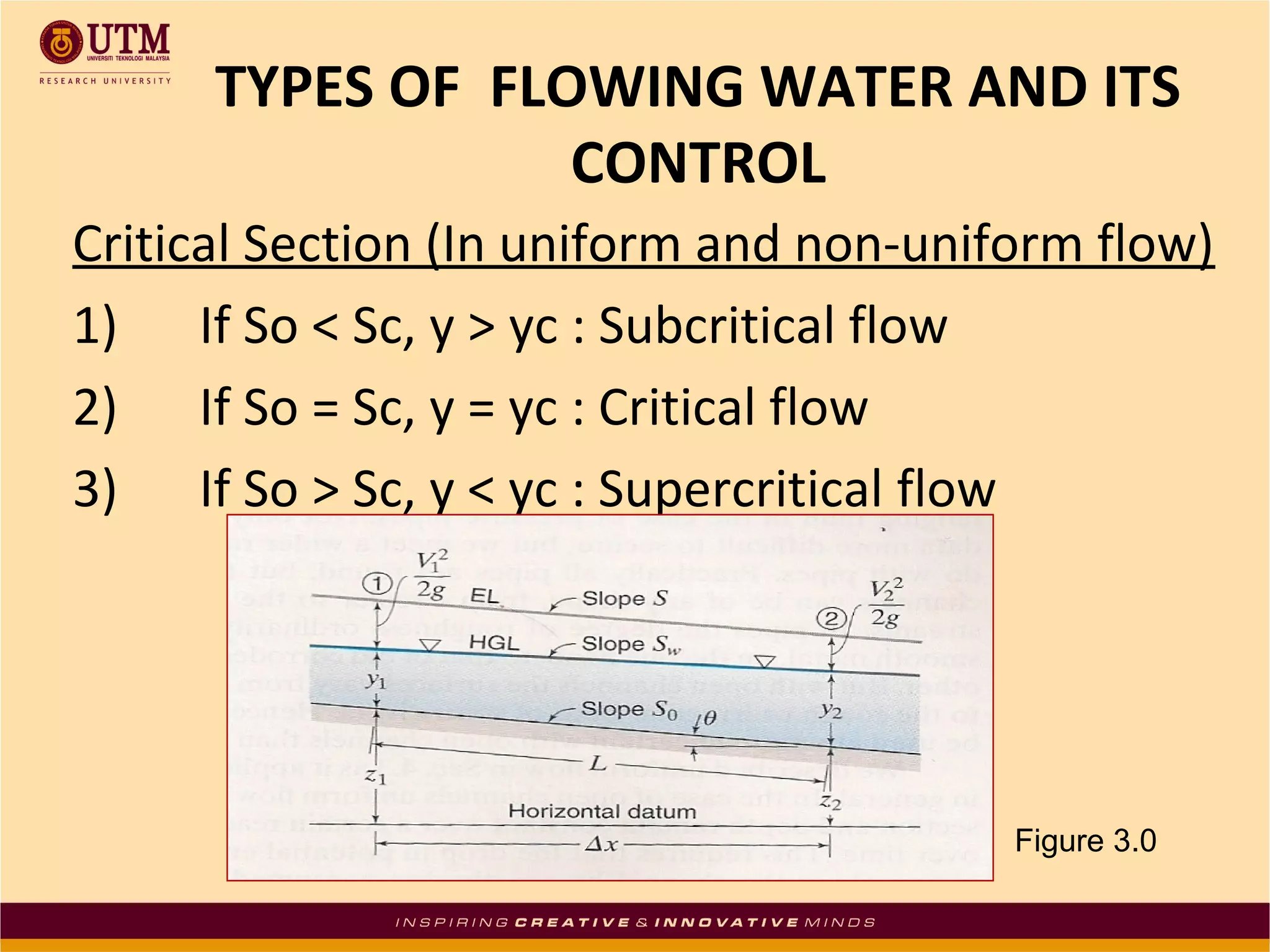
Critical Section (In uniform and non-uniform flow)
1) If So < Sc, y > yc : Subcritical flow
2) If So = Sc, y = yc : Critical flow
3) If So > Sc, y < yc : Supercritical flow
Figure 3.0
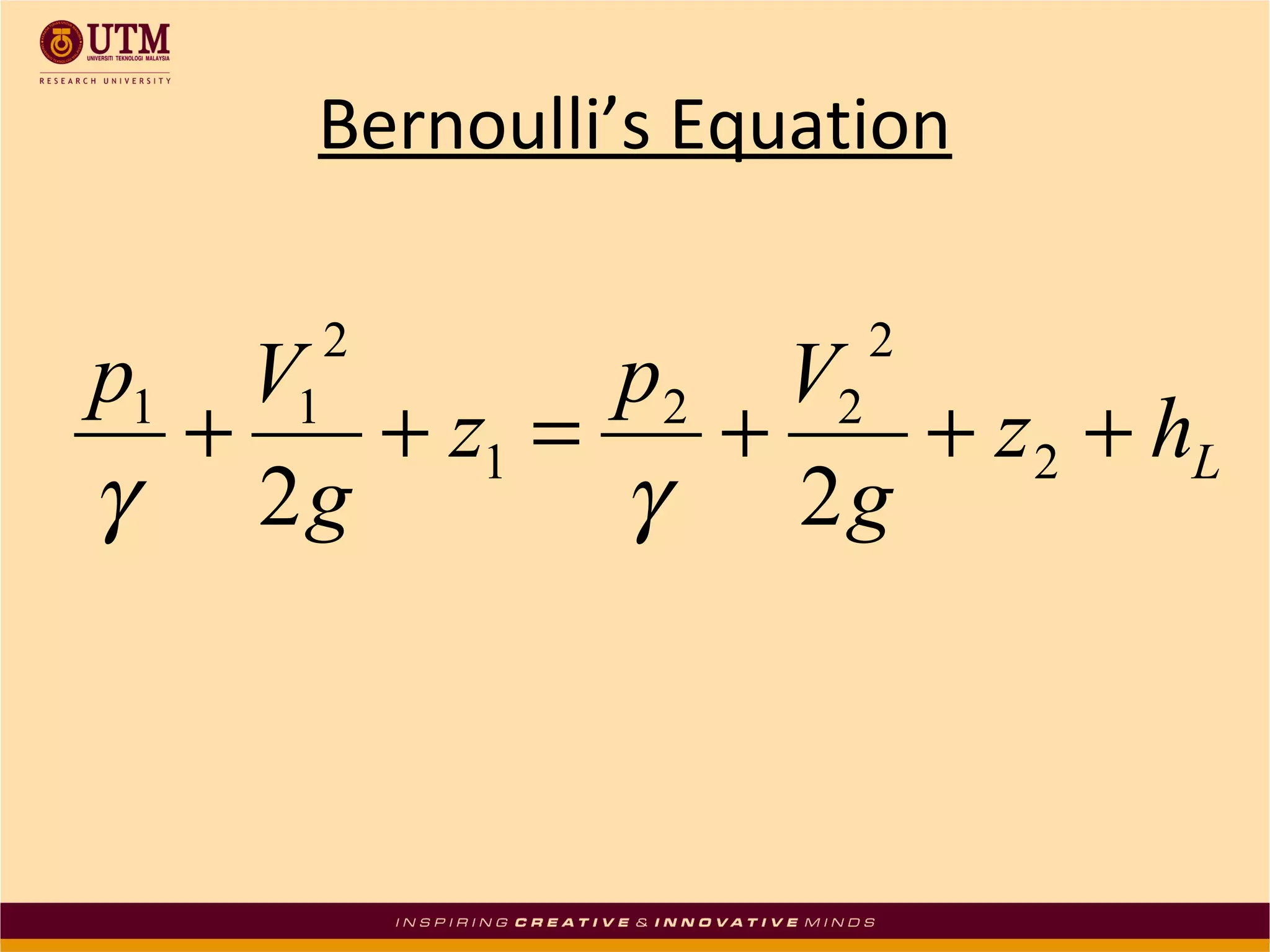
Bernoulli’s Equation
Lhz
g
Vp
z
g
Vp
+++=++ 2
2
22
1
2
11
22 γγ
Open Channel
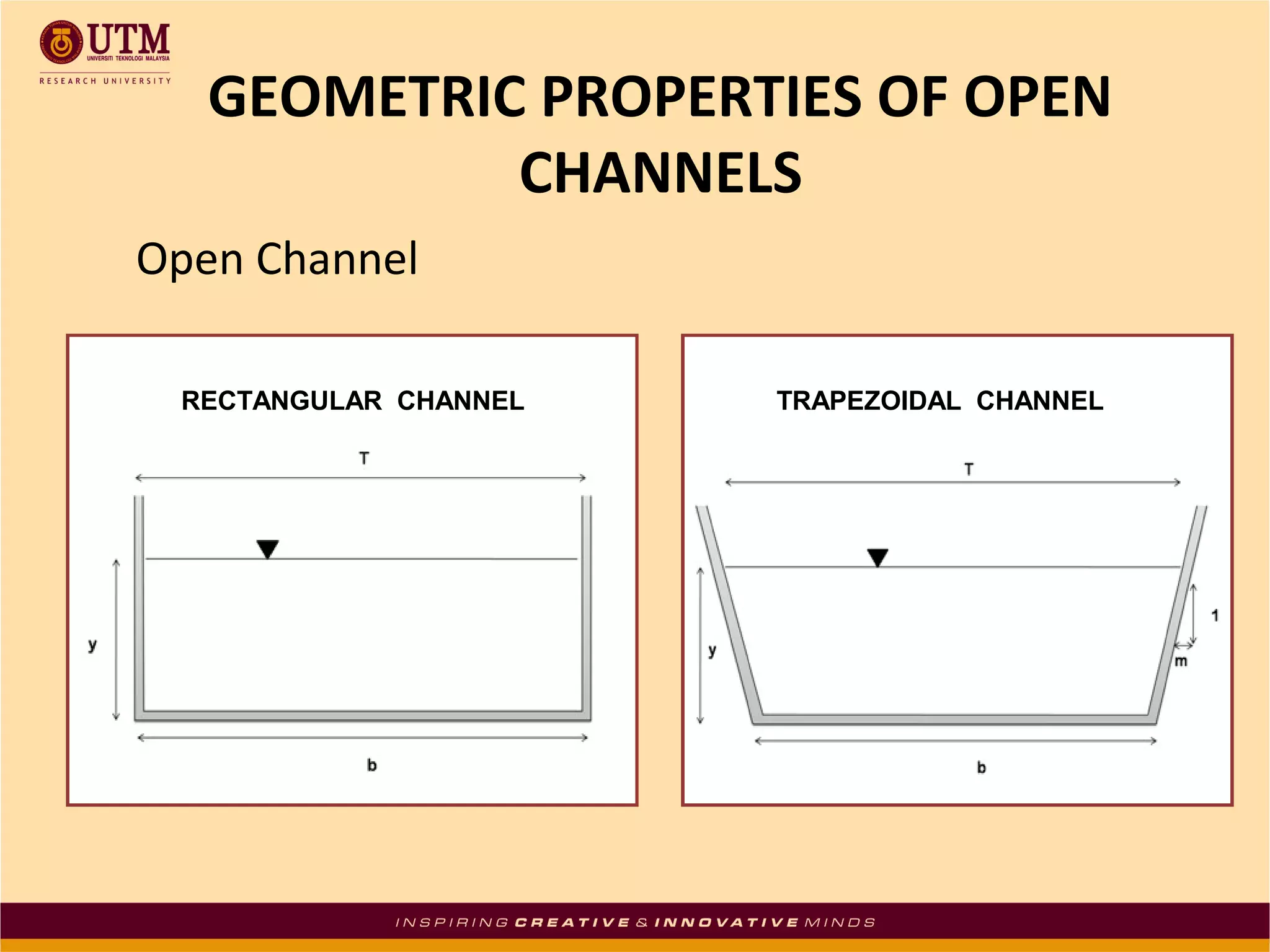
GEOMETRIC PROPERTIES OF OPEN
CHANNELS
RECTANGULAR CHANNEL TRAPEZOIDAL CHANNEL
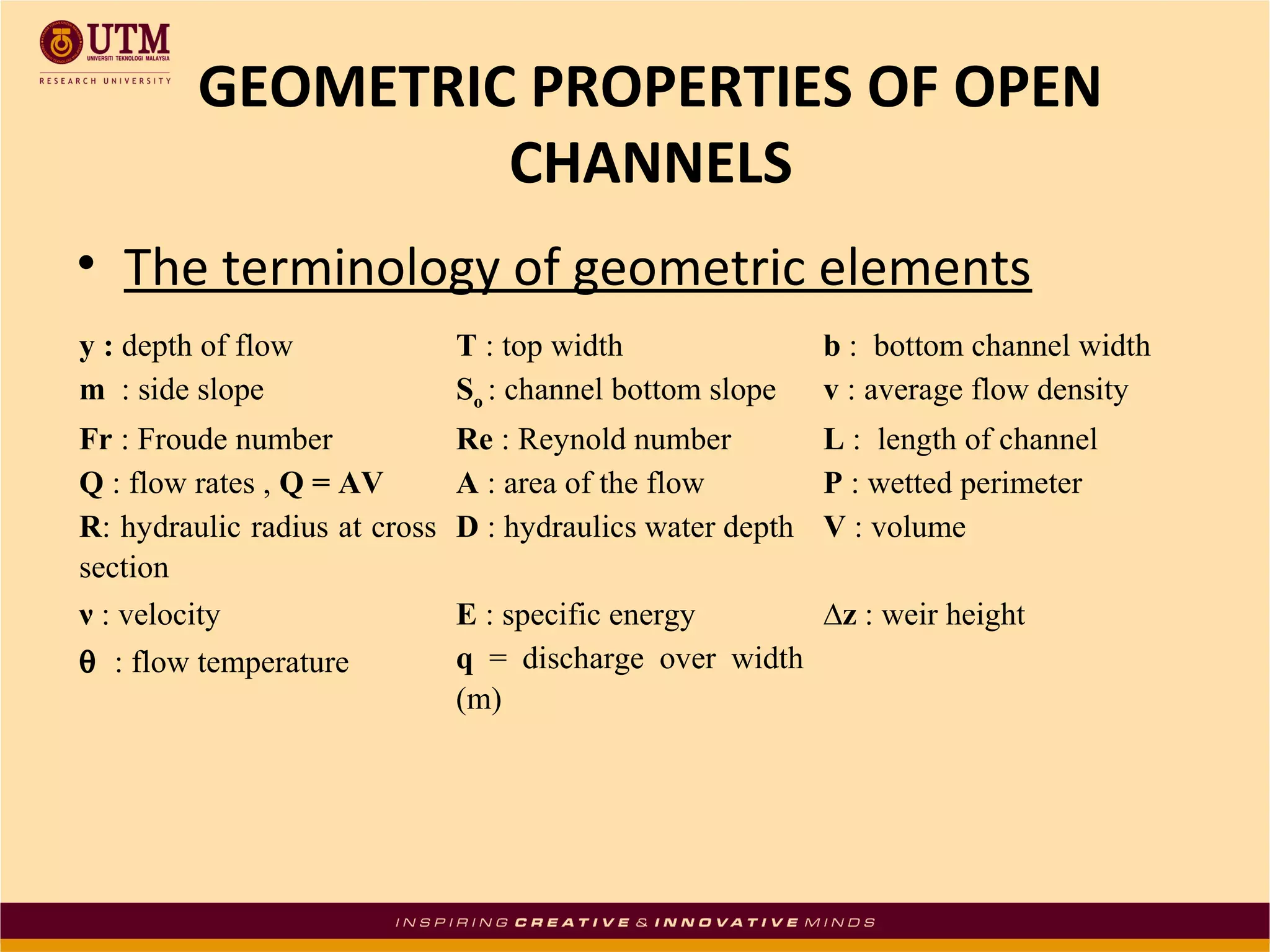
• The terminology of geometric elements
y : depth of flow T : top width b : bottom channel width
m : side slope So : channel bottom slope v : average flow density
Fr : Froude number Re : Reynold number L : length of channel
Q : flow rates , Q = AV A : area of the flow P : wetted perimeter
R: hydraulic radius at cross
section
D : hydraulics water depth V : volume
ν : velocity E : specific energy ∆z : weir height
θ : flow temperature q = discharge over width
(m)
GEOMETRIC PROPERTIES OF OPEN
CHANNELS
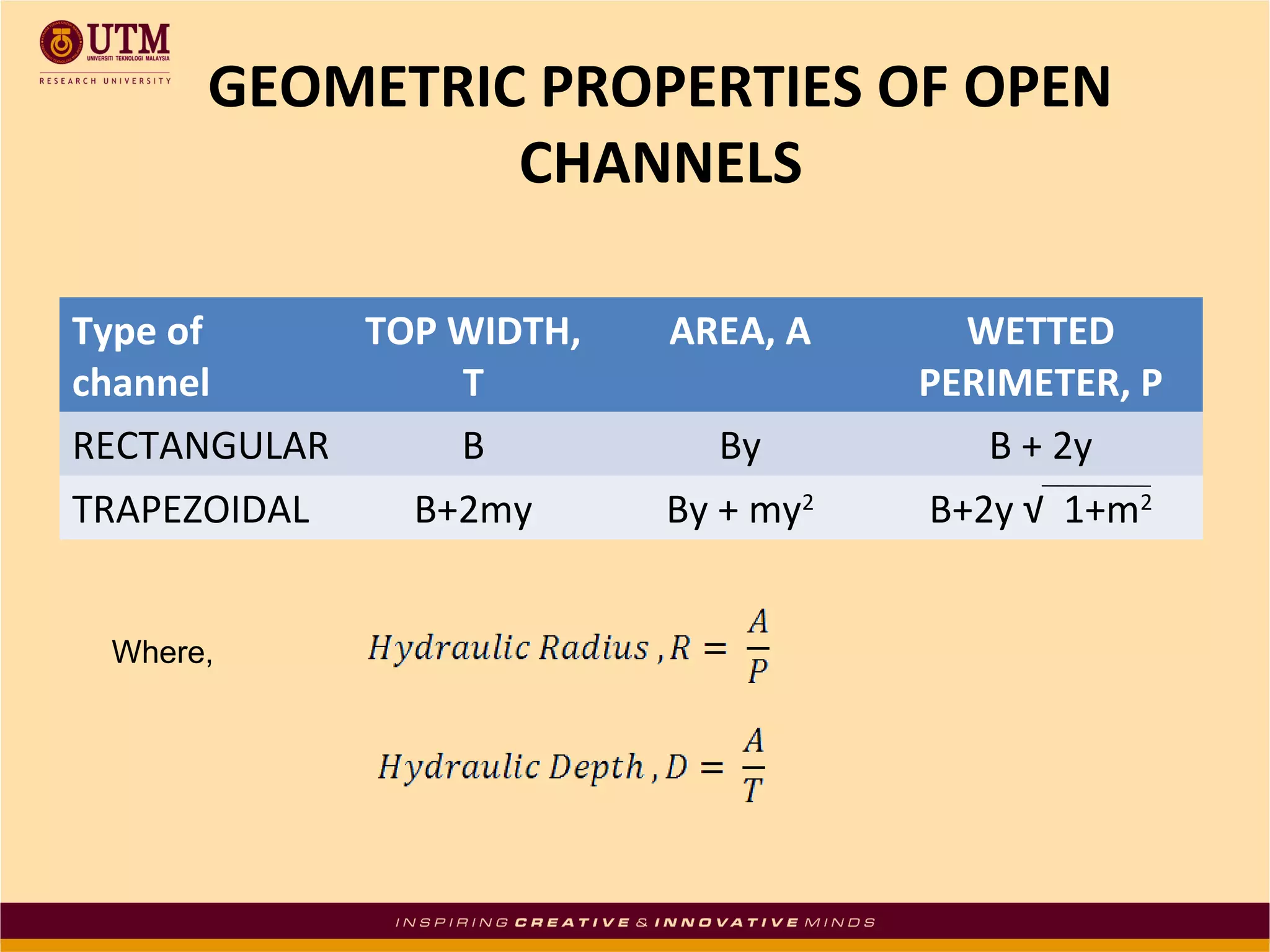
Type of
channel
TOP WIDTH,
T
AREA, A WETTED
PERIMETER, P
RECTANGULAR B By B + 2y
TRAPEZOIDAL B+2my By + my2
B+2y √ 1+m2
GEOMETRIC PROPERTIES OF OPEN
CHANNELS
Where,
UNIFORM FLOW IN OPEN CHANNEL
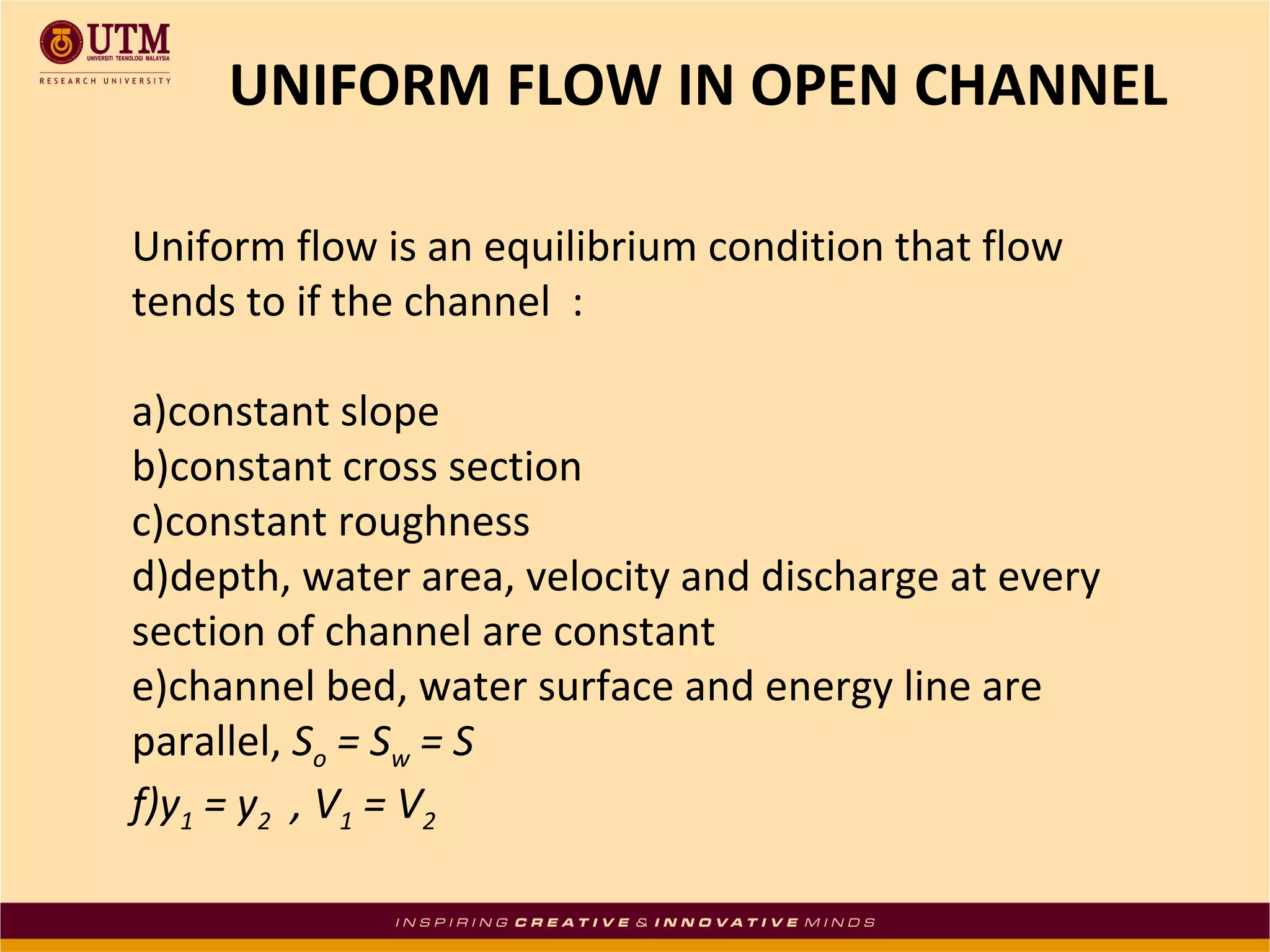
Uniform flow is an equilibrium condition that flow
tends to if the channel :
a)constant slope
b)constant cross section
c)constant roughness
d)depth, water area, velocity and discharge at every
section of channel are constant
e)channel bed, water surface and energy line are
parallel, So = Sw = S
f)y1 = y2 , V1 = V2
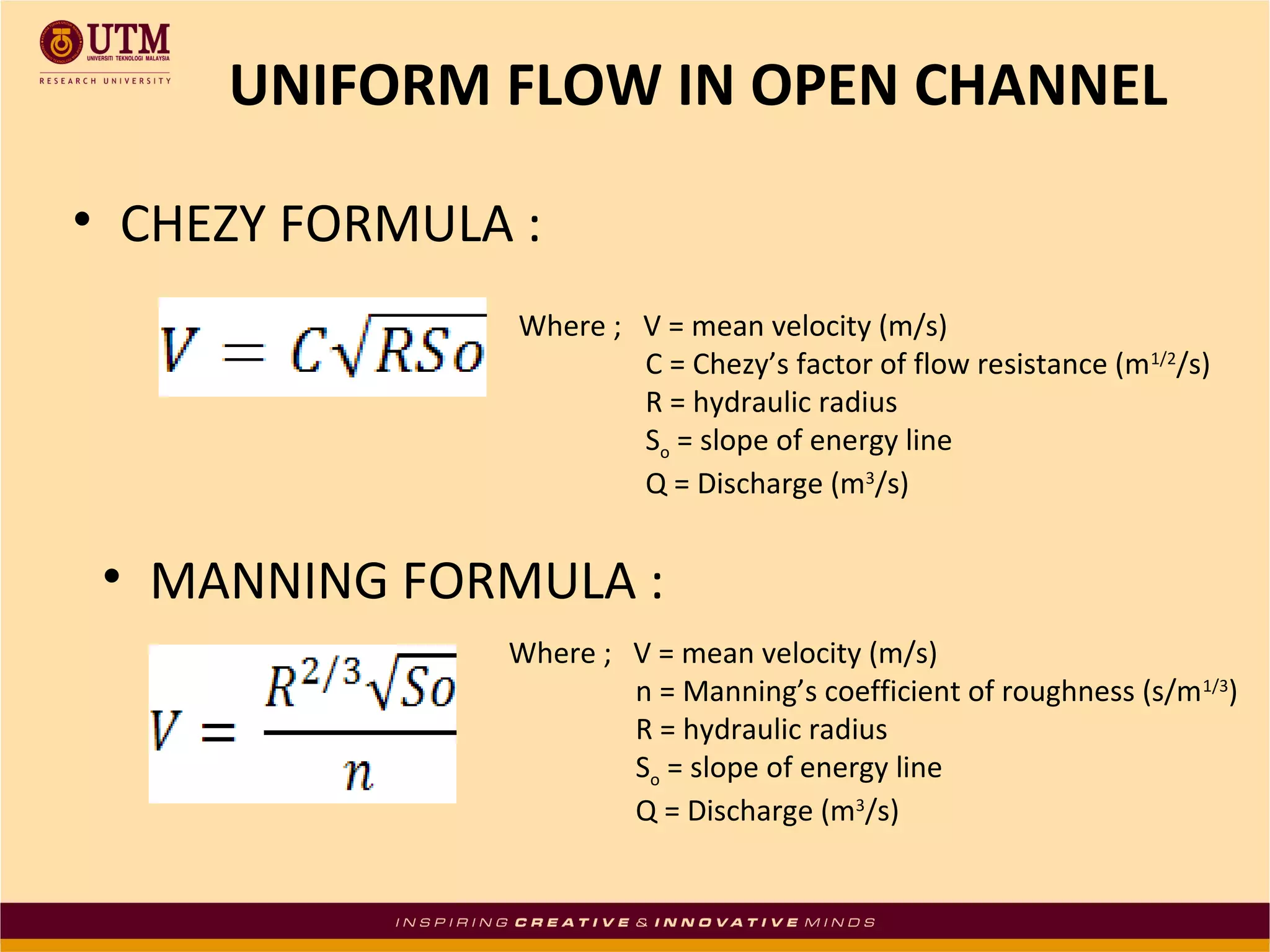
• CHEZY FORMULA :
UNIFORM FLOW IN OPEN CHANNEL
Where ; V = mean velocity (m/s)
C = Chezy’s factor of flow resistance (m1/2
/s)
R = hydraulic radius
So = slope of energy line
Q = Discharge (m3
/s)
• MANNING FORMULA :
Where ; V = mean velocity (m/s)
n = Manning’s coefficient of roughness (s/m1/3
)
R = hydraulic radius
So = slope of energy line
Q = Discharge (m3
/s)
UNIFORM FLOW IN OPEN CHANNEL
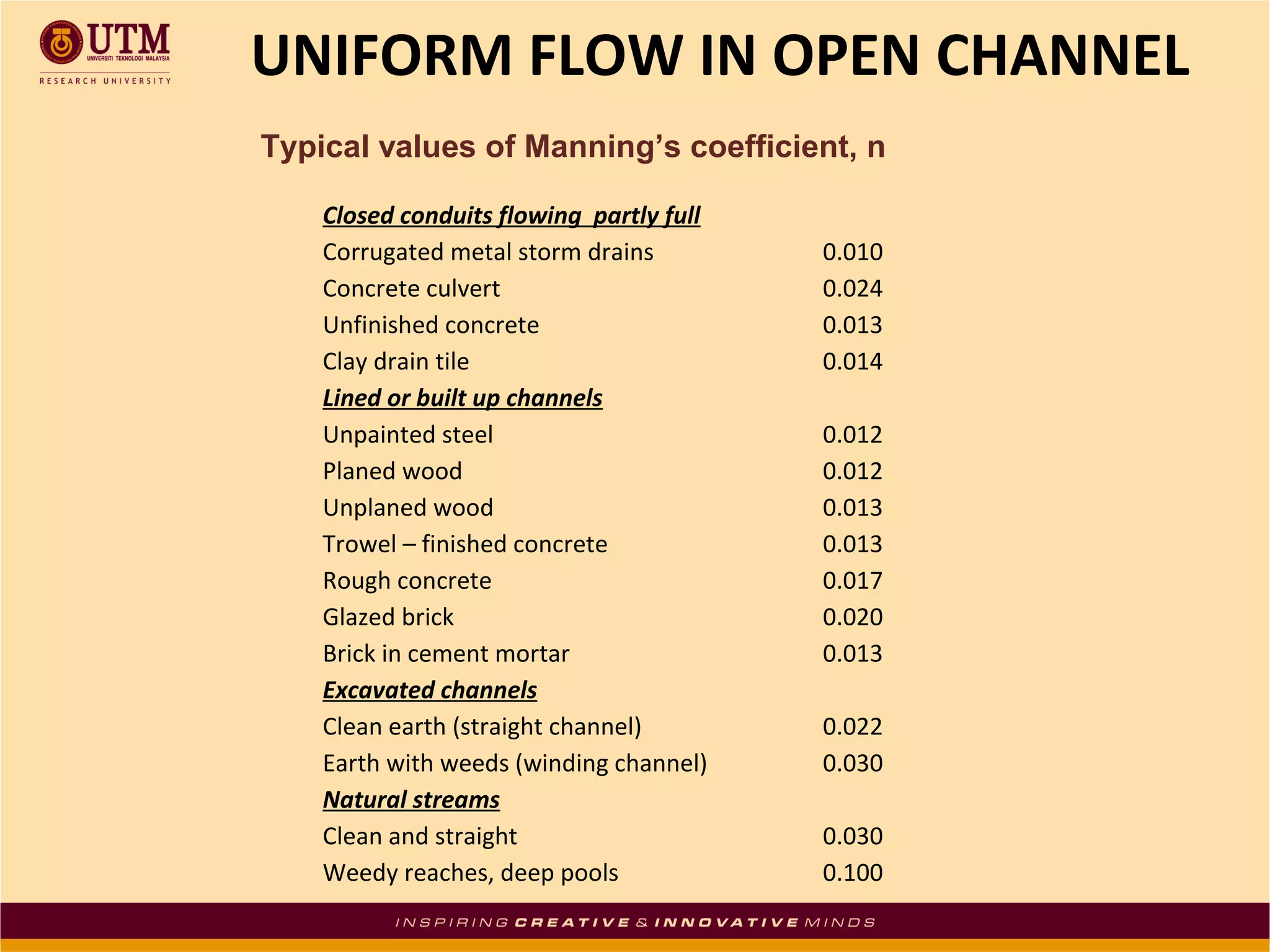
Closed conduits flowing partly full
Corrugated metal storm drains 0.010
Concrete culvert 0.024
Unfinished concrete 0.013
Clay drain tile 0.014
Lined or built up channels
Unpainted steel 0.012
Planed wood 0.012
Unplaned wood 0.013
Trowel – finished concrete 0.013
Rough concrete 0.017
Glazed brick 0.020
Brick in cement mortar 0.013
Excavated channels
Clean earth (straight channel) 0.022
Earth with weeds (winding channel) 0.030
Natural streams
Clean and straight 0.030
Weedy reaches, deep pools 0.100
Typical values of Manning’s coefficient, n
SOLUTION IN OPEN CHANNEL
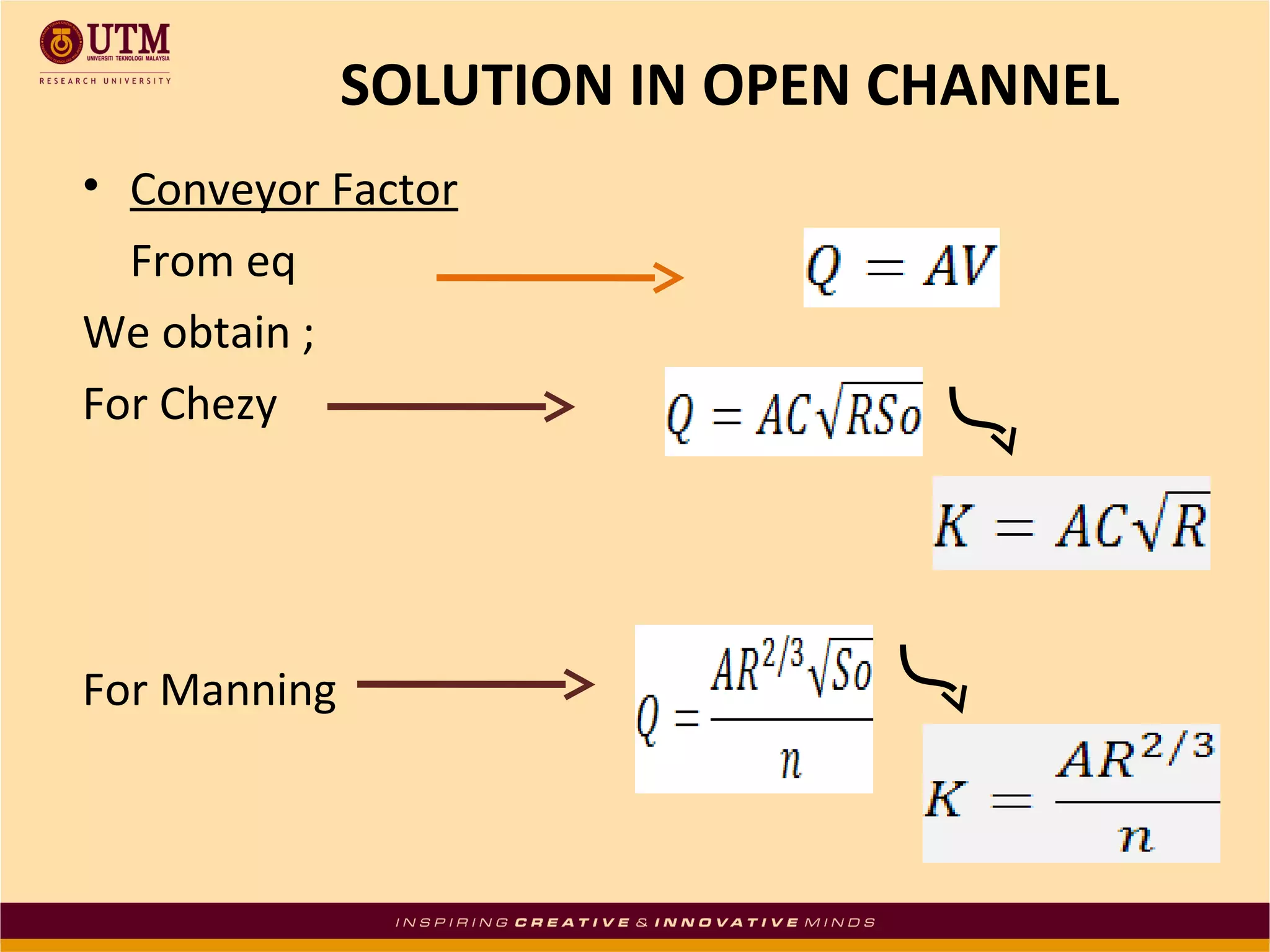
• Conveyor Factor
From eq
We obtain ;
For Chezy
For Manning
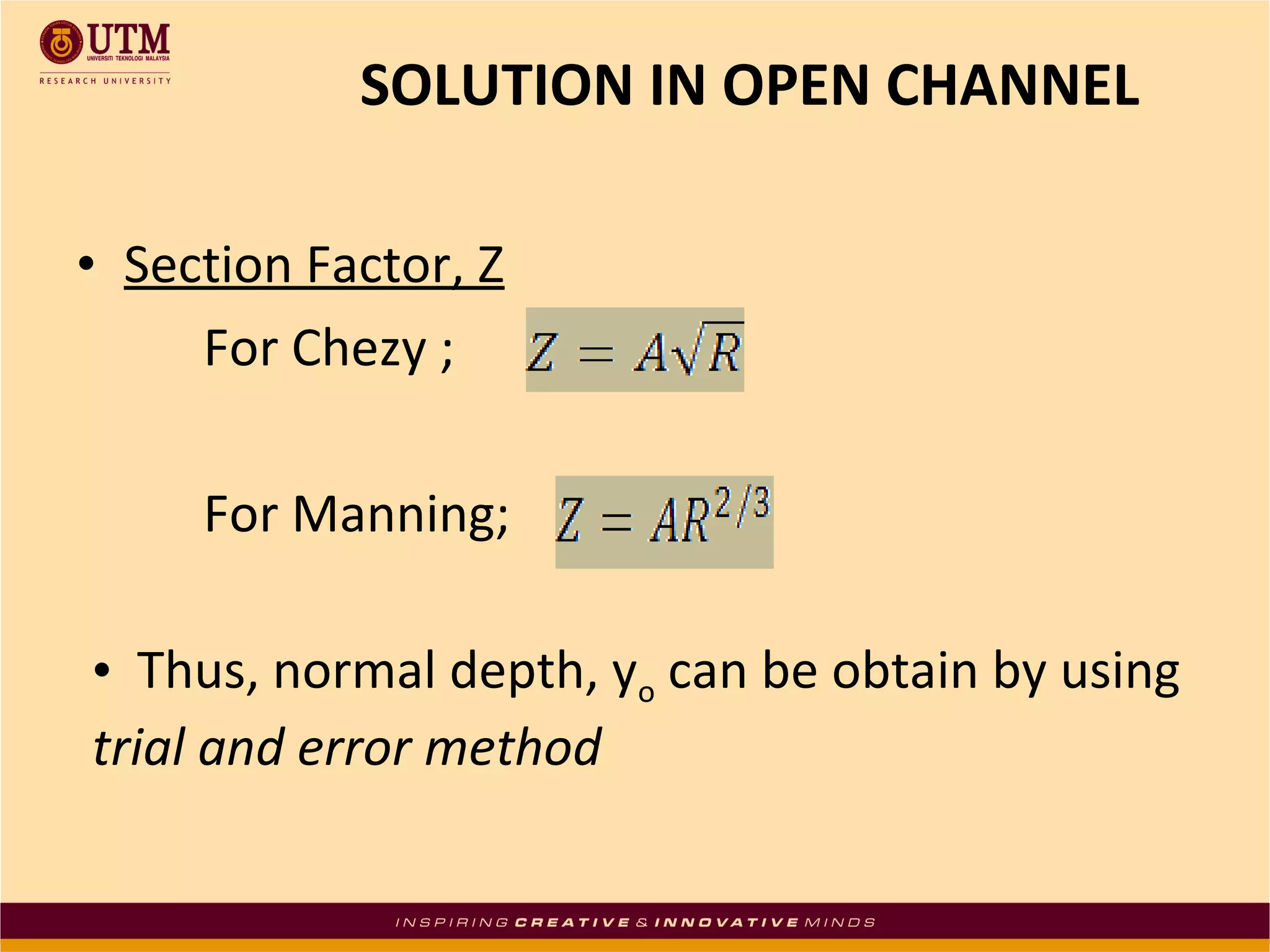
• Section Factor, Z
For Chezy ;
For Manning;
SOLUTION IN OPEN CHANNEL
• Thus, normal depth, yo can be obtain by using
trial and error method
SOLUTION IN OPEN CHANNEL
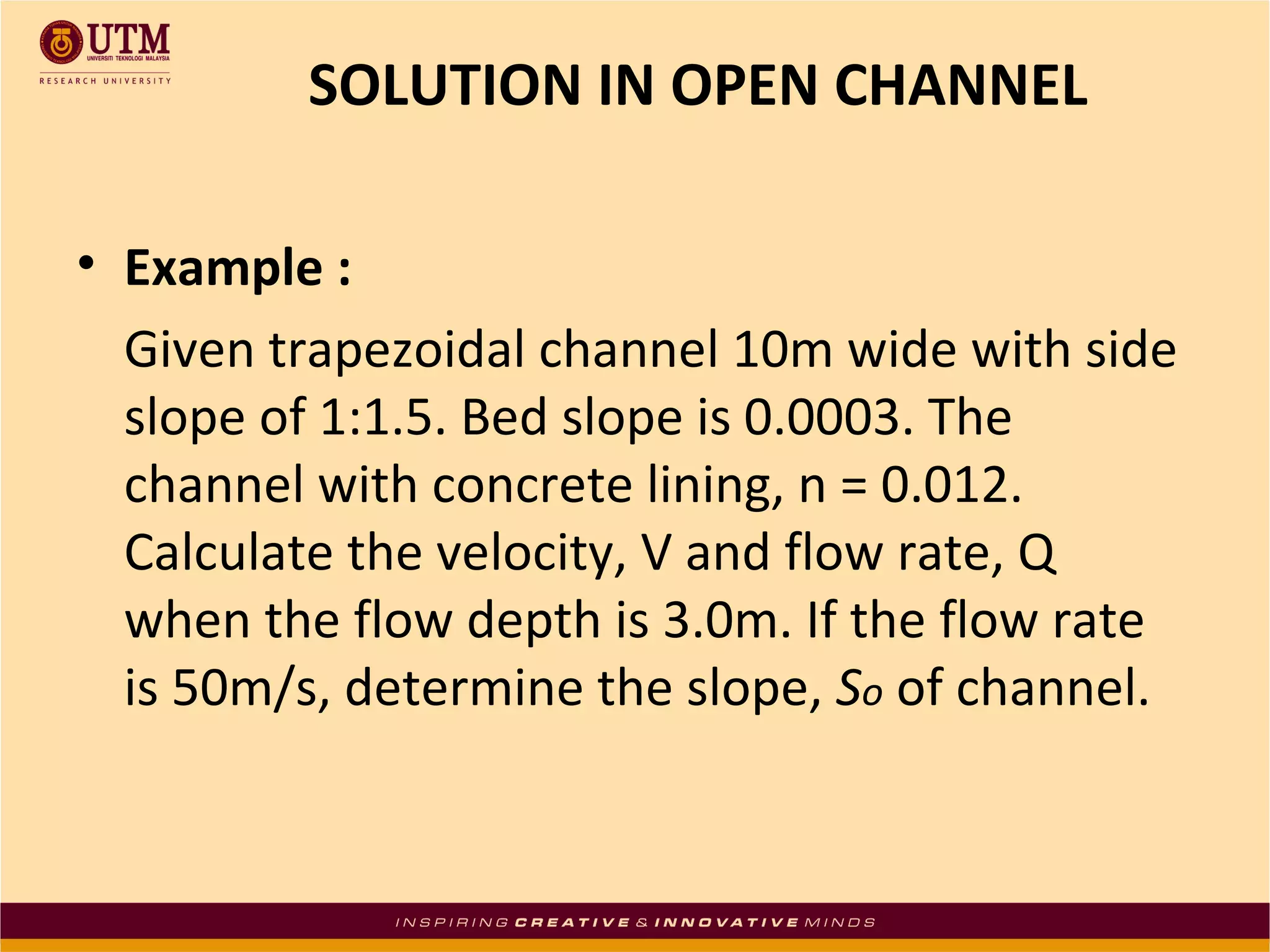
• Example :
Given trapezoidal channel 10m wide with side
slope of 1:1.5. Bed slope is 0.0003. The
channel with concrete lining, n = 0.012.
Calculate the velocity, V and flow rate, Q
when the flow depth is 3.0m. If the flow rate
is 50m/s, determine the slope, So of channel.

Chap1 open channel flow

  • 1.
    HYDRAULICS UNIFORM FLOW INOPEN CHANNELS By Erni Syuhada Bt Mazwil Ishan
  • 2.
    HYDRAULICS ENGINEERING • Ascientific fluid flow particularly in water thoroughly in pipe, open channel, orifice and embankment, including the problem related to energy and pressure. • Related to water or fluid in dynamic condition.
  • 3.
    CONTENT  What isOpen Channel  Types of Open Channel Types of flowing water and control Solution of uniform flow in Open Channel
  • 4.
    OPEN CHANNEL An openchannel : a)The stream not completely enclosed by solid boundaries b)It has free surface subjected only to atmospheric pressure. c)Referred as free-surface flow or gravity flow
  • 5.
    Open Channel TYPES OFOPEN CHANNEL Natural Channel Irregular shape i.e : river, hillsides rivulets, tidal etuaries Artificial Channel Regular shape i.e : drains, culverts, sewer, tunnels
  • 6.
  • 7.
    TYPES OF FLOWINGWATER AND ITS CONTROL Rapidly Varied Flow i.e : hydraulic jump Non-Uniform Flow ≠ 0 Uniform Flow = 0 Gradually Varied flow i.e : upstream of obstruction Open Channel Steady Flow = 0 Open Channel Unsteady Flow ≠ 0
  • 8.
    TYPES OF FLOWINGWATER AND ITS CONTROL Steady • y (depth of water) and v (velocity) remain constant with respect to time Unsteady Flow • y and v change with time
  • 9.
    TYPES OF FLOWINGWATER AND ITS CONTROL Uniform • y (depth of water) and v (velocity) remain constant along the channel. Figure 2.0 Non - uniform Flow • y and v change along the length of the channel Figure 2.0
  • 10.
    • Flow Classifications 1)Depending on the Reynolds number, Re – Laminar Flow (if Re < 500): very slow and shallow flowing water in very smooth open channels. – Turbulent Flow (if Re > 1000): ordinary flow in ordinary open channels. – Transition Flow (if 500 < Re < 1000) TYPES OF FLOWING WATER AND ITS CONTROL V = average channel velocity L = length of channel v = kinematic viscosity of fluid
  • 11.
    2) Depending onFroude number, Fr – Fr = 1 : Critical Flow – Fr < 1 : Subcritical Flow – slow flowing water – Fr > 1 : Supercritical Flow – fast flowing water TYPES OF FLOWING WATER AND ITS CONTROL V = average channel velocity g = gravity acceralation D = hydraulics water depth
  • 12.
  • 15.
    TYPES OF FLOWINGWATER AND ITS CONTROL Critical Section (In uniform and non-uniform flow) 1) If So < Sc, y > yc : Subcritical flow 2) If So = Sc, y = yc : Critical flow 3) If So > Sc, y < yc : Supercritical flow Figure 3.0
  • 16.
  • 17.
    Open Channel GEOMETRIC PROPERTIESOF OPEN CHANNELS RECTANGULAR CHANNEL TRAPEZOIDAL CHANNEL
  • 18.
    • The terminologyof geometric elements y : depth of flow T : top width b : bottom channel width m : side slope So : channel bottom slope v : average flow density Fr : Froude number Re : Reynold number L : length of channel Q : flow rates , Q = AV A : area of the flow P : wetted perimeter R: hydraulic radius at cross section D : hydraulics water depth V : volume ν : velocity E : specific energy ∆z : weir height θ : flow temperature q = discharge over width (m) GEOMETRIC PROPERTIES OF OPEN CHANNELS
  • 19.
    Type of channel TOP WIDTH, T AREA,A WETTED PERIMETER, P RECTANGULAR B By B + 2y TRAPEZOIDAL B+2my By + my2 B+2y √ 1+m2 GEOMETRIC PROPERTIES OF OPEN CHANNELS Where,
  • 20.
    UNIFORM FLOW INOPEN CHANNEL Uniform flow is an equilibrium condition that flow tends to if the channel : a)constant slope b)constant cross section c)constant roughness d)depth, water area, velocity and discharge at every section of channel are constant e)channel bed, water surface and energy line are parallel, So = Sw = S f)y1 = y2 , V1 = V2
  • 21.
    • CHEZY FORMULA: UNIFORM FLOW IN OPEN CHANNEL Where ; V = mean velocity (m/s) C = Chezy’s factor of flow resistance (m1/2 /s) R = hydraulic radius So = slope of energy line Q = Discharge (m3 /s) • MANNING FORMULA : Where ; V = mean velocity (m/s) n = Manning’s coefficient of roughness (s/m1/3 ) R = hydraulic radius So = slope of energy line Q = Discharge (m3 /s)
  • 22.
    UNIFORM FLOW INOPEN CHANNEL Closed conduits flowing partly full Corrugated metal storm drains 0.010 Concrete culvert 0.024 Unfinished concrete 0.013 Clay drain tile 0.014 Lined or built up channels Unpainted steel 0.012 Planed wood 0.012 Unplaned wood 0.013 Trowel – finished concrete 0.013 Rough concrete 0.017 Glazed brick 0.020 Brick in cement mortar 0.013 Excavated channels Clean earth (straight channel) 0.022 Earth with weeds (winding channel) 0.030 Natural streams Clean and straight 0.030 Weedy reaches, deep pools 0.100 Typical values of Manning’s coefficient, n
  • 23.
    SOLUTION IN OPENCHANNEL • Conveyor Factor From eq We obtain ; For Chezy For Manning
  • 24.
    • Section Factor,Z For Chezy ; For Manning; SOLUTION IN OPEN CHANNEL • Thus, normal depth, yo can be obtain by using trial and error method
  • 25.
    SOLUTION IN OPENCHANNEL • Example : Given trapezoidal channel 10m wide with side slope of 1:1.5. Bed slope is 0.0003. The channel with concrete lining, n = 0.012. Calculate the velocity, V and flow rate, Q when the flow depth is 3.0m. If the flow rate is 50m/s, determine the slope, So of channel.