tics
Slide
1
Problem 1: Relationship between Two
Variables-1 (1)
First, identify two variables with which this
question is related. Here, the variables of
interest are [attend] and [sex].
Second, examine the direction of relationship. In
other words, for example, examine whether female
were “more” or “less” likely to attend religious
services more than once a week than male.
tics
Slide
2
Problem 1: Relationship between Two
Variables-1 (2)
Furthermore, by now, you should be able
to identify that [sex] is an independent
variable and [attend] is a dependent
variable in this statement.
Now, let’s explore how to answer this
question using SPSS.
tics
Slide
3 Cross Tabulation in SPSS-1 (1)
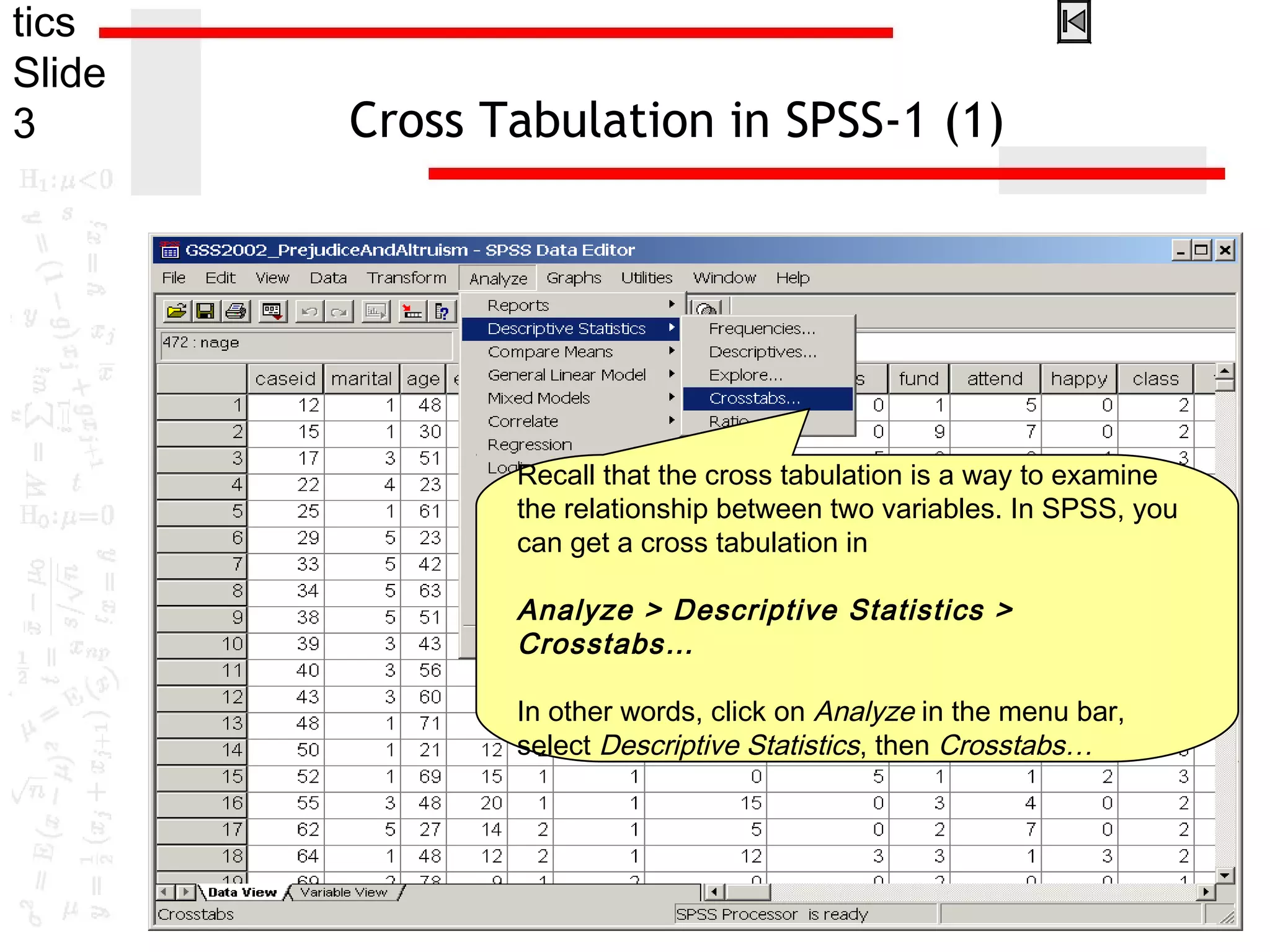
Recall that the cross tabulation is a way to examine
the relationship between two variables. In SPSS, you
can get a cross tabulation in
Analyze > Descriptive Statistics >
Crosstabs…
In other words, click on Analyze in the menu bar,
select Descriptive Statistics, then Crosstabs…
tics
Slide
4 Cross Tabulation in SPSS-1 (2)
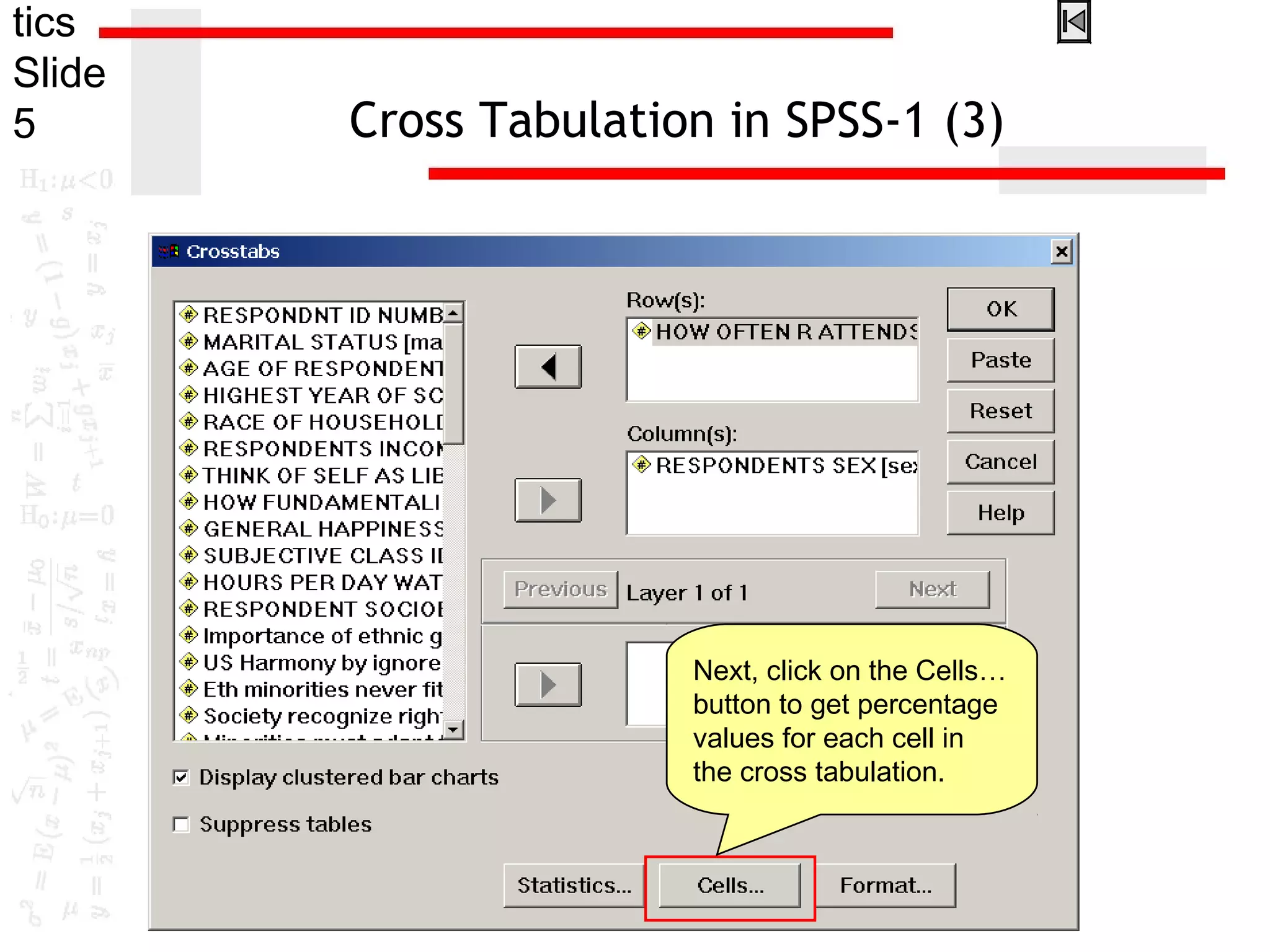
In the Crosstabs window, find and move the
independent and dependent variable to
Column(s): and Row(s): boxes, respectively. In
this case, the independent variable [sex] goes to
Column(s): box and the dependent variable
[attend] goes to Row(s): box.
tics
Slide
5 Cross Tabulation in SPSS-1 (3)
Next, click on the Cells…
button to get percentage
values for each cell in
the cross tabulation.
tics
Slide
6 Cross Tabulation in SPSS-1 (4)
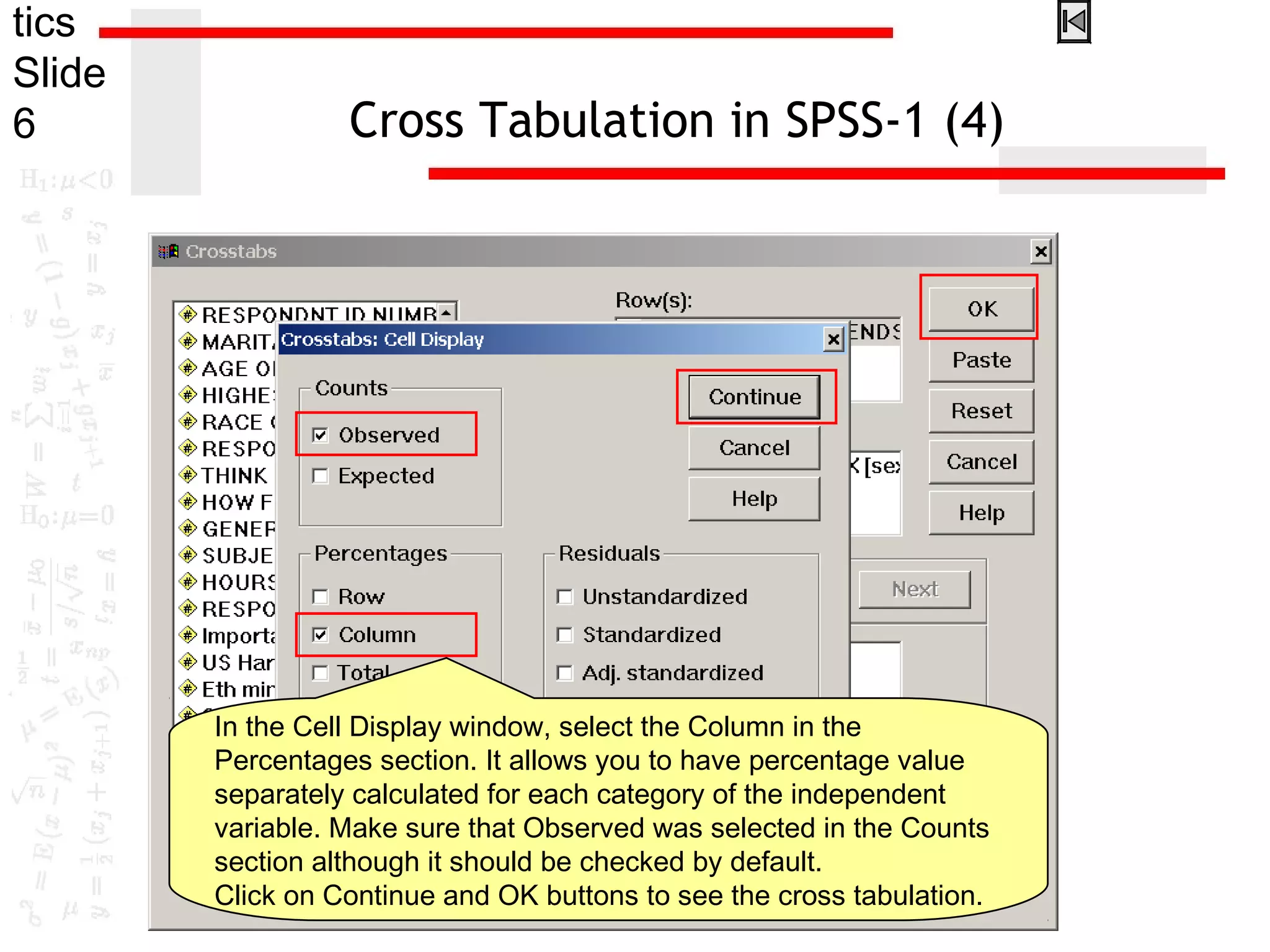
In the Cell Display window, select the Column in the
Percentages section. It allows you to have percentage value
separately calculated for each category of the independent
variable. Make sure that Observed was selected in the Counts
section although it should be checked by default.
Click on Continue and OK buttons to see the cross tabulation.
tics
Slide
7 Cross Tabulation in SPSS-1 (5)
The output displays two
tables, one for case
processing summary
and the other for cross
tabulation of the two
variables. Notice that
[sex] is on the column
and [attend] is on the
row of the cross
tabulation as we
assigned.
tics
Slide
8 Cross Tabulation in SPSS-1 (6)
Also notice that the percentage
values were calculated by column
(i.e., [sex]). For example, the
percentage value on the row
labeled “8 MORE THAN ONCE
WK”, “% within RESPONDENTS
SEX”, in the column labeled “1
MALE” was obtained with the
count of the cell (18) divided by
the count of the males (291) (i.e.
18/291=6.2%). In other words,
6.2% of male respondents said
that they attended religious
services more than once a week.
tics
Slide
9 Cross Tabulation in SPSS-1 (7)
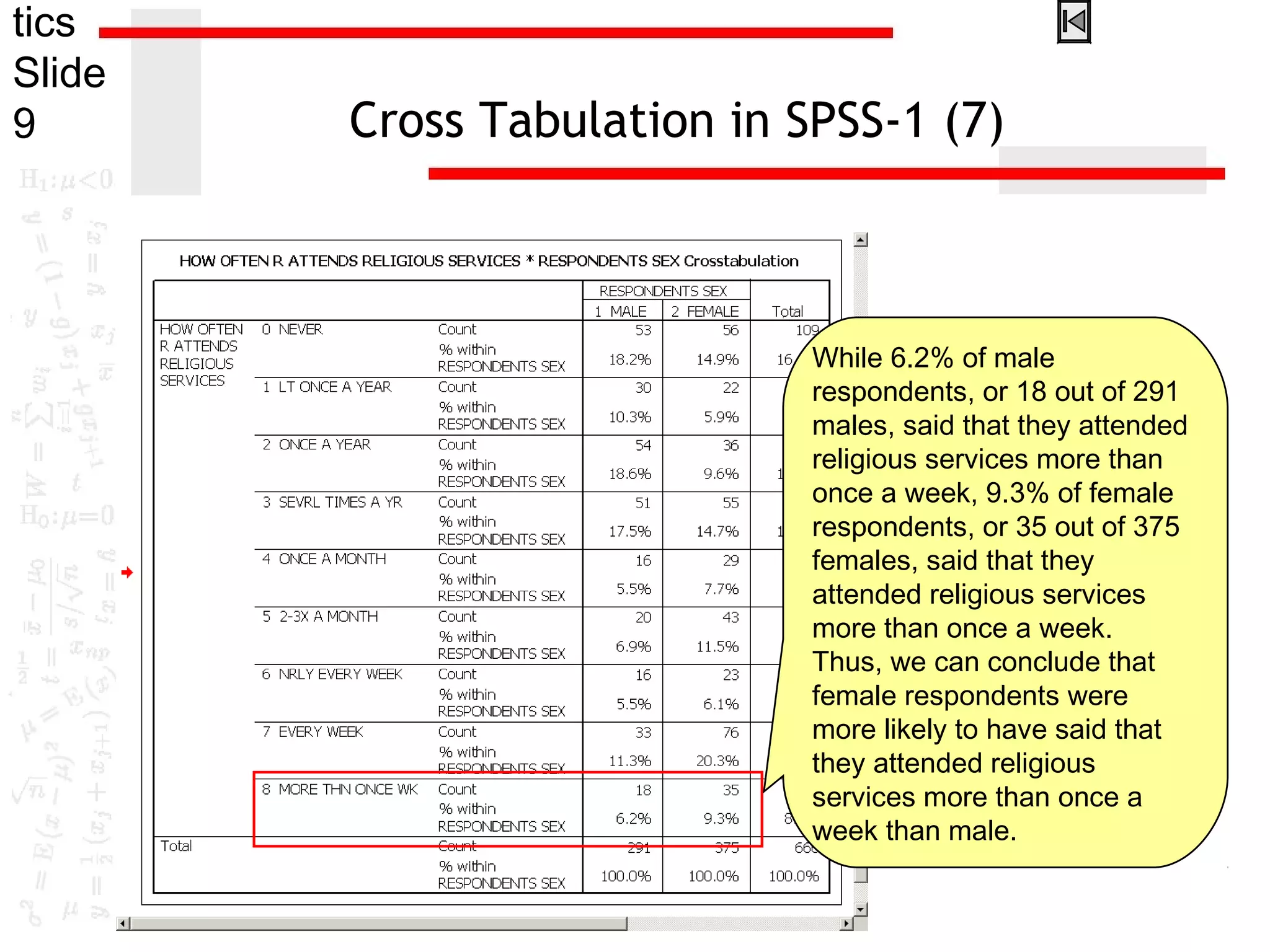
While 6.2% of male
respondents, or 18 out of 291
males, said that they attended
religious services more than
once a week, 9.3% of female
respondents, or 35 out of 375
females, said that they
attended religious services
more than once a week.
Thus, we can conclude that
female respondents were
more likely to have said that
they attended religious
services more than once a
week than male.
tics
Slide
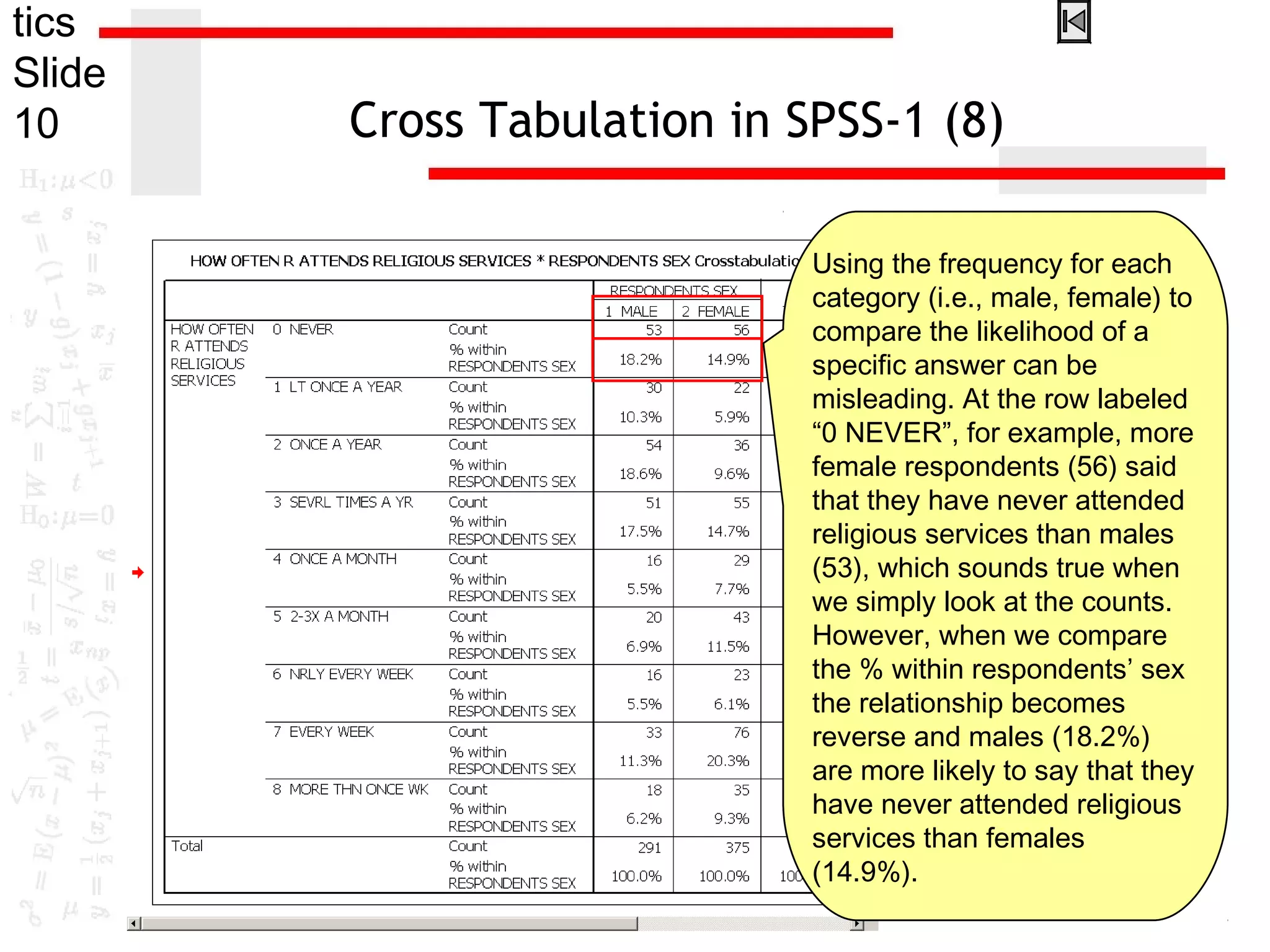
10 Cross Tabulation in SPSS-1 (8)
Using the frequency for each
category (i.e., male, female) to
compare the likelihood of a
specific answer can be
misleading. At the row labeled
“0 NEVER”, for example, more
female respondents (56) said
that they have never attended
religious services than males
(53), which sounds true when
we simply look at the counts.
However, when we compare
the % within respondents’ sex
the relationship becomes
reverse and males (18.2%)
are more likely to say that they
have never attended religious
services than females
(14.9%).
tics
Slide
11
Problem 2: Relationship between Two
Variables-2
This question is asking
whether there is a
relationship between
[sex] and [ethimp].
Again, you have to
know that [sex] is an
independent variable
and [ethimp] is a
dependent variable
here.
tics
Slide
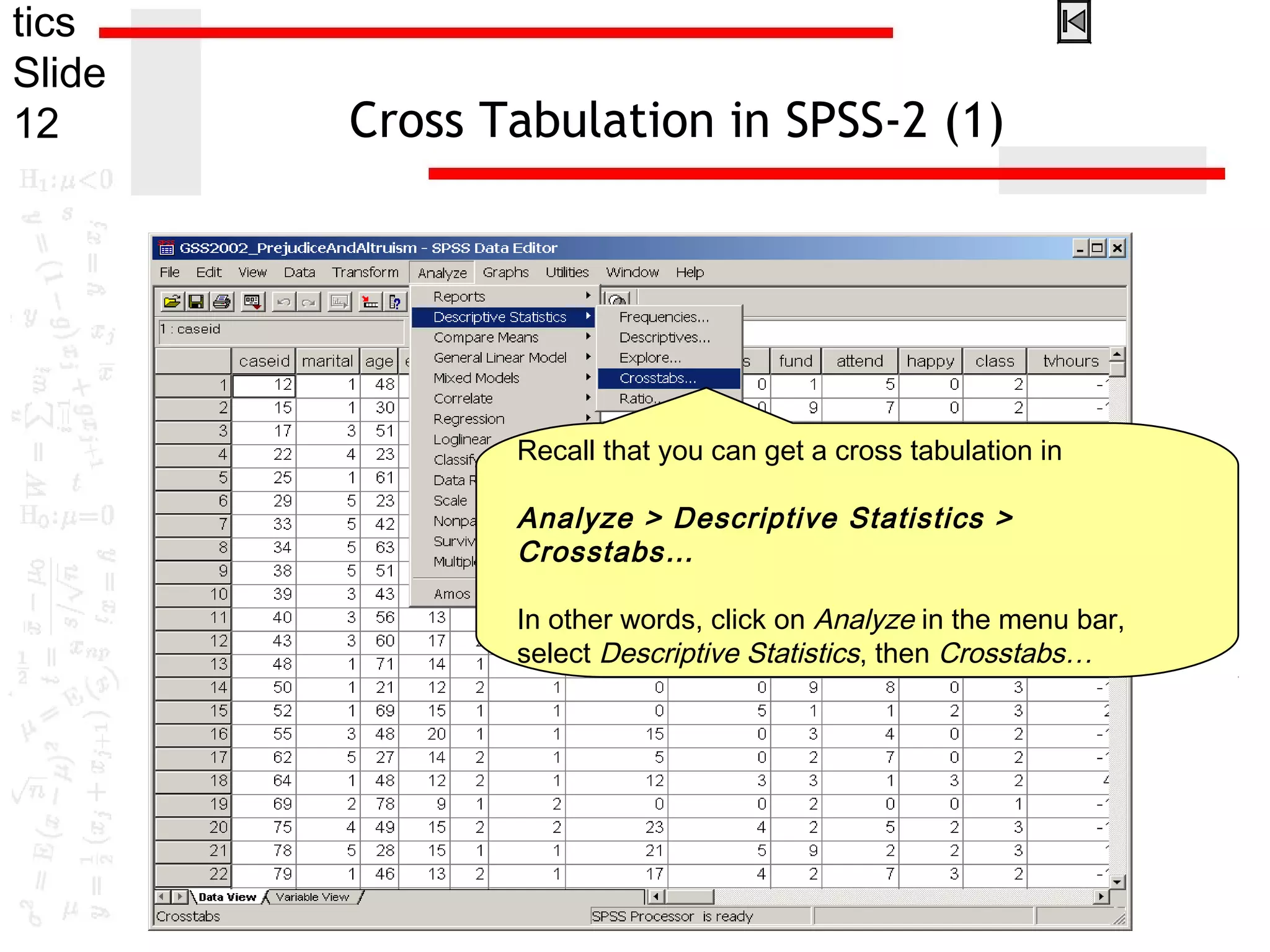
12 Cross Tabulation in SPSS-2 (1)
Recall that you can get a cross tabulation in
Analyze > Descriptive Statistics >
Crosstabs…
In other words, click on Analyze in the menu bar,
select Descriptive Statistics, then Crosstabs…
tics
Slide
13 Cross Tabulation in SPSS-2 (2)
First, in the Crosstabs window,
find and move the independent
variable [sex] to Column(s): box
and the dependent variable
[ethimp] to Row(s): box.
Next, click Cells… button and
select Columns in Percentages
section.
tics
Slide
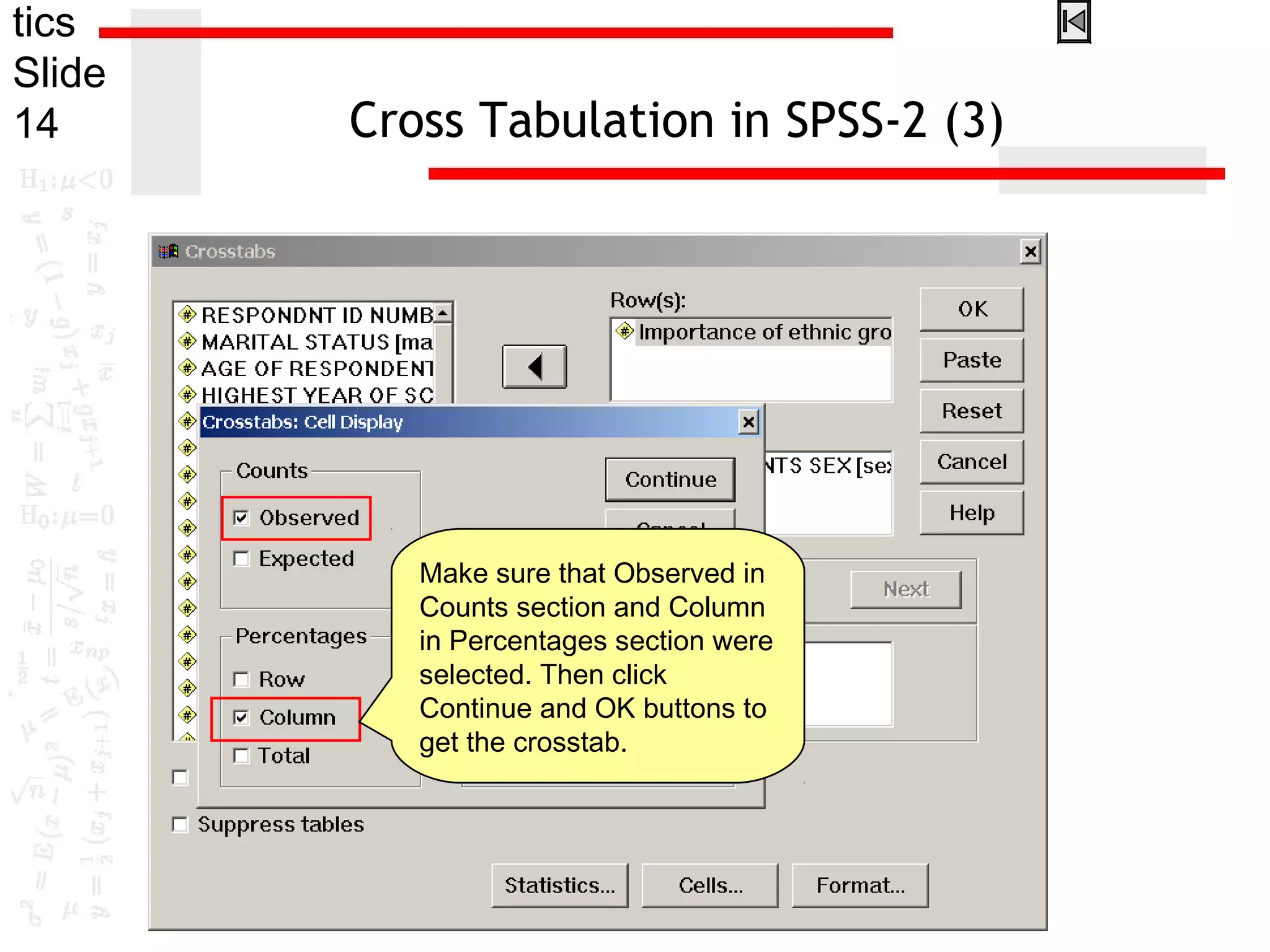
14 Cross Tabulation in SPSS-2 (3)
Make sure that Observed in
Counts section and Column
in Percentages section were
selected. Then click
Continue and OK buttons to
get the crosstab.
tics
Slide
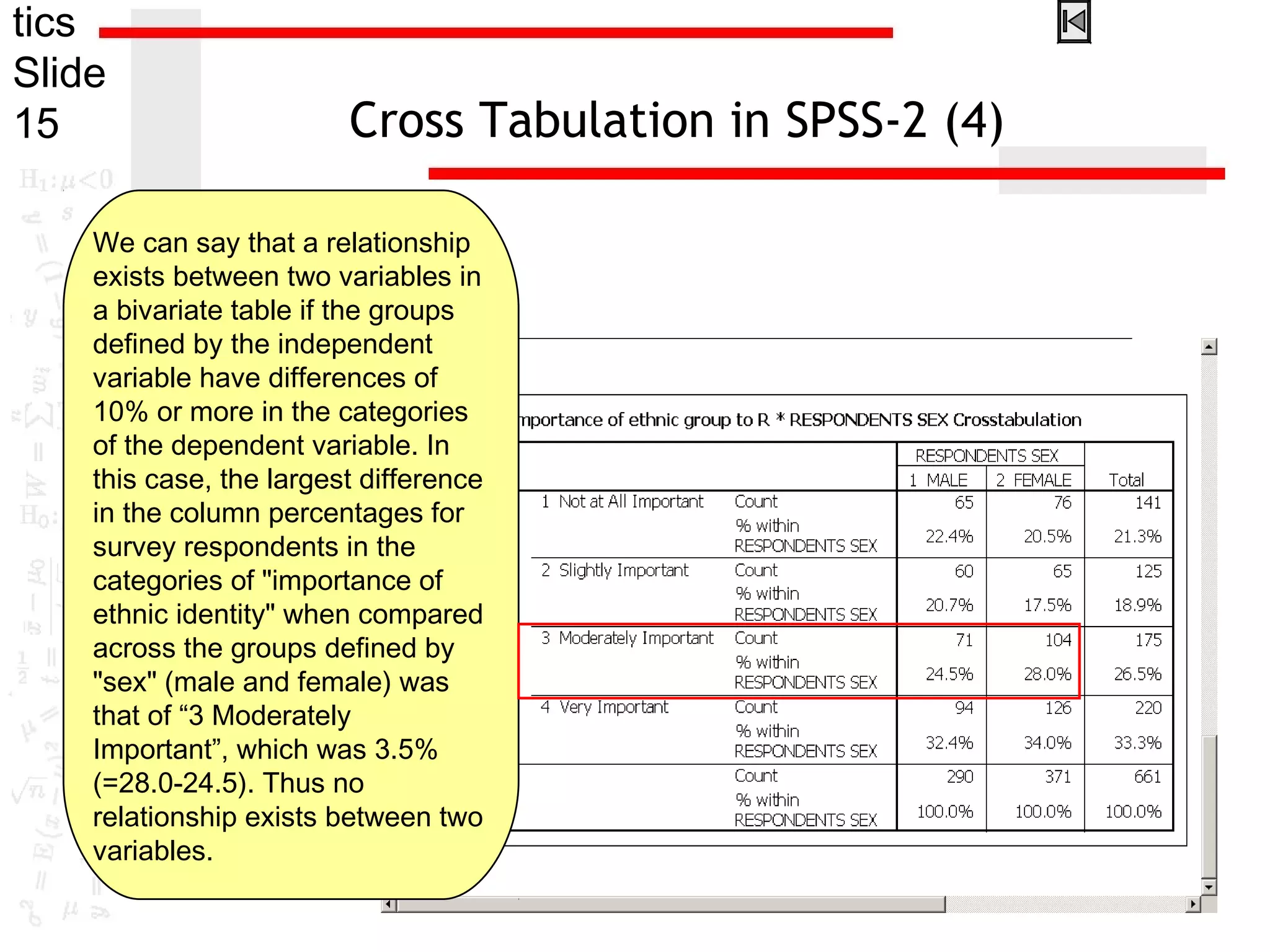
15 Cross Tabulation in SPSS-2 (4)
We can say that a relationship
exists between two variables in
a bivariate table if the groups
defined by the independent
variable have differences of
10% or more in the categories
of the dependent variable. In
this case, the largest difference
in the column percentages for
survey respondents in the
categories of "importance of
ethnic identity" when compared
across the groups defined by
"sex" (male and female) was
that of “3 Moderately
Important”, which was 3.5%
(=28.0-24.5). Thus no
relationship exists between two
variables.
tics
Slide
16
Problem 3: Relationship between Two
Variables-3 (1)
This question asks about how much is the relationship
between the two variables. Notice that the dependent
variable in this question is [ethtrads] and the independent
variable is [sex].
tics
Slide
17 Cross Tabulation in SPSS-3 (1)
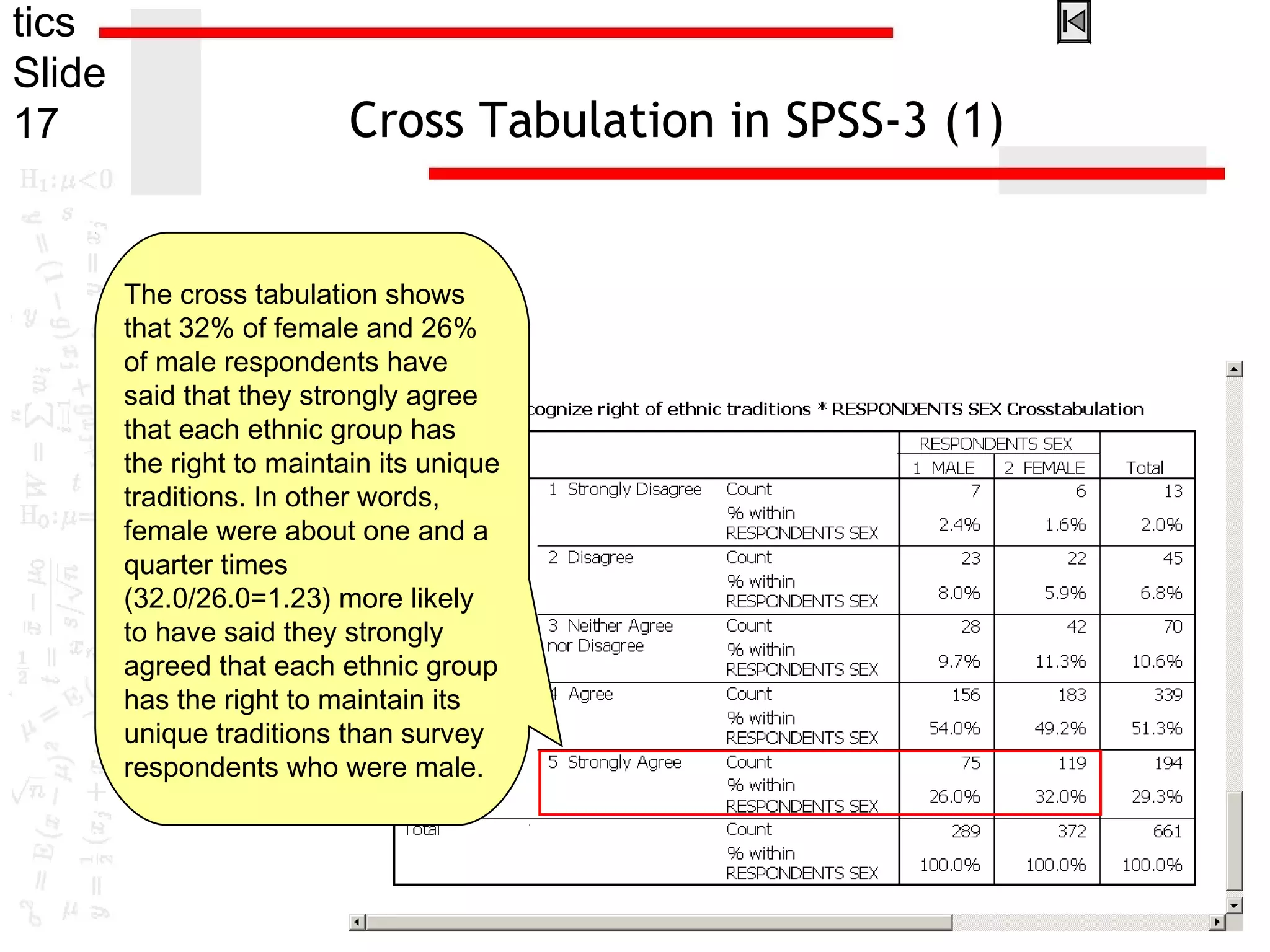
The cross tabulation shows
that 32% of female and 26%
of male respondents have
said that they strongly agree
that each ethnic group has
the right to maintain its unique
traditions. In other words,
female were about one and a
quarter times
(32.0/26.0=1.23) more likely
to have said they strongly
agreed that each ethnic group
has the right to maintain its
unique traditions than survey
respondents who were male.
tics
Slide
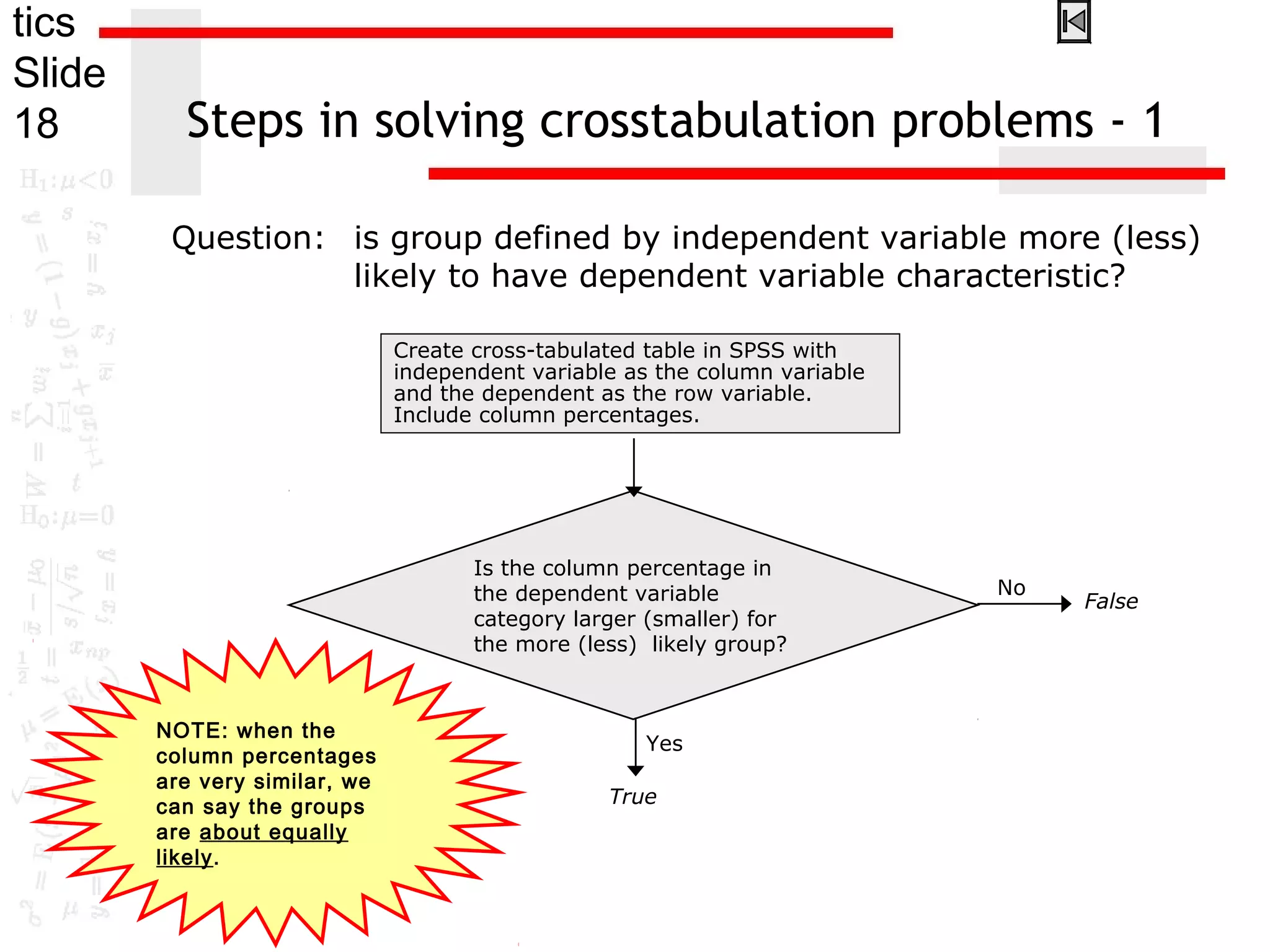
18 Steps in solving crosstabulation problems - 1
Question: is group defined by independent variable more (less)
likely to have dependent variable characteristic?
False
Is the column percentage in
the dependent variable
category larger (smaller) for
the more (less) likely group?
No
True
Yes
Create cross-tabulated table in SPSS with
independent variable as the column variable
and the dependent as the row variable.
Include column percentages.
NOTE: when the
column percentages
are very similar, we
can say the groups
are about equally
likely.
tics
Slide
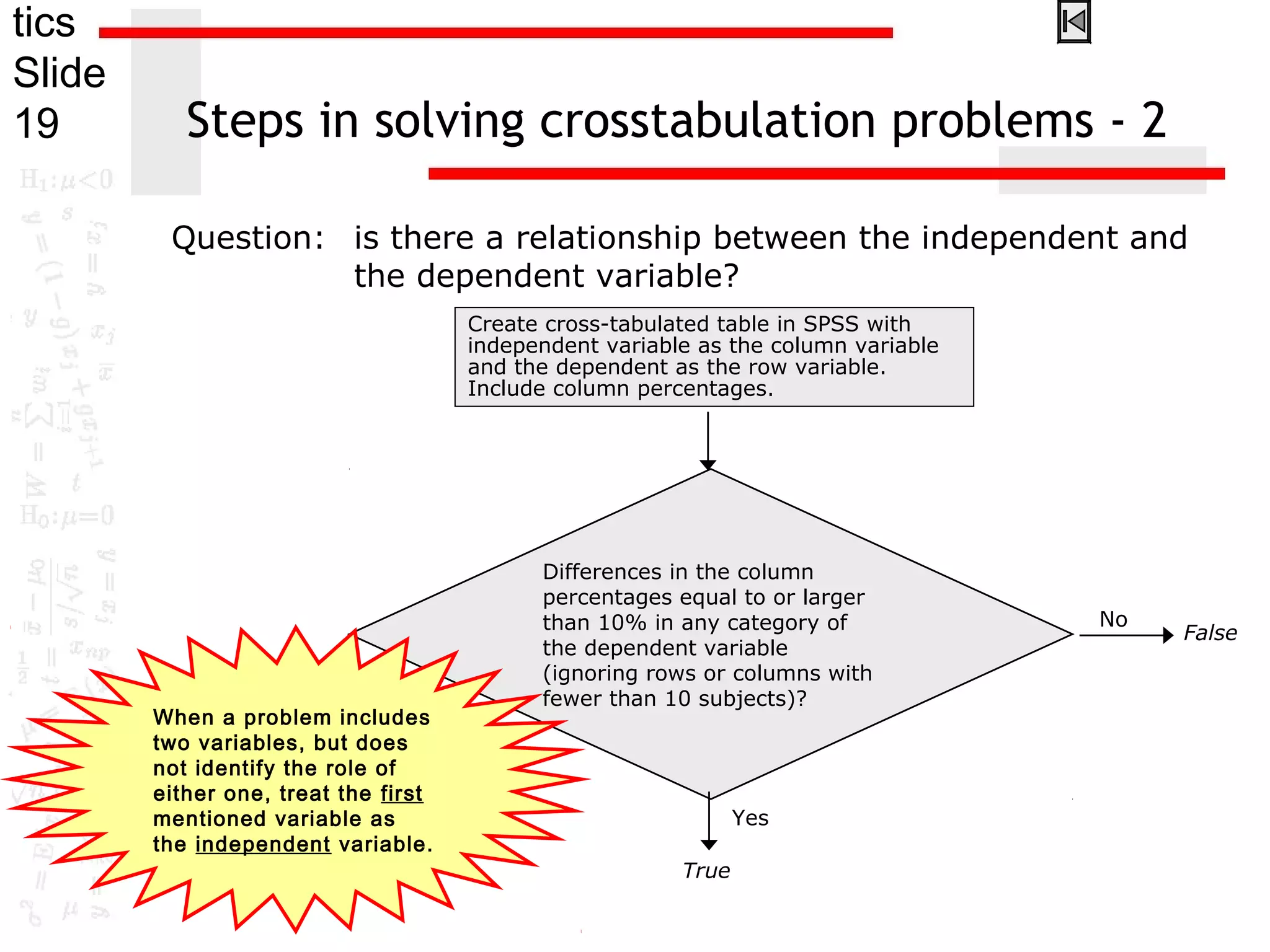
19 Steps in solving crosstabulation problems - 2
Question: is there a relationship between the independent and
the dependent variable?
False
Differences in the column
percentages equal to or larger
than 10% in any category of
the dependent variable
(ignoring rows or columns with
fewer than 10 subjects)?
No
True
Yes
Create cross-tabulated table in SPSS with
independent variable as the column variable
and the dependent as the row variable.
Include column percentages.
When a problem includes
two variables, but does
not identify the role of
either one, treat the first
mentioned variable as
the independent variable.
tics
Slide
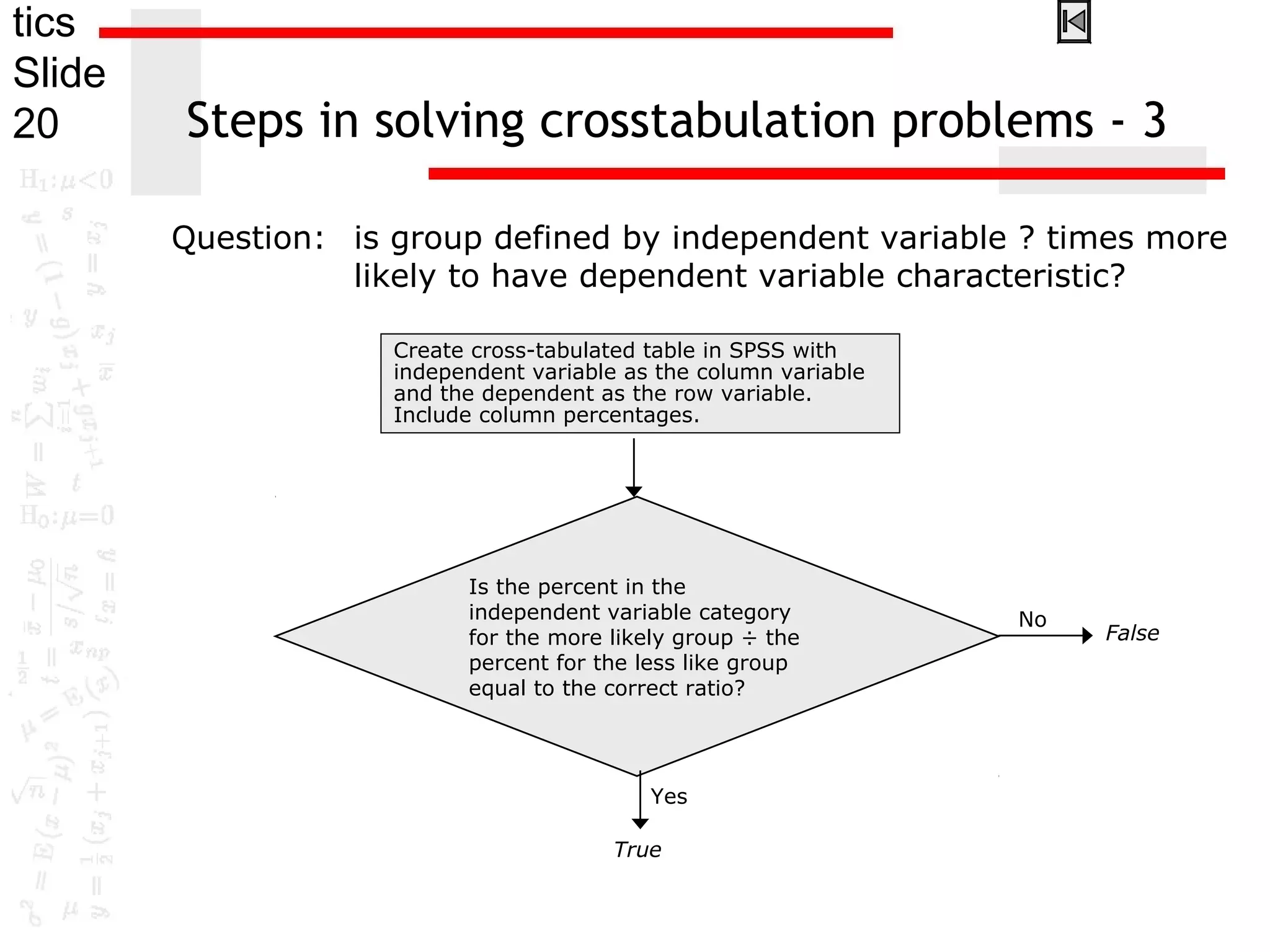
20 Steps in solving crosstabulation problems - 3
Question: is group defined by independent variable ? times more
likely to have dependent variable characteristic?
False
Is the percent in the
independent variable category
for the more likely group ÷ the
percent for the less like group
equal to the correct ratio?
No
True
Yes
Create cross-tabulated table in SPSS with
independent variable as the column variable
and the dependent as the row variable.
Include column percentages.

cross tabulation

  • 1.
    tics Slide 1 Problem 1: Relationshipbetween Two Variables-1 (1) First, identify two variables with which this question is related. Here, the variables of interest are [attend] and [sex]. Second, examine the direction of relationship. In other words, for example, examine whether female were “more” or “less” likely to attend religious services more than once a week than male.
  • 2.
    tics Slide 2 Problem 1: Relationshipbetween Two Variables-1 (2) Furthermore, by now, you should be able to identify that [sex] is an independent variable and [attend] is a dependent variable in this statement. Now, let’s explore how to answer this question using SPSS.
  • 3.
    tics Slide 3 Cross Tabulationin SPSS-1 (1) Recall that the cross tabulation is a way to examine the relationship between two variables. In SPSS, you can get a cross tabulation in Analyze > Descriptive Statistics > Crosstabs… In other words, click on Analyze in the menu bar, select Descriptive Statistics, then Crosstabs…
  • 4.
    tics Slide 4 Cross Tabulationin SPSS-1 (2) In the Crosstabs window, find and move the independent and dependent variable to Column(s): and Row(s): boxes, respectively. In this case, the independent variable [sex] goes to Column(s): box and the dependent variable [attend] goes to Row(s): box.
  • 5.
    tics Slide 5 Cross Tabulationin SPSS-1 (3) Next, click on the Cells… button to get percentage values for each cell in the cross tabulation.
  • 6.
    tics Slide 6 Cross Tabulationin SPSS-1 (4) In the Cell Display window, select the Column in the Percentages section. It allows you to have percentage value separately calculated for each category of the independent variable. Make sure that Observed was selected in the Counts section although it should be checked by default. Click on Continue and OK buttons to see the cross tabulation.
  • 7.
    tics Slide 7 Cross Tabulationin SPSS-1 (5) The output displays two tables, one for case processing summary and the other for cross tabulation of the two variables. Notice that [sex] is on the column and [attend] is on the row of the cross tabulation as we assigned.
  • 8.
    tics Slide 8 Cross Tabulationin SPSS-1 (6) Also notice that the percentage values were calculated by column (i.e., [sex]). For example, the percentage value on the row labeled “8 MORE THAN ONCE WK”, “% within RESPONDENTS SEX”, in the column labeled “1 MALE” was obtained with the count of the cell (18) divided by the count of the males (291) (i.e. 18/291=6.2%). In other words, 6.2% of male respondents said that they attended religious services more than once a week.
  • 9.
    tics Slide 9 Cross Tabulationin SPSS-1 (7) While 6.2% of male respondents, or 18 out of 291 males, said that they attended religious services more than once a week, 9.3% of female respondents, or 35 out of 375 females, said that they attended religious services more than once a week. Thus, we can conclude that female respondents were more likely to have said that they attended religious services more than once a week than male.
  • 10.
    tics Slide 10 Cross Tabulationin SPSS-1 (8) Using the frequency for each category (i.e., male, female) to compare the likelihood of a specific answer can be misleading. At the row labeled “0 NEVER”, for example, more female respondents (56) said that they have never attended religious services than males (53), which sounds true when we simply look at the counts. However, when we compare the % within respondents’ sex the relationship becomes reverse and males (18.2%) are more likely to say that they have never attended religious services than females (14.9%).
  • 11.
    tics Slide 11 Problem 2: Relationshipbetween Two Variables-2 This question is asking whether there is a relationship between [sex] and [ethimp]. Again, you have to know that [sex] is an independent variable and [ethimp] is a dependent variable here.
  • 12.
    tics Slide 12 Cross Tabulationin SPSS-2 (1) Recall that you can get a cross tabulation in Analyze > Descriptive Statistics > Crosstabs… In other words, click on Analyze in the menu bar, select Descriptive Statistics, then Crosstabs…
  • 13.
    tics Slide 13 Cross Tabulationin SPSS-2 (2) First, in the Crosstabs window, find and move the independent variable [sex] to Column(s): box and the dependent variable [ethimp] to Row(s): box. Next, click Cells… button and select Columns in Percentages section.
  • 14.
    tics Slide 14 Cross Tabulationin SPSS-2 (3) Make sure that Observed in Counts section and Column in Percentages section were selected. Then click Continue and OK buttons to get the crosstab.
  • 15.
    tics Slide 15 Cross Tabulationin SPSS-2 (4) We can say that a relationship exists between two variables in a bivariate table if the groups defined by the independent variable have differences of 10% or more in the categories of the dependent variable. In this case, the largest difference in the column percentages for survey respondents in the categories of "importance of ethnic identity" when compared across the groups defined by "sex" (male and female) was that of “3 Moderately Important”, which was 3.5% (=28.0-24.5). Thus no relationship exists between two variables.
  • 16.
    tics Slide 16 Problem 3: Relationshipbetween Two Variables-3 (1) This question asks about how much is the relationship between the two variables. Notice that the dependent variable in this question is [ethtrads] and the independent variable is [sex].
  • 17.
    tics Slide 17 Cross Tabulationin SPSS-3 (1) The cross tabulation shows that 32% of female and 26% of male respondents have said that they strongly agree that each ethnic group has the right to maintain its unique traditions. In other words, female were about one and a quarter times (32.0/26.0=1.23) more likely to have said they strongly agreed that each ethnic group has the right to maintain its unique traditions than survey respondents who were male.
  • 18.
    tics Slide 18 Steps insolving crosstabulation problems - 1 Question: is group defined by independent variable more (less) likely to have dependent variable characteristic? False Is the column percentage in the dependent variable category larger (smaller) for the more (less) likely group? No True Yes Create cross-tabulated table in SPSS with independent variable as the column variable and the dependent as the row variable. Include column percentages. NOTE: when the column percentages are very similar, we can say the groups are about equally likely.
  • 19.
    tics Slide 19 Steps insolving crosstabulation problems - 2 Question: is there a relationship between the independent and the dependent variable? False Differences in the column percentages equal to or larger than 10% in any category of the dependent variable (ignoring rows or columns with fewer than 10 subjects)? No True Yes Create cross-tabulated table in SPSS with independent variable as the column variable and the dependent as the row variable. Include column percentages. When a problem includes two variables, but does not identify the role of either one, treat the first mentioned variable as the independent variable.
  • 20.
    tics Slide 20 Steps insolving crosstabulation problems - 3 Question: is group defined by independent variable ? times more likely to have dependent variable characteristic? False Is the percent in the independent variable category for the more likely group ÷ the percent for the less like group equal to the correct ratio? No True Yes Create cross-tabulated table in SPSS with independent variable as the column variable and the dependent as the row variable. Include column percentages.