CROSS-CLASSIFICATION
22-01-2015
2:00 - 3:00 PM
Selvarasu A Mutharasu
Annamalai University
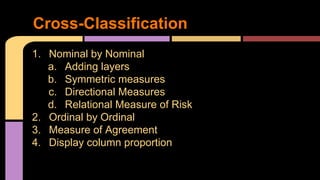
1. Nominal by Nominal
a. Adding layers
b. Symmetric measures
c. Directional Measures
d. Relational Measure of Risk
2. Ordinal by Ordinal
3. Measure of Agreement
4. Display column proportion
Cross-Classification
Nominal by Nominal
Sample SPSS File: satisf.sav
Ordinal by Ordinal
Sample File:
Cross classification
Nominal by Nominal
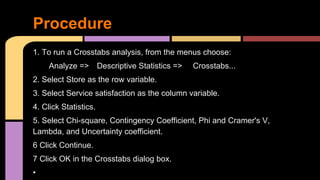
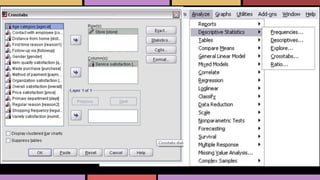
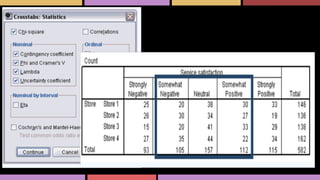
1. To run a Crosstabs analysis, from the menus choose:
Analyze => Descriptive Statistics => Crosstabs...
2. Select Store as the row variable.
3. Select Service satisfaction as the column variable.
4. Click Statistics.
5. Select Chi-square, Contingency Coefficient, Phi and Cramer's V,
Lambda, and Uncertainty coefficient.
6 Click Continue.
7 Click OK in the Crosstabs dialog box.
•
Procedure
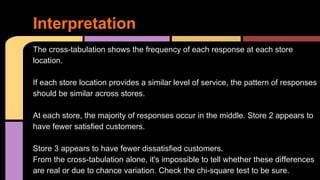
The cross-tabulation shows the frequency of each response at each store
location.
If each store location provides a similar level of service, the pattern of responses
should be similar across stores.
At each store, the majority of responses occur in the middle. Store 2 appears to
have fewer satisfied customers.
Store 3 appears to have fewer dissatisfied customers.
From the cross-tabulation alone, it's impossible to tell whether these differences
are real or due to chance variation. Check the chi-square test to be sure.
Interpretation
Chi-square Test result
The two-sided asymptotic significance of the chi-square statistic is greater
than 0.10, so it's safe to say that the differences are due to chance
variation, which implies that each store offers the same level of customer
service.
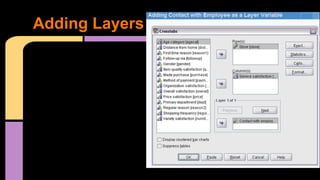
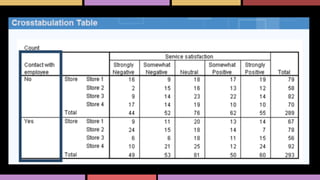
However, not all customers surveyed actually had contact with a service
representative. The ratings from these customers will not reflect the actual
quality of service at a store, so you further cross-classify by whether they
had contact with a service representative
Chi-square Test - Interpretation
Adding Layers
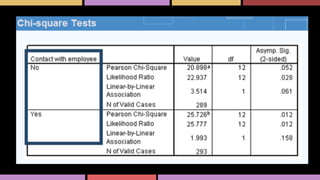
The chi-square test is performed separately for customers who did and did
not have contact with a store representative. The significance value of the
test for customers who did not have contact is 0.052. This is suggestive,
but not conclusive, evidence of a relationship between Store and Service
satisfaction for these customers. While not directly related to the quality of
service given by your employees, you might consider a separate analysis of
these customers to determine if there is some other factor that accounts for
this relationship. The significance value of the test for customers who had
contact with an employee is 0.012. Since this value is less than 0.05, you
can conclude that the relationship observed in the crosstabulation is real
and not due to chance.
Chi-square test With Layers
Symmetric Measures
While the chi-square test is useful for determining
whether there is a relationship, it doesn't tell you the
strength of the relationship. Symmetric measures
attempt to quantify this.
Symmetric measures are reported separately for
customers who did and did not have contact with a store
representative. These measures are based on the chi-
square statistic.
Symmetric Measures
Phi is the ratio of the chi-square statistic to
the weighted total number of observations. It
is the most "optimistic" of the symmetric
measures, and unlike most association
measures, does not have a theoretical upper
bound when either of the variables has more
than two categories.
Phi
Cramer's V is a rescaling of phi so that its
maximum possible value is always 1. As the
number of rows and columns increases,
Cramer's V becomes more conservative with
respect to phi.
Cramer’s V
The contingency coefficient takes values
between 0 and SQRT[(k-1)/k], where k = the
number of rows or columns, whichever is
smaller. It becomes more conservative with
respect to phi as the associations between
the variables become stronger.
The Contingency Co-efficient
The significance values of all three measures
are 0.012, indicating a statistically significant
relationship. However, the values of all three
measures are under 0.3, so although the
relationship is not due to chance, it is also
not very strong.
Interpretation of results
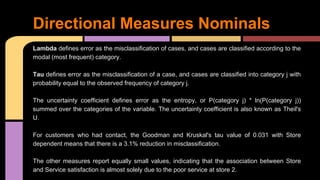
Directional Measures Nominal
Lambda defines error as the misclassification of cases, and cases are classified according to the
modal (most frequent) category.
Tau defines error as the misclassification of a case, and cases are classified into category j with
probability equal to the observed frequency of category j.
The uncertainty coefficient defines error as the entropy, or P(category j) * ln(P(category j))
summed over the categories of the variable. The uncertainty coefficient is also known as Theil's
U.
For customers who had contact, the Goodman and Kruskal's tau value of 0.031 with Store
dependent means that there is a 3.1% reduction in misclassification.
The other measures report equally small values, indicating that the association between Store
and Service satisfaction is almost solely due to the poor service at store 2.
Directional Measures Nominals
Ordinal by Ordinal Cross-Classifications
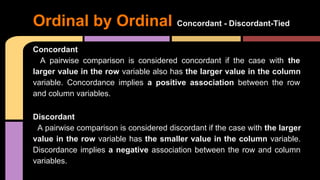
Concordant
A pairwise comparison is considered concordant if the case with the
larger value in the row variable also has the larger value in the column
variable. Concordance implies a positive association between the row
and column variables.
Discordant
A pairwise comparison is considered discordant if the case with the larger
value in the row variable has the smaller value in the column variable.
Discordance implies a negative association between the row and column
variables.
Ordinal by Ordinal Concordant - Discordant-Tied
Gamma is P(concordant) - P(discordant), ignoring comparisons that are
tied.
Somer's d decreases with as the tied comparisonon one variable
increases.
Tau-b: It decreases with respect to gamma as the number of comparisons
tied on one variable increases.
Tau-c does not have a simple interpretation.
Tau-c may be preferable to tau-b when the numbers of categories in the
row and column variables are not equal.
Directional and Symmetric Ordinal

Spss cross classification

  • 1.
    CROSS-CLASSIFICATION 22-01-2015 2:00 - 3:00PM Selvarasu A Mutharasu Annamalai University
  • 2.
    1. Nominal byNominal a. Adding layers b. Symmetric measures c. Directional Measures d. Relational Measure of Risk 2. Ordinal by Ordinal 3. Measure of Agreement 4. Display column proportion Cross-Classification
  • 3.
    Nominal by Nominal SampleSPSS File: satisf.sav Ordinal by Ordinal Sample File: Cross classification
  • 4.
  • 5.
    1. To runa Crosstabs analysis, from the menus choose: Analyze => Descriptive Statistics => Crosstabs... 2. Select Store as the row variable. 3. Select Service satisfaction as the column variable. 4. Click Statistics. 5. Select Chi-square, Contingency Coefficient, Phi and Cramer's V, Lambda, and Uncertainty coefficient. 6 Click Continue. 7 Click OK in the Crosstabs dialog box. • Procedure
  • 8.
    The cross-tabulation showsthe frequency of each response at each store location. If each store location provides a similar level of service, the pattern of responses should be similar across stores. At each store, the majority of responses occur in the middle. Store 2 appears to have fewer satisfied customers. Store 3 appears to have fewer dissatisfied customers. From the cross-tabulation alone, it's impossible to tell whether these differences are real or due to chance variation. Check the chi-square test to be sure. Interpretation
  • 9.
  • 10.
    The two-sided asymptoticsignificance of the chi-square statistic is greater than 0.10, so it's safe to say that the differences are due to chance variation, which implies that each store offers the same level of customer service. However, not all customers surveyed actually had contact with a service representative. The ratings from these customers will not reflect the actual quality of service at a store, so you further cross-classify by whether they had contact with a service representative Chi-square Test - Interpretation
  • 11.
  • 14.
    The chi-square testis performed separately for customers who did and did not have contact with a store representative. The significance value of the test for customers who did not have contact is 0.052. This is suggestive, but not conclusive, evidence of a relationship between Store and Service satisfaction for these customers. While not directly related to the quality of service given by your employees, you might consider a separate analysis of these customers to determine if there is some other factor that accounts for this relationship. The significance value of the test for customers who had contact with an employee is 0.012. Since this value is less than 0.05, you can conclude that the relationship observed in the crosstabulation is real and not due to chance. Chi-square test With Layers
  • 15.
  • 16.
    While the chi-squaretest is useful for determining whether there is a relationship, it doesn't tell you the strength of the relationship. Symmetric measures attempt to quantify this. Symmetric measures are reported separately for customers who did and did not have contact with a store representative. These measures are based on the chi- square statistic. Symmetric Measures
  • 17.
    Phi is theratio of the chi-square statistic to the weighted total number of observations. It is the most "optimistic" of the symmetric measures, and unlike most association measures, does not have a theoretical upper bound when either of the variables has more than two categories. Phi
  • 18.
    Cramer's V isa rescaling of phi so that its maximum possible value is always 1. As the number of rows and columns increases, Cramer's V becomes more conservative with respect to phi. Cramer’s V
  • 19.
    The contingency coefficienttakes values between 0 and SQRT[(k-1)/k], where k = the number of rows or columns, whichever is smaller. It becomes more conservative with respect to phi as the associations between the variables become stronger. The Contingency Co-efficient
  • 20.
    The significance valuesof all three measures are 0.012, indicating a statistically significant relationship. However, the values of all three measures are under 0.3, so although the relationship is not due to chance, it is also not very strong. Interpretation of results
  • 21.
  • 22.
    Lambda defines erroras the misclassification of cases, and cases are classified according to the modal (most frequent) category. Tau defines error as the misclassification of a case, and cases are classified into category j with probability equal to the observed frequency of category j. The uncertainty coefficient defines error as the entropy, or P(category j) * ln(P(category j)) summed over the categories of the variable. The uncertainty coefficient is also known as Theil's U. For customers who had contact, the Goodman and Kruskal's tau value of 0.031 with Store dependent means that there is a 3.1% reduction in misclassification. The other measures report equally small values, indicating that the association between Store and Service satisfaction is almost solely due to the poor service at store 2. Directional Measures Nominals
  • 23.
    Ordinal by OrdinalCross-Classifications
  • 24.
    Concordant A pairwise comparisonis considered concordant if the case with the larger value in the row variable also has the larger value in the column variable. Concordance implies a positive association between the row and column variables. Discordant A pairwise comparison is considered discordant if the case with the larger value in the row variable has the smaller value in the column variable. Discordance implies a negative association between the row and column variables. Ordinal by Ordinal Concordant - Discordant-Tied
  • 25.
    Gamma is P(concordant)- P(discordant), ignoring comparisons that are tied. Somer's d decreases with as the tied comparisonon one variable increases. Tau-b: It decreases with respect to gamma as the number of comparisons tied on one variable increases. Tau-c does not have a simple interpretation. Tau-c may be preferable to tau-b when the numbers of categories in the row and column variables are not equal. Directional and Symmetric Ordinal