Download as PDF, PPTX
- 1 / 24

- 2 / 24

- 3 / 24

- 4 / 24

- 5 / 24

- 6 / 24

- 7 / 24

- 8 / 24

- 9 / 24
- 10 / 24

- 11 / 24
- 12 / 24

- 13 / 24

- 14 / 24
- 15 / 24
- 16 / 24

- 17 / 24
- 18 / 24
- 19 / 24
- 20 / 24

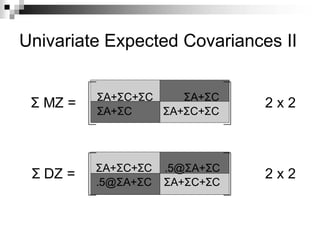
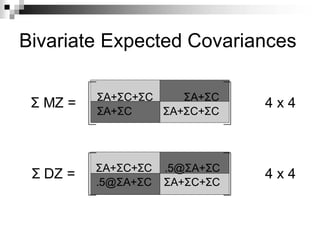
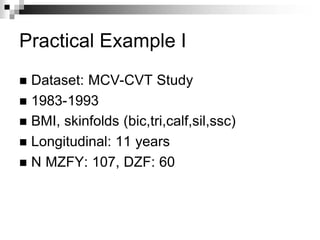


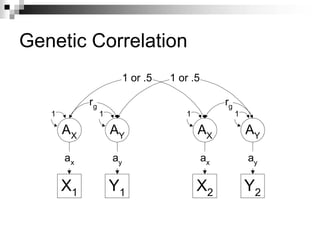
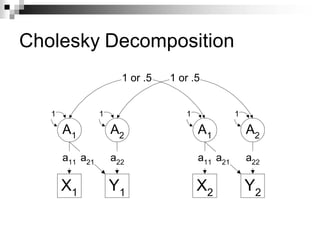
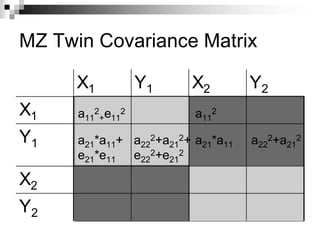
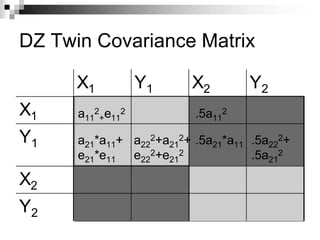
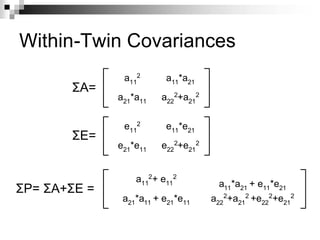
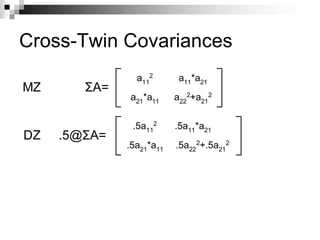
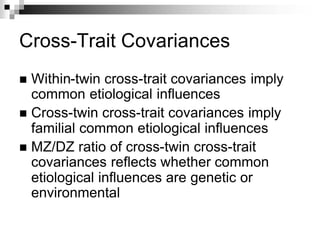
This document discusses bivariate analysis of twin data to examine the genetic and environmental contributions to the covariance between two traits. It introduces bivariate twin models that partition the covariance into additive genetic (A), shared environmental (C), and unique environmental (E) components. The expected covariance matrices for MZ and DZ twins are presented. The goal of bivariate analysis is to understand what factors make sets of variables correlate through examining within-twin and cross-twin covariances. Examples of applications to real twin datasets are given.


