ORGANISING
BY,
C.HELEN JOSEPHINE
S.SNEHA
V.RATHNA PRIYADHARSHINI
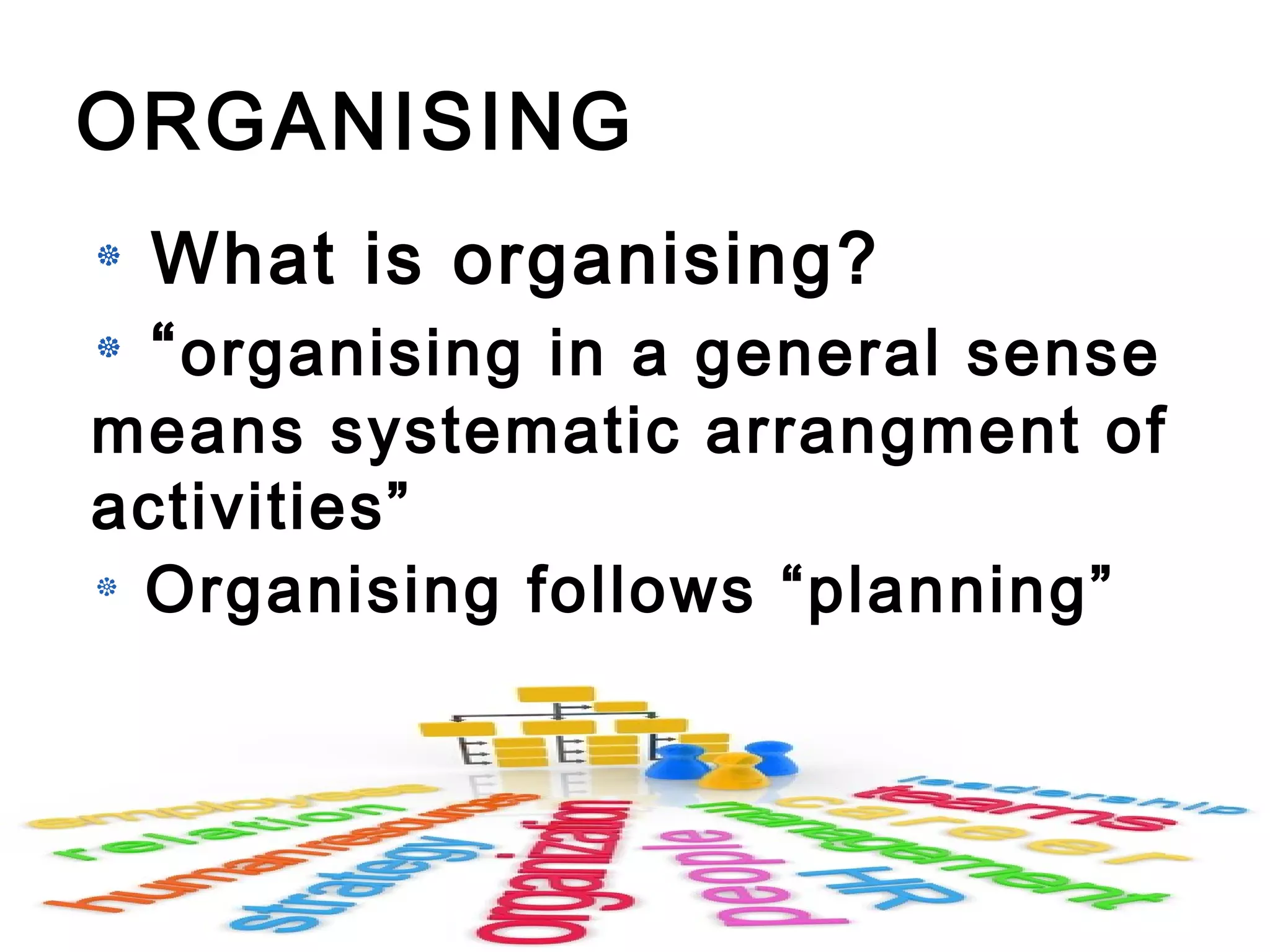
What is organising?
“organising in a general sense
means systematic arrangment of
activities”
Organising follows “planning”
ORGANISING
3
ALLEN defines “Organizing “ is the
process of identifying and grouping
the work to be performed defining
and delegating resposibility and
authority and establishing
relationship for the purpose of
enabling people to work most
effectively together in
accomplishing objectives”.
DEFINITION
THEO HAIMANN
“Organising is the process of
defining and grouping the
activities of the entire
process and establishing the
authority and relationship
among them”
Organising in management
refers to the relationship
between people,work and
resources used to achieve
the common objectives
ORGANISING IN MANAGEMENT
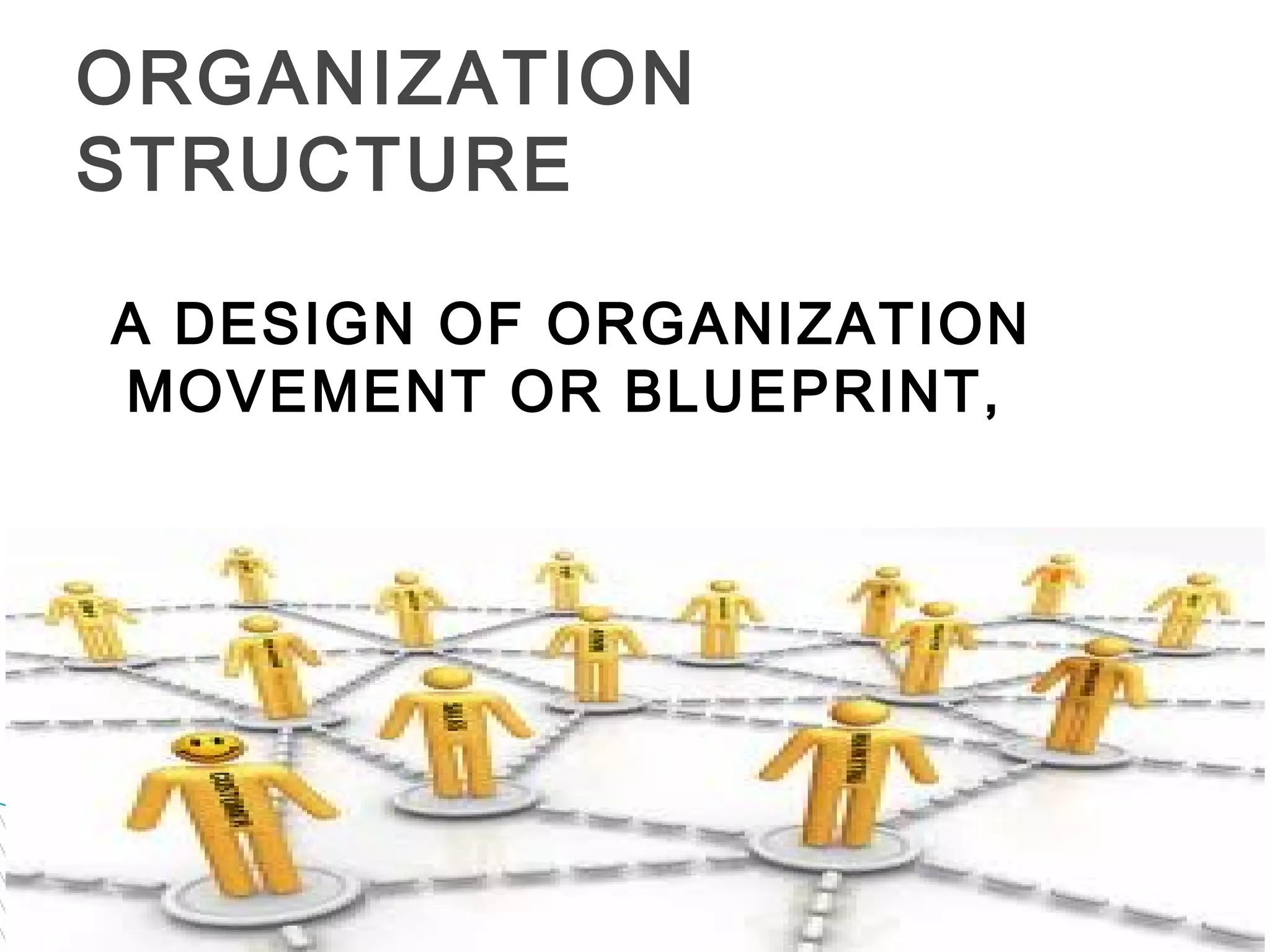
A DESIGN OF ORGANIZATION
MOVEMENT OR BLUEPRINT,
ORGANIZATION
STRUCTURE
ORGANIZATION STRUCTURE
EXPLAINS THE POSITION
AND OFFICIAL
RELATIONSHIP BETWEEN
VARIOUS INDIVIDUALS IN
THE ORGANIZATION.
DEFINITION
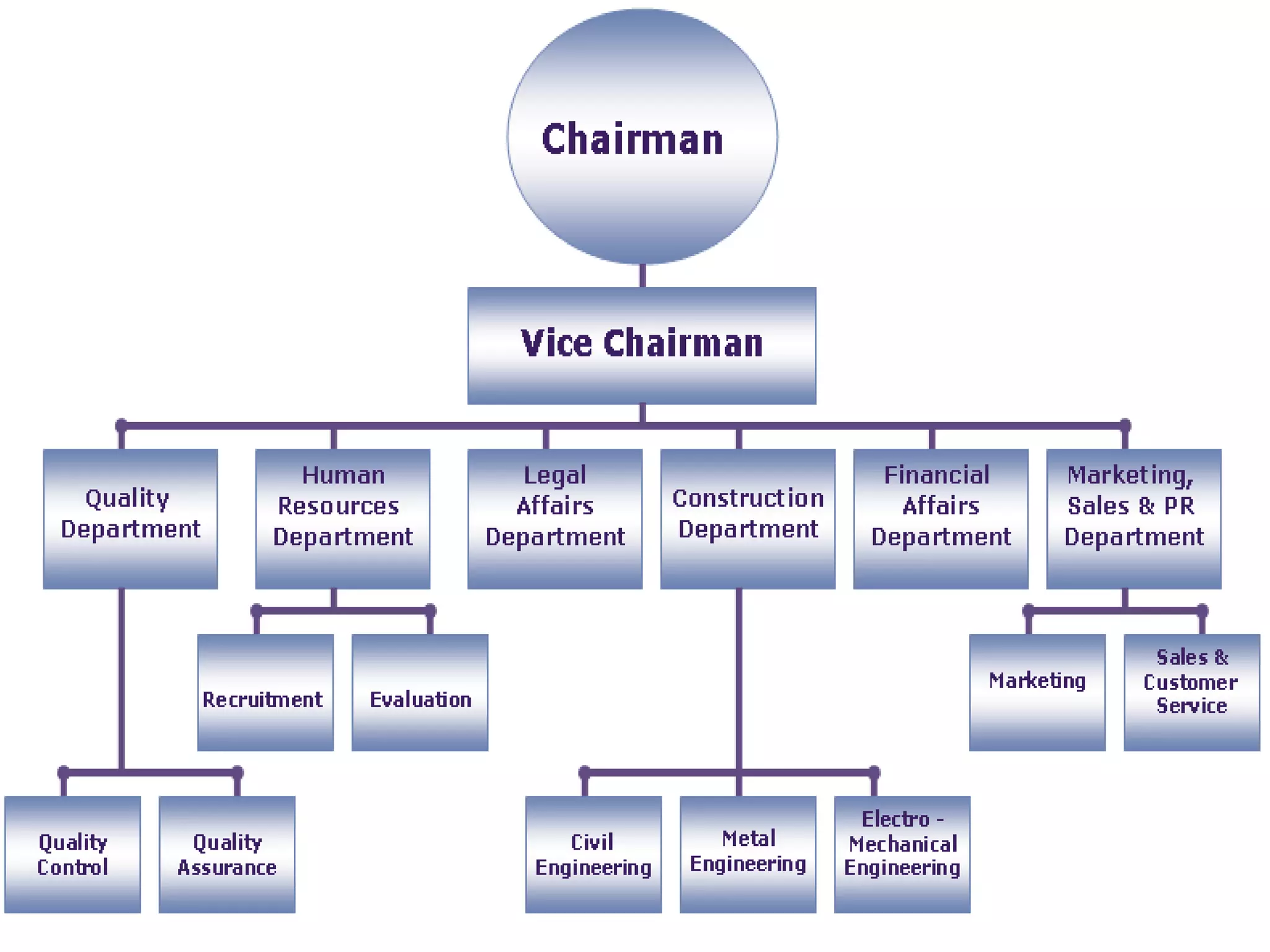
It is a diagrammatic
representation of
organization structure
show names designation
functions of personnel in
a organization.
ORGANISATION CHART
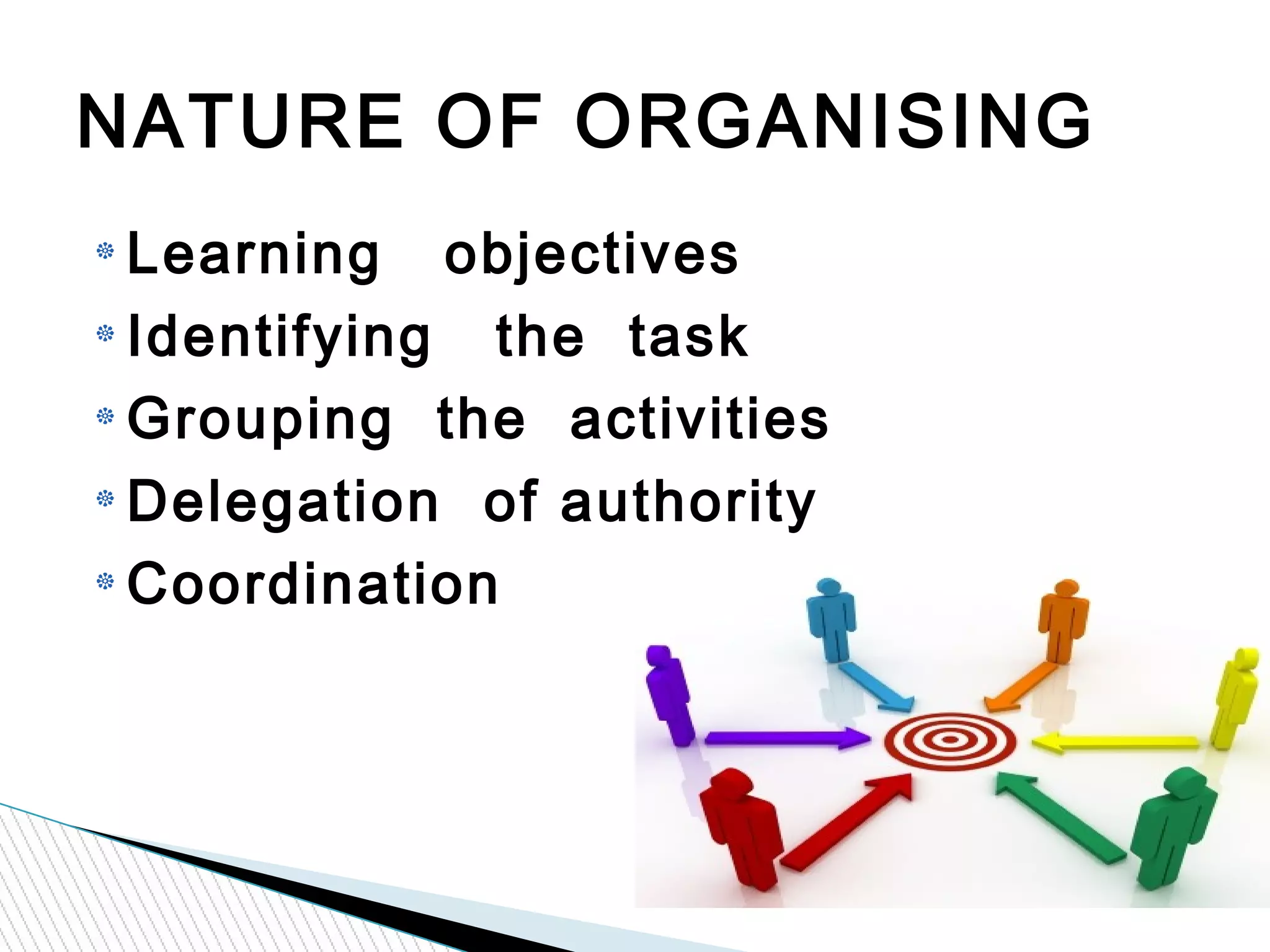
Learning objectives
Identifying the task
Grouping the activities
Delegation of authority
Coordination
NATURE OF ORGANISING
Perform an analysis about the
work
Identify the work
Organisation structure
The grouping of activities
neccesary for attaining
objectives(division of labour)
Assignment of
work(communication)
Delegation of authority(authority
structure)
NATURE
Aids to management
It facilitates growth,creativity
It ensures optimum use
resources
Establishes relationship among
individual groups
Clusters job into units
Coordinates.
PURPOSE OF ORGANISING
FORMAL GROUP- A formal
group is a structured
group,which has a plan and
positions each job’s objective
and functions
FORMAL AND INFORMAL
GROUPS
Formal means something
systematic.
It is in an official structure
It provides official relationship
between individual.
It is objective oriented
It abides with rules and regulations
CHARACTERISTICS OF FORMAL GROUP
The line of communication is very
clear
It is accuracy of the information.
systematic
It is objective oriented.
It has a heirarchial pattern
ADVANTAGES:
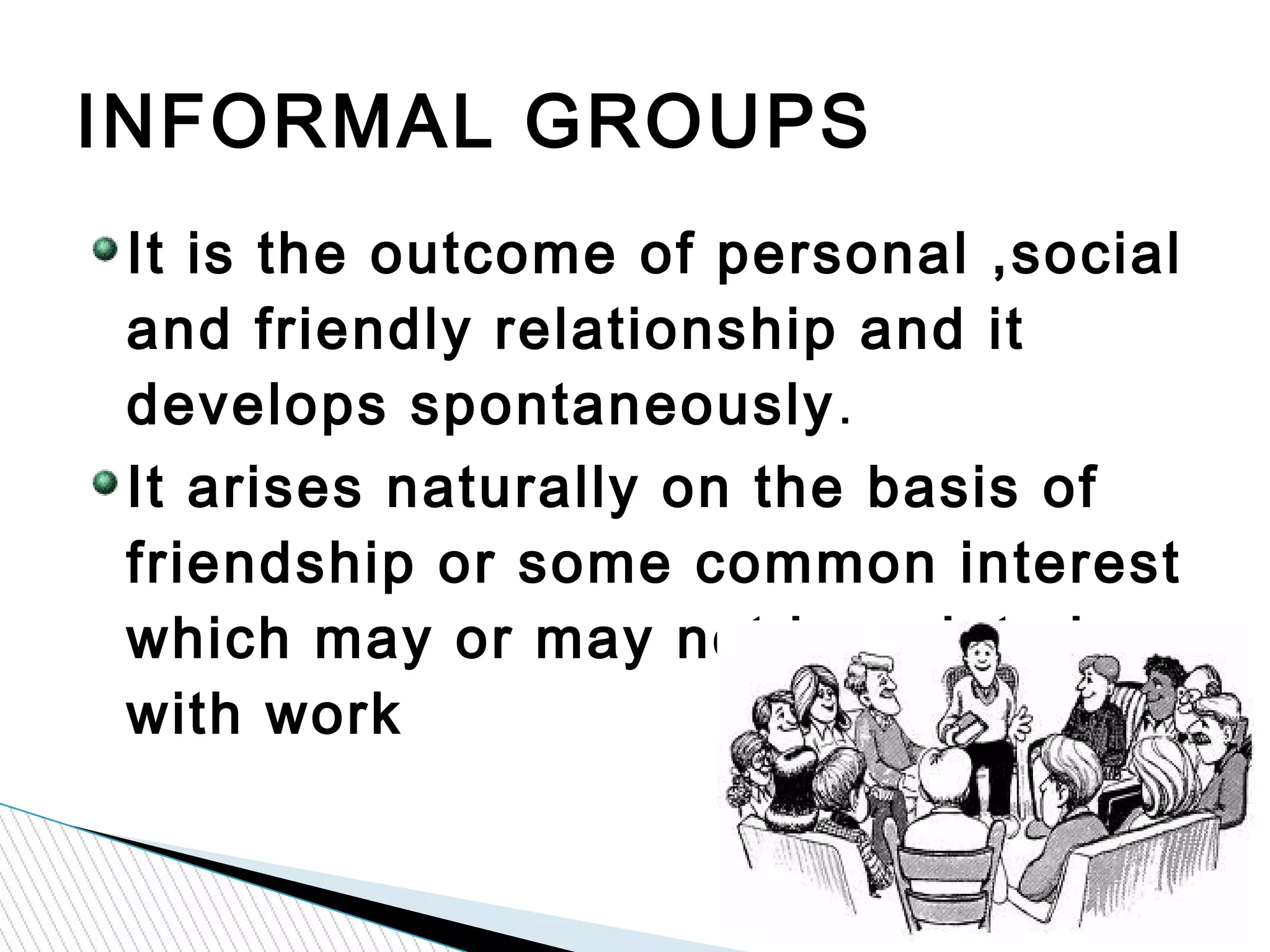
It is the outcome of personal ,social
and friendly relationship and it
develops spontaneously.
It arises naturally on the basis of
friendship or some common interest
which may or may not be related
with work
INFORMAL GROUPS
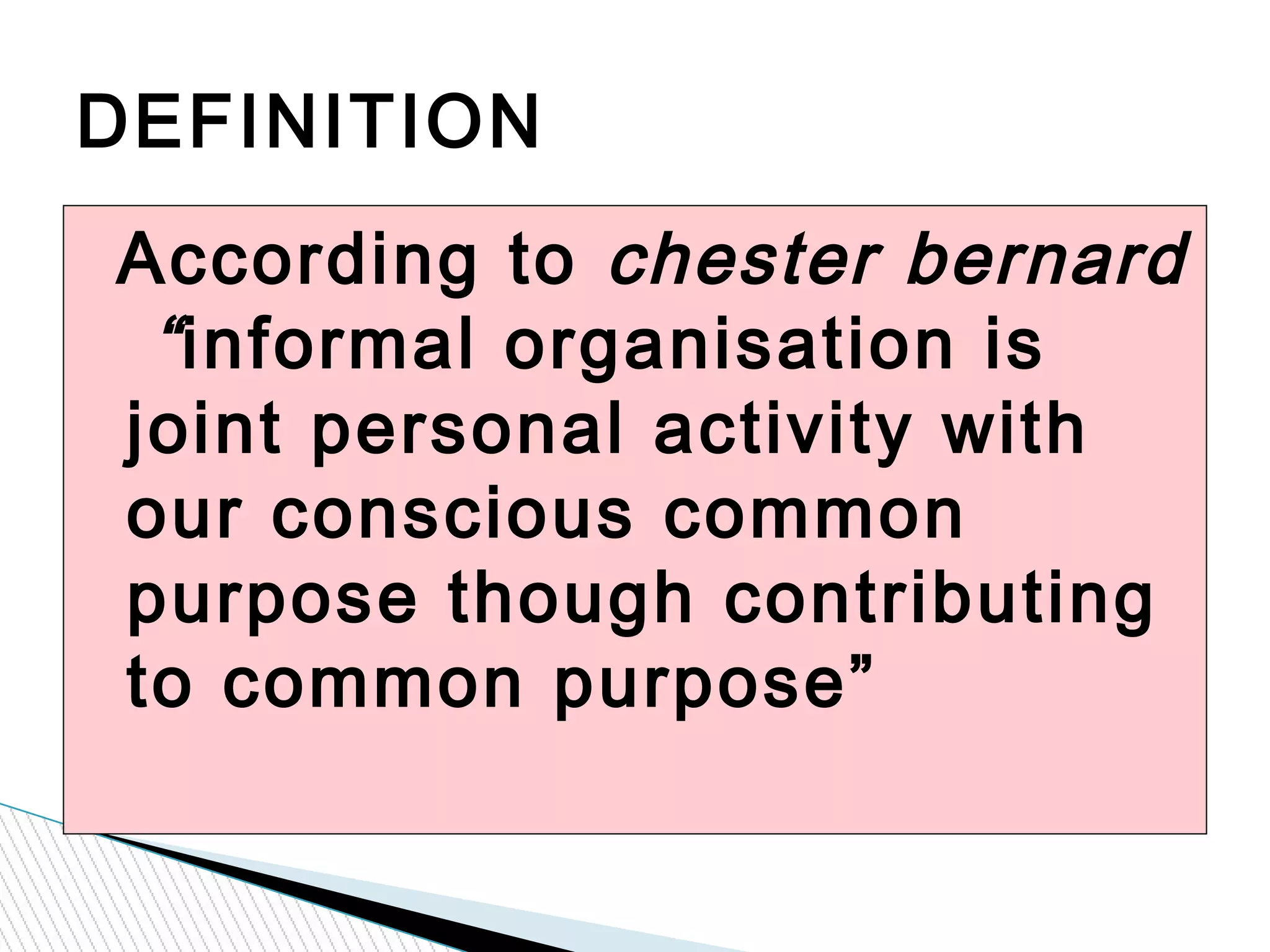
According to chester bernard
“informal organisation is
joint personal activity with
our conscious common
purpose though contributing
to common purpose”
DEFINITION
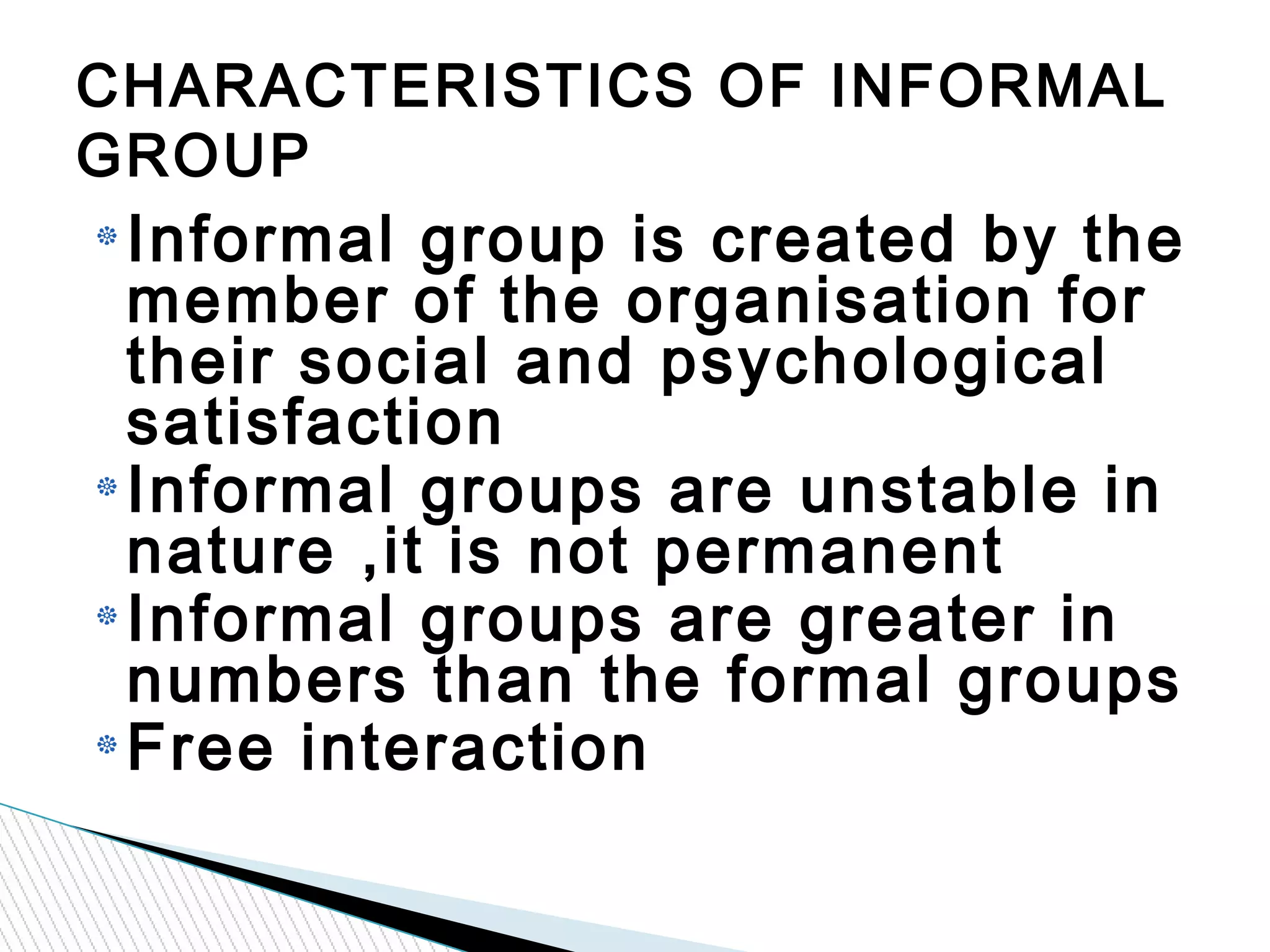
Informal group is created by the
member of the organisation for
their social and psychological
satisfaction
Informal groups are unstable in
nature ,it is not permanent
Informal groups are greater in
numbers than the formal groups
Free interaction
CHARACTERISTICS OF INFORMAL
GROUP
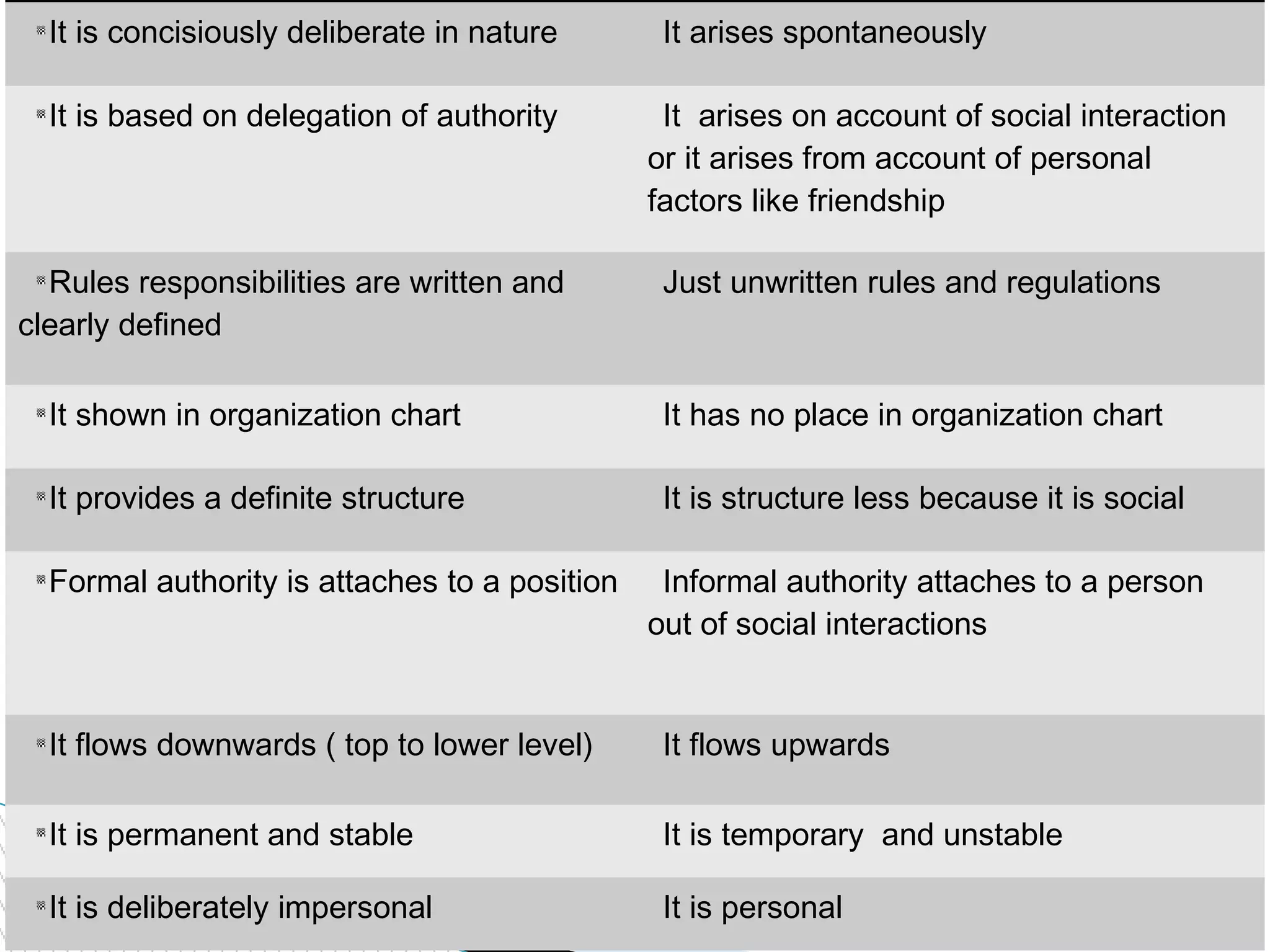
It is concisiously deliberate in nature It arises spontaneously
It is based on delegation of authority It arises on account of social interaction
or it arises from account of personal
factors like friendship
Rules responsibilities are written and
clearly defined
Just unwritten rules and regulations
It shown in organization chart It has no place in organization chart
It provides a definite structure It is structure less because it is social
Formal authority is attaches to a position Informal authority attaches to a person
out of social interactions
It flows downwards ( top to lower level) It flows upwards
It is permanent and stable It is temporary and unstable
It is deliberately impersonal It is personal
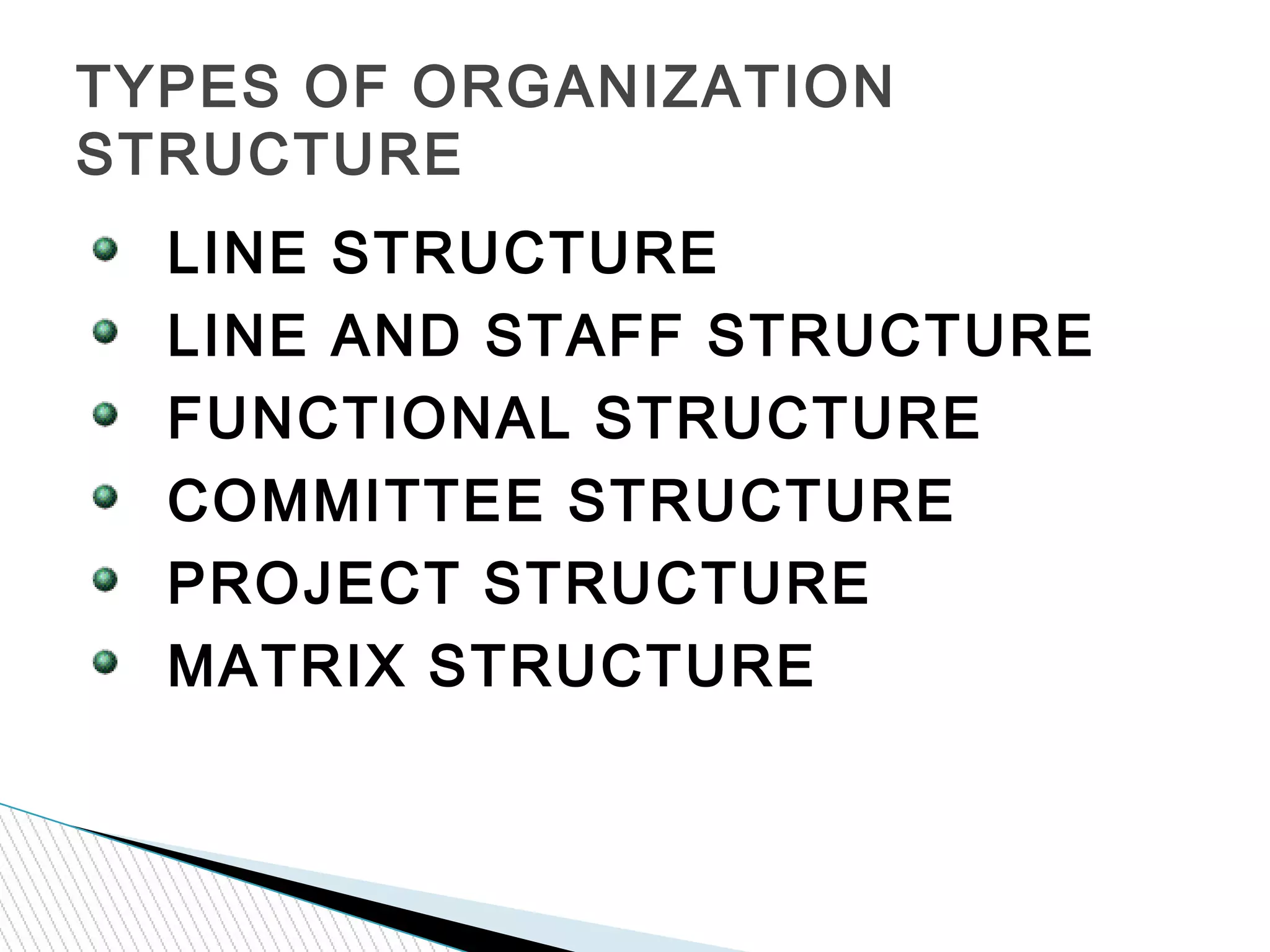
LINE STRUCTURE
LINE AND STAFF STRUCTURE
FUNCTIONAL STRUCTURE
COMMITTEE STRUCTURE
PROJECT STRUCTURE
MATRIX STRUCTURE
TYPES OF ORGANIZATION
STRUCTURE
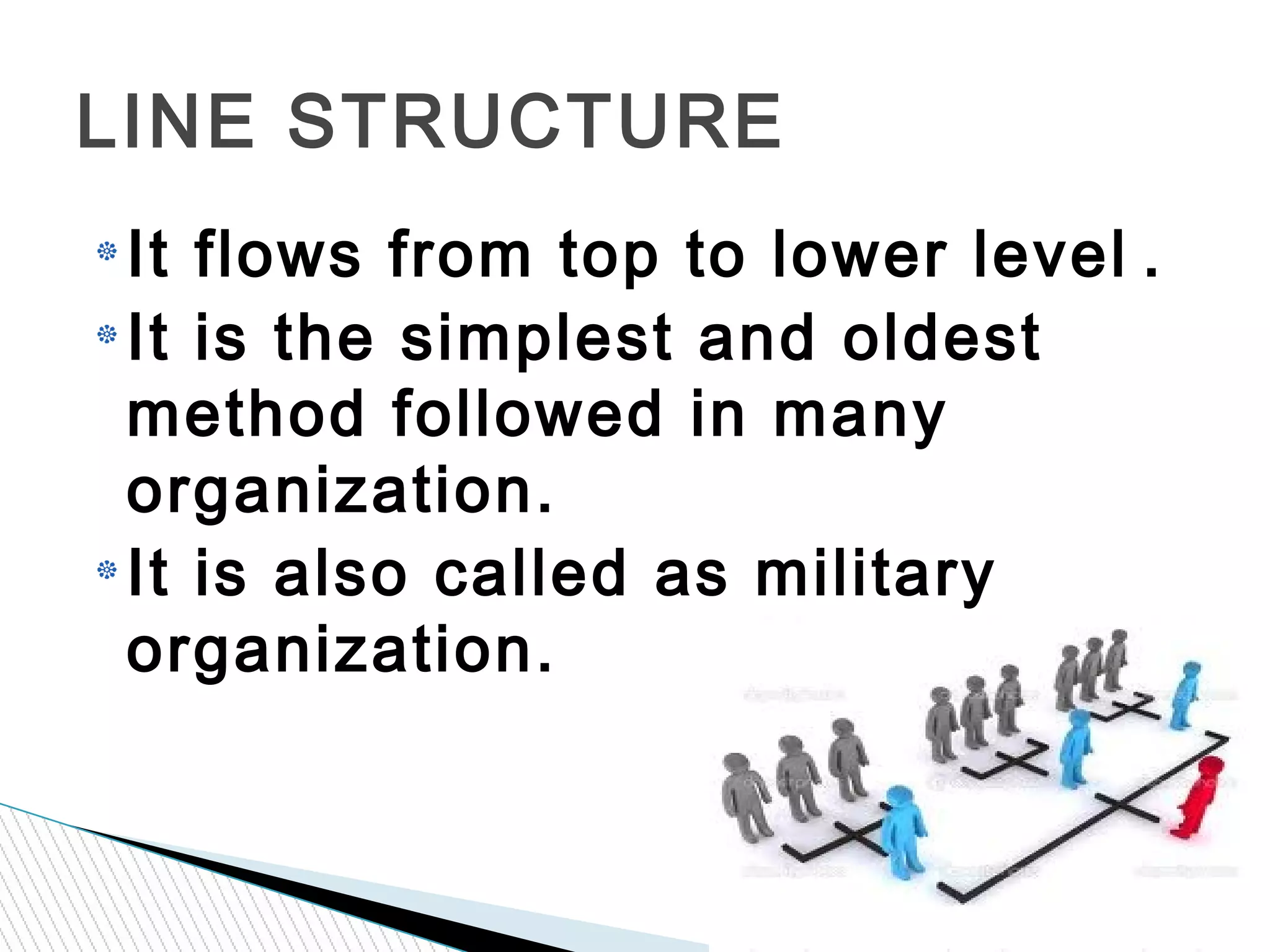
It flows from top to lower level .
It is the simplest and oldest
method followed in many
organization.
It is also called as military
organization.
LINE STRUCTURE
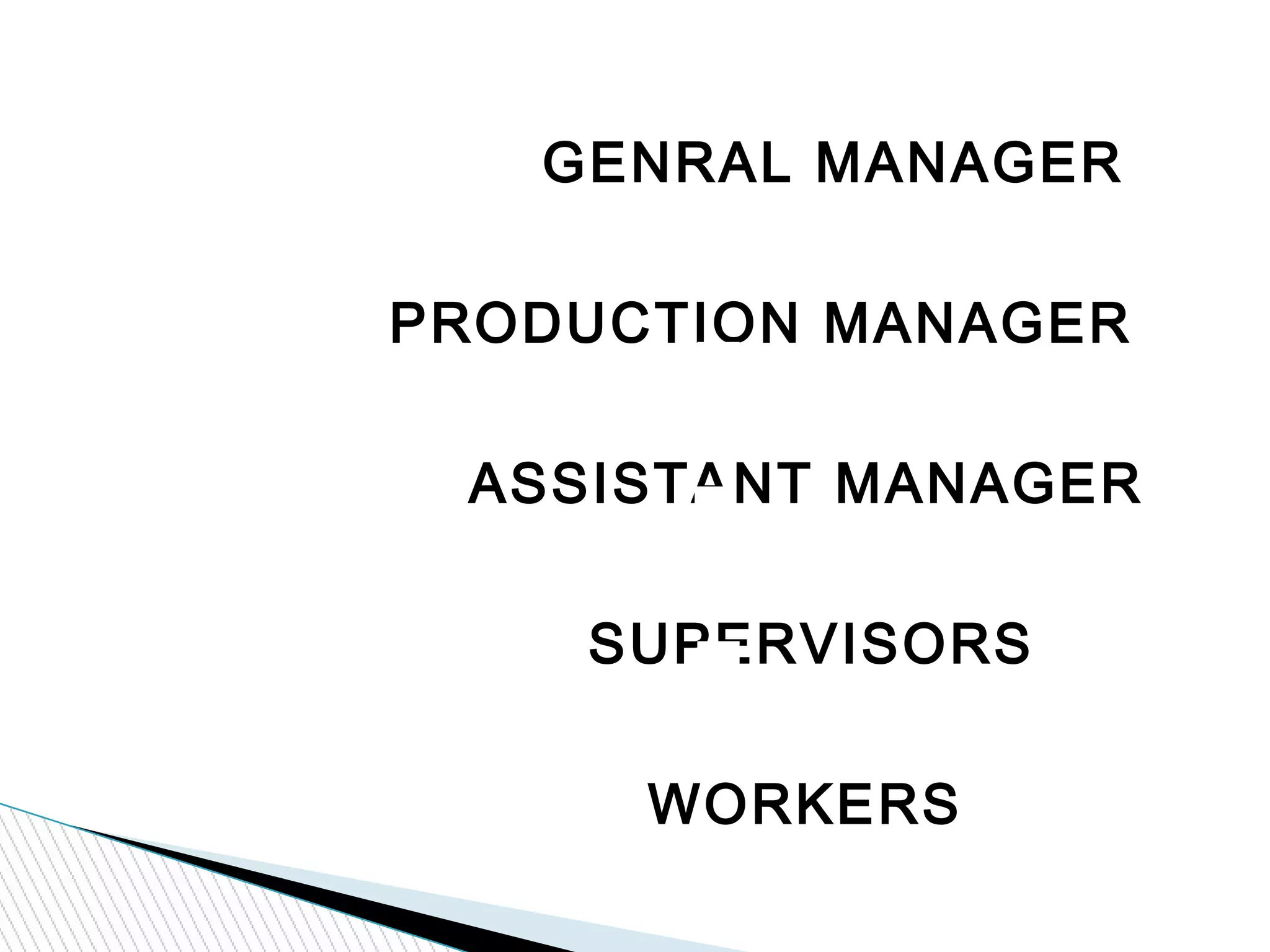
GENRAL MANAGER
PRODUCTION MANAGER
ASSISTANT MANAGER
SUPERVISORS
WORKERS
Simple and easy to establish.
Authority and responsibility is clearly
defined
Prompts decision.
Speedy action taken.
Unity of command since each will have
full control over subordinates.
Ensures Better discipline.
It is very economical since it is less
elaborate.
It provides better scope for
supervision.
MERITS OF LINE
STRUCTURE
Lacks specialization
Overburden with lots of administrative
work
It may result in autocratic control
Manager enjoys monopoly in the matter
of decision making ( he himself take
decision)
Always downward communications is
possible
Lacks upward communication
It is suitable for small concerns
employing few persons
DEMERITS OF LINE
STRUCTURE
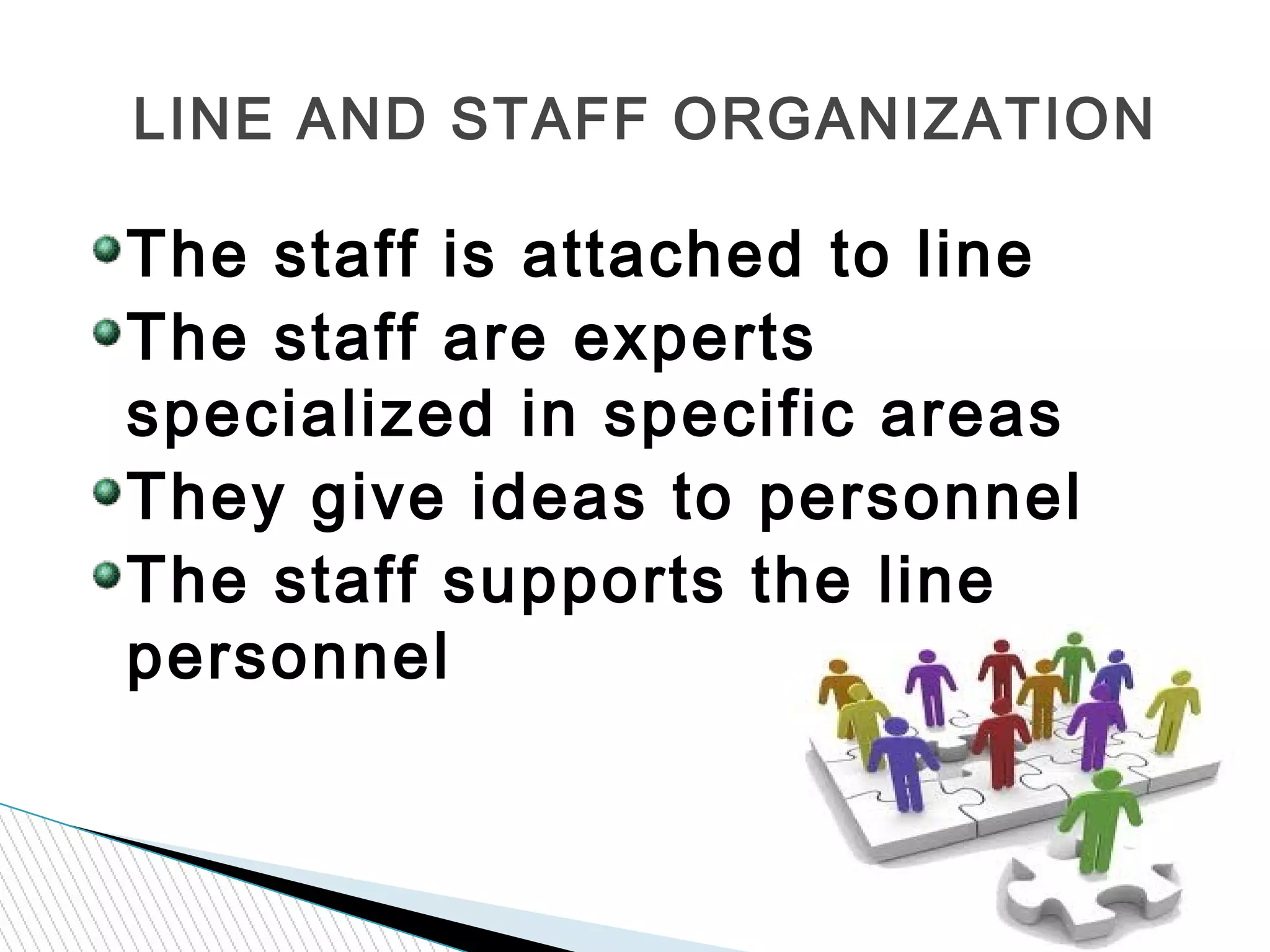
The staff is attached to line
The staff are experts
specialized in specific areas
They give ideas to personnel
The staff supports the line
personnel
LINE AND STAFF ORGANIZATION
Expert advice
Relief to top executives.
Quality decisions.
Flexible.
Specialization is not violated.
Unity of command is not violated.
MERITS OF LINE AND
STAFF
Often arises conflicts between line
and staff.
Leads to confusion since
responsibility is not well defined.
Ineffective staff .
Suitability ( in large organization).
DEMERITS OF LINE AND
STAFF
There will be a separate
department for different actions
or activities.
FUNCTIONAL ORGANIZATION
Specialization is possible
Work load is less
Better control over
subordinates
Scope for expansion
Higher efficiency
MERITS OF FUNCTIONAL
ORGANIZATION
Unity of command is violated.
Interdepartmental conflicts.
Delay in decision making.
DEMERITS
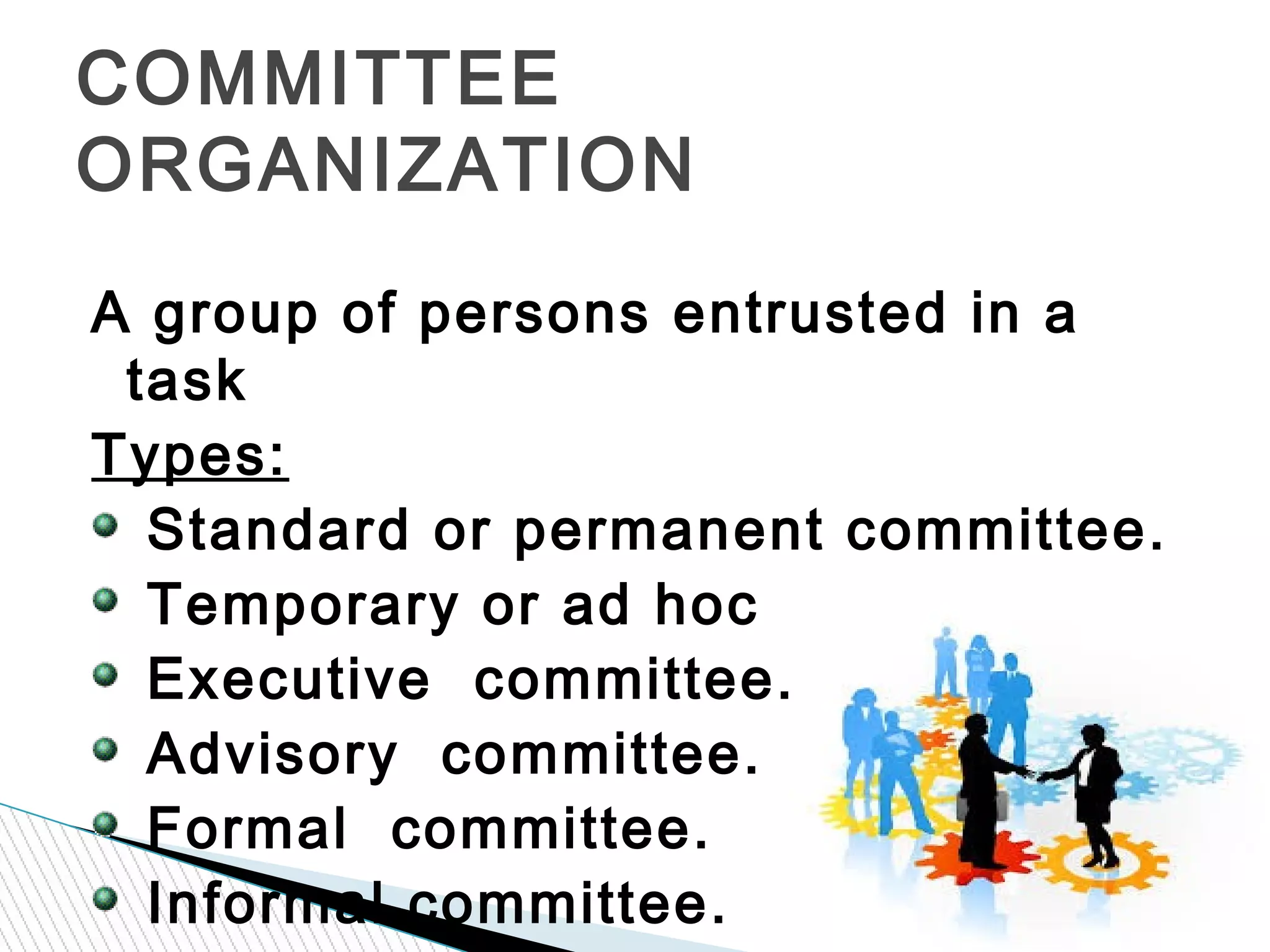
A group of persons entrusted in a
task
Types:
Standard or permanent committee.
Temporary or ad hoc committee.
Executive committee.
Advisory committee.
Formal committee.
Informal committee.
COMMITTEE
ORGANIZATION
Scope of group judgment .
Proper coordination and control
among individuals and
departments.
Motivation through participation is
possible.
Various interest groups.
Check against misuse of powers.
MERITS
Expensive affair to constitute a
committee
Time consuming or slow
decision
Compromise decision
Suppression of ideas
DEMERITS
It varies from one organization to
organization.
Any organization execute a large
project for a long period of time
adopt this project organization.
Usually some company have large
number of small projects.
The term leader organize the
expert or specialist.
PROJECT ORGANIZATION
Maximum use of specialized knowledge
and skills.
Unity of command exist in this
organization
Flexibility of operation.
Fixation of individual responsibility for
results.
Focuses attention on the specific
projects.
Provides better coordination.
MERITS
Difficulty in decision making.
Pressure and uncertainty due to
some several specialist.
Difficulty in coordination.
Evaluation of performance of
various specialist is difficult.
DEMERITS
37
It is suitable where there is large
number of small projects.
It is also called as multiple
command system.
It is also called as linking pins.
MATRIX ORGANIZATION
STRUCTURE
BEST UTILISATION OF
ORGANIZATIONAL RESOURCES.
BENEFIT TO BOTH FUNCTIONAL
AND TECHNICAL SPECIALIST .
IT PROMOTES COMMUNICATION
PERMITS HIGHER DEGREE OF
FLEXIBLITY AND ADAPTABILITY.
MERITS
Its against principle of unity of
command.
Quick decision may not be possible
It gives scope for conflicts.
DEMERITS
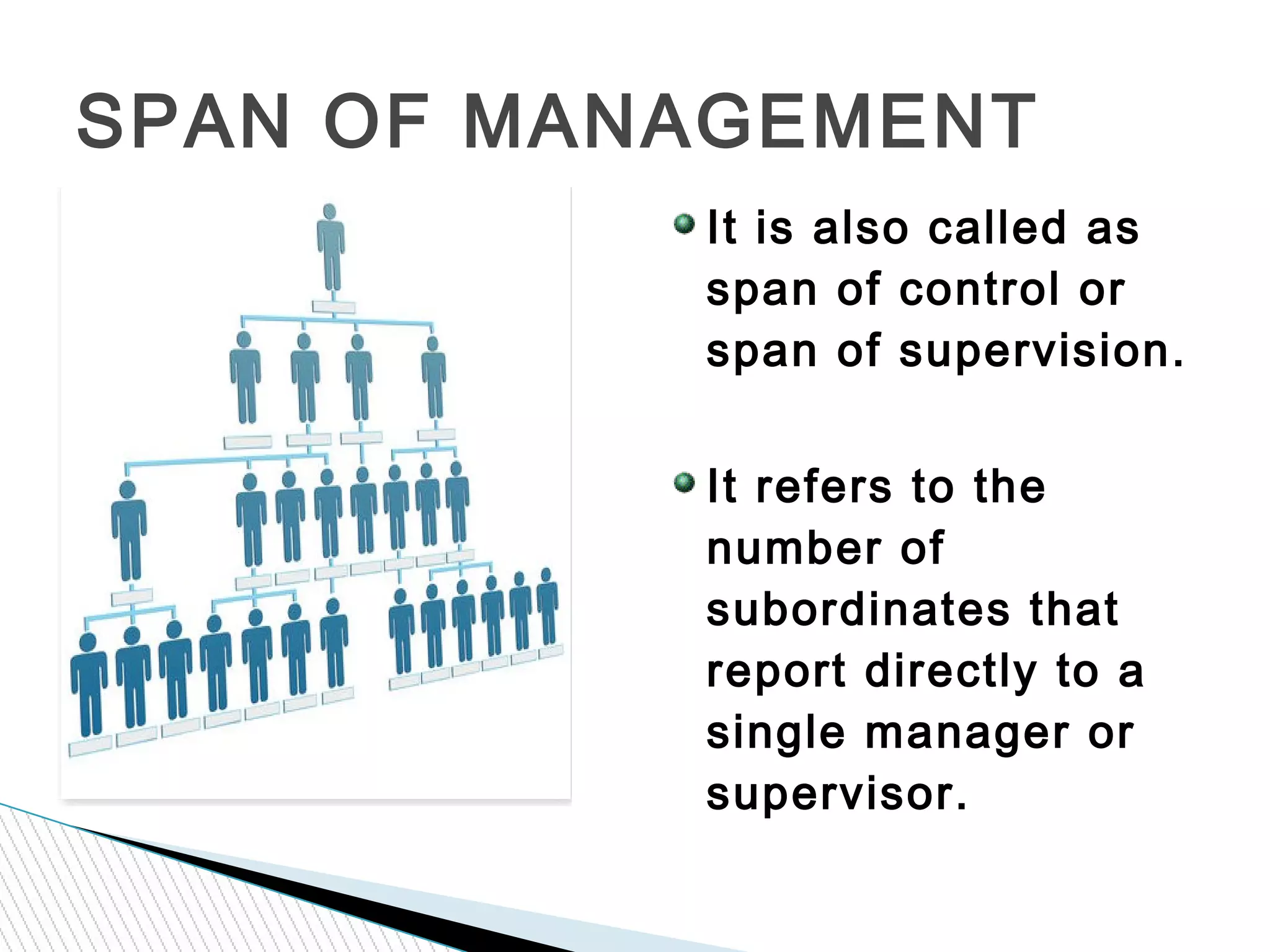
SPAN OF MANAGEMENT
It is also called as
span of control or
span of supervision.
It refers to the
number of
subordinates that
report directly to a
single manager or
supervisor.
TWO TYPES OF SPAN
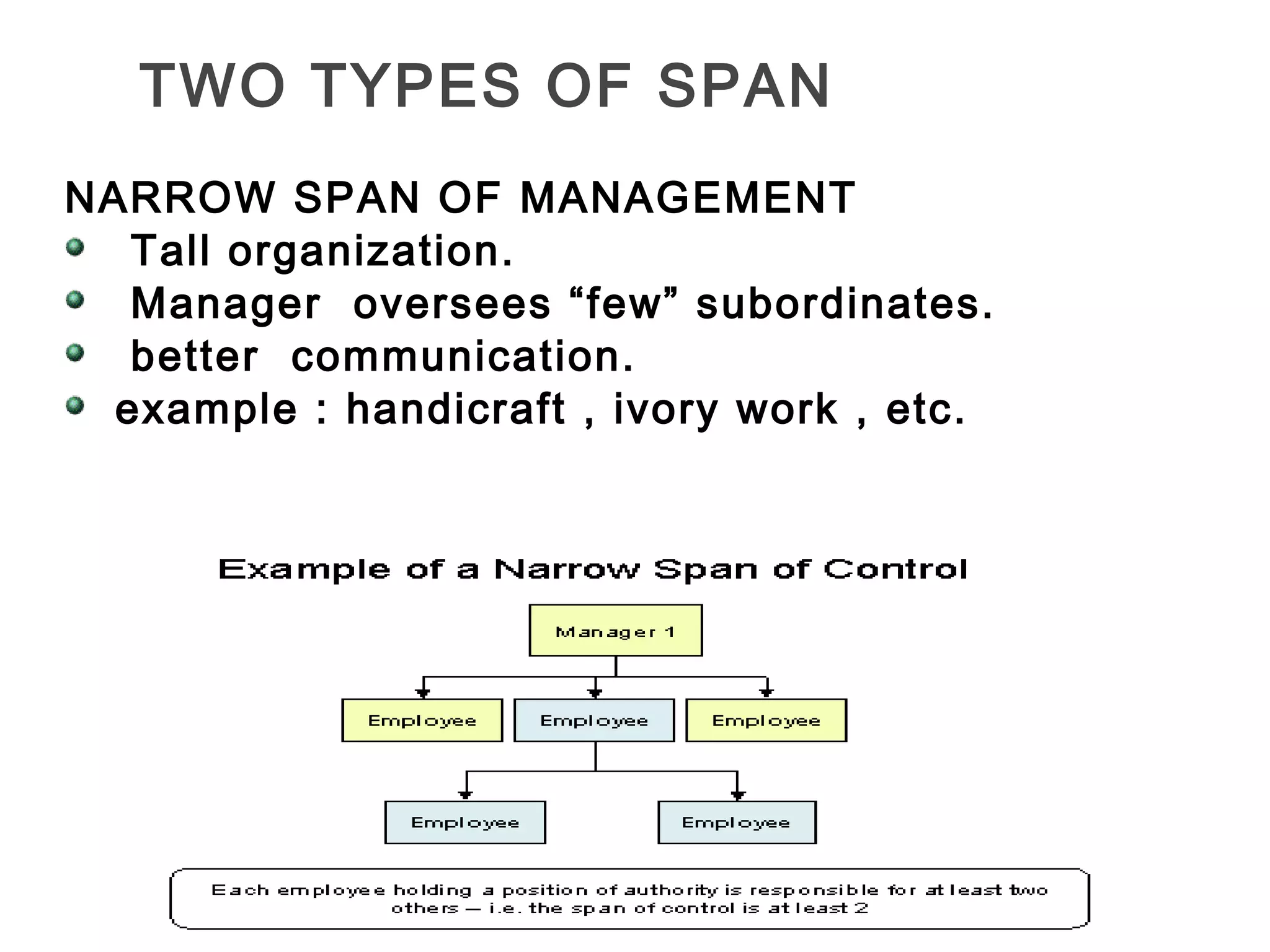
NARROW SPAN OF MANAGEMENT
Tall organization.
Manager oversees “few” subordinates.
better communication.
example : handicraft , ivory work , etc.
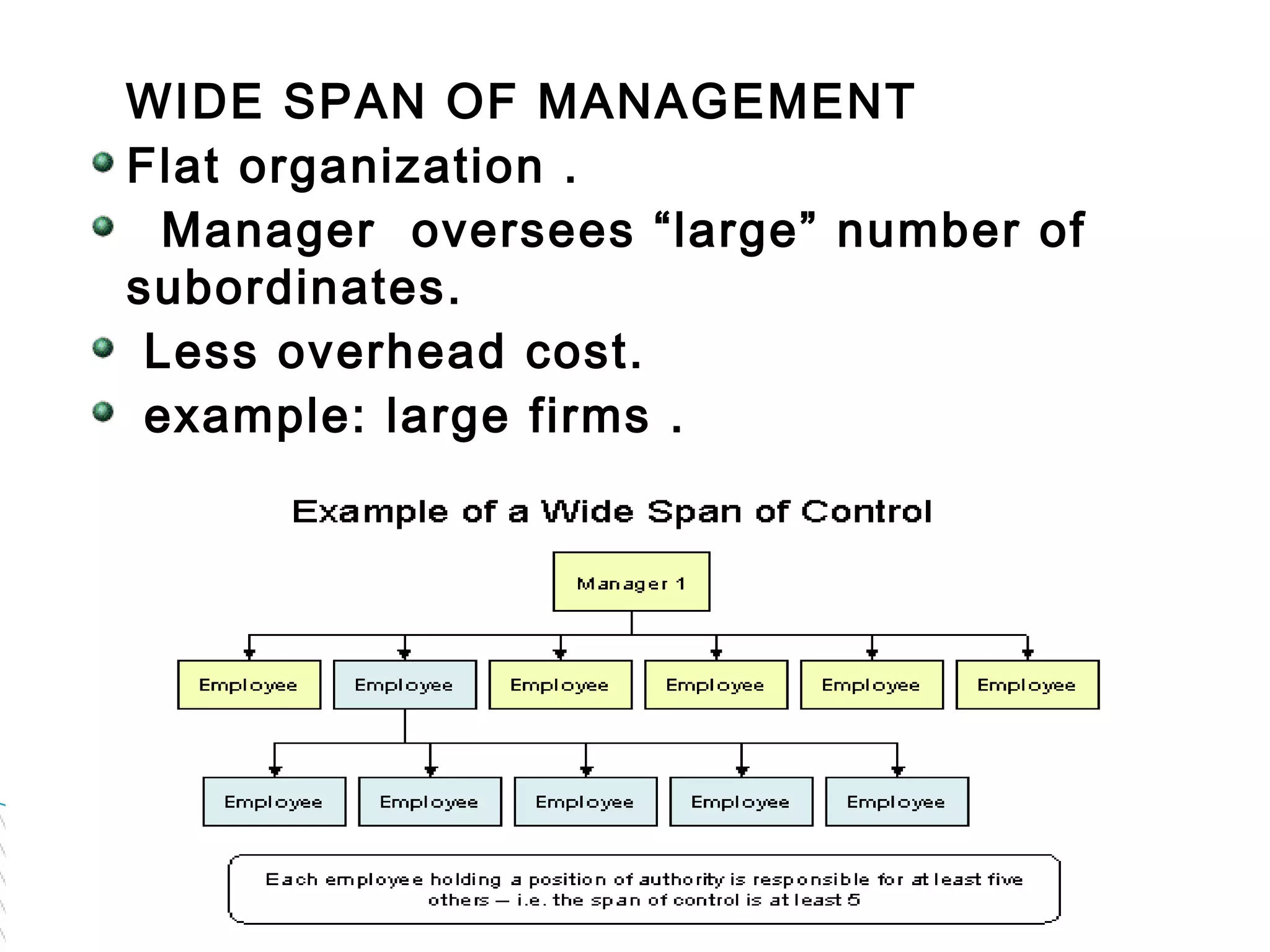
WIDE SPAN OF MANAGEMENT
Flat organization .
Manager oversees “large” number of
subordinates.
Less overhead cost.
example: large firms .
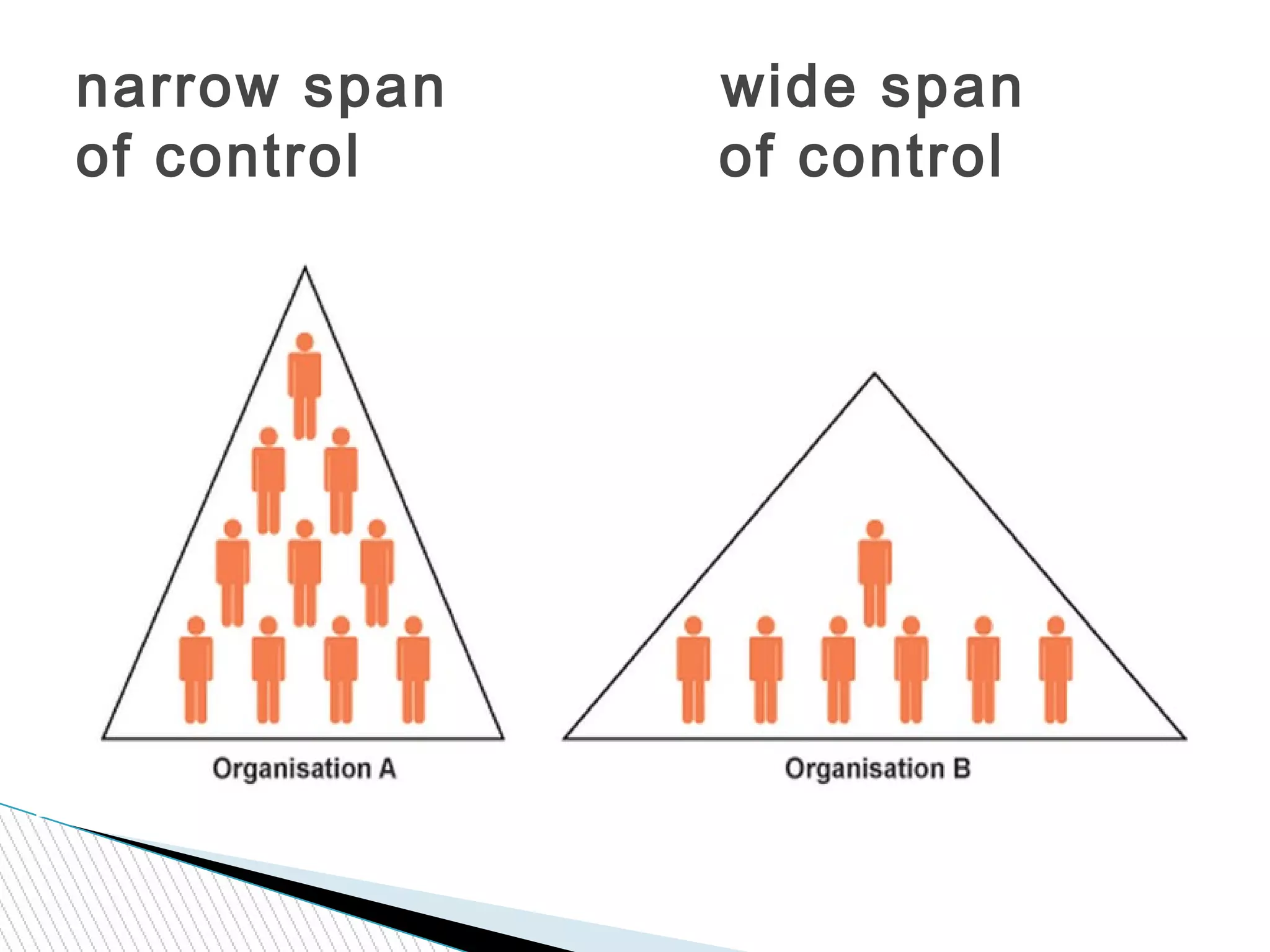
narrow span wide span
of control of control
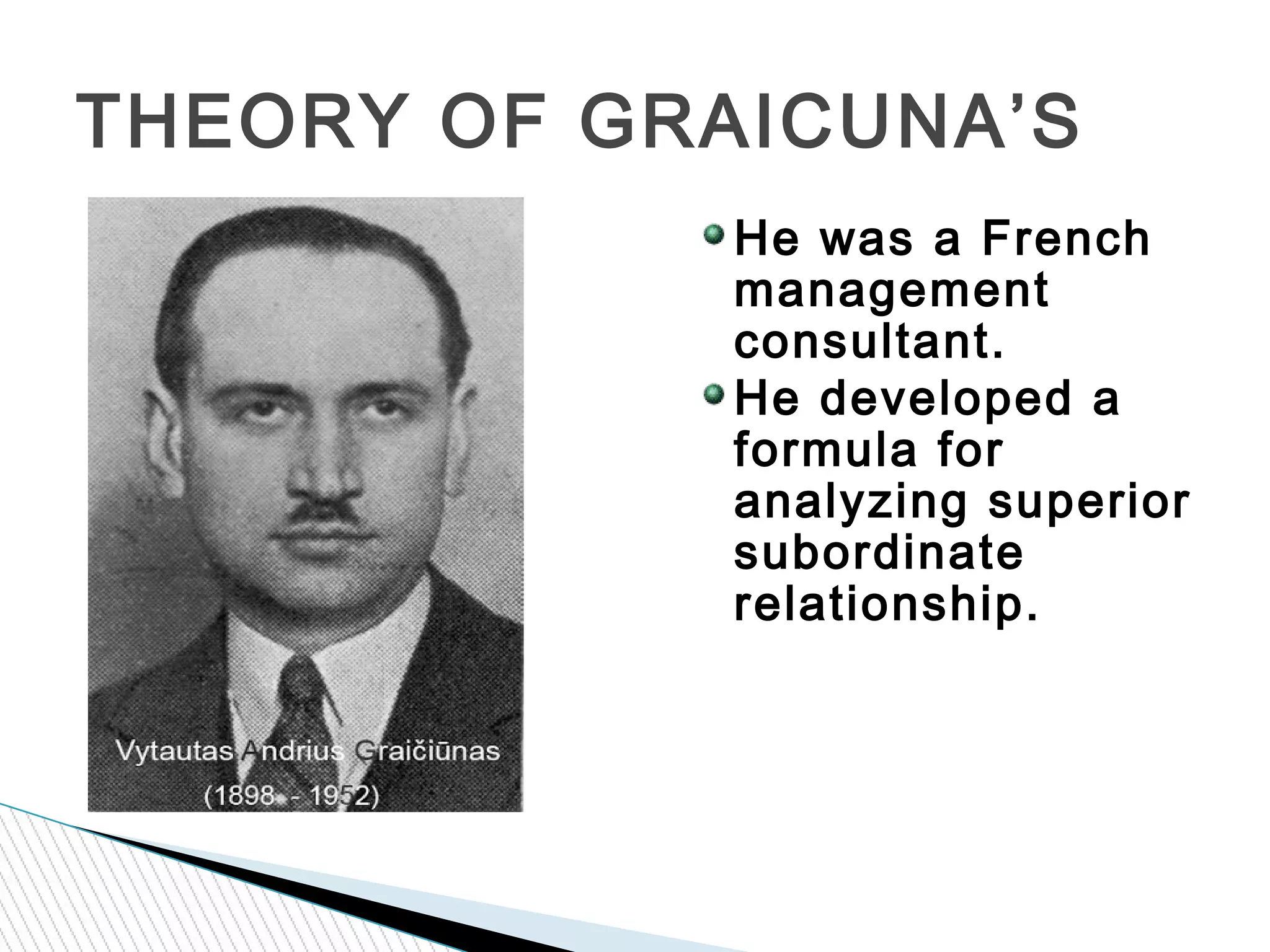
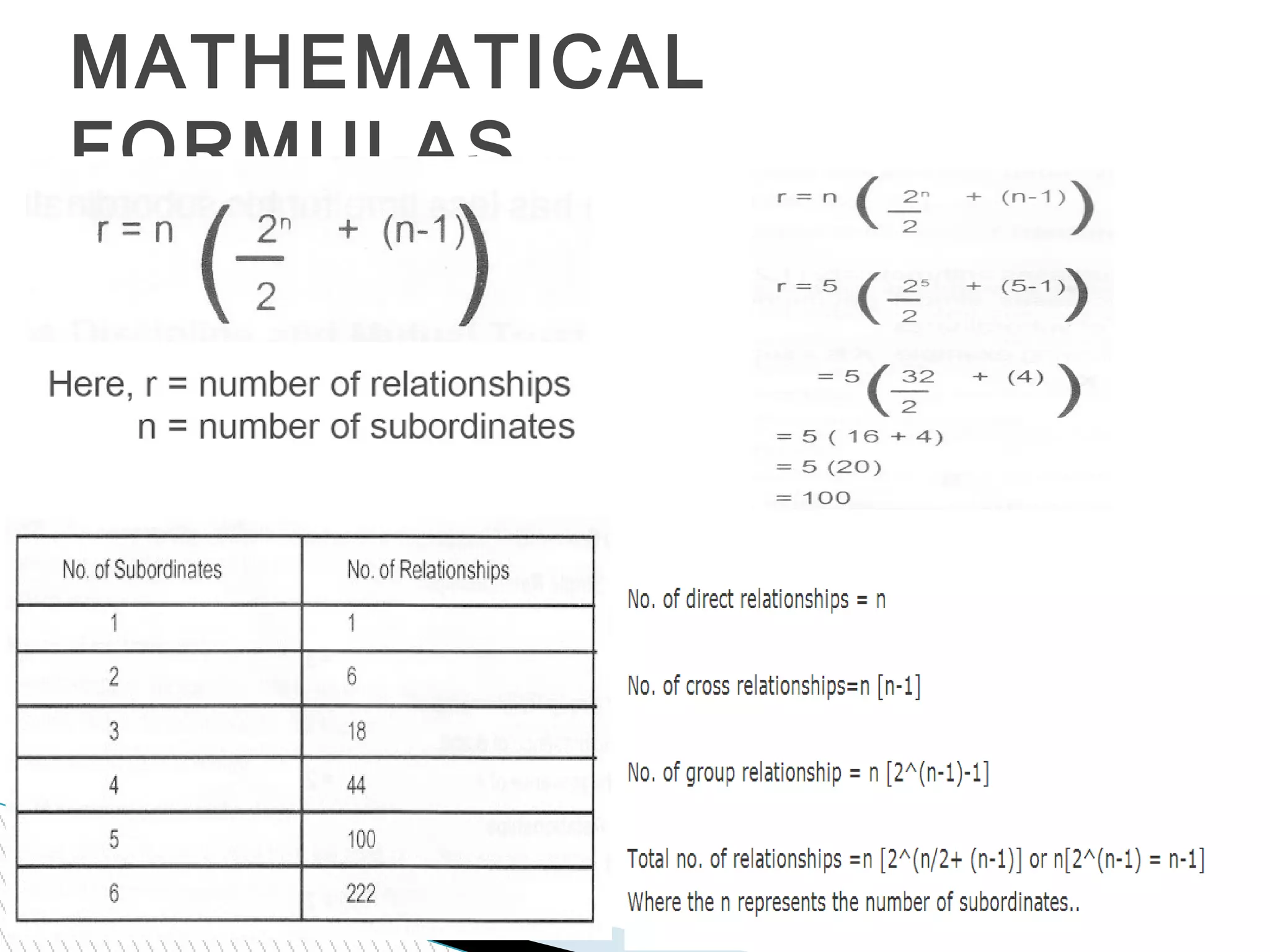
THEORY OF GRAICUNA’S
He was a French
management
consultant.
He developed a
formula for
analyzing superior
subordinate
relationship.
THREE TYPES OF
RELATIONSHIP
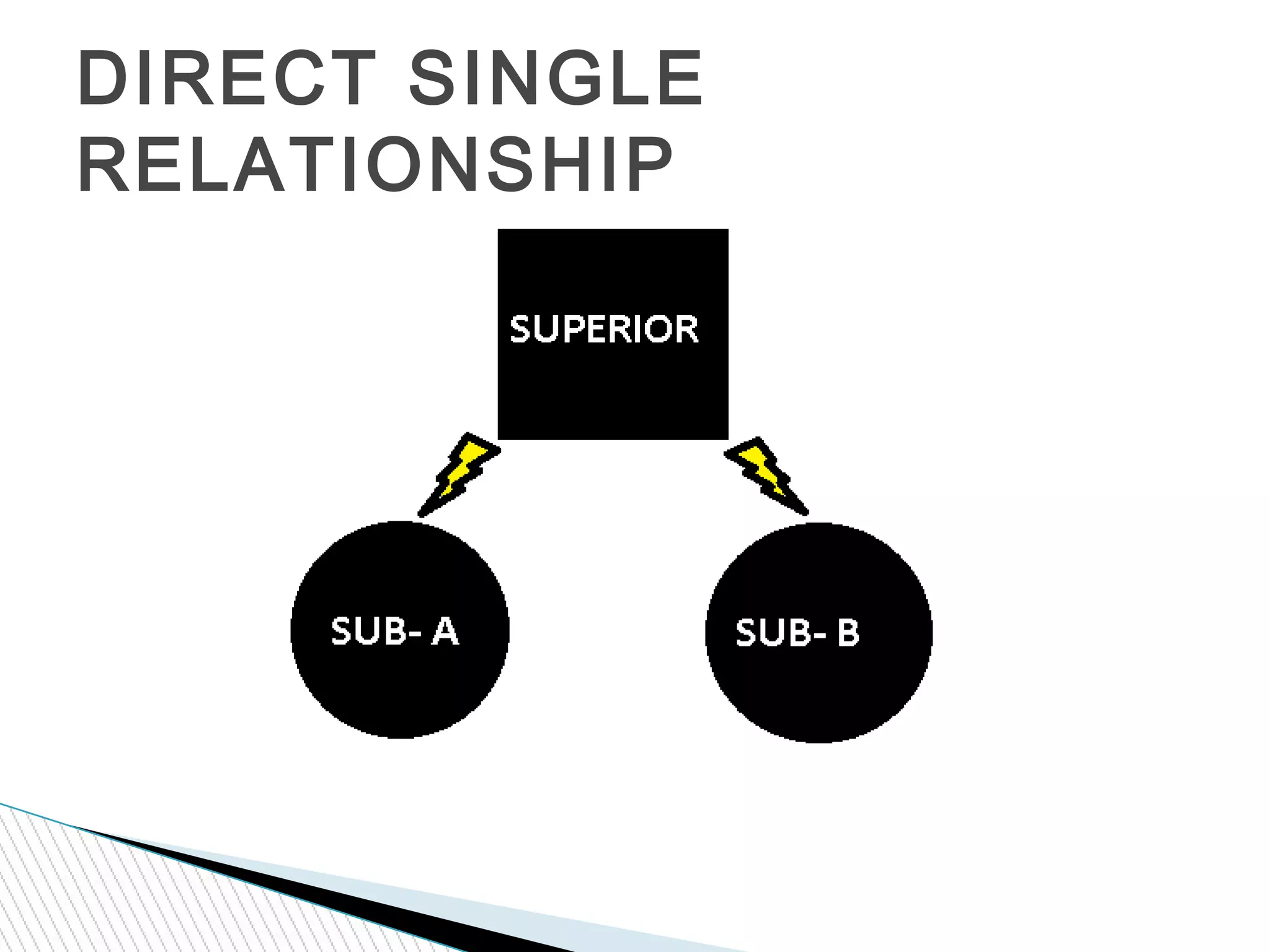
Direct relationship (superior has
direct link with subordinates).
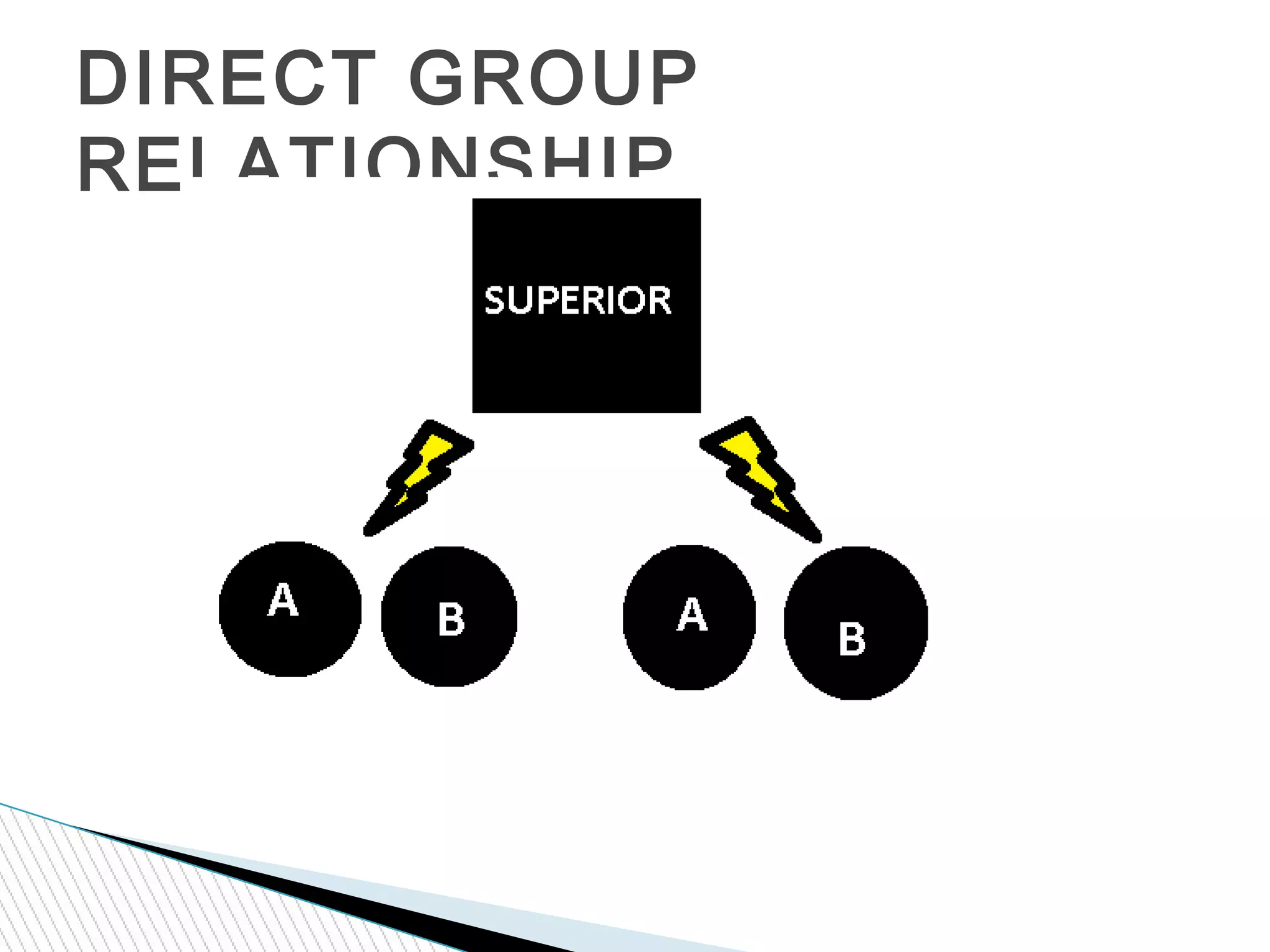
Direct group relationship(arises
between manager and group of
subordinates ).
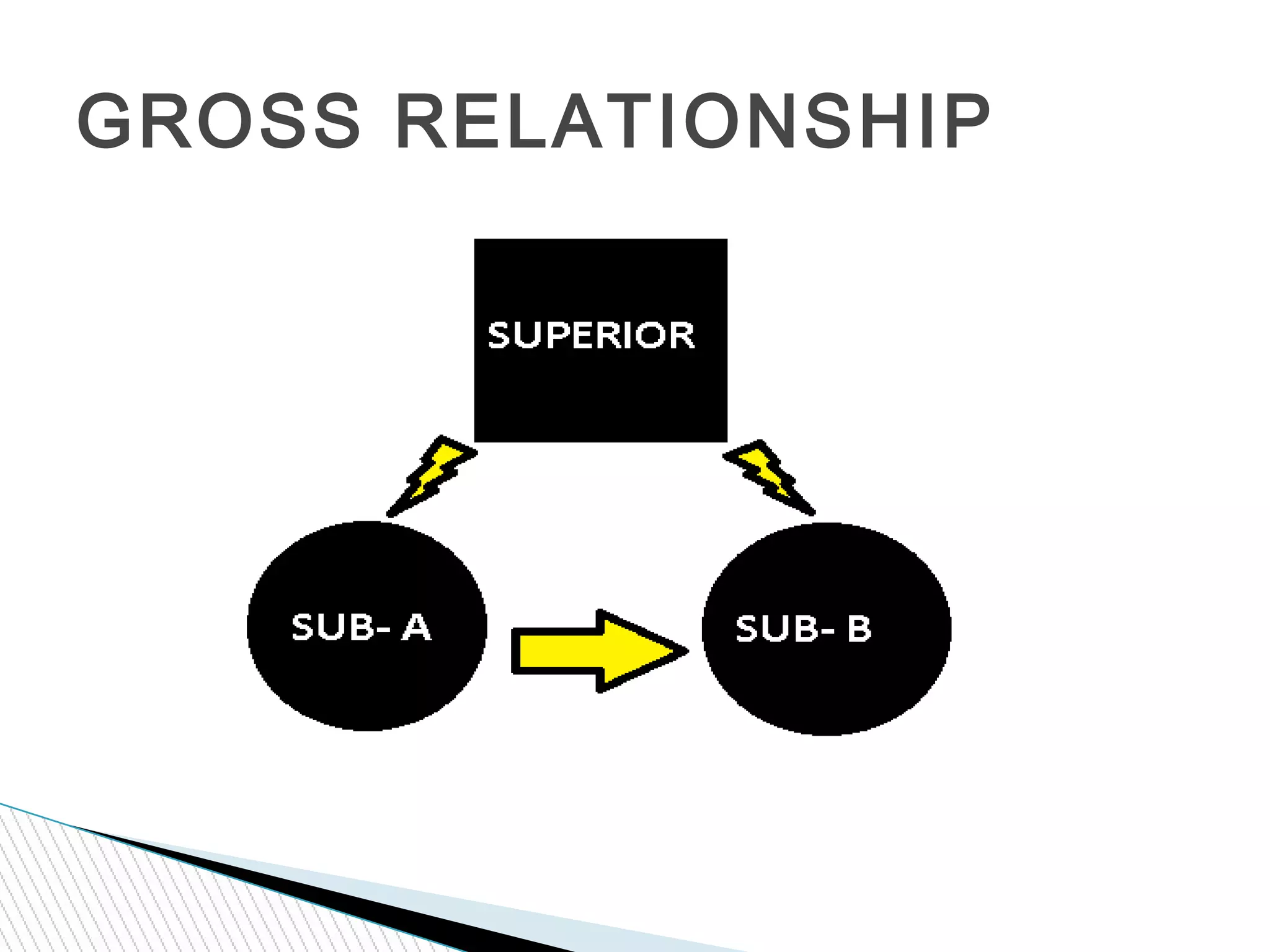
Gross relationship ( relationship
among subordinates).
DIRECT SINGLE
RELATIONSHIP
DIRECT GROUP
RELATIONSHIP
GROSS RELATIONSHIP
MATHEMATICAL
FORMULAS
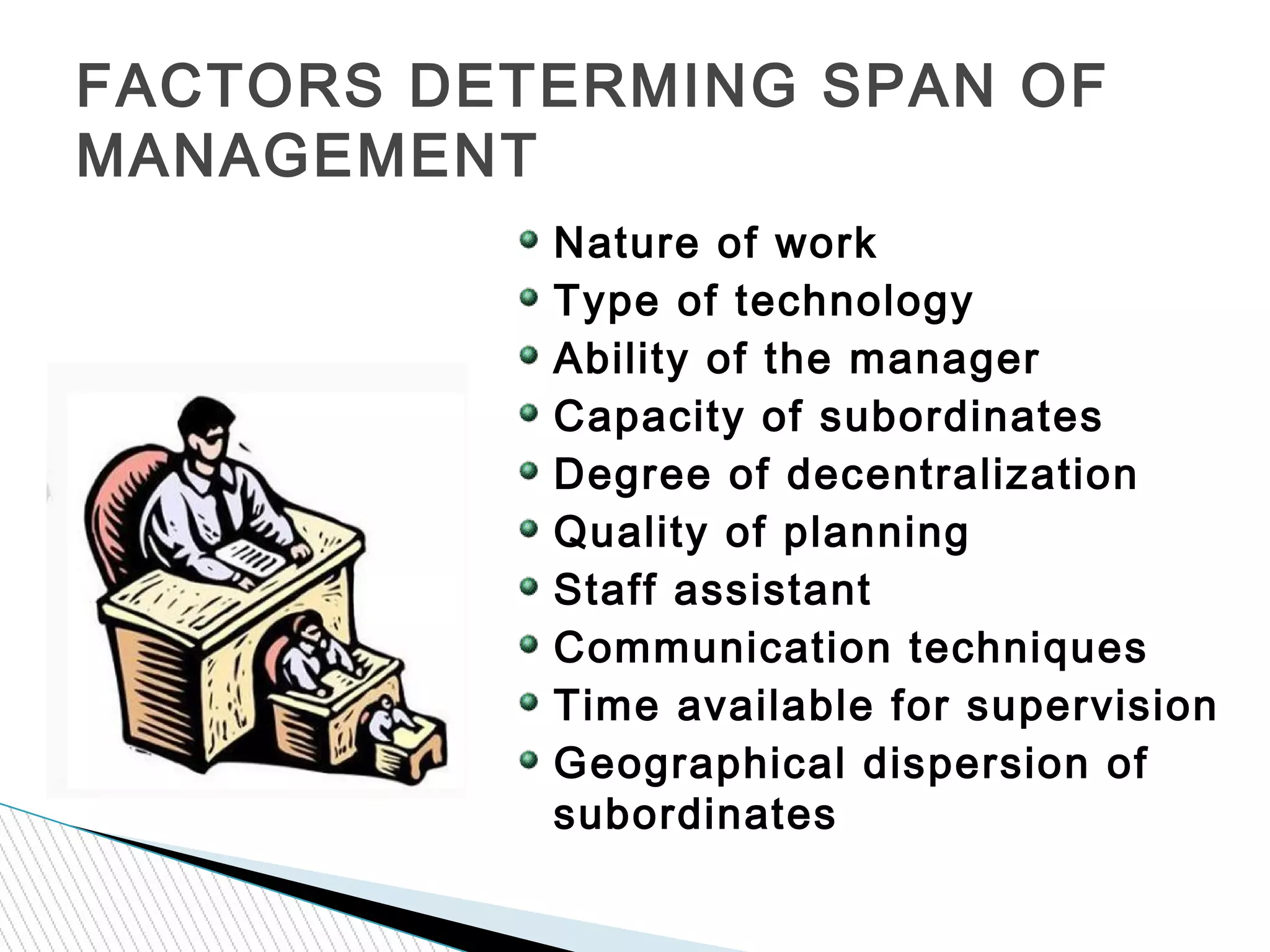
FACTORS DETERMING SPAN OF
MANAGEMENT
Nature of work
Type of technology
Ability of the manager
Capacity of subordinates
Degree of decentralization
Quality of planning
Staff assistant
Communication techniques
Time available for supervision
Geographical dispersion of
subordinates
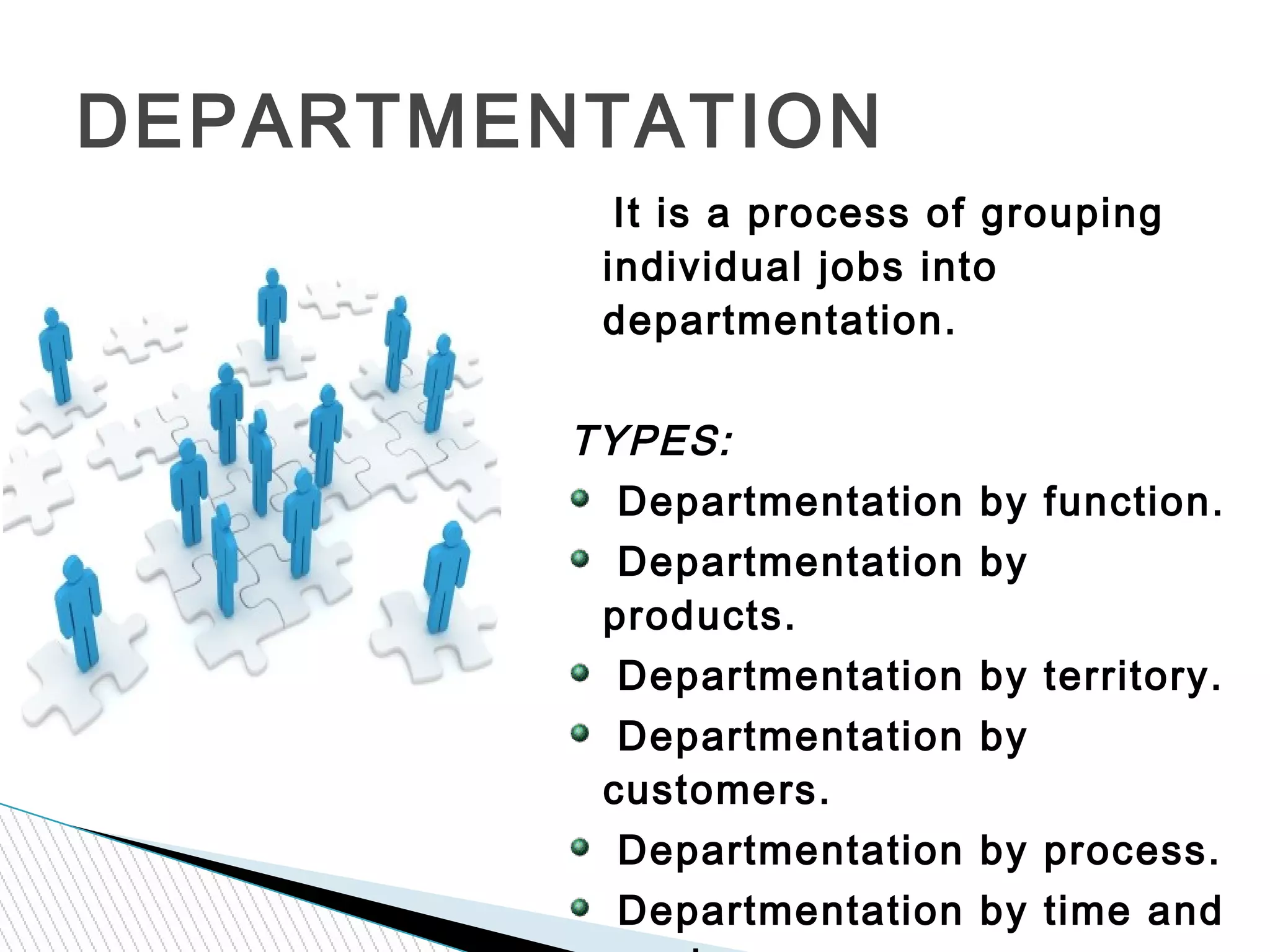
DEPARTMENTATION
It is a process of grouping
individual jobs into
departmentation.
TYPES:
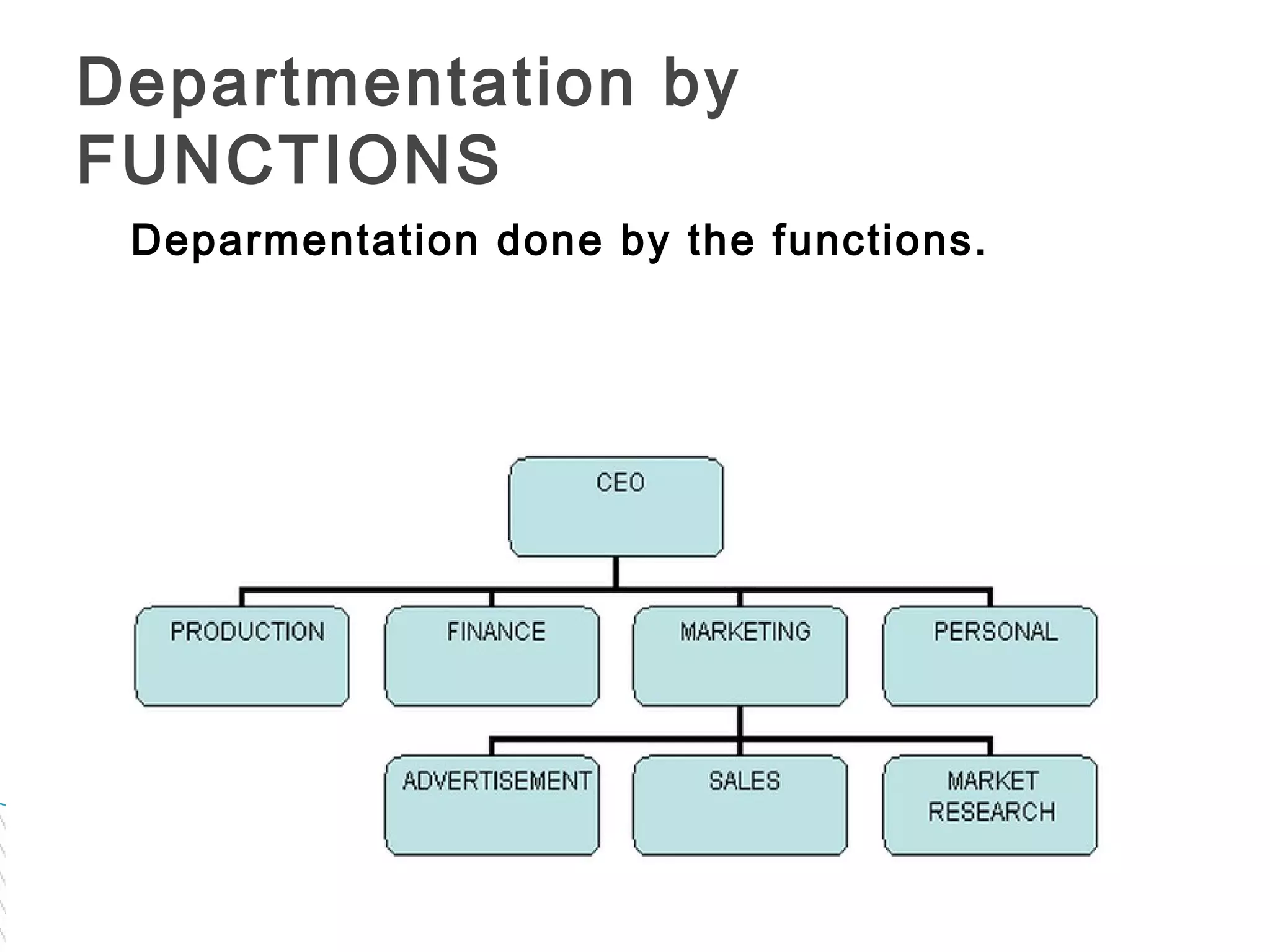
Departmentation by function.
Departmentation by
products.
Departmentation by territory.
Departmentation by
customers.
Departmentation by process.
Departmentation by time and
Departmentation by
FUNCTIONS
Deparmentation done by the functions.
MERITS & DEMERITS
Provides scope of specialization.
Eliminates cost of duplication of
work.
Effective control over performance.
Facilitates delegation of authority.
Interdepartmental conflicts.
Difficulty in coordination of activities.
Increases responsibility of departmental
heads.
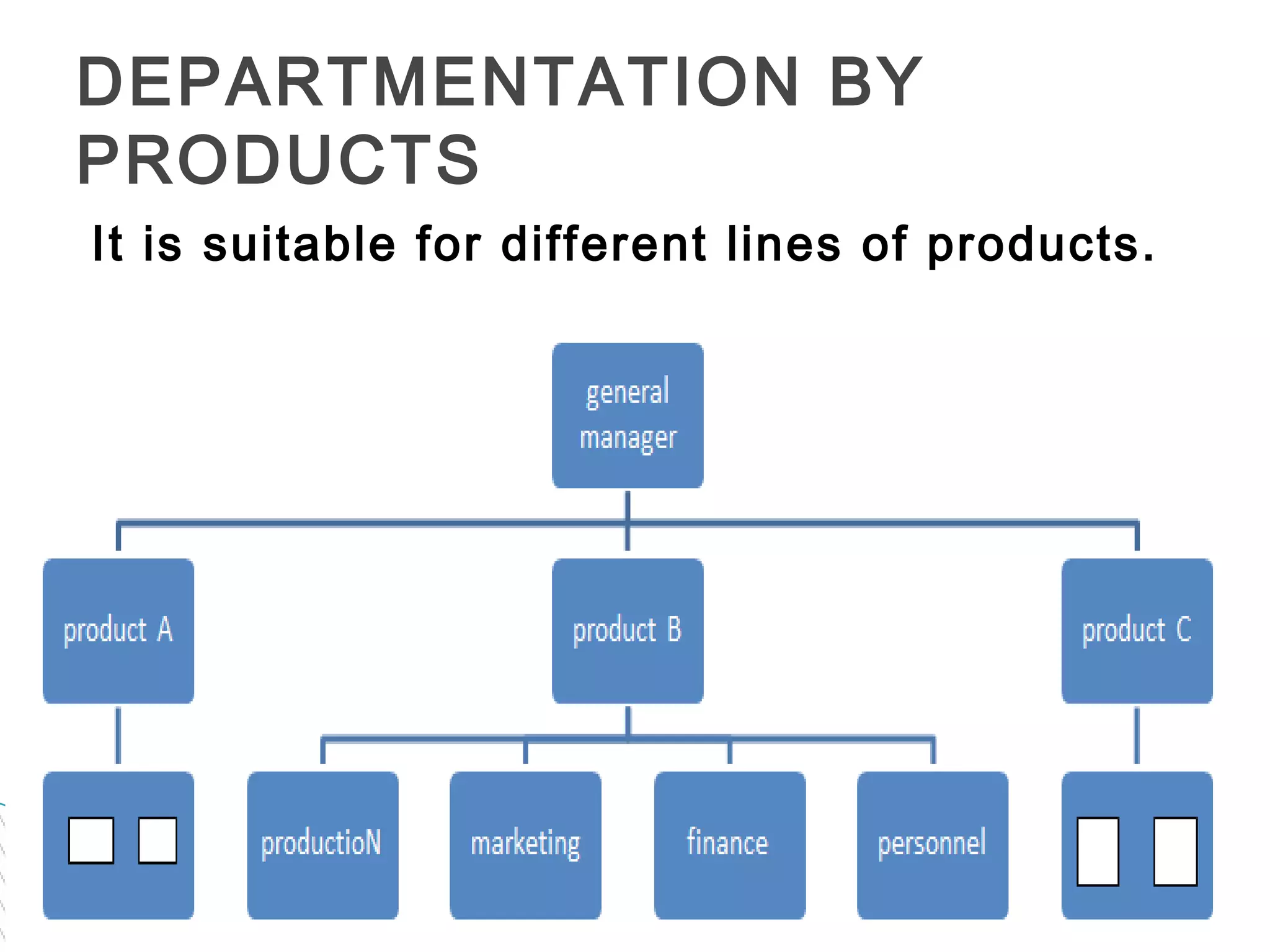
DEPARTMENTATION BY
PRODUCTS
It is suitable for different lines of products.
MERITS & DEMERITS
Reduces problem of coordination.
It leads to specialization.
Performance evaluation can be done
easily.
It is flexible and adaptable to change .
Chance of duplication is more.
There may be underutilization of plant
capacity when the demand of product is
not adequate.
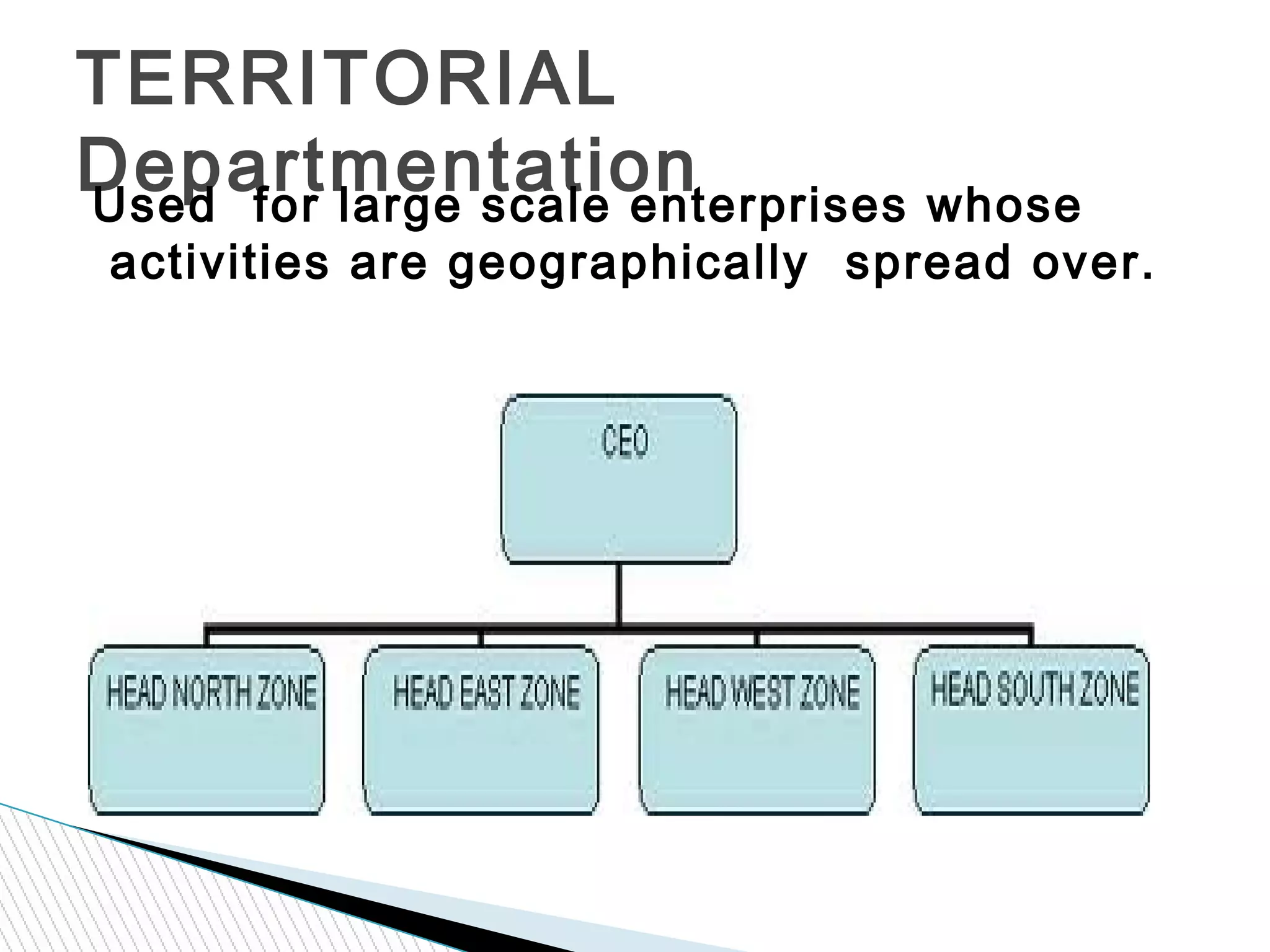
TERRITORIAL
DepartmentationUsed for large scale enterprises whose
activities are geographically spread over.
MERITS & DEMERITS
It helps in achieving benefits of local
operation.
Better coordination of activities.
Provides effective span of control.
Opportunity to train managers.
Facilitates expansion of business to
various regions
Due to geographical distance problem of
communication.
Coordination and control becomes less
effective.
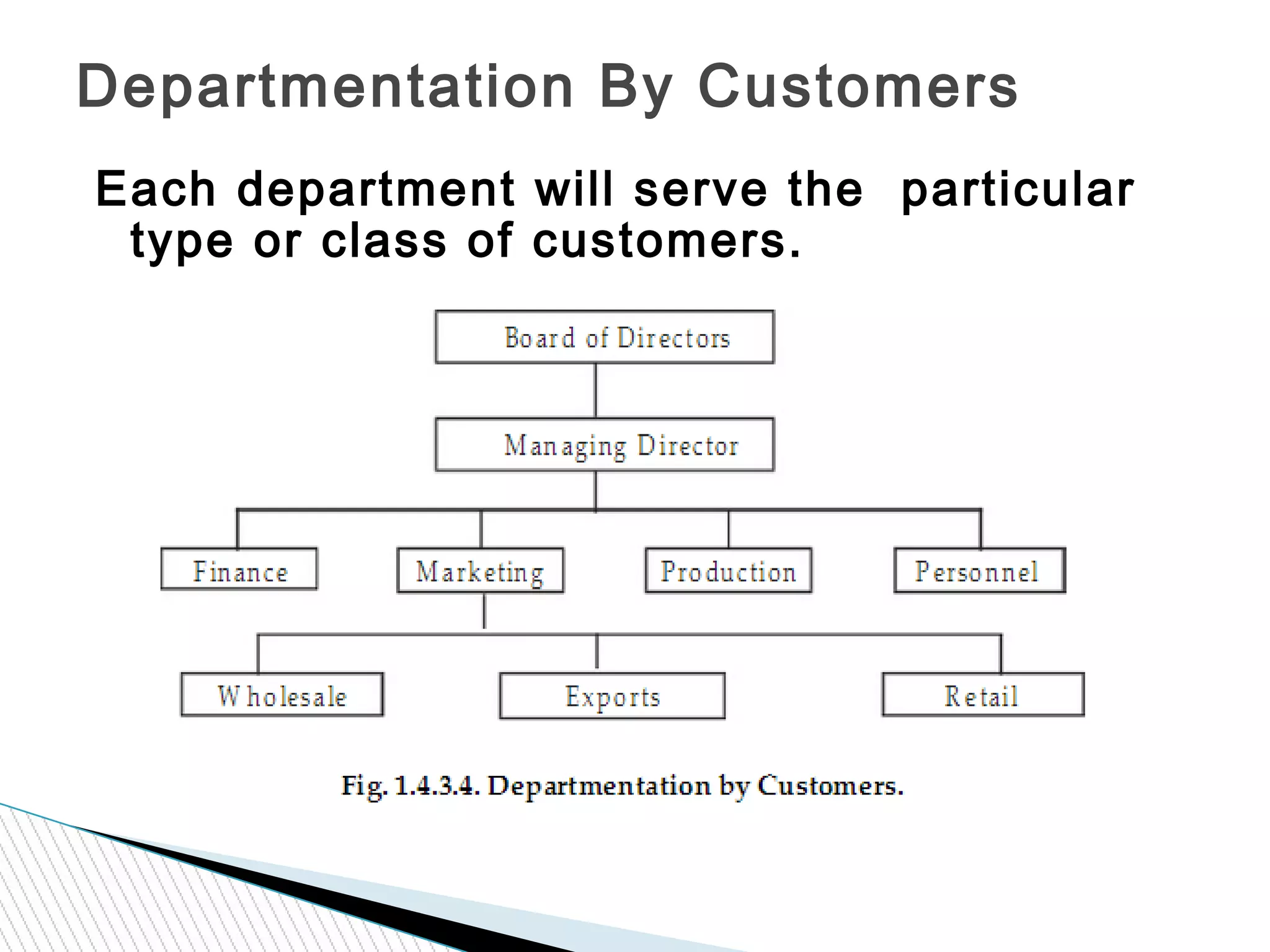
Departmentation By Customers
Each department will serve the particular
type or class of customers.
MERITS & DEMERITS
Offer scope of specialization.
Enterprise gain ultimate
knowledge about needs of various
categories of customers.
Lead to duplication of activities.
DEPARTMENTATION BY PROCESS
OR EQUIPMENT
The activities are grouped according to
process or equipment.
It is generally used in manufacturing
industries.
Lead to specialization.
No confusion.
Proper utilization of manpower and
machine engaged in proper way.
TIME AND NUMBER
DEPARTMENTATION
TIME:
The activities or group on basis
of time
EXAMPLE: Call centers or
any factory.
NUMBER:
The activities or group on
basis of performance by certain
number of persons.
organising - principles of management

organising - principles of management

  • 1.
  • 2.
    What is organising? “organisingin a general sense means systematic arrangment of activities” Organising follows “planning” ORGANISING
  • 3.
    3 ALLEN defines “Organizing“ is the process of identifying and grouping the work to be performed defining and delegating resposibility and authority and establishing relationship for the purpose of enabling people to work most effectively together in accomplishing objectives”. DEFINITION
  • 4.
    THEO HAIMANN “Organising isthe process of defining and grouping the activities of the entire process and establishing the authority and relationship among them”
  • 5.
    Organising in management refersto the relationship between people,work and resources used to achieve the common objectives ORGANISING IN MANAGEMENT
  • 6.
    A DESIGN OFORGANIZATION MOVEMENT OR BLUEPRINT, ORGANIZATION STRUCTURE
  • 7.
    ORGANIZATION STRUCTURE EXPLAINS THEPOSITION AND OFFICIAL RELATIONSHIP BETWEEN VARIOUS INDIVIDUALS IN THE ORGANIZATION. DEFINITION
  • 8.
    It is adiagrammatic representation of organization structure show names designation functions of personnel in a organization. ORGANISATION CHART
  • 10.
    Learning objectives Identifying thetask Grouping the activities Delegation of authority Coordination NATURE OF ORGANISING
  • 11.
    Perform an analysisabout the work Identify the work Organisation structure The grouping of activities neccesary for attaining objectives(division of labour) Assignment of work(communication) Delegation of authority(authority structure) NATURE
  • 12.
    Aids to management Itfacilitates growth,creativity It ensures optimum use resources Establishes relationship among individual groups Clusters job into units Coordinates. PURPOSE OF ORGANISING
  • 13.
    FORMAL GROUP- Aformal group is a structured group,which has a plan and positions each job’s objective and functions FORMAL AND INFORMAL GROUPS
  • 14.
    Formal means something systematic. Itis in an official structure It provides official relationship between individual. It is objective oriented It abides with rules and regulations CHARACTERISTICS OF FORMAL GROUP
  • 15.
    The line ofcommunication is very clear It is accuracy of the information. systematic It is objective oriented. It has a heirarchial pattern ADVANTAGES:
  • 16.
    It is theoutcome of personal ,social and friendly relationship and it develops spontaneously. It arises naturally on the basis of friendship or some common interest which may or may not be related with work INFORMAL GROUPS
  • 17.
    According to chesterbernard “informal organisation is joint personal activity with our conscious common purpose though contributing to common purpose” DEFINITION
  • 18.
    Informal group iscreated by the member of the organisation for their social and psychological satisfaction Informal groups are unstable in nature ,it is not permanent Informal groups are greater in numbers than the formal groups Free interaction CHARACTERISTICS OF INFORMAL GROUP
  • 19.
    It is concisiouslydeliberate in nature It arises spontaneously It is based on delegation of authority It arises on account of social interaction or it arises from account of personal factors like friendship Rules responsibilities are written and clearly defined Just unwritten rules and regulations It shown in organization chart It has no place in organization chart It provides a definite structure It is structure less because it is social Formal authority is attaches to a position Informal authority attaches to a person out of social interactions It flows downwards ( top to lower level) It flows upwards It is permanent and stable It is temporary and unstable It is deliberately impersonal It is personal
  • 20.
    LINE STRUCTURE LINE ANDSTAFF STRUCTURE FUNCTIONAL STRUCTURE COMMITTEE STRUCTURE PROJECT STRUCTURE MATRIX STRUCTURE TYPES OF ORGANIZATION STRUCTURE
  • 21.
    It flows fromtop to lower level . It is the simplest and oldest method followed in many organization. It is also called as military organization. LINE STRUCTURE
  • 22.
  • 23.
    Simple and easyto establish. Authority and responsibility is clearly defined Prompts decision. Speedy action taken. Unity of command since each will have full control over subordinates. Ensures Better discipline. It is very economical since it is less elaborate. It provides better scope for supervision. MERITS OF LINE STRUCTURE
  • 24.
    Lacks specialization Overburden withlots of administrative work It may result in autocratic control Manager enjoys monopoly in the matter of decision making ( he himself take decision) Always downward communications is possible Lacks upward communication It is suitable for small concerns employing few persons DEMERITS OF LINE STRUCTURE
  • 25.
    The staff isattached to line The staff are experts specialized in specific areas They give ideas to personnel The staff supports the line personnel LINE AND STAFF ORGANIZATION
  • 26.
    Expert advice Relief totop executives. Quality decisions. Flexible. Specialization is not violated. Unity of command is not violated. MERITS OF LINE AND STAFF
  • 27.
    Often arises conflictsbetween line and staff. Leads to confusion since responsibility is not well defined. Ineffective staff . Suitability ( in large organization). DEMERITS OF LINE AND STAFF
  • 28.
    There will bea separate department for different actions or activities. FUNCTIONAL ORGANIZATION
  • 29.
    Specialization is possible Workload is less Better control over subordinates Scope for expansion Higher efficiency MERITS OF FUNCTIONAL ORGANIZATION
  • 30.
    Unity of commandis violated. Interdepartmental conflicts. Delay in decision making. DEMERITS
  • 31.
    A group ofpersons entrusted in a task Types: Standard or permanent committee. Temporary or ad hoc committee. Executive committee. Advisory committee. Formal committee. Informal committee. COMMITTEE ORGANIZATION
  • 32.
    Scope of groupjudgment . Proper coordination and control among individuals and departments. Motivation through participation is possible. Various interest groups. Check against misuse of powers. MERITS
  • 33.
    Expensive affair toconstitute a committee Time consuming or slow decision Compromise decision Suppression of ideas DEMERITS
  • 34.
    It varies fromone organization to organization. Any organization execute a large project for a long period of time adopt this project organization. Usually some company have large number of small projects. The term leader organize the expert or specialist. PROJECT ORGANIZATION
  • 35.
    Maximum use ofspecialized knowledge and skills. Unity of command exist in this organization Flexibility of operation. Fixation of individual responsibility for results. Focuses attention on the specific projects. Provides better coordination. MERITS
  • 36.
    Difficulty in decisionmaking. Pressure and uncertainty due to some several specialist. Difficulty in coordination. Evaluation of performance of various specialist is difficult. DEMERITS
  • 37.
    37 It is suitablewhere there is large number of small projects. It is also called as multiple command system. It is also called as linking pins. MATRIX ORGANIZATION STRUCTURE
  • 38.
    BEST UTILISATION OF ORGANIZATIONALRESOURCES. BENEFIT TO BOTH FUNCTIONAL AND TECHNICAL SPECIALIST . IT PROMOTES COMMUNICATION PERMITS HIGHER DEGREE OF FLEXIBLITY AND ADAPTABILITY. MERITS
  • 39.
    Its against principleof unity of command. Quick decision may not be possible It gives scope for conflicts. DEMERITS
  • 40.
    SPAN OF MANAGEMENT Itis also called as span of control or span of supervision. It refers to the number of subordinates that report directly to a single manager or supervisor.
  • 41.
    TWO TYPES OFSPAN NARROW SPAN OF MANAGEMENT Tall organization. Manager oversees “few” subordinates. better communication. example : handicraft , ivory work , etc.
  • 42.
    WIDE SPAN OFMANAGEMENT Flat organization . Manager oversees “large” number of subordinates. Less overhead cost. example: large firms .
  • 43.
    narrow span widespan of control of control
  • 44.
    THEORY OF GRAICUNA’S Hewas a French management consultant. He developed a formula for analyzing superior subordinate relationship.
  • 45.
    THREE TYPES OF RELATIONSHIP Directrelationship (superior has direct link with subordinates). Direct group relationship(arises between manager and group of subordinates ). Gross relationship ( relationship among subordinates).
  • 46.
  • 47.
  • 48.
  • 49.
  • 50.
    FACTORS DETERMING SPANOF MANAGEMENT Nature of work Type of technology Ability of the manager Capacity of subordinates Degree of decentralization Quality of planning Staff assistant Communication techniques Time available for supervision Geographical dispersion of subordinates
  • 51.
    DEPARTMENTATION It is aprocess of grouping individual jobs into departmentation. TYPES: Departmentation by function. Departmentation by products. Departmentation by territory. Departmentation by customers. Departmentation by process. Departmentation by time and
  • 52.
  • 53.
    MERITS & DEMERITS Providesscope of specialization. Eliminates cost of duplication of work. Effective control over performance. Facilitates delegation of authority. Interdepartmental conflicts. Difficulty in coordination of activities. Increases responsibility of departmental heads.
  • 54.
    DEPARTMENTATION BY PRODUCTS It issuitable for different lines of products.
  • 55.
    MERITS & DEMERITS Reducesproblem of coordination. It leads to specialization. Performance evaluation can be done easily. It is flexible and adaptable to change . Chance of duplication is more. There may be underutilization of plant capacity when the demand of product is not adequate.
  • 56.
    TERRITORIAL DepartmentationUsed for largescale enterprises whose activities are geographically spread over.
  • 57.
    MERITS & DEMERITS Ithelps in achieving benefits of local operation. Better coordination of activities. Provides effective span of control. Opportunity to train managers. Facilitates expansion of business to various regions Due to geographical distance problem of communication. Coordination and control becomes less effective.
  • 58.
    Departmentation By Customers Eachdepartment will serve the particular type or class of customers.
  • 59.
    MERITS & DEMERITS Offerscope of specialization. Enterprise gain ultimate knowledge about needs of various categories of customers. Lead to duplication of activities.
  • 60.
    DEPARTMENTATION BY PROCESS OREQUIPMENT The activities are grouped according to process or equipment. It is generally used in manufacturing industries. Lead to specialization. No confusion. Proper utilization of manpower and machine engaged in proper way.
  • 61.
    TIME AND NUMBER DEPARTMENTATION TIME: Theactivities or group on basis of time EXAMPLE: Call centers or any factory. NUMBER: The activities or group on basis of performance by certain number of persons.