Formal organization
Organizational
structure
Reasons for
organizing
Organized defined
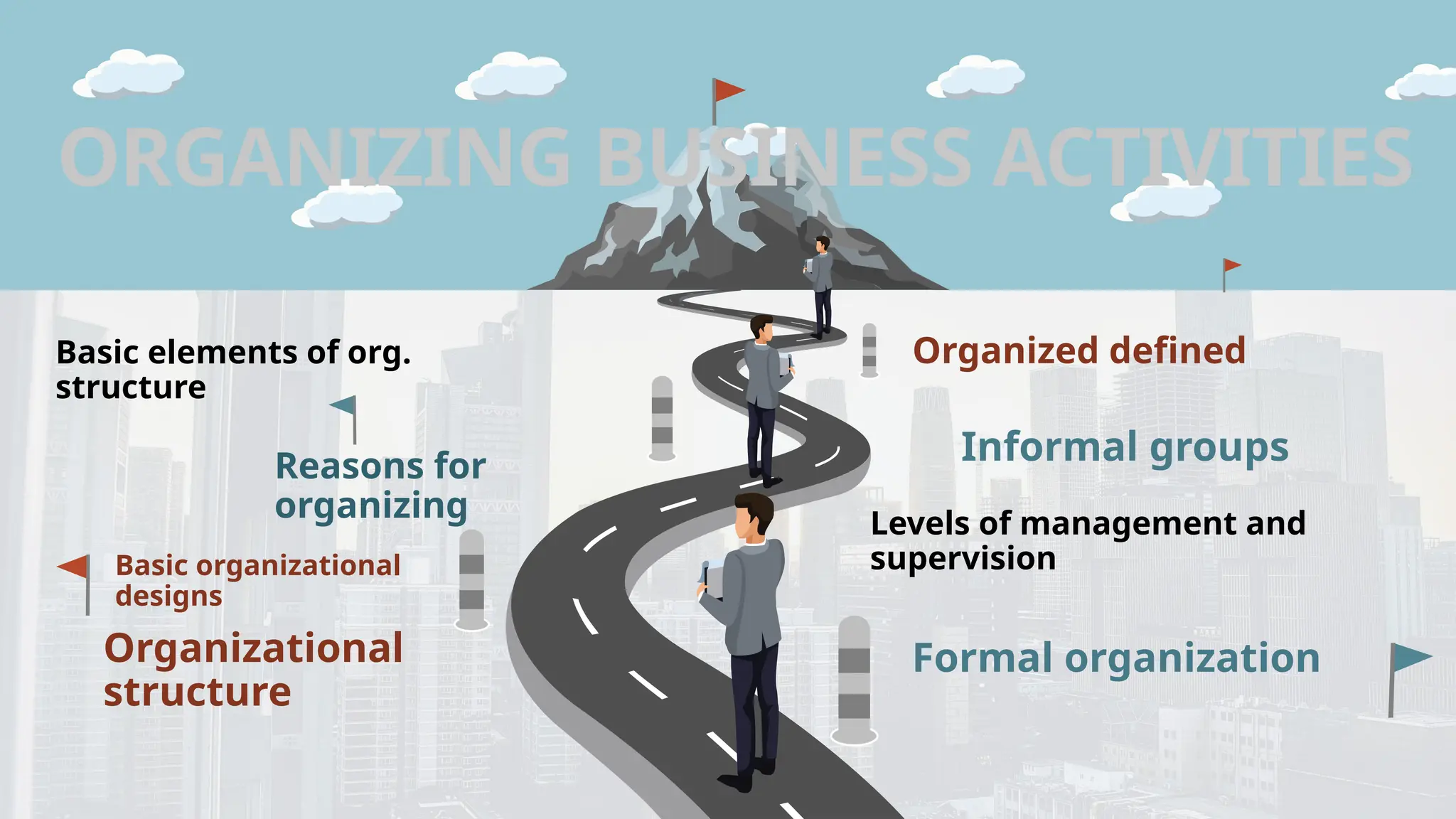
ORGANIZING BUSINESS ACTIVITIES
Informal groups
Levels of management and
supervision
Basic elements of org.
structure
Basic organizational
designs
• Is a management function which
relates to the structuring of
resources and activities to
accomplish objectives in an
efficient and effective manner.
• The aim of organizing activities is
to have a collection of people in
the organization who perform
activities for a specific purpose.
ORGANIZIN
G
WHAT ARE THE
REASONS FOR
ORGANIZING?
STRUCTURE – is the means by
which the organization will attain its
objectives and goals.
The Organizational Structure and
Its Determinants
Determinants of an organization structure are:
• Strategy or plans for achieving the company’s
objectives;
• Technology that will be used in carrying out the
strategy;
• People employed at all levels and their functions;
and
• Size of the organization.
According to Nelson & Quick, formal
organization “is the part of the system that has
legitimacy and official recognition”. What is
depicted in the organization chart is the formal
organization. It is the planned structure
representing the intended configuration of
positions, job duties, and lines of authority
among the component parts of the
organization.
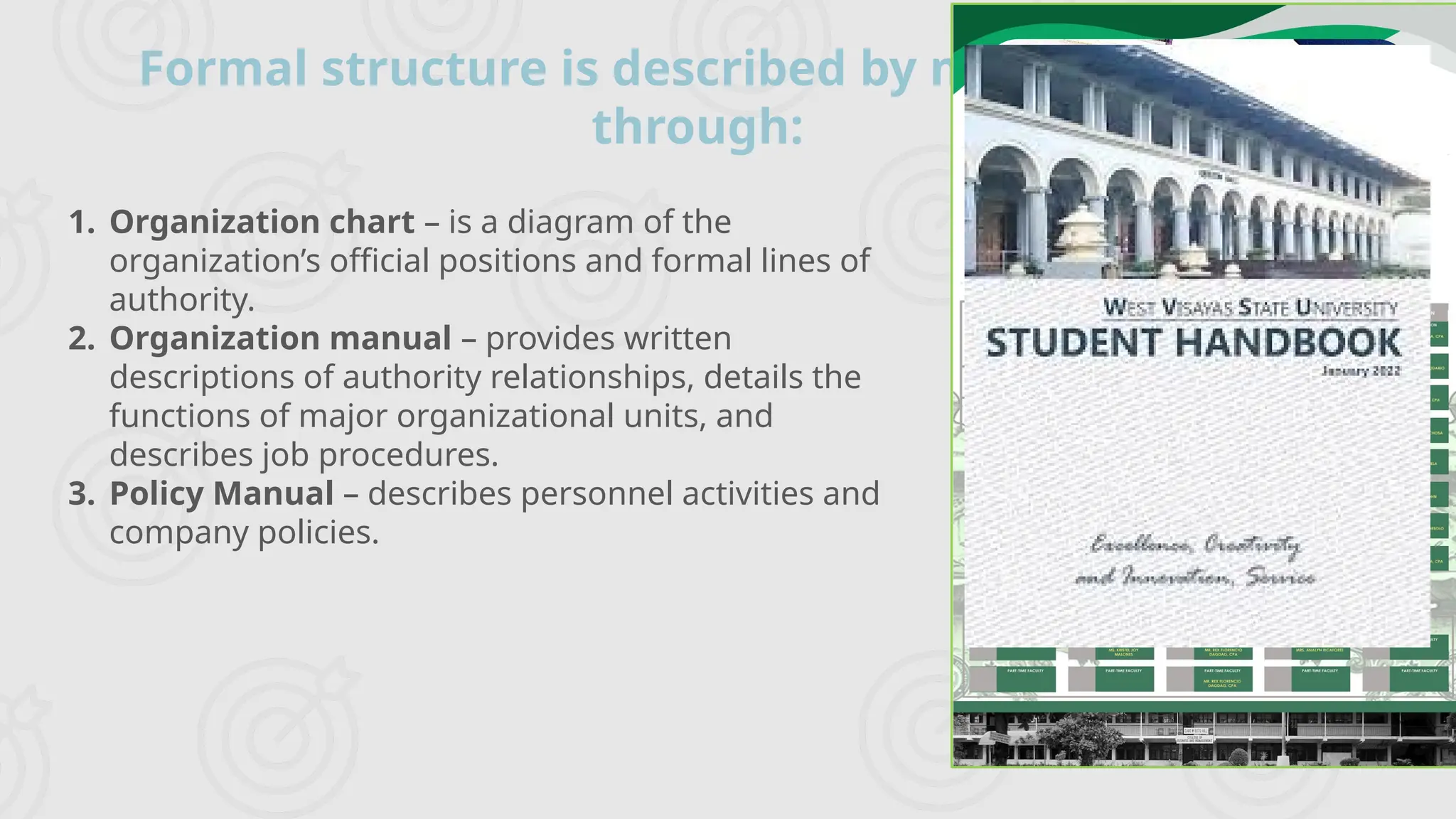
Formal structure is described by management
through:
1. Organization chart – is a diagram of the
organization’s official positions and formal lines of
authority.
2. Organization manual – provides written
descriptions of authority relationships, details the
functions of major organizational units, and
describes job procedures.
3. Policy Manual – describes personnel activities and
company policies.
When members of an
organization spontaneously
form a group with
friendship as a principal
reason for belonging. This
is refers to an informal
groups.
Informal groups are oftentimes very useful in
the accomplishment of major tasks, especially if
these tasks conform to the expectations of the
members of the informal group. Valentine,
stresses caution, “Informal groups are
vulnerable to expediency, manipulation, and
opportunism.
LEVELS OF MANAGEMENT
& SUPERVISION
LEVELS OF MANAGEMENT
& SUPERVISION
1. TALL STRUCTURE – has many levels of
management. It has the following advantages:
• Since the average span of control is narrower, the
supervisory load is less for each manager;
• There are more opportunities for promotion because
there are more levels of positions;
• Managers are provided with opportunities to
specialize;
• There is less demand for managers with multiple skills;
and
• Managers are afforded with more time to attend to
other important problems.
LEVELS OF MANAGEMENT
& SUPERVISION
Disadvantages:
• Communication tends to be slower and distorted
because of the number of levels it has to pass
through;
• The number of management levels also hinders
effective decision making rendering such activity
slower and less accurate; and
• It is kore expensive to maintain as there are more
managers to compensate.
BASIC ELEMENTS OF ORGANIZATIONAL
STRUCTURE
In designing the organizational structure, basic elements
are considered. These are as follows:
1. Work specialization
2. Departmentation
3. Pattern of authority
4. Span of control
5. Coordination of activities
WORK SPECIALIZATION
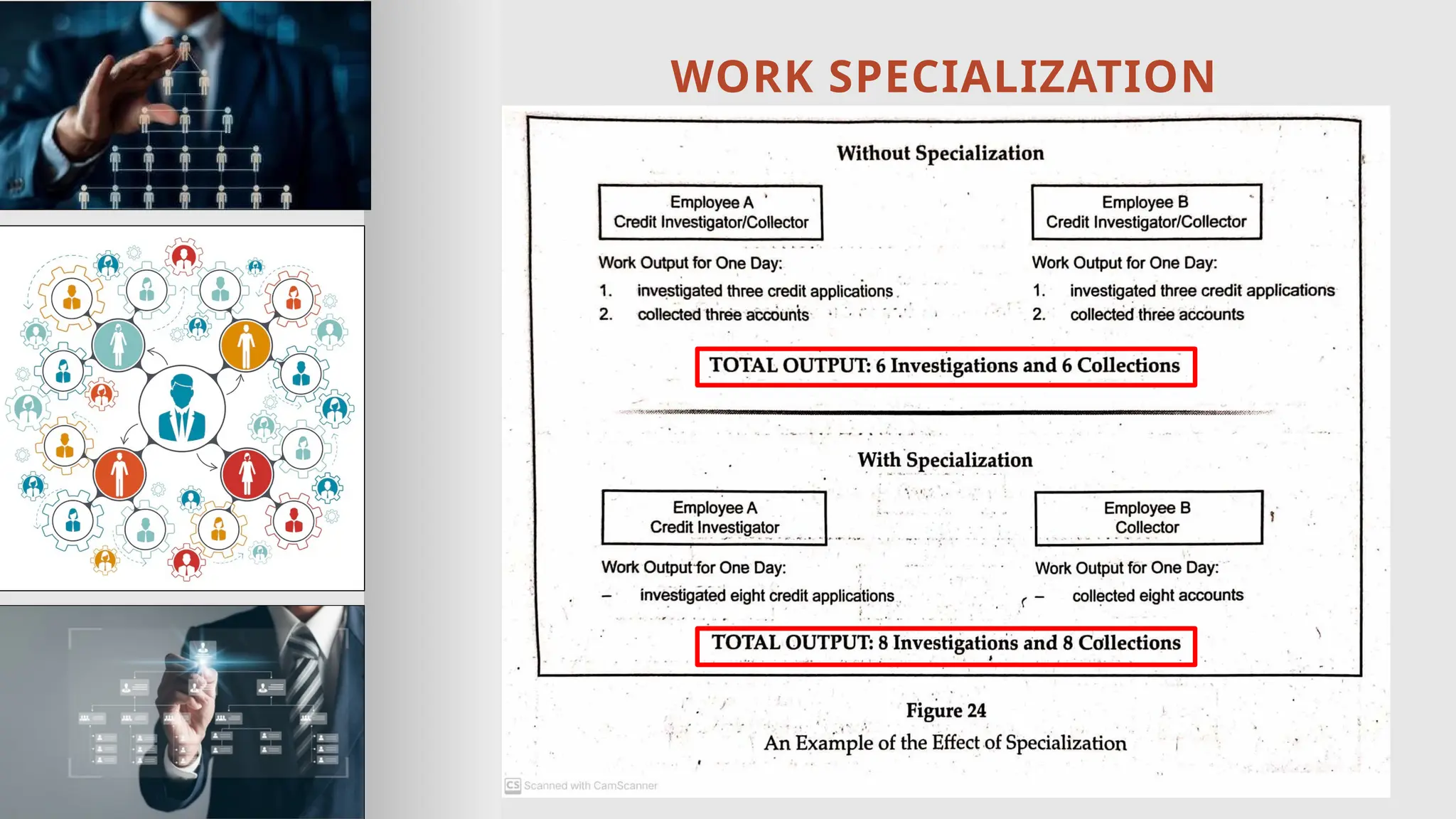
The degree to which tasks are divided in the organization
is referred to as work specialization. A decision must be
made regarding this element and it should be reflected
in the organizational structure.
WORK SPECIALIZATION
WHY
SPECIALIZATION?
DEPARTMENTATION
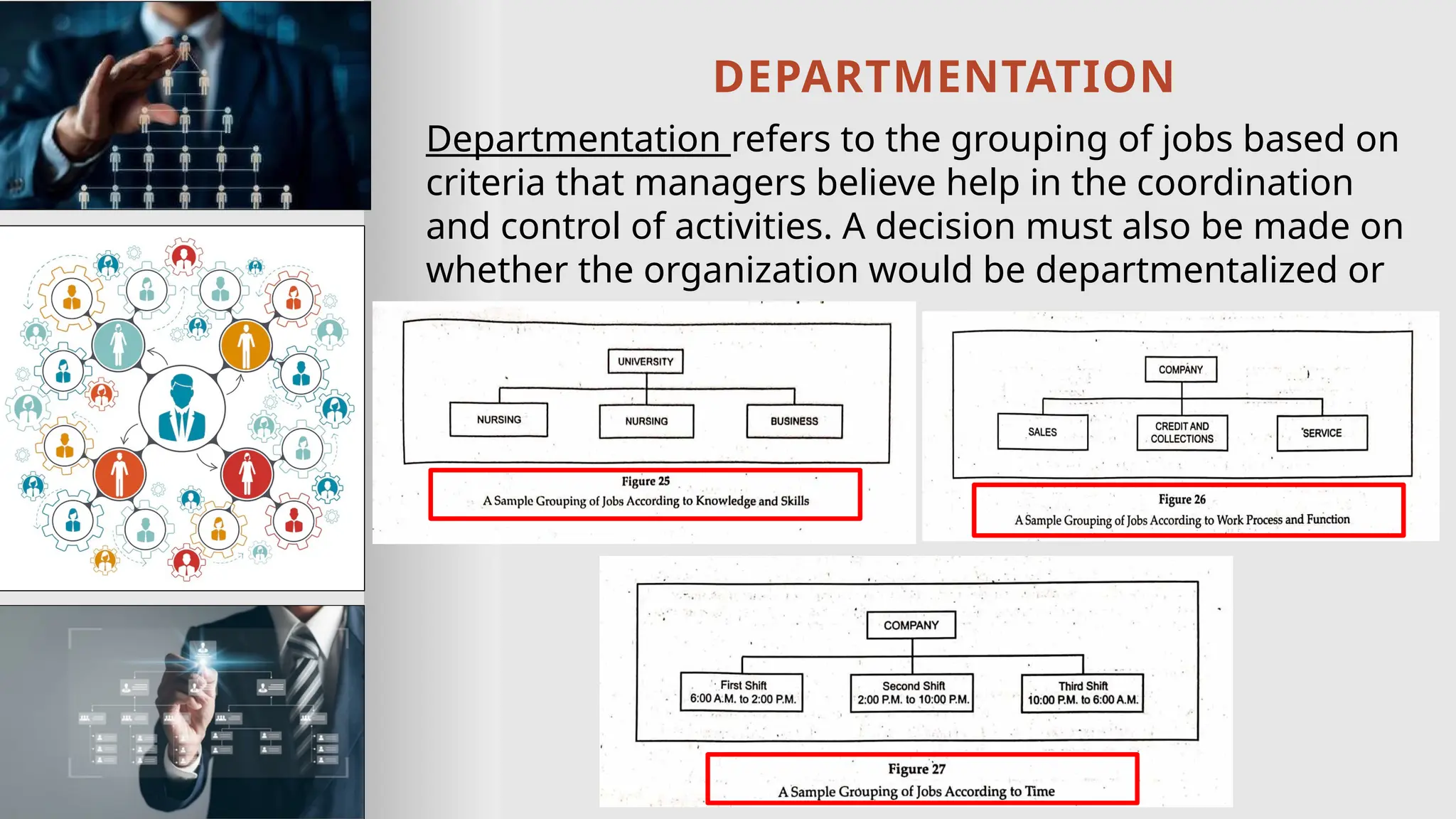
Departmentation refers to the grouping of jobs based on
criteria that managers believe help in the coordination
and control of activities. A decision must also be made on
whether the organization would be departmentalized or
not.
DEPARTMENTATION
DEPARTMENTATION
Advantages of Grouping Jobs:
1. Supervision is made easier
2. The sharing of resources, such as men, machines,
and materials results in maximum use of such
resources
3. Common measures of performance are established
PATTERN OF AUTHORITY
The pattern of authority as an element in deciding
organizational structure refers to the extent by which
organization members are allowed to make decisions
without getting the approval of another member.
Authority patterns may either be centralized or
decentralized. It is centralized when decision making is
concentrated in the hands of higher-level managers. It is
decentralized when decision making authority is
granted to middle and lower level management
DEPARTMENTATION
Decentralized authority offers the following
advantages:
1. Efficiency: red tapes and bottlenecks are reduced
2. Flexibility: managers can cope with situations as they
come
3. Initiative: managers are highly motivated by the
challenge
4. Development: managers are provided with
opportunity for training
Decentralized authority offers the following
disadvantages:
1. Control: coordinating overall activities is more difficult
2. Duplication: There is a great chance of duplication of
efforts between departments
3. Centralized expertise: home office experts may be
overlooked or disregarded
4. Competency: the organization may not be able to
produce competent managers at all levels
SPAN OF CONTROL
SPAN OF CONTROL – is another consideration in
designing the organizational structure. It refers to the
number of subordinates reporting to a single supervisor.
Span of control may either be narrow or wide. It is
narrow when there are few subordinates reporting to a
supervisor. The narrow span of control is characterized by
the following:
1. There is closer relationship between manager and
subordinates;
2. There is less delegation of authority;
3. Controlling activities is kore tight; and
4. There is more time for rewarding behavior.
SPAN OF CONTROL
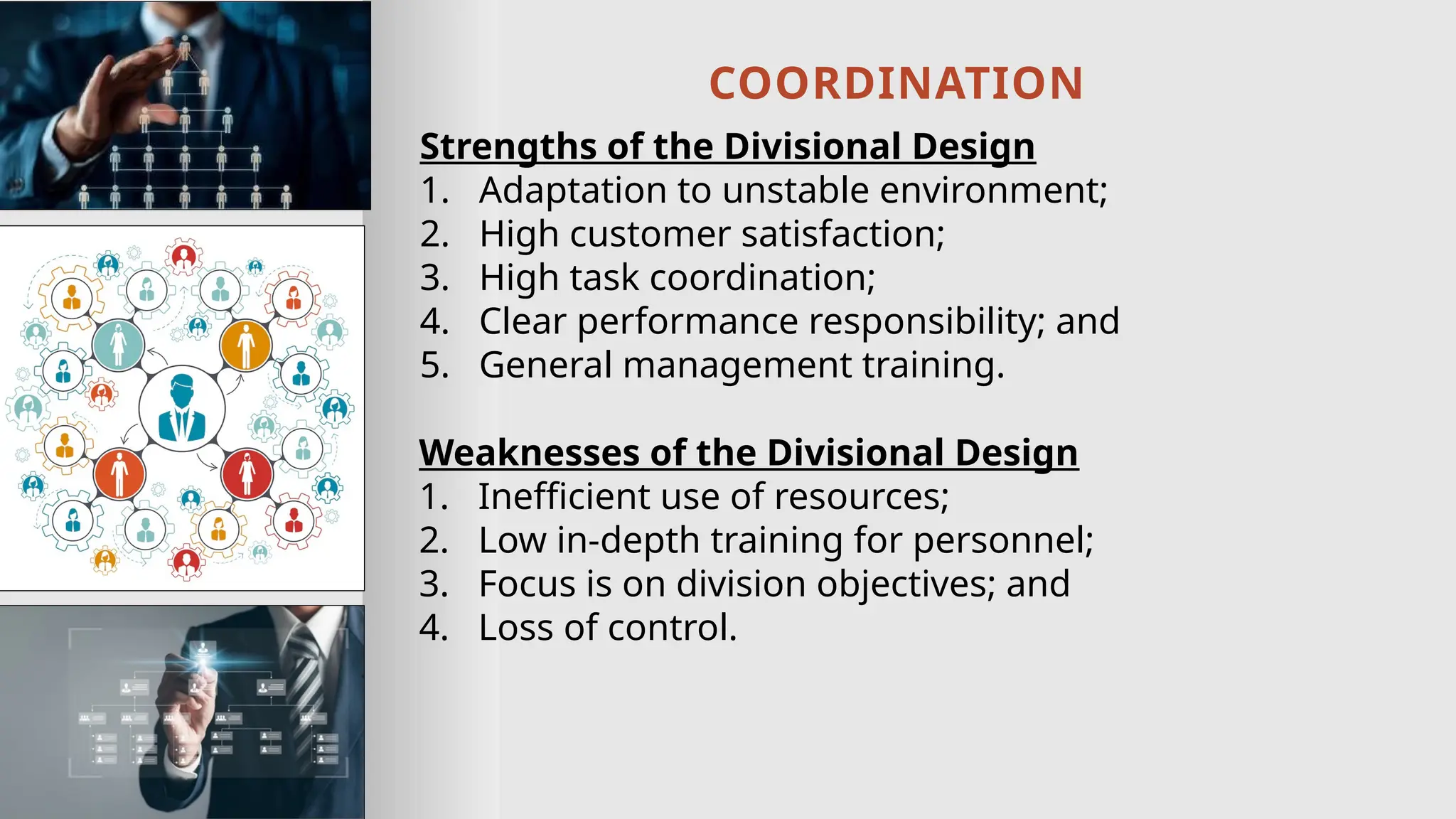
Span of control is wide when there are many
subordinates reporting to a supervisor. The following
characteristics are inherent to an organization with wide
span of control:
1. Employees work with little supervision;
2. There is a high level of delegation of authority;
3. Controlling is lighter; and
4. There is less time for nrewarding behavior
SPAN OF CONTROL
SPAN OF CONTROL
COORDINATION
Coordination refers to the linking of activities in the
organization that serve to achieve a common goal or
objective.
BASIC ORGANIZATIONAL DESIGNS
1. Functional Designs – an organization may be
designed basically according to function. In
organizations with functional design, employees are
grouped together in separate departments on the basis
of common tasks, skills, or activities.
COORDINATION
Strengths of the Functional Design
1. Efficient use of resources;
2. In-depth skill development;
3. Clear career paths;
4. Unity of direction; and
5. Enhanced coordination within functions.
Weaknesses of the Functional Design
1. Slow decision making;
2. Less innovation;
3. Unclear performance responsibility;
4. Limited management training; and
5. Poor coordination across functions.
COORDINATION
BASIC ORGANIZATIONAL DESIGNS
2. Divisional Design– the organization with divisional
design is that type where all activities needed to produce
a good or service are grouped together into independent
units.
COORDINATION
Strengths of the Divisional Design
1. Adaptation to unstable environment;
2. High customer satisfaction;
3. High task coordination;
4. Clear performance responsibility; and
5. General management training.
Weaknesses of the Divisional Design
1. Inefficient use of resources;
2. Low in-depth training for personnel;
3. Focus is on division objectives; and
4. Loss of control.
COORDINATION
BASIC ORGANIZATIONAL DESIGNS
3. Hybrid Design– also called the matrix structure. It is a
combination of divisional units and functional
departments.
COORDINATION
Strengths of the Hybrid Design
1. Simultaneous coordination;
2. Integration of goals with objectives; and
3. Efficient and highly adaptable.
Weaknesses of the Hybrid Design
1. Slow responses to exceptional situations;
2. Conflict between headquarters and divisions; and
3. Administrative overhead.
COORDINATION
BASIC ORGANIZATIONAL DESIGNS
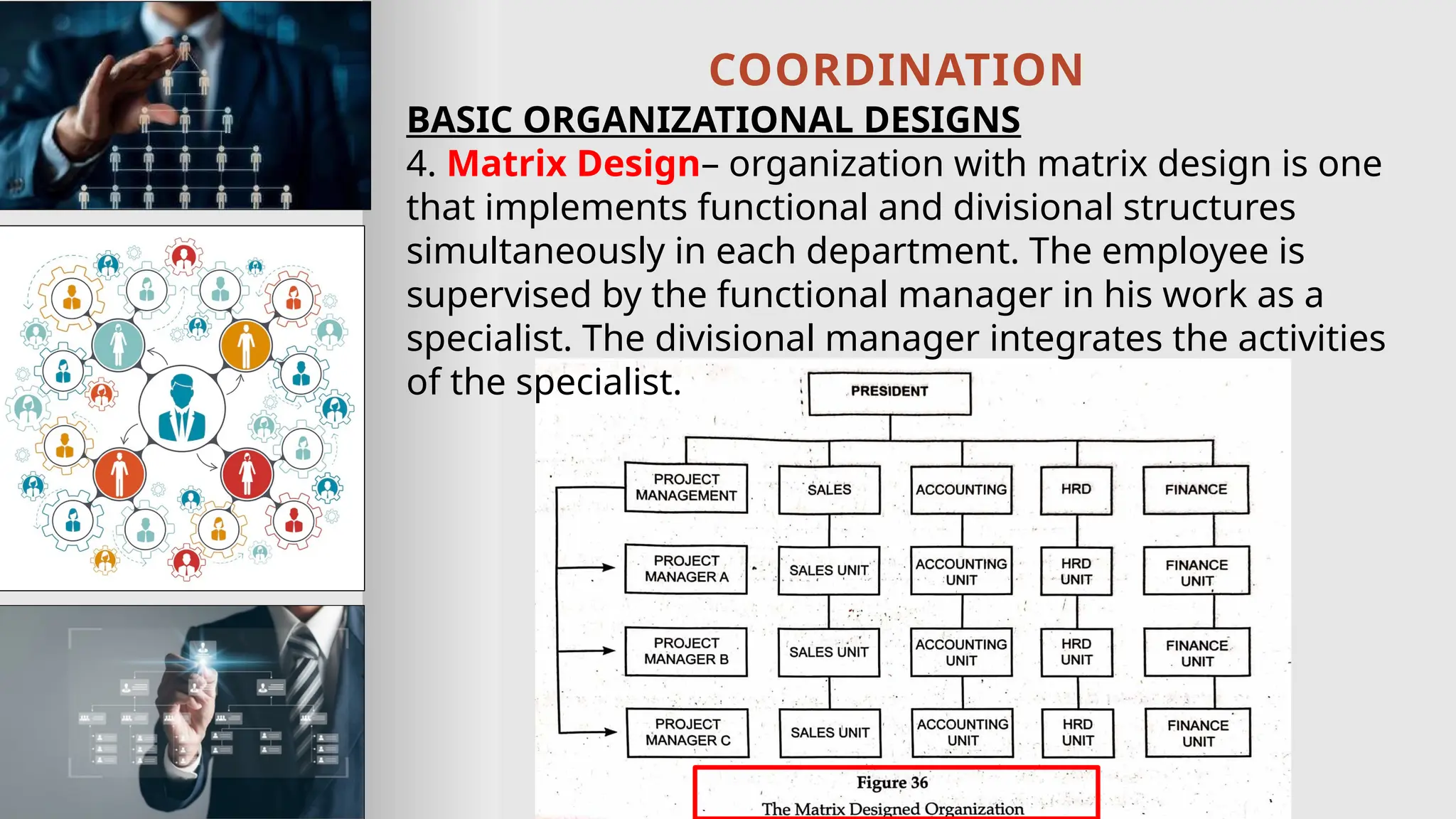
4. Matrix Design– organization with matrix design is one
that implements functional and divisional structures
simultaneously in each department. The employee is
supervised by the functional manager in his work as a
specialist. The divisional manager integrates the activities
of the specialist.
COORDINATION
Strengths of the Matrix Design
1. Allows demands from the environment to be met
simultaneously;
2. Provides flexibility;
3. Encourages resource efficiency;
4. Enhances skill development;
5. Increases motivation and commitment among
employees; and
6. Aids top management planning.
Weaknesses of the Matrix Design
1. Creates confusion;
2. Power struggles within the group are potential
problems; and
3. Places stress on individuals.
END

Chapter 7 - Organizing Business ACtivities

  • 1.
    Formal organization Organizational structure Reasons for organizing Organizeddefined ORGANIZING BUSINESS ACTIVITIES Informal groups Levels of management and supervision Basic elements of org. structure Basic organizational designs
  • 2.
    • Is amanagement function which relates to the structuring of resources and activities to accomplish objectives in an efficient and effective manner. • The aim of organizing activities is to have a collection of people in the organization who perform activities for a specific purpose. ORGANIZIN G
  • 3.
    WHAT ARE THE REASONSFOR ORGANIZING?
  • 4.
    STRUCTURE – isthe means by which the organization will attain its objectives and goals. The Organizational Structure and Its Determinants Determinants of an organization structure are: • Strategy or plans for achieving the company’s objectives; • Technology that will be used in carrying out the strategy; • People employed at all levels and their functions; and • Size of the organization.
  • 5.
    According to Nelson& Quick, formal organization “is the part of the system that has legitimacy and official recognition”. What is depicted in the organization chart is the formal organization. It is the planned structure representing the intended configuration of positions, job duties, and lines of authority among the component parts of the organization.
  • 6.
    Formal structure isdescribed by management through: 1. Organization chart – is a diagram of the organization’s official positions and formal lines of authority. 2. Organization manual – provides written descriptions of authority relationships, details the functions of major organizational units, and describes job procedures. 3. Policy Manual – describes personnel activities and company policies.
  • 7.
    When members ofan organization spontaneously form a group with friendship as a principal reason for belonging. This is refers to an informal groups.
  • 8.
    Informal groups areoftentimes very useful in the accomplishment of major tasks, especially if these tasks conform to the expectations of the members of the informal group. Valentine, stresses caution, “Informal groups are vulnerable to expediency, manipulation, and opportunism.
  • 9.
  • 10.
    LEVELS OF MANAGEMENT &SUPERVISION 1. TALL STRUCTURE – has many levels of management. It has the following advantages: • Since the average span of control is narrower, the supervisory load is less for each manager; • There are more opportunities for promotion because there are more levels of positions; • Managers are provided with opportunities to specialize; • There is less demand for managers with multiple skills; and • Managers are afforded with more time to attend to other important problems.
  • 11.
    LEVELS OF MANAGEMENT &SUPERVISION Disadvantages: • Communication tends to be slower and distorted because of the number of levels it has to pass through; • The number of management levels also hinders effective decision making rendering such activity slower and less accurate; and • It is kore expensive to maintain as there are more managers to compensate.
  • 12.
    BASIC ELEMENTS OFORGANIZATIONAL STRUCTURE In designing the organizational structure, basic elements are considered. These are as follows: 1. Work specialization 2. Departmentation 3. Pattern of authority 4. Span of control 5. Coordination of activities
  • 13.
    WORK SPECIALIZATION The degreeto which tasks are divided in the organization is referred to as work specialization. A decision must be made regarding this element and it should be reflected in the organizational structure.
  • 14.
  • 15.
  • 16.
    DEPARTMENTATION Departmentation refers tothe grouping of jobs based on criteria that managers believe help in the coordination and control of activities. A decision must also be made on whether the organization would be departmentalized or not.
  • 17.
  • 18.
    DEPARTMENTATION Advantages of GroupingJobs: 1. Supervision is made easier 2. The sharing of resources, such as men, machines, and materials results in maximum use of such resources 3. Common measures of performance are established PATTERN OF AUTHORITY The pattern of authority as an element in deciding organizational structure refers to the extent by which organization members are allowed to make decisions without getting the approval of another member. Authority patterns may either be centralized or decentralized. It is centralized when decision making is concentrated in the hands of higher-level managers. It is decentralized when decision making authority is granted to middle and lower level management
  • 19.
    DEPARTMENTATION Decentralized authority offersthe following advantages: 1. Efficiency: red tapes and bottlenecks are reduced 2. Flexibility: managers can cope with situations as they come 3. Initiative: managers are highly motivated by the challenge 4. Development: managers are provided with opportunity for training Decentralized authority offers the following disadvantages: 1. Control: coordinating overall activities is more difficult 2. Duplication: There is a great chance of duplication of efforts between departments 3. Centralized expertise: home office experts may be overlooked or disregarded 4. Competency: the organization may not be able to produce competent managers at all levels
  • 20.
    SPAN OF CONTROL SPANOF CONTROL – is another consideration in designing the organizational structure. It refers to the number of subordinates reporting to a single supervisor. Span of control may either be narrow or wide. It is narrow when there are few subordinates reporting to a supervisor. The narrow span of control is characterized by the following: 1. There is closer relationship between manager and subordinates; 2. There is less delegation of authority; 3. Controlling activities is kore tight; and 4. There is more time for rewarding behavior.
  • 21.
    SPAN OF CONTROL Spanof control is wide when there are many subordinates reporting to a supervisor. The following characteristics are inherent to an organization with wide span of control: 1. Employees work with little supervision; 2. There is a high level of delegation of authority; 3. Controlling is lighter; and 4. There is less time for nrewarding behavior
  • 22.
  • 23.
  • 24.
    COORDINATION Coordination refers tothe linking of activities in the organization that serve to achieve a common goal or objective. BASIC ORGANIZATIONAL DESIGNS 1. Functional Designs – an organization may be designed basically according to function. In organizations with functional design, employees are grouped together in separate departments on the basis of common tasks, skills, or activities.
  • 25.
    COORDINATION Strengths of theFunctional Design 1. Efficient use of resources; 2. In-depth skill development; 3. Clear career paths; 4. Unity of direction; and 5. Enhanced coordination within functions. Weaknesses of the Functional Design 1. Slow decision making; 2. Less innovation; 3. Unclear performance responsibility; 4. Limited management training; and 5. Poor coordination across functions.
  • 26.
    COORDINATION BASIC ORGANIZATIONAL DESIGNS 2.Divisional Design– the organization with divisional design is that type where all activities needed to produce a good or service are grouped together into independent units.
  • 27.
    COORDINATION Strengths of theDivisional Design 1. Adaptation to unstable environment; 2. High customer satisfaction; 3. High task coordination; 4. Clear performance responsibility; and 5. General management training. Weaknesses of the Divisional Design 1. Inefficient use of resources; 2. Low in-depth training for personnel; 3. Focus is on division objectives; and 4. Loss of control.
  • 28.
    COORDINATION BASIC ORGANIZATIONAL DESIGNS 3.Hybrid Design– also called the matrix structure. It is a combination of divisional units and functional departments.
  • 29.
    COORDINATION Strengths of theHybrid Design 1. Simultaneous coordination; 2. Integration of goals with objectives; and 3. Efficient and highly adaptable. Weaknesses of the Hybrid Design 1. Slow responses to exceptional situations; 2. Conflict between headquarters and divisions; and 3. Administrative overhead.
  • 30.
    COORDINATION BASIC ORGANIZATIONAL DESIGNS 4.Matrix Design– organization with matrix design is one that implements functional and divisional structures simultaneously in each department. The employee is supervised by the functional manager in his work as a specialist. The divisional manager integrates the activities of the specialist.
  • 31.
    COORDINATION Strengths of theMatrix Design 1. Allows demands from the environment to be met simultaneously; 2. Provides flexibility; 3. Encourages resource efficiency; 4. Enhances skill development; 5. Increases motivation and commitment among employees; and 6. Aids top management planning. Weaknesses of the Matrix Design 1. Creates confusion; 2. Power struggles within the group are potential problems; and 3. Places stress on individuals.
  • 32.