ORGANISING
CONCEPT
 Backbone of management
 Sociologists organization means a study of the
interactions of the people
 Functional components in the best possible
combination so that an enterprise can achieve its
goals
Definition
 "It is grouping of activities necessary to attain enterprise
objectives and the assignment of each grouping to a manager
with authority necessary to supervise it". Koontz and O'Donnel
 "The structure and process by which a cooperative group of
human beings allocates its tasks among its members, identifies
relationship, and integrates its activities towards common
objectives". Joseph Massive
Definition
 "The process of identifying and grouping the work to be
performed, defining and delegating responsibility and
authority and establishing relationship for the purpose of
enabling people to work more effectively together in
accomplishing objects". Louis A. Allen
Characteristics
 It is a group of individuals which may be large or small.
 The group in the organization works under the executive
leadership.
 It is a machine or mechanism of management.
 It has some directing authority or power which controls the
Characteristics
 The division of labour, power and responsibilities are
deliberately planned.
 It implies a structure of duties and responsibilities.
 It is established for accomplishment of common objectives
 It is a functional concept.
Advantages
 Facilitates attainment of the objectives of the enterprise.
 Facilitates optimum use of resources and new technological
development.
 Facilitates growth and diversification.
 Stimulates creativity and innovation.
 Facilities effective communication.
 Encourages better relations between the labour and the
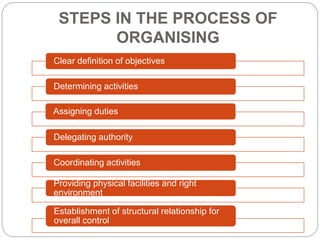
STEPS IN THE PROCESS OF
ORGANISING
Clear definition of objectives
Determining activities
Assigning duties
Delegating authority
Coordinating activities
Providing physical facilities and right
environment
Establishment of structural relationship for
overall control
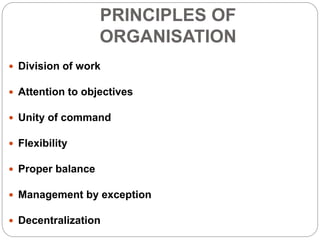
PRINCIPLES OF
ORGANISATION
 Division of work
 Attention to objectives
 Unity of command
 Flexibility
 Proper balance
 Management by exception
 Decentralization
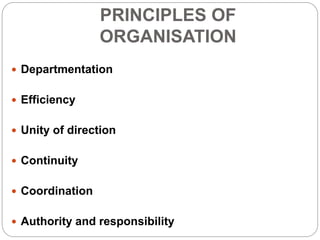
PRINCIPLES OF
ORGANISATION
 Departmentation
 Efficiency
 Unity of direction
 Continuity
 Coordination
 Authority and responsibility
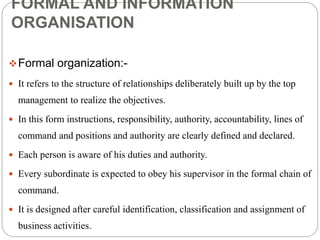
FORMAL AND INFORMATION
ORGANISATION
Formal organization:-
 It refers to the structure of relationships deliberately built up by the top
management to realize the objectives.
 In this form instructions, responsibility, authority, accountability, lines of
command and positions and authority are clearly defined and declared.
 Each person is aware of his duties and authority.
 Every subordinate is expected to obey his supervisor in the formal chain of
command.
 It is designed after careful identification, classification and assignment of
business activities.
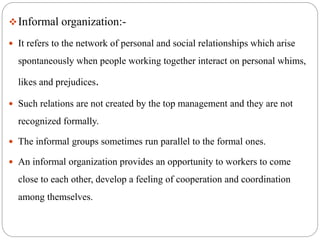
Informal organization:-
 It refers to the network of personal and social relationships which arise
spontaneously when people working together interact on personal whims,
likes and prejudices.
 Such relations are not created by the top management and they are not
recognized formally.
 The informal groups sometimes run parallel to the formal ones.
 An informal organization provides an opportunity to workers to come
close to each other, develop a feeling of cooperation and coordination
among themselves.
FORMAL AND INFORMATION
ORGANISATION
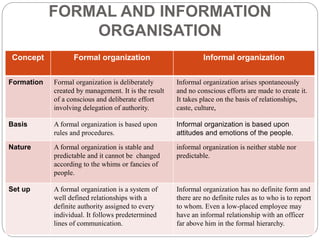
Concept Formal organization Informal organization
Formation Formal organization is deliberately
created by management. It is the result
of a conscious and deliberate effort
involving delegation of authority.
Informal organization arises spontaneously
and no conscious efforts are made to create it.
It takes place on the basis of relationships,
caste, culture,
Basis A formal organization is based upon
rules and procedures.
Informal organization is based upon
attitudes and emotions of the people.
Nature A formal organization is stable and
predictable and it cannot be changed
according to the whims or fancies of
people.
informal organization is neither stable nor
predictable.
Set up A formal organization is a system of
well defined relationships with a
definite authority assigned to every
individual. It follows predetermined
lines of communication.
Informal organization has no definite form and
there are no definite rules as to who is to report
to whom. Even a low-placed employee may
have an informal relationship with an officer
far above him in the formal hierarchy.
FORMAL AND INFORMATION
ORGANISATION
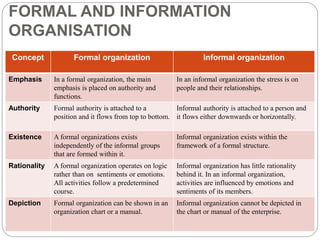
Concept Formal organization Informal organization
Emphasis In a formal organization, the main
emphasis is placed on authority and
functions.
In an informal organization the stress is on
people and their relationships.
Authority Formal authority is attached to a
position and it flows from top to bottom.
Informal authority is attached to a person and
it flows either downwards or horizontally.
Existence A formal organizations exists
independently of the informal groups
that are formed within it.
Informal organization exists within the
framework of a formal structure.
Rationality A formal organization operates on logic
rather than on sentiments or emotions.
All activities follow a predetermined
course.
Informal organization has little rationality
behind it. In an informal organization,
activities are influenced by emotions and
sentiments of its members.
Depiction Formal organization can be shown in an
organization chart or a manual.
Informal organization cannot be depicted in
the chart or manual of the enterprise.
FORMS OF ORGANISATION
STRUCTURE
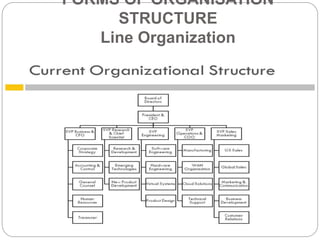
Line Organization
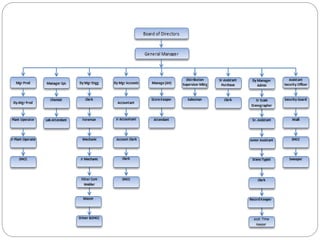
Line Organization
 Advantages of Line Organization
(i) It is very easy to establish line organization and it can
be easily understood by the employees.
(ii) If facilitates unity of command and thus conforms to the
scalar principle of organization.
(iii) There is clear-cut identification of authority and
responsibility relationship. Employees are fully aware of
the boundaries of their jobs.
Advantages of Line Organization
(iv) It ensures excellent discipline in the enterprise
because every individual knows to whom he is
responsible.
(v) It facilitates prompt decision-making because there is
definite authority at every level. An executive cannot shift
his decision making to others, nor can the blame be
shifted.
 Disadvantages of Line Organization
(i) Makes the superiors too overloaded with work.
(ii) The executive unable to pay proper attention to each one.
(iii) It will hamper their effectiveness.
(iv) There is concentration of authority at the top.
(v) If the top executives are not capable, the enterprise will not be
successful.
(vi) Line organization is not suitable to big organizations because it
does not provide specialists in the structure.
(vii) There is partially no communication from bottom upwards
because of concentration of authority at the higher levels.
(viii) If superiors take a wrong decision, it would be carried out
without anybody having the courage to point out its deficiencies.
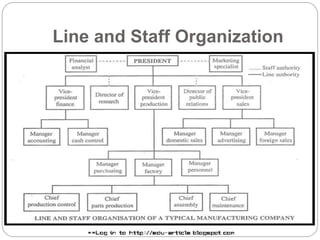
Line and Staff Organization
 Advantages of Line and Staff Organization
(i) Specialized knowledge.
(ii) Reduction of burden.
(iii) Proper weightage
(iv) Better decisions.
(v) Flexibility
(vi) Unity of command.
 Demerits of Line and Staff Organization
(i) There is generally a conflict between the line and staff
executives.
(ii) The allocation of duties between the line and staff
executives is generally not very clear.
(iii) Since staff men are not accountable for the results, they
may not be performing their duties well.
(iv) There is a wide difference between the orientation of the
line and staff men.
(v) Line executives’ deals with problems in a more practical
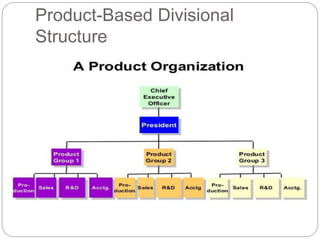
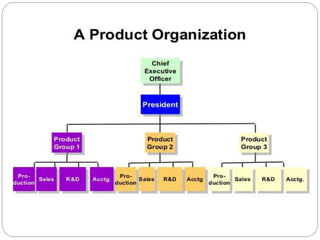
Product-Based Divisional
Structure
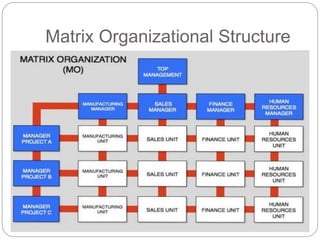
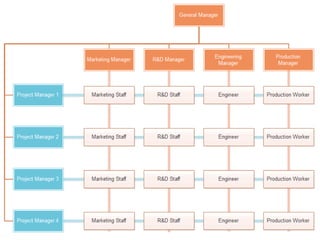
Matrix Organizational Structure
Organising

Organising

  • 1.
  • 2.
    CONCEPT  Backbone ofmanagement  Sociologists organization means a study of the interactions of the people  Functional components in the best possible combination so that an enterprise can achieve its goals
  • 3.
    Definition  "It isgrouping of activities necessary to attain enterprise objectives and the assignment of each grouping to a manager with authority necessary to supervise it". Koontz and O'Donnel  "The structure and process by which a cooperative group of human beings allocates its tasks among its members, identifies relationship, and integrates its activities towards common objectives". Joseph Massive
  • 4.
    Definition  "The processof identifying and grouping the work to be performed, defining and delegating responsibility and authority and establishing relationship for the purpose of enabling people to work more effectively together in accomplishing objects". Louis A. Allen
  • 5.
    Characteristics  It isa group of individuals which may be large or small.  The group in the organization works under the executive leadership.  It is a machine or mechanism of management.  It has some directing authority or power which controls the
  • 6.
    Characteristics  The divisionof labour, power and responsibilities are deliberately planned.  It implies a structure of duties and responsibilities.  It is established for accomplishment of common objectives  It is a functional concept.
  • 7.
    Advantages  Facilitates attainmentof the objectives of the enterprise.  Facilitates optimum use of resources and new technological development.  Facilitates growth and diversification.  Stimulates creativity and innovation.  Facilities effective communication.  Encourages better relations between the labour and the
  • 8.
    STEPS IN THEPROCESS OF ORGANISING Clear definition of objectives Determining activities Assigning duties Delegating authority Coordinating activities Providing physical facilities and right environment Establishment of structural relationship for overall control
  • 9.
    PRINCIPLES OF ORGANISATION  Divisionof work  Attention to objectives  Unity of command  Flexibility  Proper balance  Management by exception  Decentralization
  • 10.
    PRINCIPLES OF ORGANISATION  Departmentation Efficiency  Unity of direction  Continuity  Coordination  Authority and responsibility
  • 11.
    FORMAL AND INFORMATION ORGANISATION Formalorganization:-  It refers to the structure of relationships deliberately built up by the top management to realize the objectives.  In this form instructions, responsibility, authority, accountability, lines of command and positions and authority are clearly defined and declared.  Each person is aware of his duties and authority.  Every subordinate is expected to obey his supervisor in the formal chain of command.  It is designed after careful identification, classification and assignment of business activities.
  • 12.
    Informal organization:-  Itrefers to the network of personal and social relationships which arise spontaneously when people working together interact on personal whims, likes and prejudices.  Such relations are not created by the top management and they are not recognized formally.  The informal groups sometimes run parallel to the formal ones.  An informal organization provides an opportunity to workers to come close to each other, develop a feeling of cooperation and coordination among themselves.
  • 13.
    FORMAL AND INFORMATION ORGANISATION ConceptFormal organization Informal organization Formation Formal organization is deliberately created by management. It is the result of a conscious and deliberate effort involving delegation of authority. Informal organization arises spontaneously and no conscious efforts are made to create it. It takes place on the basis of relationships, caste, culture, Basis A formal organization is based upon rules and procedures. Informal organization is based upon attitudes and emotions of the people. Nature A formal organization is stable and predictable and it cannot be changed according to the whims or fancies of people. informal organization is neither stable nor predictable. Set up A formal organization is a system of well defined relationships with a definite authority assigned to every individual. It follows predetermined lines of communication. Informal organization has no definite form and there are no definite rules as to who is to report to whom. Even a low-placed employee may have an informal relationship with an officer far above him in the formal hierarchy.
  • 14.
    FORMAL AND INFORMATION ORGANISATION ConceptFormal organization Informal organization Emphasis In a formal organization, the main emphasis is placed on authority and functions. In an informal organization the stress is on people and their relationships. Authority Formal authority is attached to a position and it flows from top to bottom. Informal authority is attached to a person and it flows either downwards or horizontally. Existence A formal organizations exists independently of the informal groups that are formed within it. Informal organization exists within the framework of a formal structure. Rationality A formal organization operates on logic rather than on sentiments or emotions. All activities follow a predetermined course. Informal organization has little rationality behind it. In an informal organization, activities are influenced by emotions and sentiments of its members. Depiction Formal organization can be shown in an organization chart or a manual. Informal organization cannot be depicted in the chart or manual of the enterprise.
  • 15.
  • 17.
    Line Organization  Advantagesof Line Organization (i) It is very easy to establish line organization and it can be easily understood by the employees. (ii) If facilitates unity of command and thus conforms to the scalar principle of organization. (iii) There is clear-cut identification of authority and responsibility relationship. Employees are fully aware of the boundaries of their jobs.
  • 18.
    Advantages of LineOrganization (iv) It ensures excellent discipline in the enterprise because every individual knows to whom he is responsible. (v) It facilitates prompt decision-making because there is definite authority at every level. An executive cannot shift his decision making to others, nor can the blame be shifted.
  • 19.
     Disadvantages ofLine Organization (i) Makes the superiors too overloaded with work. (ii) The executive unable to pay proper attention to each one. (iii) It will hamper their effectiveness. (iv) There is concentration of authority at the top. (v) If the top executives are not capable, the enterprise will not be successful. (vi) Line organization is not suitable to big organizations because it does not provide specialists in the structure. (vii) There is partially no communication from bottom upwards because of concentration of authority at the higher levels. (viii) If superiors take a wrong decision, it would be carried out without anybody having the courage to point out its deficiencies.
  • 20.
    Line and StaffOrganization
  • 21.
     Advantages ofLine and Staff Organization (i) Specialized knowledge. (ii) Reduction of burden. (iii) Proper weightage (iv) Better decisions. (v) Flexibility (vi) Unity of command.
  • 22.
     Demerits ofLine and Staff Organization (i) There is generally a conflict between the line and staff executives. (ii) The allocation of duties between the line and staff executives is generally not very clear. (iii) Since staff men are not accountable for the results, they may not be performing their duties well. (iv) There is a wide difference between the orientation of the line and staff men. (v) Line executives’ deals with problems in a more practical
  • 23.
  • 25.