Copyright, Public Domain, Fair Use, and Creative Commons 7 th  Grade Digital Literacy
What is Copyright Law? Copyright insures that the people who create “Intellectual Property” can own, control and be paid for their efforts. Intellectual property is a tangible form of expression: Written work, musical work, works of art, dramatic work, digitized work, video Copyright protection is automatic when intellectual property is created.
What is the Public Domain? A work of authorship is in the “public domain” if it is no longer under copyright protection. Works in the public domain may be used without the permission of the former copyright owner. Rules for when items pass into the public domain  vary considerably .
What is Fair Use? Fair Use allows the use of  portions  of copyrighted works and materials for educational purposes. Copyright is a  law ; Fair Use is a  guideline Four guidelines determine Fair Use: The  purpose   and character of the use.  The  nature  of the copyrighted work.  The  amount  of the portion used.  The  effect  of the use upon its value.
Fair Use: Print Material Poem less than 250 words; 250-word excerpt of poem greater than 250 words Excerpt from a longer work (10 percent of work or 1,000 words, whichever is less).
Fair Use: Images Single works may be used in their entirety, but no more than five images by a single artist or photographer may be used. From a collection, not more than 15 images or 10 percent (whichever is less) may be used.
Fair Use: Video Students may use10 percent or three minutes (whichever is less) of “motion media.” Copyright works included in multimedia projects must give proper attribution to copyright holder.
Fair Use: Audio Students may use10 percent or 30 seconds (whichever is less) of a musical composition. The multimedia program must have an educational use.
What is Creative Commons?
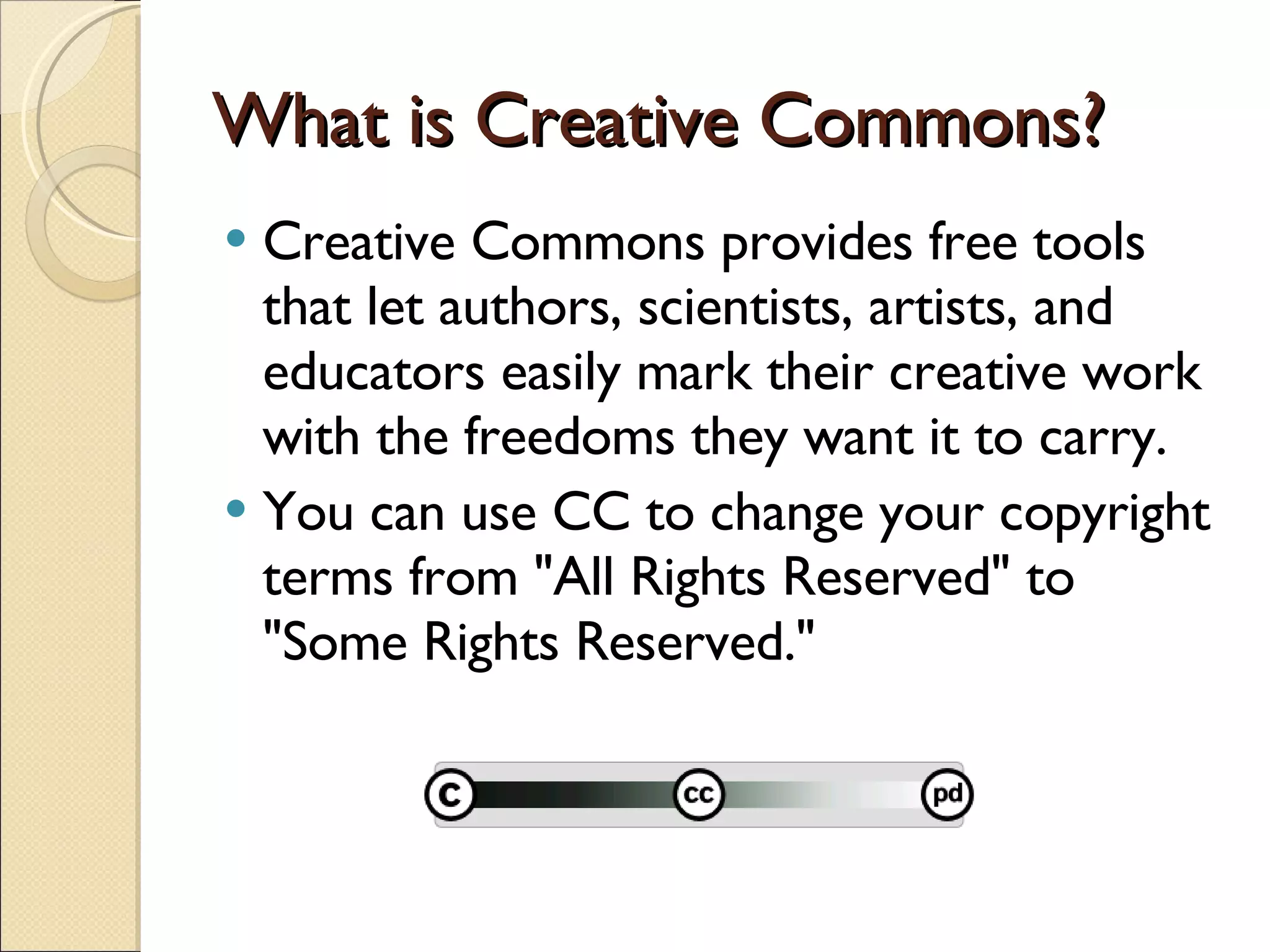
What is Creative Commons? Creative Commons provides free tools that let authors, scientists, artists, and educators easily mark their creative work with the freedoms they want it to carry. You can use CC to change your copyright terms from "All Rights Reserved" to "Some Rights Reserved."
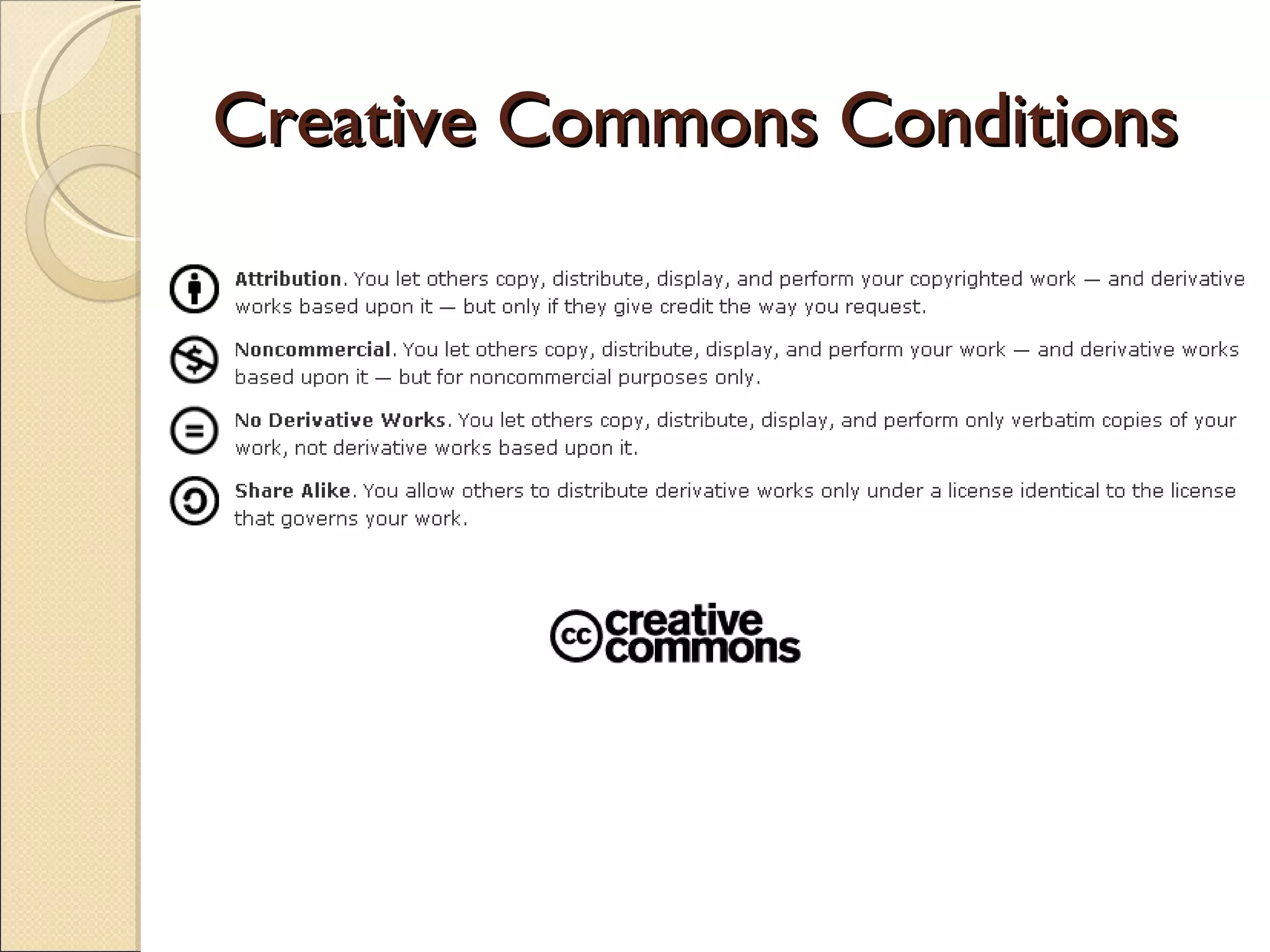
Creative Commons Conditions
Public Domain Resources Bartleby.com  Public domain texts online  Books on the Internet.  E-texts from UT Austin Great Books.   Ancient classics to 20 th  century masterpieces. Images  Listing of public domain images Internet Public Library  Library for the Internet community Moving Image Archive  Movies, films, and videos Online Books  Listing over 30,000 free books on the Web Project Gutenberg  More than 25,000 free e-books
Additional Resources General Purpose Creative Commons Search Images Flickr CC Flickr Storm Audio CC Mixter Free Sounds  Shambles List
Always Cite Your Sources Copyrighted Material: Use the MLA style as shown on the  library bibliography page ArtistName. &quot;Title of Image.&quot; Date Taken/Created. Online Image. Name of Image Site. Date you accessed/downloaded the picture. <http://www.electronicaddress.com>. Creative Commons Material: Use the guidelines found on the  CC Marking page This video features the song “Play Your Part (Pt.1)” by  Girl Talk , available under a  Creative Commons Attribution-Noncommercial license . © 2008, Greg Gillis. See  Molly Kleinman’s blog  for more CC citation information

Copyright, Fair Use, And Creative Commons

  • 1.
    Copyright, Public Domain,Fair Use, and Creative Commons 7 th Grade Digital Literacy
  • 2.
    What is CopyrightLaw? Copyright insures that the people who create “Intellectual Property” can own, control and be paid for their efforts. Intellectual property is a tangible form of expression: Written work, musical work, works of art, dramatic work, digitized work, video Copyright protection is automatic when intellectual property is created.
  • 3.
    What is thePublic Domain? A work of authorship is in the “public domain” if it is no longer under copyright protection. Works in the public domain may be used without the permission of the former copyright owner. Rules for when items pass into the public domain vary considerably .
  • 4.
    What is FairUse? Fair Use allows the use of portions of copyrighted works and materials for educational purposes. Copyright is a law ; Fair Use is a guideline Four guidelines determine Fair Use: The purpose and character of the use. The nature of the copyrighted work. The amount of the portion used. The effect of the use upon its value.
  • 5.
    Fair Use: PrintMaterial Poem less than 250 words; 250-word excerpt of poem greater than 250 words Excerpt from a longer work (10 percent of work or 1,000 words, whichever is less).
  • 6.
    Fair Use: ImagesSingle works may be used in their entirety, but no more than five images by a single artist or photographer may be used. From a collection, not more than 15 images or 10 percent (whichever is less) may be used.
  • 7.
    Fair Use: VideoStudents may use10 percent or three minutes (whichever is less) of “motion media.” Copyright works included in multimedia projects must give proper attribution to copyright holder.
  • 8.
    Fair Use: AudioStudents may use10 percent or 30 seconds (whichever is less) of a musical composition. The multimedia program must have an educational use.
  • 9.
  • 10.
    What is CreativeCommons? Creative Commons provides free tools that let authors, scientists, artists, and educators easily mark their creative work with the freedoms they want it to carry. You can use CC to change your copyright terms from &quot;All Rights Reserved&quot; to &quot;Some Rights Reserved.&quot;
  • 11.
  • 12.
    Public Domain ResourcesBartleby.com Public domain texts online Books on the Internet. E-texts from UT Austin Great Books. Ancient classics to 20 th century masterpieces. Images Listing of public domain images Internet Public Library Library for the Internet community Moving Image Archive Movies, films, and videos Online Books Listing over 30,000 free books on the Web Project Gutenberg More than 25,000 free e-books
  • 13.
    Additional Resources GeneralPurpose Creative Commons Search Images Flickr CC Flickr Storm Audio CC Mixter Free Sounds Shambles List
  • 14.
    Always Cite YourSources Copyrighted Material: Use the MLA style as shown on the library bibliography page ArtistName. &quot;Title of Image.&quot; Date Taken/Created. Online Image. Name of Image Site. Date you accessed/downloaded the picture. <http://www.electronicaddress.com>. Creative Commons Material: Use the guidelines found on the CC Marking page This video features the song “Play Your Part (Pt.1)” by Girl Talk , available under a Creative Commons Attribution-Noncommercial license . © 2008, Greg Gillis. See Molly Kleinman’s blog for more CC citation information