Copyright for K-12 Librarians
       and Educators

                 April 11, 2013
Carrie Russell, Director of the Program on Public
             Access to Information
                      ALA
   Office for Information Technology Policy
             crussell@alawash.org
Purpose of the Copyright Law
1. To ensure that authors are paid
2. To promote learning and the dissemination of
   knowledge
3. To manage the financial interests of rights
   holders
4. To ensure that the heirs of rights holders can
   continue to benefit from creative works
“The Constitution does not establish copyright, but provides that Congress
will have the power to grant such rights if it thinks best. Not primarily for
the benefit of the author, but primarily for the benefit of the public, such
rights are given. Not that any particular class of citizens, however worthy,
may benefit, but because the policy is believed to be for the benefit of the
great body of the people, in that it will stimulate writing and invention, to give
some bonus to authors and inventors.”

H.R. 2222, pp 6-7, Copyright Act of 1976
Copyright is Good
• Benefits the public by making creative works
  available
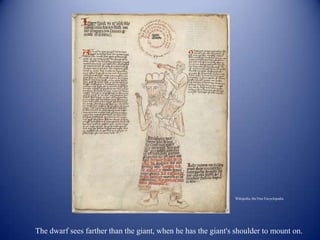
• Understands that creators stand on the shoulder of
  giants
• Creates economic markets for works
• Is flexible
• Loves non-profit libraries and schools
Wikipedia, the Free Encyclopedia


The dwarf sees farther than the giant, when he has the giant's shoulder to mount on.
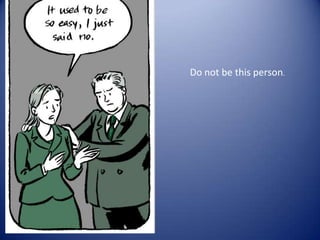
Do not be this person.
Review of Copyright Law
• Exclusive rights make up the limited monopoly
  created by Congress
   –   reproduction
   –   distribution
   –   derivative works
   –   public performance
   –   public display
• Exclusive rights are divisible and can be
  inherited, given or contracted away
• Original and creative works fixed in a tangible
  medium get automatic copyright protection
• Distinction between copyright and a copy (the
  physical object)
There are “holes” in the Copyright
              Monopoly
• “Exceptions” are legal rules that allow one to use a copyright without prior
  authorization and without a fee

• “Limitations” are ways in which the monopoly is restricted

Statutory monopoly limited by:
    – user privileges like fair use, first sale, interlibrary loan, etc.
    – public domain (current term: life plus 70 years)
    – checks on what can be protected (not facts, lists, processes, federal
      government documents, etc.)
    – idea v. expression dichotomy
    – and others

• If copyright monopoly was not curbed – what would be the result?
Socially beneficial uses of
       copyright materials
• Are central to the purpose of the law
• Are often reflected in copyright exceptions (ex.
  public performances in the classroom)
• Places of learning, enrichment, and
  scholarship have a special status under the law
• Non-profit, educational institutions are one of
  the few institutions that are specifically singled
  out as needing exceptions
Copyright is often confused with…
Some other intellectual property law
  – Patents, trademark, trade secret
Contract law (licensing)
  – When you ask and get permission to use a copyrighted
    work from the copyright holder, you get a license to use
    the work
  – We try to get user rights we would expect in the
    copyright law reflected in a license agreement
  Fair use guidelines
  – Do not have the force and effect of law
  – But you might use these as your institutional policy
  Plagiarism
  – You can infringe and plagiarize at the same time, or you
    can do one or the other separately
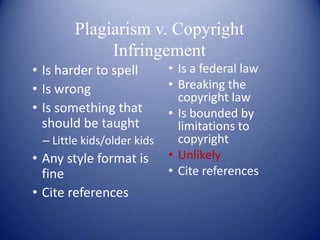
Plagiarism v. Copyright
            Infringement
• Is harder to spell        • Is a federal law
• Is wrong                  • Breaking the
                              copyright law
• Is something that         • Is bounded by
  should be taught            limitations to
 – Little kids/older kids     copyright
• Any style format is       • Unlikely
  fine                      • Cite references
• Cite references
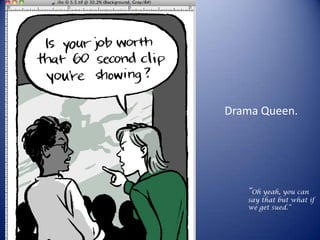
Drama Queen.


   “Oh yeah, you can
   say that but what if
   we get sued.”
Your Liability
• Unlikely that a teacher or librarian would be
  taken to court, but still could happen
• Section 504(c)(2) limits statutory damages for
  alleged infringers who work at a non-
  profit, educational institutions
• 11th Amendment – Constitutional doctrine
  that state or state agencies cannot be sued for
  dollar damages by the federal government
• Risky proposition to go to court; many
  disputes settled out of court
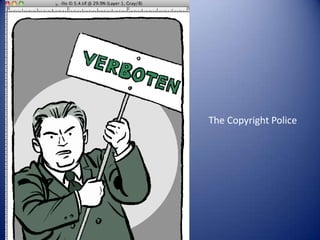
The Copyright Police
Fair Use
•   Most important for you to know
•   Section 107, codified with the Copyright Act of 1976
•   Determined on a case by case basis
•   Requires one to think and make a judgment
•   You may never know for sure that a use of a
    copyright is fair or not
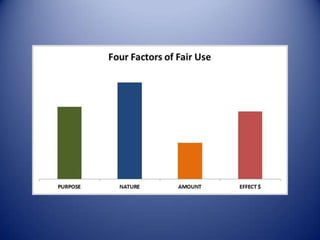
Four Factors of Fair Use
• Purpose of the use (Why do you want to use a
  copyright?)
• Nature of the publication (What is the material that
  you are using?)
• Amount (How much of the works are you using?)
• Effect on the market (What economic harm are you
  causing?)
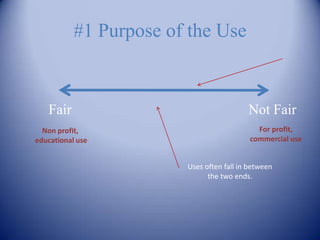
#1 Purpose of the Use


   Fair                                   Not Fair
  Non profit,                                For profit,
educational use                            commercial use


                        Uses often fall in between
                              the two ends.
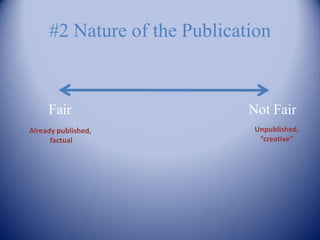
#2 Nature of the Publication


     Fair                     Not Fair
Already published,             Unpublished,
      factual                   “creative”
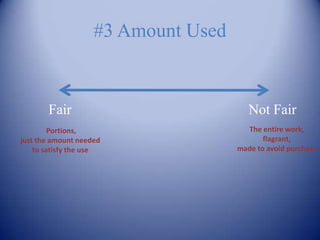
#3 Amount Used


       Fair                             Not Fair
         Portions,                     The entire work,
just the amount needed                      flagrant,
    to satisfy the use               made to avoid purchase
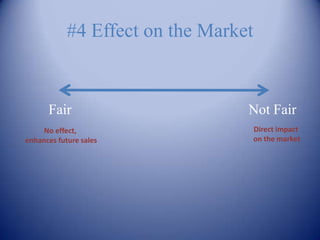
#4 Effect on the Market


      Fair                        Not Fair
     No effect,                       Direct impact
enhances future sales                 on the market
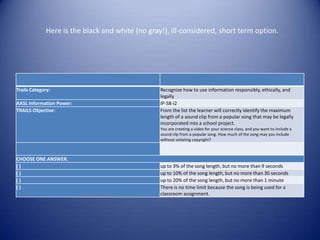
Here is the black and white (no gray!), ill-considered, short term option.


Trails Category:                                 Recognize how to use information responsibly, ethically, and
                                                 legally
AASL Information Power:                          IP-S8-I2
TRAILS Objective:                                From the list the learner will correctly identify the maximum
                                                 length of a sound clip from a popular song that may be legally
                                                 incorporated into a school project.
                                                 You are creating a video for your science class, and you want to include a
                                                 sound clip from a popular song. How much of the song may you include
                                                 without violating copyright?


CHOOSE ONE ANSWER.
()                                               up to 3% of the song length, but no more than 9 seconds
()                                               up to 10% of the song length, but no more than 30 seconds
()                                               up to 20% of the song length, but no more than 1 minute
()                                               There is no time limit because the song is being used for a
                                                 classroom assignment.
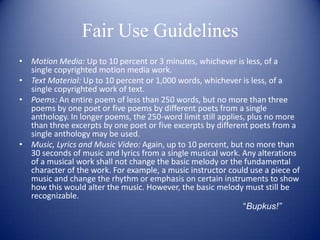
Fair Use Guidelines
• Motion Media: Up to 10 percent or 3 minutes, whichever is less, of a
  single copyrighted motion media work.
• Text Material: Up to 10 percent or 1,000 words, whichever is less, of a
  single copyrighted work of text.
• Poems: An entire poem of less than 250 words, but no more than three
  poems by one poet or five poems by different poets from a single
  anthology. In longer poems, the 250-word limit still applies, plus no more
  than three excerpts by one poet or five excerpts by different poets from a
  single anthology may be used.
• Music, Lyrics and Music Video: Again, up to 10 percent, but no more than
  30 seconds of music and lyrics from a single musical work. Any alterations
  of a musical work shall not change the basic melody or the fundamental
  character of the work. For example, a music instructor could use a piece of
  music and change the rhythm or emphasis on certain instruments to show
  how this would alter the music. However, the basic melody must still be
  recognizable.
                                                              “Bupkus!”
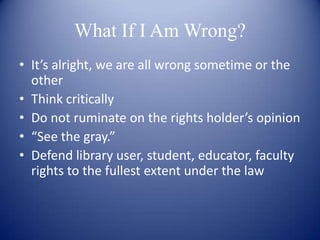
What If I Am Wrong?
• It’s alright, we are all wrong sometime or the
  other
• Think critically
• Do not ruminate on the rights holder’s opinion
• “See the gray.”
• Defend library user, student, educator, faculty
  rights to the fullest extent under the law
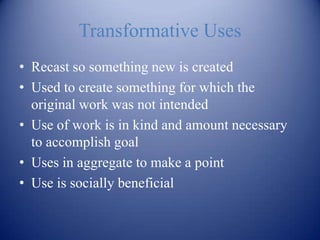
Transformative Uses
• Recast so something new is created
• Used to create something for which the
  original work was not intended
• Use of work is in kind and amount necessary
  to accomplish goal
• Uses in aggregate to make a point
• Use is socially beneficial
Real Court Examples
            All Commercial Uses

•   Campbell v. Acuff-Rose Music, Inc. (parody)
•   Blanch v. Koons (collage)
•   Perfect 10 v. Amazon.com (search engine)
•   A.V. et al. v. iParadigms (new purpose)
•   Bill Graham Archives v. Dorling Kindersley (to
    make a point or argument)
Other Copyright Exceptions
• Section 108 – allows libraries and archives to make copies for
  library users, interlibrary loan, replacement and preservation

• Section 109 – allows owners of locally acquired copies the
  right to distribute that copy (library lending, used book stores,
  garage sales, etc.)

• Section 110 – allows teachers to display or perform works in
  the face-to-face classroom and in the digital or distance
  education classroom via digital networks

• Section 117 – owner of a software program can make a back-
  up copy

• Section 121 – allows for the making of accessible copies for
  people with disabilities
More Copyright Exceptions
• Section 110 – allows teachers to display or perform works in
  the face-to-face classroom and in the digital or distance
  education classroom via digital networks

• Section 117 – owner of a software program can make a back-
  up copy

• Section 121 – allows for the making of accessible copies for
  people with disabilities

These exceptions don’t address every situation (go to fair use)
    These exceptions are not the final word (try fair use)
Digital
• Must assume copyright protection; notice and
  registration not required
• Fair use applies except when ….
• License, “terms of use” defines what you can do
  with the work
• Implied license sometimes can be presumed
• Point to work (URL) when possible
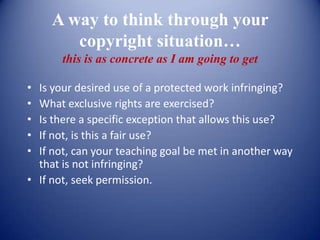
A way to think through your
        copyright situation…
       this is as concrete as I am going to get

• Is your desired use of a protected work infringing?
• What exclusive rights are exercised?
• Is there a specific exception that allows this use?
• If not, is this a fair use?
• If not, can your teaching goal be met in another way
  that is not infringing?
• If not, seek permission.
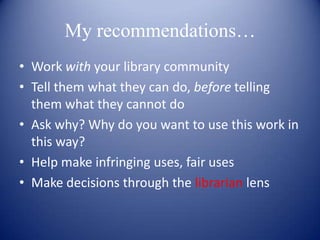
My recommendations…
• Work with your library community
• Tell them what they can do, before telling
  them what they cannot do
• Ask why? Why do you want to use this work in
  this way?
• Help make infringing uses, fair uses
• Make decisions through the librarian lens
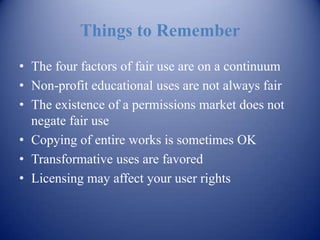
Things to Remember
• The four factors of fair use are on a continuum
• Non-profit educational uses are not always fair
• The existence of a permissions market does not
  negate fair use
• Copying of entire works is sometimes OK
• Transformative uses are favored
• Licensing may affect your user rights
Thank You!

    Carrie Russell
crussell@alawash.org
    800.941.8478

Copyright for K–12 Librarians and Educators

  • 1.
    Copyright for K-12Librarians and Educators April 11, 2013 Carrie Russell, Director of the Program on Public Access to Information ALA Office for Information Technology Policy crussell@alawash.org
  • 2.
    Purpose of theCopyright Law 1. To ensure that authors are paid 2. To promote learning and the dissemination of knowledge 3. To manage the financial interests of rights holders 4. To ensure that the heirs of rights holders can continue to benefit from creative works
  • 3.
    “The Constitution doesnot establish copyright, but provides that Congress will have the power to grant such rights if it thinks best. Not primarily for the benefit of the author, but primarily for the benefit of the public, such rights are given. Not that any particular class of citizens, however worthy, may benefit, but because the policy is believed to be for the benefit of the great body of the people, in that it will stimulate writing and invention, to give some bonus to authors and inventors.” H.R. 2222, pp 6-7, Copyright Act of 1976
  • 4.
    Copyright is Good •Benefits the public by making creative works available • Understands that creators stand on the shoulder of giants • Creates economic markets for works • Is flexible • Loves non-profit libraries and schools
  • 5.
    Wikipedia, the FreeEncyclopedia The dwarf sees farther than the giant, when he has the giant's shoulder to mount on.
  • 6.
    Do not bethis person.
  • 7.
    Review of CopyrightLaw • Exclusive rights make up the limited monopoly created by Congress – reproduction – distribution – derivative works – public performance – public display • Exclusive rights are divisible and can be inherited, given or contracted away • Original and creative works fixed in a tangible medium get automatic copyright protection • Distinction between copyright and a copy (the physical object)
  • 8.
    There are “holes”in the Copyright Monopoly • “Exceptions” are legal rules that allow one to use a copyright without prior authorization and without a fee • “Limitations” are ways in which the monopoly is restricted Statutory monopoly limited by: – user privileges like fair use, first sale, interlibrary loan, etc. – public domain (current term: life plus 70 years) – checks on what can be protected (not facts, lists, processes, federal government documents, etc.) – idea v. expression dichotomy – and others • If copyright monopoly was not curbed – what would be the result?
  • 9.
    Socially beneficial usesof copyright materials • Are central to the purpose of the law • Are often reflected in copyright exceptions (ex. public performances in the classroom) • Places of learning, enrichment, and scholarship have a special status under the law • Non-profit, educational institutions are one of the few institutions that are specifically singled out as needing exceptions
  • 10.
    Copyright is oftenconfused with… Some other intellectual property law – Patents, trademark, trade secret Contract law (licensing) – When you ask and get permission to use a copyrighted work from the copyright holder, you get a license to use the work – We try to get user rights we would expect in the copyright law reflected in a license agreement Fair use guidelines – Do not have the force and effect of law – But you might use these as your institutional policy Plagiarism – You can infringe and plagiarize at the same time, or you can do one or the other separately
  • 11.
    Plagiarism v. Copyright Infringement • Is harder to spell • Is a federal law • Is wrong • Breaking the copyright law • Is something that • Is bounded by should be taught limitations to – Little kids/older kids copyright • Any style format is • Unlikely fine • Cite references • Cite references
  • 12.
    Drama Queen. “Oh yeah, you can say that but what if we get sued.”
  • 13.
    Your Liability • Unlikelythat a teacher or librarian would be taken to court, but still could happen • Section 504(c)(2) limits statutory damages for alleged infringers who work at a non- profit, educational institutions • 11th Amendment – Constitutional doctrine that state or state agencies cannot be sued for dollar damages by the federal government • Risky proposition to go to court; many disputes settled out of court
  • 14.
  • 15.
    Fair Use • Most important for you to know • Section 107, codified with the Copyright Act of 1976 • Determined on a case by case basis • Requires one to think and make a judgment • You may never know for sure that a use of a copyright is fair or not
  • 16.
    Four Factors ofFair Use • Purpose of the use (Why do you want to use a copyright?) • Nature of the publication (What is the material that you are using?) • Amount (How much of the works are you using?) • Effect on the market (What economic harm are you causing?)
  • 17.
    #1 Purpose ofthe Use Fair Not Fair Non profit, For profit, educational use commercial use Uses often fall in between the two ends.
  • 18.
    #2 Nature ofthe Publication Fair Not Fair Already published, Unpublished, factual “creative”
  • 19.
    #3 Amount Used Fair Not Fair Portions, The entire work, just the amount needed flagrant, to satisfy the use made to avoid purchase
  • 20.
    #4 Effect onthe Market Fair Not Fair No effect, Direct impact enhances future sales on the market
  • 22.
    Here is theblack and white (no gray!), ill-considered, short term option. Trails Category: Recognize how to use information responsibly, ethically, and legally AASL Information Power: IP-S8-I2 TRAILS Objective: From the list the learner will correctly identify the maximum length of a sound clip from a popular song that may be legally incorporated into a school project. You are creating a video for your science class, and you want to include a sound clip from a popular song. How much of the song may you include without violating copyright? CHOOSE ONE ANSWER. () up to 3% of the song length, but no more than 9 seconds () up to 10% of the song length, but no more than 30 seconds () up to 20% of the song length, but no more than 1 minute () There is no time limit because the song is being used for a classroom assignment.
  • 23.
    Fair Use Guidelines •Motion Media: Up to 10 percent or 3 minutes, whichever is less, of a single copyrighted motion media work. • Text Material: Up to 10 percent or 1,000 words, whichever is less, of a single copyrighted work of text. • Poems: An entire poem of less than 250 words, but no more than three poems by one poet or five poems by different poets from a single anthology. In longer poems, the 250-word limit still applies, plus no more than three excerpts by one poet or five excerpts by different poets from a single anthology may be used. • Music, Lyrics and Music Video: Again, up to 10 percent, but no more than 30 seconds of music and lyrics from a single musical work. Any alterations of a musical work shall not change the basic melody or the fundamental character of the work. For example, a music instructor could use a piece of music and change the rhythm or emphasis on certain instruments to show how this would alter the music. However, the basic melody must still be recognizable. “Bupkus!”
  • 24.
    What If IAm Wrong? • It’s alright, we are all wrong sometime or the other • Think critically • Do not ruminate on the rights holder’s opinion • “See the gray.” • Defend library user, student, educator, faculty rights to the fullest extent under the law
  • 25.
    Transformative Uses • Recastso something new is created • Used to create something for which the original work was not intended • Use of work is in kind and amount necessary to accomplish goal • Uses in aggregate to make a point • Use is socially beneficial
  • 26.
    Real Court Examples All Commercial Uses • Campbell v. Acuff-Rose Music, Inc. (parody) • Blanch v. Koons (collage) • Perfect 10 v. Amazon.com (search engine) • A.V. et al. v. iParadigms (new purpose) • Bill Graham Archives v. Dorling Kindersley (to make a point or argument)
  • 27.
    Other Copyright Exceptions •Section 108 – allows libraries and archives to make copies for library users, interlibrary loan, replacement and preservation • Section 109 – allows owners of locally acquired copies the right to distribute that copy (library lending, used book stores, garage sales, etc.) • Section 110 – allows teachers to display or perform works in the face-to-face classroom and in the digital or distance education classroom via digital networks • Section 117 – owner of a software program can make a back- up copy • Section 121 – allows for the making of accessible copies for people with disabilities
  • 28.
    More Copyright Exceptions •Section 110 – allows teachers to display or perform works in the face-to-face classroom and in the digital or distance education classroom via digital networks • Section 117 – owner of a software program can make a back- up copy • Section 121 – allows for the making of accessible copies for people with disabilities These exceptions don’t address every situation (go to fair use) These exceptions are not the final word (try fair use)
  • 29.
    Digital • Must assumecopyright protection; notice and registration not required • Fair use applies except when …. • License, “terms of use” defines what you can do with the work • Implied license sometimes can be presumed • Point to work (URL) when possible
  • 31.
    A way tothink through your copyright situation… this is as concrete as I am going to get • Is your desired use of a protected work infringing? • What exclusive rights are exercised? • Is there a specific exception that allows this use? • If not, is this a fair use? • If not, can your teaching goal be met in another way that is not infringing? • If not, seek permission.
  • 32.
    My recommendations… • Workwith your library community • Tell them what they can do, before telling them what they cannot do • Ask why? Why do you want to use this work in this way? • Help make infringing uses, fair uses • Make decisions through the librarian lens
  • 33.
    Things to Remember •The four factors of fair use are on a continuum • Non-profit educational uses are not always fair • The existence of a permissions market does not negate fair use • Copying of entire works is sometimes OK • Transformative uses are favored • Licensing may affect your user rights
  • 34.
    Thank You! Carrie Russell crussell@alawash.org 800.941.8478