ONLINE 
ETHICS 
iPad Introduction Class 
Faculty of Creative Technology and Heritage 
Universiti Malaysia Kelantan
• What is Ethics and Information Technology? 
• Ethical issues relating to computer application 
• Security Threats 
– Computer Viruses 
– Cyber Crime 
– Software piracy and Hacking 
– Computer crime prevention 
– Ethical dilemmas and consideration 
• Ethics in using the internet 
Topics
• Derived from the Greek word “ethos”, which means 
“custom”, “habit”, and “way of living” 
• Definition: "the discipline and practice of applying 
value to human behavior, resulting in meaningful 
conduct.“ 
Ethics?
• Computer ethics defined as the application of 
classical ethical principles to the use of computer 
technology. 
• Ethical problems related to computers: 
– Privacy 
• Computers create a false sense of security 
• People do not realize how vulnerable 
information stored on computers are 
– Property 
• Physical property 
• Intellectual property 
• Data as property 
Computer ethics?
Computer ethics? 
• Access 
– Access to computing technology 
– Access to data 
• Accuracy 
– Accuracy of information stored 
• Hacking, cracking and virus creation 
• Software piracy
Computer 
ETHICS
As Defined by Computer Ethics Institute. 
1. Do not use a computer to harm other people. 
2. Do not interfere with other people's computer 
work. 
3. Do not snoop around in other people's files. 
4. Do not use a computer to steal. 
5. Do not use a computer to bear false witness. 
The Ten Commandments of Computer Ethics
6. Do not use or copy software for which you have 
not paid. 
7. Do not use other people's computer resources 
without authorization. 
8. Do not use other people's intellectual output. 
9. Think about the social consequences of the 
program you write. 
10. Use a computer in ways that show consideration 
and respect. 
The Ten Commandments of Computer Ethics
Security 
THREATS 
THE PRECAUTION
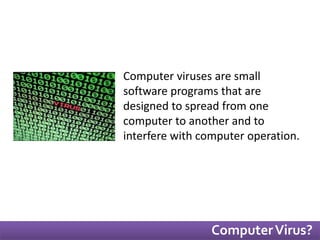
Computer viruses are small 
software programs that are 
designed to spread from one 
computer to another and to 
interfere with computer operation. 
Computer Virus?
• Virus are most easily spread, 
• Spread through E-mail Attachments, 
– Instant Messaging messages, 
– Funny Images, 
– Audio and Videos files, 
– Downloading files from Internet, 
– Greeting cards and many more. 
Spreading of Virus
• Use an Internet firewall 
• Subscribe to industry standard antivirus software 
• Never open an e-mail attachment from someone you 
don't know 
• Scan each and every attachment 
• Rules to be followed, while surfing net 
• Always update the databases 
• Avoid copying folder(s),untrusted files like keygen, 
crack files etc 
Steps to Avoid Viruses
• IT Infrastructure 
• Illegal access 
• Illegal Interruption 
• Data Interfere 
• System Interference 
• Misuse Of Devices 
• Electronic Fraud 
Computer Crime
• Target of the crime 
• Medium of the Attack 
• Tool 
• Intimidate or Deceive 
Type Computer Crimes
• Outsiders 
• Insiders 
Type Computer Crimes
• Economic 
• Ideological 
• Psychological 
• Egocentric 
Reason for Computer Crime
• Data tempering 
• Programming techniques 
• Other method 
Methods od Attack
• Reselling media 
• Downloading from a website without permission 
• Taping songs 
• Buying a used book or CD 
• Watching broadcast television but skipping 
commercials 
What is Piracy
• End User Piracy 
• Client – Server Piracy 
• Internet Piracy 
• Hard-Disk Piracy 
• Software Counterfeiting 
Reason for Computer Crime
• Some one who bypasses the system’s access 
controls by taking advantage of security 
weaknesses left in the system by developers 
• System penetration 
• Access confidential information 
• Threaten someone from your computer 
• Broadcast your confidential letters or materials . 
• Store illegal material 
• Stalking privacy or personal data 
Hacker
Compromise the security of system 
without permission from an 
authorized party, usually with the 
intent of accessing computers 
connected to the network. 
Evils of Hacking
• To determine problem and weakness for program 
• Creation of firewall 
• Useful for military purpose and spying 
• Better computer security 
Advantages of Hacking
Dilemmas are discussed in relation to four areas- 
• Privacy 
• Information accuracy 
• Access to information 
• Intellectual property rights 
Ethical Dilemmas in it…
• PLAGIARISM-The taking of ideas, writing and 
drawings or other similar intellectual property 
created by others and presenting it as your own. 
• NETIQUETTE-A set of rules (mainly unwritten) to 
follow while you are online. 
Ethical Dilemmas in It…
• Internet crime prevention. 
• Prevention of cyber crime 
• Prevention of computer crime in banking 
• IT security 
• Computer crime prevention law 
• Hi tech crime prevention law 
• Computer crime preventing on line fraud 
• World risk investigation and terrorist prevention 
How can We Stop It
ETHICS in using 
INTERNET 
BEHAVE WHEN ONLINE
Internet ethics means acceptable behavior for using 
internet. 
We should be honest, respect the rights and 
property of others on the internet 
Internet Ethics
Internet Ethics 
Acceptance 
One has to accept that Internet is not a value free-zone. 
It means World Wide Web is a place where values are 
considered in the broadest sense so we must take 
care while shaping content and services and we 
should recognize that internet is not apart from 
universal society but it is a primary component of it.
Sensitivity to National and Local cultures 
It belongs to all and there is no barrier of national and 
local cultures. It cannot be subject to one set of values 
like the local TV channel or the local newspaper we 
have to accommodate multiplicity of usage. 
Internet Ethics
Internet Ethics 
While using e-mail and chatting 
Internet must be used for communication with family 
and friends. Avoid chatting with strangers and 
forwarding e-mails from unknown people /strangers. 
We must be aware of risks involved in chatting and 
forwarding e-mails to strangers.
Internet Ethics 
Pretending to be someone else 
We must not use internet to fool others by pretending 
to be someone else. 
Hiding our own identity to fool others in the Internet 
world is a crime and may also be a risk to others.
Internet Ethics 
Avoid Bad language 
We must not use rude or bad language while using e- 
Mail, chatting, blogging and social networking, 
We need to respect their views and should not 
criticize anyone on the internet.
Internet Ethics 
Hide personal information 
We should not give personal details like home 
address, phone numbers, interests, passwords. 
No photographs should be sent to strangers because it 
might be misused and shared with others without 
their knowledge.
Internet Ethics 
While Downloading 
Internet is used to listen and learn about music. 
It is also used to watch videos and play games we 
must not use it to download them or share 
copyrighted material. 
We must be aware of the importance of copyrights 
and issues of copyright.
Internet Ethics 
Access to Internet 
The internet is a time-efficient tool for everyone that 
enlarges the possibilities for curriculum growth. 
Learning depends on the ability to find relevant and 
reliable information quickly and easily, and to select, 
understand and assess that information. Searching for 
information on the internet can help to develop these 
skills.
Internet Ethics 
Access to Internet 
Classroom exercises and take-home assessment tasks, 
where students are required to compare website 
content, are ideal for alerting students to the 
requirements of writing for different audiences, the 
purpose of particular content, identifying and judging 
accuracy and reliability. Since many sites adopt 
particular views about issues, the internet is a useful 
tool for developing the skills of distinguishing fact 
from opinion and exploring subjectivity and 
objectivity.
THANK YOU 
iPad Introduction Class

Online ethics

  • 1.
    ONLINE ETHICS iPadIntroduction Class Faculty of Creative Technology and Heritage Universiti Malaysia Kelantan
  • 2.
    • What isEthics and Information Technology? • Ethical issues relating to computer application • Security Threats – Computer Viruses – Cyber Crime – Software piracy and Hacking – Computer crime prevention – Ethical dilemmas and consideration • Ethics in using the internet Topics
  • 3.
    • Derived fromthe Greek word “ethos”, which means “custom”, “habit”, and “way of living” • Definition: "the discipline and practice of applying value to human behavior, resulting in meaningful conduct.“ Ethics?
  • 4.
    • Computer ethicsdefined as the application of classical ethical principles to the use of computer technology. • Ethical problems related to computers: – Privacy • Computers create a false sense of security • People do not realize how vulnerable information stored on computers are – Property • Physical property • Intellectual property • Data as property Computer ethics?
  • 5.
    Computer ethics? •Access – Access to computing technology – Access to data • Accuracy – Accuracy of information stored • Hacking, cracking and virus creation • Software piracy
  • 6.
  • 7.
    As Defined byComputer Ethics Institute. 1. Do not use a computer to harm other people. 2. Do not interfere with other people's computer work. 3. Do not snoop around in other people's files. 4. Do not use a computer to steal. 5. Do not use a computer to bear false witness. The Ten Commandments of Computer Ethics
  • 8.
    6. Do notuse or copy software for which you have not paid. 7. Do not use other people's computer resources without authorization. 8. Do not use other people's intellectual output. 9. Think about the social consequences of the program you write. 10. Use a computer in ways that show consideration and respect. The Ten Commandments of Computer Ethics
  • 9.
  • 10.
    Computer viruses aresmall software programs that are designed to spread from one computer to another and to interfere with computer operation. Computer Virus?
  • 11.
    • Virus aremost easily spread, • Spread through E-mail Attachments, – Instant Messaging messages, – Funny Images, – Audio and Videos files, – Downloading files from Internet, – Greeting cards and many more. Spreading of Virus
  • 12.
    • Use anInternet firewall • Subscribe to industry standard antivirus software • Never open an e-mail attachment from someone you don't know • Scan each and every attachment • Rules to be followed, while surfing net • Always update the databases • Avoid copying folder(s),untrusted files like keygen, crack files etc Steps to Avoid Viruses
  • 13.
    • IT Infrastructure • Illegal access • Illegal Interruption • Data Interfere • System Interference • Misuse Of Devices • Electronic Fraud Computer Crime
  • 14.
    • Target ofthe crime • Medium of the Attack • Tool • Intimidate or Deceive Type Computer Crimes
  • 15.
    • Outsiders •Insiders Type Computer Crimes
  • 16.
    • Economic •Ideological • Psychological • Egocentric Reason for Computer Crime
  • 17.
    • Data tempering • Programming techniques • Other method Methods od Attack
  • 18.
    • Reselling media • Downloading from a website without permission • Taping songs • Buying a used book or CD • Watching broadcast television but skipping commercials What is Piracy
  • 19.
    • End UserPiracy • Client – Server Piracy • Internet Piracy • Hard-Disk Piracy • Software Counterfeiting Reason for Computer Crime
  • 20.
    • Some onewho bypasses the system’s access controls by taking advantage of security weaknesses left in the system by developers • System penetration • Access confidential information • Threaten someone from your computer • Broadcast your confidential letters or materials . • Store illegal material • Stalking privacy or personal data Hacker
  • 21.
    Compromise the securityof system without permission from an authorized party, usually with the intent of accessing computers connected to the network. Evils of Hacking
  • 22.
    • To determineproblem and weakness for program • Creation of firewall • Useful for military purpose and spying • Better computer security Advantages of Hacking
  • 23.
    Dilemmas are discussedin relation to four areas- • Privacy • Information accuracy • Access to information • Intellectual property rights Ethical Dilemmas in it…
  • 24.
    • PLAGIARISM-The takingof ideas, writing and drawings or other similar intellectual property created by others and presenting it as your own. • NETIQUETTE-A set of rules (mainly unwritten) to follow while you are online. Ethical Dilemmas in It…
  • 25.
    • Internet crimeprevention. • Prevention of cyber crime • Prevention of computer crime in banking • IT security • Computer crime prevention law • Hi tech crime prevention law • Computer crime preventing on line fraud • World risk investigation and terrorist prevention How can We Stop It
  • 26.
    ETHICS in using INTERNET BEHAVE WHEN ONLINE
  • 27.
    Internet ethics meansacceptable behavior for using internet. We should be honest, respect the rights and property of others on the internet Internet Ethics
  • 28.
    Internet Ethics Acceptance One has to accept that Internet is not a value free-zone. It means World Wide Web is a place where values are considered in the broadest sense so we must take care while shaping content and services and we should recognize that internet is not apart from universal society but it is a primary component of it.
  • 29.
    Sensitivity to Nationaland Local cultures It belongs to all and there is no barrier of national and local cultures. It cannot be subject to one set of values like the local TV channel or the local newspaper we have to accommodate multiplicity of usage. Internet Ethics
  • 30.
    Internet Ethics Whileusing e-mail and chatting Internet must be used for communication with family and friends. Avoid chatting with strangers and forwarding e-mails from unknown people /strangers. We must be aware of risks involved in chatting and forwarding e-mails to strangers.
  • 31.
    Internet Ethics Pretendingto be someone else We must not use internet to fool others by pretending to be someone else. Hiding our own identity to fool others in the Internet world is a crime and may also be a risk to others.
  • 32.
    Internet Ethics AvoidBad language We must not use rude or bad language while using e- Mail, chatting, blogging and social networking, We need to respect their views and should not criticize anyone on the internet.
  • 33.
    Internet Ethics Hidepersonal information We should not give personal details like home address, phone numbers, interests, passwords. No photographs should be sent to strangers because it might be misused and shared with others without their knowledge.
  • 34.
    Internet Ethics WhileDownloading Internet is used to listen and learn about music. It is also used to watch videos and play games we must not use it to download them or share copyrighted material. We must be aware of the importance of copyrights and issues of copyright.
  • 35.
    Internet Ethics Accessto Internet The internet is a time-efficient tool for everyone that enlarges the possibilities for curriculum growth. Learning depends on the ability to find relevant and reliable information quickly and easily, and to select, understand and assess that information. Searching for information on the internet can help to develop these skills.
  • 36.
    Internet Ethics Accessto Internet Classroom exercises and take-home assessment tasks, where students are required to compare website content, are ideal for alerting students to the requirements of writing for different audiences, the purpose of particular content, identifying and judging accuracy and reliability. Since many sites adopt particular views about issues, the internet is a useful tool for developing the skills of distinguishing fact from opinion and exploring subjectivity and objectivity.
  • 37.
    THANK YOU iPadIntroduction Class