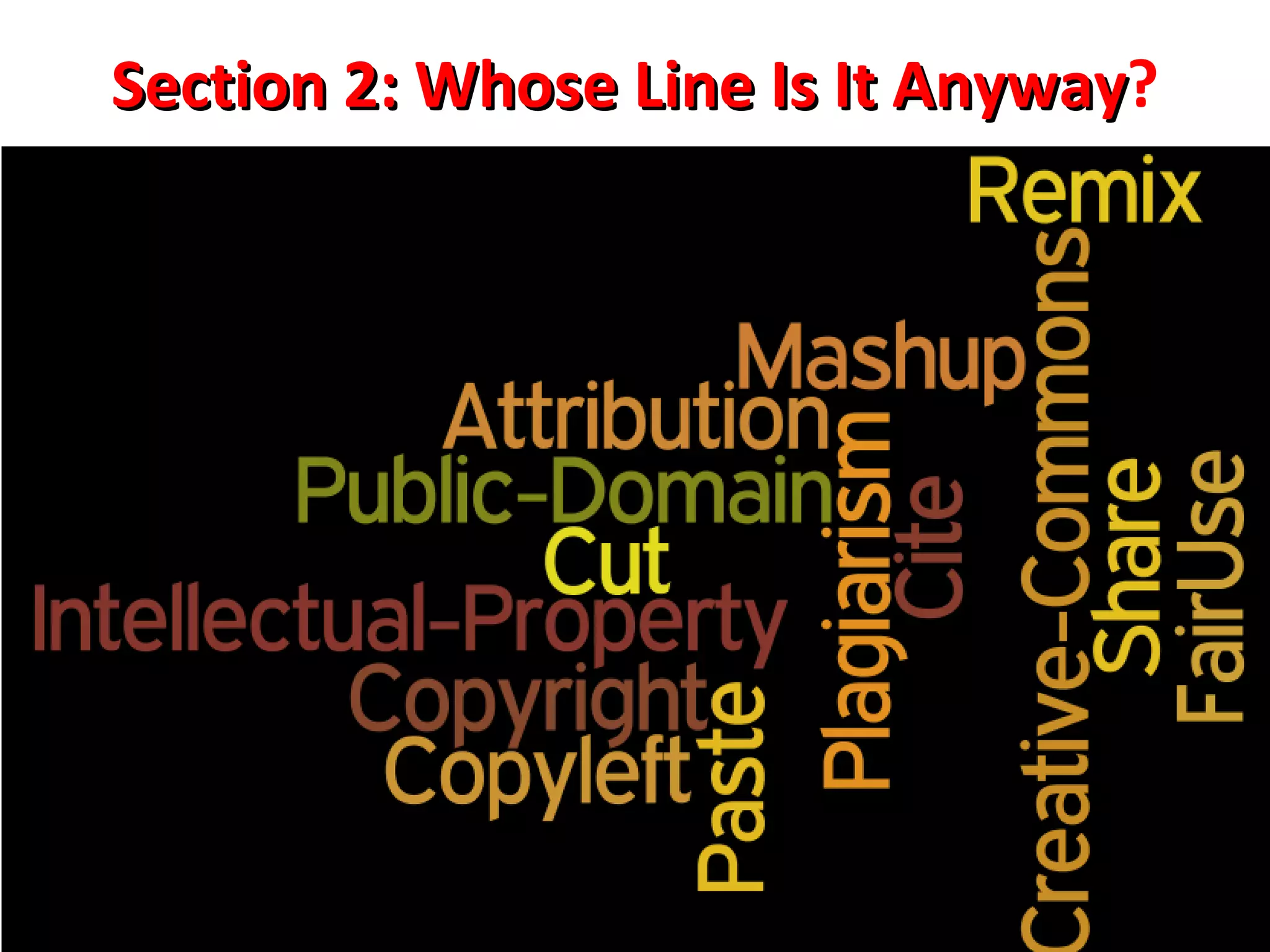
Section 2: Whose Line Is It Anyway ?
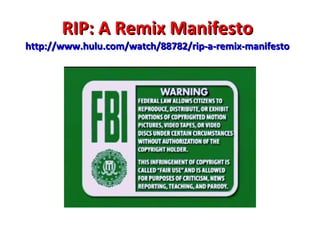
RIP: A Remix Manifesto http://www.hulu.com/watch/88782/rip-a-remix-manifesto
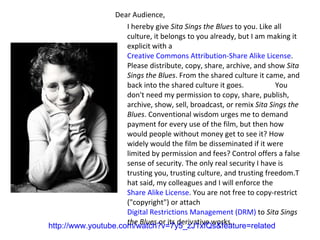
Dear Audience, I hereby give  Sita Sings the Blues  to you. Like all culture, it belongs to you already, but I am making it explicit with a  Creative Commons Attribution-Share Alike License . Please distribute, copy, share, archive, and show  Sita Sings the Blues . From the shared culture it came, and back into the shared culture it goes.  You don't need my permission to copy, share, publish, archive, show, sell, broadcast, or remix  Sita Sings the Blues . Conventional wisdom urges me to demand payment for every use of the film, but then how would people without money get to see it? How widely would the film be disseminated if it were limited by permission and fees? Control offers a false sense of security. The only real security I have is trusting you, trusting culture, and trusting freedom.T hat said, my colleagues and I will enforce the  Share Alike License . You are not free to copy-restrict ("copyright") or attach  Digital Restrictions Management (DRM)  to  Sita Sings the Blues  or its derivative works. http://www.youtube.com/watch?v=7y5_zJ1xfQs&feature=related
How Long Does Copyright Protection Last? Copyrights do not last forever, but they do last a pretty long time. Under the current laws, copyright protection starts from the moment of creation of the work and continues until 70 years after the death of the author or artist. That means that if someone who is 15 in the year 2001 writes a story that year and dies when he is 85 in the year 2086, the copyright will not expire until 70 years after 2086 -- in the year 2156, which is 130 years away. When the term of a copyright expires (meaning it's finished), the work falls into what's called the "public domain." When a work is in the public domain anyone can copy it and use it without permission. This is why you can copy artists like Leonardo da VInci and writers like Shakespeare and music writers like Mozart all you want. In the case of a joint work prepared by two or more authors, the term of copyright lasts for 70 years after the last surviving author's death. For works made for hire, and for anonymous and pseudonymous works (unless the author's identity is revealed in Copyright Office records), the duration of copyright will be 95 years from publication or 120 years from creation (whichever is shorter). Works created when prior copyright laws were in effect had shorter terms. Under the law in effect before 1978, copyright was secured either on the date a work was publicly distributed or on the date of registration (if the work was not publicly distributed). In either case, the copyright lasted for a first term of 28 years. During the last (28th) year of the first term, the copyright was eligible for renewal for another 28 years by filing with the Copyright Office.  The terms of many earlier copyrights were extended by later laws, and you cannot assume that any work is in the public domain unless it was first published before 1923.
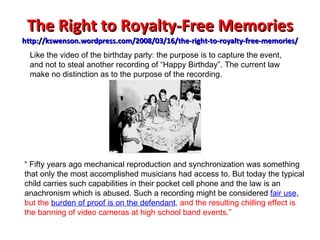
The Right to Royalty-Free Memories http://kswenson.wordpress.com/2008/03/16/the-right-to-royalty-free-memories/ “  Fifty years ago mechanical reproduction and synchronization was something that only the most accomplished musicians had access to. But today the typical child carries such capabilities in their pocket cell phone and the law is an anachronism which is abused. Such a recording might be considered  fair use ,  but the  burden of proof is on the defendant , and the resulting chilling effect is the banning of video cameras at high school band events.” Like the video of the birthday party: the purpose is to capture the event, and not to steal another recording of “Happy Birthday”. The current law make no distinction as to the purpose of the recording.
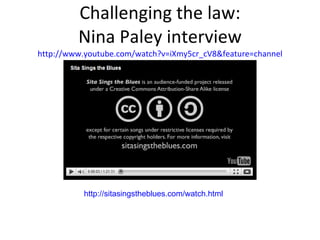
Challenging the law: Nina Paley interview http://www.youtube.com/watch?v=iXmy5cr_cV8&feature=channel http://sitasingstheblues.com/watch.html
Michael Moore Agrees http://www.youtube.com/watch?v=E8wVvZxjUrQ&feature=related
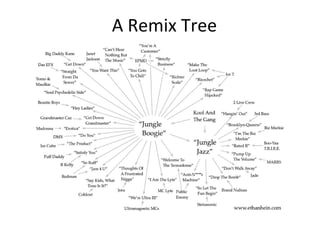
A Remix Tree
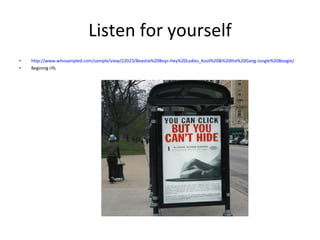
Listen for yourself http://www.whosampled.com/sample/view/22023/Beastie%20Boys-Hey%20Ladies_Kool%20&%20the%20Gang-Jungle%20Boogie/ Begining rifs
Open Video Alliance   http://openvideoalliance.org/video-content/whyopenvideo_v1.ogv video alliance
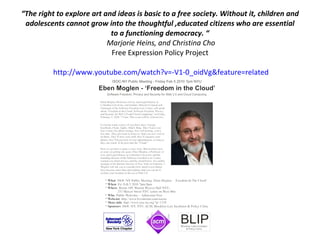
“ The right to explore art and ideas is basic to a free society. Without it, children and adolescents cannot grow into the thoughtful ,educated citizens who are essential to a functioning democracy. “  Marjorie Heins, and Christina Cho Free Expression Policy Project  http://www.youtube.com/watch?v=-V1-0_oidVg&feature=related
 
 
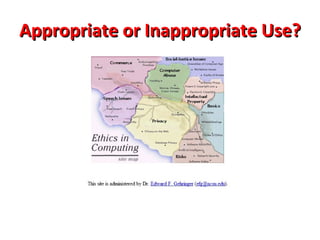
Appropriate or Inappropriate Use?
Yes, You Can Use Copyrighted Materials!  Renee Hobbs Media Education Lab Temple University
Strengthening Public  Understanding  of  Copyright and Fair Use Supported by a grant from the  John D. and Catherine T. MacArthur Foundation
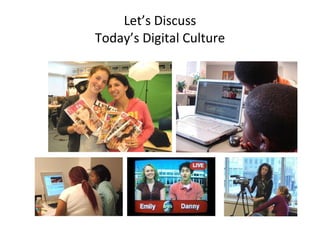
Let’s Discuss Today’s Digital Culture
What is the purpose of
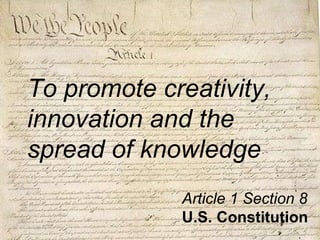
To promote creativity, innovation and the spread of knowledge Article 1 Section 8 U.S. Constitution
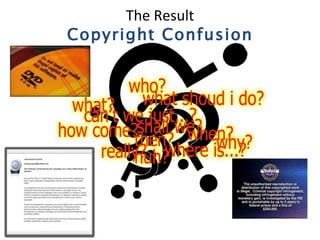
The Result Copyright Confusion
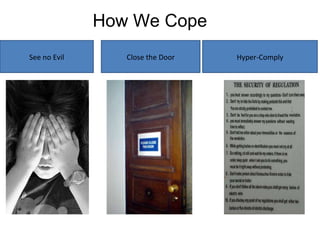
How We Cope See no Evil Close the Door Hyper-Comply
When I use the creative work of others in my own work, which concepts apply to my situation? Attribution : Citing your sources Plagiarism:  Not acknowledging source material used in your work Infringement:  Copying another’s work in violation of law Fair Use : Legal use of copyrighted works without permission or payment Licensing : Asking permission and paying a fee
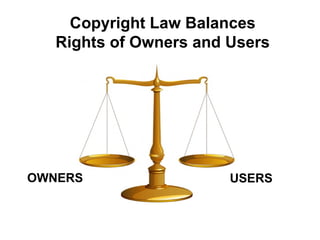
OWNERS USERS Copyright Law Balances Rights of Owners and Users
Strengthening Public  Understanding  of  Copyright and Fair Use Supported by a grant from the  John D. and Catherine T. MacArthur Foundation
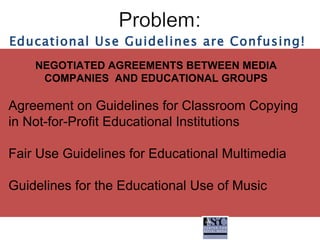
NEGOTIATED AGREEMENTS BETWEEN MEDIA COMPANIES  AND EDUCATIONAL GROUPS Agreement on Guidelines for Classroom Copying in Not-for-Profit Educational Institutions Fair Use Guidelines for Educational Multimedia Guidelines for the Educational Use of Music Educational Use Guidelines are Confusing!
 
The documents created by these negotiated agreements give them “the appearance of positive law.  These qualities are merely illusory, and consequently the guidelines have had a seriously detrimental effec t. They interfere with an actual understanding of the law and erode confidence in the law as created by Congress and the courts”  --Kenneth Crews, 2001
with accurate knowledge
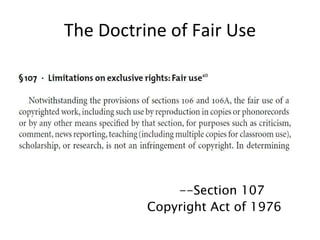
The Doctrine of Fair Use --Section 107 Copyright Act of 1976
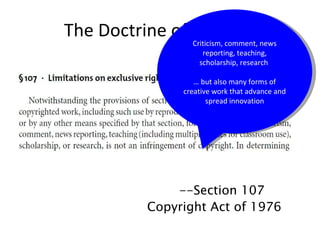
The Doctrine of Fair Use --Section 107 Copyright Act of 1976 Criticism, comment, news reporting, teaching, scholarship, research  …  but also many forms of creative work that advance and spread innovation
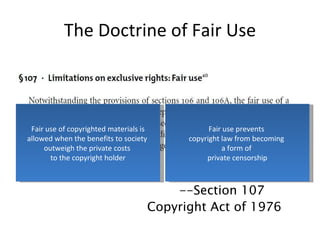
The Doctrine of Fair Use --Section 107 Copyright Act of 1976 Fair use of copyrighted materials is allowed when the benefits to society  outweigh the private costs  to the copyright holder Fair use prevents  copyright law from becoming  a form of  private censorship
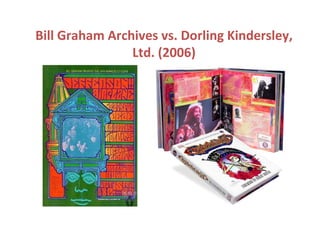
Bill Graham Archives vs. Dorling Kindersley, Ltd. (2006)
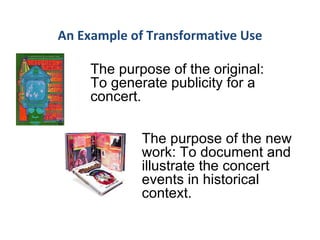
An Example of Transformative Use The purpose of the original: To generate publicity for a concert.   The purpose of the new work: To document and illustrate the concert events in historical context.
Transformative Use is Fair Use When a user of copyrighted materials adds value to, or repurposes materials for a use different from that for which it was originally intended, it will likely be considered transformative use ; it will also likely be considered fair use. Fair use embraces the modifying of existing media content, placing it in new context.   --Joyce Valenza,  School Library Journal
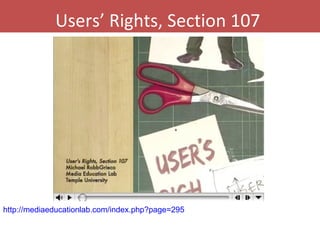
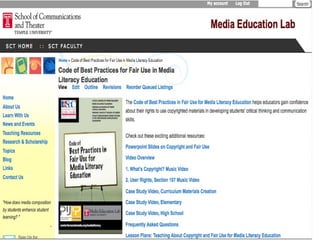
Users’ Rights, Section 107  http://mediaeducationlab.com/index.php?page=295
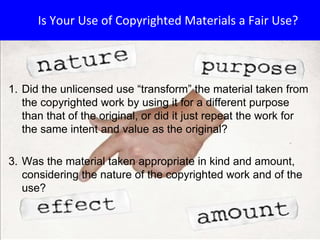
Is Your Use of Copyrighted Materials a Fair Use? Did the unlicensed use “transform” the material taken from the copyrighted work by using it for a different purpose than that of the original, or did it just repeat the work for the same intent and value as the original? Was the material taken appropriate in kind and amount, considering the nature of the copyrighted work and of the use?
Fair Use Is Empowering  MYTH :  FAIR USE IS TOO UNCLEAR AND COMPLICATED FOR ME; IT’S BETTER LEFT TO LAWYERS AND ADMINISTRATORS. TRUTH:   The fair use provision of the Copyright Act is written broadly because  it is designed to apply to a wide range of creative works and the people who use them.  Fair use is a part of the law that belongs to  everyone.
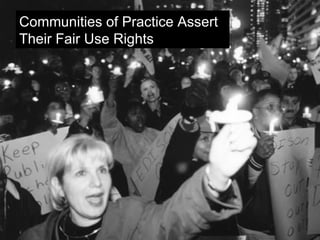
Communities of Practice Assert Their Fair Use Rights
Five Principles  Code of Best Practices in Fair Use  Educators can: make copies of newspaper articles, TV shows, and other copyrighted works and use them and keep them for educational use create curriculum materials and scholarship with copyrighted materials embedded share, sell and distribute curriculum materials with copyrighted materials embedded  Learners can: use copyrighted works in creating new material distribute their works digitally if they meet the transformativeness standard
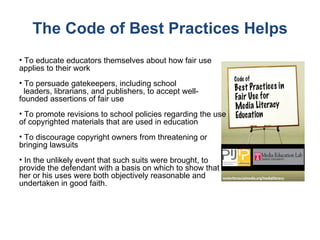
The Code of Best Practices Helps To educate educators themselves about how fair use applies to their work To persuade gatekeepers, including school  leaders, librarians, and publishers, to accept well-founded assertions of fair use To promote revisions to school policies regarding the use of copyrighted materials that are used in education To discourage copyright owners from threatening or bringing lawsuits In the unlikely event that such suits were brought, to provide the defendant with a basis on which to show that her or his uses were both objectively reasonable and undertaken in good faith.
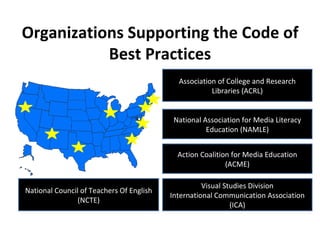
Organizations Supporting the Code of Best Practices Action Coalition for Media Education (ACME) National Association for Media Literacy Education (NAMLE) National Council of Teachers Of English (NCTE) Visual Studies Division International Communication Association (ICA) Association of College and Research Libraries (ACRL)
1201 ANTI-CIRCUMVENTION  RULEMAKING PROCESS When encryption  interferes with fair use  Digital Millennium Copyright Act DMCA 1201 A petition requesting an exemption for media literacy educators and their students
 
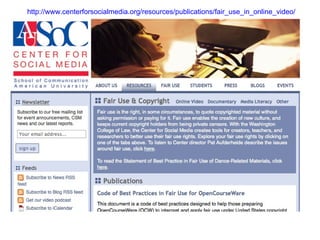
http://www.centerforsocialmedia.org/resources/publications/fair_use_in_online_video/
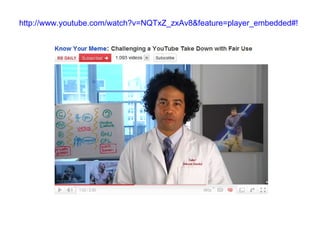
http://www.youtube.com/watch?v=NQTxZ_zxAv8&feature=player_embedded#!
Are We On the Same Page? “…more than two-thirds of college faculty and administrators say it's wrong to download or swap files. However, fewer than one-quarter of students at those same colleges say it's wrong.”  Business Software Alliance  On the tenth anniversary of the DMCA, the  Electronic Frontier Foundation  documented harmful consequences of the anti-circumvention provisions. They document that the DMCA: 1) stifles free expression 2) jeopardizes  fair use ; 3) impedes competition, such as blocking aftermarket competition in toner cartridges, garage door openers, and enforcing  walled gardens  around the  iPod ; [24]  and 4) interferes with computer intrusion laws. [25]

HUM 140: Social Media: Copyright, plagiarism, remix

  • 1.
    Section 2: WhoseLine Is It Anyway ?
  • 2.
    RIP: A RemixManifesto http://www.hulu.com/watch/88782/rip-a-remix-manifesto
  • 3.
    Dear Audience, Ihereby give  Sita Sings the Blues  to you. Like all culture, it belongs to you already, but I am making it explicit with a  Creative Commons Attribution-Share Alike License . Please distribute, copy, share, archive, and show  Sita Sings the Blues . From the shared culture it came, and back into the shared culture it goes. You don't need my permission to copy, share, publish, archive, show, sell, broadcast, or remix  Sita Sings the Blues . Conventional wisdom urges me to demand payment for every use of the film, but then how would people without money get to see it? How widely would the film be disseminated if it were limited by permission and fees? Control offers a false sense of security. The only real security I have is trusting you, trusting culture, and trusting freedom.T hat said, my colleagues and I will enforce the  Share Alike License . You are not free to copy-restrict ("copyright") or attach  Digital Restrictions Management (DRM)  to  Sita Sings the Blues  or its derivative works. http://www.youtube.com/watch?v=7y5_zJ1xfQs&feature=related
  • 4.
    How Long DoesCopyright Protection Last? Copyrights do not last forever, but they do last a pretty long time. Under the current laws, copyright protection starts from the moment of creation of the work and continues until 70 years after the death of the author or artist. That means that if someone who is 15 in the year 2001 writes a story that year and dies when he is 85 in the year 2086, the copyright will not expire until 70 years after 2086 -- in the year 2156, which is 130 years away. When the term of a copyright expires (meaning it's finished), the work falls into what's called the "public domain." When a work is in the public domain anyone can copy it and use it without permission. This is why you can copy artists like Leonardo da VInci and writers like Shakespeare and music writers like Mozart all you want. In the case of a joint work prepared by two or more authors, the term of copyright lasts for 70 years after the last surviving author's death. For works made for hire, and for anonymous and pseudonymous works (unless the author's identity is revealed in Copyright Office records), the duration of copyright will be 95 years from publication or 120 years from creation (whichever is shorter). Works created when prior copyright laws were in effect had shorter terms. Under the law in effect before 1978, copyright was secured either on the date a work was publicly distributed or on the date of registration (if the work was not publicly distributed). In either case, the copyright lasted for a first term of 28 years. During the last (28th) year of the first term, the copyright was eligible for renewal for another 28 years by filing with the Copyright Office. The terms of many earlier copyrights were extended by later laws, and you cannot assume that any work is in the public domain unless it was first published before 1923.
  • 5.
    The Right toRoyalty-Free Memories http://kswenson.wordpress.com/2008/03/16/the-right-to-royalty-free-memories/ “  Fifty years ago mechanical reproduction and synchronization was something that only the most accomplished musicians had access to. But today the typical child carries such capabilities in their pocket cell phone and the law is an anachronism which is abused. Such a recording might be considered  fair use , but the  burden of proof is on the defendant , and the resulting chilling effect is the banning of video cameras at high school band events.” Like the video of the birthday party: the purpose is to capture the event, and not to steal another recording of “Happy Birthday”. The current law make no distinction as to the purpose of the recording.
  • 6.
    Challenging the law:Nina Paley interview http://www.youtube.com/watch?v=iXmy5cr_cV8&feature=channel http://sitasingstheblues.com/watch.html
  • 7.
    Michael Moore Agreeshttp://www.youtube.com/watch?v=E8wVvZxjUrQ&feature=related
  • 8.
  • 9.
    Listen for yourselfhttp://www.whosampled.com/sample/view/22023/Beastie%20Boys-Hey%20Ladies_Kool%20&%20the%20Gang-Jungle%20Boogie/ Begining rifs
  • 10.
    Open Video Alliance http://openvideoalliance.org/video-content/whyopenvideo_v1.ogv video alliance
  • 11.
    “ The rightto explore art and ideas is basic to a free society. Without it, children and adolescents cannot grow into the thoughtful ,educated citizens who are essential to a functioning democracy. “ Marjorie Heins, and Christina Cho Free Expression Policy Project http://www.youtube.com/watch?v=-V1-0_oidVg&feature=related
  • 12.
  • 13.
  • 14.
  • 15.
    Yes, You CanUse Copyrighted Materials! Renee Hobbs Media Education Lab Temple University
  • 16.
    Strengthening Public Understanding of Copyright and Fair Use Supported by a grant from the John D. and Catherine T. MacArthur Foundation
  • 17.
  • 18.
    What is thepurpose of
  • 19.
    To promote creativity,innovation and the spread of knowledge Article 1 Section 8 U.S. Constitution
  • 20.
  • 21.
    How We CopeSee no Evil Close the Door Hyper-Comply
  • 22.
    When I usethe creative work of others in my own work, which concepts apply to my situation? Attribution : Citing your sources Plagiarism: Not acknowledging source material used in your work Infringement: Copying another’s work in violation of law Fair Use : Legal use of copyrighted works without permission or payment Licensing : Asking permission and paying a fee
  • 23.
    OWNERS USERS CopyrightLaw Balances Rights of Owners and Users
  • 24.
    Strengthening Public Understanding of Copyright and Fair Use Supported by a grant from the John D. and Catherine T. MacArthur Foundation
  • 25.
    NEGOTIATED AGREEMENTS BETWEENMEDIA COMPANIES AND EDUCATIONAL GROUPS Agreement on Guidelines for Classroom Copying in Not-for-Profit Educational Institutions Fair Use Guidelines for Educational Multimedia Guidelines for the Educational Use of Music Educational Use Guidelines are Confusing!
  • 26.
  • 27.
    The documents createdby these negotiated agreements give them “the appearance of positive law. These qualities are merely illusory, and consequently the guidelines have had a seriously detrimental effec t. They interfere with an actual understanding of the law and erode confidence in the law as created by Congress and the courts” --Kenneth Crews, 2001
  • 28.
  • 29.
    The Doctrine ofFair Use --Section 107 Copyright Act of 1976
  • 30.
    The Doctrine ofFair Use --Section 107 Copyright Act of 1976 Criticism, comment, news reporting, teaching, scholarship, research … but also many forms of creative work that advance and spread innovation
  • 31.
    The Doctrine ofFair Use --Section 107 Copyright Act of 1976 Fair use of copyrighted materials is allowed when the benefits to society outweigh the private costs to the copyright holder Fair use prevents copyright law from becoming a form of private censorship
  • 32.
    Bill Graham Archivesvs. Dorling Kindersley, Ltd. (2006)
  • 33.
    An Example ofTransformative Use The purpose of the original: To generate publicity for a concert. The purpose of the new work: To document and illustrate the concert events in historical context.
  • 34.
    Transformative Use isFair Use When a user of copyrighted materials adds value to, or repurposes materials for a use different from that for which it was originally intended, it will likely be considered transformative use ; it will also likely be considered fair use. Fair use embraces the modifying of existing media content, placing it in new context.  --Joyce Valenza, School Library Journal
  • 35.
    Users’ Rights, Section107 http://mediaeducationlab.com/index.php?page=295
  • 36.
    Is Your Useof Copyrighted Materials a Fair Use? Did the unlicensed use “transform” the material taken from the copyrighted work by using it for a different purpose than that of the original, or did it just repeat the work for the same intent and value as the original? Was the material taken appropriate in kind and amount, considering the nature of the copyrighted work and of the use?
  • 37.
    Fair Use IsEmpowering MYTH : FAIR USE IS TOO UNCLEAR AND COMPLICATED FOR ME; IT’S BETTER LEFT TO LAWYERS AND ADMINISTRATORS. TRUTH: The fair use provision of the Copyright Act is written broadly because it is designed to apply to a wide range of creative works and the people who use them. Fair use is a part of the law that belongs to everyone.
  • 38.
    Communities of PracticeAssert Their Fair Use Rights
  • 39.
    Five Principles Code of Best Practices in Fair Use Educators can: make copies of newspaper articles, TV shows, and other copyrighted works and use them and keep them for educational use create curriculum materials and scholarship with copyrighted materials embedded share, sell and distribute curriculum materials with copyrighted materials embedded Learners can: use copyrighted works in creating new material distribute their works digitally if they meet the transformativeness standard
  • 40.
    The Code ofBest Practices Helps To educate educators themselves about how fair use applies to their work To persuade gatekeepers, including school leaders, librarians, and publishers, to accept well-founded assertions of fair use To promote revisions to school policies regarding the use of copyrighted materials that are used in education To discourage copyright owners from threatening or bringing lawsuits In the unlikely event that such suits were brought, to provide the defendant with a basis on which to show that her or his uses were both objectively reasonable and undertaken in good faith.
  • 41.
    Organizations Supporting theCode of Best Practices Action Coalition for Media Education (ACME) National Association for Media Literacy Education (NAMLE) National Council of Teachers Of English (NCTE) Visual Studies Division International Communication Association (ICA) Association of College and Research Libraries (ACRL)
  • 42.
    1201 ANTI-CIRCUMVENTION RULEMAKING PROCESS When encryption interferes with fair use Digital Millennium Copyright Act DMCA 1201 A petition requesting an exemption for media literacy educators and their students
  • 43.
  • 44.
  • 45.
  • 46.
    Are We Onthe Same Page? “…more than two-thirds of college faculty and administrators say it's wrong to download or swap files. However, fewer than one-quarter of students at those same colleges say it's wrong.” Business Software Alliance  On the tenth anniversary of the DMCA, the  Electronic Frontier Foundation  documented harmful consequences of the anti-circumvention provisions. They document that the DMCA: 1) stifles free expression 2) jeopardizes  fair use ; 3) impedes competition, such as blocking aftermarket competition in toner cartridges, garage door openers, and enforcing  walled gardens  around the  iPod ; [24]  and 4) interferes with computer intrusion laws. [25]

Editor's Notes

  • #17 Pass out code during video
  • #20 Why do most people think that it is all about the owners? Where do these misconceptions come from From Wikipedia, the free encyclopedia: only clause the explains explicit purpose Article I, Section 8, Clause 8 of the United States Constitution, known as the Copyright Clause, the Copyright and Patent Clause (or Patent and Copyright Clause), the Intellectual Property Clause and the Progressive Clause, empowers the United States Congress: “ To promote the Progress of Science and useful Arts, by securing for limited Times to Authors and Inventors the exclusive Right to their respective Writings and Discoveries.
  • #23 Talk about Creative Commons Permissions
  • #25 Pass out code during video
  • #29 It’st time for educators to get smarter about their rights under the law About c & fair use and how it relates to our work
  • #37 Screen shot video hand 4 factors…questions over The law refers to four considerations: the nature of the use, the nature of the work used, the extent of the use, and its economic effect (the so-called “four factors”). This still leaves much room for interpretation, especially since the law is clear that these are not the only permissible considerations. In assessing fair use, courts ask: (1) Did the unlicensed use “transform” the material taken from the copyrighted work by using it for a different purpose than that of the original, or did it just repeat the work for the same intent and value as the original? (2) Was the material taken appropriate in kind and amount, considering the nature of the copyrighted work and of the use?
  • #38 Lawer picture…isn’t it up to the lawyers… IMAGE… MYTH : FAIR USE IS TOO UNCLEAR AND COMPLICATED FOR ME; IT’S BETTER LEFT TO LAWYERS AND ADMINISTRATORS. TRUTH: The fair use provision of the Copyright Act is written broadly—not narrowly—because it is designed to apply to a wide range of creative works and the people who use them. Fair use is a part of the law that belongs to everyone—especially to working educators. Educators know best what they need to use of existing copyrighted culture to construct their own lessons and materials. Only members of the actual community can decide what’s really needed. Once they know, they can tell their lawyers and administrators.