Scheme Of Presentation Introduction Core Idea: Cellular Concept Frequency Reuse System Architecture
INTRODUCTION First commercially automated cellular network (1G) was launched in Tokyo by Nippon Telephone and Telegraph (NTT) in 1979. In 1981, Nordic Mobile Telephone (NMT) system was launched simultaneously in Denmark, Finland, Norway and Sweden NMT was first mobile phone network featuring international roaming First "modern" network technology on digital 2G cellular technology was launched by Radiolinja in 1991 in Finland on GSM standard
Building Blocks – before GSM AMPS – Advanced Mobile Phone System TACS – Total Access Communication System NMT – Nordic Mobile Telephone System
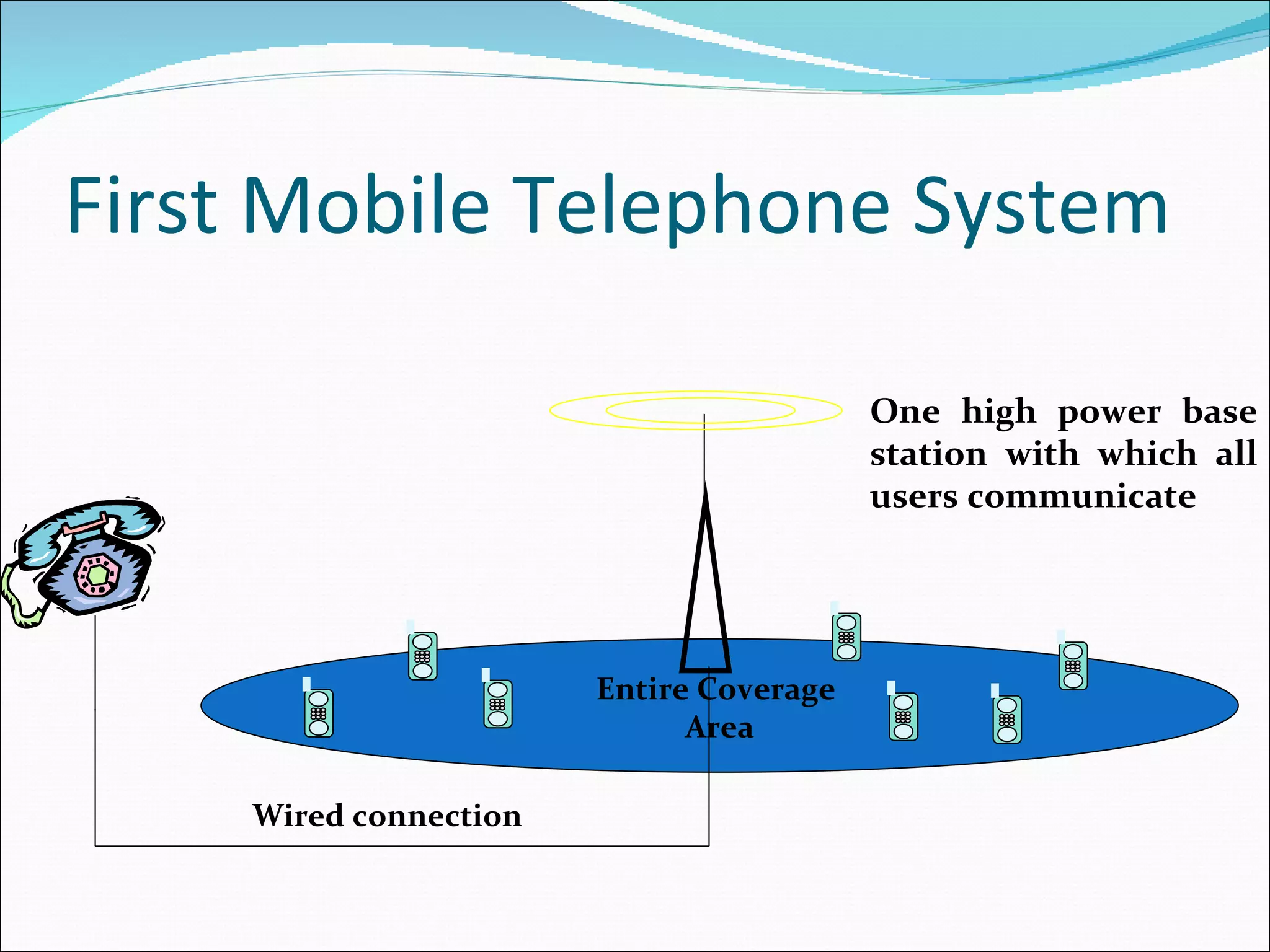
First Mobile Telephone System One high power base station with which all users communicate Wired connection Entire Coverage  Area
Problem with Original Design Original mobile telephone system could only support a handful of users at a time over an entire city With only one high power base station, users phones also needed to be able to transmit at high powers (to reliably transmit signals to the distant base station)
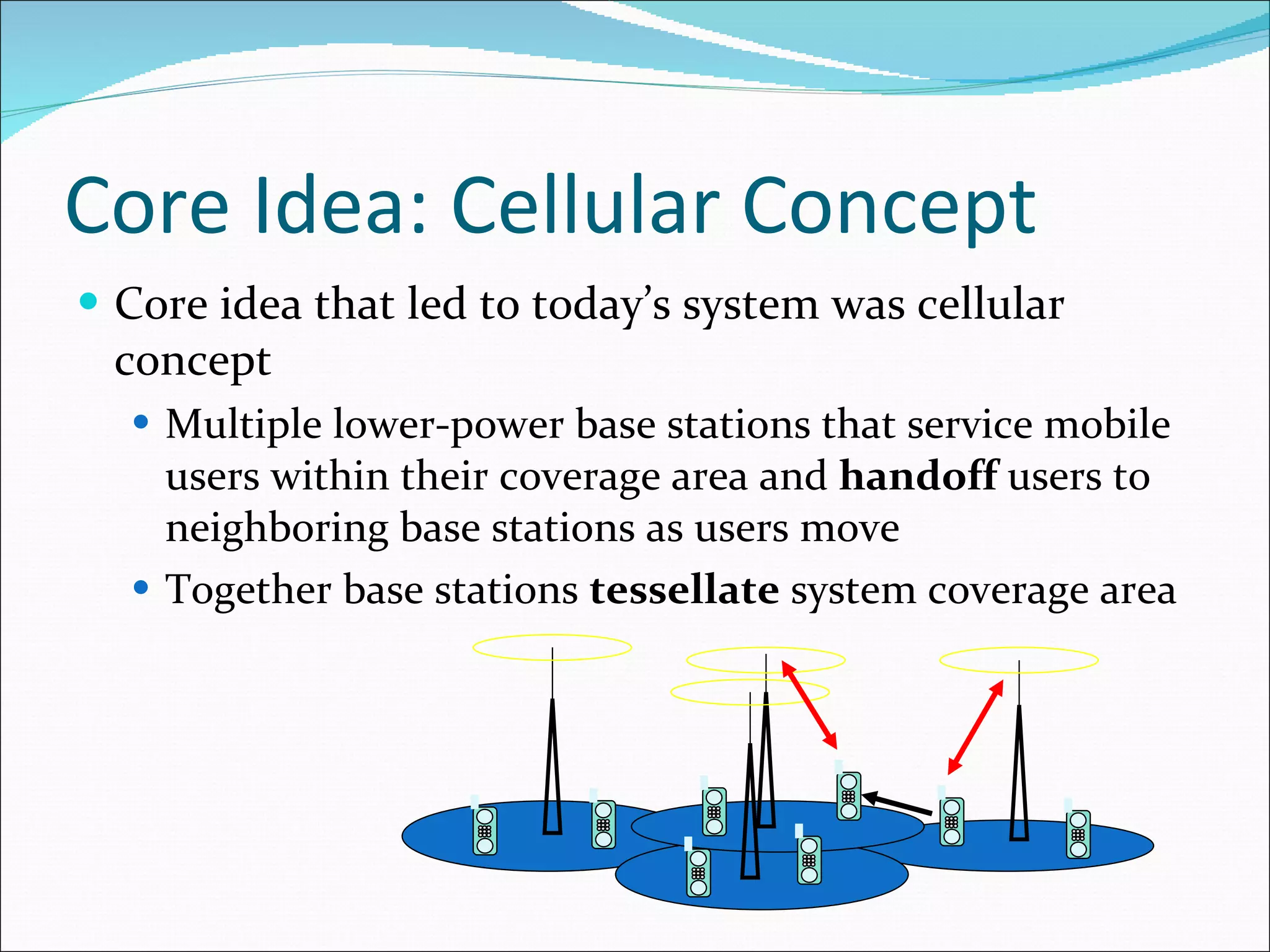
Core Idea: Cellular Concept Core idea that led to today’s system was cellular concept Multiple lower-power base stations that service mobile users within their coverage area and  handoff  users to neighboring base stations as users move Together base stations  tessellate  system coverage area
Cellular Concept Thus, instead of one base station covering an entire city, the city was broken up into  cells , or smaller coverage areas Each of these smaller coverage areas had its own lower-power base station User phones in one cell communicate with the base station in that cell
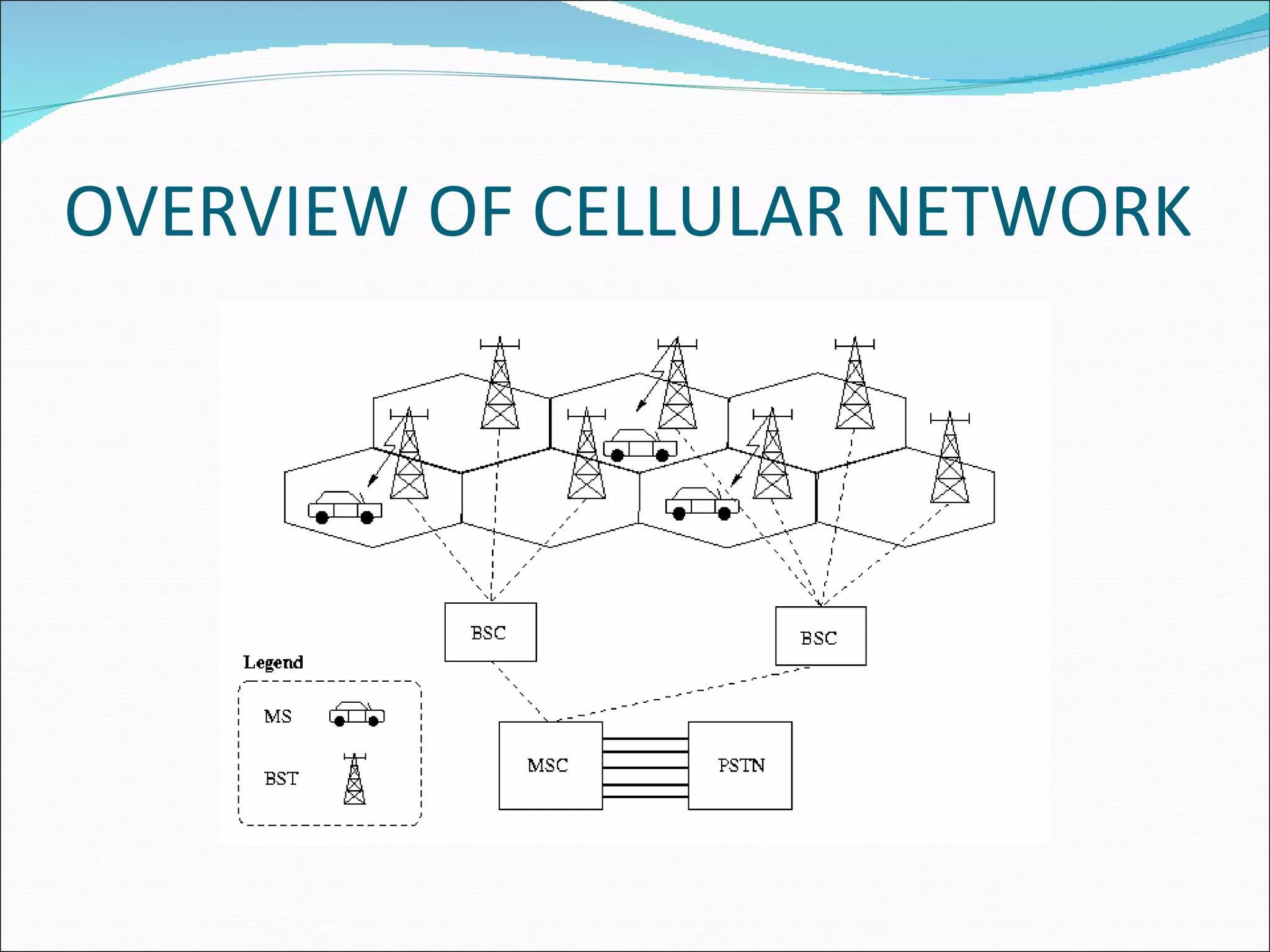
OVERVIEW OF CELLULAR NETWORK
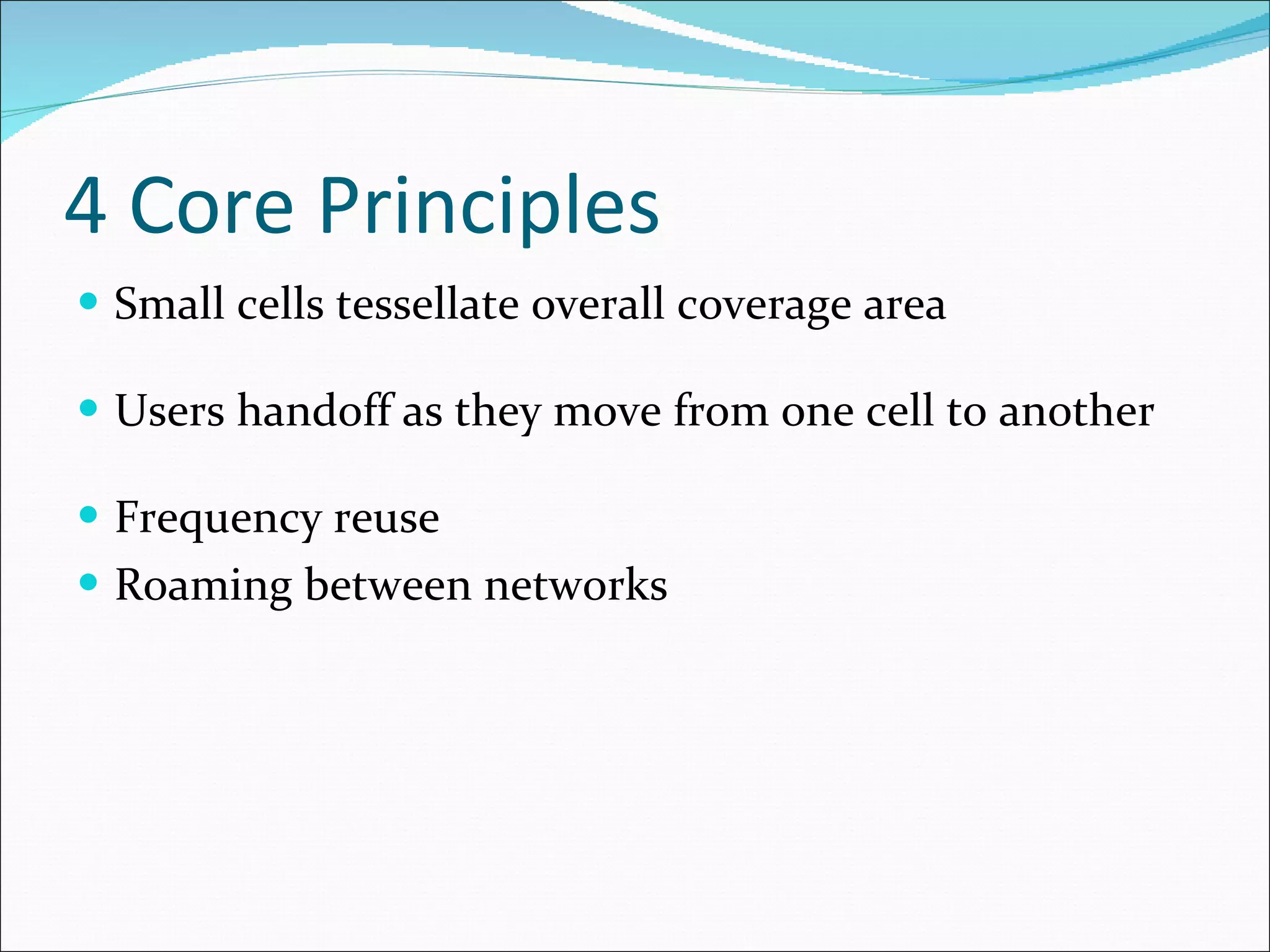
4 Core Principles Small cells tessellate overall coverage area Users handoff as they move from one cell to another Frequency reuse Roaming between networks
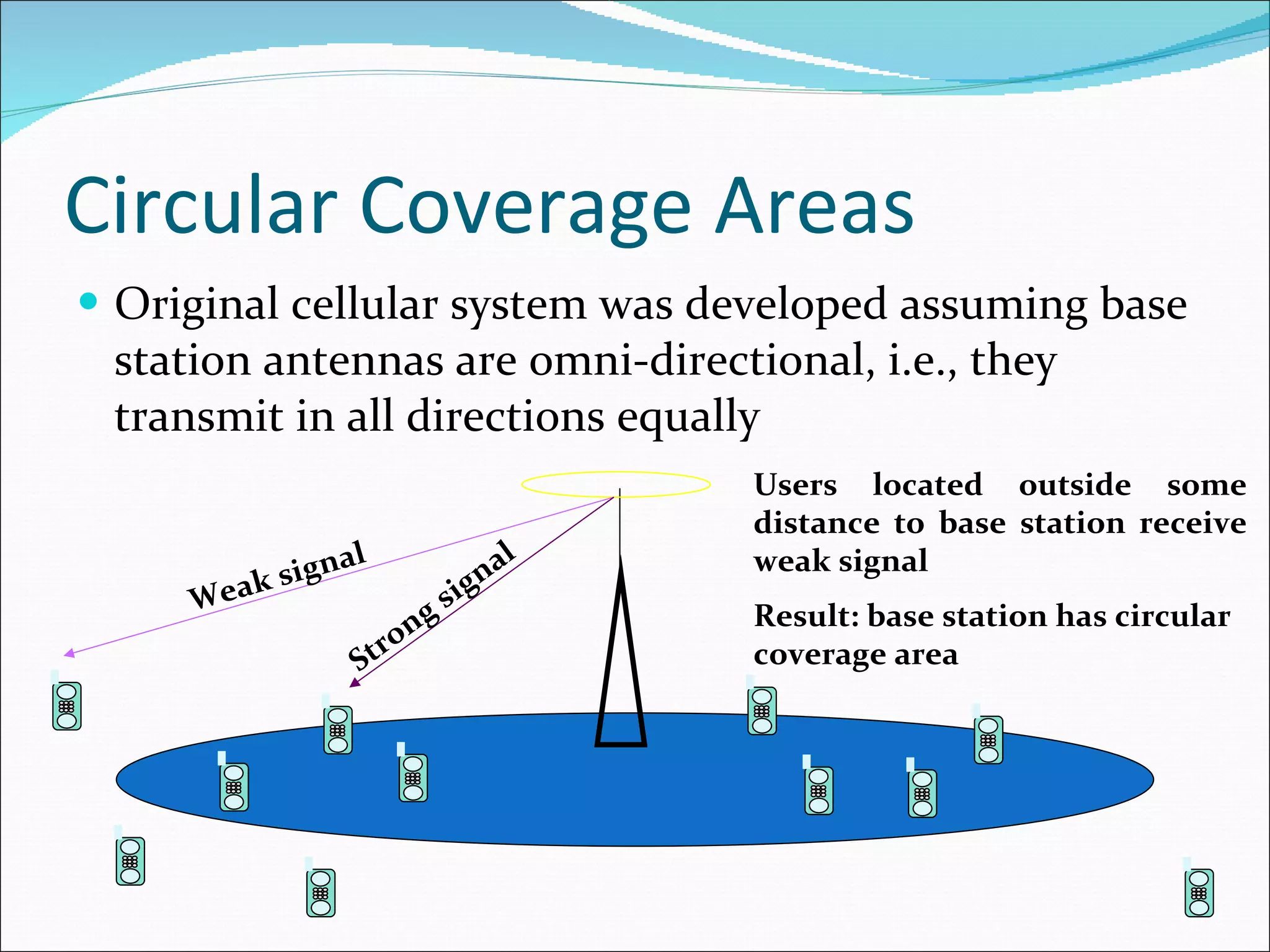
Circular Coverage Areas Original cellular system was developed assuming base station antennas are omni-directional, i.e., they transmit in all directions equally Users located outside some distance to base station receive weak signal Result: base station has circular coverage area Weak signal Strong signal
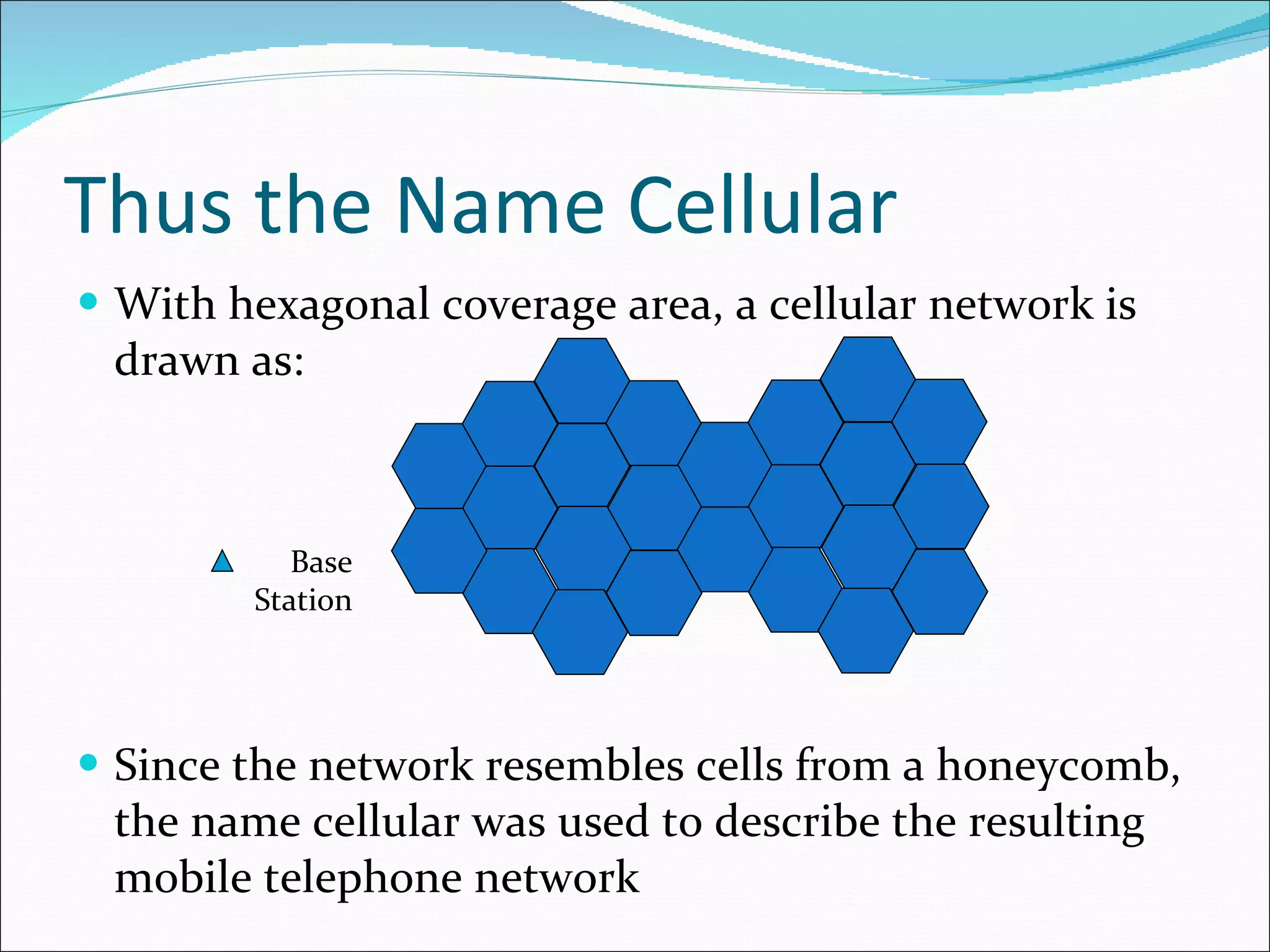
Thus the Name Cellular With hexagonal coverage area, a cellular network is drawn as: Since the network resembles cells from a honeycomb, the name cellular was used to describe the resulting mobile telephone network Base Station
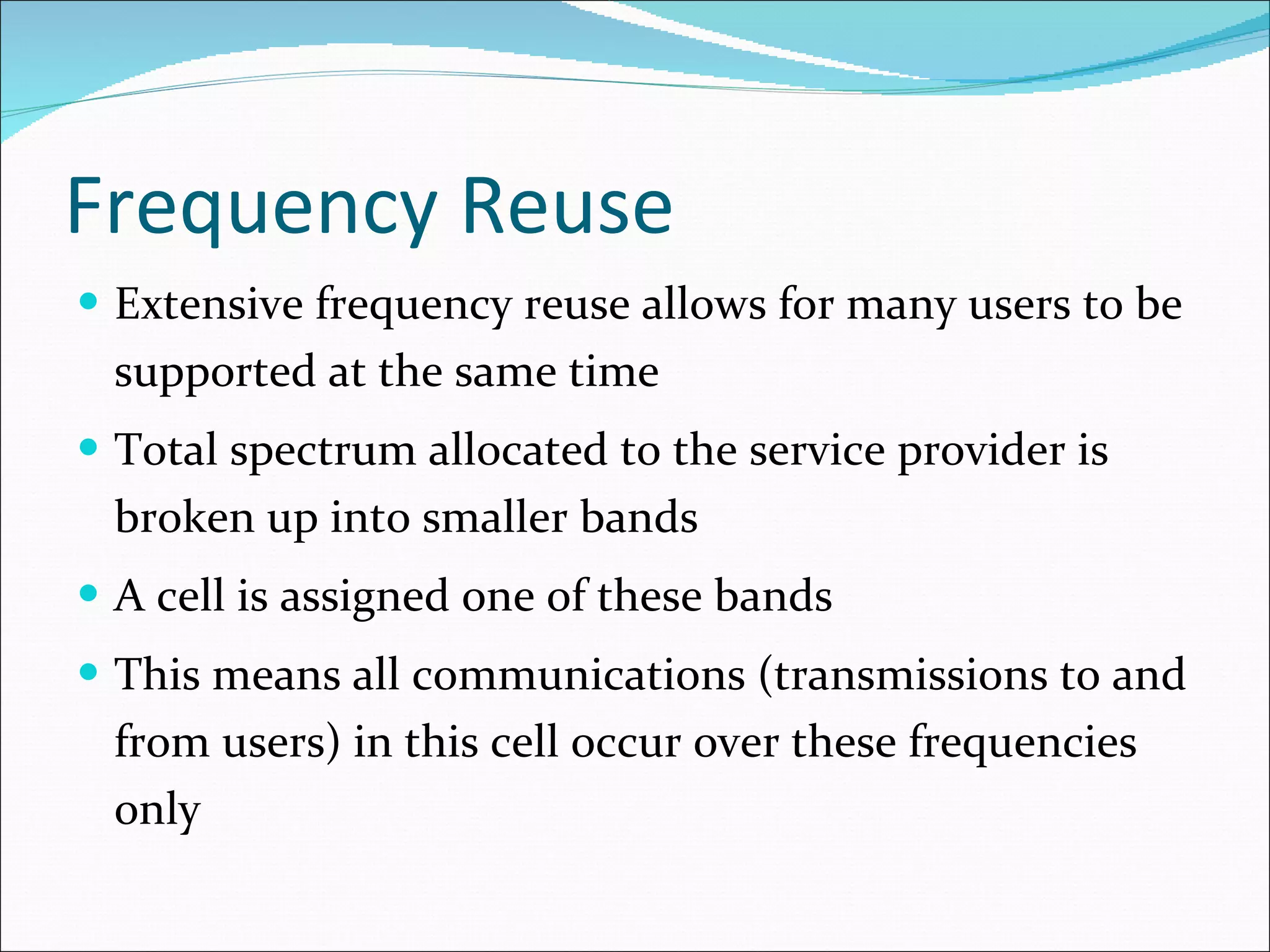
Handoffs A crucial component of the cellular concept is the notion of handoffs Mobile phone users are by definition mobile, i.e., they move around while using the phone Thus, the network should be able to give them continuous access as they move This is not a problem when users move within the same cell When they move from one cell to another, a  handoff  is needed
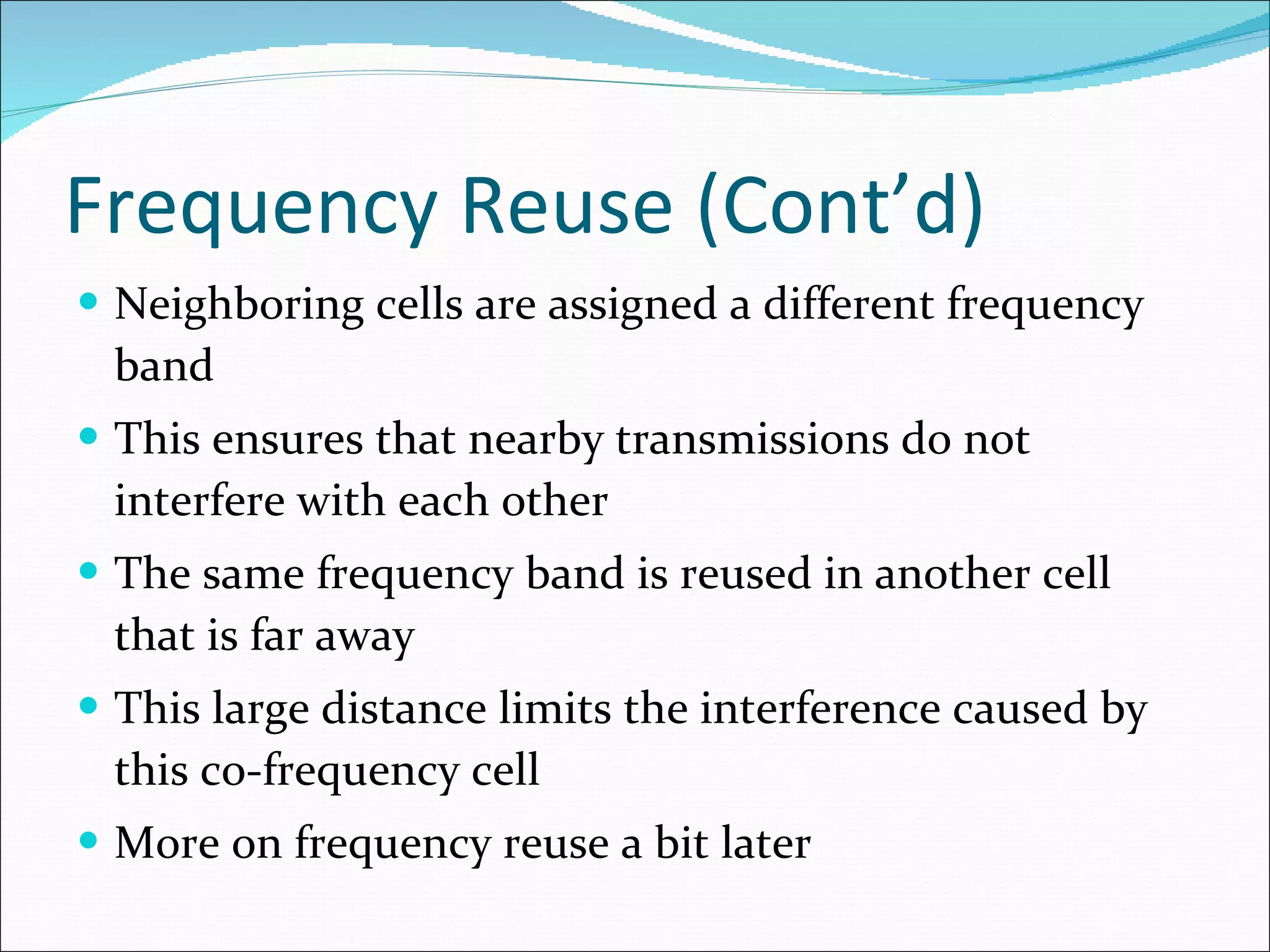
Frequency Reuse Extensive frequency reuse allows for many users to be supported at the same time Total spectrum allocated to the service provider is broken up into smaller bands A cell is assigned one of these bands This means all communications (transmissions to and from users) in this cell occur over these frequencies only
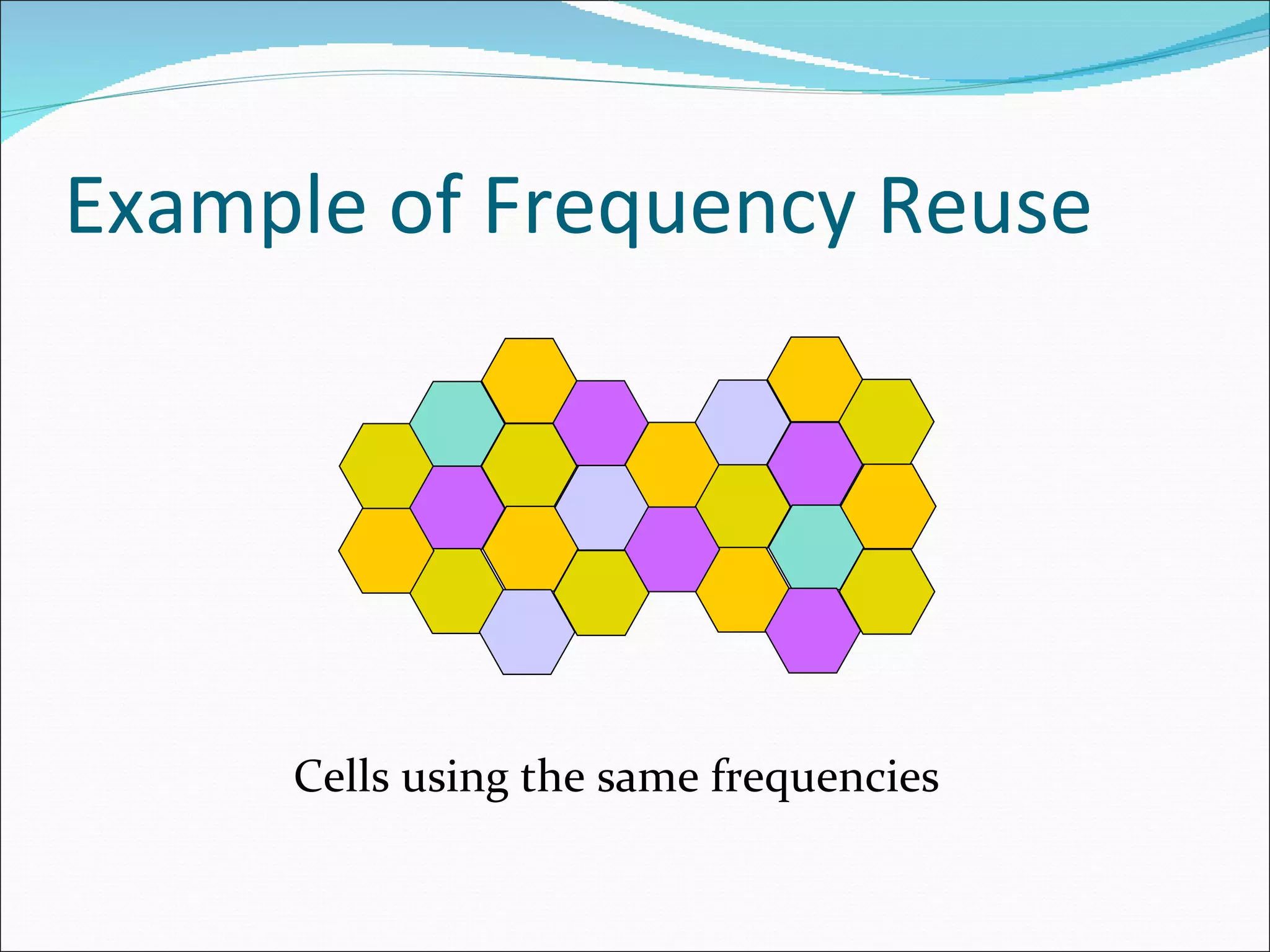
Frequency Reuse (Cont’d) Neighboring cells are assigned a different frequency band This ensures that nearby transmissions do not interfere with each other The same frequency band is reused in another cell that is far away This large distance limits the interference caused by this co-frequency cell More on frequency reuse a bit later
Example of Frequency Reuse Cells using the same frequencies
There are three common technologies used by  cell-phone networks for transmitting information : Frequency division multiple access  (FDMA) Time division multiple access (TDMA) Code division multiple access (CDMA)
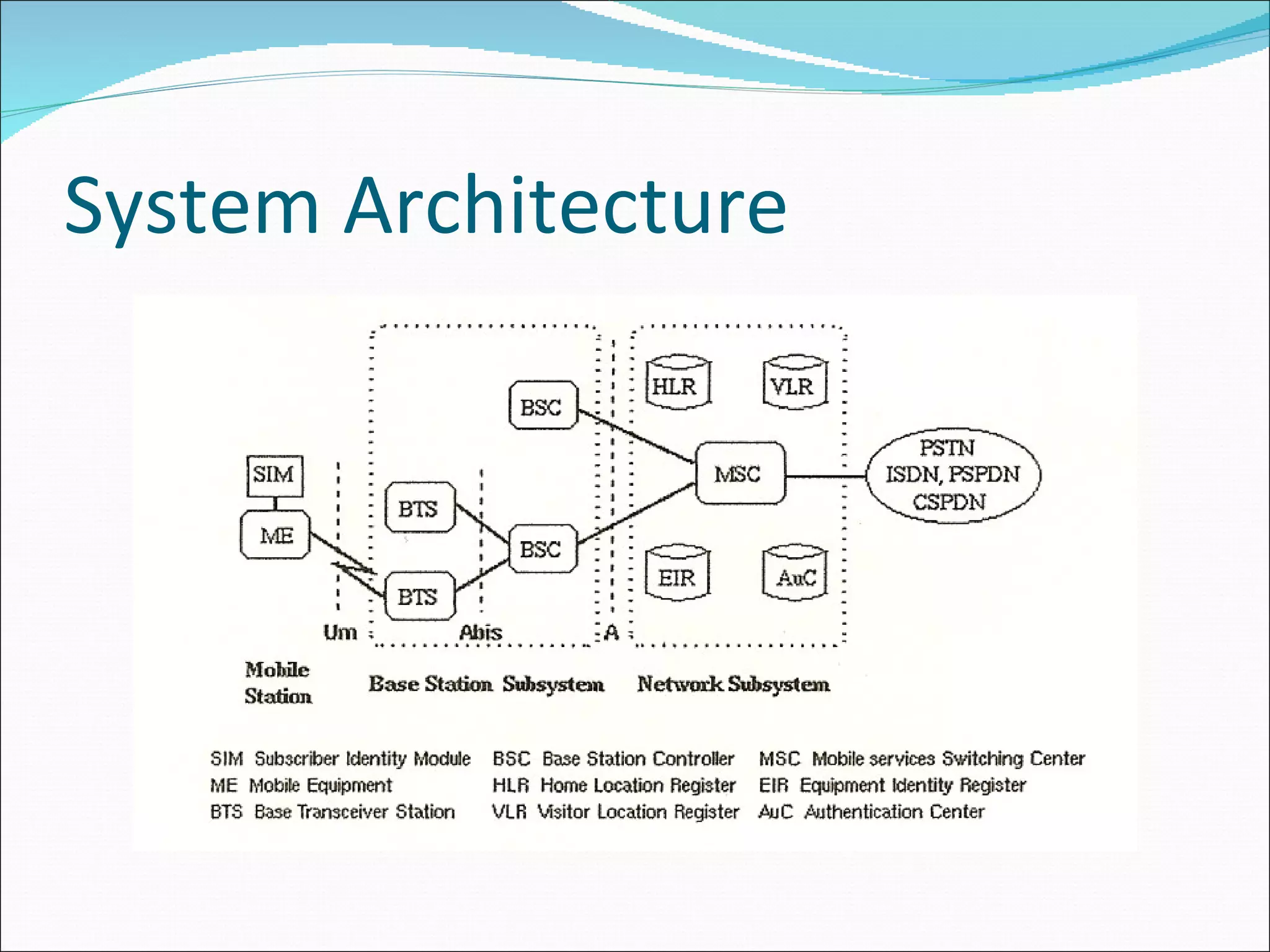
System Architecture
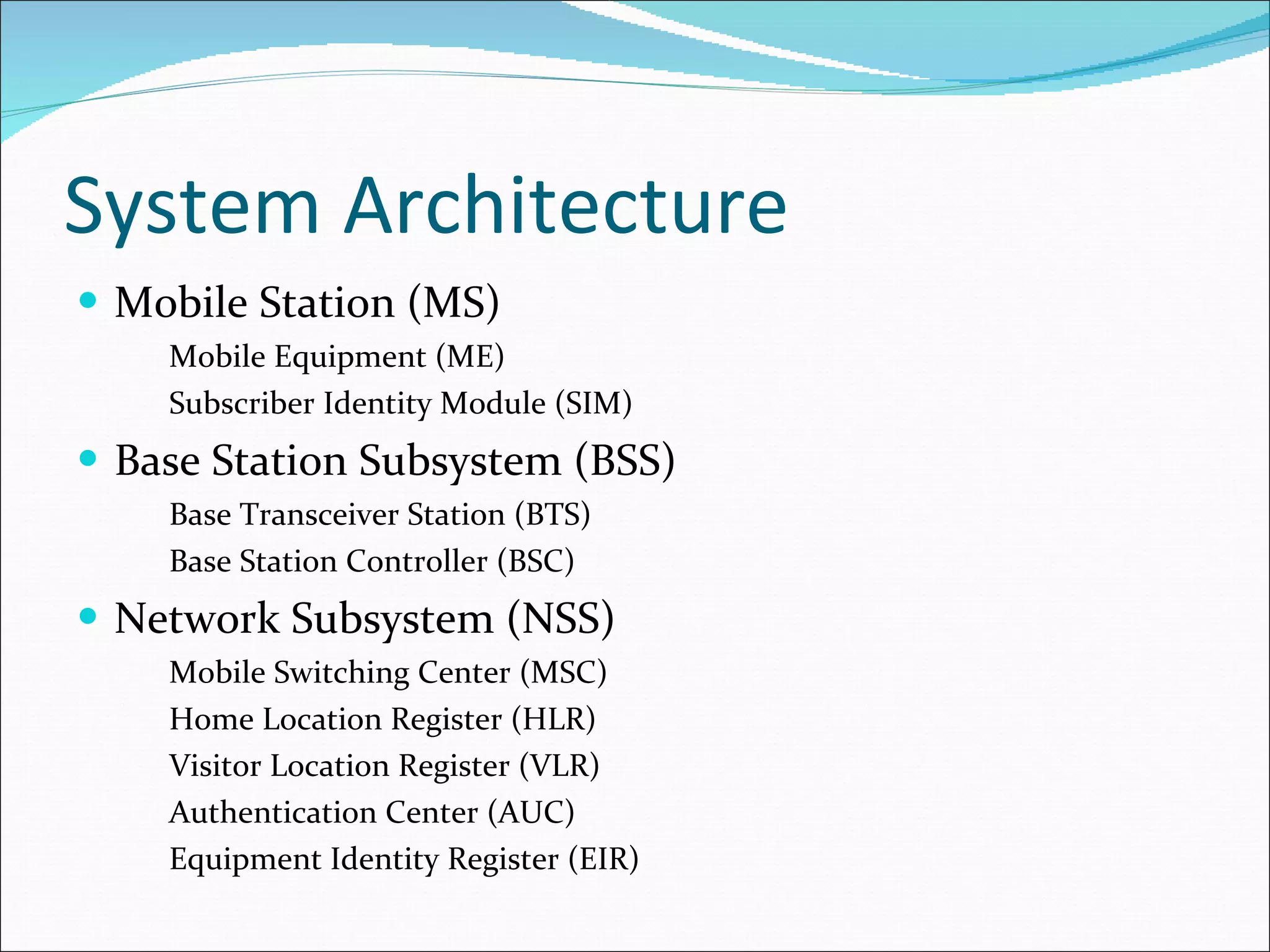
System Architecture Mobile Station (MS) Mobile Equipment (ME) Subscriber Identity Module (SIM) Base Station Subsystem (BSS) Base Transceiver Station (BTS) Base Station Controller (BSC) Network Subsystem (NSS) Mobile Switching Center (MSC) Home Location Register (HLR) Visitor Location Register (VLR) Authentication Center (AUC) Equipment Identity Register (EIR)
THANK YOU

Cellular networks

  • 1.
  • 2.
    Scheme Of PresentationIntroduction Core Idea: Cellular Concept Frequency Reuse System Architecture
  • 3.
    INTRODUCTION First commerciallyautomated cellular network (1G) was launched in Tokyo by Nippon Telephone and Telegraph (NTT) in 1979. In 1981, Nordic Mobile Telephone (NMT) system was launched simultaneously in Denmark, Finland, Norway and Sweden NMT was first mobile phone network featuring international roaming First "modern" network technology on digital 2G cellular technology was launched by Radiolinja in 1991 in Finland on GSM standard
  • 4.
    Building Blocks –before GSM AMPS – Advanced Mobile Phone System TACS – Total Access Communication System NMT – Nordic Mobile Telephone System
  • 5.
    First Mobile TelephoneSystem One high power base station with which all users communicate Wired connection Entire Coverage Area
  • 6.
    Problem with OriginalDesign Original mobile telephone system could only support a handful of users at a time over an entire city With only one high power base station, users phones also needed to be able to transmit at high powers (to reliably transmit signals to the distant base station)
  • 7.
    Core Idea: CellularConcept Core idea that led to today’s system was cellular concept Multiple lower-power base stations that service mobile users within their coverage area and handoff users to neighboring base stations as users move Together base stations tessellate system coverage area
  • 8.
    Cellular Concept Thus,instead of one base station covering an entire city, the city was broken up into cells , or smaller coverage areas Each of these smaller coverage areas had its own lower-power base station User phones in one cell communicate with the base station in that cell
  • 9.
  • 10.
    4 Core PrinciplesSmall cells tessellate overall coverage area Users handoff as they move from one cell to another Frequency reuse Roaming between networks
  • 11.
    Circular Coverage AreasOriginal cellular system was developed assuming base station antennas are omni-directional, i.e., they transmit in all directions equally Users located outside some distance to base station receive weak signal Result: base station has circular coverage area Weak signal Strong signal
  • 12.
    Thus the NameCellular With hexagonal coverage area, a cellular network is drawn as: Since the network resembles cells from a honeycomb, the name cellular was used to describe the resulting mobile telephone network Base Station
  • 13.
    Handoffs A crucialcomponent of the cellular concept is the notion of handoffs Mobile phone users are by definition mobile, i.e., they move around while using the phone Thus, the network should be able to give them continuous access as they move This is not a problem when users move within the same cell When they move from one cell to another, a handoff is needed
  • 14.
    Frequency Reuse Extensivefrequency reuse allows for many users to be supported at the same time Total spectrum allocated to the service provider is broken up into smaller bands A cell is assigned one of these bands This means all communications (transmissions to and from users) in this cell occur over these frequencies only
  • 15.
    Frequency Reuse (Cont’d)Neighboring cells are assigned a different frequency band This ensures that nearby transmissions do not interfere with each other The same frequency band is reused in another cell that is far away This large distance limits the interference caused by this co-frequency cell More on frequency reuse a bit later
  • 16.
    Example of FrequencyReuse Cells using the same frequencies
  • 17.
    There are threecommon technologies used by cell-phone networks for transmitting information : Frequency division multiple access  (FDMA) Time division multiple access (TDMA) Code division multiple access (CDMA)
  • 18.
  • 19.
    System Architecture MobileStation (MS) Mobile Equipment (ME) Subscriber Identity Module (SIM) Base Station Subsystem (BSS) Base Transceiver Station (BTS) Base Station Controller (BSC) Network Subsystem (NSS) Mobile Switching Center (MSC) Home Location Register (HLR) Visitor Location Register (VLR) Authentication Center (AUC) Equipment Identity Register (EIR)
  • 20.