Quantum Mechanics
The other great theory of modern physics

     Deals with very small objects
      Electrons, atoms, molecules

Grew out of problems that seemed simple

      Black-body radiation

      Photoelectric Effect

      Atomic Spectra

Produces some very strange results…
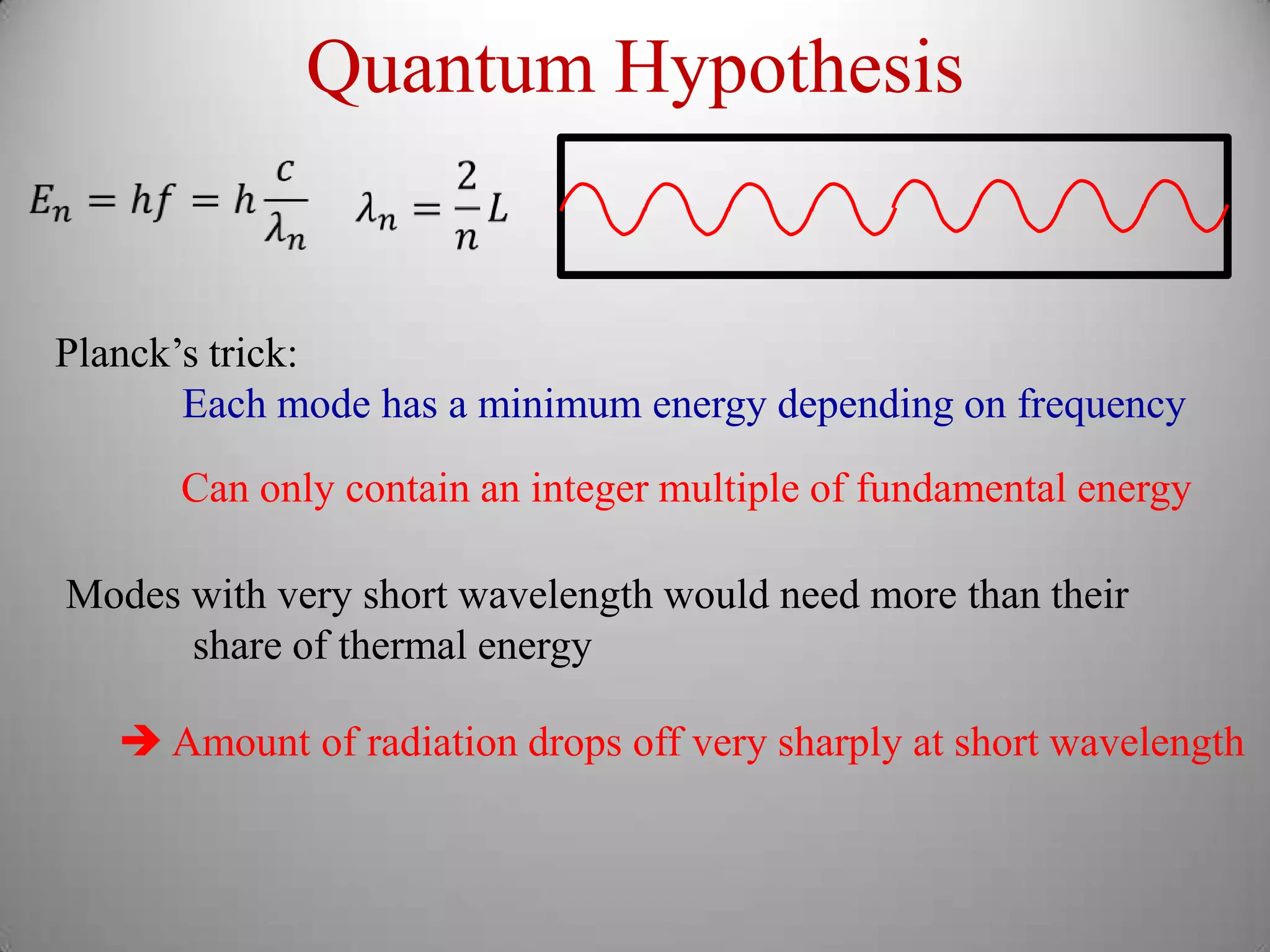
Quantum Hypothesis


Planck’s trick:
       Each mode has a minimum energy depending on frequency
      Can only contain an integer multiple of fundamental energy

Modes with very short wavelength would need more than their
      share of thermal energy

    Amount of radiation drops off very sharply at short wavelength
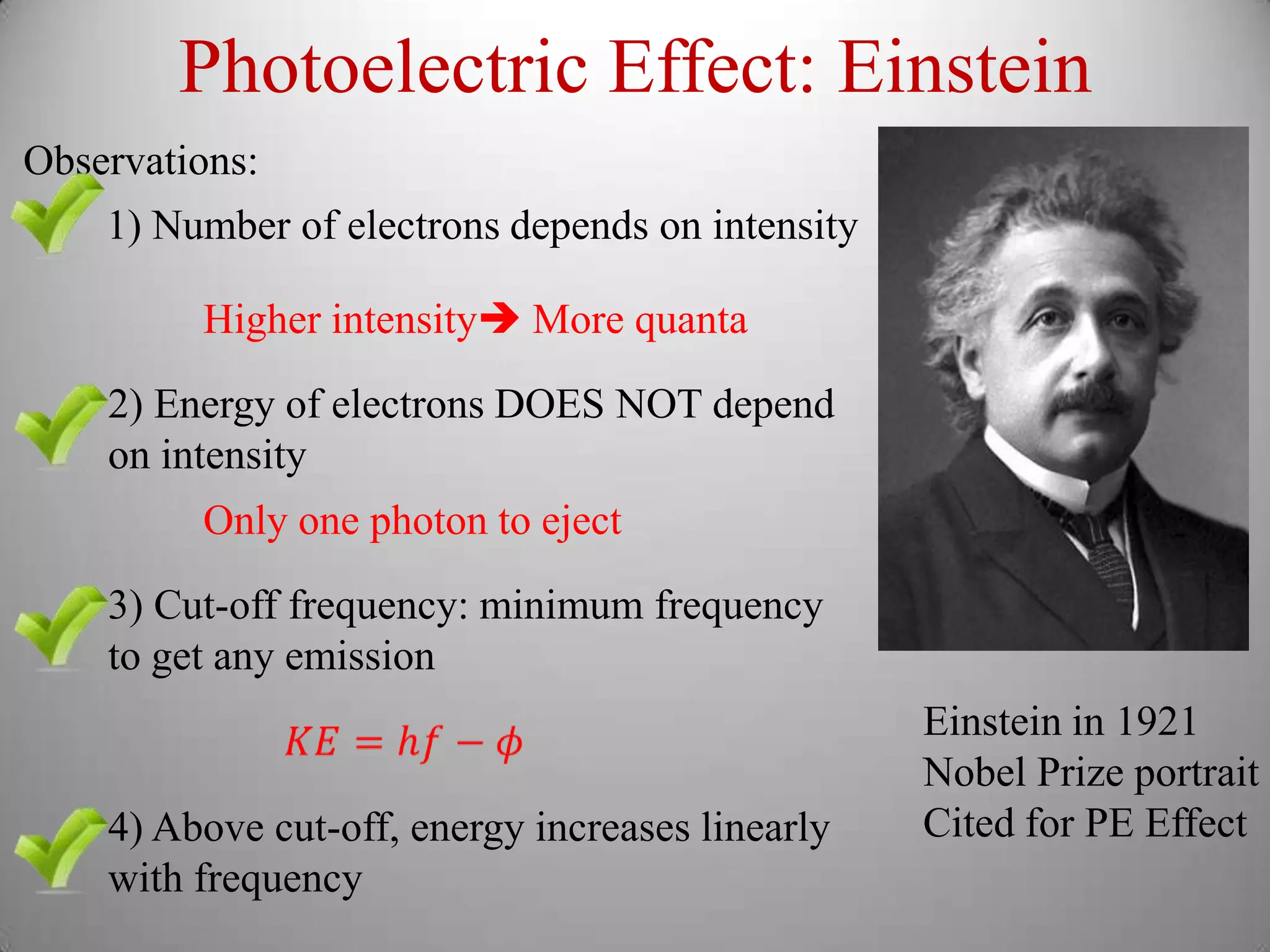
Photoelectric Effect: Einstein
Observations:
    1) Number of electrons depends on intensity

         Higher intensity More quanta
    2) Energy of electrons DOES NOT depend
    on intensity
         Only one photon to eject
    3) Cut-off frequency: minimum frequency
    to get any emission
                                                  Einstein in 1921
                                                  Nobel Prize portrait
    4) Above cut-off, energy increases linearly   Cited for PE Effect
    with frequency
Bohr Model
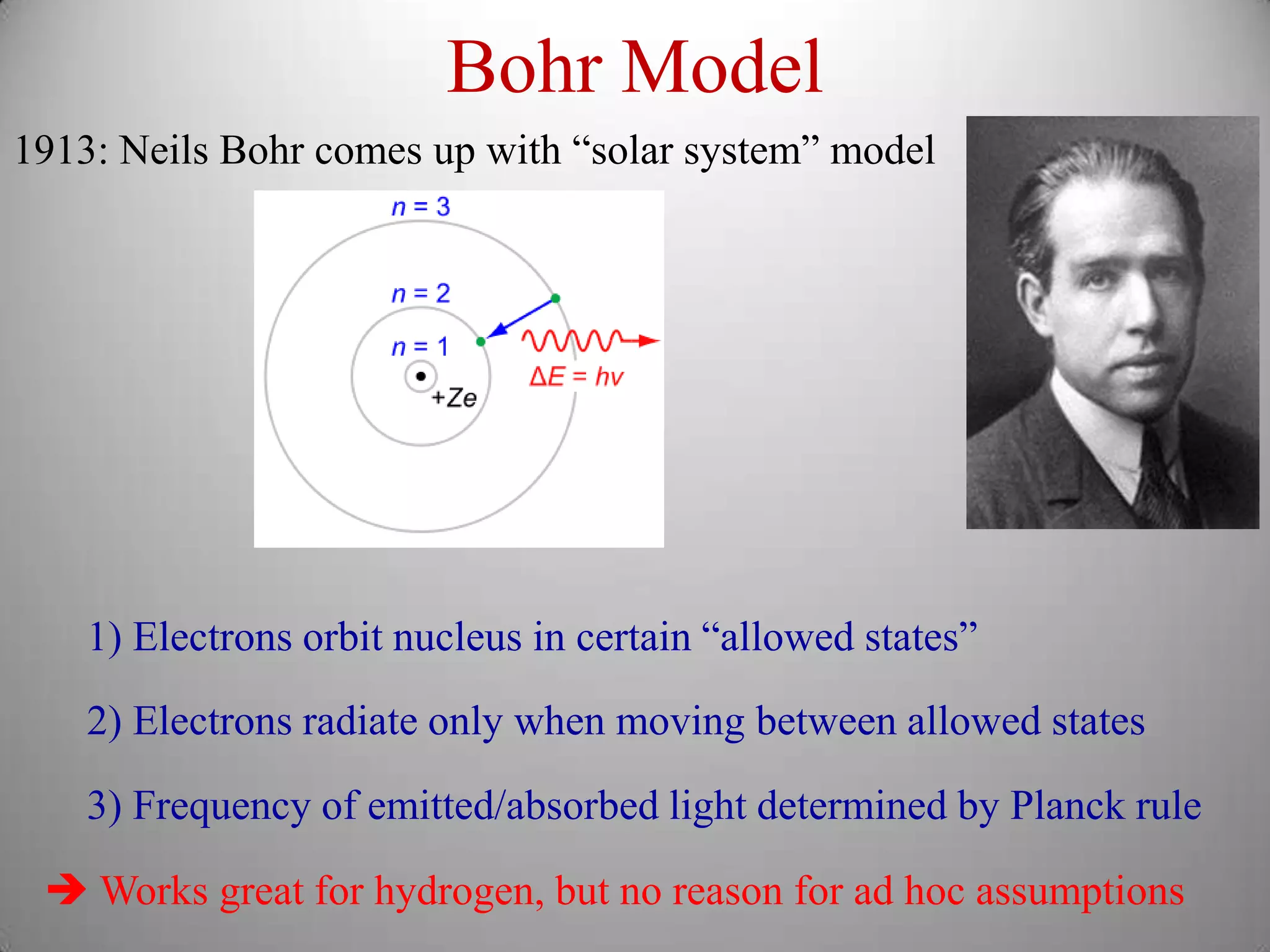
1913: Neils Bohr comes up with “solar system” model


    1) Electrons orbit nucleus in certain “allowed states”
    2) Electrons radiate only when moving between allowed states
    3) Frequency of emitted/absorbed light determined by Planck rule

  Works great for hydrogen, but no reason for ad hoc assumptions
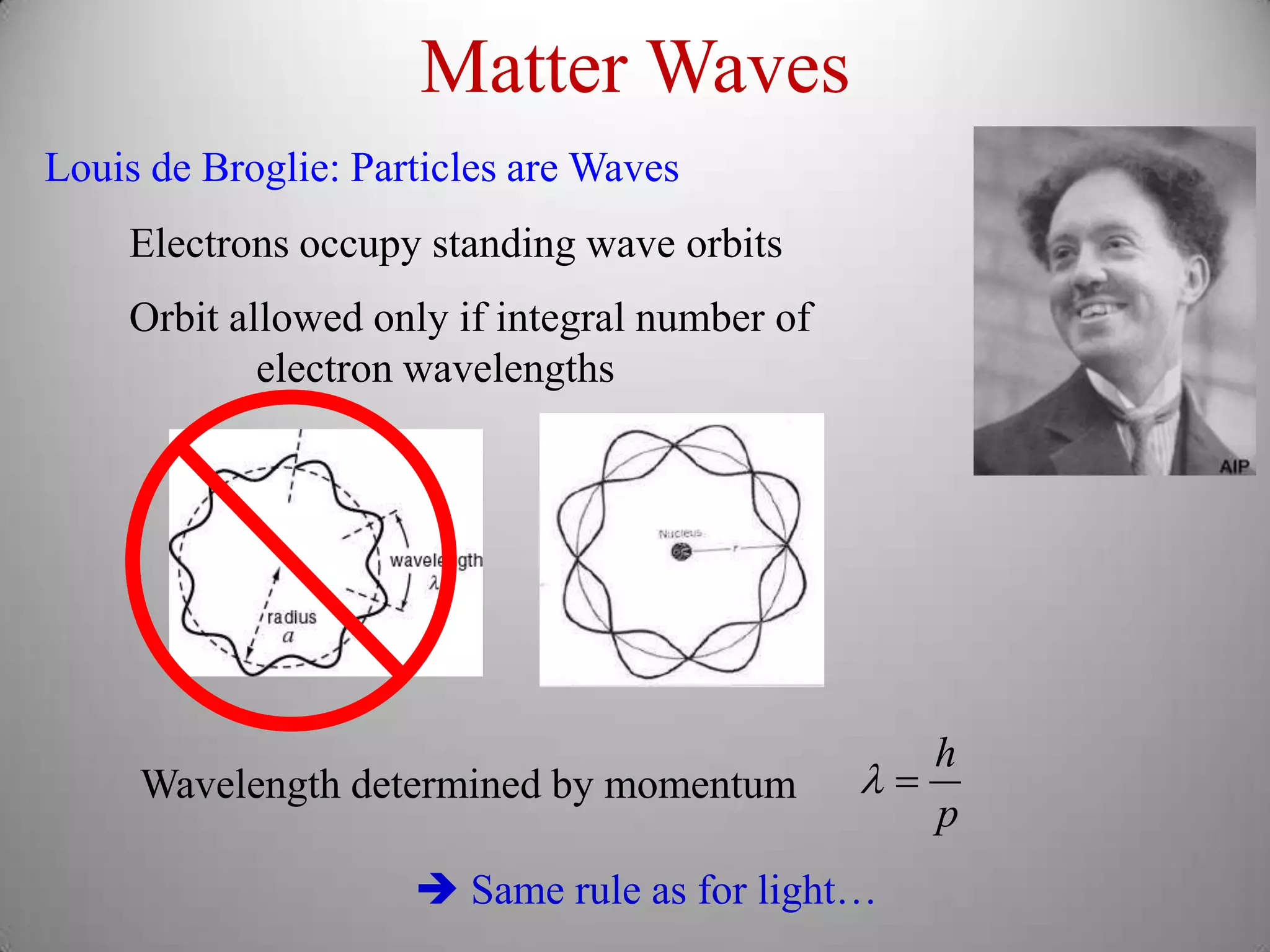
Matter Waves
Louis de Broglie: Particles are Waves
    Electrons occupy standing wave orbits
    Orbit allowed only if integral number of
            electron wavelengths


                                                  h
     Wavelength determined by momentum         
                                                  p
                      Same rule as for light…
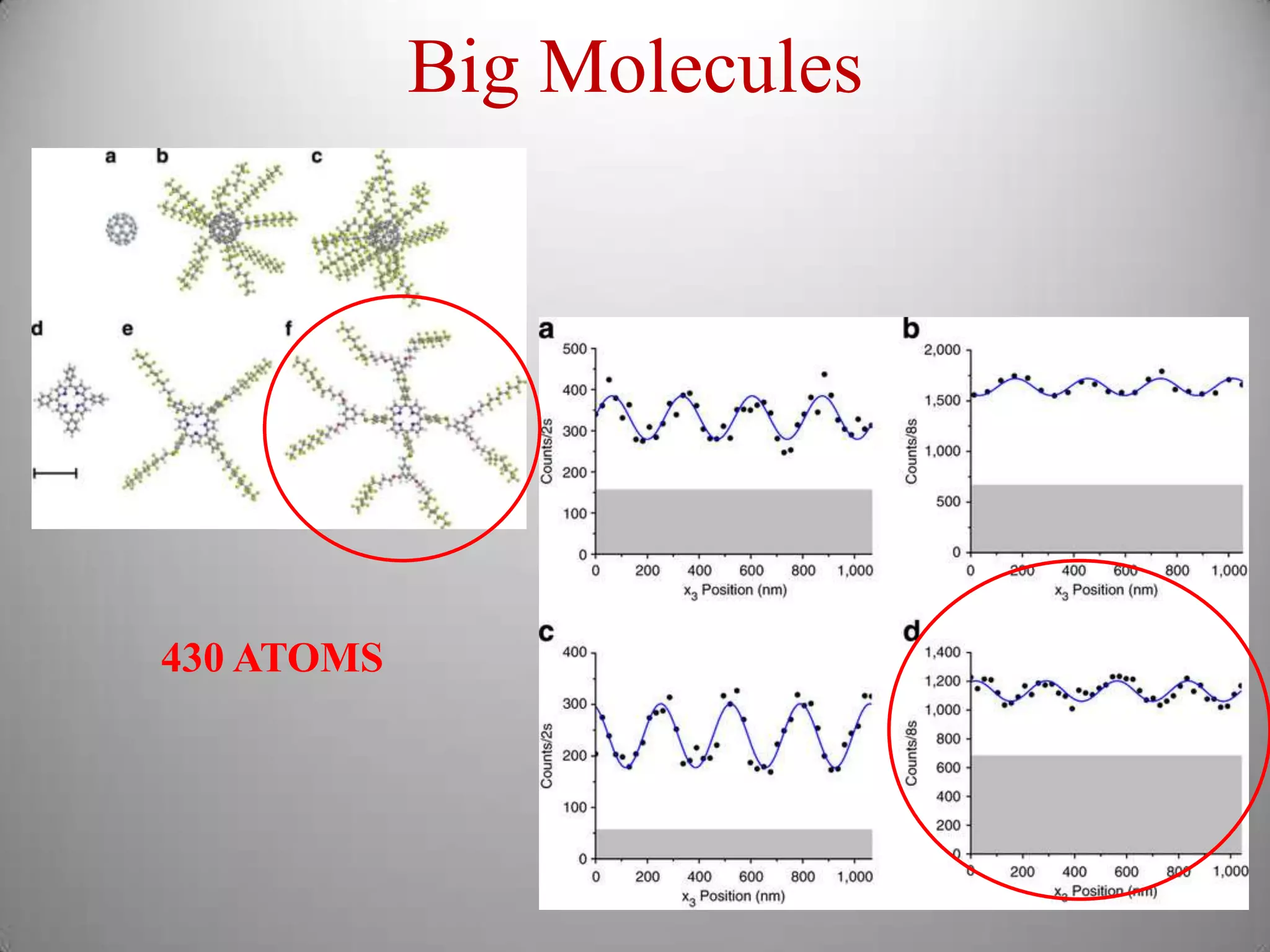
Big Molecules


430 ATOMS
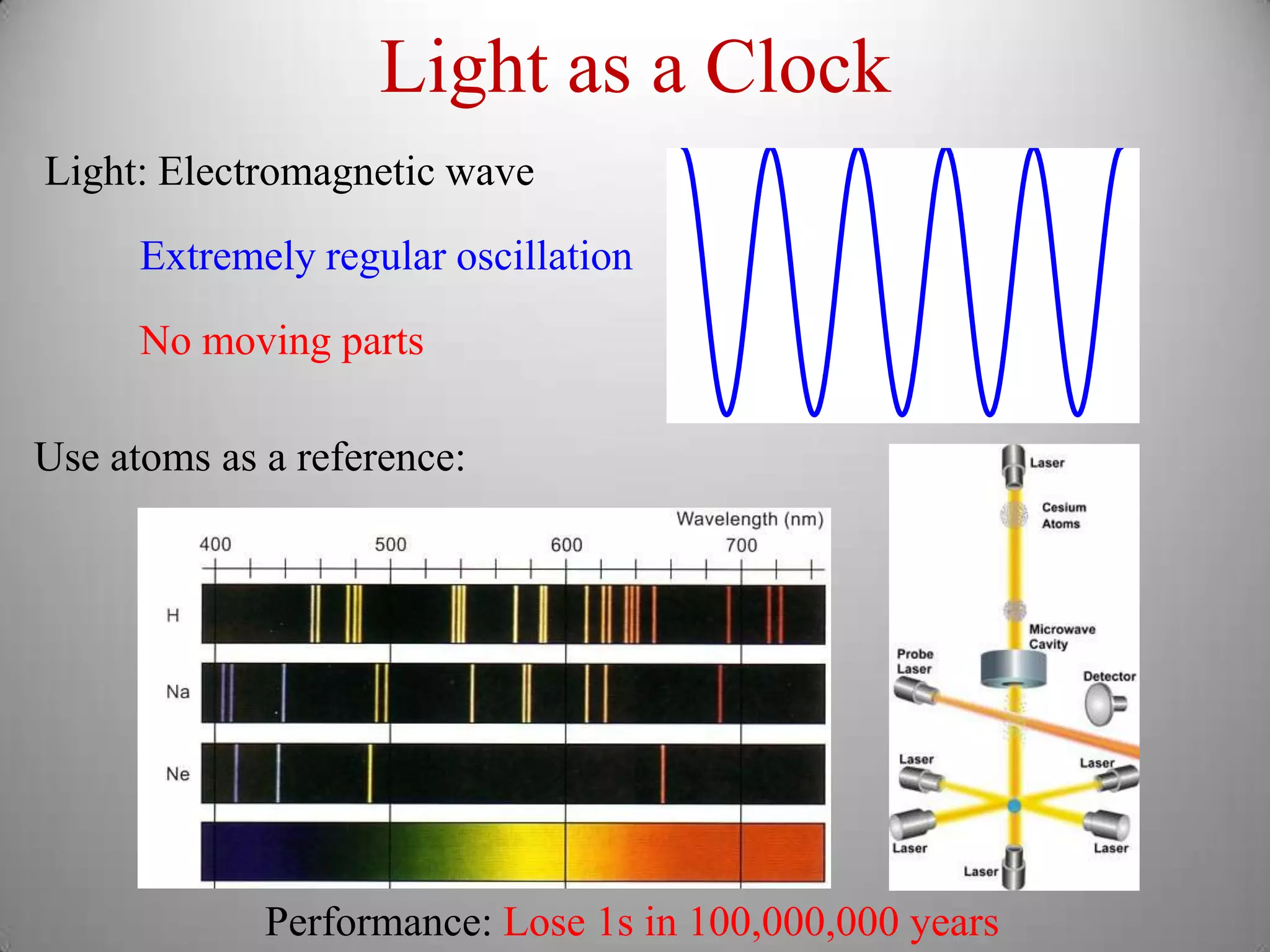
Light as a Clock
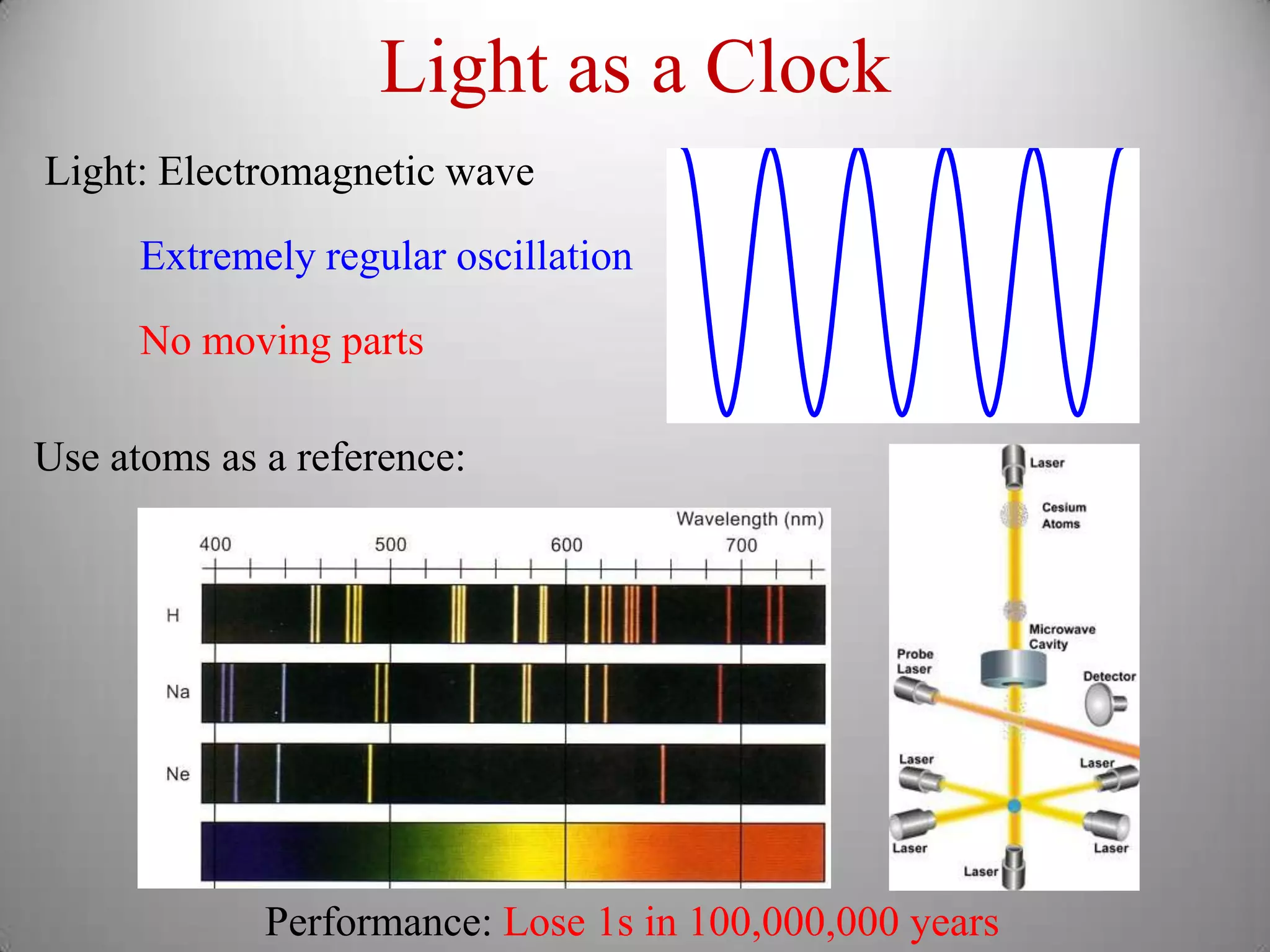
Light: Electromagnetic wave

      Extremely regular oscillation

      No moving parts

Use atoms as a reference:


             Performance: Lose 1s in 100,000,000 years
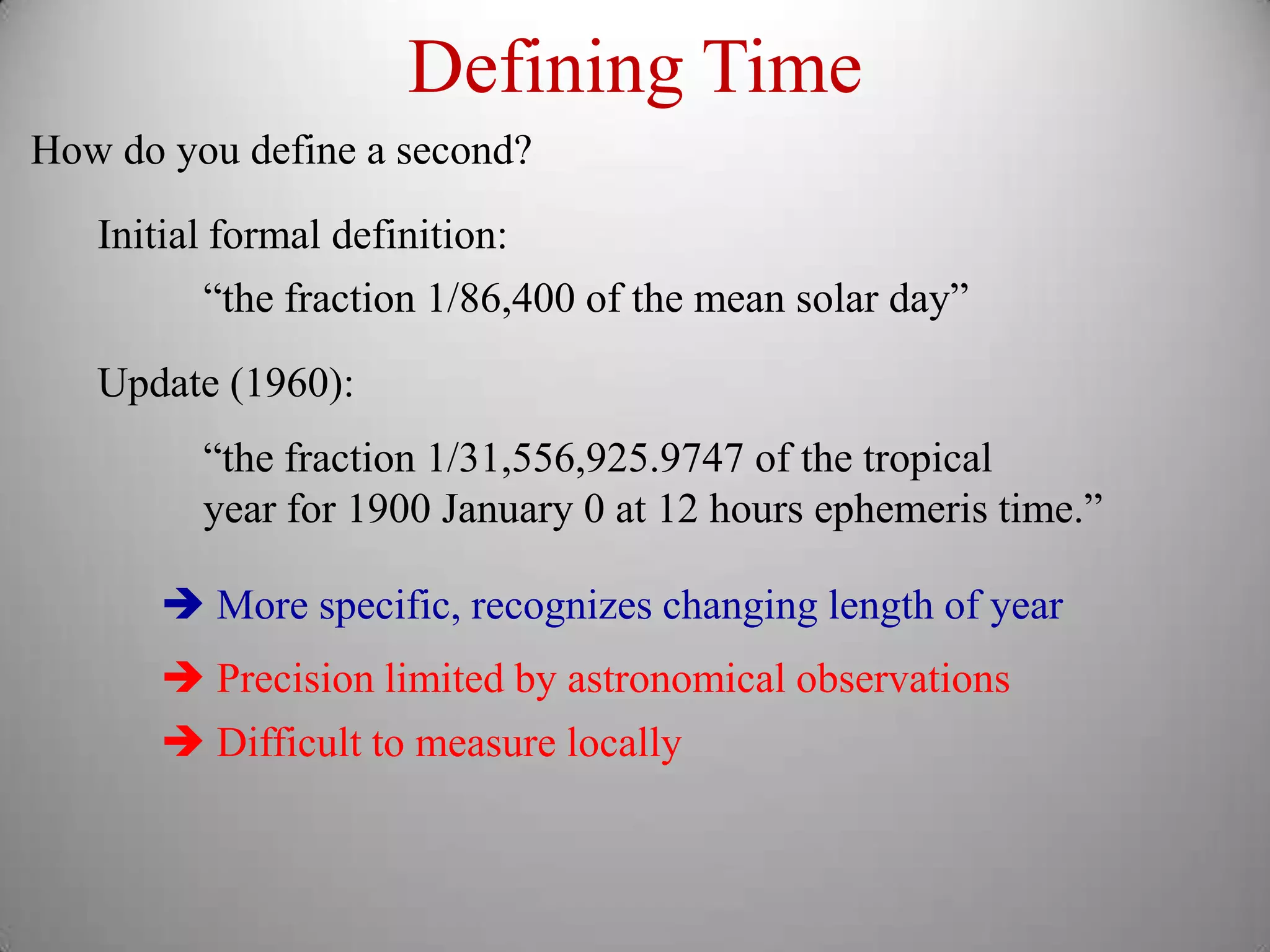
Defining Time
How do you define a second?

   Initial formal definition:
          “the fraction 1/86,400 of the mean solar day”

   Update (1960):
         “the fraction 1/31,556,925.9747 of the tropical
         year for 1900 January 0 at 12 hours ephemeris time.”

        More specific, recognizes changing length of year
        Precision limited by astronomical observations
        Difficult to measure locally
Quality Factor
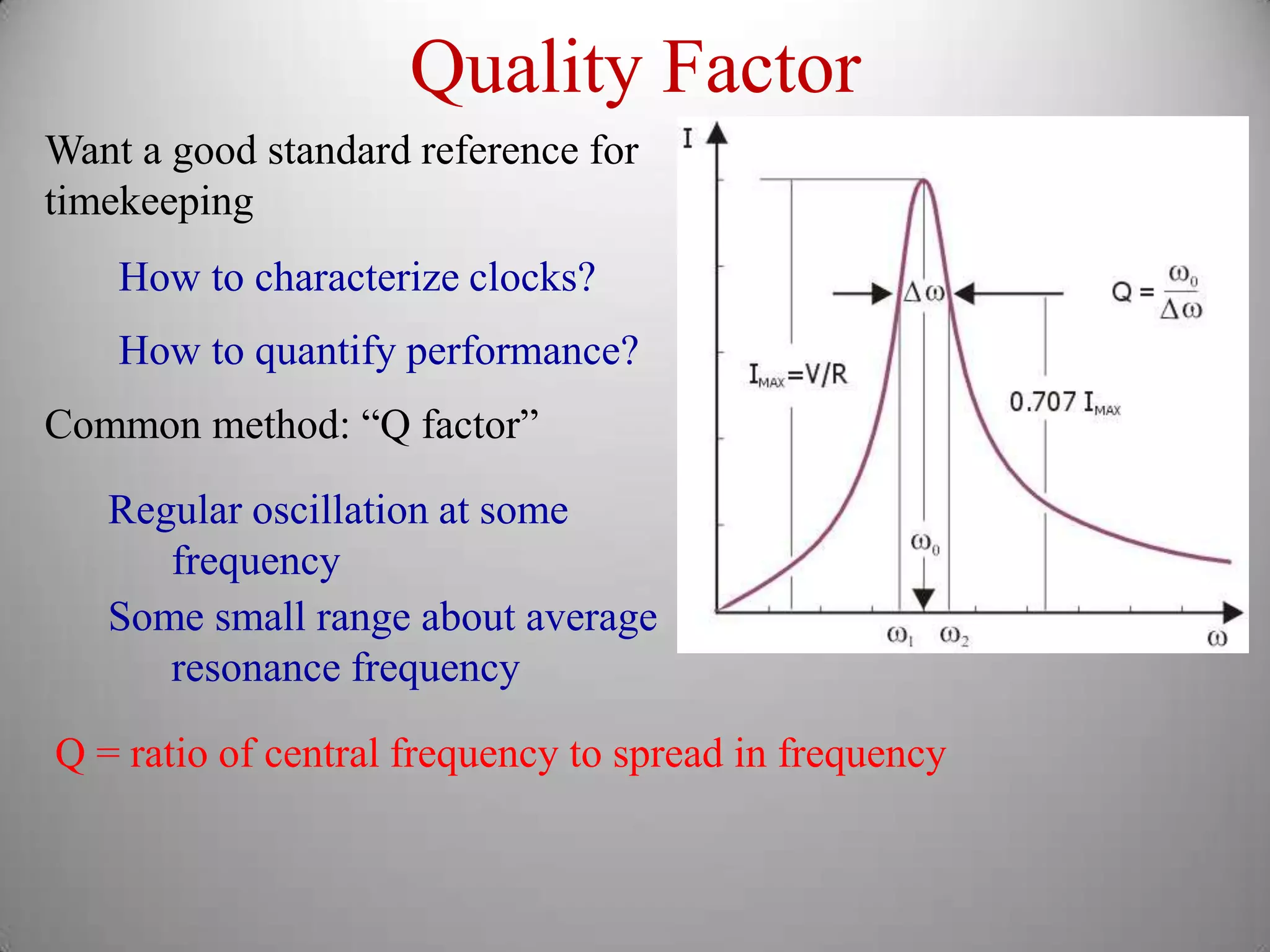
Want a good standard reference for
timekeeping
    How to characterize clocks?
    How to quantify performance?
Common method: “Q factor”

   Regular oscillation at some
      frequency
   Some small range about average
      resonance frequency

Q = ratio of central frequency to spread in frequency
Quality Factor
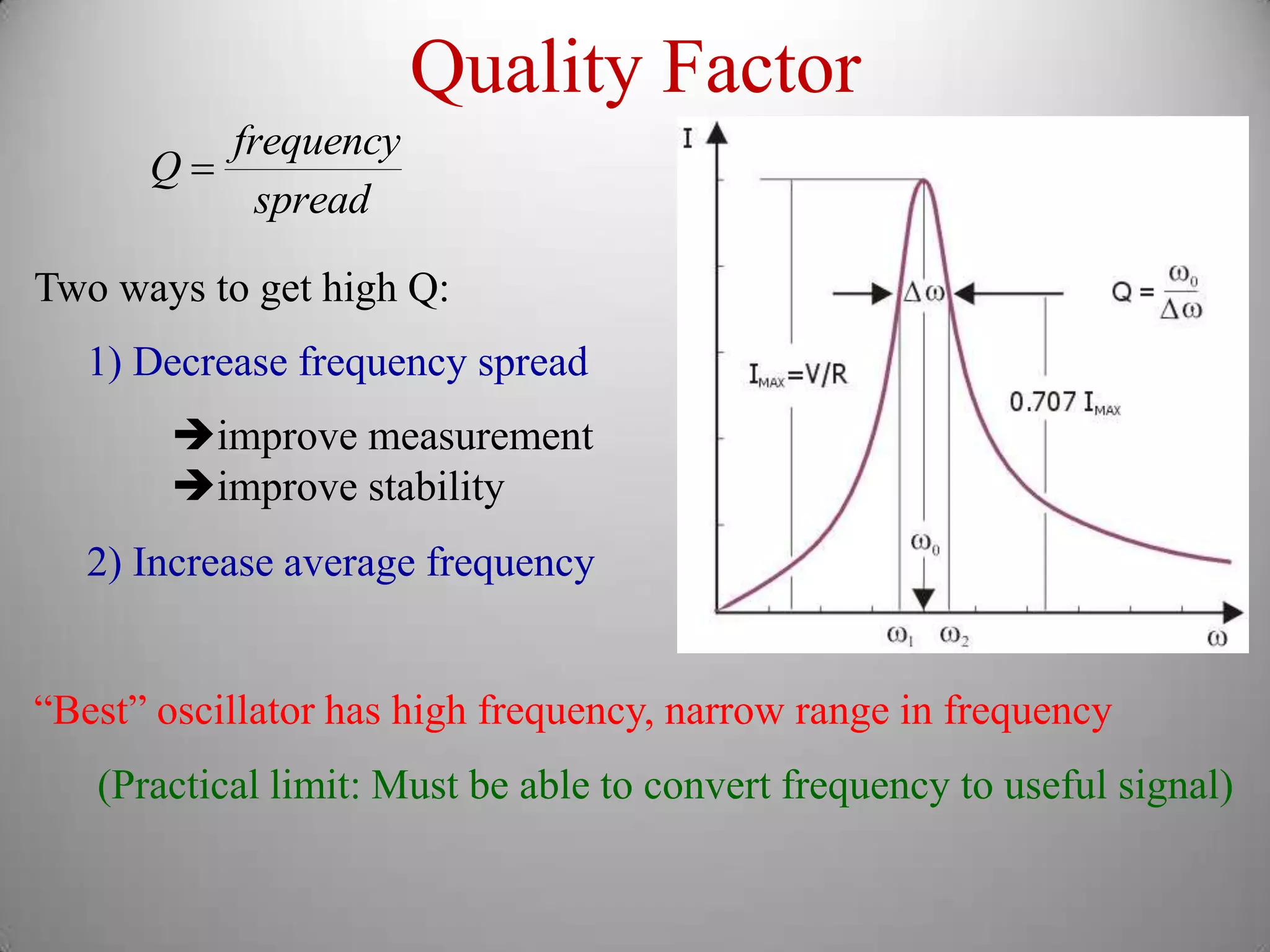
         frequency
      Q
           spread

Two ways to get high Q:
   1) Decrease frequency spread
        improve measurement
        improve stability
   2) Increase average frequency


“Best” oscillator has high frequency, narrow range in frequency
   (Practical limit: Must be able to convert frequency to useful signal)
Light as a Clock
Light: Electromagnetic wave

      Extremely regular oscillation

      No moving parts

Use atoms as a reference:


             Performance: Lose 1s in 100,000,000 years
Ammonia
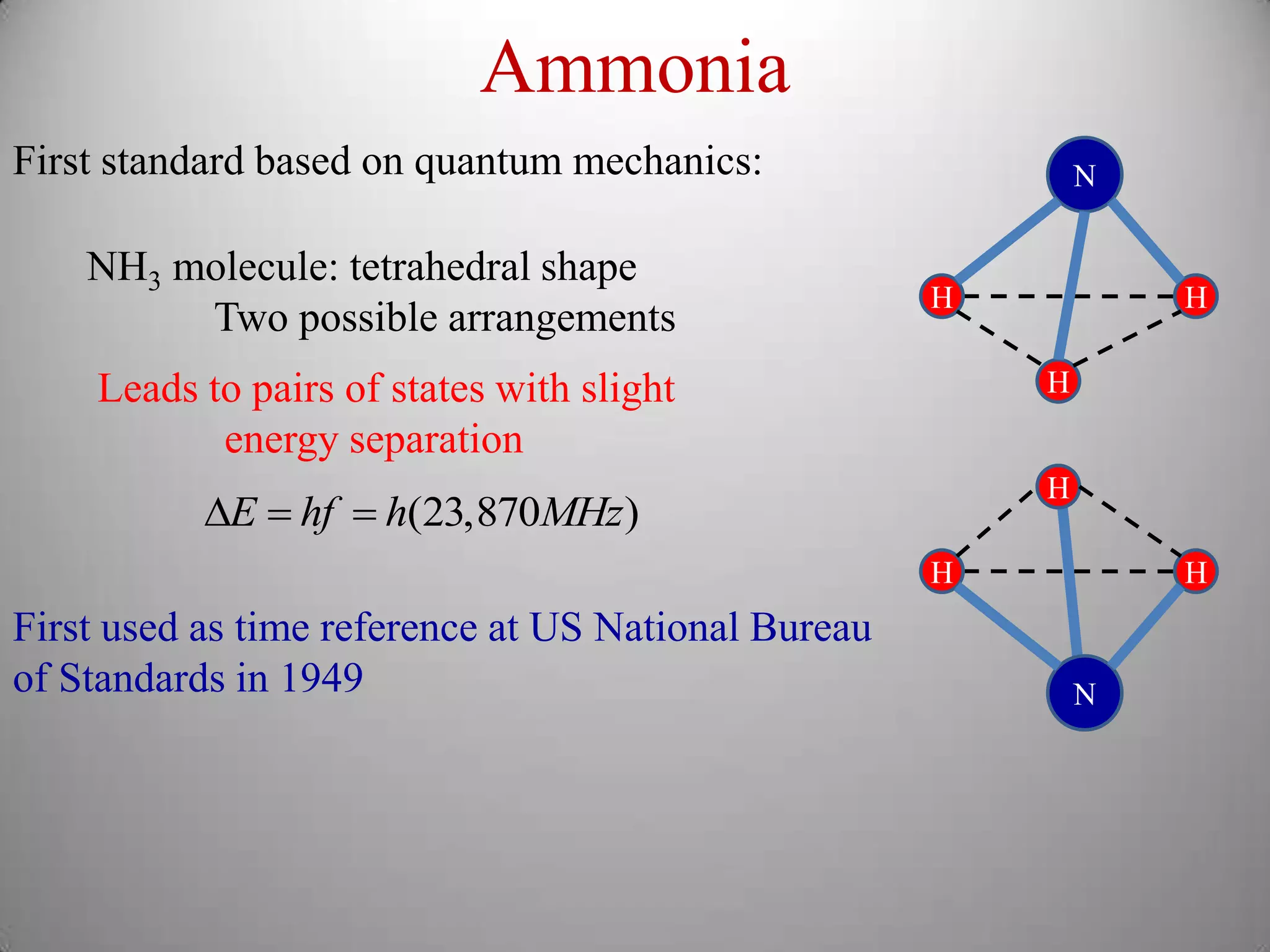
First standard based on quantum mechanics:                   N

    NH3 molecule: tetrahedral shape
                                                     H           H
         Two possible arrangements
    Leads to pairs of states with slight                 H
           energy separation
                                                         H
           E  hf  h(23,870MHz)
                                                     H           H
First used as time reference at US National Bureau
of Standards in 1949                                         N
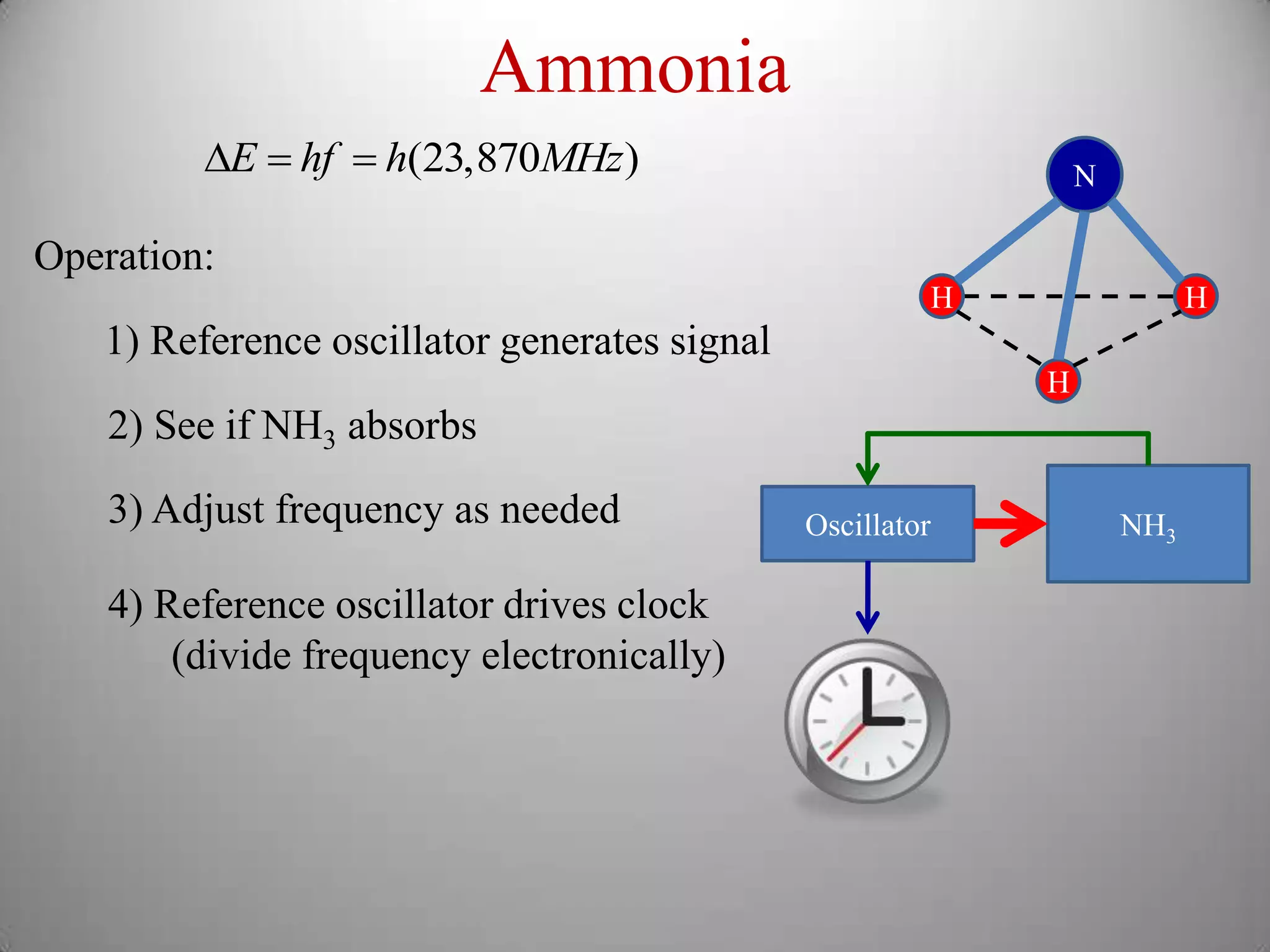
Ammonia
         E  hf  h(23,870MHz)                                N

Operation:
                                                       H                 H
   1) Reference oscillator generates signal
                                                           H
    2) See if NH3 absorbs
    3) Adjust frequency as needed             Oscillator           NH3

    4) Reference oscillator drives clock
        (divide frequency electronically)
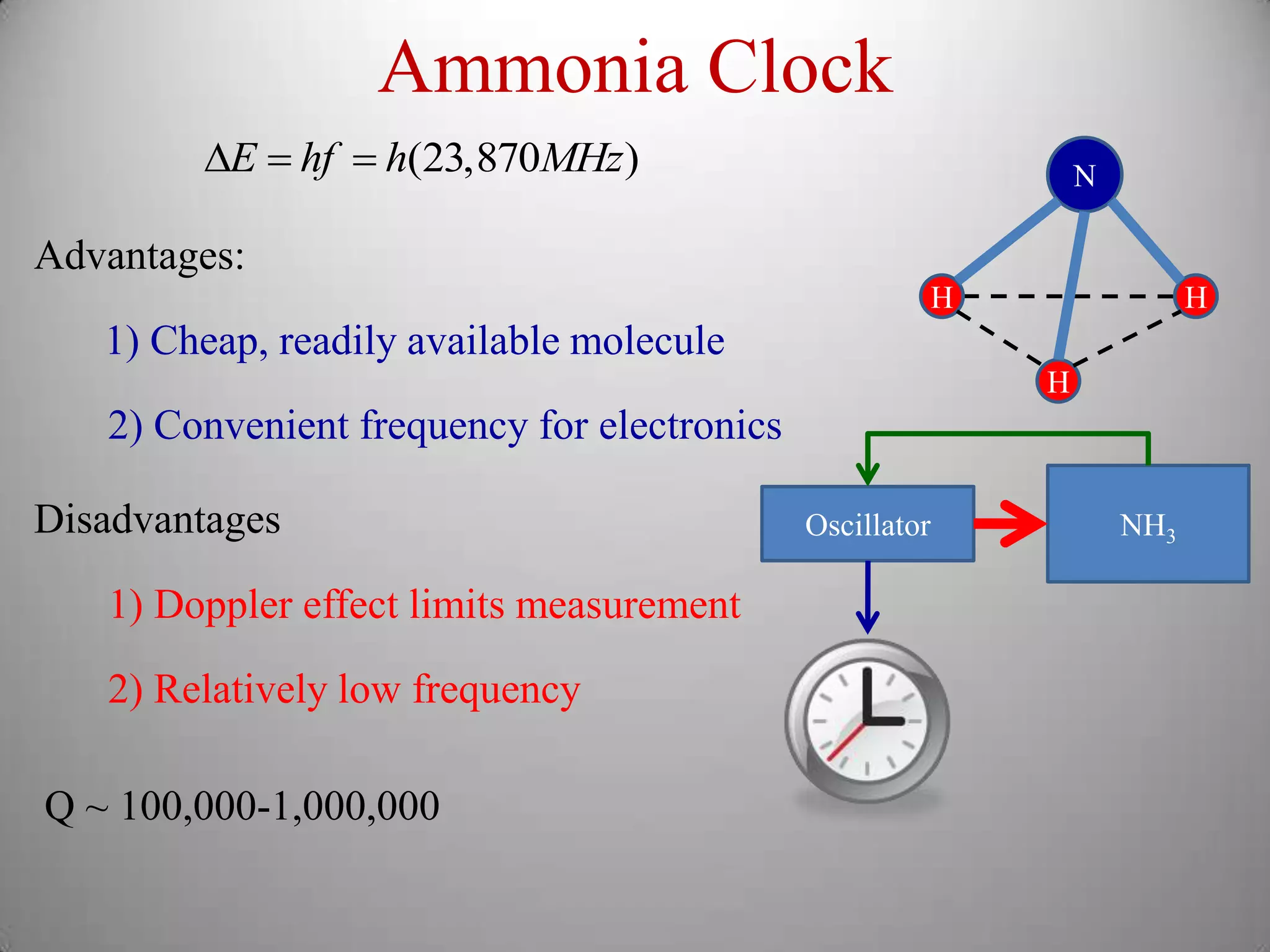
Ammonia Clock
        E  hf  h(23,870MHz)                                N

Advantages:
                                                      H                 H
   1) Cheap, readily available molecule
                                                          H
   2) Convenient frequency for electronics

Disadvantages                                Oscillator           NH3

   1) Doppler effect limits measurement

   2) Relatively low frequency

Q ~ 100,000-1,000,000
Cesium
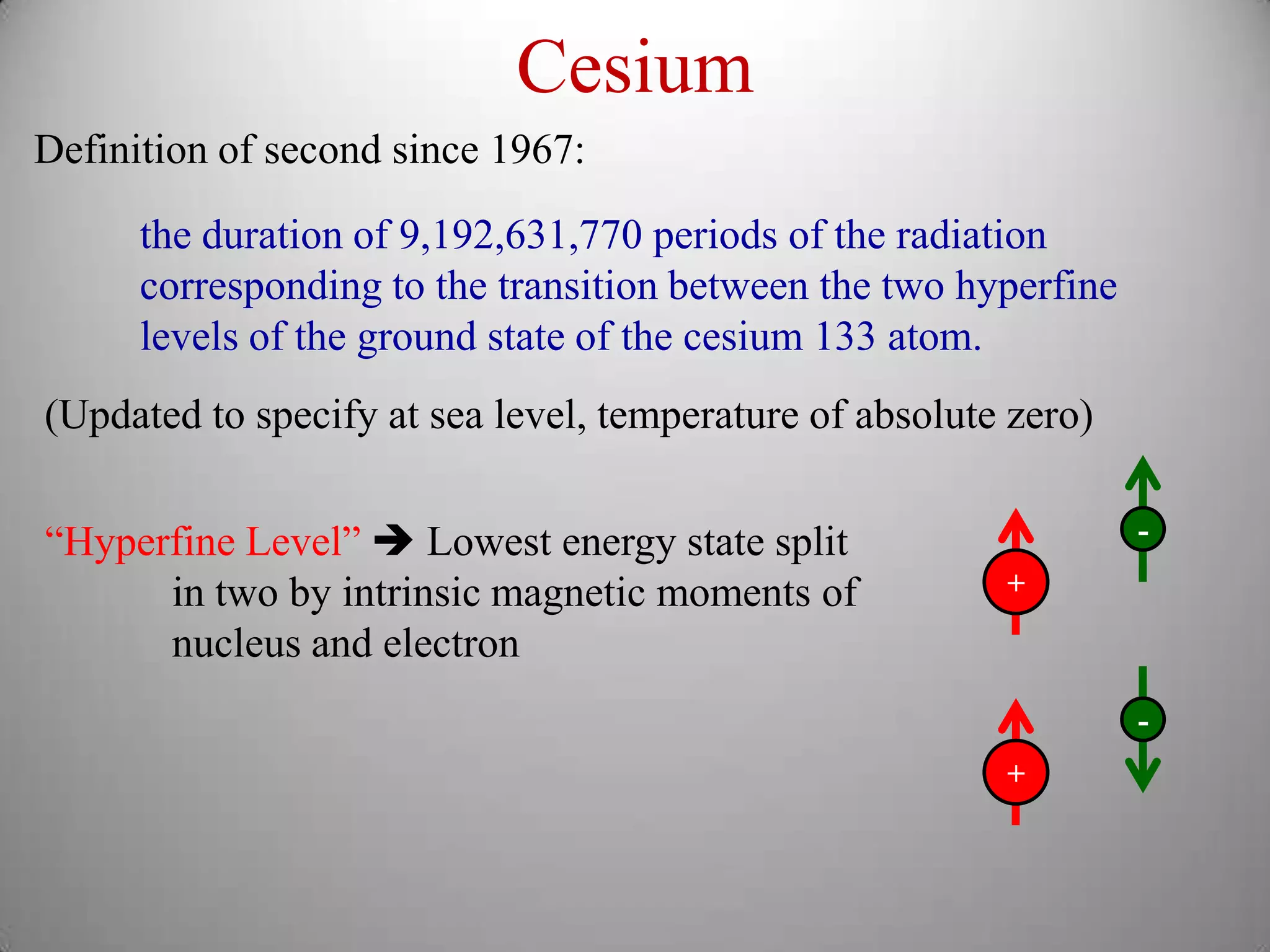
Definition of second since 1967:

      the duration of 9,192,631,770 periods of the radiation
      corresponding to the transition between the two hyperfine
      levels of the ground state of the cesium 133 atom.
(Updated to specify at sea level, temperature of absolute zero)


“Hyperfine Level”  Lowest energy state split                     -

      in two by intrinsic magnetic moments of            +
      nucleus and electron
                                                                  -
                                                         +
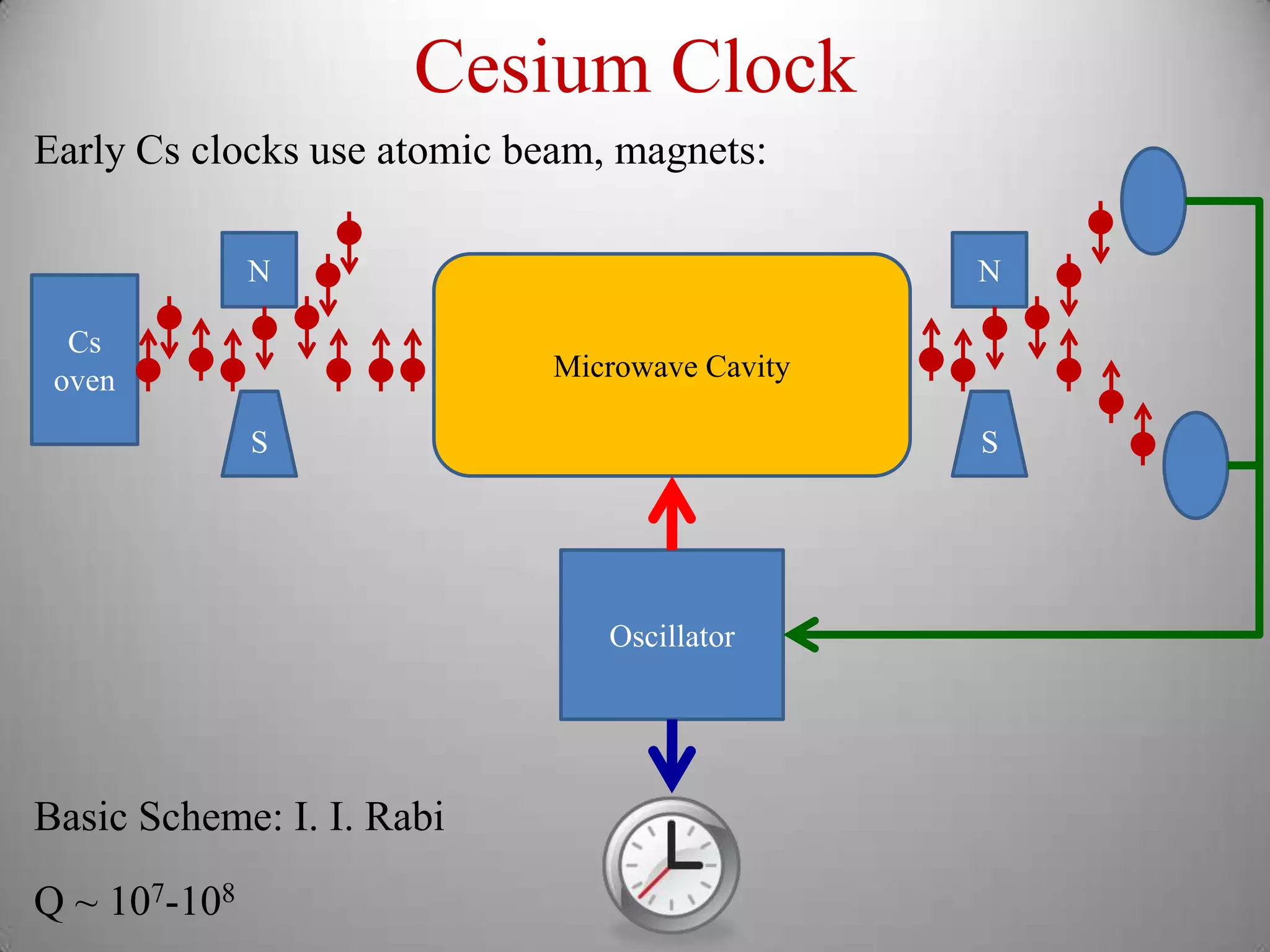
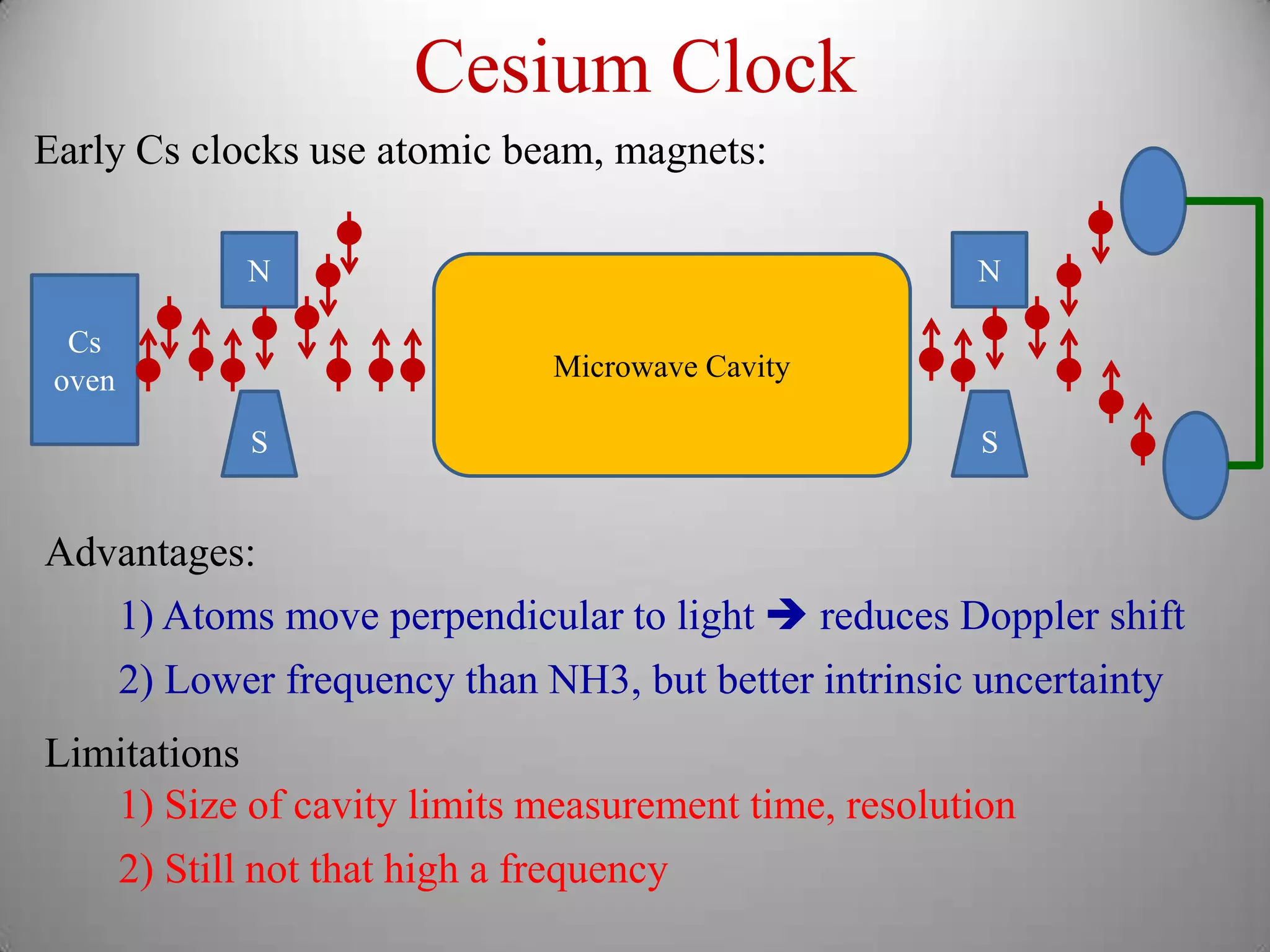
Cesium Clock
Early Cs clocks use atomic beam, magnets:

              N                                 N

  Cs
 oven                        Microwave Cavity

              S                                 S


                                Oscillator


Basic Scheme: I. I. Rabi

Q ~ 107-108
Cesium Clock
Early Cs clocks use atomic beam, magnets:

               N                                          N

  Cs
 oven                             Microwave Cavity

                S                                         S


Advantages:
   1) Atoms move perpendicular to light  reduces Doppler shift
        2) Lower frequency than NH3, but better intrinsic uncertainty
Limitations
   1) Size of cavity limits measurement time, resolution
        2) Still not that high a frequency
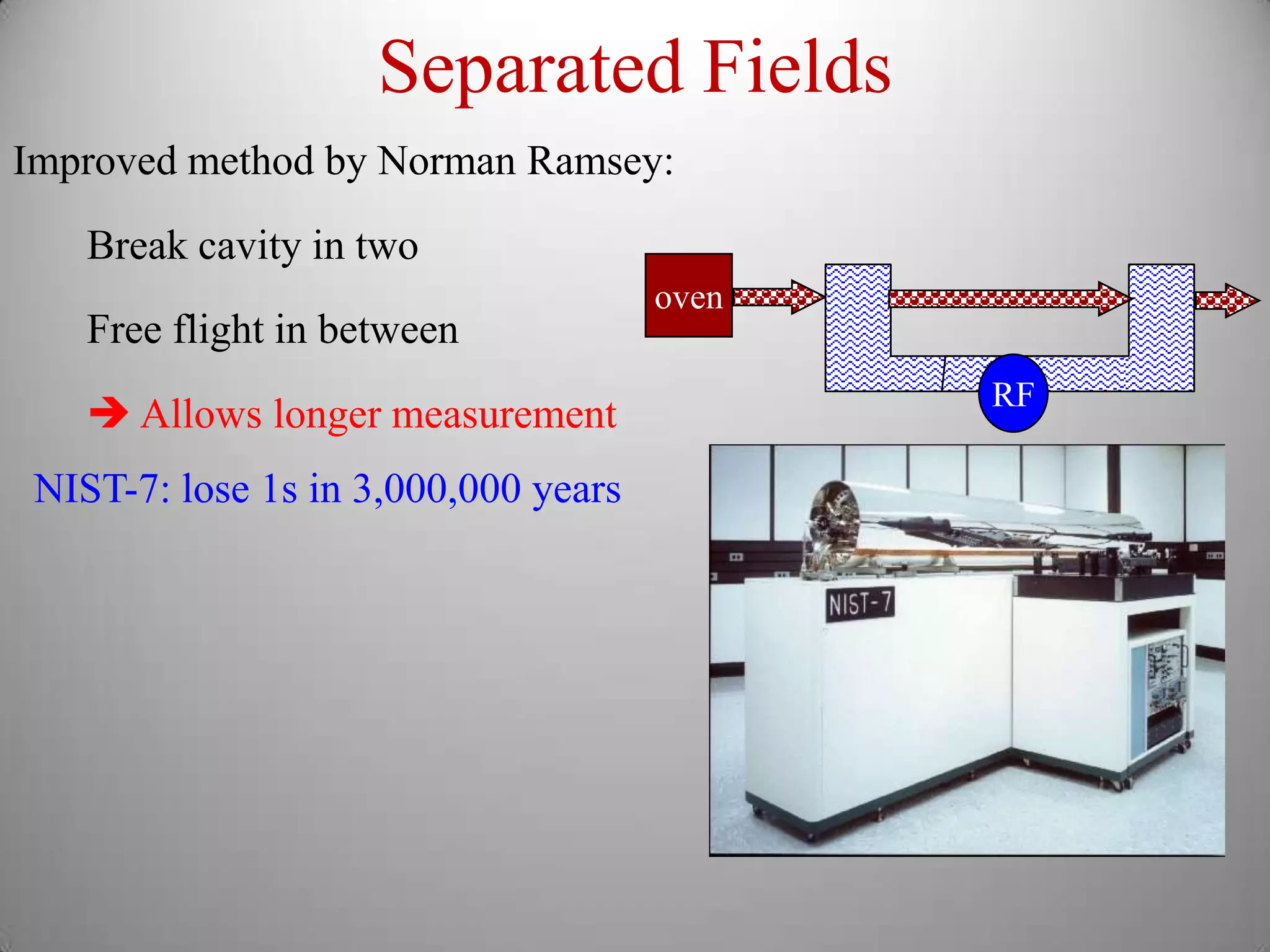
Separated Fields
Improved method by Norman Ramsey:

    Break cavity in two
                                      oven
    Free flight in between
                                             RF
     Allows longer measurement
 NIST-7: lose 1s in 3,000,000 years
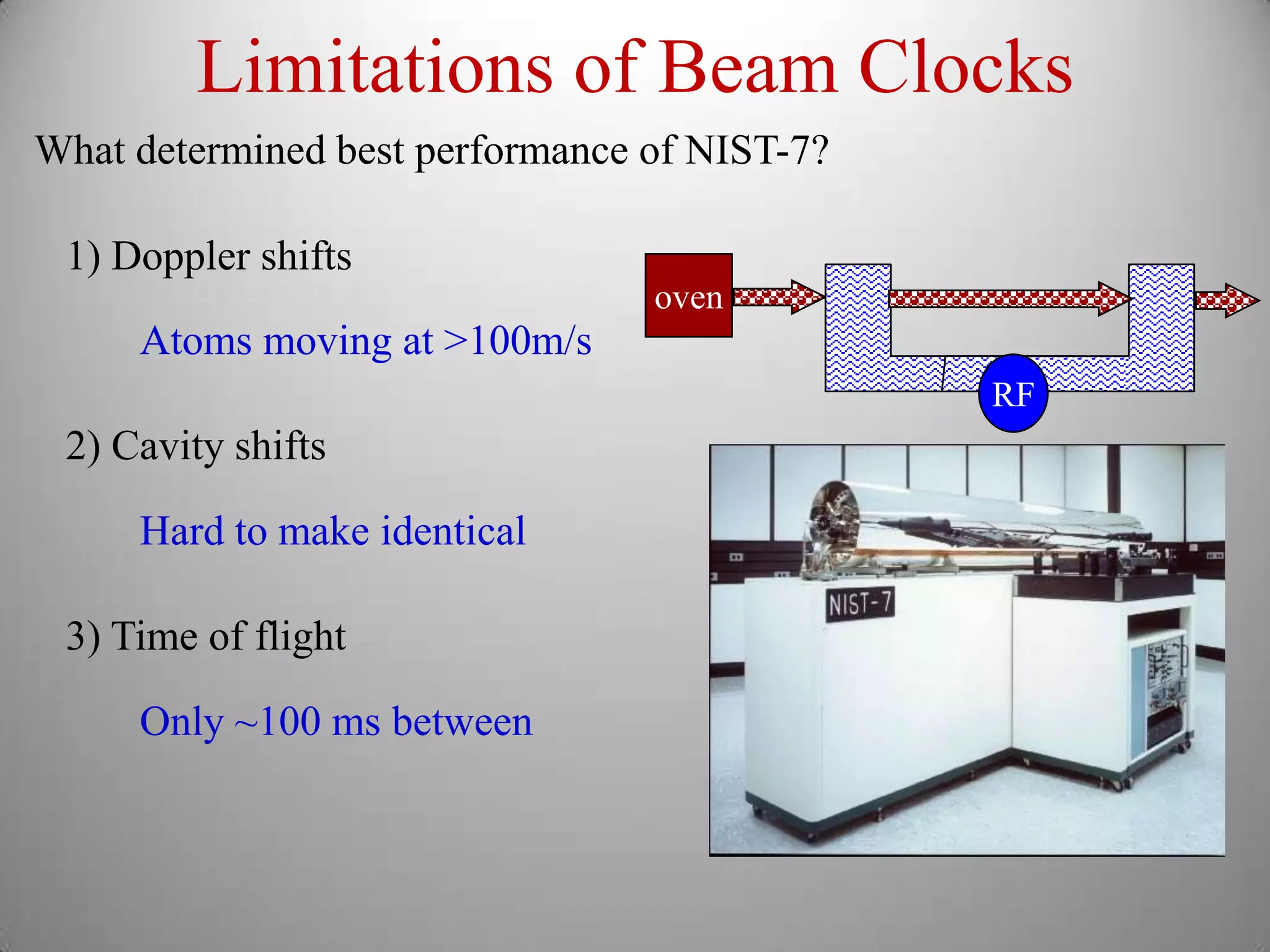
Limitations of Beam Clocks
What determined best performance of NIST-7?

 1) Doppler shifts
                                 oven
     Atoms moving at >100m/s
                                              RF
 2) Cavity shifts

     Hard to make identical

 3) Time of flight

     Only ~100 ms between
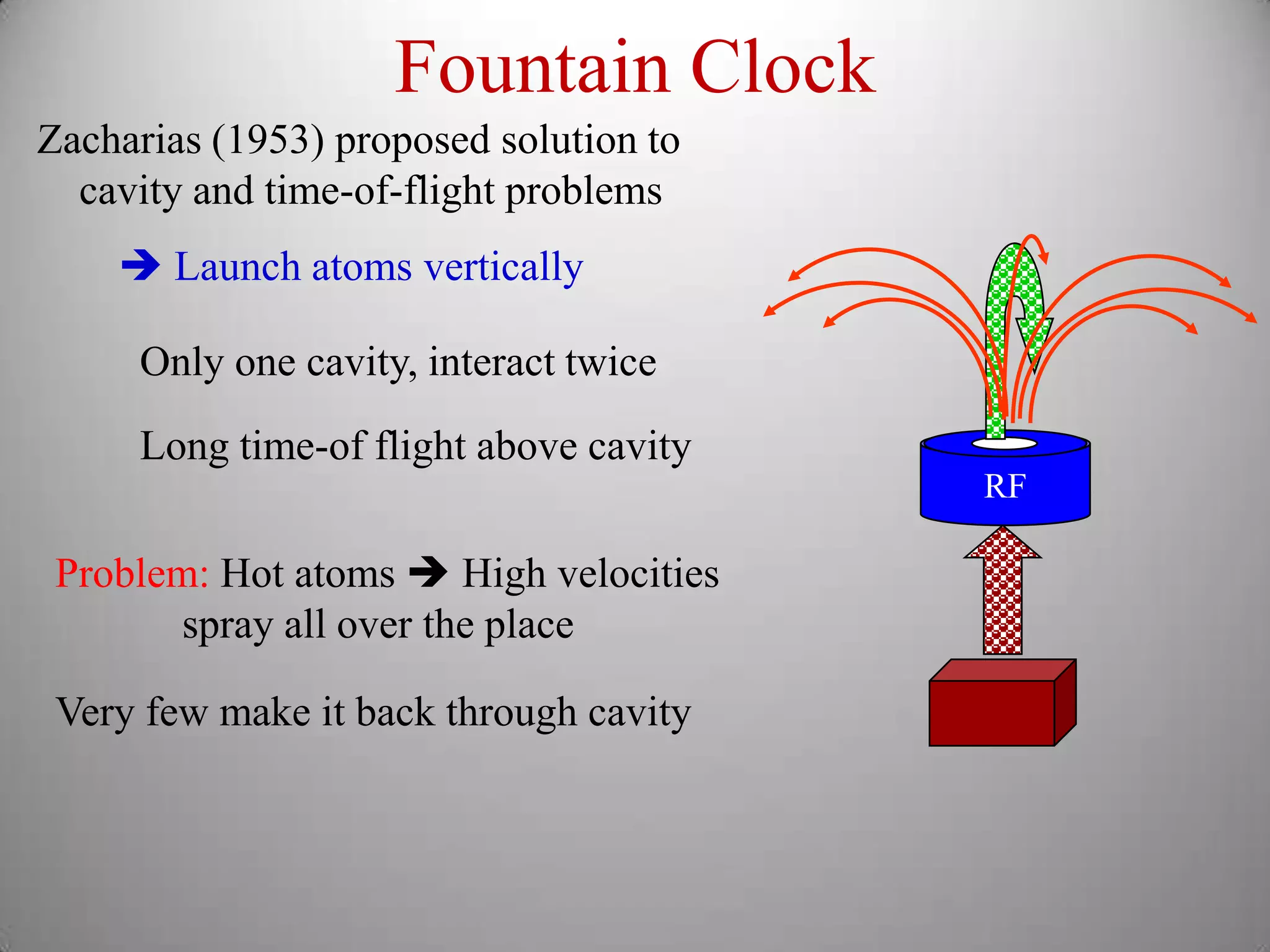
Fountain Clock
Zacharias (1953) proposed solution to
  cavity and time-of-flight problems
     Launch atoms vertically

     Only one cavity, interact twice
     Long time-of flight above cavity
                                        RF

 Problem: Hot atoms  High velocities
        spray all over the place

 Very few make it back through cavity
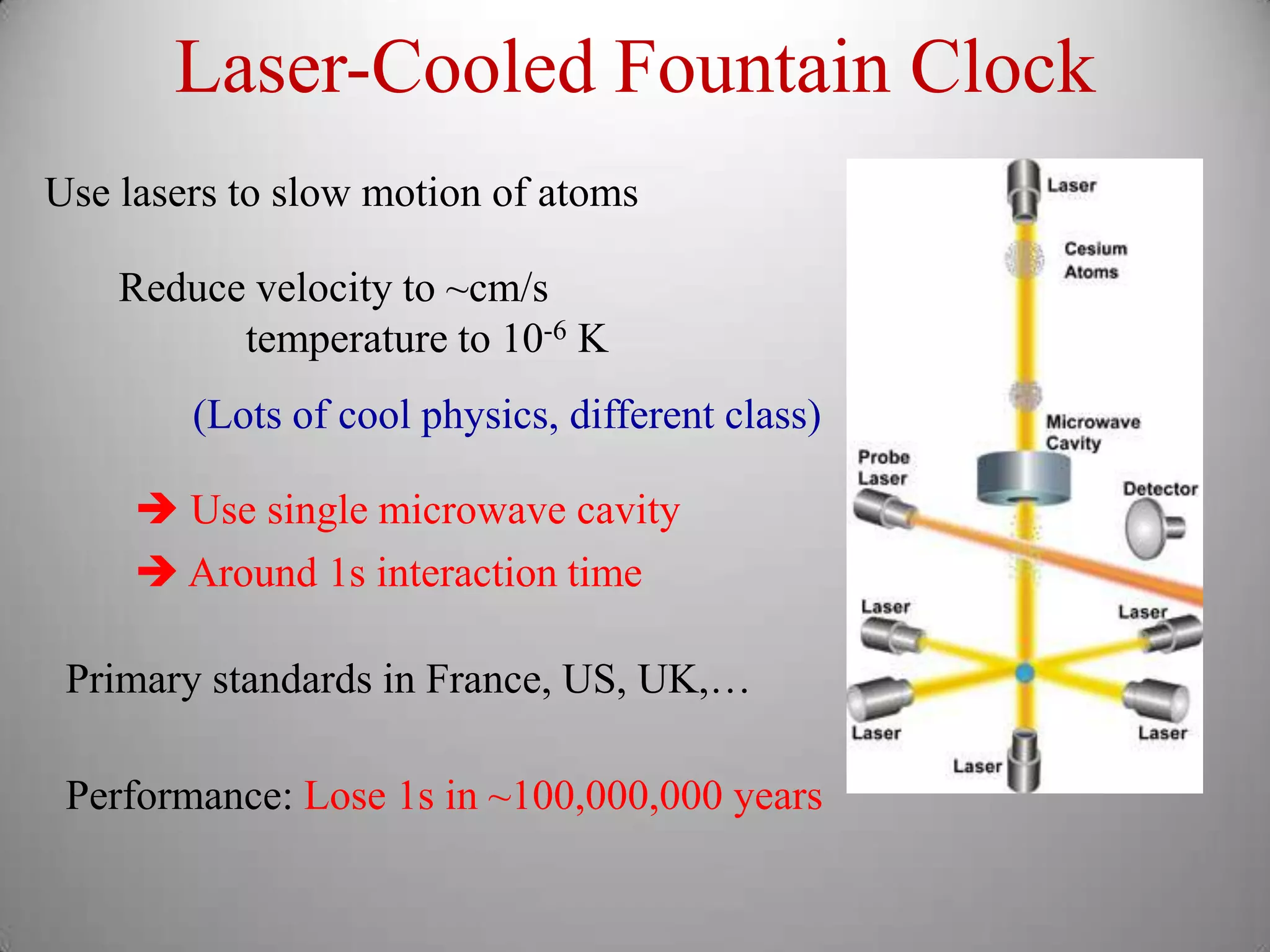
Laser-Cooled Fountain Clock
Use lasers to slow motion of atoms

    Reduce velocity to ~cm/s
          temperature to 10-6 K
        (Lots of cool physics, different class)

      Use single microwave cavity
      Around 1s interaction time

 Primary standards in France, US, UK,…

 Performance: Lose 1s in ~100,000,000 years

A History of Atomic Clocks

  • 1.
    Quantum Mechanics The othergreat theory of modern physics Deals with very small objects  Electrons, atoms, molecules Grew out of problems that seemed simple  Black-body radiation  Photoelectric Effect  Atomic Spectra Produces some very strange results…
  • 2.
    Quantum Hypothesis Planck’s trick: Each mode has a minimum energy depending on frequency Can only contain an integer multiple of fundamental energy Modes with very short wavelength would need more than their share of thermal energy  Amount of radiation drops off very sharply at short wavelength
  • 3.
    Photoelectric Effect: Einstein Observations: 1) Number of electrons depends on intensity Higher intensity More quanta 2) Energy of electrons DOES NOT depend on intensity Only one photon to eject 3) Cut-off frequency: minimum frequency to get any emission Einstein in 1921 Nobel Prize portrait 4) Above cut-off, energy increases linearly Cited for PE Effect with frequency
  • 4.
    Bohr Model 1913: NeilsBohr comes up with “solar system” model 1) Electrons orbit nucleus in certain “allowed states” 2) Electrons radiate only when moving between allowed states 3) Frequency of emitted/absorbed light determined by Planck rule  Works great for hydrogen, but no reason for ad hoc assumptions
  • 5.
    Matter Waves Louis deBroglie: Particles are Waves Electrons occupy standing wave orbits Orbit allowed only if integral number of electron wavelengths h Wavelength determined by momentum  p  Same rule as for light…
  • 6.
  • 7.
    Light as aClock Light: Electromagnetic wave Extremely regular oscillation No moving parts Use atoms as a reference: Performance: Lose 1s in 100,000,000 years
  • 8.
    Defining Time How doyou define a second? Initial formal definition: “the fraction 1/86,400 of the mean solar day” Update (1960): “the fraction 1/31,556,925.9747 of the tropical year for 1900 January 0 at 12 hours ephemeris time.”  More specific, recognizes changing length of year  Precision limited by astronomical observations  Difficult to measure locally
  • 9.
    Quality Factor Want agood standard reference for timekeeping How to characterize clocks? How to quantify performance? Common method: “Q factor” Regular oscillation at some frequency Some small range about average resonance frequency Q = ratio of central frequency to spread in frequency
  • 10.
    Quality Factor frequency Q spread Two ways to get high Q: 1) Decrease frequency spread improve measurement improve stability 2) Increase average frequency “Best” oscillator has high frequency, narrow range in frequency (Practical limit: Must be able to convert frequency to useful signal)
  • 11.
    Light as aClock Light: Electromagnetic wave Extremely regular oscillation No moving parts Use atoms as a reference: Performance: Lose 1s in 100,000,000 years
  • 12.
    Ammonia First standard basedon quantum mechanics: N NH3 molecule: tetrahedral shape H H Two possible arrangements Leads to pairs of states with slight H energy separation H E  hf  h(23,870MHz) H H First used as time reference at US National Bureau of Standards in 1949 N
  • 13.
    Ammonia E  hf  h(23,870MHz) N Operation: H H 1) Reference oscillator generates signal H 2) See if NH3 absorbs 3) Adjust frequency as needed Oscillator NH3 4) Reference oscillator drives clock (divide frequency electronically)
  • 14.
    Ammonia Clock E  hf  h(23,870MHz) N Advantages: H H 1) Cheap, readily available molecule H 2) Convenient frequency for electronics Disadvantages Oscillator NH3 1) Doppler effect limits measurement 2) Relatively low frequency Q ~ 100,000-1,000,000
  • 15.
    Cesium Definition of secondsince 1967: the duration of 9,192,631,770 periods of the radiation corresponding to the transition between the two hyperfine levels of the ground state of the cesium 133 atom. (Updated to specify at sea level, temperature of absolute zero) “Hyperfine Level”  Lowest energy state split - in two by intrinsic magnetic moments of + nucleus and electron - +
  • 16.
    Cesium Clock Early Csclocks use atomic beam, magnets: N N Cs oven Microwave Cavity S S Oscillator Basic Scheme: I. I. Rabi Q ~ 107-108
  • 17.
    Cesium Clock Early Csclocks use atomic beam, magnets: N N Cs oven Microwave Cavity S S Advantages: 1) Atoms move perpendicular to light  reduces Doppler shift 2) Lower frequency than NH3, but better intrinsic uncertainty Limitations 1) Size of cavity limits measurement time, resolution 2) Still not that high a frequency
  • 18.
    Separated Fields Improved methodby Norman Ramsey: Break cavity in two oven Free flight in between RF  Allows longer measurement NIST-7: lose 1s in 3,000,000 years
  • 19.
    Limitations of BeamClocks What determined best performance of NIST-7? 1) Doppler shifts oven Atoms moving at >100m/s RF 2) Cavity shifts Hard to make identical 3) Time of flight Only ~100 ms between
  • 20.
    Fountain Clock Zacharias (1953)proposed solution to cavity and time-of-flight problems  Launch atoms vertically Only one cavity, interact twice Long time-of flight above cavity RF Problem: Hot atoms  High velocities spray all over the place Very few make it back through cavity
  • 21.
    Laser-Cooled Fountain Clock Uselasers to slow motion of atoms Reduce velocity to ~cm/s temperature to 10-6 K (Lots of cool physics, different class)  Use single microwave cavity  Around 1s interaction time Primary standards in France, US, UK,… Performance: Lose 1s in ~100,000,000 years