Radionuclide Soil Pollution
Claudia Fontana, Silvia Socciarelli, Rita Aromolo
Consiglio per la ricerca in agricoltura e l’analisi dell’economia agraria
(Council for Agricultural Research and Economics)
Centro di ricerca Agricoltura e Ambiente sede di Roma
(Research Centre for Agriculture and Environment)
Introduction
The contamination of soils of natural and artificial radionuclides is becoming
increasingly important.
 Monitoring is very primary both to measure the pollution level and to identify
the uncontaminated soils that can be used for agriculture and livestock farming.
 Prevention of soil contamination remains the best way to ensure healthy soils
and food safet.
Exposition of the world population to
Natural and Artificial radionuclides
(WHO)
 80% Natural
 20% Artificial
Natural radionuclides
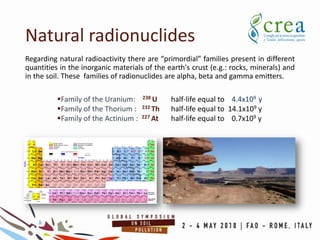
Regarding natural radioactivity there are “primordial” families present in different
quantities in the inorganic materials of the earth's crust (e.g.: rocks, minerals) and
in the soil. These families of radionuclides are alpha, beta and gamma emitters.
Family of the Uranium: 238 U half-life equal to 4.4x10⁹ y
Family of the Thorium : 232 Th half-life equal to 14.1x10⁹ y
Family of the Actinium : 227 At half-life equal to 0.7x10⁹ y
Natural radionuclides
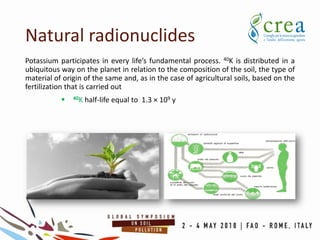
Potassium participates in every life’s fundamental process. 40K is distributed in a
ubiquitous way on the planet in relation to the composition of the soil, the type of
material of origin of the same and, as in the case of agricultural soils, based on the
fertilization that is carried out
 40K half-life equal to 1.3 × 10⁹ y
 Th, U, and 226Ra (alpha, beta and/or gamma emitters) are important for the
high radiotoxicity in the industrial processing of materials containing them (soil,
water, farmland, plant, etc).
 Naturally Occurring Radioactive Material (NORM) has affected large areas near
the installations chemical industries.
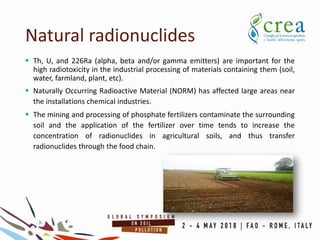
 The mining and processing of phosphate fertilizers contaminate the surrounding
soil and the application of the fertilizer over time tends to increase the
concentration of radionuclides in agricultural soils, and thus transfer
radionuclides through the food chain.
Natural radionuclides
Artificial radionuclides
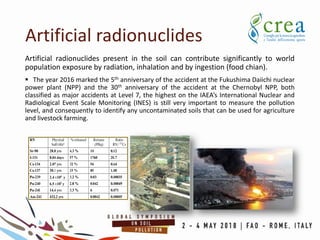
Artificial radionuclides present in the soil can contribute significantly to world
population exposure by radiation, inhalation and by ingestion (food chian).
 The year 2016 marked the 5th anniversary of the accident at the Fukushima Daiichi nuclear
power plant (NPP) and the 30th anniversary of the accident at the Chernobyl NPP, both
classified as major accidents at Level 7, the highest on the IAEA’s International Nuclear and
Radiological Event Scale Monitoring (INES) is still very important to measure the pollution
level, and consequently to identify any uncontaminated soils that can be used for agriculture
and livestock farming.
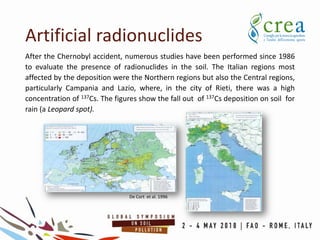
After the Chernobyl accident, numerous studies have been performed since 1986
to evaluate the presence of radionuclides in the soil. The Italian regions most
affected by the deposition were the Northern regions but also the Central regions,
particularly Campania and Lazio, where, in the city of Rieti, there was a high
concentration of 137Cs. The figures show the fall out of 137Cs deposition on soil for
rain (a Leopard spot).
Artificial radionuclides
De Cort et al. 1996
• In Italy, the months following the Chernobyl accident (1986) many measurements
were made on particle deposition environmental matrixes (soils, drinking water,
sediments, S.M.O.D., sands, etc.) and agricultural and zootechnical products (wheat,
potatoes, vegetables, milk, fruit, mushrooms, fodder, honey, meat, etc.),
“Zero Point”, (background levels), that is to establish a concentration value of the various radionuclides that
can allow to calculate any variations in the concentration of radioactivity over time, and go back to the
actual concentration in case of a possible new deposition on the soil. Risk assessment, including total cost
assessment, and remediation should be applied to reduce risks to humans and ecological systems.
Artificial radionuclides
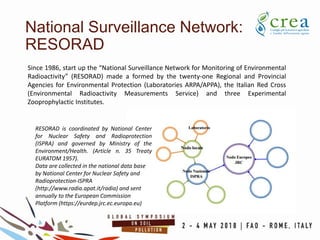
Since 1986, start up the “National Surveillance Network for Monitoring of Environmental
Radioactivity” (RESORAD) made a formed by the twenty-one Regional and Provincial
Agencies for Environmental Protection (Laboratories ARPA/APPA), the Italian Red Cross
(Environmental Radioactivity Measurements Service) and three Experimental
Zooprophylactic Institutes.
National Surveillance Network:
RESORAD
RESORAD is coordinated by National Center
for Nuclear Safety and Radioprotection
(ISPRA) and governed by Ministry of the
Environment/Health. (Article n. 35 Treaty
EURATOM 1957).
Data are collected in the national data base
by National Center for Nuclear Safety and
Radioprotection-ISPRA
(http://www.radia.apat.it/radia) and sent
annually to the European Commission
Platform (https://eurdep.jrc.ec.europa.eu)
•Follow spice-time trend of the radionuclide concentrations in different environmental and
food matrices on the whole territory in order to have a modeling and soil maps
•Provide a representative radiometric dataset for the evaluation of the dose received by
the Italian population following exposure
•Detect phenomena of accumulation of long-life radionuclides
•Promptly identify anomalies arising from cross-border events
•Develop a system capable of responding in real time to possible emergencies
•Standardize methods and protocols for the data reliability and comparability
•Periodically inform the population and Institutions about the environmental status
National Surveillance Network: RESORAD
GOALS
Guide Lines &
Scientific Researces
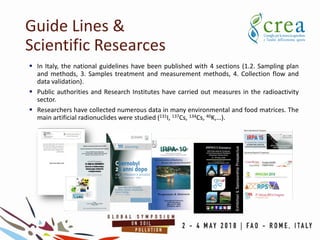
 In Italy, the national guidelines have been published with 4 sections (1.2. Sampling plan
and methods, 3. Samples treatment and measurement methods, 4. Collection flow and
data validation).
 Public authorities and Research Institutes have carried out measures in the radioactivity
sector.
 Researchers have collected numerous data in many environmental and food matrices. The
main artificial radionuclides were studied (131I, 137Cs, 134Cs, 40K,…).
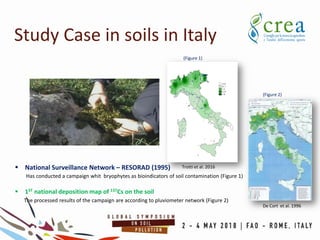
 National Surveillance Network – RESORAD (1995)
Has conducted a campaign whit bryophytes as bioindicators of soil contamination (Figure 1)
 1ST national deposition map of 137Cs on the soil
The processed results of the campaign are according to pluviometer network (Figure 2)
(Figure 1)
(Figure 2)
Study Case in soils in Italy
De Cort et al. 1996
Trotti et al. 2016
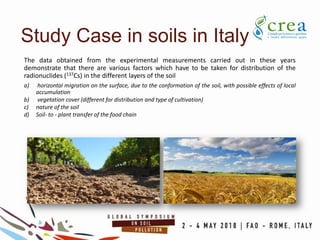
The data obtained from the experimental measurements carried out in these years
demonstrate that there are various factors which have to be taken for distribution of the
radionuclides (137Cs) in the different layers of the soil
a) horizontal migration on the surface, due to the conformation of the soil, with possible effects of local
accumulation
b) vegetation cover (different for distribution and type of cultivation)
c) nature of the soil
d) Soil- to - plant transfer of the food chain
Study Case in soils in Italy
Results and Discussion
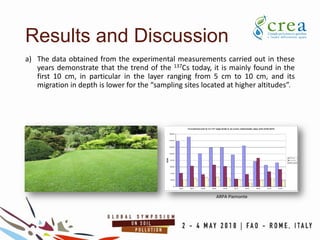
a) The data obtained from the experimental measurements carried out in these
years demonstrate that the trend of the 137Cs today, it is mainly found in the
first 10 cm, in particular in the layer ranging from 5 cm to 10 cm, and its
migration in depth is lower for the “sampling sites located at higher altitudes”.
ARPA Piemonte
Results and Discussion
b) The data obtained from the experimental measurements carried out in these years
demonstrate that an agricultural soils the 137Cs is dispersed along the arable layer,
treated a vertical mechanical homogenization.
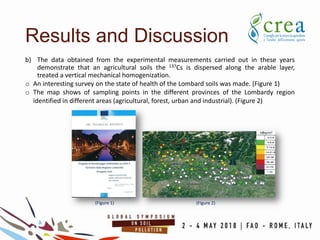
o An interesting survey on the state of health of the Lombard soils was made. (Figure 1)
o The map shows of sampling points in the different provinces of the Lombardy region
identified in different areas (agricultural, forest, urban and industrial). (Figure 2)
(Figure 1) (Figure 2)
Results and Discussion
c) The data obtained from the experimental measurements carried out in these years
demonstrate that the concentration of the radionuclides depends of the different
nature of the soil.
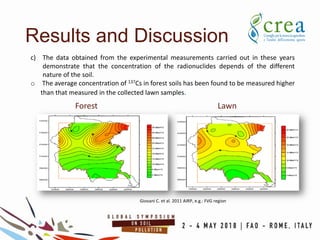
o The average concentration of 137Cs in forest soils has been found to be measured higher
than that measured in the collected lawn samples.
Forest Lawn
Giovani C. et al. 2011 AIRP, e.g.: FVG region
d) The data obtained from the experimental measurements carried out in these years
demonstrate that from the studies carried out that the vegetation can have an important
“dynamic” role, with the effect of radical absorption, redistribution to the plant aerial parts
and finally restitution to the ground with the death of the plant.
Numerous studies carried out in radioecology and radioprotection in Italy North regions
allowed to assess the mechanisms of radionuclides transfer from soil to plants, and to
analyze the food chain and the biological cycle in humans .
Results and Discussion
137 Cs concentration in mushrooms [2015-2016]
The highest value of Cesium in honeys was found in
that produced by chestnut plants.
The variability of 137 Cs in the plants studied in
different sites is due to the fall out.
(0.2<137Cs>10 Bq/m2)
Some studies have shown that the concentration of
Cesium in mushrooms varies in different species.
The mushrooms have a high capacity of
accumulation of radionuclides, for this reason they
should be monitored to avoid ingestion potential
risks.
(0.3<137Cs>1000 Bq/m2)
137 Cs concentration in honey [2015-2016]
The foods at higher risk of contamination are berries, potatoes, salads,
honey, milk, chestnuts and the mushrooms.
ARPA Piemonte
Conclusion
→Continue to develop radioactive deposition modelling and maps
→Disseminate current knowledge (ICT e-learning courses, training,…..)
→Inform the operators in the agricultural sector about the risks and possible
contamination of soil and agricultural products
→Develop protocols for sampling and analyzing food products
→Control of radionuclides in food and agriculture (Routine-Emergency monitoring)
→Other projects are in progress and we are opened to new future collaborations with
different partners in according to the Mission of the CREA Research Centre
Agriculture and Environment, Council for Agricultural Research and Economics.
Thanks for your attention
claudia.fontana@crea.gov.it silvia.socciarelli@crea.gov.it rita.aromolo@crea.gov.it
Radionuclide Soil Pollution

Radionuclide Soil Pollution

  • 2.
    Radionuclide Soil Pollution ClaudiaFontana, Silvia Socciarelli, Rita Aromolo Consiglio per la ricerca in agricoltura e l’analisi dell’economia agraria (Council for Agricultural Research and Economics) Centro di ricerca Agricoltura e Ambiente sede di Roma (Research Centre for Agriculture and Environment)
  • 3.
    Introduction The contamination ofsoils of natural and artificial radionuclides is becoming increasingly important.  Monitoring is very primary both to measure the pollution level and to identify the uncontaminated soils that can be used for agriculture and livestock farming.  Prevention of soil contamination remains the best way to ensure healthy soils and food safet. Exposition of the world population to Natural and Artificial radionuclides (WHO)  80% Natural  20% Artificial
  • 4.
    Natural radionuclides Regarding naturalradioactivity there are “primordial” families present in different quantities in the inorganic materials of the earth's crust (e.g.: rocks, minerals) and in the soil. These families of radionuclides are alpha, beta and gamma emitters. Family of the Uranium: 238 U half-life equal to 4.4x10⁹ y Family of the Thorium : 232 Th half-life equal to 14.1x10⁹ y Family of the Actinium : 227 At half-life equal to 0.7x10⁹ y
  • 5.
    Natural radionuclides Potassium participatesin every life’s fundamental process. 40K is distributed in a ubiquitous way on the planet in relation to the composition of the soil, the type of material of origin of the same and, as in the case of agricultural soils, based on the fertilization that is carried out  40K half-life equal to 1.3 × 10⁹ y
  • 6.
     Th, U,and 226Ra (alpha, beta and/or gamma emitters) are important for the high radiotoxicity in the industrial processing of materials containing them (soil, water, farmland, plant, etc).  Naturally Occurring Radioactive Material (NORM) has affected large areas near the installations chemical industries.  The mining and processing of phosphate fertilizers contaminate the surrounding soil and the application of the fertilizer over time tends to increase the concentration of radionuclides in agricultural soils, and thus transfer radionuclides through the food chain. Natural radionuclides
  • 7.
    Artificial radionuclides Artificial radionuclidespresent in the soil can contribute significantly to world population exposure by radiation, inhalation and by ingestion (food chian).  The year 2016 marked the 5th anniversary of the accident at the Fukushima Daiichi nuclear power plant (NPP) and the 30th anniversary of the accident at the Chernobyl NPP, both classified as major accidents at Level 7, the highest on the IAEA’s International Nuclear and Radiological Event Scale Monitoring (INES) is still very important to measure the pollution level, and consequently to identify any uncontaminated soils that can be used for agriculture and livestock farming.
  • 8.
    After the Chernobylaccident, numerous studies have been performed since 1986 to evaluate the presence of radionuclides in the soil. The Italian regions most affected by the deposition were the Northern regions but also the Central regions, particularly Campania and Lazio, where, in the city of Rieti, there was a high concentration of 137Cs. The figures show the fall out of 137Cs deposition on soil for rain (a Leopard spot). Artificial radionuclides De Cort et al. 1996
  • 9.
    • In Italy,the months following the Chernobyl accident (1986) many measurements were made on particle deposition environmental matrixes (soils, drinking water, sediments, S.M.O.D., sands, etc.) and agricultural and zootechnical products (wheat, potatoes, vegetables, milk, fruit, mushrooms, fodder, honey, meat, etc.), “Zero Point”, (background levels), that is to establish a concentration value of the various radionuclides that can allow to calculate any variations in the concentration of radioactivity over time, and go back to the actual concentration in case of a possible new deposition on the soil. Risk assessment, including total cost assessment, and remediation should be applied to reduce risks to humans and ecological systems. Artificial radionuclides
  • 10.
    Since 1986, startup the “National Surveillance Network for Monitoring of Environmental Radioactivity” (RESORAD) made a formed by the twenty-one Regional and Provincial Agencies for Environmental Protection (Laboratories ARPA/APPA), the Italian Red Cross (Environmental Radioactivity Measurements Service) and three Experimental Zooprophylactic Institutes. National Surveillance Network: RESORAD RESORAD is coordinated by National Center for Nuclear Safety and Radioprotection (ISPRA) and governed by Ministry of the Environment/Health. (Article n. 35 Treaty EURATOM 1957). Data are collected in the national data base by National Center for Nuclear Safety and Radioprotection-ISPRA (http://www.radia.apat.it/radia) and sent annually to the European Commission Platform (https://eurdep.jrc.ec.europa.eu)
  • 11.
    •Follow spice-time trendof the radionuclide concentrations in different environmental and food matrices on the whole territory in order to have a modeling and soil maps •Provide a representative radiometric dataset for the evaluation of the dose received by the Italian population following exposure •Detect phenomena of accumulation of long-life radionuclides •Promptly identify anomalies arising from cross-border events •Develop a system capable of responding in real time to possible emergencies •Standardize methods and protocols for the data reliability and comparability •Periodically inform the population and Institutions about the environmental status National Surveillance Network: RESORAD GOALS
  • 12.
    Guide Lines & ScientificResearces  In Italy, the national guidelines have been published with 4 sections (1.2. Sampling plan and methods, 3. Samples treatment and measurement methods, 4. Collection flow and data validation).  Public authorities and Research Institutes have carried out measures in the radioactivity sector.  Researchers have collected numerous data in many environmental and food matrices. The main artificial radionuclides were studied (131I, 137Cs, 134Cs, 40K,…).
  • 13.
     National SurveillanceNetwork – RESORAD (1995) Has conducted a campaign whit bryophytes as bioindicators of soil contamination (Figure 1)  1ST national deposition map of 137Cs on the soil The processed results of the campaign are according to pluviometer network (Figure 2) (Figure 1) (Figure 2) Study Case in soils in Italy De Cort et al. 1996 Trotti et al. 2016
  • 14.
    The data obtainedfrom the experimental measurements carried out in these years demonstrate that there are various factors which have to be taken for distribution of the radionuclides (137Cs) in the different layers of the soil a) horizontal migration on the surface, due to the conformation of the soil, with possible effects of local accumulation b) vegetation cover (different for distribution and type of cultivation) c) nature of the soil d) Soil- to - plant transfer of the food chain Study Case in soils in Italy
  • 15.
    Results and Discussion a)The data obtained from the experimental measurements carried out in these years demonstrate that the trend of the 137Cs today, it is mainly found in the first 10 cm, in particular in the layer ranging from 5 cm to 10 cm, and its migration in depth is lower for the “sampling sites located at higher altitudes”. ARPA Piemonte
  • 16.
    Results and Discussion b)The data obtained from the experimental measurements carried out in these years demonstrate that an agricultural soils the 137Cs is dispersed along the arable layer, treated a vertical mechanical homogenization. o An interesting survey on the state of health of the Lombard soils was made. (Figure 1) o The map shows of sampling points in the different provinces of the Lombardy region identified in different areas (agricultural, forest, urban and industrial). (Figure 2) (Figure 1) (Figure 2)
  • 17.
    Results and Discussion c)The data obtained from the experimental measurements carried out in these years demonstrate that the concentration of the radionuclides depends of the different nature of the soil. o The average concentration of 137Cs in forest soils has been found to be measured higher than that measured in the collected lawn samples. Forest Lawn Giovani C. et al. 2011 AIRP, e.g.: FVG region
  • 18.
    d) The dataobtained from the experimental measurements carried out in these years demonstrate that from the studies carried out that the vegetation can have an important “dynamic” role, with the effect of radical absorption, redistribution to the plant aerial parts and finally restitution to the ground with the death of the plant. Numerous studies carried out in radioecology and radioprotection in Italy North regions allowed to assess the mechanisms of radionuclides transfer from soil to plants, and to analyze the food chain and the biological cycle in humans . Results and Discussion
  • 19.
    Results and Discussion 137Cs concentration in mushrooms [2015-2016] The highest value of Cesium in honeys was found in that produced by chestnut plants. The variability of 137 Cs in the plants studied in different sites is due to the fall out. (0.2<137Cs>10 Bq/m2) Some studies have shown that the concentration of Cesium in mushrooms varies in different species. The mushrooms have a high capacity of accumulation of radionuclides, for this reason they should be monitored to avoid ingestion potential risks. (0.3<137Cs>1000 Bq/m2) 137 Cs concentration in honey [2015-2016] The foods at higher risk of contamination are berries, potatoes, salads, honey, milk, chestnuts and the mushrooms. ARPA Piemonte
  • 20.
    Conclusion →Continue to developradioactive deposition modelling and maps →Disseminate current knowledge (ICT e-learning courses, training,…..) →Inform the operators in the agricultural sector about the risks and possible contamination of soil and agricultural products →Develop protocols for sampling and analyzing food products →Control of radionuclides in food and agriculture (Routine-Emergency monitoring) →Other projects are in progress and we are opened to new future collaborations with different partners in according to the Mission of the CREA Research Centre Agriculture and Environment, Council for Agricultural Research and Economics.
  • 21.
    Thanks for yourattention claudia.fontana@crea.gov.it silvia.socciarelli@crea.gov.it rita.aromolo@crea.gov.it