Schartz Atomic Clocks
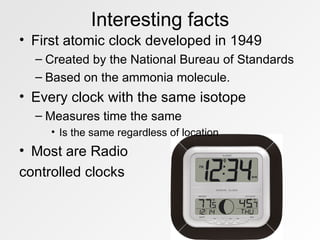
Interesting facts First atomic clock developed in 1949 Created by the National Bureau of Standards Based on the ammonia molecule.  Every clock with the same isotope Measures time the same Is the same regardless of location Most are Radio controlled clocks
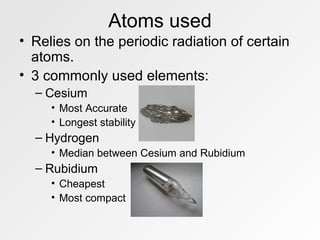
Atoms used Relies on the periodic radiation of certain atoms. 3 commonly used elements: Cesium Most Accurate Longest stability Hydrogen  Median between Cesium and Rubidium Rubidium Cheapest Most compact
Impact Navigation GPS (More accurate) Radio Astronomy Several telescopes to synchronize Regardless of location Space Exploration Doppler tracking
Scientific Principles Vibrations and Waves Energy Translated by Waves Wave Motion Mathematical Representation of a Traveling Wave Simple Harmonic Motion Quantum Mechanics
What types of discoveries/technologies/inventions were necessary to reach this point? Necessary Atomic particles Radio waves Electricity Improved LED Advancements in  Metallurgy Plastics
What if it was never invented? GPS Inaccurate/unreliable Communication Not as advanced Astronomy Radio telescopes inaccurate
Bibliography Cessium picture from Americanelements.com Rubidium picture from commons.wikimedia.org/wiki/User:Dnn87 Clock Picture from  http://www.clocklordblog.com/wp-content/uploads/2008/10/atomic-clock.jpg Clocks. (2008).  In  P. J. Bungert & A. J. Darnay (Eds.) Encyclopedia of Products & Industries - Manufacturing , (Vol. 1). (pp. 239-246) Detroit: Gale Retrieved February 7, 2010, from Gale Virtual Reference Library via Gale: http://go.galegroup.com/ps/start.do?p=GVRL&u=stil34938 Itano, W. M. (2007). Atomic Clock.  In   McGraw-Hill Encyclopedia of Science & Technology , (Vol. 2). (10 th  ed., pp. 369-372) New York: McGraw-Hill Retrieved February 7, 2010, from Gale Virtual Reference Library via Gale: http://go.galegroup.com/ps/start.do?p=GVRL&u=stil34938 Galleon Systems, . (2006).  Atomic clock information . Retrieved from http://www.atomic-clock.galleon.eu.com/atomic-clock/atomic-clock.htm

Atomic Clock

  • 1.
  • 2.
    Interesting facts Firstatomic clock developed in 1949 Created by the National Bureau of Standards Based on the ammonia molecule. Every clock with the same isotope Measures time the same Is the same regardless of location Most are Radio controlled clocks
  • 3.
    Atoms used Relieson the periodic radiation of certain atoms. 3 commonly used elements: Cesium Most Accurate Longest stability Hydrogen Median between Cesium and Rubidium Rubidium Cheapest Most compact
  • 4.
    Impact Navigation GPS(More accurate) Radio Astronomy Several telescopes to synchronize Regardless of location Space Exploration Doppler tracking
  • 5.
    Scientific Principles Vibrationsand Waves Energy Translated by Waves Wave Motion Mathematical Representation of a Traveling Wave Simple Harmonic Motion Quantum Mechanics
  • 6.
    What types ofdiscoveries/technologies/inventions were necessary to reach this point? Necessary Atomic particles Radio waves Electricity Improved LED Advancements in Metallurgy Plastics
  • 7.
    What if itwas never invented? GPS Inaccurate/unreliable Communication Not as advanced Astronomy Radio telescopes inaccurate
  • 8.
    Bibliography Cessium picturefrom Americanelements.com Rubidium picture from commons.wikimedia.org/wiki/User:Dnn87 Clock Picture from http://www.clocklordblog.com/wp-content/uploads/2008/10/atomic-clock.jpg Clocks. (2008). In P. J. Bungert & A. J. Darnay (Eds.) Encyclopedia of Products & Industries - Manufacturing , (Vol. 1). (pp. 239-246) Detroit: Gale Retrieved February 7, 2010, from Gale Virtual Reference Library via Gale: http://go.galegroup.com/ps/start.do?p=GVRL&u=stil34938 Itano, W. M. (2007). Atomic Clock. In McGraw-Hill Encyclopedia of Science & Technology , (Vol. 2). (10 th ed., pp. 369-372) New York: McGraw-Hill Retrieved February 7, 2010, from Gale Virtual Reference Library via Gale: http://go.galegroup.com/ps/start.do?p=GVRL&u=stil34938 Galleon Systems, . (2006).  Atomic clock information . Retrieved from http://www.atomic-clock.galleon.eu.com/atomic-clock/atomic-clock.htm