Atomic Clock
Ismaeel Asghar
Whatisatomicclock?
 An atomic clock is a clock whose timekeeping mechanism is based on the
interaction of electromagnetic radiation with the excited states of certain
atoms.
HistoryofAtomicClock
 The atomic clock was invented and announced by
Harold Lyons, the Microwave Standards Section
Chief at NBS, (National Bureau of Standards) and
his team in 1949.
HistoryofAtomicClock
 In 1923 U.S. radio stations were assigned to 81 fixed frequencies, but
the lack of timing standards made it difficult to stay on their assigned
frequency (frequency is a measure of cycles per second).
 The first atomic clock was based on the properties of the ammonia
molecule, and produced light pulses at a constant rate.
 Harold Lyons and his team improved upon their original design from
1949, creating a clock based on beans of cesium atoms. This is the
standard still in use today.
TypesofAtomicClocks
There are three different types of atomic clocks.
 Cesium atomic clocks
 Hydrogen atomic clocks and
 Rubidium atomic clocks.
CesiumAtomicClocks-
Cesium Atomic Clocks sends out a beam of cesium atoms. The clock
separates the cesium atoms of different energy levels by a magnetic
field.
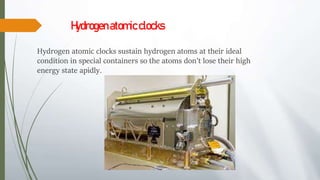
Hydrogenatomicclocks
Hydrogen atomic clocks sustain hydrogen atoms at their ideal
condition in special containers so the atoms don’t lose their high
energy state apidly.
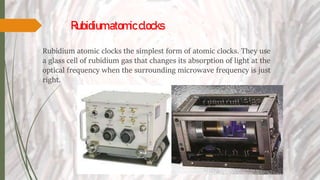
Rubidiumatomicclocks
Rubidium atomic clocks the simplest form of atomic clocks. They use
a glass cell of rubidium gas that changes its absorption of light at the
optical frequency when the surrounding microwave frequency is just
right.
Howdoesitwork?
NIST-F1 is a fountain clock, meaning that the way lasers and atoms looks
like a fountain.
Howisatomictimemeasured?
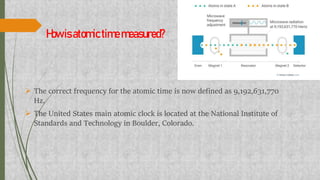
 The correct frequency for the atomic time is now defined as 9,192,631,770
Hz.
 The United States main atomic clock is located at the National Institute of
Standards and Technology in Boulder, Colorado.

Atomic Clock.pptx

  • 1.
  • 2.
    Whatisatomicclock?  An atomicclock is a clock whose timekeeping mechanism is based on the interaction of electromagnetic radiation with the excited states of certain atoms.
  • 3.
    HistoryofAtomicClock  The atomicclock was invented and announced by Harold Lyons, the Microwave Standards Section Chief at NBS, (National Bureau of Standards) and his team in 1949.
  • 4.
    HistoryofAtomicClock  In 1923U.S. radio stations were assigned to 81 fixed frequencies, but the lack of timing standards made it difficult to stay on their assigned frequency (frequency is a measure of cycles per second).  The first atomic clock was based on the properties of the ammonia molecule, and produced light pulses at a constant rate.  Harold Lyons and his team improved upon their original design from 1949, creating a clock based on beans of cesium atoms. This is the standard still in use today.
  • 5.
    TypesofAtomicClocks There are threedifferent types of atomic clocks.  Cesium atomic clocks  Hydrogen atomic clocks and  Rubidium atomic clocks.
  • 6.
    CesiumAtomicClocks- Cesium Atomic Clockssends out a beam of cesium atoms. The clock separates the cesium atoms of different energy levels by a magnetic field.
  • 7.
    Hydrogenatomicclocks Hydrogen atomic clockssustain hydrogen atoms at their ideal condition in special containers so the atoms don’t lose their high energy state apidly.
  • 8.
    Rubidiumatomicclocks Rubidium atomic clocksthe simplest form of atomic clocks. They use a glass cell of rubidium gas that changes its absorption of light at the optical frequency when the surrounding microwave frequency is just right.
  • 9.
    Howdoesitwork? NIST-F1 is afountain clock, meaning that the way lasers and atoms looks like a fountain.
  • 10.
    Howisatomictimemeasured?  The correctfrequency for the atomic time is now defined as 9,192,631,770 Hz.  The United States main atomic clock is located at the National Institute of Standards and Technology in Boulder, Colorado.