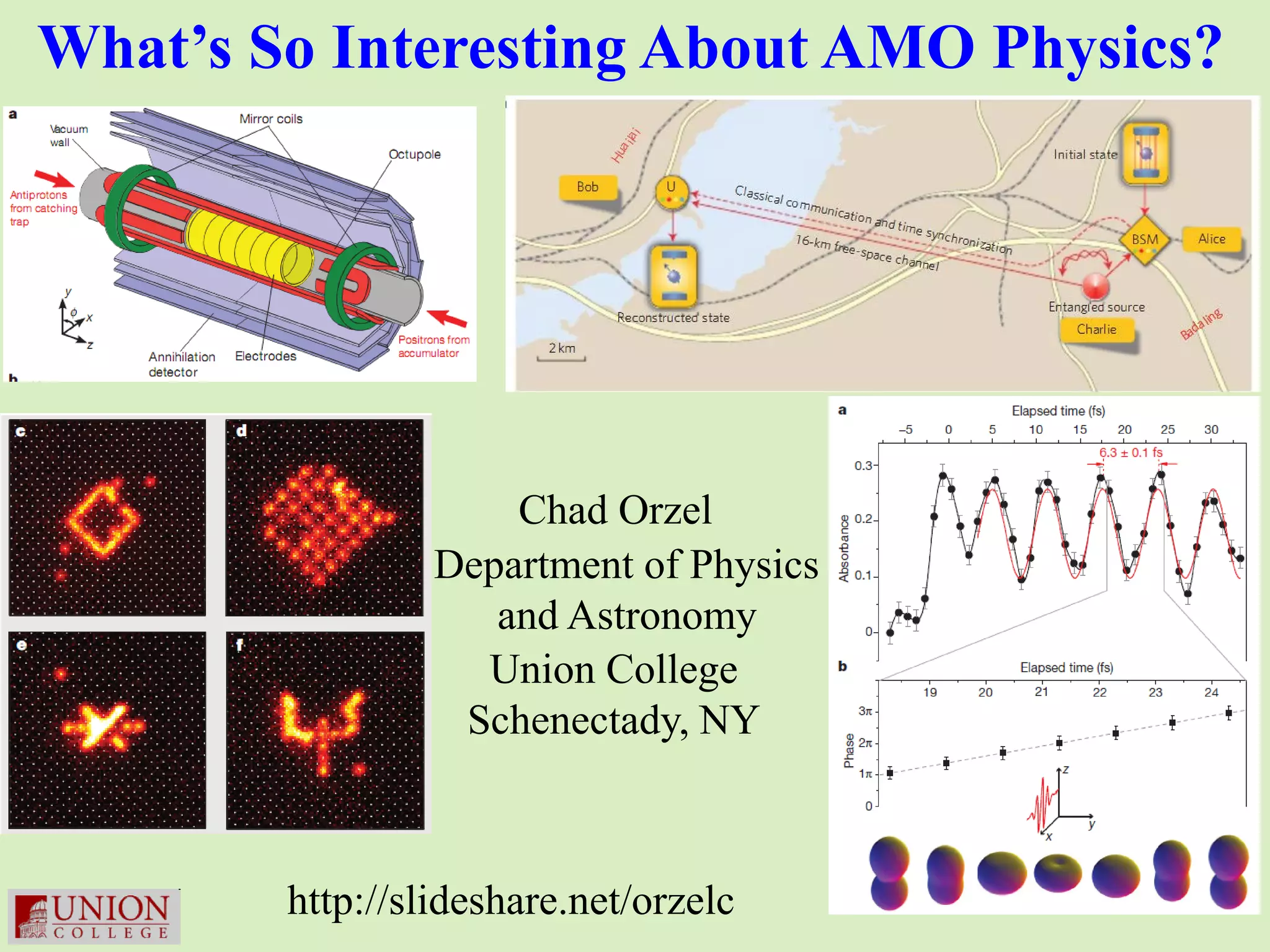
What’s So Interesting About AMO Physics?


                     Chad Orzel
                 Department of Physics
                    and Astronomy
                   Union College
                  Schenectady, NY


        http://slideshare.net/orzelc
Why This Talk?
              2001 DAMOP/ DAMP Meeting

                    3-4 parallel sessions

                    270 talks, 293 posters


              2011 DAMOP Meeting

                    6-7 parallel sessions

                    477 talks, 548 posters


 http://slideshare.net/orzelc
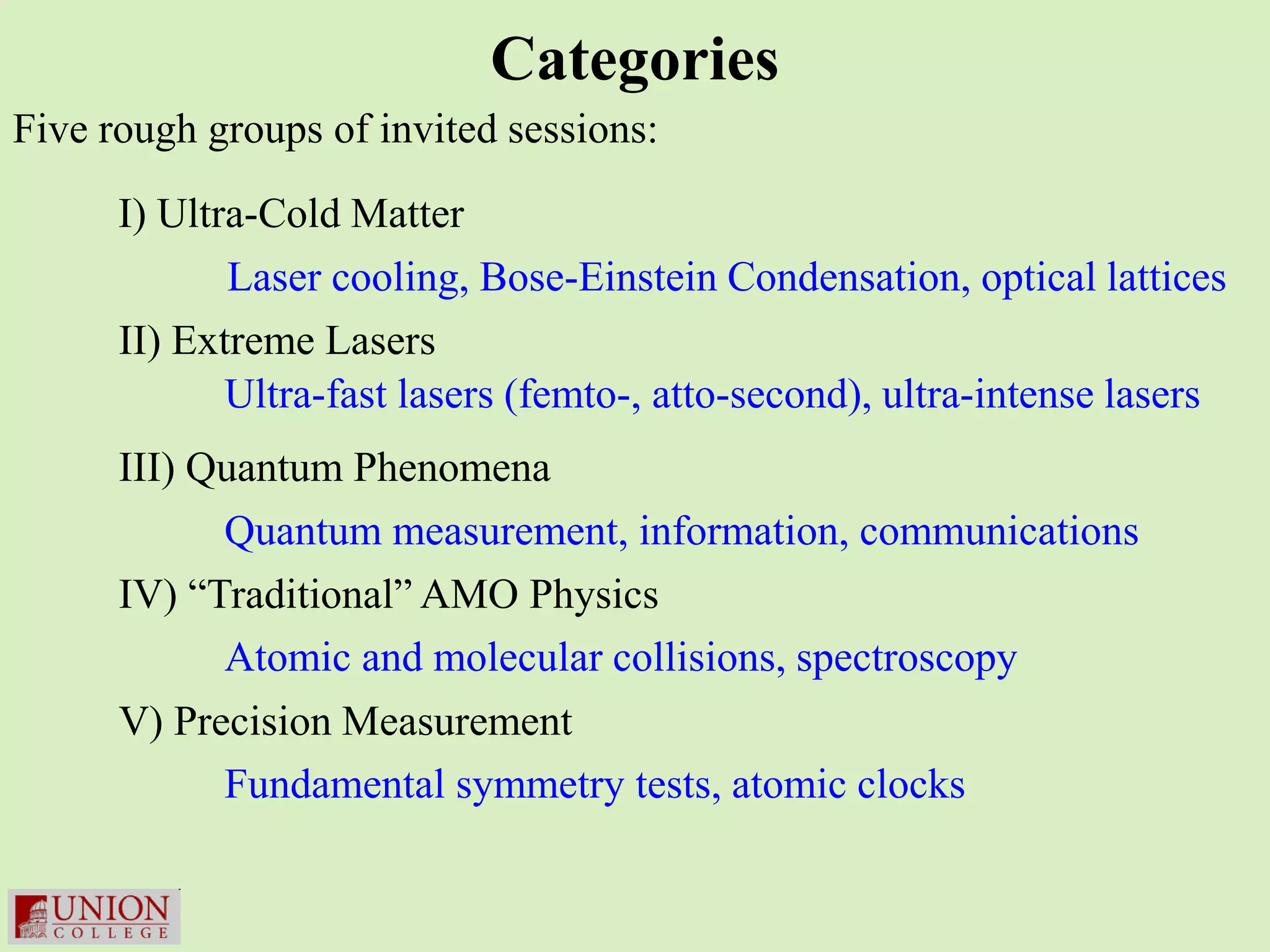
Categories
Five rough groups of invited sessions:

      I) Ultra-Cold Matter
             Laser cooling, Bose-Einstein Condensation, optical lattices
      II) Extreme Lasers
             Ultra-fast lasers (femto-, atto-second), ultra-intense lasers
      III) Quantum Phenomena
            Quantum measurement, information, communications
      IV) “Traditional” AMO Physics
            Atomic and molecular collisions, spectroscopy
      V) Precision Measurement
            Fundamental symmetry tests, atomic clocks
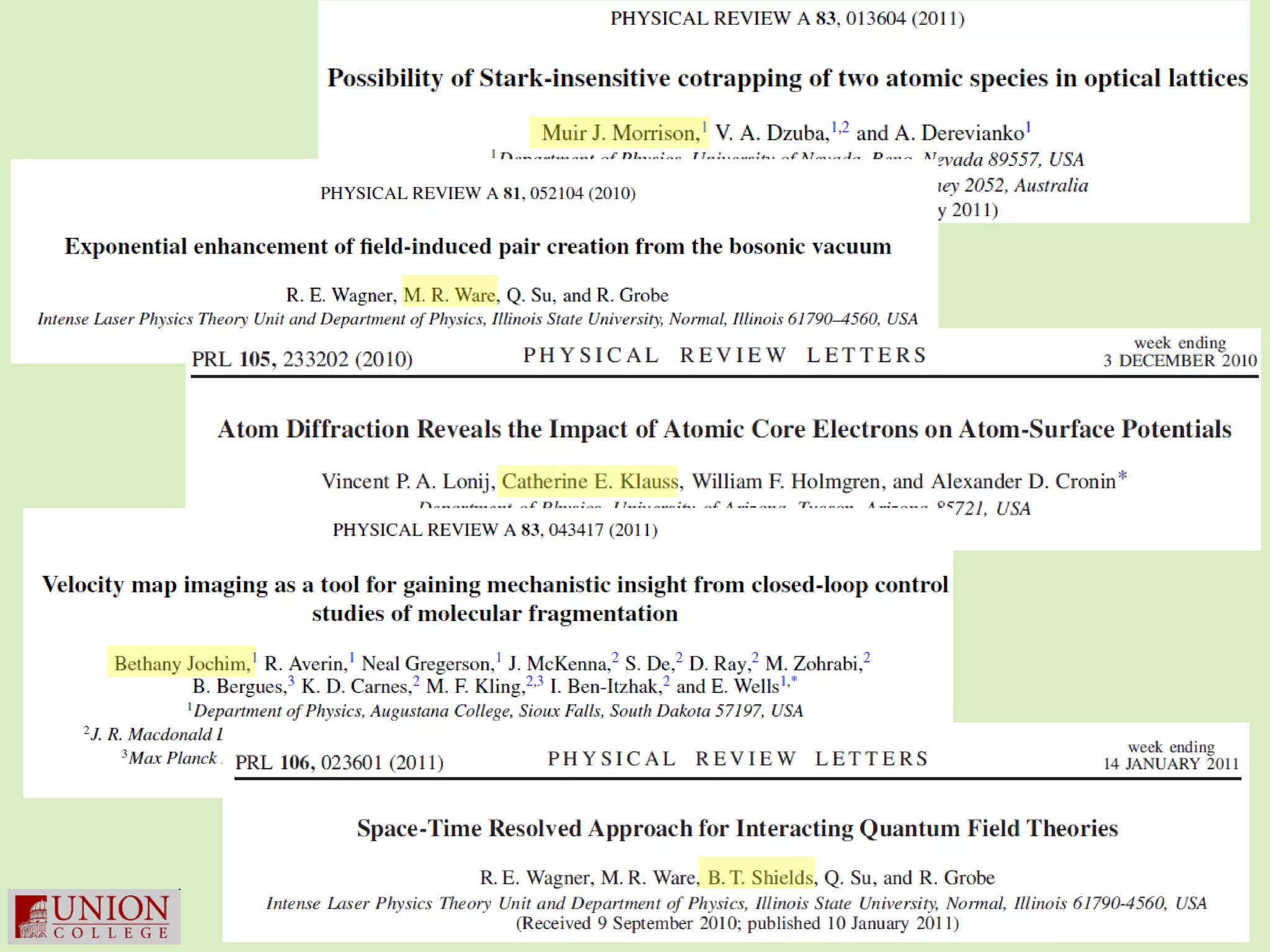
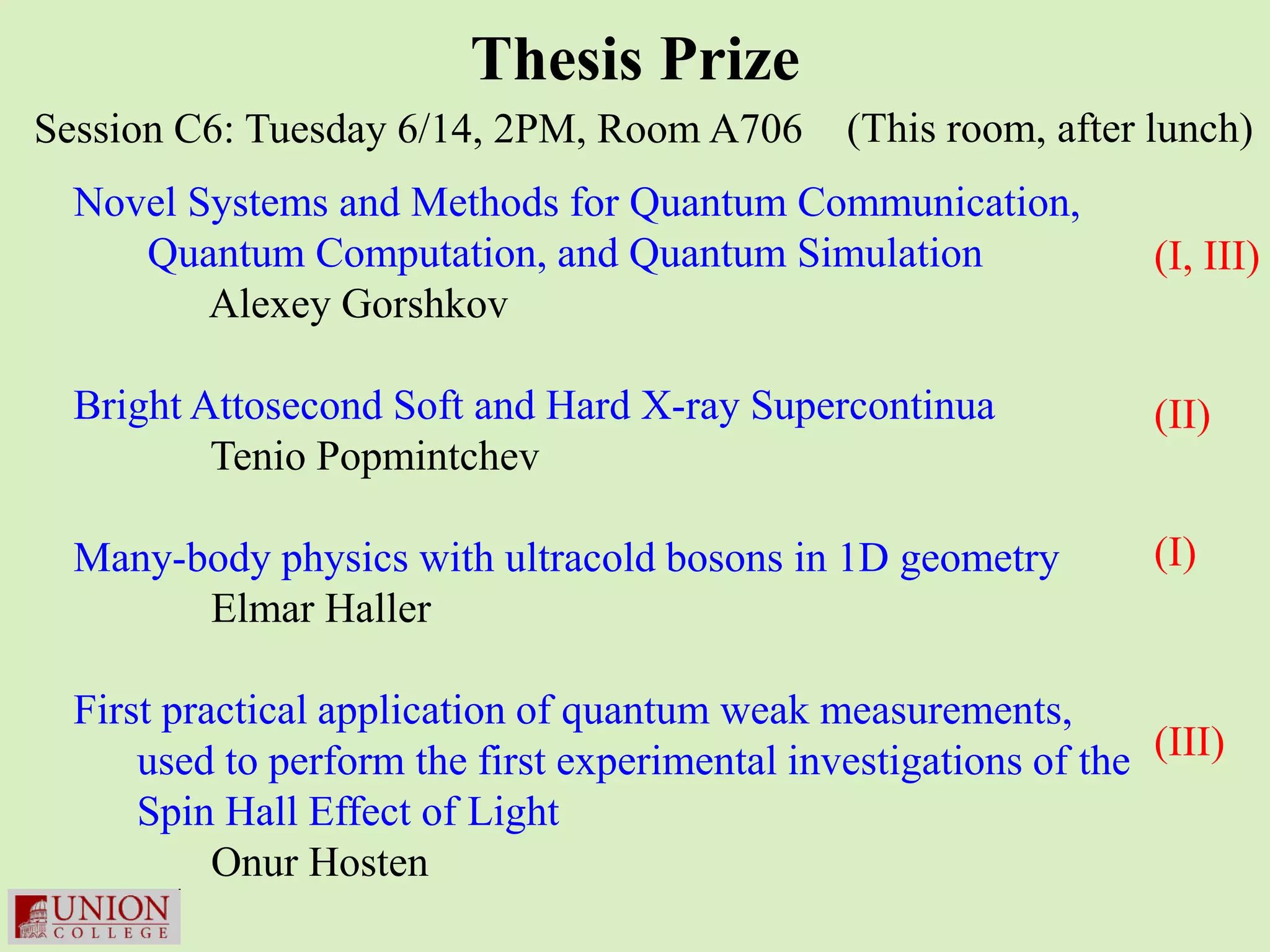
Thesis Prize
Session C6: Tuesday 6/14, 2PM, Room A706         (This room, after lunch)
  Novel Systems and Methods for Quantum Communication,
     Quantum Computation, and Quantum Simulation                   (I, III)
         Alexey Gorshkov

  Bright Attosecond Soft and Hard X-ray Supercontinua              (II)
          Tenio Popmintchev

  Many-body physics with ultracold bosons in 1D geometry           (I)
        Elmar Haller

  First practical application of quantum weak measurements,
      used to perform the first experimental investigations of the (III)
      Spin Hall Effect of Light
           Onur Hosten
“Hot Topics”
Session U6: Friday 6/17 10:30 AM Room A706

 Atom Trap Trace Analysis                              (V, I)
       Zheng-Tian Lu

 Improved Measurement of the Electron EDM
                                                       (V)
        E.A. Hinds

 Sequential Double Ionization: The Timing of Release   (II, IV)
        A.N. Pfeiffer

 14-qubit entanglement: creation and coherence
        Julio Barreiro                                 (III, I)
Ultra-Cold Matter
Invited Talk Sessions:

        H4:    Focus: Phases of Strongly Interacting Cold Gases
Wed:
        J4:    Atom Circuits

       M6:     Focus: In-situ Imaging of Ultracold Atomic Gases
Thurs: N6:     Ultracold Molecules
       P6:     Few-body Ultracold Systems

        T2:    Non-Equilibrium and Cooperativity in Ultracold Systems
Fri:    T6:    Focus: Synthetic Gauge Fields in Ultracold Systems
        U4:    Cold Rydberg Gases
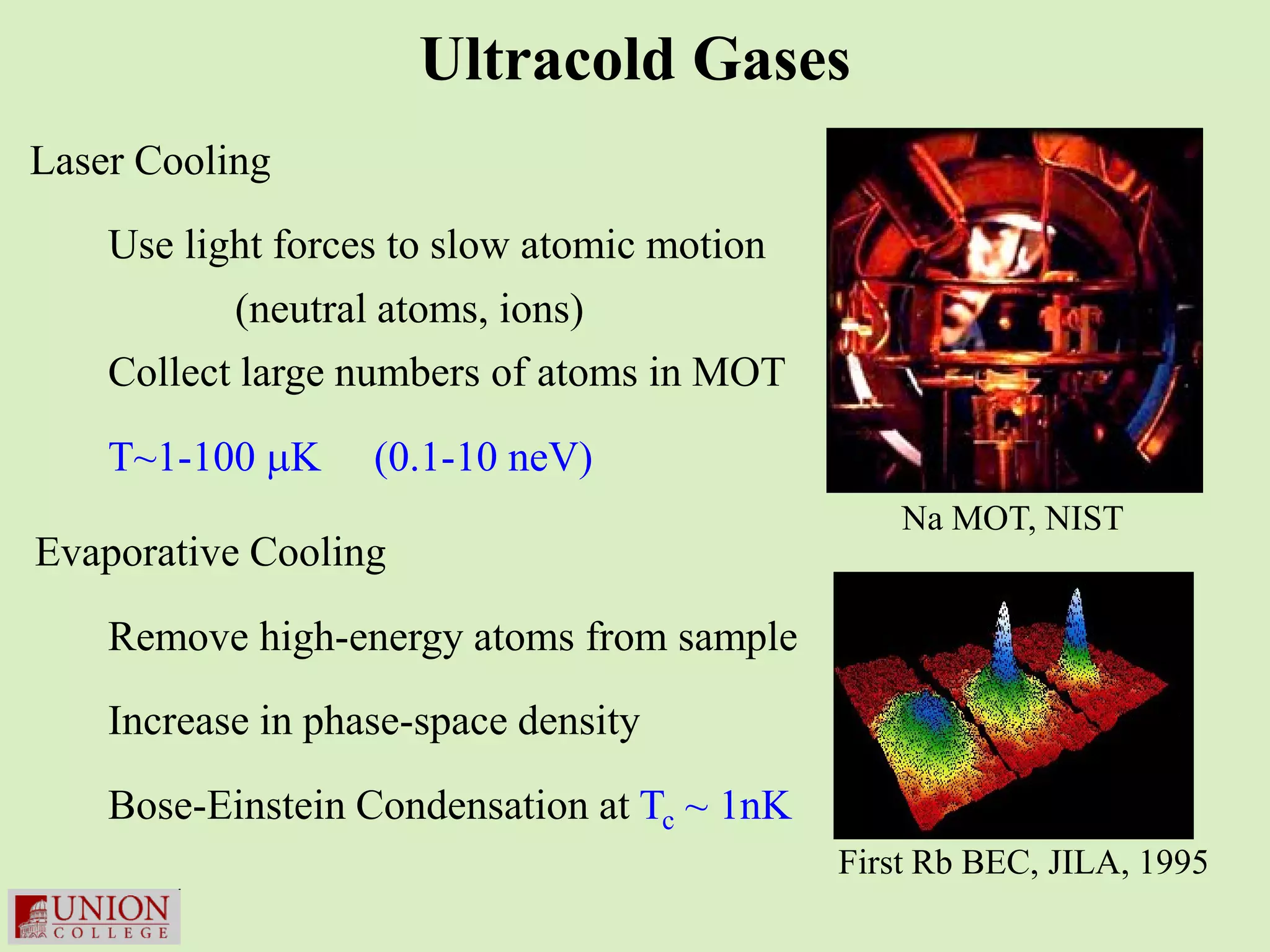
Ultracold Gases
Laser Cooling
    Use light forces to slow atomic motion
           (neutral atoms, ions)
    Collect large numbers of atoms in MOT

    T~1-100 µK     (0.1-10 neV)
                                                 Na MOT, NIST
Evaporative Cooling

    Remove high-energy atoms from sample
    Increase in phase-space density

    Bose-Einstein Condensation at Tc ~ 1nK
                                             First Rb BEC, JILA, 1995
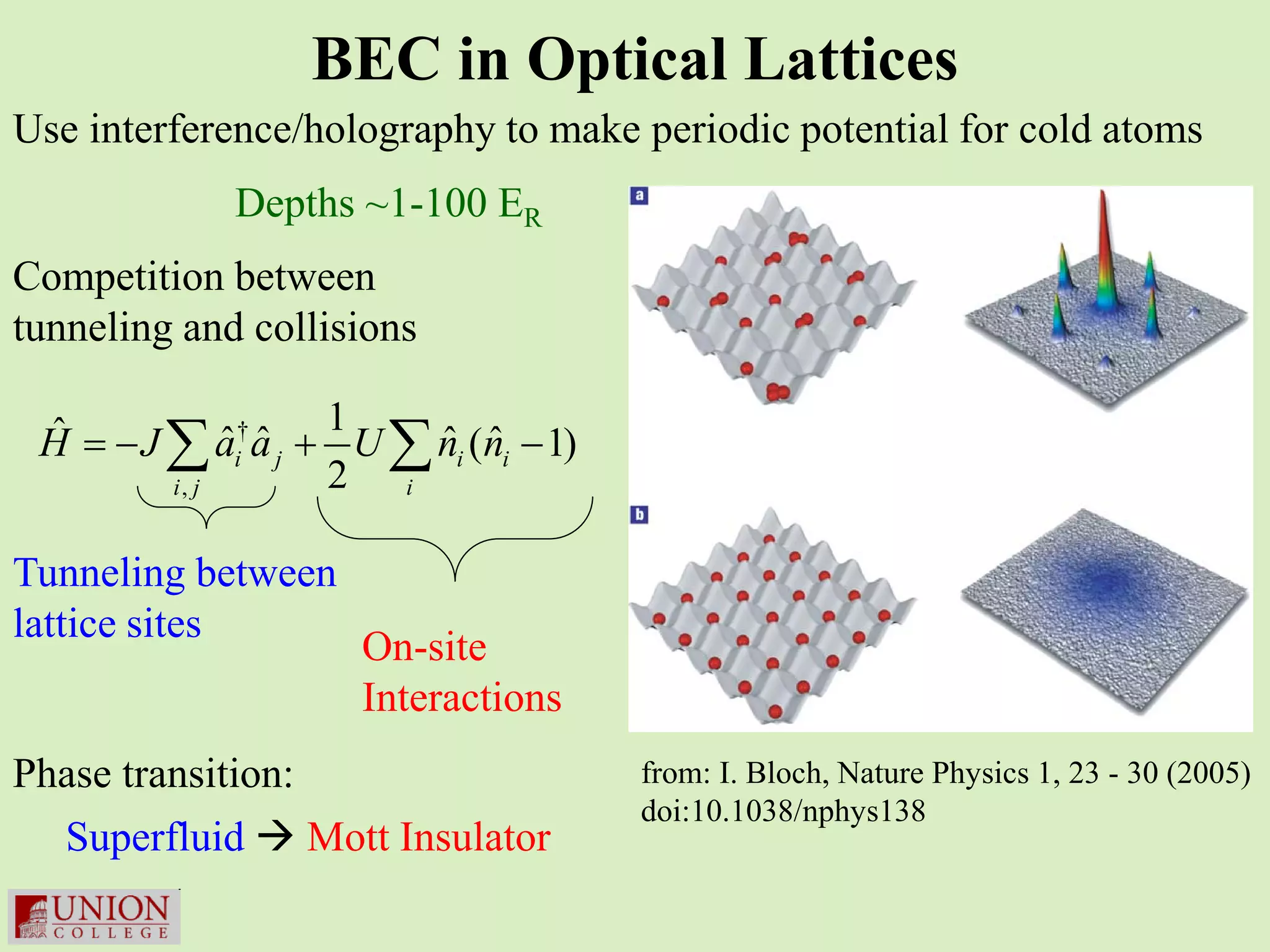
BEC in Optical Lattices
Use interference/holography to make periodic potential for cold atoms
             Depths ~1-100 ER
Competition between
tunneling and collisions

 ˆ =a + 1 U ∑ n (n − 1)
 H − J ∑ ai† ˆ j
            ˆ        ˆi ˆi
       i, j      2 i

Tunneling between
lattice sites
                    On-site
                    Interactions
Phase transition:                   from: I. Bloch, Nature Physics 1, 23 - 30 (2005)
                                    doi:10.1038/nphys138
  Superfluid  Mott Insulator
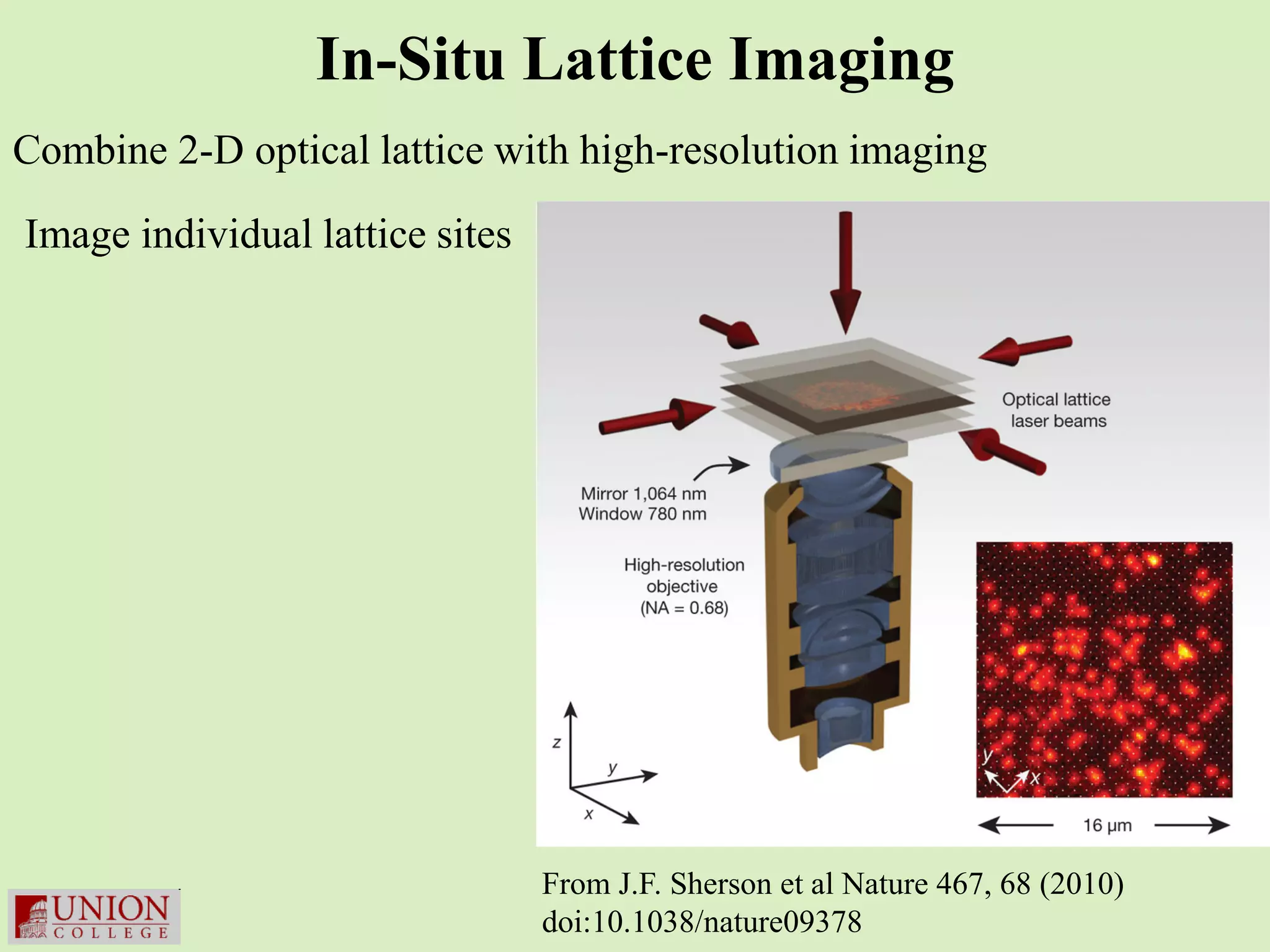
In-Situ Lattice Imaging
Combine 2-D optical lattice with high-resolution imaging
Image individual lattice sites


                                 From J.F. Sherson et al Nature 467, 68 (2010)
                                 doi:10.1038/nature09378
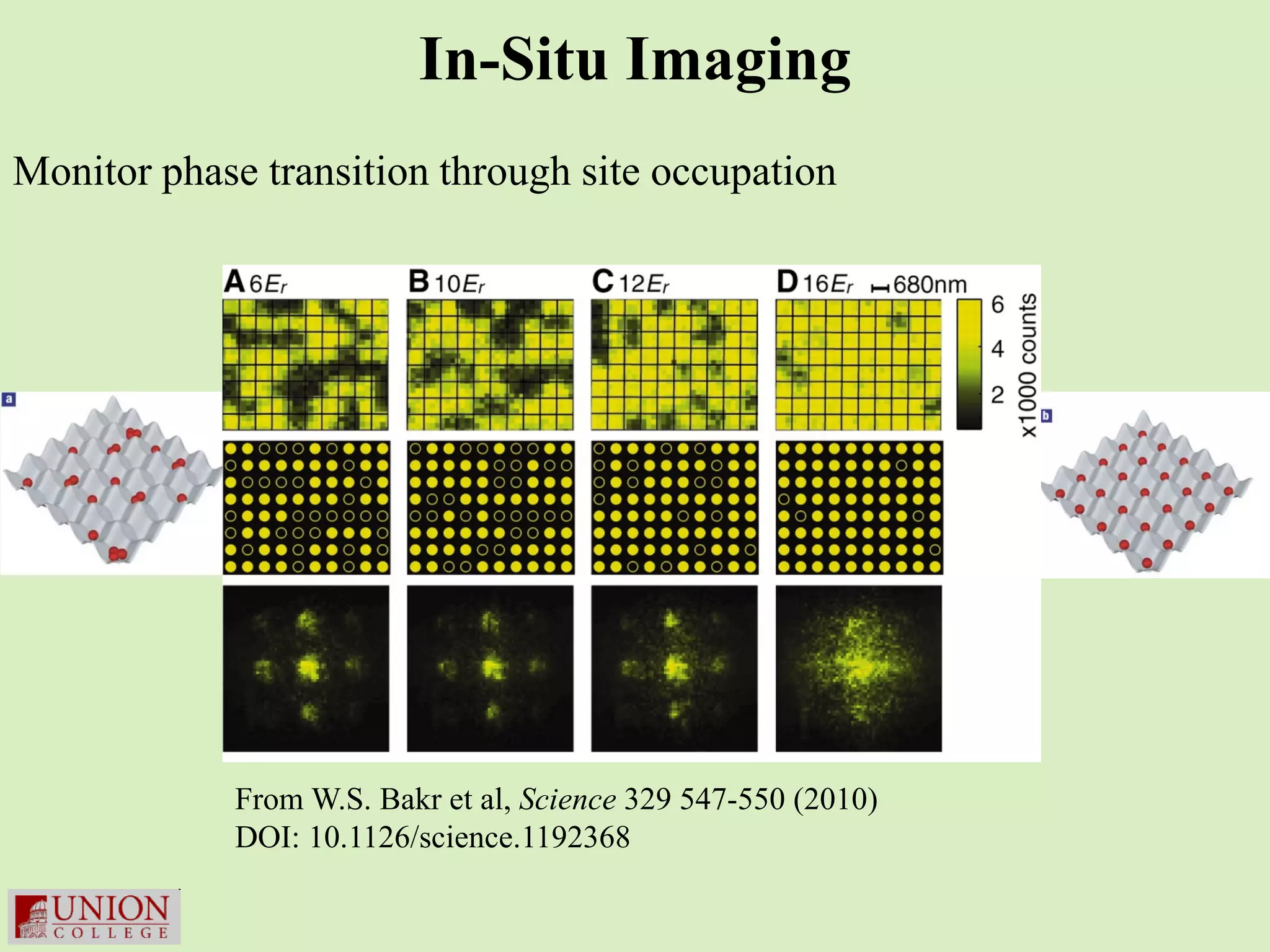
In-Situ Imaging
Monitor phase transition through site occupation


            From W.S. Bakr et al, Science 329 547-550 (2010)
            DOI: 10.1126/science.1192368
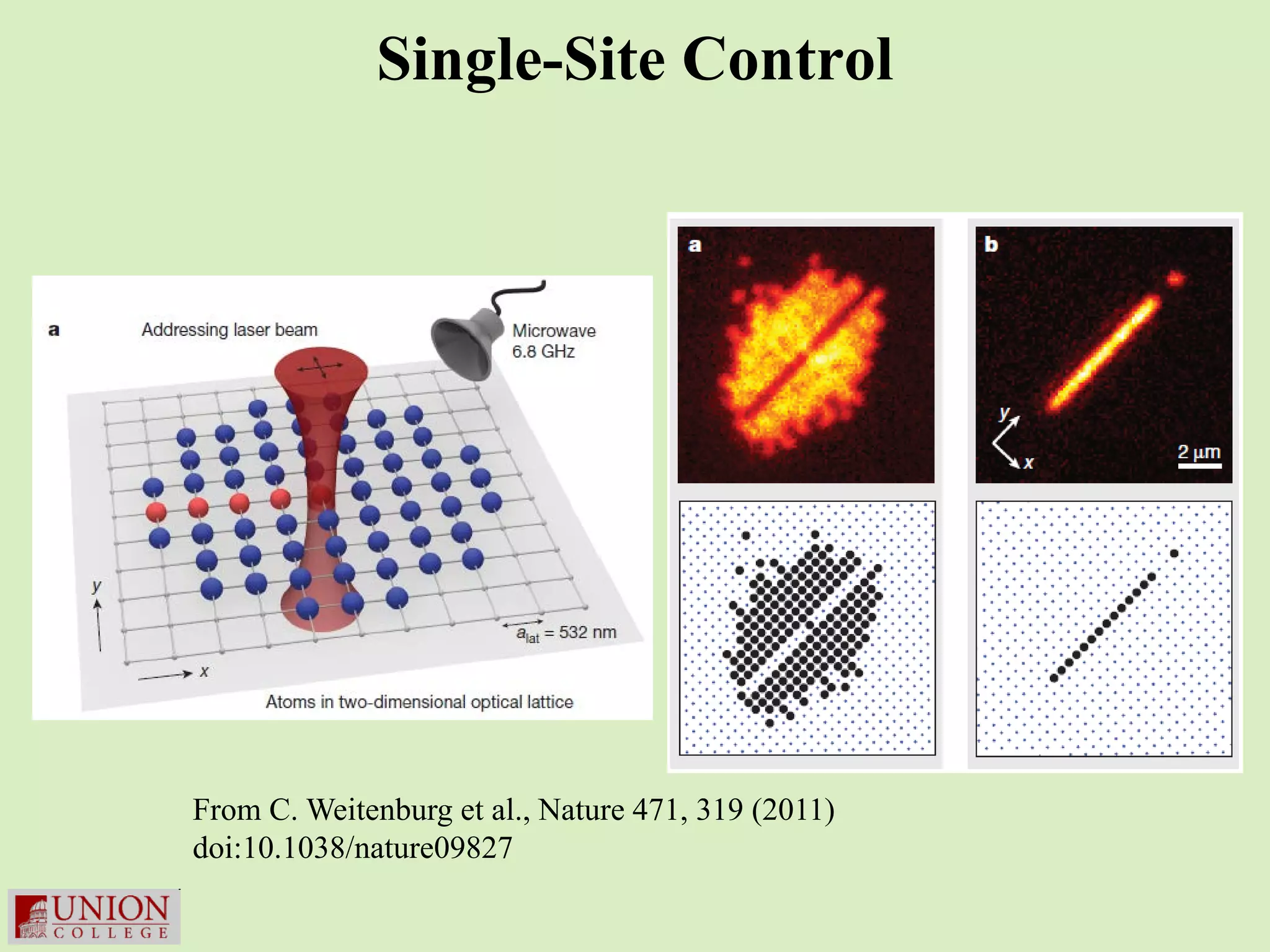
Single-Site Control


From C. Weitenburg et al., Nature 471, 319 (2011)
doi:10.1038/nature09827
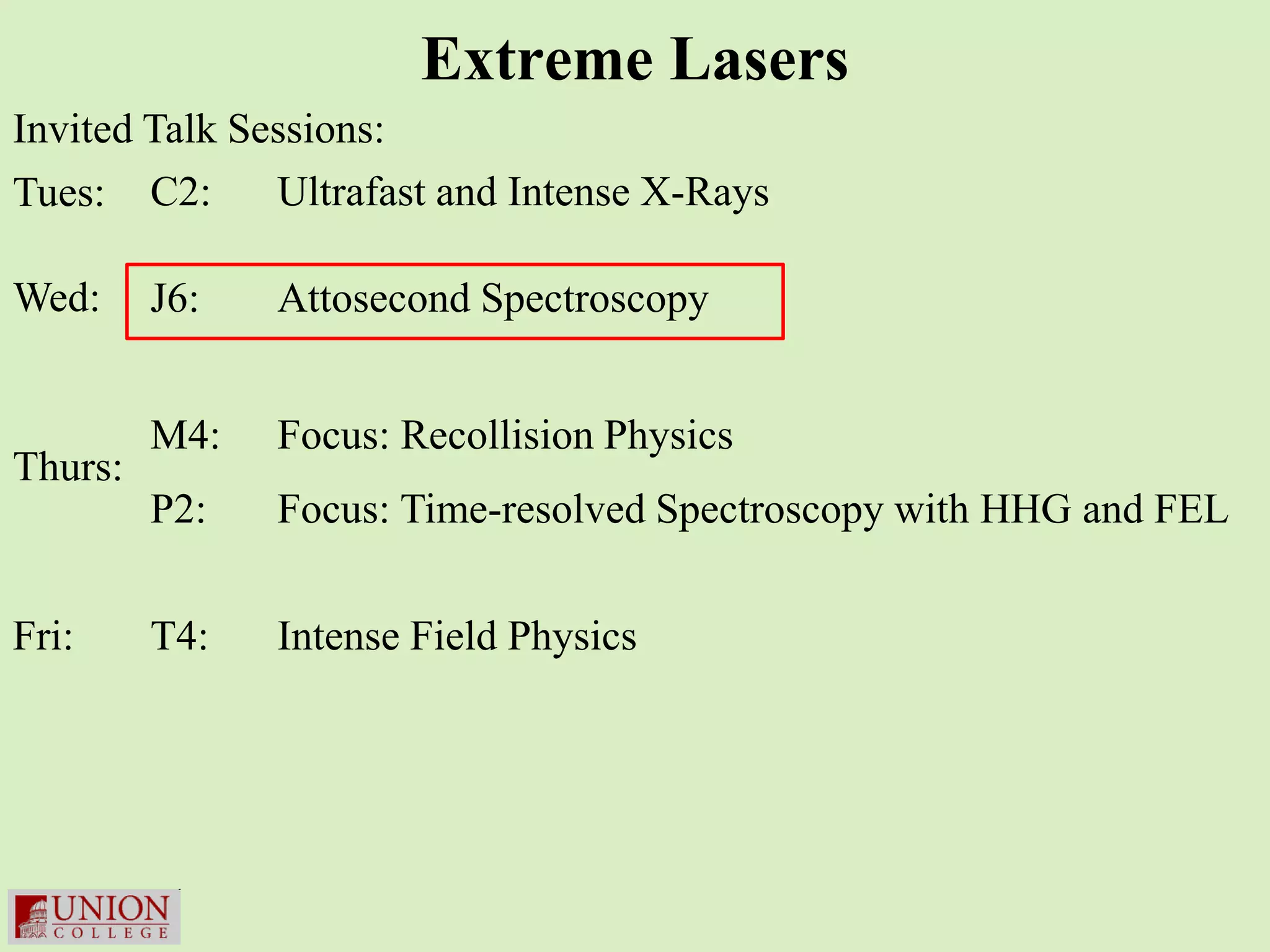
Extreme Lasers
Invited Talk Sessions:
Tues: C2:      Ultrafast and Intense X-Rays

Wed:     J6:   Attosecond Spectroscopy


         M4:   Focus: Recollision Physics
Thurs:
         P2:   Focus: Time-resolved Spectroscopy with HHG and FEL


Fri:     T4:   Intense Field Physics
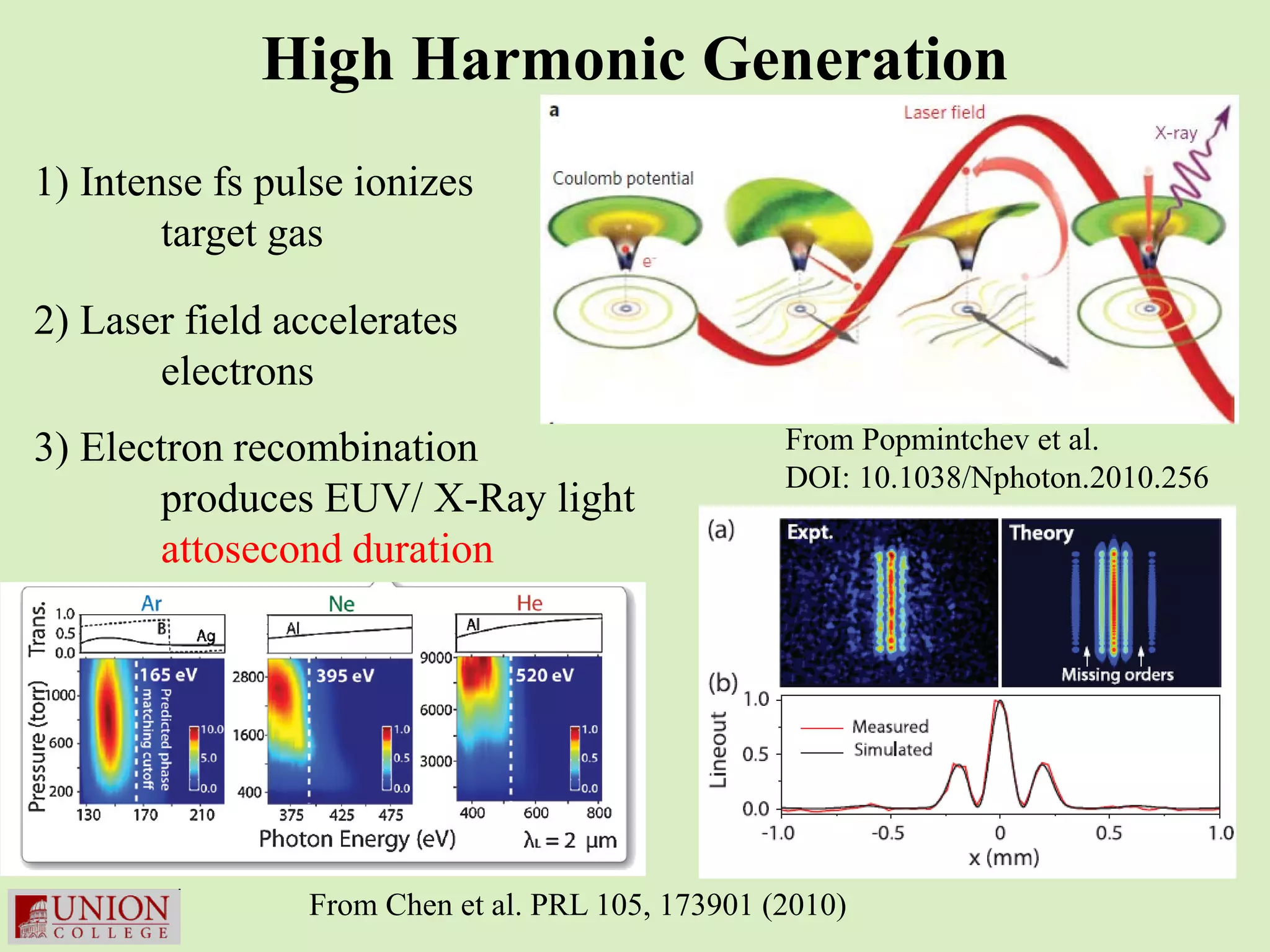
High Harmonic Generation
1) Intense fs pulse ionizes
        target gas

2) Laser field accelerates
       electrons
3) Electron recombination                         From Popmintchev et al.
                                                  DOI: 10.1038/Nphoton.2010.256
       produces EUV/ X-Ray light
       attosecond duration


                From Chen et al. PRL 105, 173901 (2010)
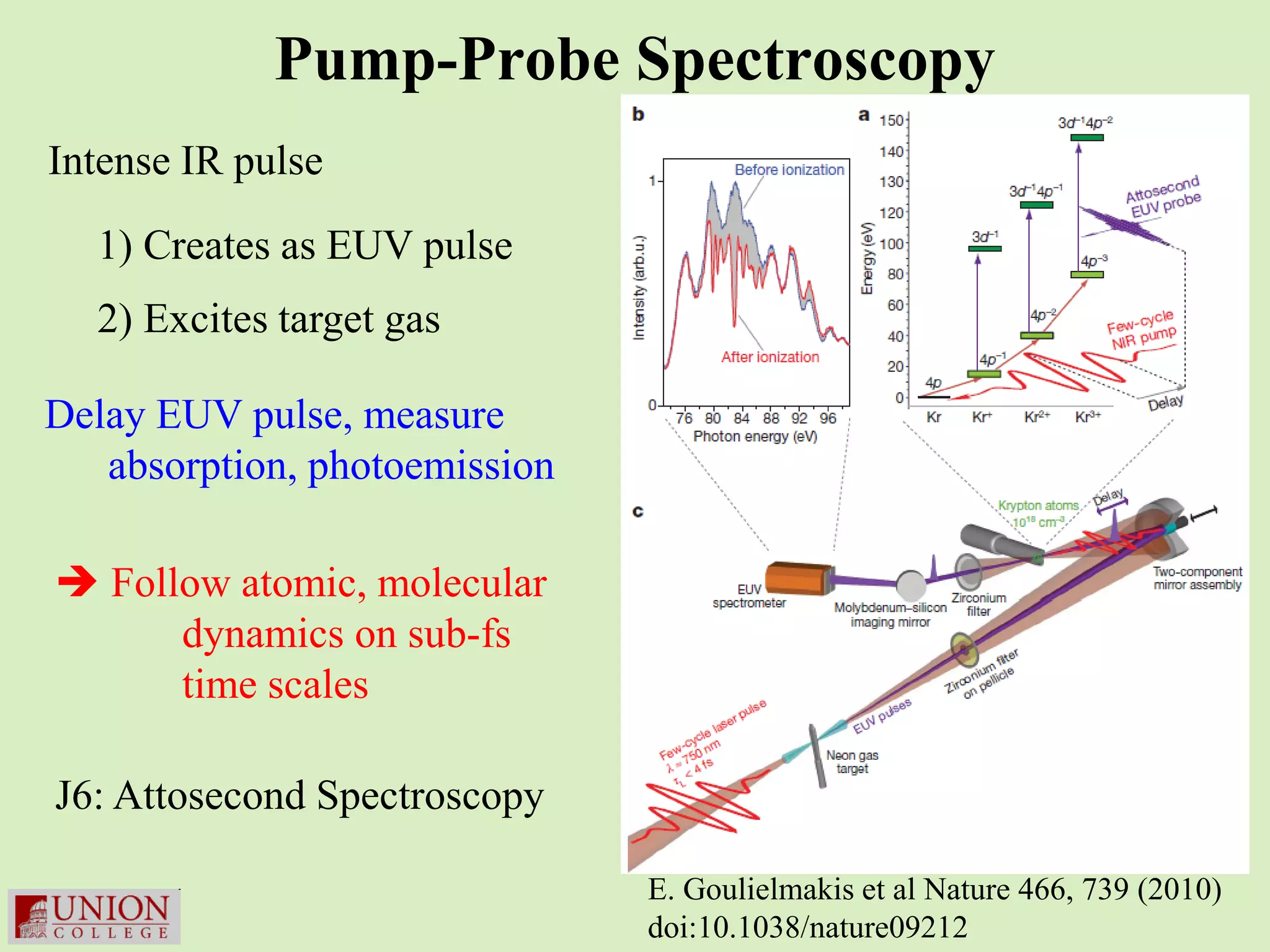
Pump-Probe Spectroscopy
Intense IR pulse

  1) Creates as EUV pulse
  2) Excites target gas

Delay EUV pulse, measure
   absorption, photoemission

 Follow atomic, molecular
      dynamics on sub-fs
      time scales

J6: Attosecond Spectroscopy

                               E. Goulielmakis et al Nature 466, 739 (2010)
                               doi:10.1038/nature09212
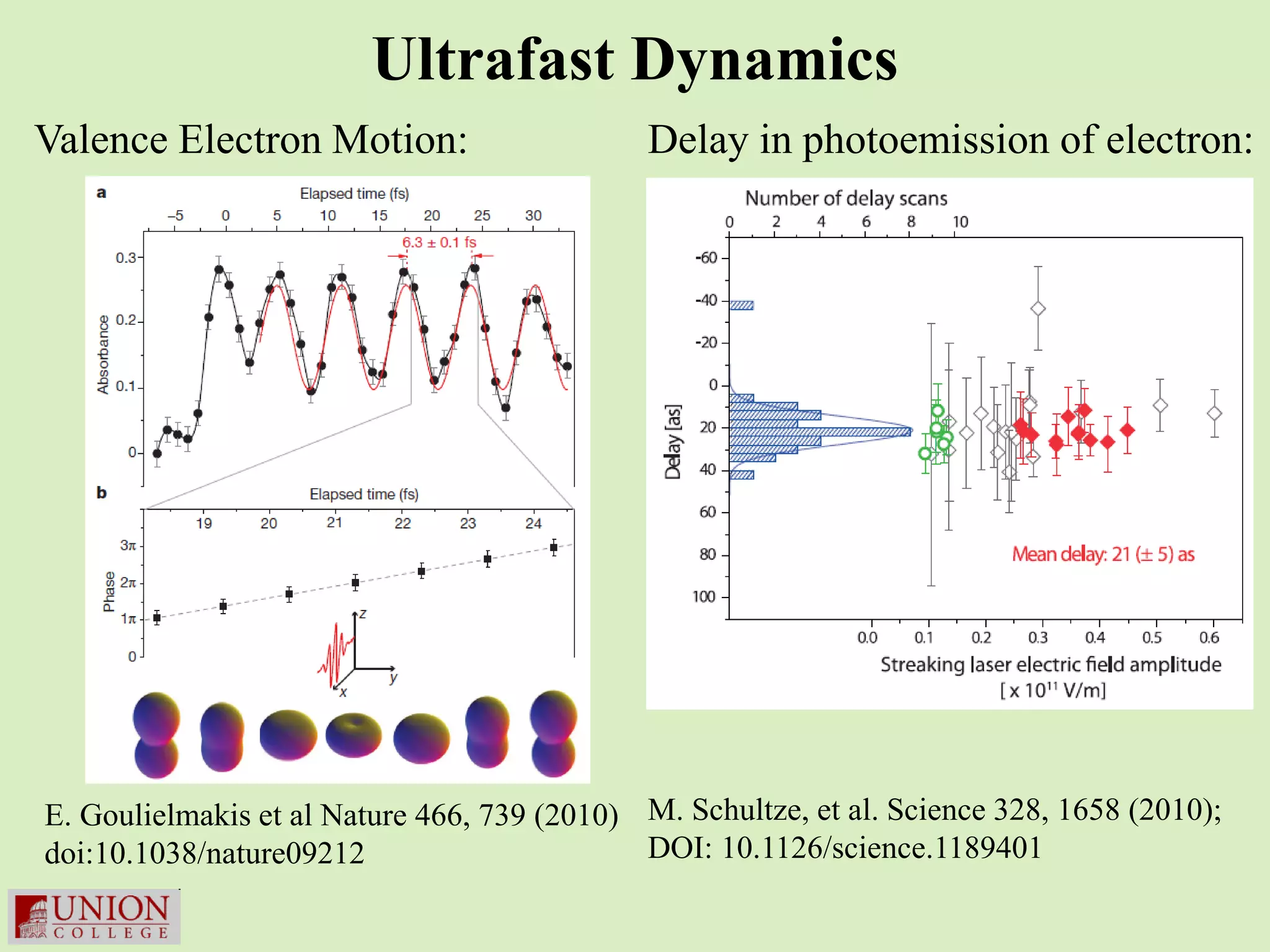
Ultrafast Dynamics
Valence Electron Motion:                      Delay in photoemission of electron:


E. Goulielmakis et al Nature 466, 739 (2010) M. Schultze, et al. Science 328, 1658 (2010);
doi:10.1038/nature09212                      DOI: 10.1126/science.1189401
Quantum Phenomena
Invited Talk Sessions:


         H2:   Focus: Advances in NV Centers
Wed:
         K6:   Advances in Quantum Communications


         N4:   Quantum Measurement and Control of Spin Ensembles
Thurs:
         P4:   Focus: Progress in Cavity Opto-Mechanics
Quantum Communications
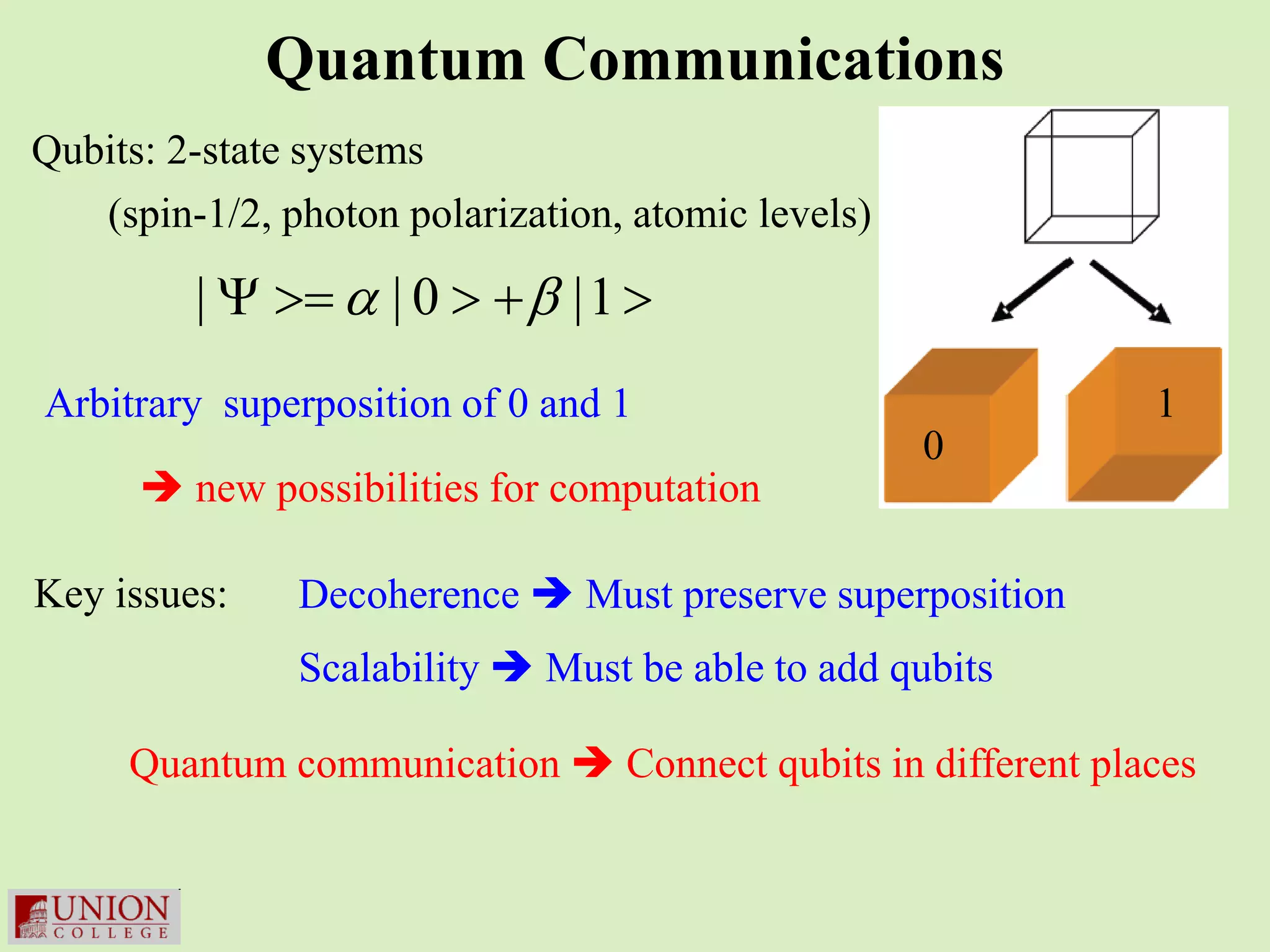
Qubits: 2-state systems
   (spin-1/2, photon polarization, atomic levels)

         | Ψ > α | 0 > +β | 1 >
           =
Arbitrary superposition of 0 and 1                          1
                                                    0
       new possibilities for computation

Key issues:    Decoherence  Must preserve superposition
               Scalability  Must be able to add qubits

     Quantum communication  Connect qubits in different places
Entanglement and Communication
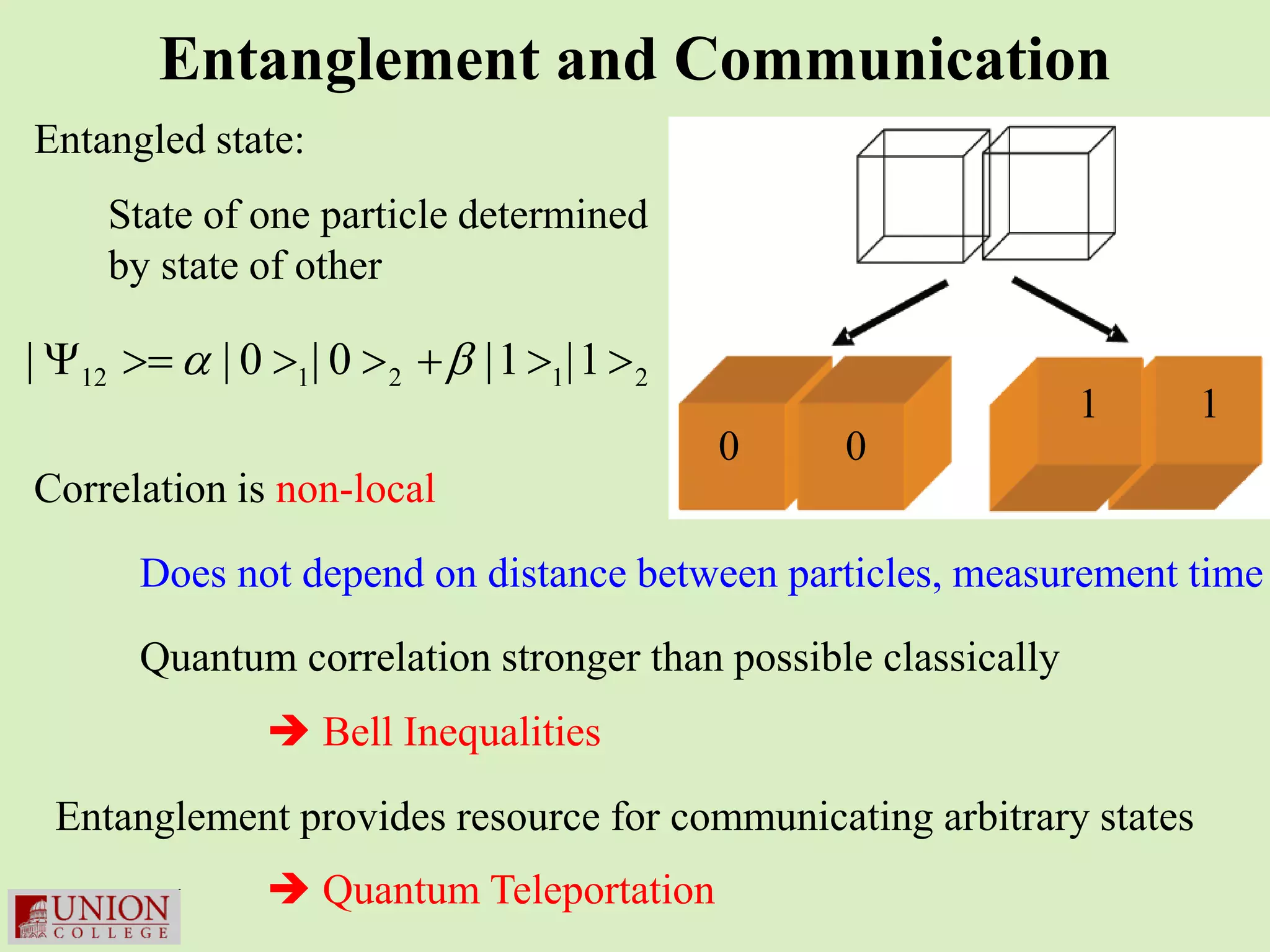
Entangled state:
    State of one particle determined
    by state of other

| Ψ= α | 0 >1| 0 > 2 + β |1 >1|1 > 2
   12 >
                                                               1     1
                                       0       0
Correlation is non-local

      Does not depend on distance between particles, measurement time
      Quantum correlation stronger than possible classically
              Bell Inequalities

 Entanglement provides resource for communicating arbitrary states
              Quantum Teleportation
Storage and Transmission


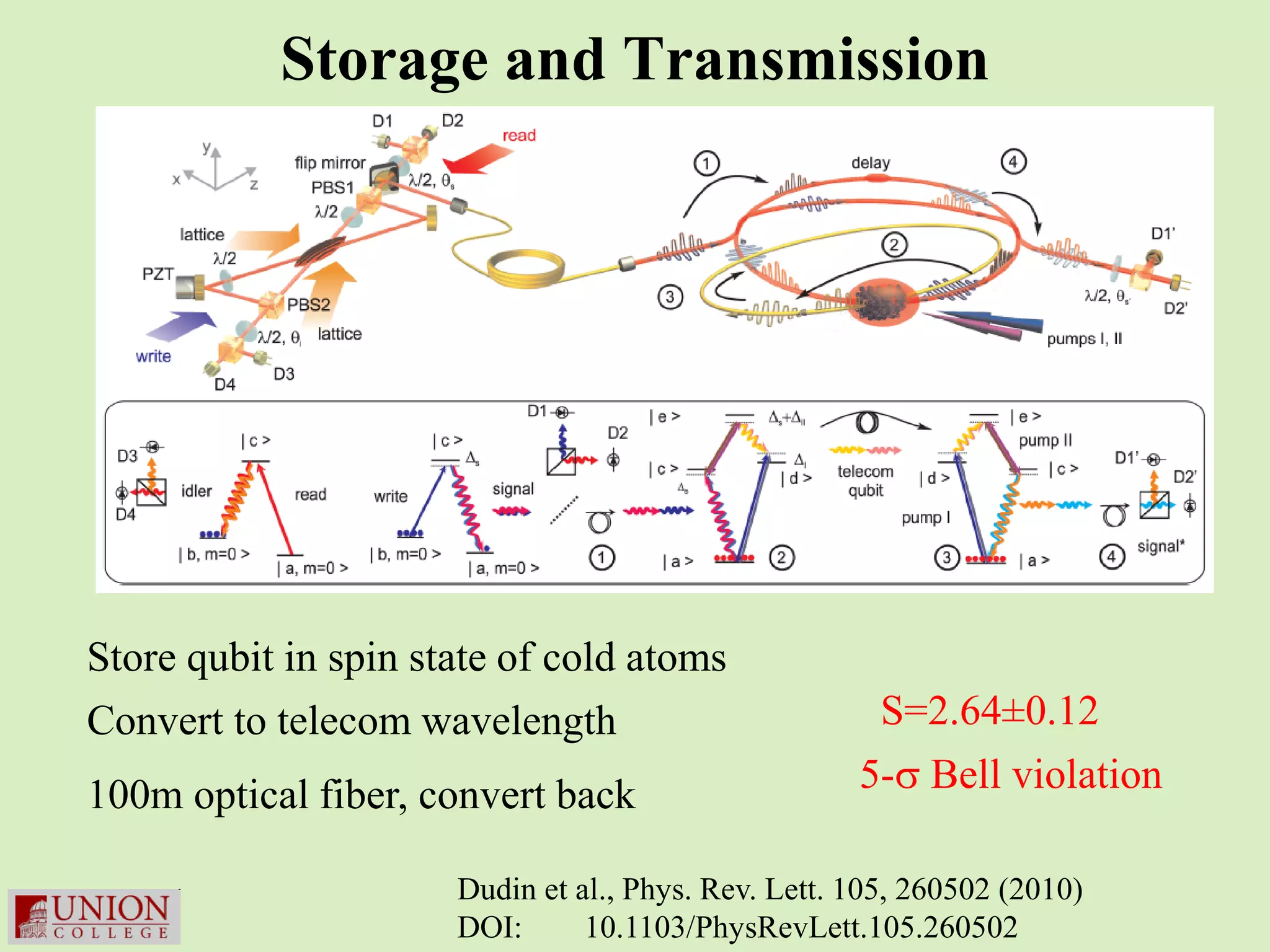
Store qubit in spin state of cold atoms
Convert to telecom wavelength                          S=2.64±0.12
100m optical fiber, convert back                     5-σ Bell violation

                      Dudin et al., Phys. Rev. Lett. 105, 260502 (2010)
                      DOI:      10.1103/PhysRevLett.105.260502
Free-Space Teleportation


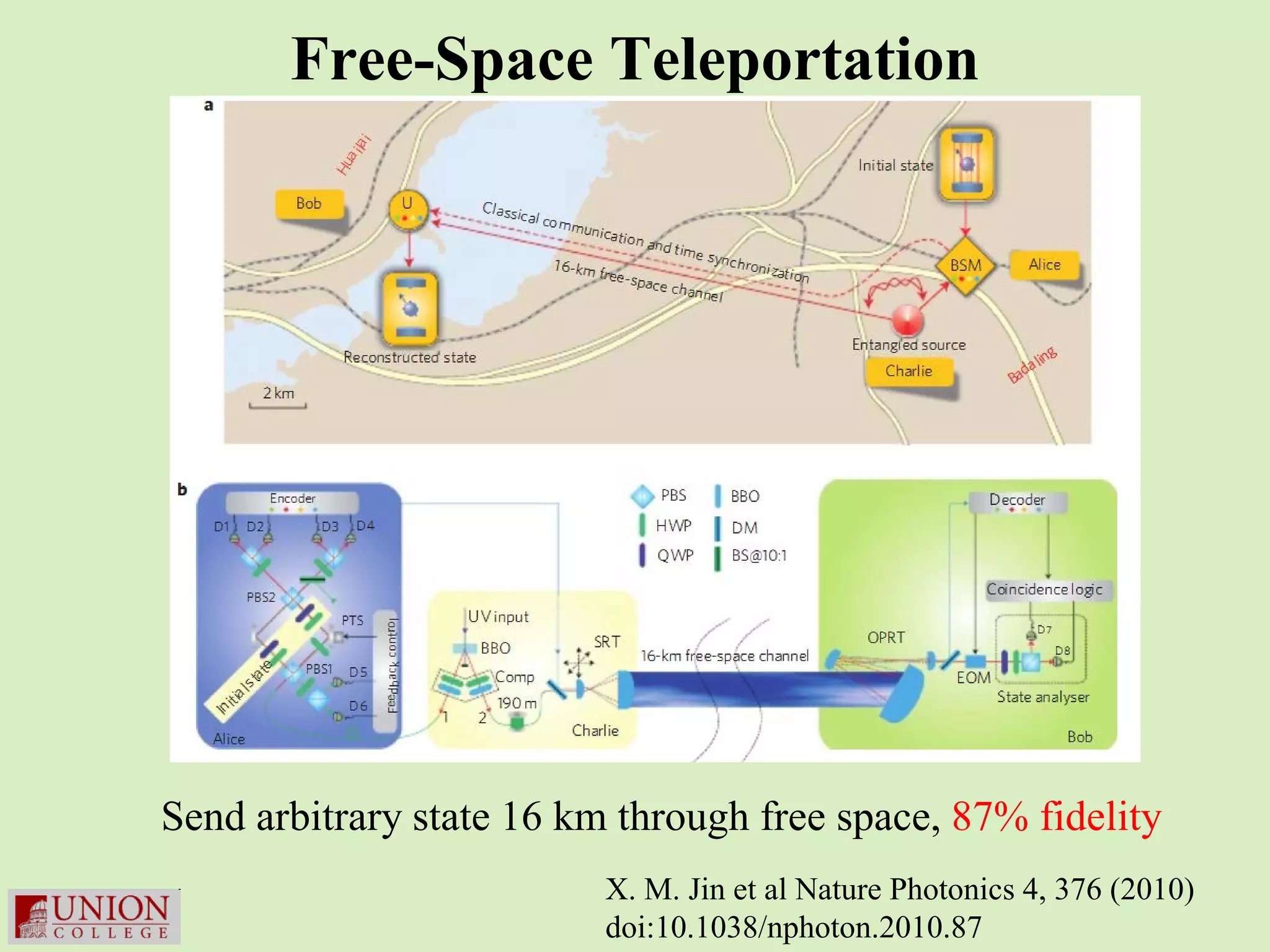
Send arbitrary state 16 km through free space, 87% fidelity
                          X. M. Jin et al Nature Photonics 4, 376 (2010)
                          doi:10.1038/nphoton.2010.87
“Traditional” AMO Physics
Invited Talk Sessions:
Tues: C1:      Positron-Matter Interactions and Antihydrogen

       H6:     Advances in Gaseous Electronics
Wed:
       K1:     Focus: Recent Advances in Collision Studies

       M1:     Focus: Photoionization Spectroscopy
Thurs:
       N6:     AMO Science for Laboratory and
                      Astrophysical Environments

Fri:   T1:     Focus: Electronic, Atomic, and Molecular
                      Collision Studies
“Traditional” AMO
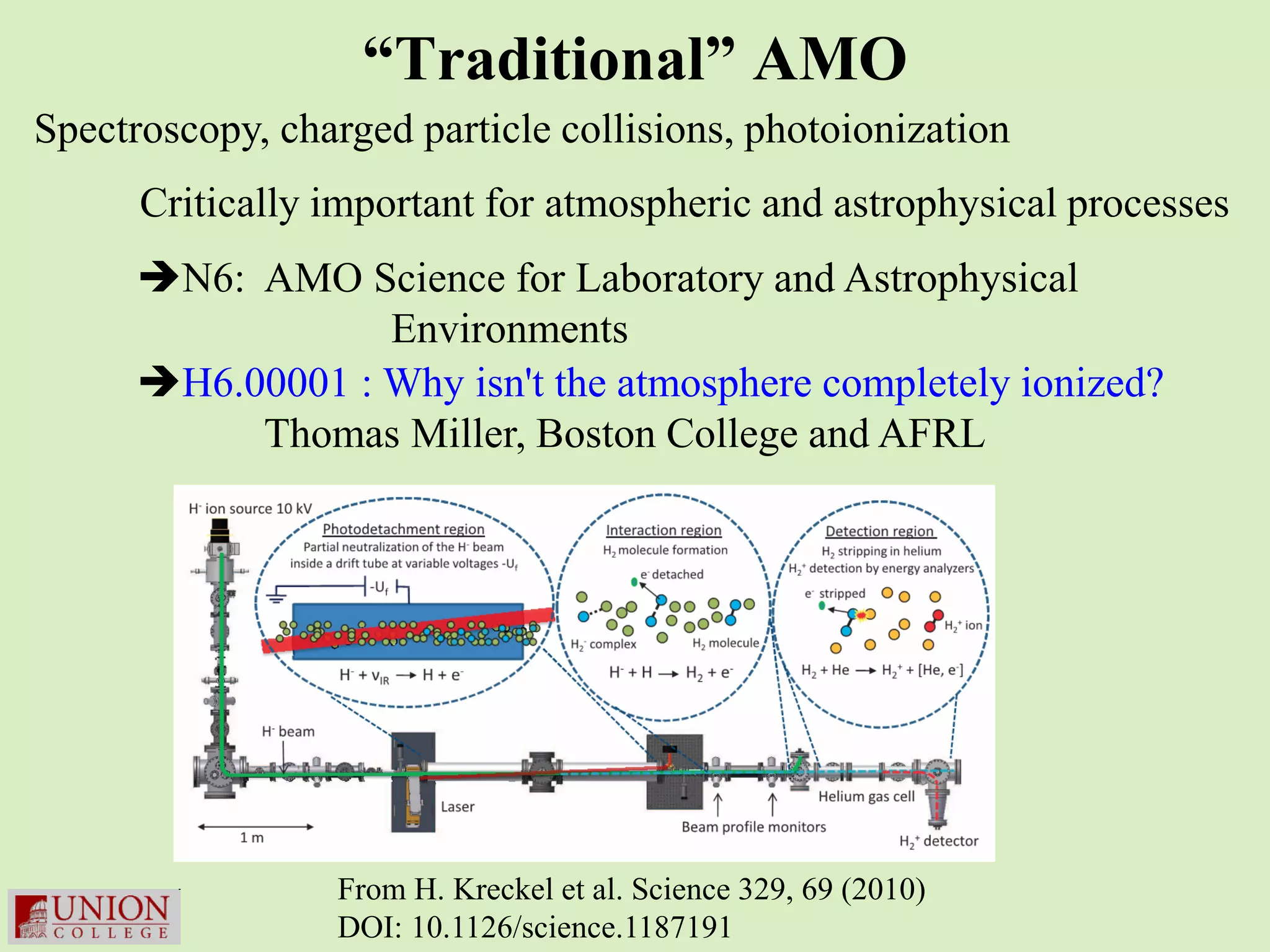
Spectroscopy, charged particle collisions, photoionization
      Critically important for atmospheric and astrophysical processes
      N6: AMO Science for Laboratory and Astrophysical
                  Environments
      H6.00001 : Why isn't the atmosphere completely ionized?
           Thomas Miller, Boston College and AFRL


                  From H. Kreckel et al. Science 329, 69 (2010)
                  DOI: 10.1126/science.1187191
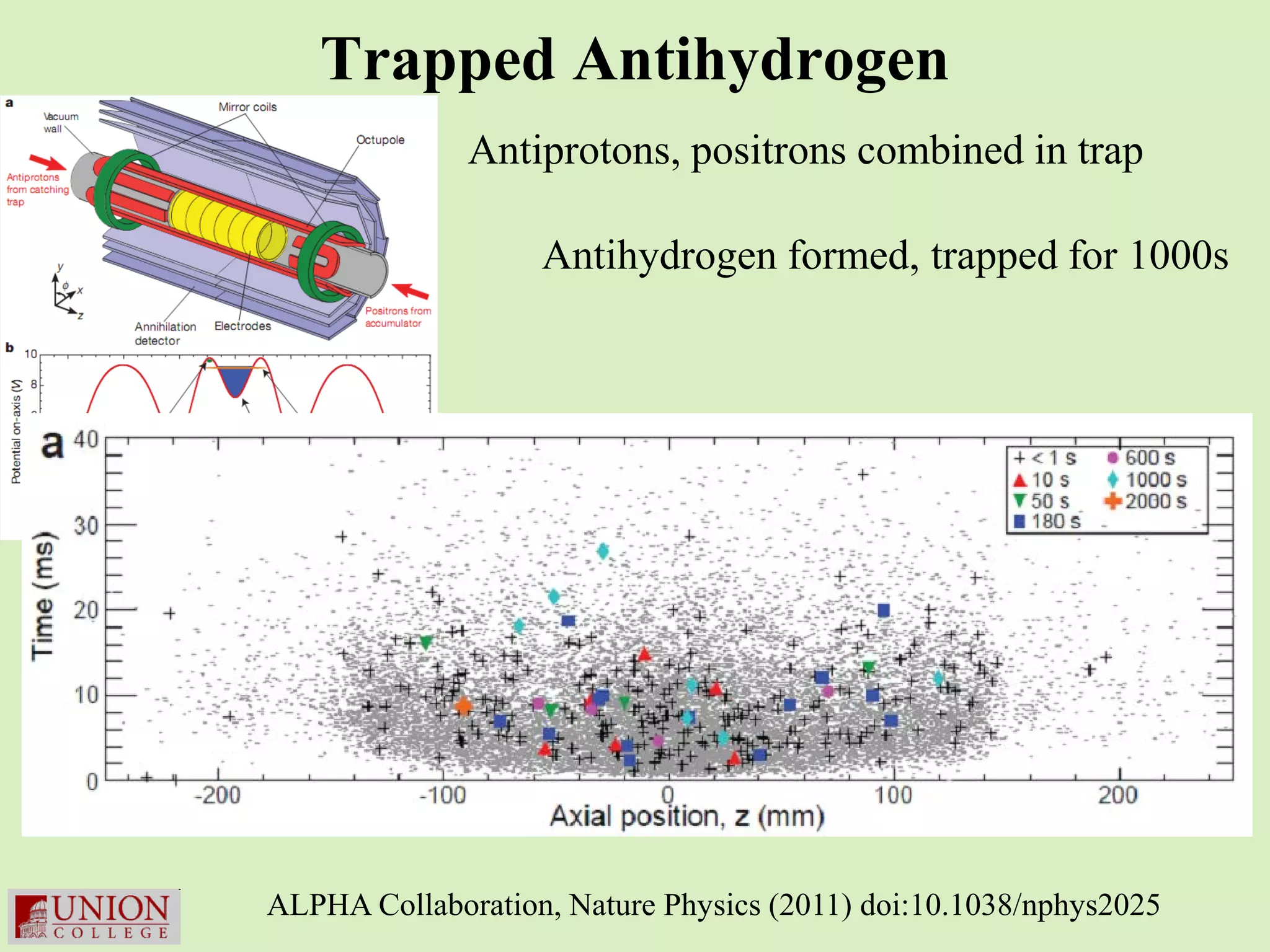
Trapped Antihydrogen
              Antiprotons, positrons combined in trap

                   Antihydrogen formed, trapped for 1000s


ALPHA Collaboration, Nature Physics (2011) doi:10.1038/nphys2025
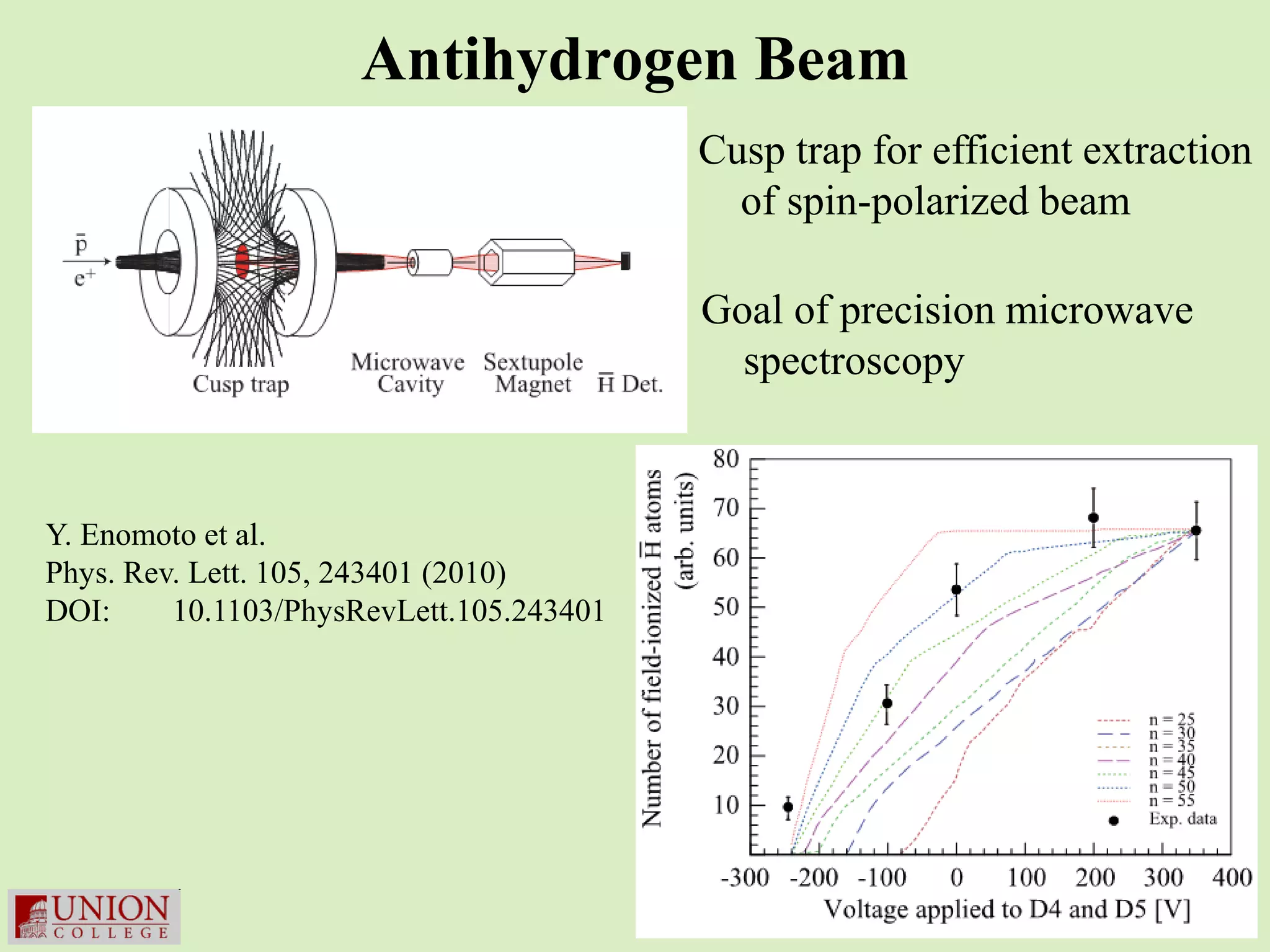
Antihydrogen Beam
                                          Cusp trap for efficient extraction
                                            of spin-polarized beam

                                          Goal of precision microwave
                                            spectroscopy


Y. Enomoto et al.
Phys. Rev. Lett. 105, 243401 (2010)
DOI:     10.1103/PhysRevLett.105.243401
Precision Measurement
Invited Talk Sessions:


Wed:    J2: Fundamental Symmetry Tests


Fri:    U6: Hot Topics
           Atom Trap Trace Analysis
                 Zheng-Tian Lu

           Improved Measurement of the Electron EDM
                  E.A. Hinds
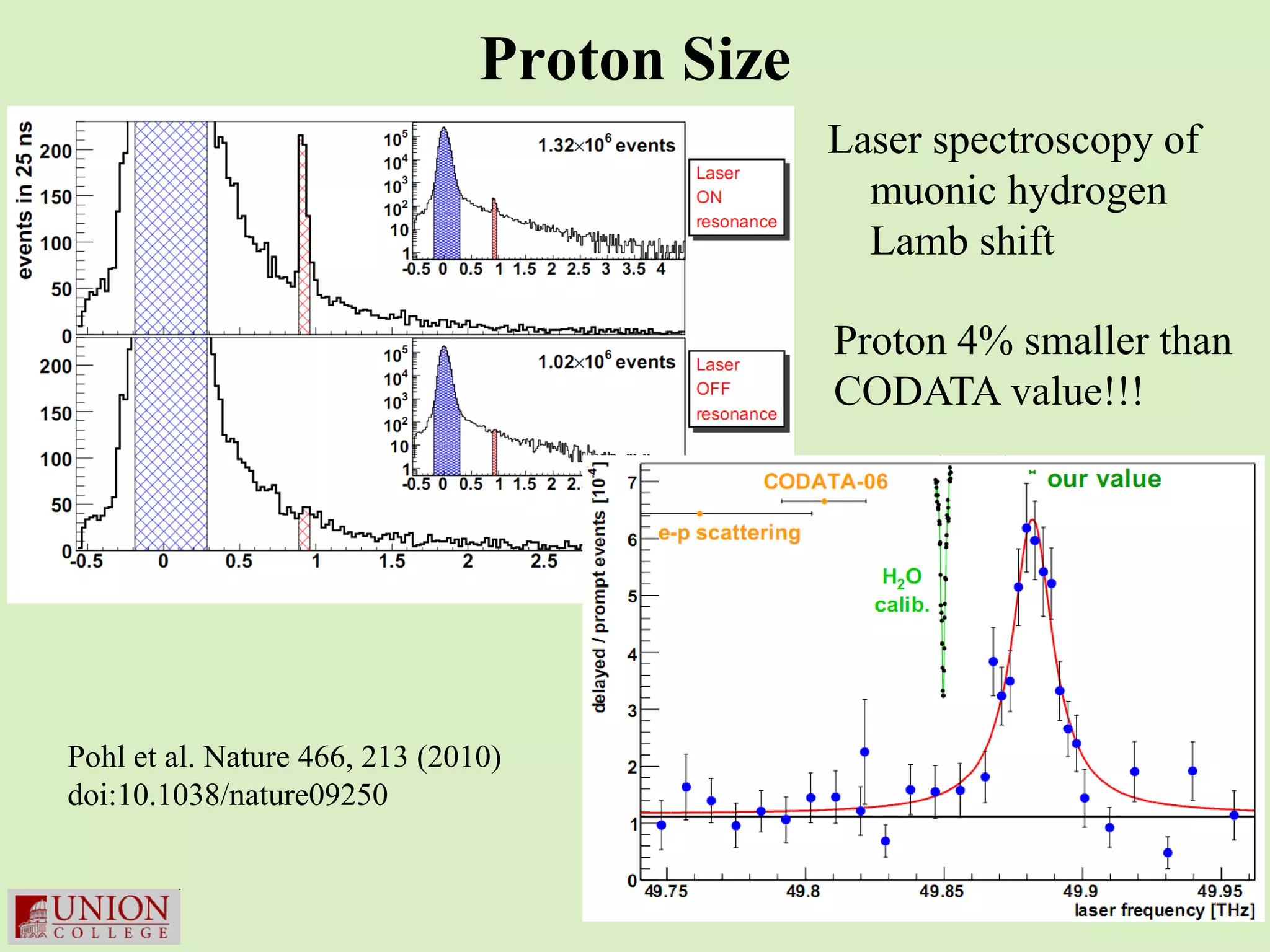
Proton Size
                                              Laser spectroscopy of
                                                muonic hydrogen
                                                Lamb shift

                                              Proton 4% smaller than
                                              CODATA value!!!


Pohl et al. Nature 466, 213 (2010)
doi:10.1038/nature09250
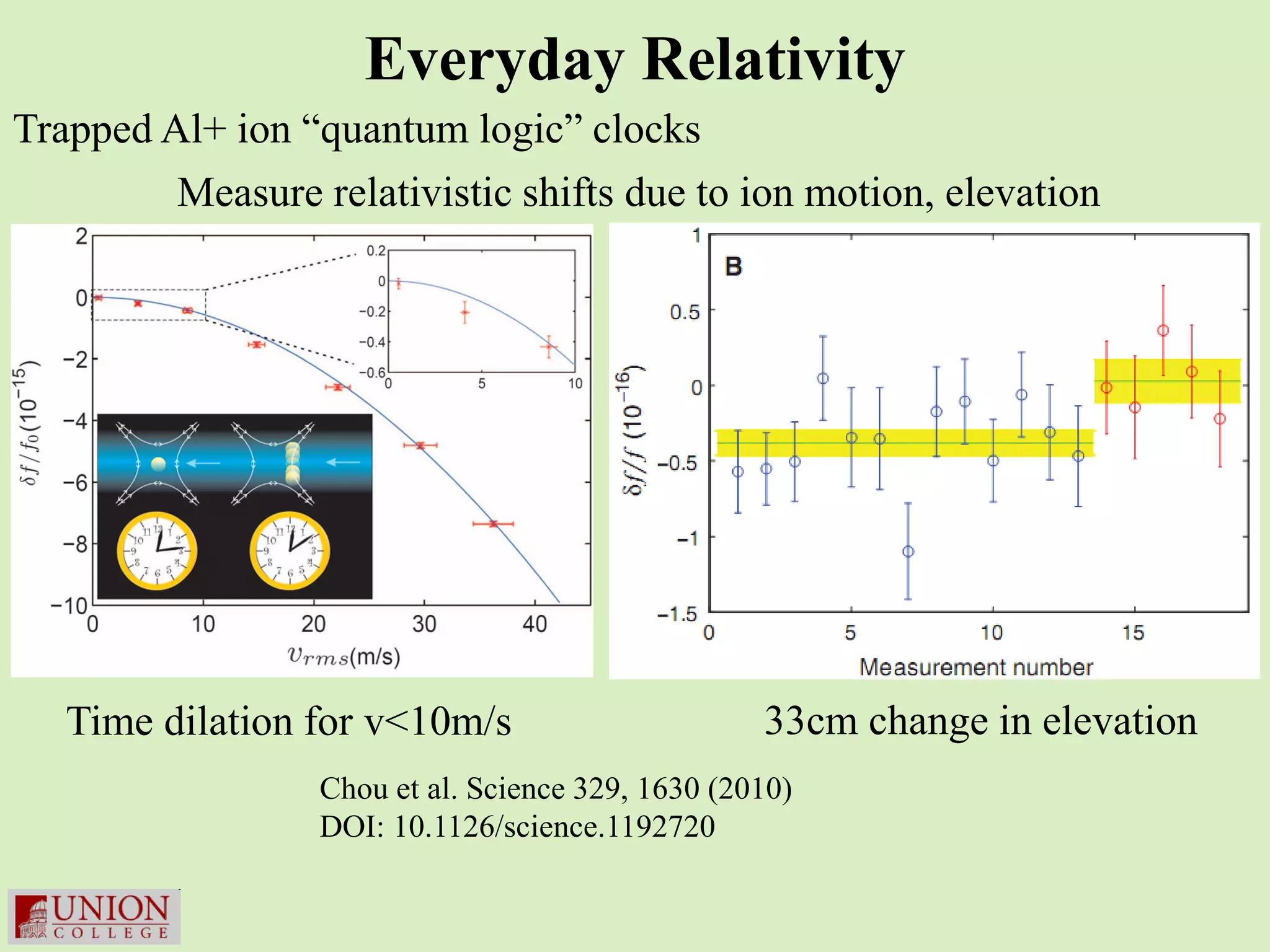
Everyday Relativity
Trapped Al+ ion “quantum logic” clocks
         Measure relativistic shifts due to ion motion, elevation


   Time dilation for v<10m/s                       33cm change in elevation
                  Chou et al. Science 329, 1630 (2010)
                  DOI: 10.1126/science.1192720
What’s So Interesting About AMO
                 Physics?
I) Ultracold atoms allow studies of superfluids, phase transitions
    with in-situ single-site monitoring

II) Ultrafast lasers and HHG allow studies of atomic and molecular
     dynamics on femto- and atto-second time scales

III) Quantum communication systems allow sharing and maniuplation
     of quantum information over long distances

IV) Understanding of charged-particle interactions allow improved
    astrophysical models, creation of antimatter
V) Ultra-precise laser spectroscopy allows laboratory tests of
    fundamental symmetry, searches for new physics
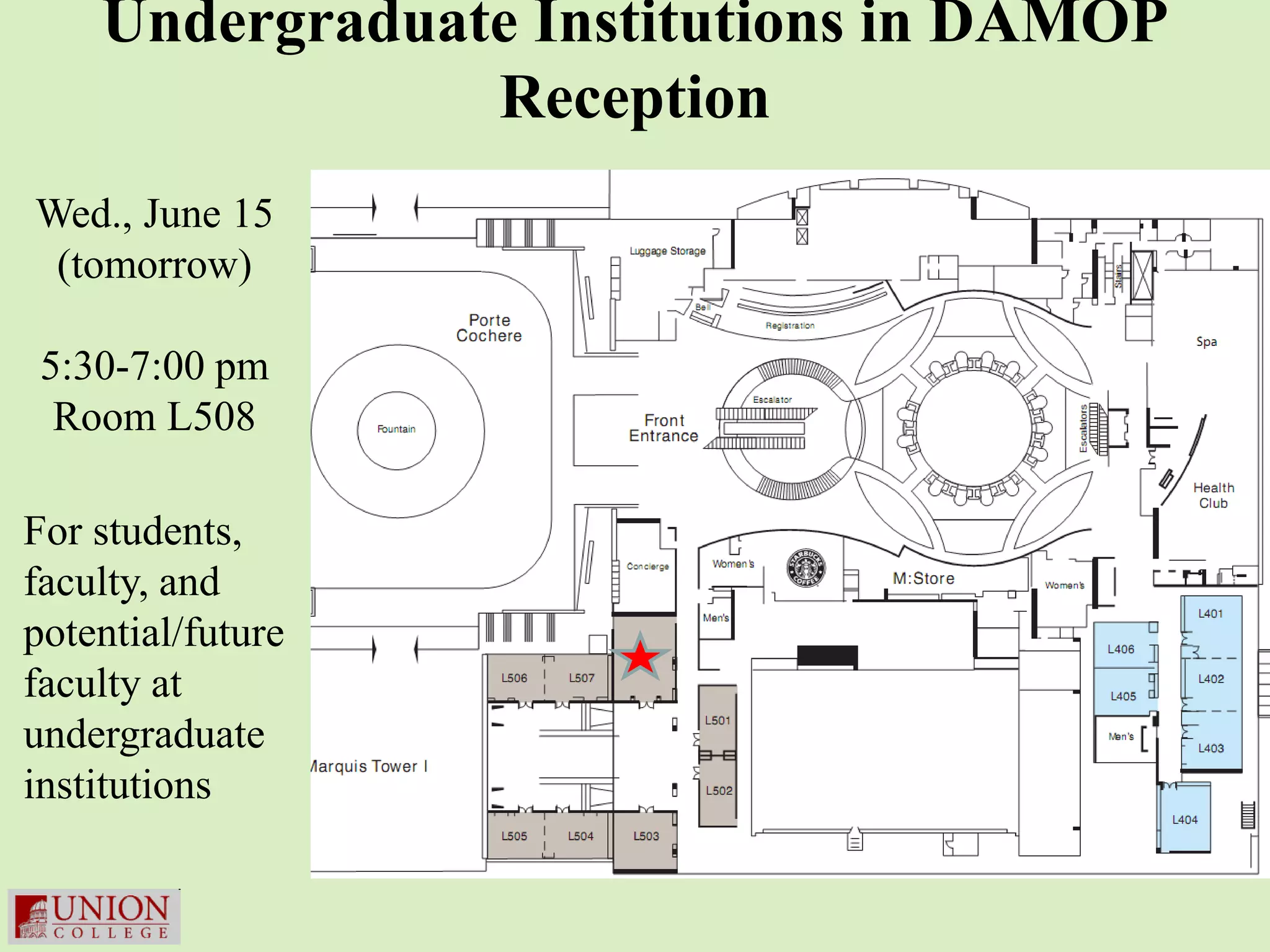
Undergraduate Institutions in DAMOP
                Reception
Wed., June 15
 (tomorrow)

 5:30-7:00 pm
  Room L508

For students,
faculty, and
potential/future
faculty at
undergraduate
institutions
What’s So Interesting About AMO
                 Physics?
I) Ultracold atoms allow studies of superfluids, phase transitions
    with in-situ single-site monitoring

II) Ultrafast lasers and HHG allow studies of atomic and molecular
     dynamics on femto- and atto-second time scales

III) Quantum communication systems allow sharing and maniuplation
     of quantum information over long distances

IV) Understanding of charged-particle interactions allow improved
    astrophysical models, creation of antimatter
V) Ultra-precise laser spectroscopy allows laboratory tests of
    fundamental symmetry, searches for new physics

What's So Interesting About AMO Phyiscs?

  • 1.
    What’s So InterestingAbout AMO Physics? Chad Orzel Department of Physics and Astronomy Union College Schenectady, NY http://slideshare.net/orzelc
  • 3.
    Why This Talk? 2001 DAMOP/ DAMP Meeting 3-4 parallel sessions 270 talks, 293 posters 2011 DAMOP Meeting 6-7 parallel sessions 477 talks, 548 posters http://slideshare.net/orzelc
  • 4.
    Categories Five rough groupsof invited sessions: I) Ultra-Cold Matter Laser cooling, Bose-Einstein Condensation, optical lattices II) Extreme Lasers Ultra-fast lasers (femto-, atto-second), ultra-intense lasers III) Quantum Phenomena Quantum measurement, information, communications IV) “Traditional” AMO Physics Atomic and molecular collisions, spectroscopy V) Precision Measurement Fundamental symmetry tests, atomic clocks
  • 5.
    Thesis Prize Session C6:Tuesday 6/14, 2PM, Room A706 (This room, after lunch) Novel Systems and Methods for Quantum Communication, Quantum Computation, and Quantum Simulation (I, III) Alexey Gorshkov Bright Attosecond Soft and Hard X-ray Supercontinua (II) Tenio Popmintchev Many-body physics with ultracold bosons in 1D geometry (I) Elmar Haller First practical application of quantum weak measurements, used to perform the first experimental investigations of the (III) Spin Hall Effect of Light Onur Hosten
  • 6.
    “Hot Topics” Session U6:Friday 6/17 10:30 AM Room A706 Atom Trap Trace Analysis (V, I) Zheng-Tian Lu Improved Measurement of the Electron EDM (V) E.A. Hinds Sequential Double Ionization: The Timing of Release (II, IV) A.N. Pfeiffer 14-qubit entanglement: creation and coherence Julio Barreiro (III, I)
  • 7.
    Ultra-Cold Matter Invited TalkSessions: H4: Focus: Phases of Strongly Interacting Cold Gases Wed: J4: Atom Circuits M6: Focus: In-situ Imaging of Ultracold Atomic Gases Thurs: N6: Ultracold Molecules P6: Few-body Ultracold Systems T2: Non-Equilibrium and Cooperativity in Ultracold Systems Fri: T6: Focus: Synthetic Gauge Fields in Ultracold Systems U4: Cold Rydberg Gases
  • 8.
    Ultracold Gases Laser Cooling Use light forces to slow atomic motion (neutral atoms, ions) Collect large numbers of atoms in MOT T~1-100 µK (0.1-10 neV) Na MOT, NIST Evaporative Cooling Remove high-energy atoms from sample Increase in phase-space density Bose-Einstein Condensation at Tc ~ 1nK First Rb BEC, JILA, 1995
  • 9.
    BEC in OpticalLattices Use interference/holography to make periodic potential for cold atoms Depths ~1-100 ER Competition between tunneling and collisions ˆ =a + 1 U ∑ n (n − 1) H − J ∑ ai† ˆ j ˆ ˆi ˆi i, j 2 i Tunneling between lattice sites On-site Interactions Phase transition: from: I. Bloch, Nature Physics 1, 23 - 30 (2005) doi:10.1038/nphys138 Superfluid  Mott Insulator
  • 10.
    In-Situ Lattice Imaging Combine2-D optical lattice with high-resolution imaging Image individual lattice sites From J.F. Sherson et al Nature 467, 68 (2010) doi:10.1038/nature09378
  • 11.
    In-Situ Imaging Monitor phasetransition through site occupation From W.S. Bakr et al, Science 329 547-550 (2010) DOI: 10.1126/science.1192368
  • 12.
    Single-Site Control From C.Weitenburg et al., Nature 471, 319 (2011) doi:10.1038/nature09827
  • 13.
    Extreme Lasers Invited TalkSessions: Tues: C2: Ultrafast and Intense X-Rays Wed: J6: Attosecond Spectroscopy M4: Focus: Recollision Physics Thurs: P2: Focus: Time-resolved Spectroscopy with HHG and FEL Fri: T4: Intense Field Physics
  • 14.
    High Harmonic Generation 1)Intense fs pulse ionizes target gas 2) Laser field accelerates electrons 3) Electron recombination From Popmintchev et al. DOI: 10.1038/Nphoton.2010.256 produces EUV/ X-Ray light attosecond duration From Chen et al. PRL 105, 173901 (2010)
  • 15.
    Pump-Probe Spectroscopy Intense IRpulse 1) Creates as EUV pulse 2) Excites target gas Delay EUV pulse, measure absorption, photoemission  Follow atomic, molecular dynamics on sub-fs time scales J6: Attosecond Spectroscopy E. Goulielmakis et al Nature 466, 739 (2010) doi:10.1038/nature09212
  • 16.
    Ultrafast Dynamics Valence ElectronMotion: Delay in photoemission of electron: E. Goulielmakis et al Nature 466, 739 (2010) M. Schultze, et al. Science 328, 1658 (2010); doi:10.1038/nature09212 DOI: 10.1126/science.1189401
  • 17.
    Quantum Phenomena Invited TalkSessions: H2: Focus: Advances in NV Centers Wed: K6: Advances in Quantum Communications N4: Quantum Measurement and Control of Spin Ensembles Thurs: P4: Focus: Progress in Cavity Opto-Mechanics
  • 18.
    Quantum Communications Qubits: 2-statesystems (spin-1/2, photon polarization, atomic levels) | Ψ > α | 0 > +β | 1 > = Arbitrary superposition of 0 and 1 1 0  new possibilities for computation Key issues: Decoherence  Must preserve superposition Scalability  Must be able to add qubits Quantum communication  Connect qubits in different places
  • 19.
    Entanglement and Communication Entangledstate: State of one particle determined by state of other | Ψ= α | 0 >1| 0 > 2 + β |1 >1|1 > 2 12 > 1 1 0 0 Correlation is non-local Does not depend on distance between particles, measurement time Quantum correlation stronger than possible classically  Bell Inequalities Entanglement provides resource for communicating arbitrary states  Quantum Teleportation
  • 20.
    Storage and Transmission Storequbit in spin state of cold atoms Convert to telecom wavelength S=2.64±0.12 100m optical fiber, convert back 5-σ Bell violation Dudin et al., Phys. Rev. Lett. 105, 260502 (2010) DOI: 10.1103/PhysRevLett.105.260502
  • 21.
    Free-Space Teleportation Send arbitrarystate 16 km through free space, 87% fidelity X. M. Jin et al Nature Photonics 4, 376 (2010) doi:10.1038/nphoton.2010.87
  • 22.
    “Traditional” AMO Physics InvitedTalk Sessions: Tues: C1: Positron-Matter Interactions and Antihydrogen H6: Advances in Gaseous Electronics Wed: K1: Focus: Recent Advances in Collision Studies M1: Focus: Photoionization Spectroscopy Thurs: N6: AMO Science for Laboratory and Astrophysical Environments Fri: T1: Focus: Electronic, Atomic, and Molecular Collision Studies
  • 23.
    “Traditional” AMO Spectroscopy, chargedparticle collisions, photoionization Critically important for atmospheric and astrophysical processes N6: AMO Science for Laboratory and Astrophysical Environments H6.00001 : Why isn't the atmosphere completely ionized? Thomas Miller, Boston College and AFRL From H. Kreckel et al. Science 329, 69 (2010) DOI: 10.1126/science.1187191
  • 24.
    Trapped Antihydrogen Antiprotons, positrons combined in trap Antihydrogen formed, trapped for 1000s ALPHA Collaboration, Nature Physics (2011) doi:10.1038/nphys2025
  • 25.
    Antihydrogen Beam Cusp trap for efficient extraction of spin-polarized beam Goal of precision microwave spectroscopy Y. Enomoto et al. Phys. Rev. Lett. 105, 243401 (2010) DOI: 10.1103/PhysRevLett.105.243401
  • 26.
    Precision Measurement Invited TalkSessions: Wed: J2: Fundamental Symmetry Tests Fri: U6: Hot Topics Atom Trap Trace Analysis Zheng-Tian Lu Improved Measurement of the Electron EDM E.A. Hinds
  • 27.
    Proton Size Laser spectroscopy of muonic hydrogen Lamb shift Proton 4% smaller than CODATA value!!! Pohl et al. Nature 466, 213 (2010) doi:10.1038/nature09250
  • 28.
    Everyday Relativity Trapped Al+ion “quantum logic” clocks Measure relativistic shifts due to ion motion, elevation Time dilation for v<10m/s 33cm change in elevation Chou et al. Science 329, 1630 (2010) DOI: 10.1126/science.1192720
  • 29.
    What’s So InterestingAbout AMO Physics? I) Ultracold atoms allow studies of superfluids, phase transitions with in-situ single-site monitoring II) Ultrafast lasers and HHG allow studies of atomic and molecular dynamics on femto- and atto-second time scales III) Quantum communication systems allow sharing and maniuplation of quantum information over long distances IV) Understanding of charged-particle interactions allow improved astrophysical models, creation of antimatter V) Ultra-precise laser spectroscopy allows laboratory tests of fundamental symmetry, searches for new physics
  • 30.
    Undergraduate Institutions inDAMOP Reception Wed., June 15 (tomorrow) 5:30-7:00 pm Room L508 For students, faculty, and potential/future faculty at undergraduate institutions
  • 31.
    What’s So InterestingAbout AMO Physics? I) Ultracold atoms allow studies of superfluids, phase transitions with in-situ single-site monitoring II) Ultrafast lasers and HHG allow studies of atomic and molecular dynamics on femto- and atto-second time scales III) Quantum communication systems allow sharing and maniuplation of quantum information over long distances IV) Understanding of charged-particle interactions allow improved astrophysical models, creation of antimatter V) Ultra-precise laser spectroscopy allows laboratory tests of fundamental symmetry, searches for new physics