Adolescent Brain
  Development:


Behavioral Implications
Adolescence
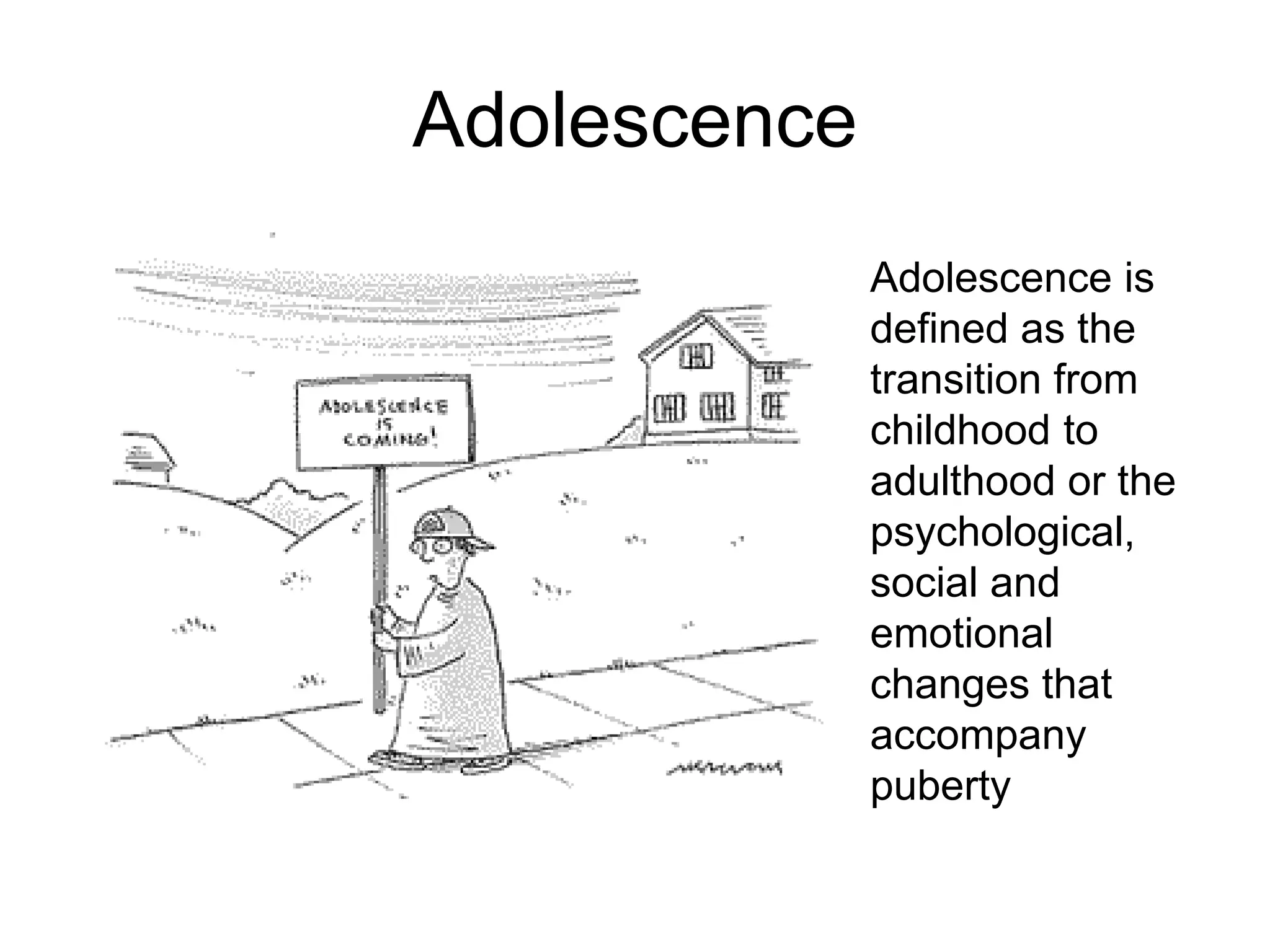
              Adolescence is
              defined as the
              transition from
              childhood to
              adulthood or the
              psychological,
              social and
              emotional
              changes that
              accompany
              puberty
Erikson’s Psychosocial Theory
of Development Adolescence:
Ages 12-18 (or 20 or 22 or 24)
Identity versus role
confusion
A time for testing limits, for
breaking dependent ties, and for
establishing a new identity. Major
conflicts center on clarification of
self-identity, life goals, and life's
meaning. Failure to achieve a
sense of identity results in role
confusion.
Brain Development Overview

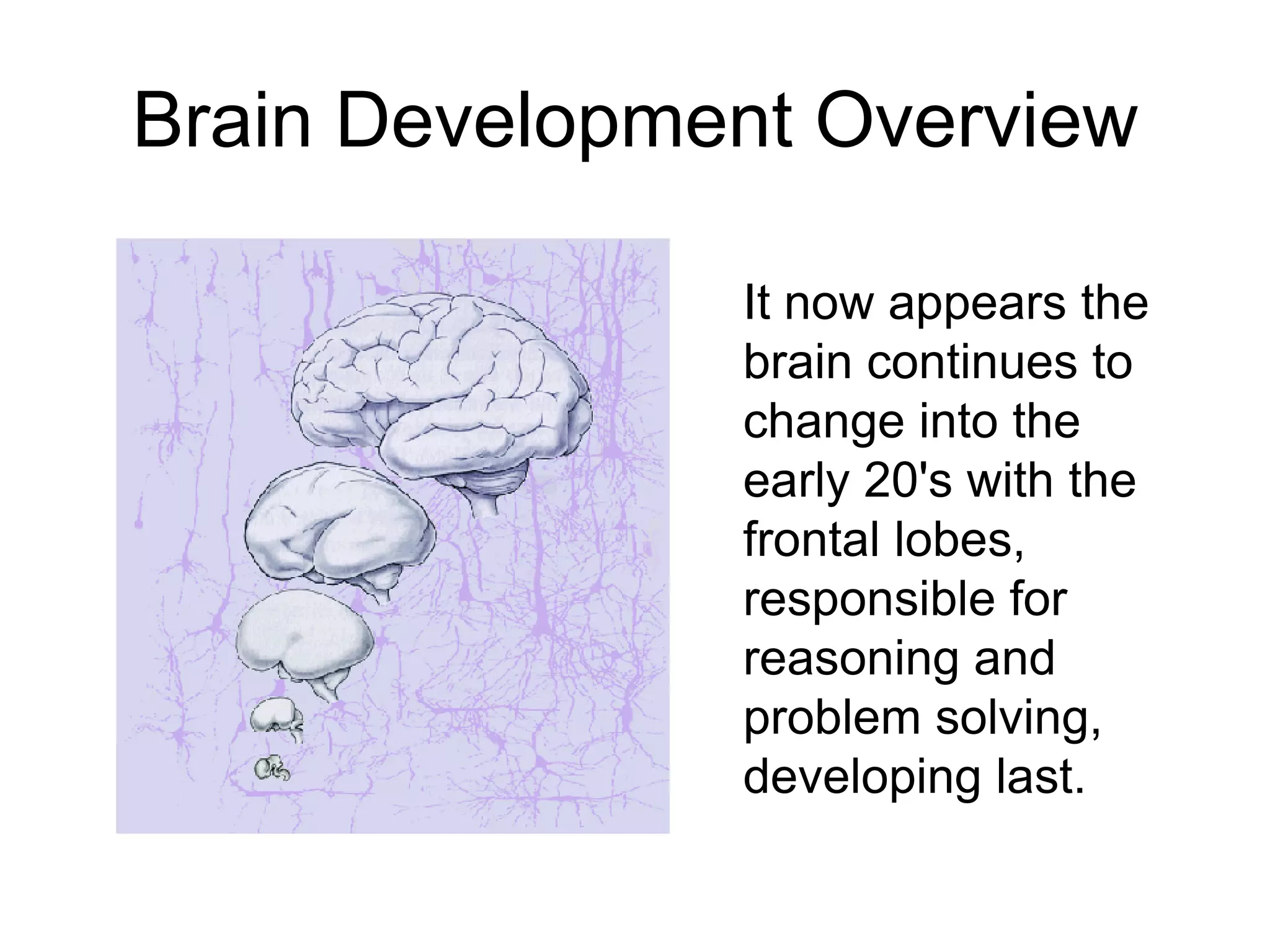
               It now appears the
               brain continues to
               change into the
               early 20's with the
               frontal lobes,
               responsible for
               reasoning and
               problem solving,
               developing last.
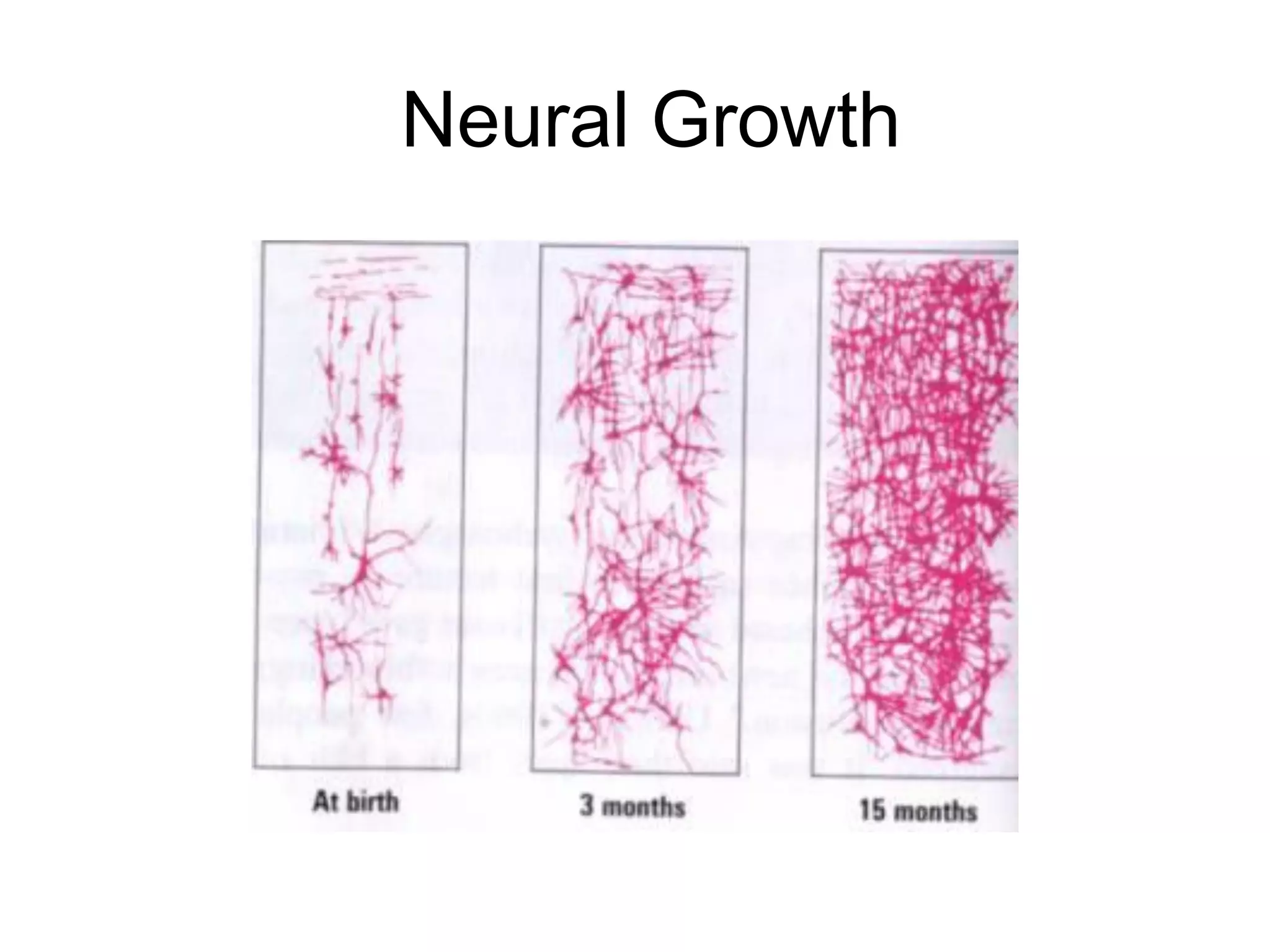
Neural Growth
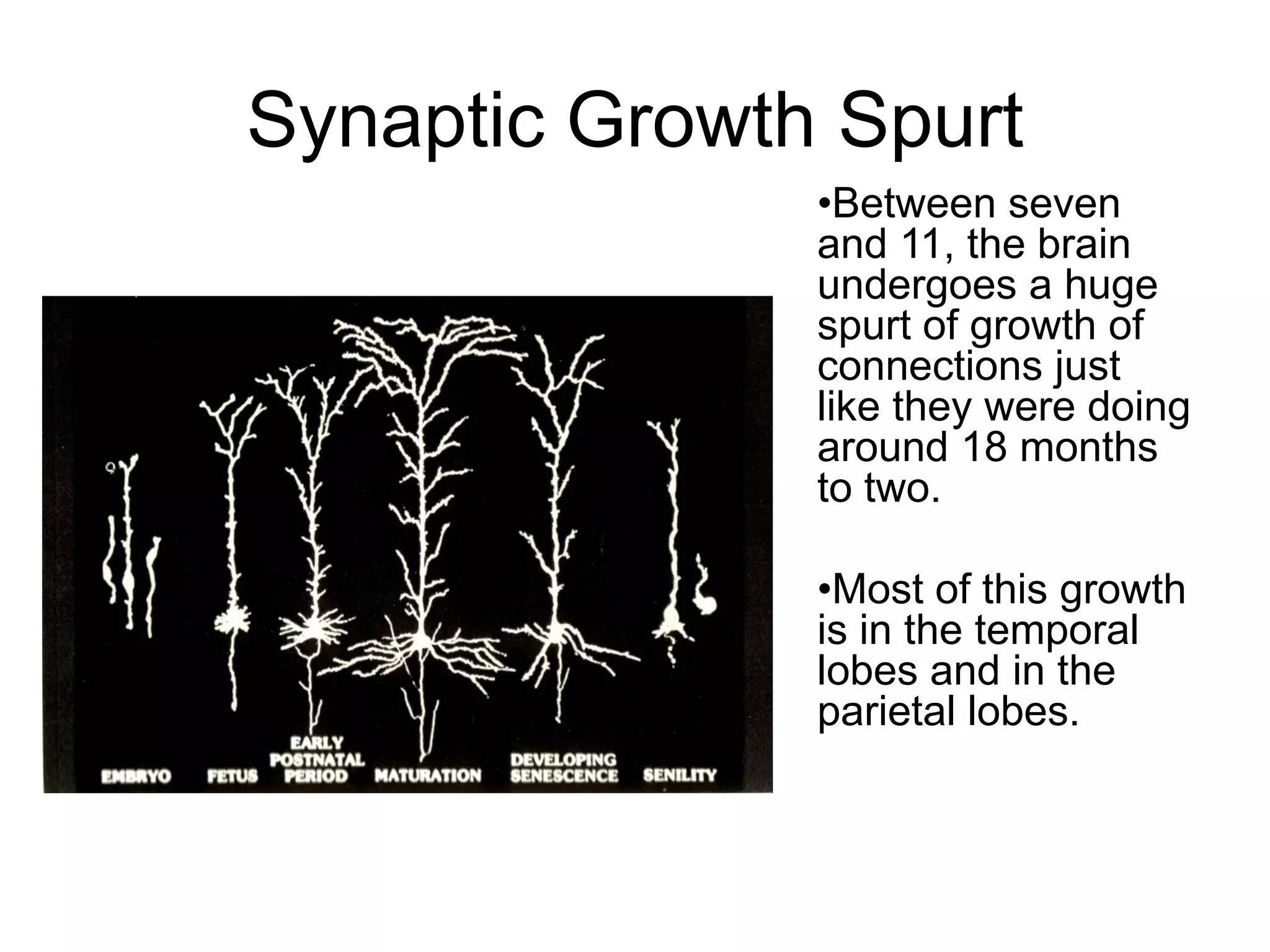
Synaptic Growth Spurt
               •Between seven
               and 11, the brain
               undergoes a huge
               spurt of growth of
               connections just
               like they were doing
               around 18 months
               to two.

               •Most of this growth
               is in the temporal
               lobes and in the
               parietal lobes.
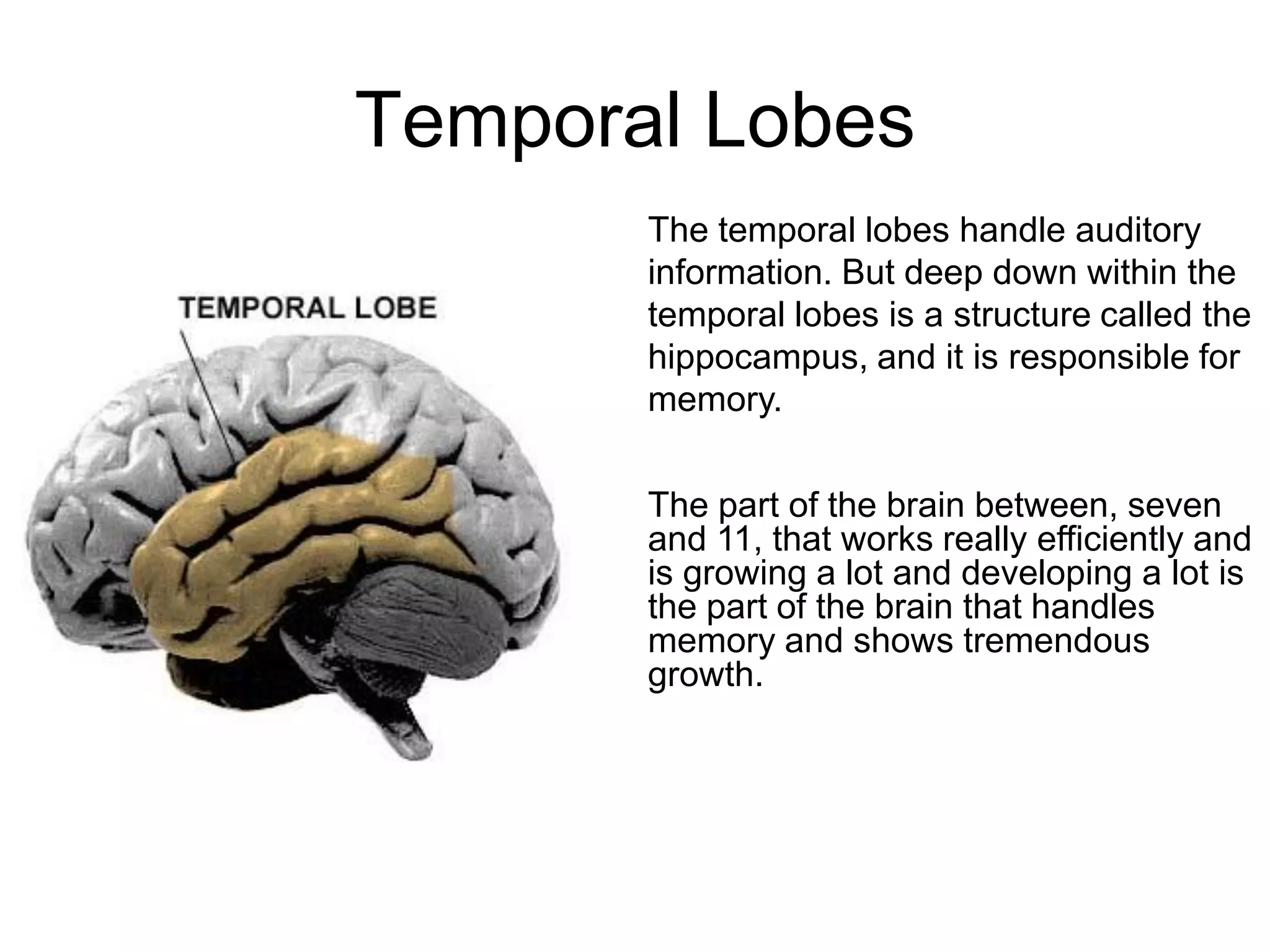
Temporal Lobes
       The temporal lobes handle auditory
       information. But deep down within the
       temporal lobes is a structure called the
       hippocampus, and it is responsible for
       memory.

       The part of the brain between, seven
       and 11, that works really efficiently and
       is growing a lot and developing a lot is
       the part of the brain that handles
       memory and shows tremendous
       growth.
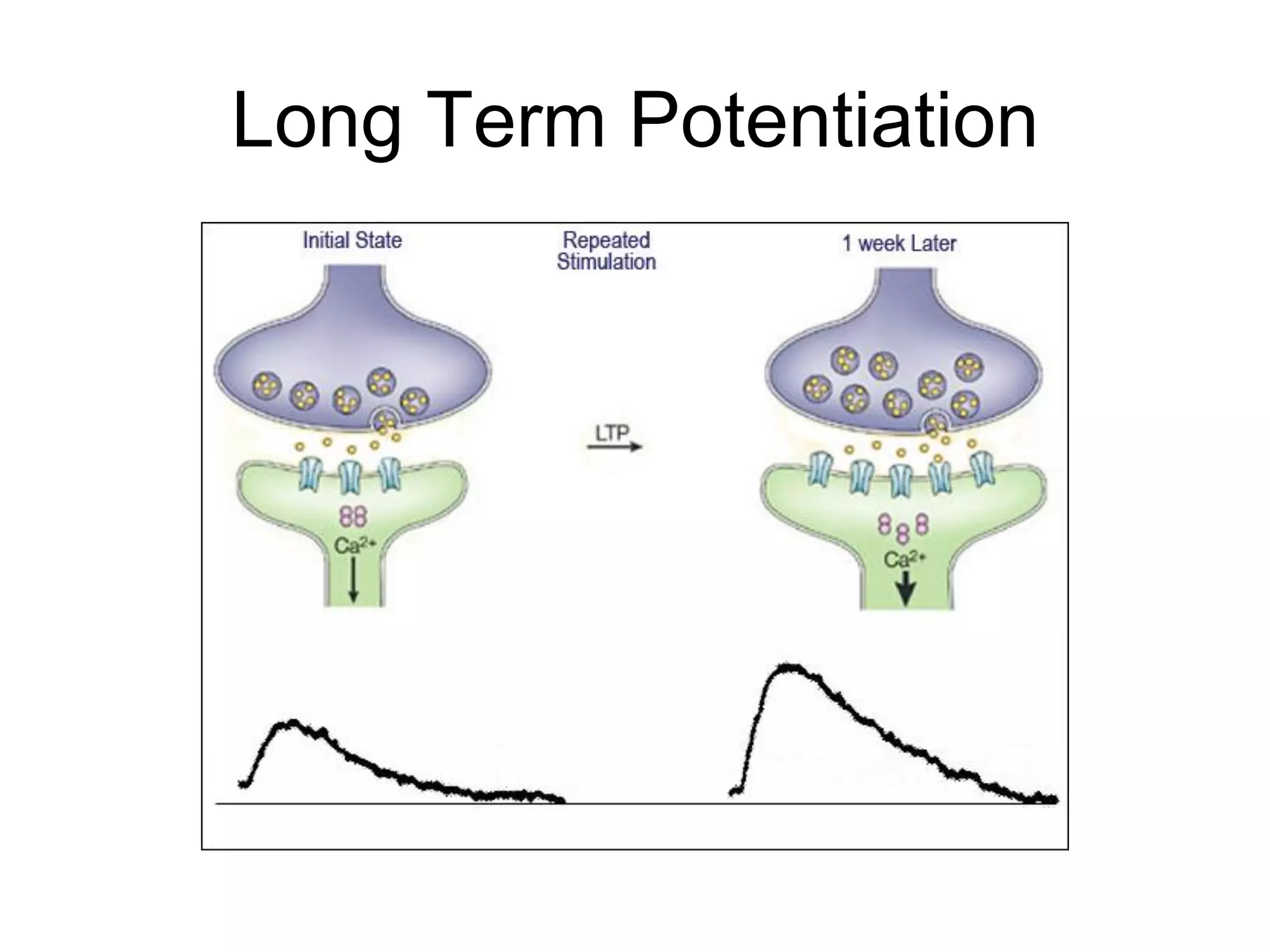
Long Term Potentiation
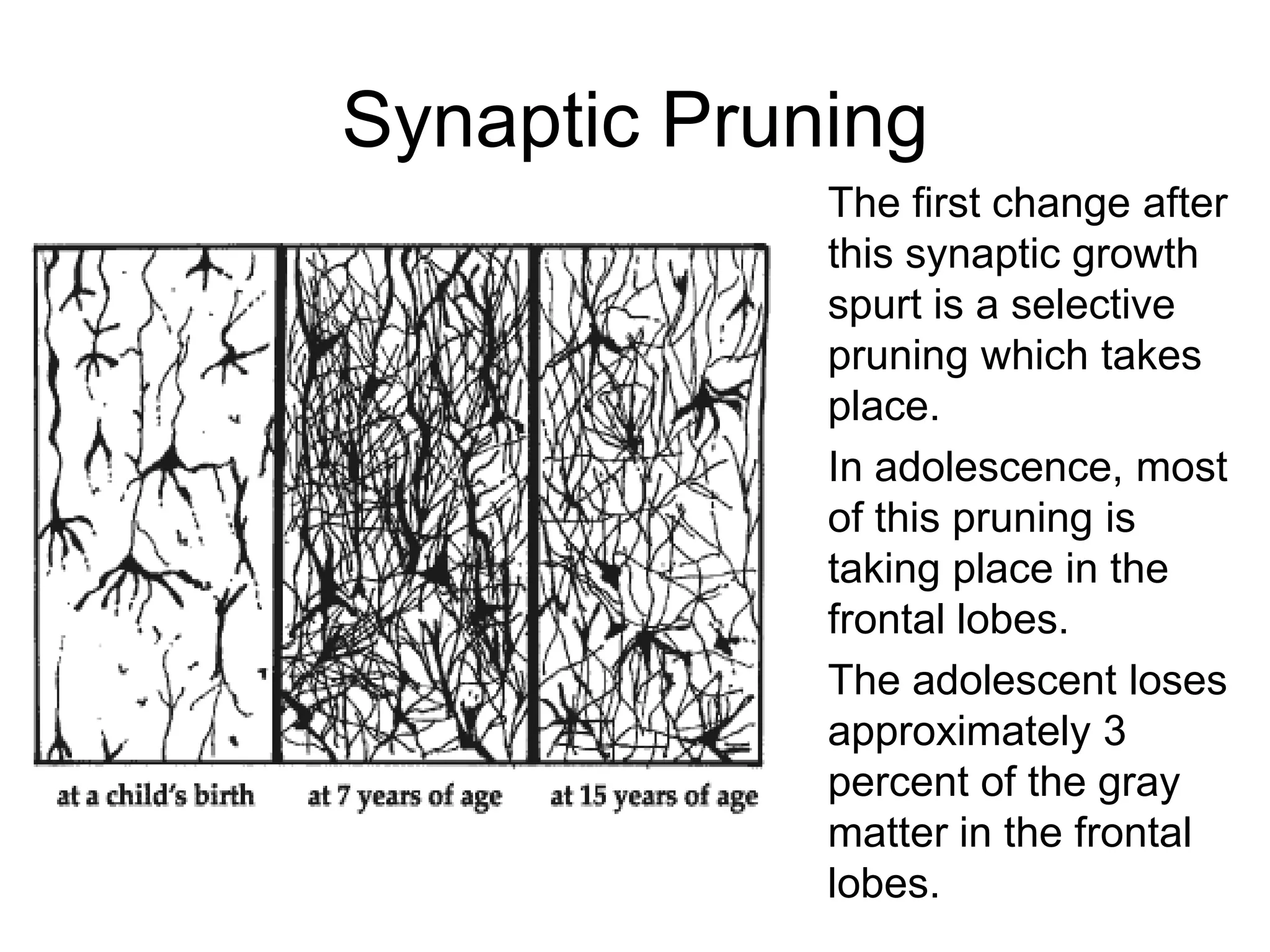
Synaptic Pruning
             The first change after
             this synaptic growth
             spurt is a selective
             pruning which takes
             place.
             In adolescence, most
             of this pruning is
             taking place in the
             frontal lobes.
             The adolescent loses
             approximately 3
             percent of the gray
             matter in the frontal
             lobes.
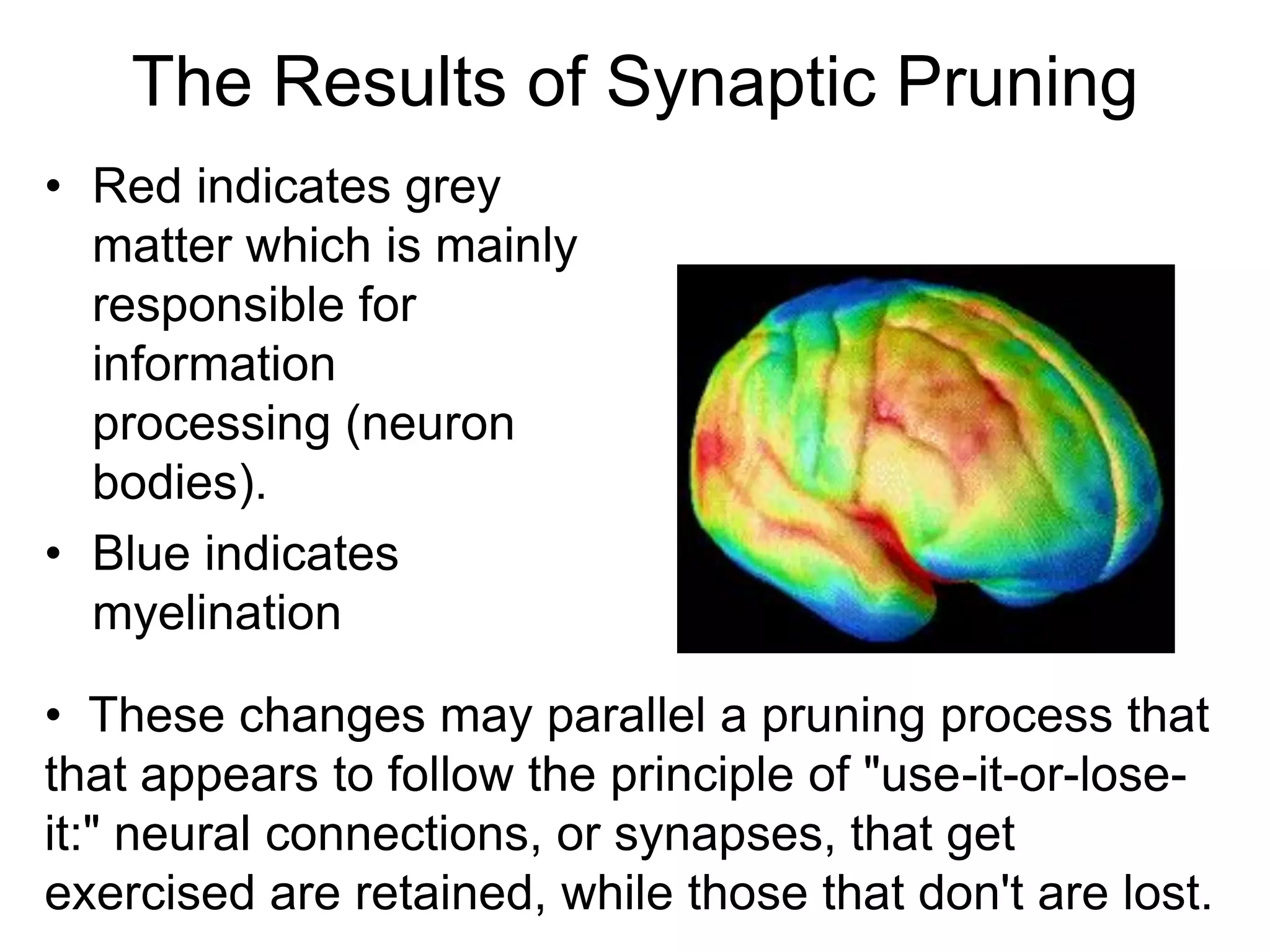
The Results of Synaptic Pruning
• Red indicates grey
  matter which is mainly
  responsible for
  information
  processing (neuron
  bodies).
• Blue indicates
  myelination

• These changes may parallel a pruning process that
that appears to follow the principle of "use-it-or-lose-
it:" neural connections, or synapses, that get
exercised are retained, while those that don't are lost.
Synaptic Pruning
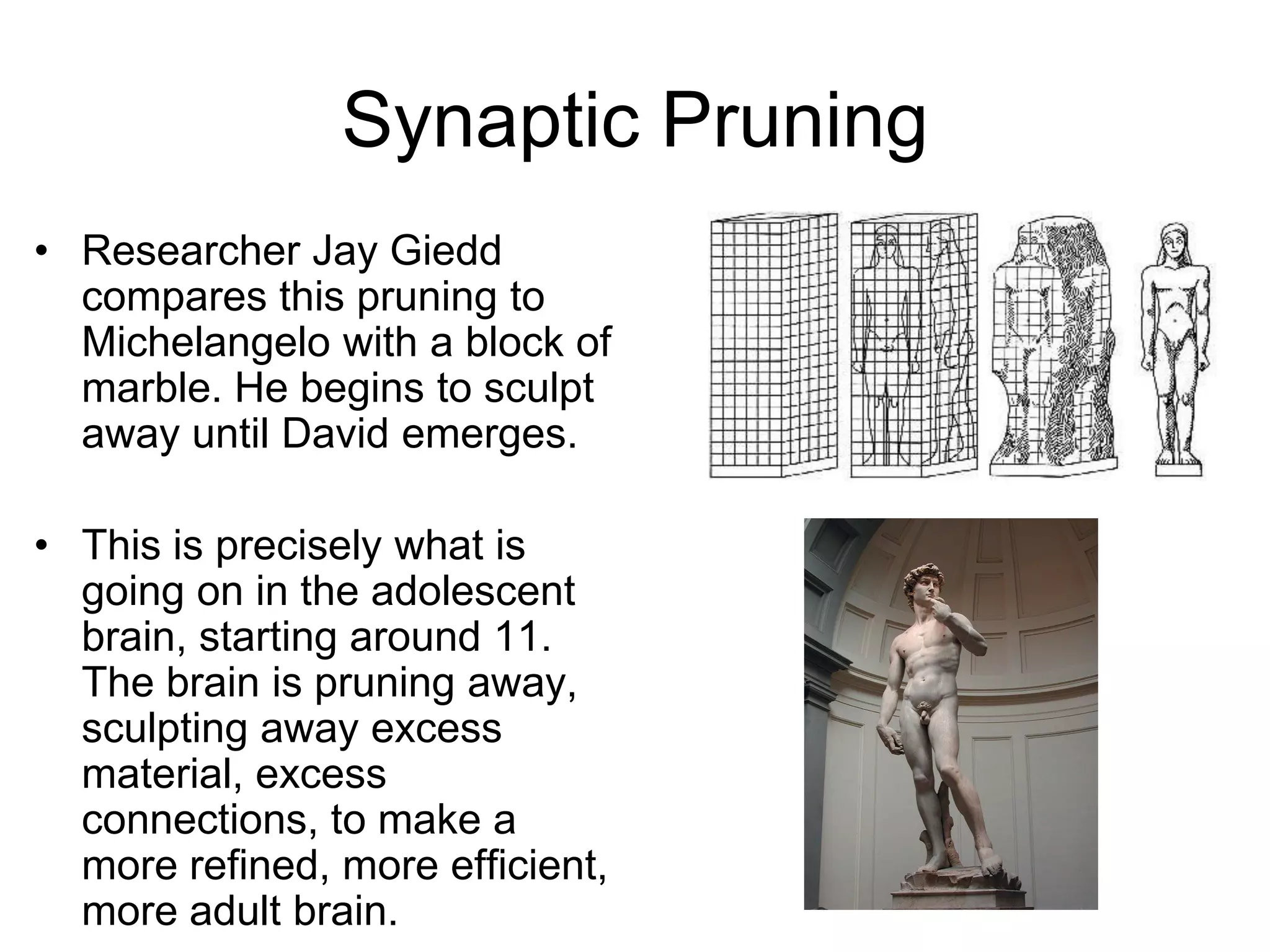
• Researcher Jay Giedd
  compares this pruning to
  Michelangelo with a block of
  marble. He begins to sculpt
  away until David emerges.

• This is precisely what is
  going on in the adolescent
  brain, starting around 11.
  The brain is pruning away,
  sculpting away excess
  material, excess
  connections, to make a
  more refined, more efficient,
  more adult brain.
Adolescent Brain Development:
            Myelination
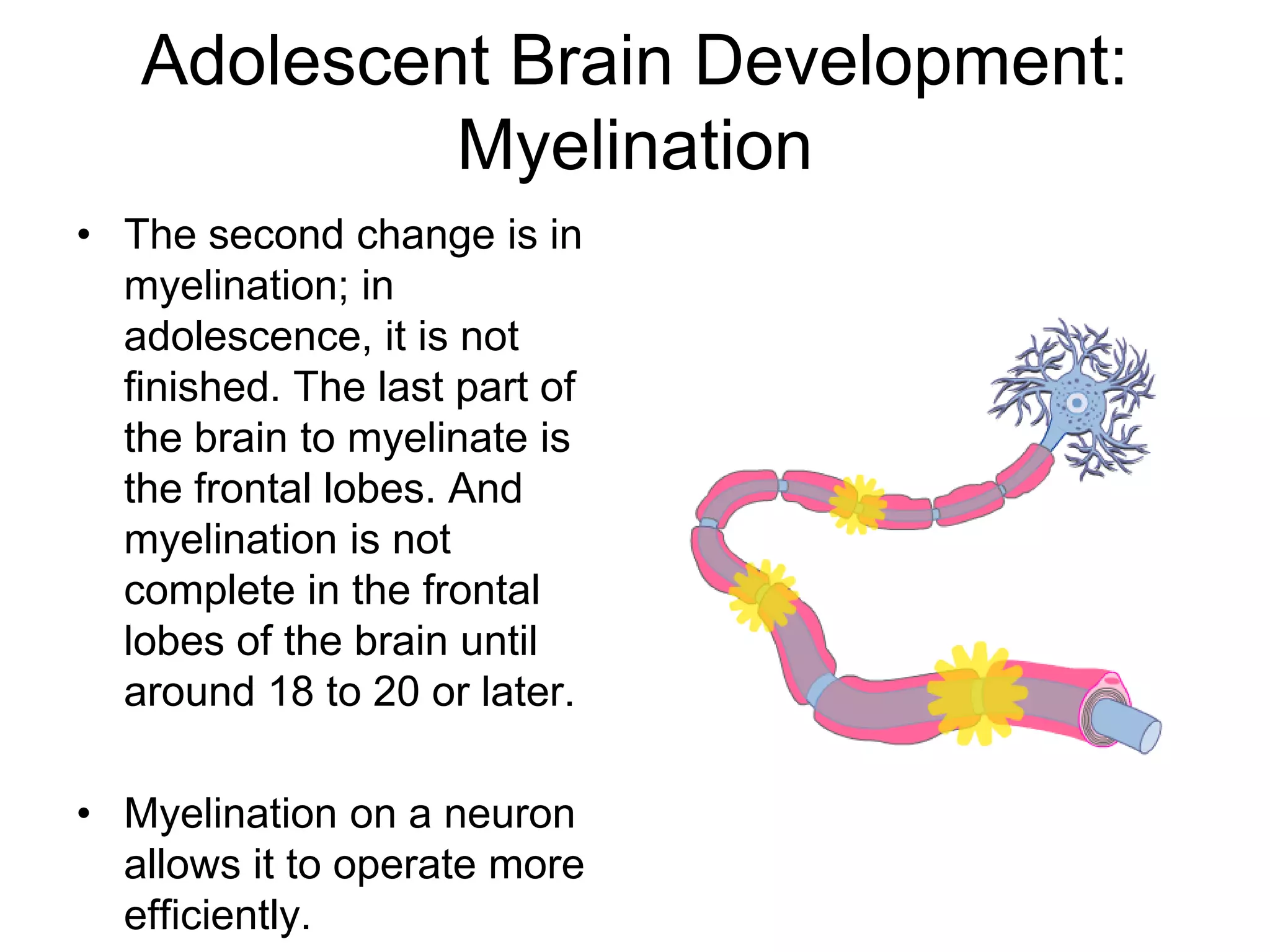
• The second change is in
  myelination; in
  adolescence, it is not
  finished. The last part of
  the brain to myelinate is
  the frontal lobes. And
  myelination is not
  complete in the frontal
  lobes of the brain until
  around 18 to 20 or later.

• Myelination on a neuron
  allows it to operate more
  efficiently.
Adolescent Brain Development:
         Myelination
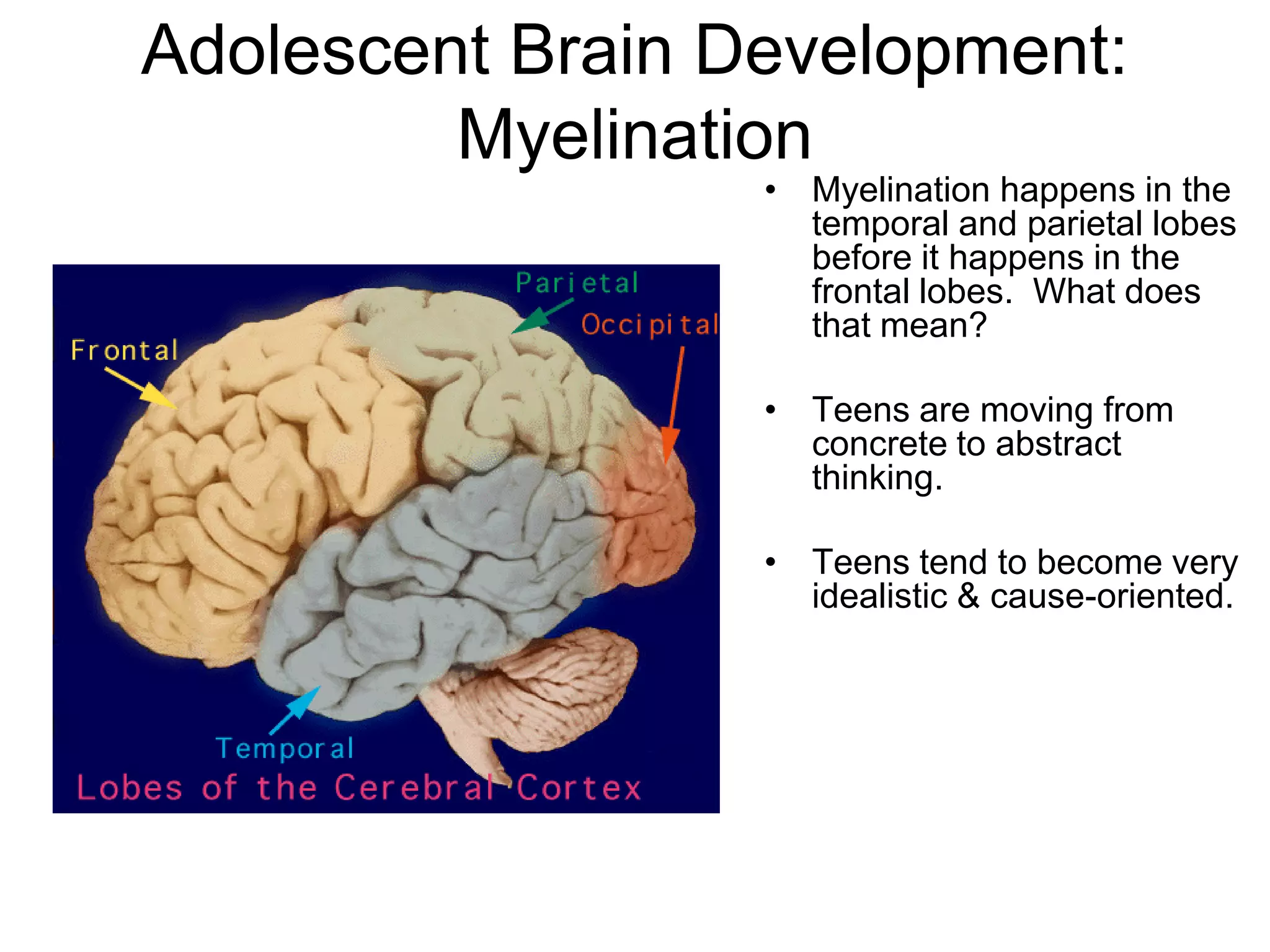
                  • Myelination happens in the
                    temporal and parietal lobes
                    before it happens in the
                    frontal lobes. What does
                    that mean?

                  • Teens are moving from
                    concrete to abstract
                    thinking.

                  • Teens tend to become very
                    idealistic & cause-oriented.
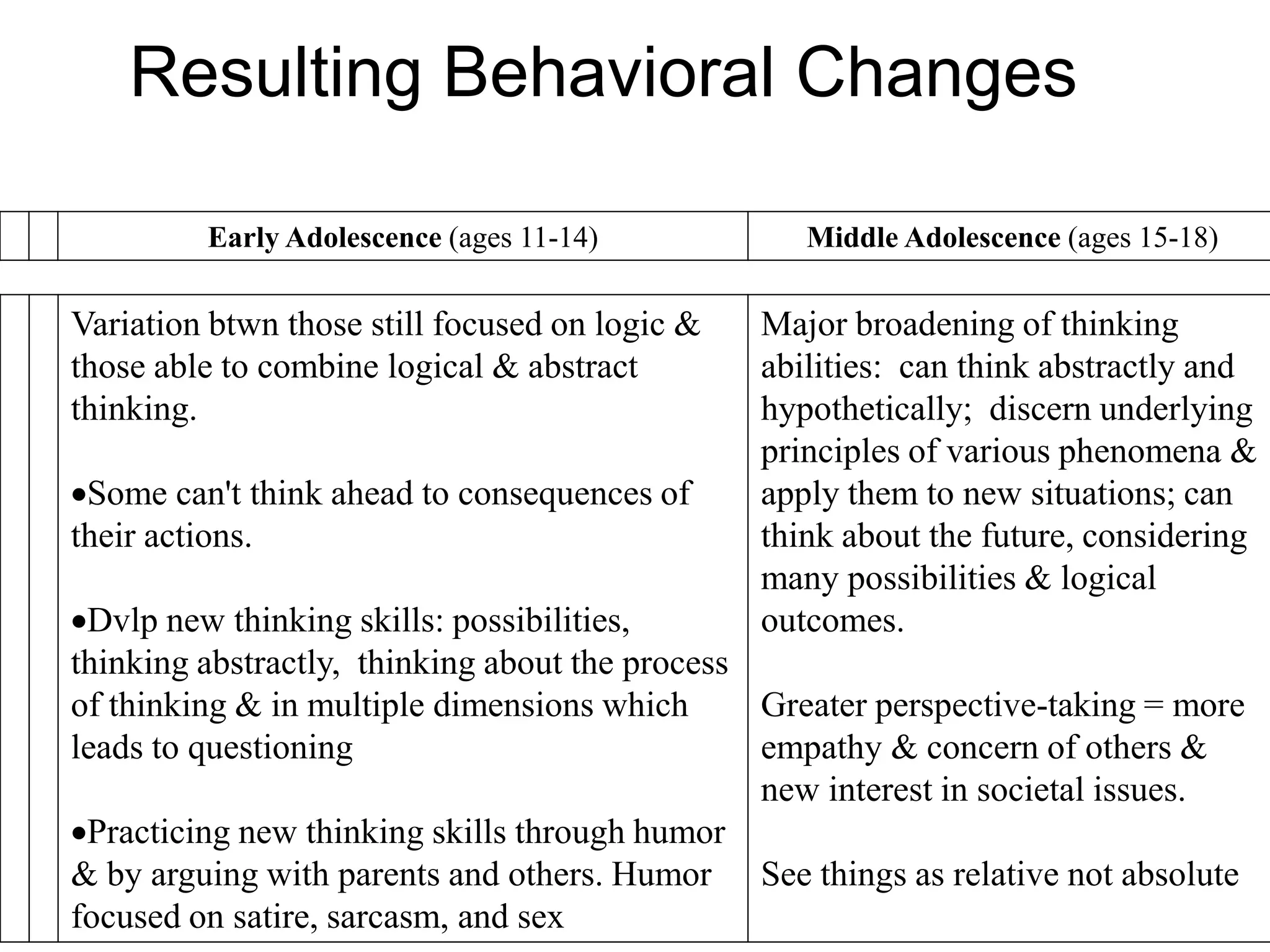
Resulting Behavioral Changes

         Early Adolescence (ages 11-14)            Middle Adolescence (ages 15-18)

Variation btwn those still focused on logic &   Major broadening of thinking
those able to combine logical & abstract        abilities: can think abstractly and
thinking.                                       hypothetically; discern underlying
                                                principles of various phenomena &
Some can't think ahead to consequences of      apply them to new situations; can
their actions.                                  think about the future, considering
                                                many possibilities & logical
Dvlp new thinking skills: possibilities,       outcomes.
thinking abstractly, thinking about the process
of thinking & in multiple dimensions which      Greater perspective-taking = more
leads to questioning                            empathy & concern of others &
                                                new interest in societal issues.
Practicing new thinking skills through humor
& by arguing with parents and others. Humor See things as relative not absolute
focused on satire, sarcasm, and sex
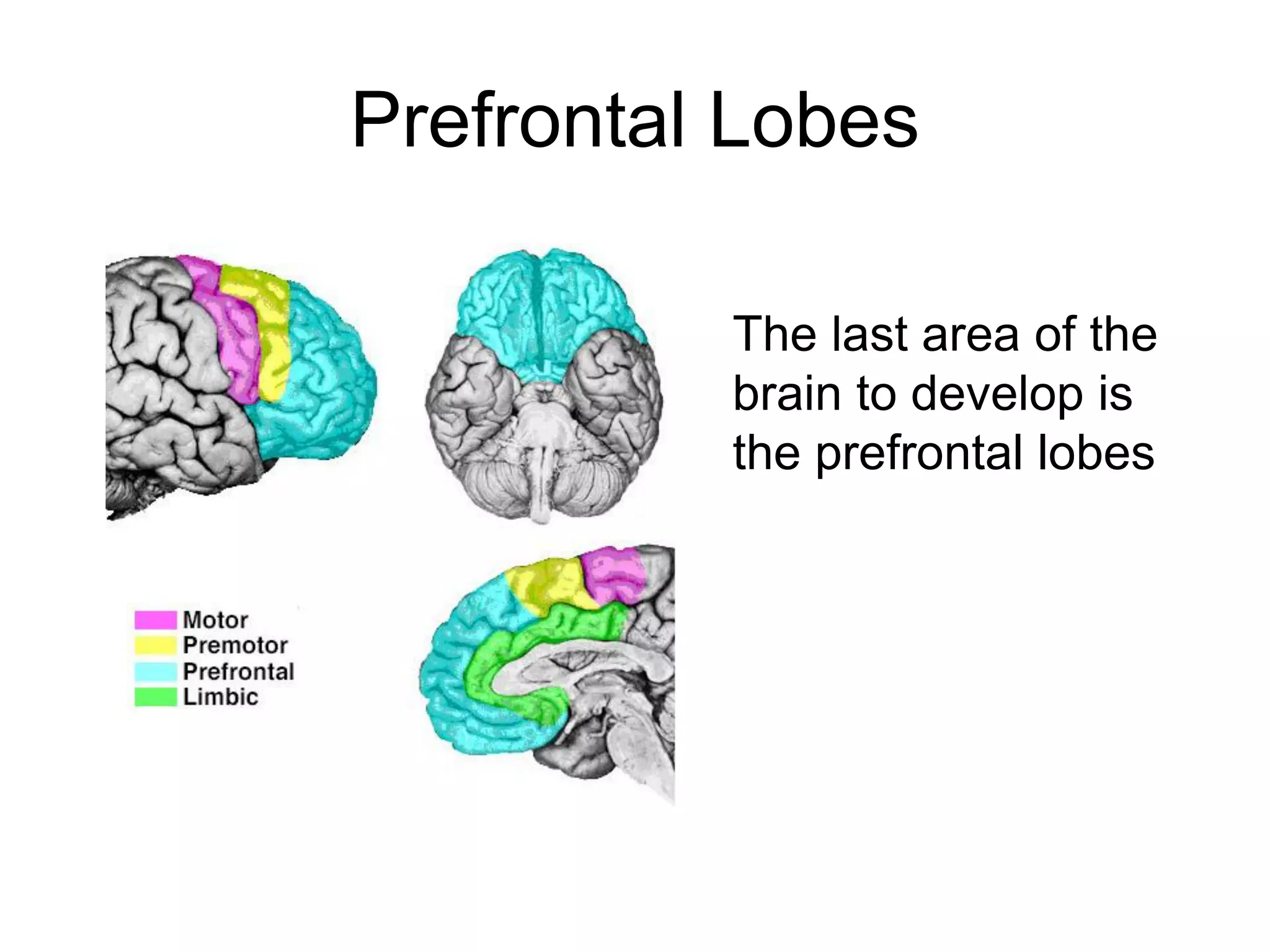
Prefrontal Lobes

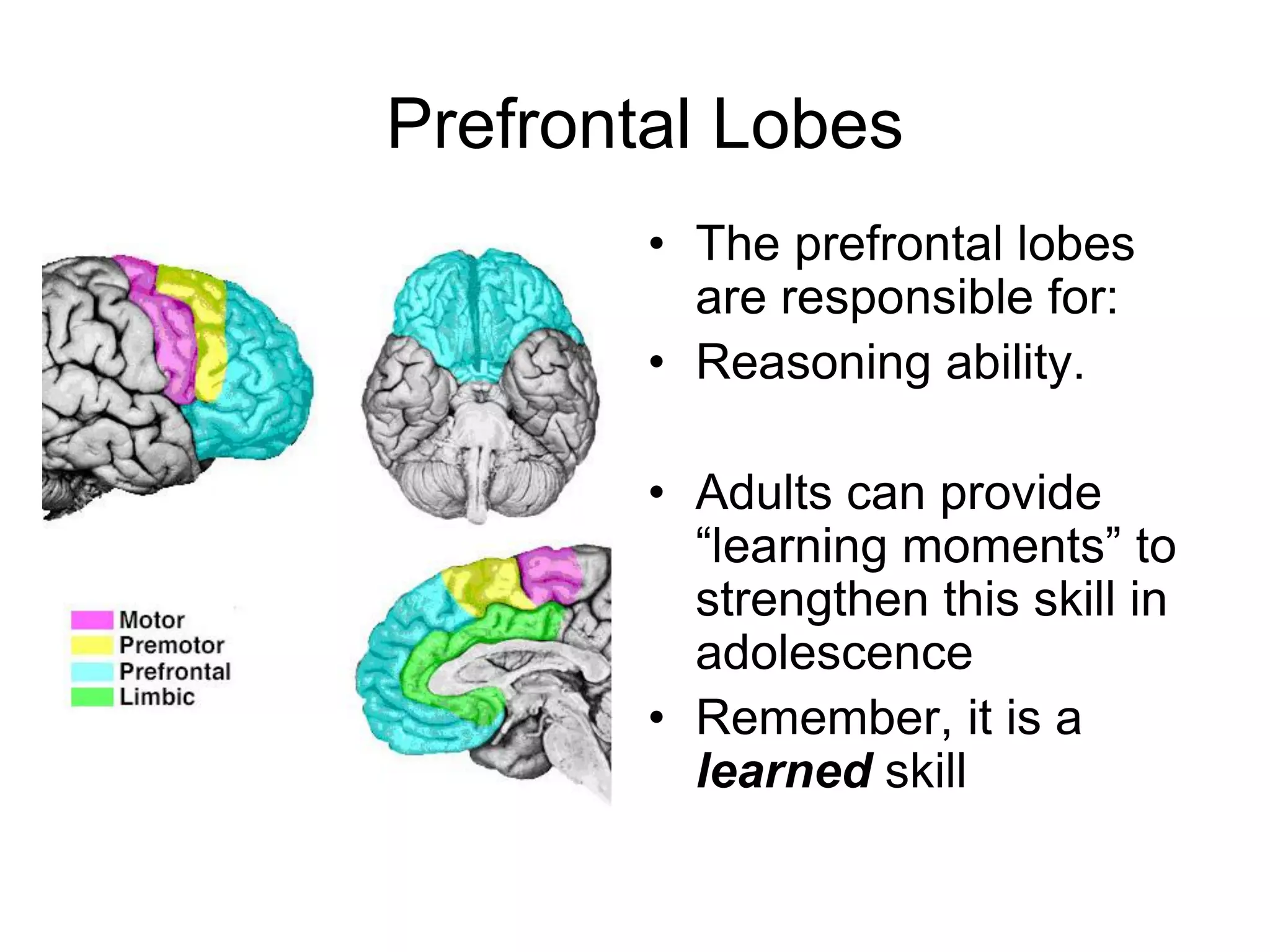
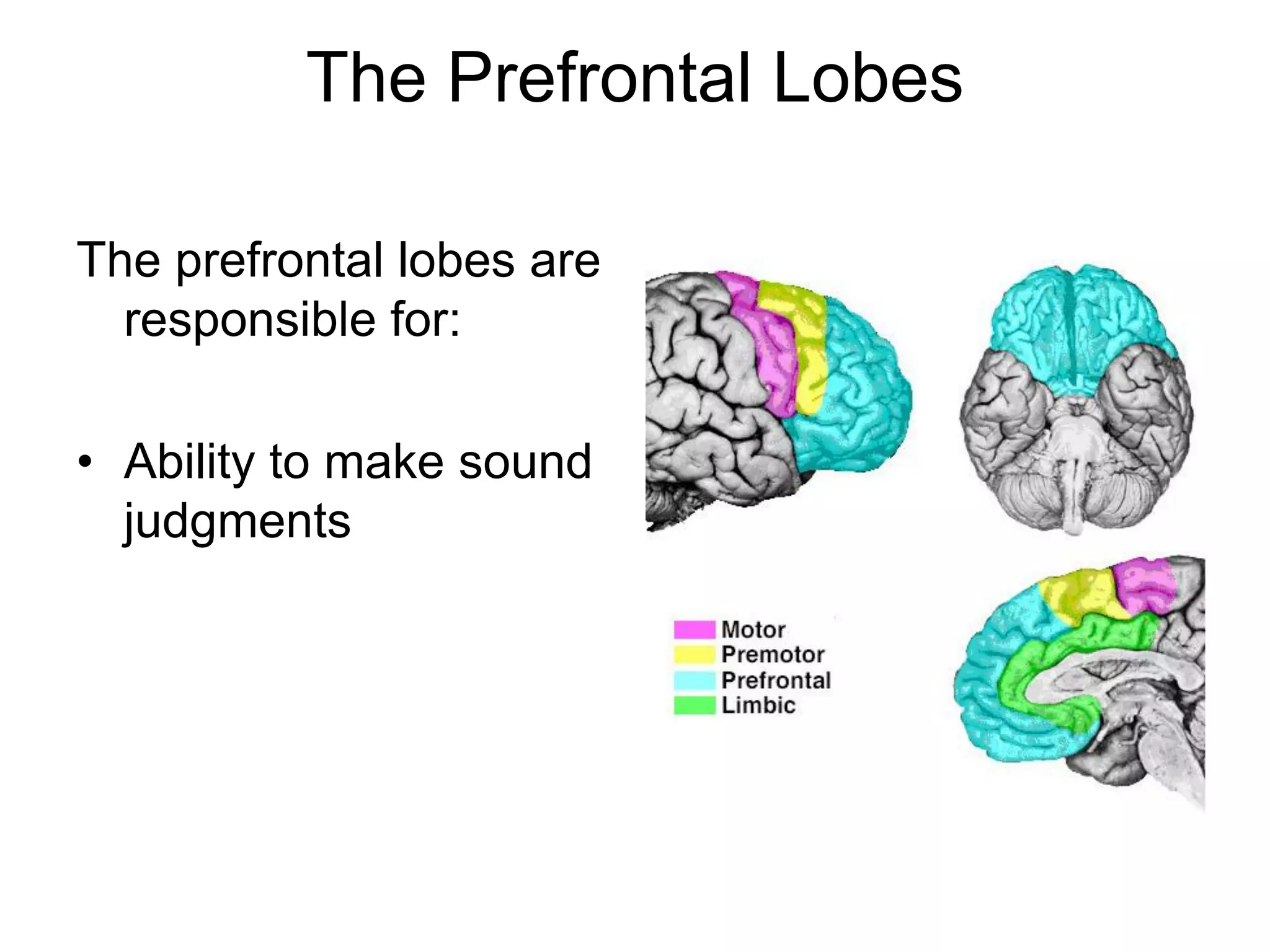
          The last area of the
          brain to develop is
          the prefrontal lobes
Prefrontal Lobes
        • The prefrontal lobes
          are responsible for:
        • Reasoning ability.

        • Adults can provide
          “learning moments” to
          strengthen this skill in
          adolescence
        • Remember, it is a
          learned skill
Prefrontal Lobes
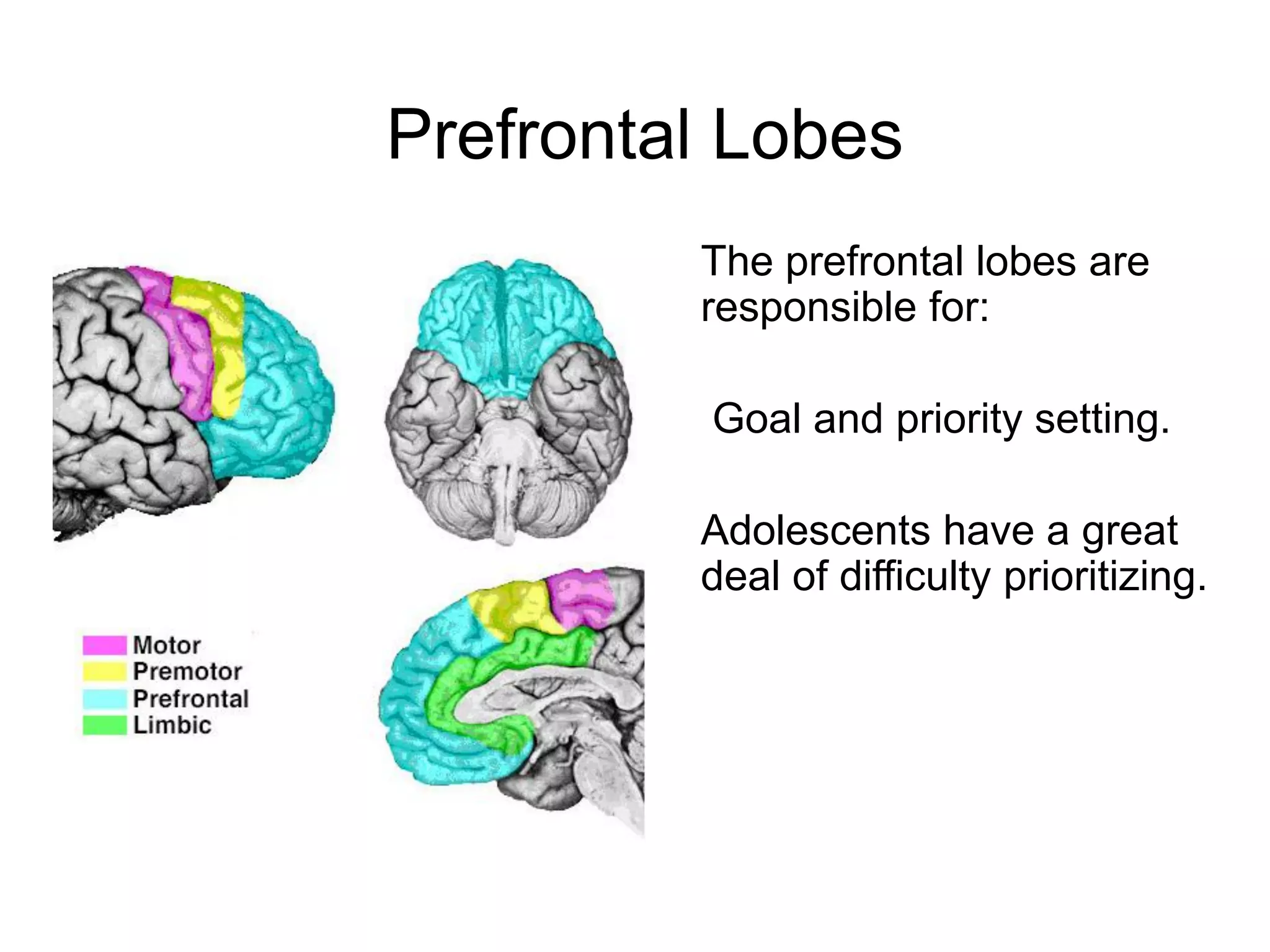
         The prefrontal lobes are
         responsible for:

          Goal and priority setting.

         Adolescents have a great
         deal of difficulty prioritizing.
Prefrontal Lobes
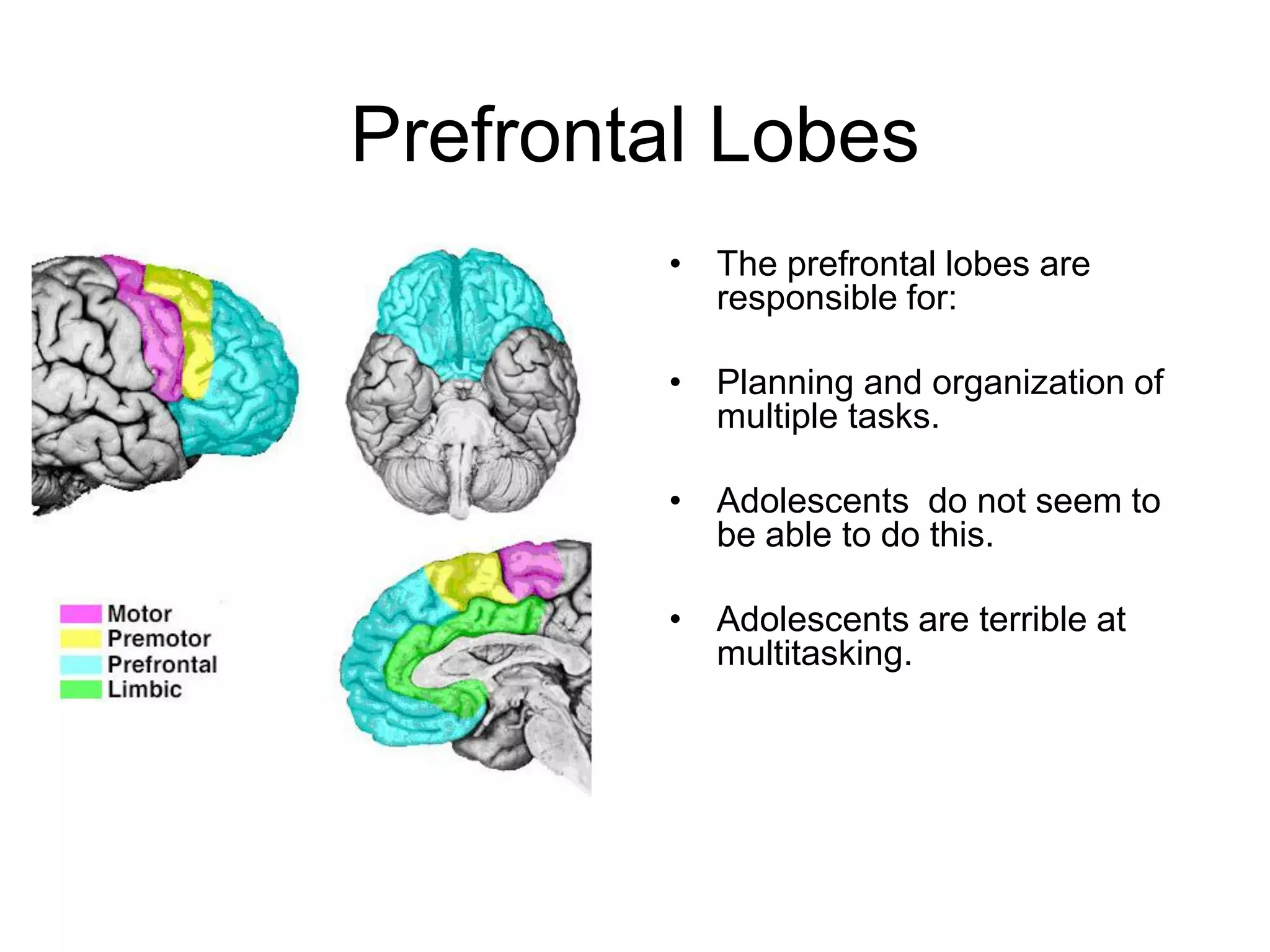
        • The prefrontal lobes are
          responsible for:

        • Planning and organization of
          multiple tasks.

        • Adolescents do not seem to
          be able to do this.

        • Adolescents are terrible at
          multitasking.
Prefrontal Lobes
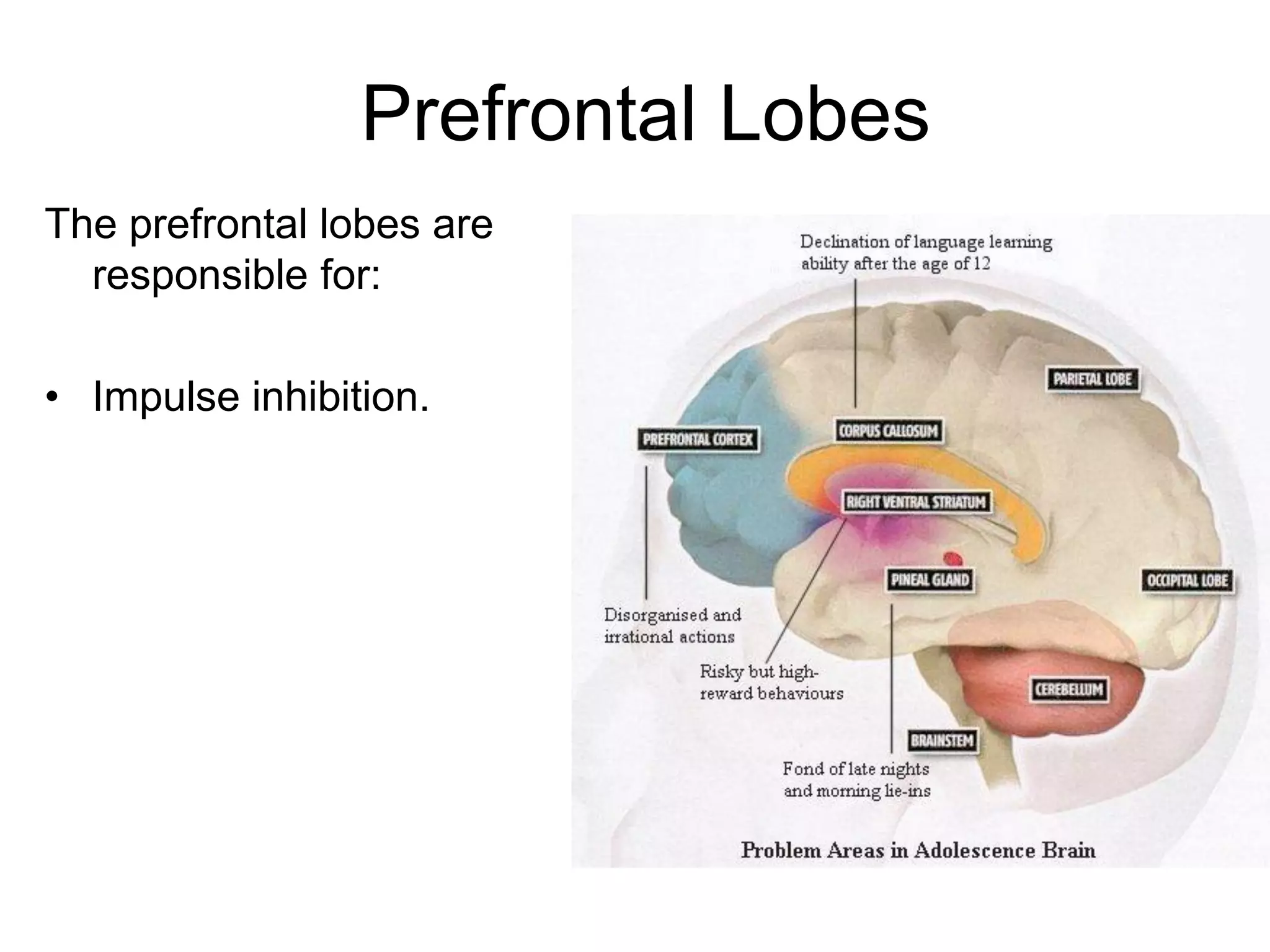
The prefrontal lobes are
  responsible for:

• Impulse inhibition.
Resulting Behavioral Change
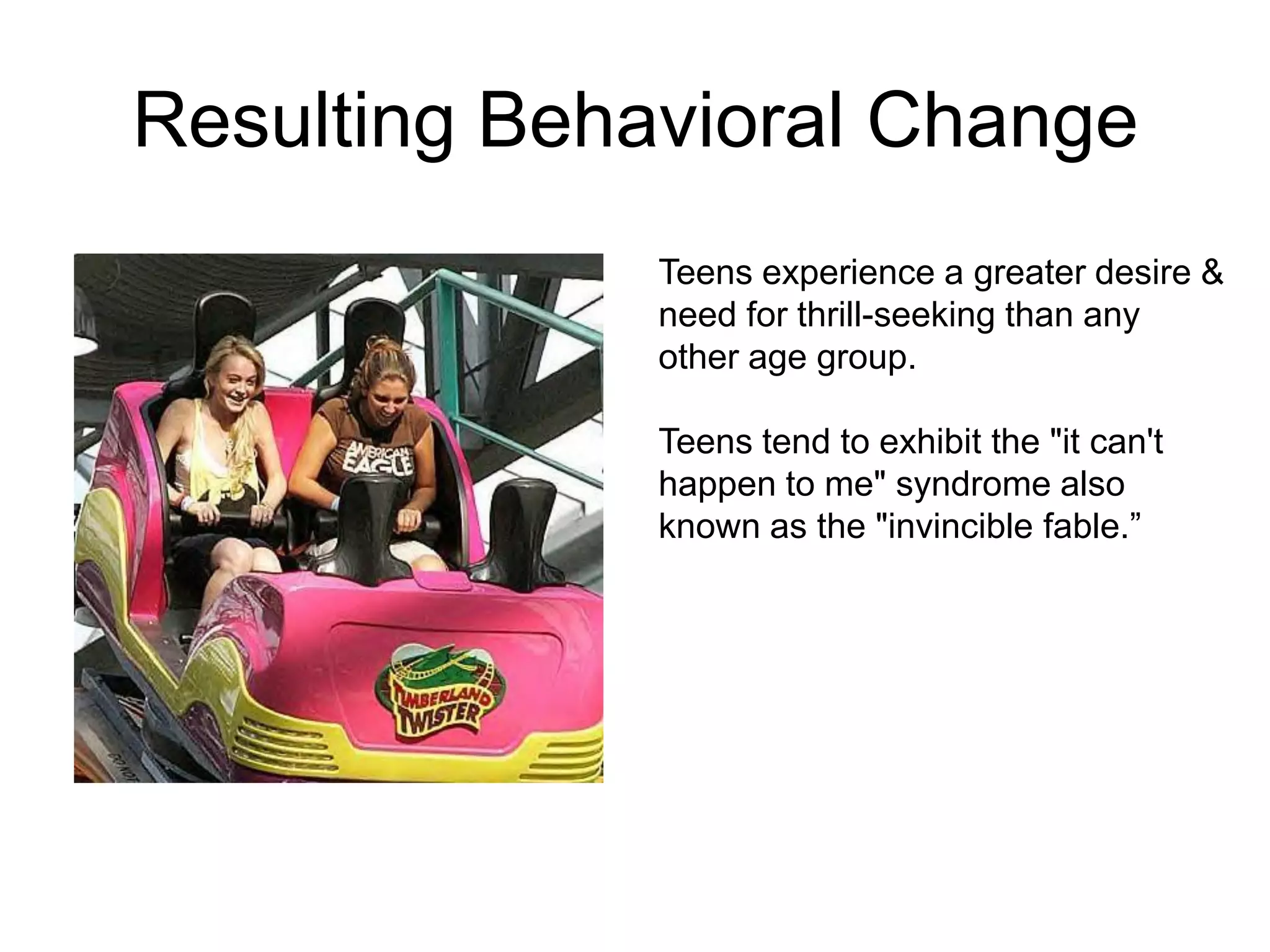
              Teens experience a greater desire &
              need for thrill-seeking than any
              other age group.

              Teens tend to exhibit the "it can't
              happen to me" syndrome also
              known as the "invincible fable.”
Prefrontal Lobes


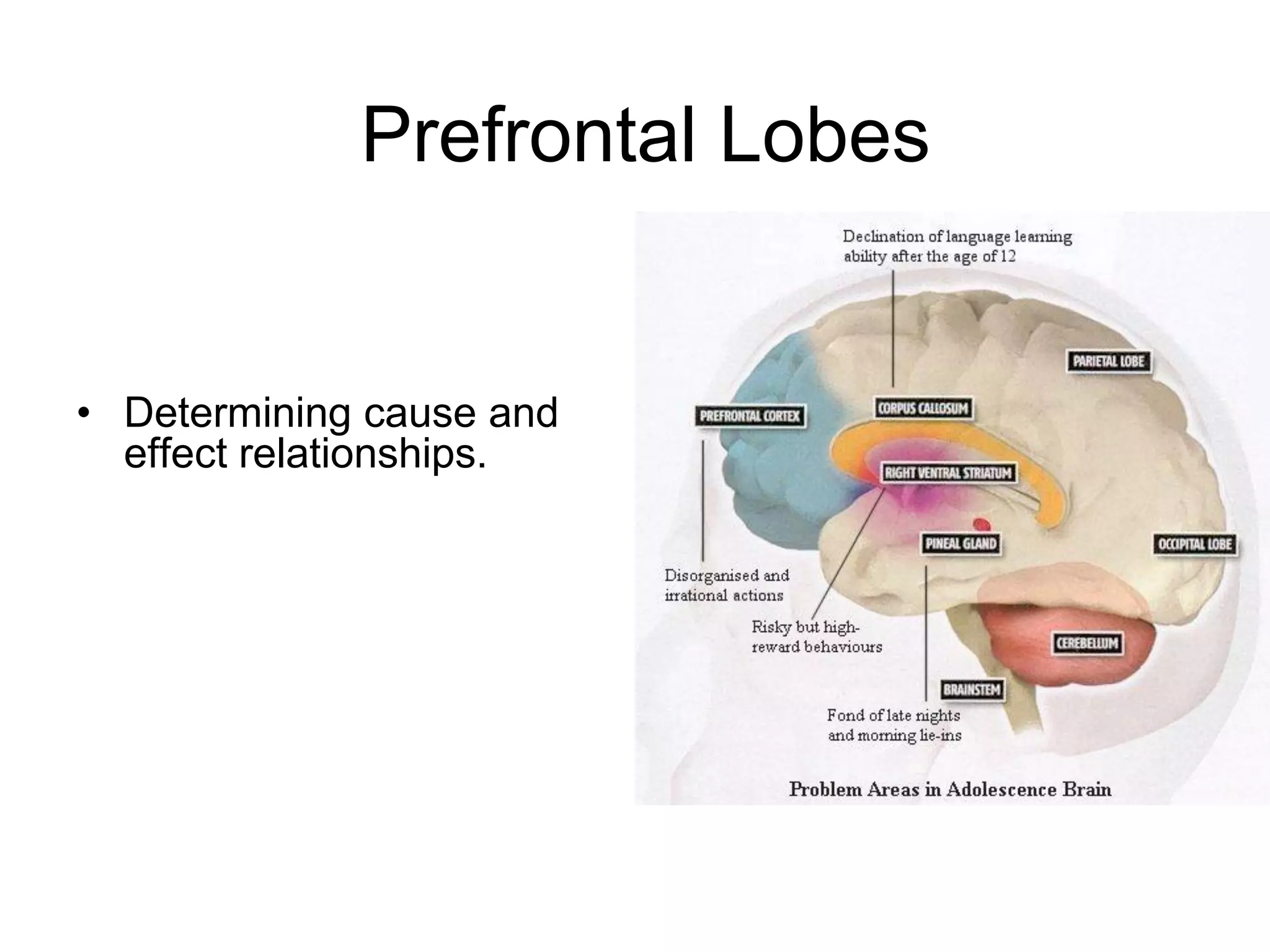
• Determining cause and
  effect relationships.
The Prefrontal Lobes

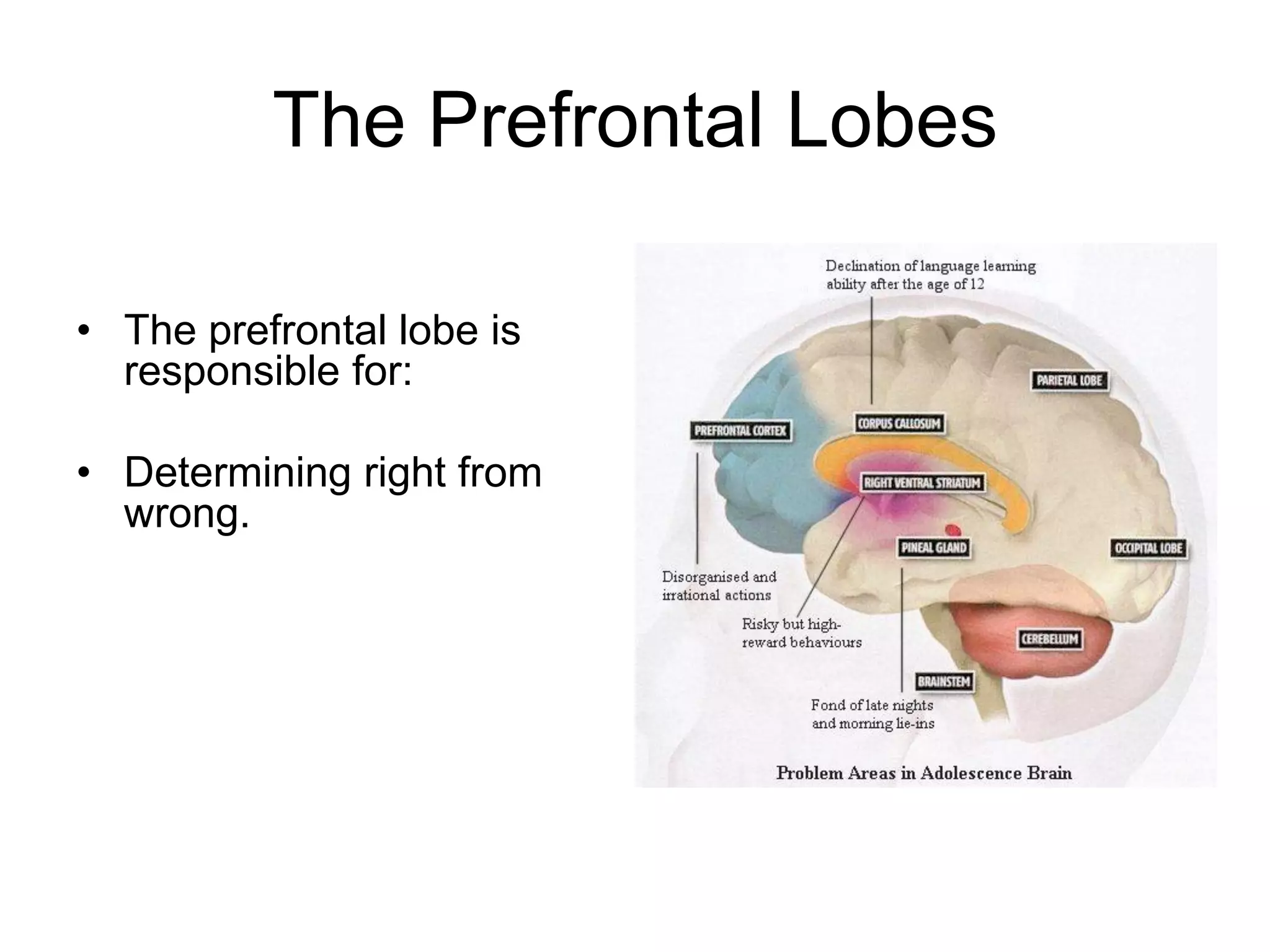
• The prefrontal lobe is
  responsible for:

• Determining right from
  wrong.
Resulting Behavioral Changes
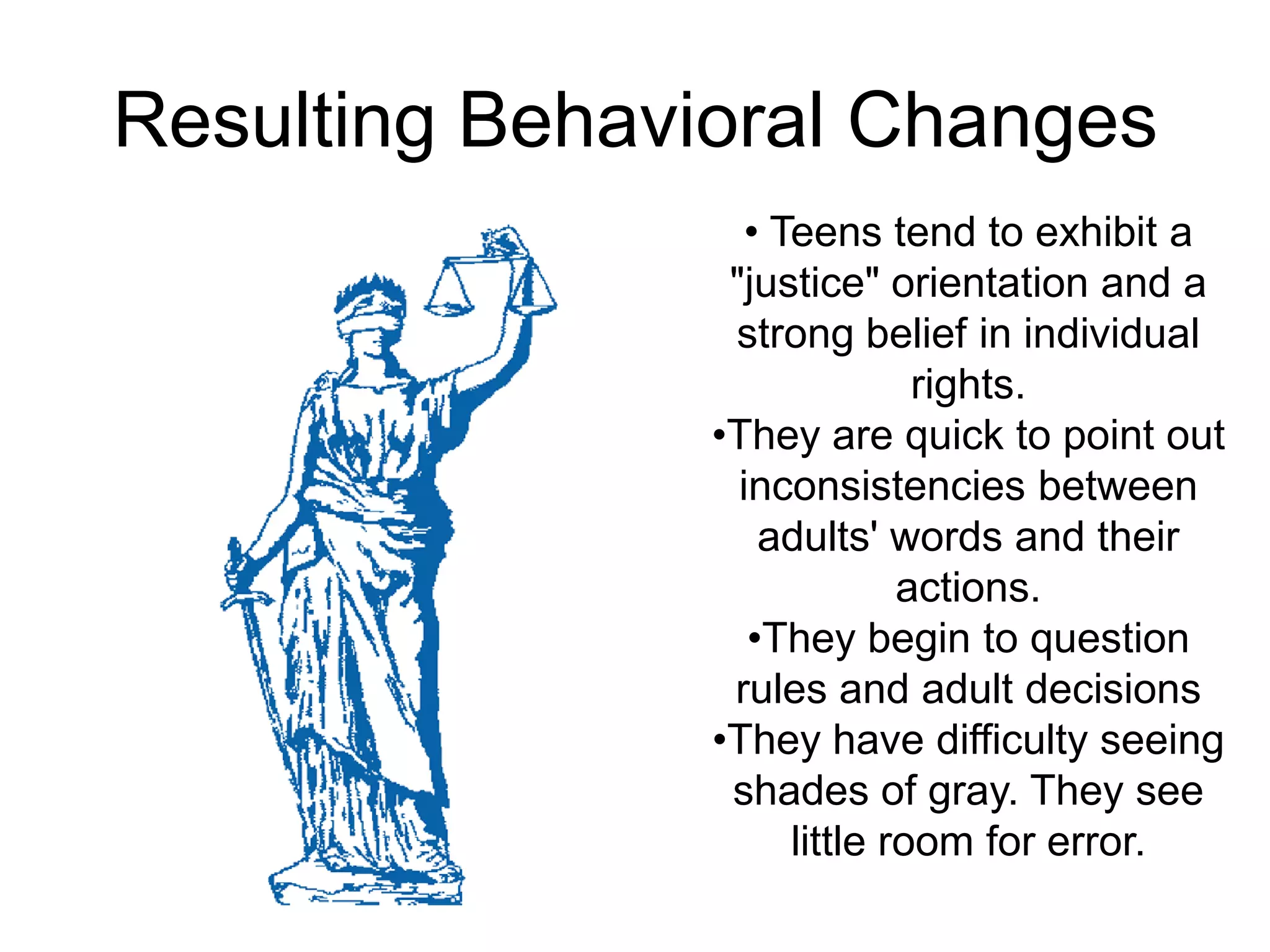
                   • Teens tend to exhibit a
                 "justice" orientation and a
                 strong belief in individual
                               rights.
                •They are quick to point out
                  inconsistencies between
                    adults' words and their
                              actions.
                   •They begin to question
                 rules and adult decisions
                •They have difficulty seeing
                 shades of gray. They see
                      little room for error.
The Prefrontal Lobes

The prefrontal lobes are
  responsible for:

• Ability to make sound
  judgments
http://www.youtube.com/watch?v=tWpCIfQYOk8
The Prefrontal Lobes
The prefrontal lobes are
  responsible for:

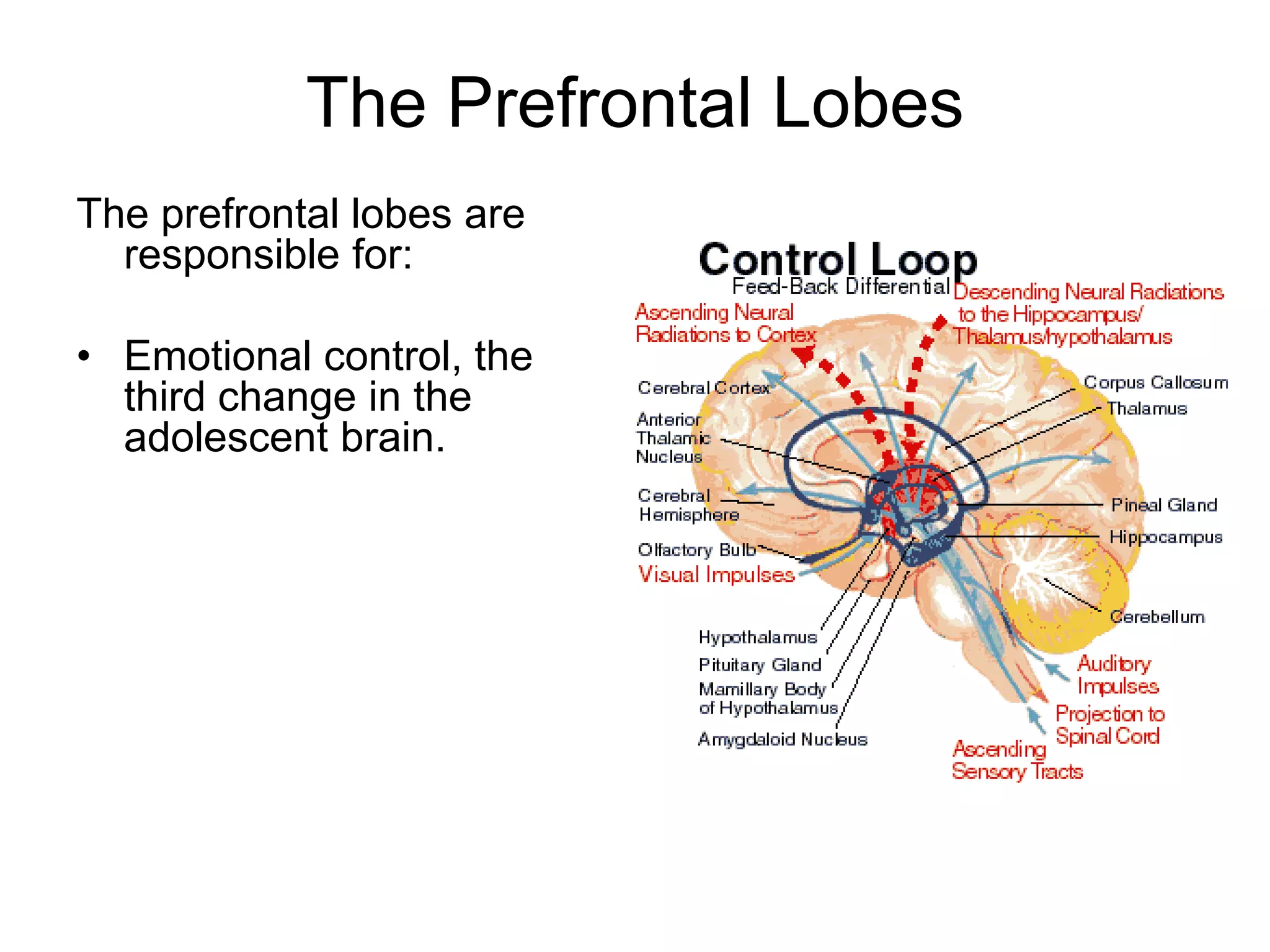
• Emotional control, the
  third change in the
  adolescent brain.
Emotional Control
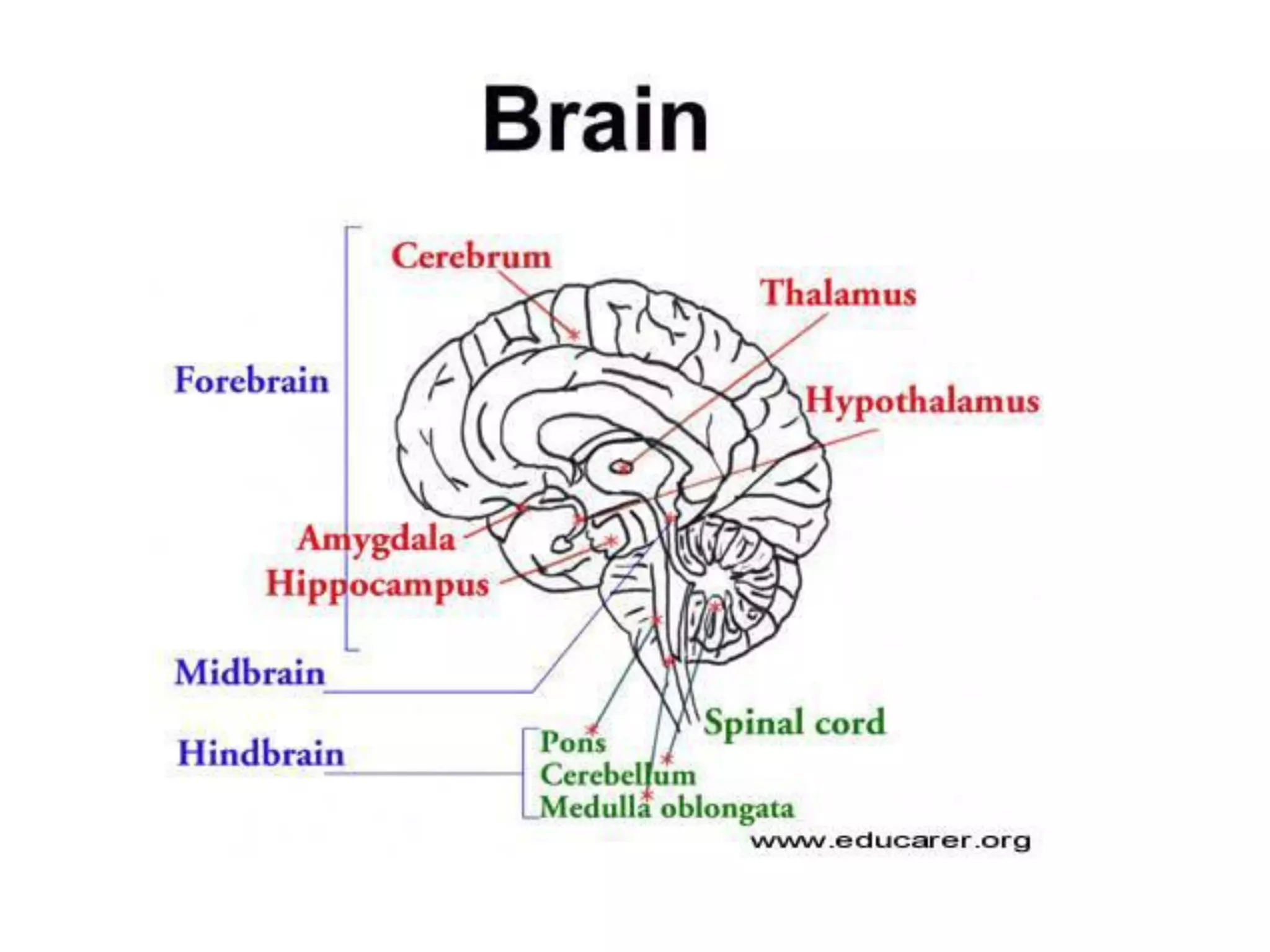
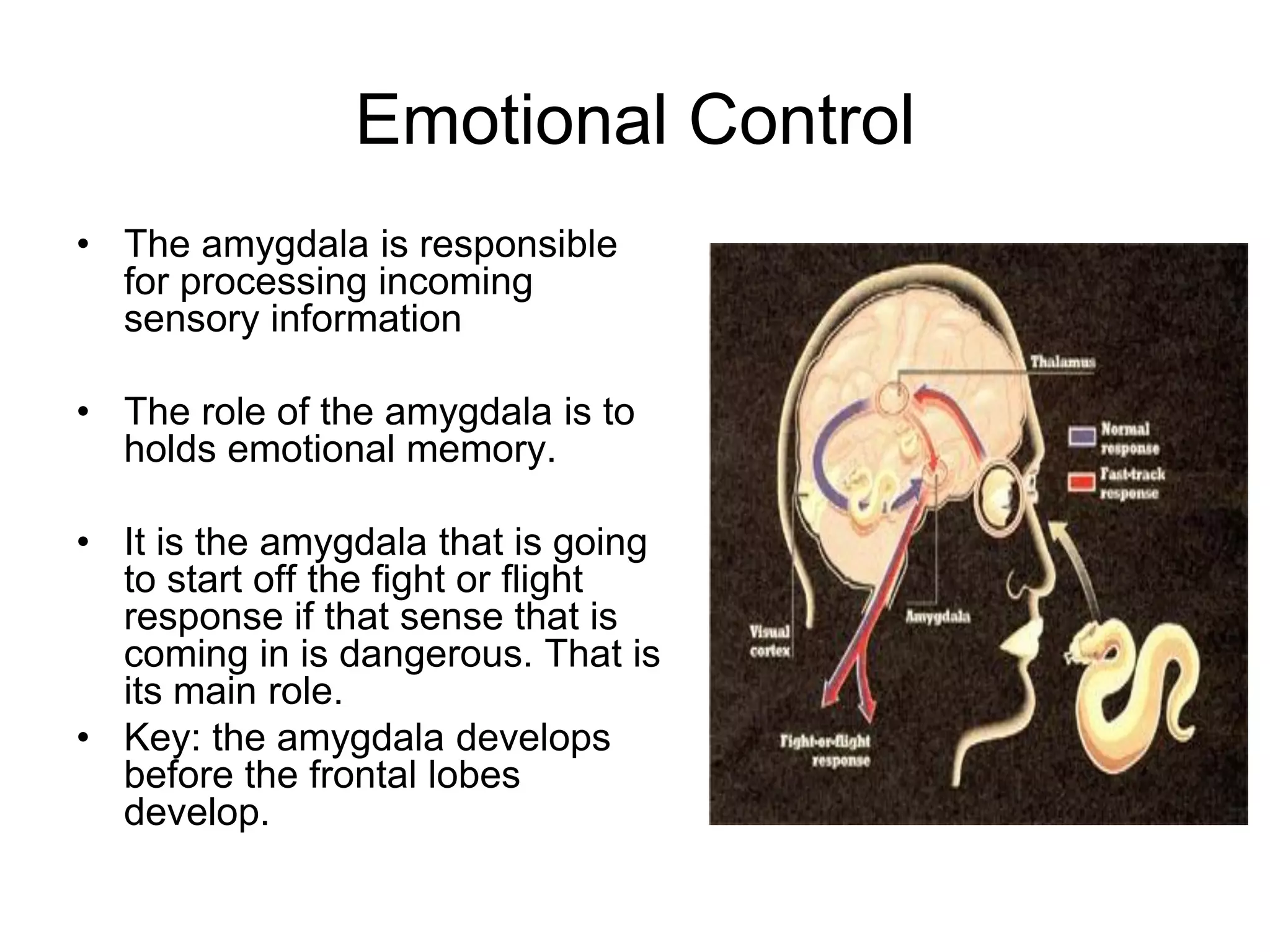
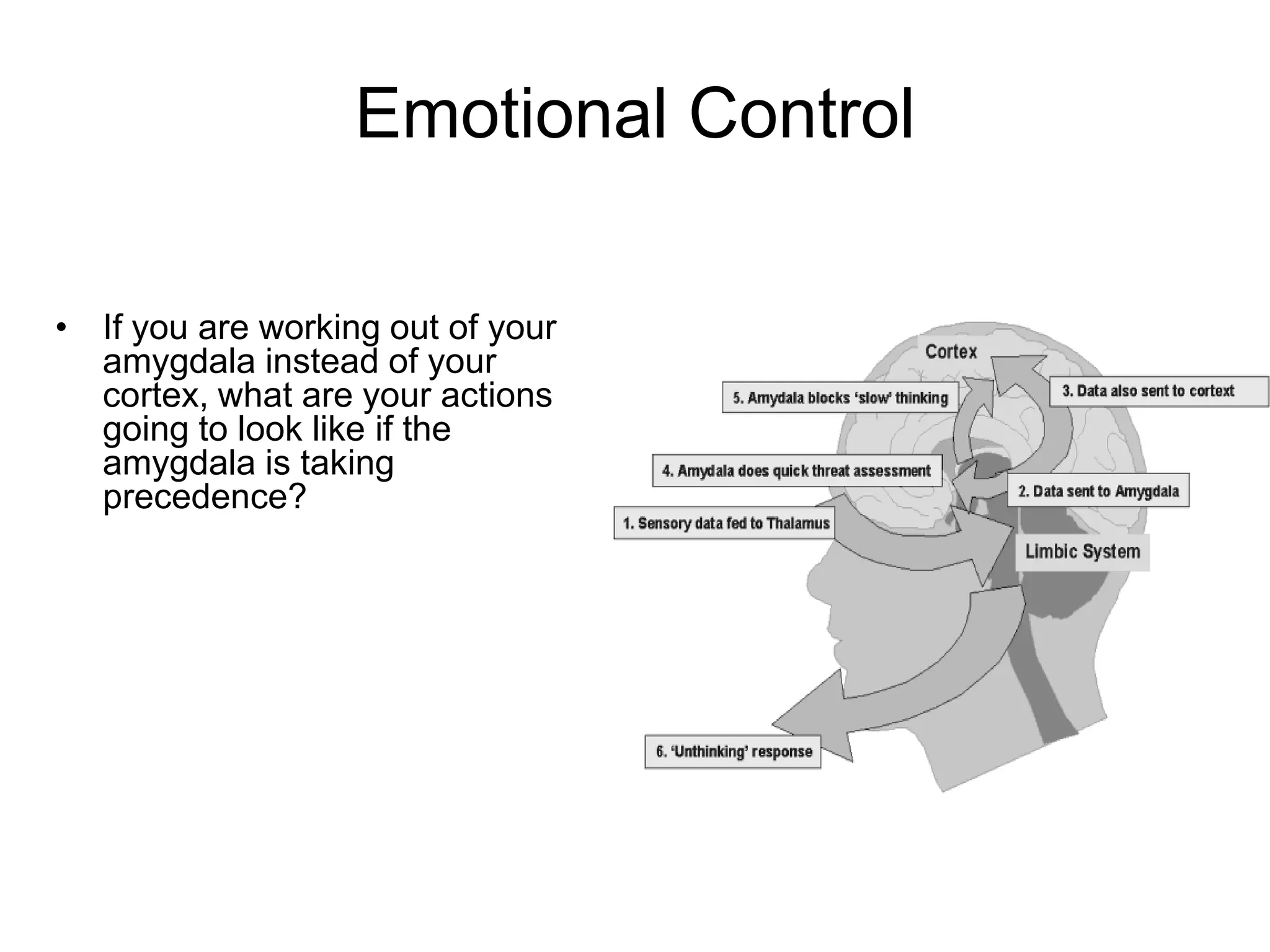
• The amygdala is responsible
  for processing incoming
  sensory information

• The role of the amygdala is to
  holds emotional memory.

• It is the amygdala that is going
  to start off the fight or flight
  response if that sense that is
  coming in is dangerous. That is
  its main role.
• Key: the amygdala develops
  before the frontal lobes
  develop.
Resulting Behavioral Change
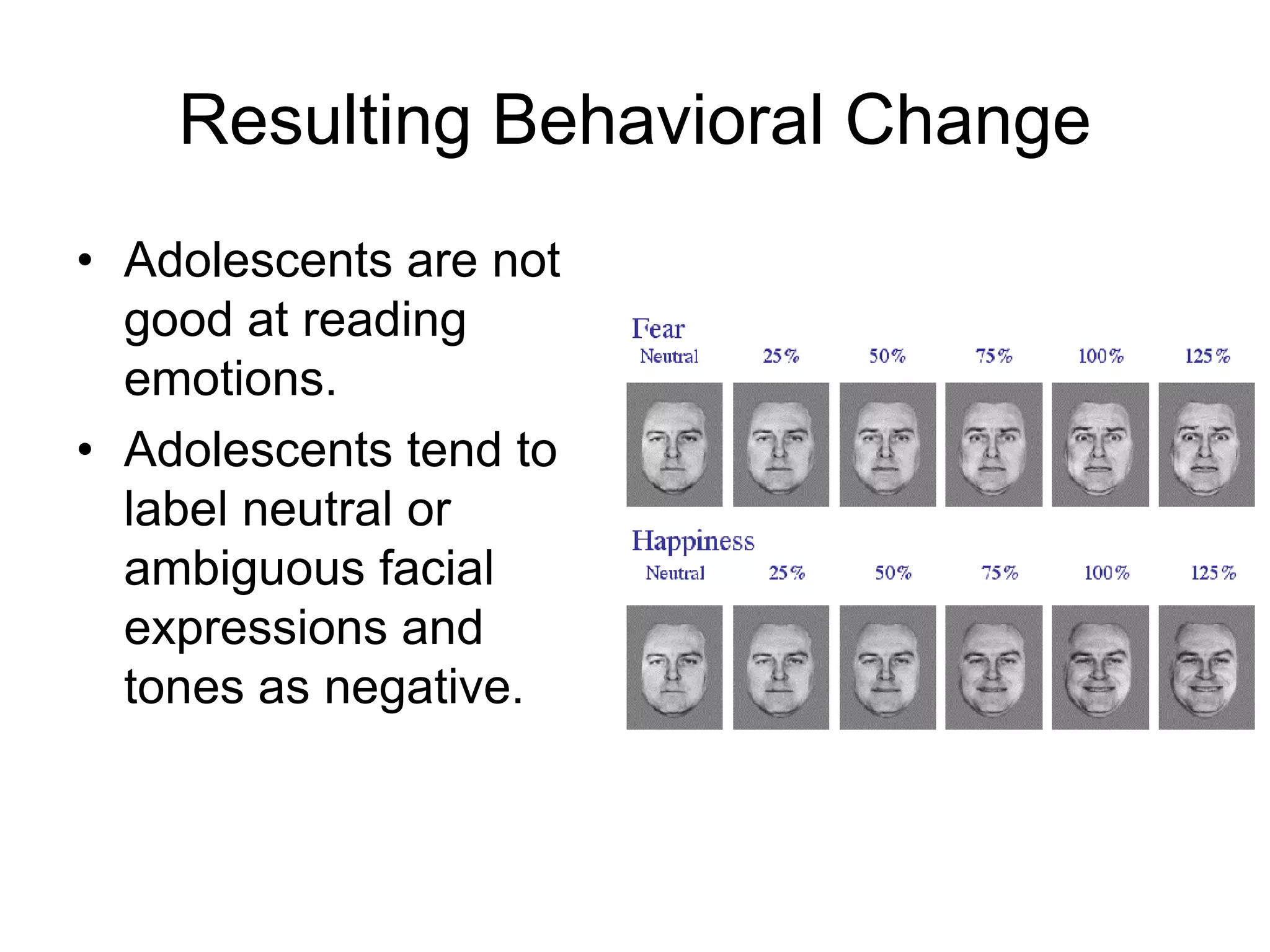
• Adolescents are not
  good at reading
  emotions.
• Adolescents tend to
  label neutral or
  ambiguous facial
  expressions and
  tones as negative.
Emotional Control

• If you are working out of your
  amygdala instead of your
  cortex, what are your actions
  going to look like if the
  amygdala is taking
  precedence?
Emotional Control

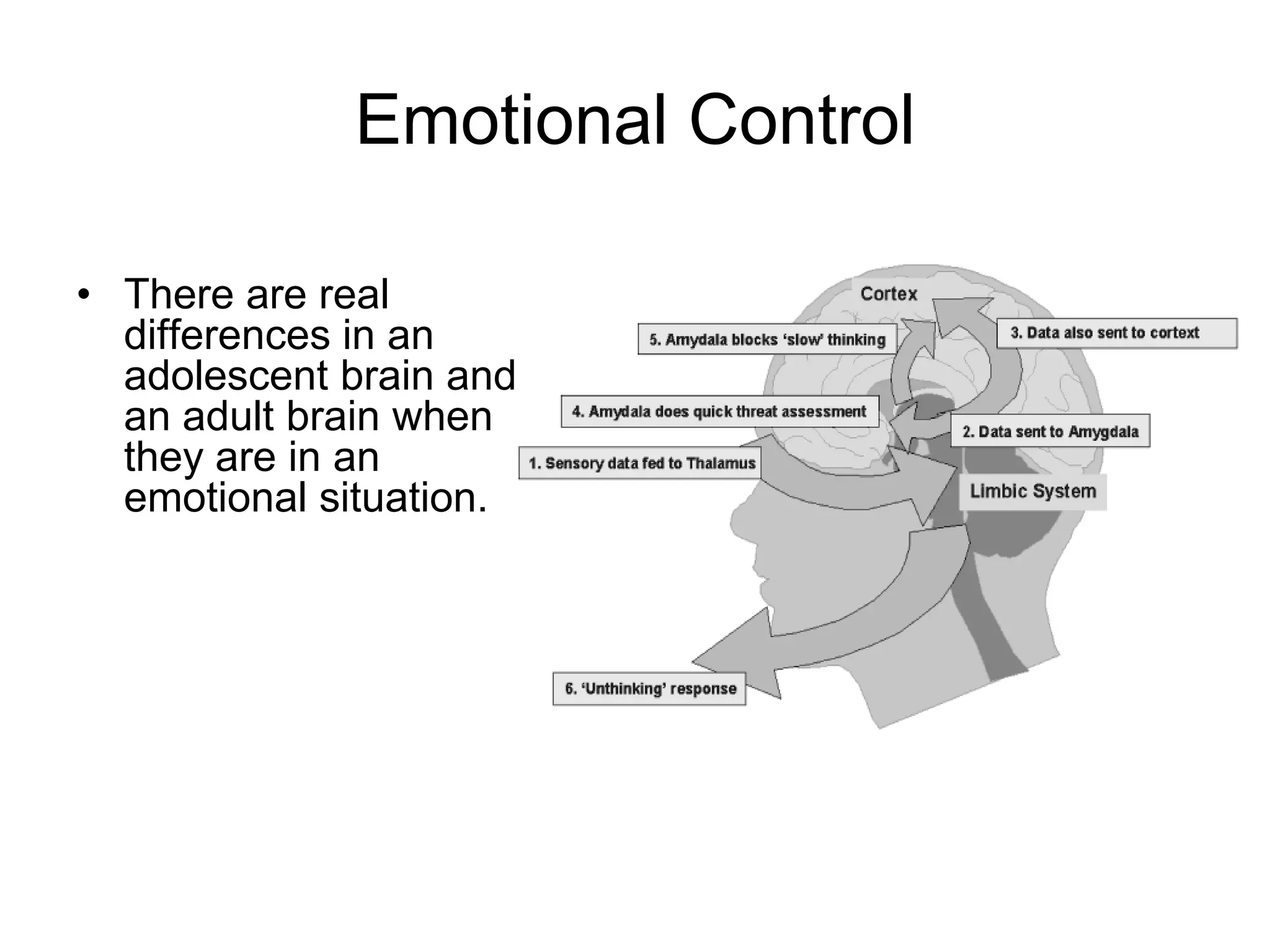
• There are real
  differences in an
  adolescent brain and
  an adult brain when
  they are in an
  emotional situation.
Emotional Control

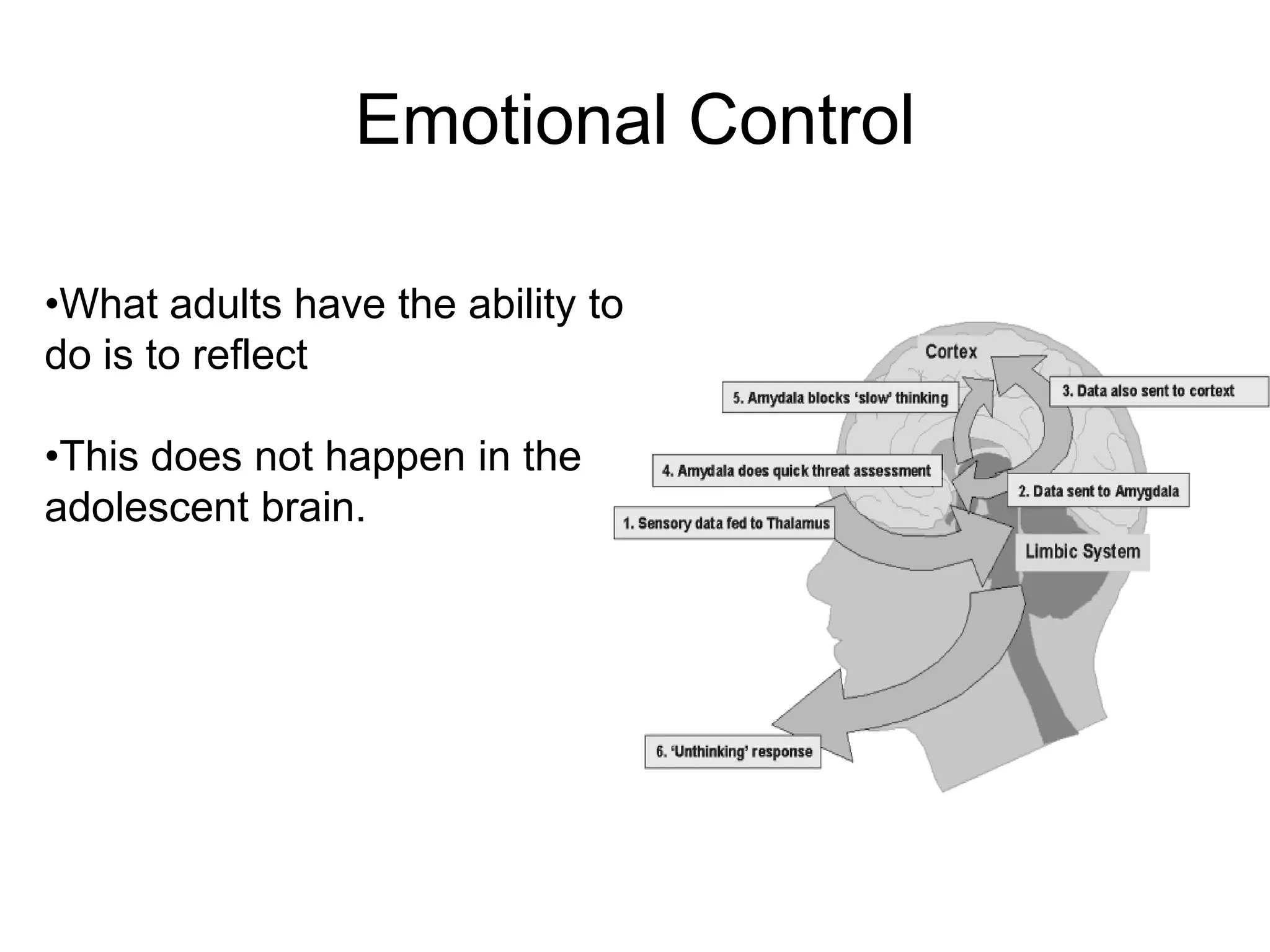
•What adults have the ability to
do is to reflect

•This does not happen in the
adolescent brain.
Resulting Behavioral Changes
• Teens demonstrate a
  heightened level of self-
  consciousness.

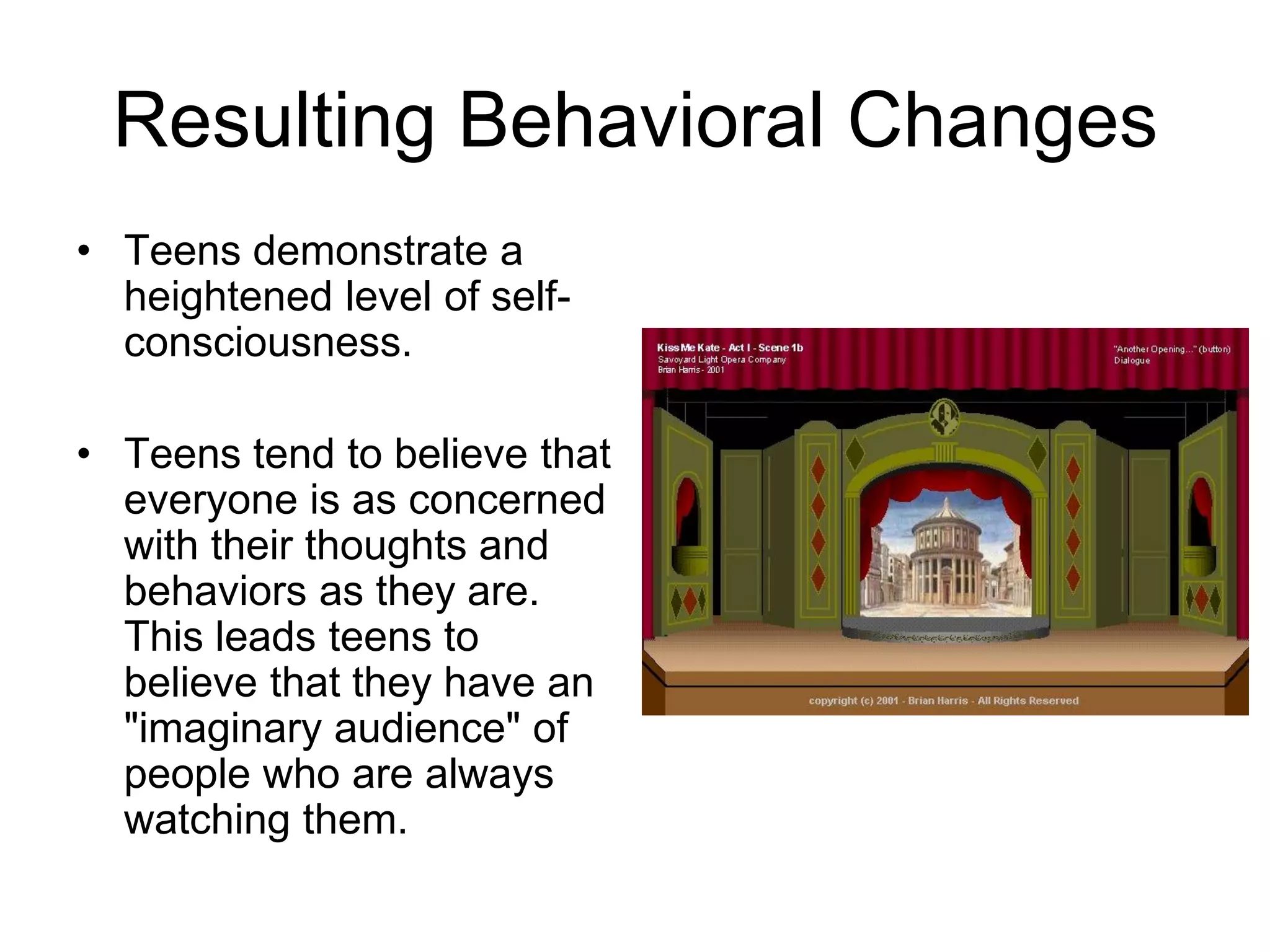
• Teens tend to believe that
  everyone is as concerned
  with their thoughts and
  behaviors as they are.
  This leads teens to
  believe that they have an
  "imaginary audience" of
  people who are always
  watching them.
Resulting Behavioral Changes

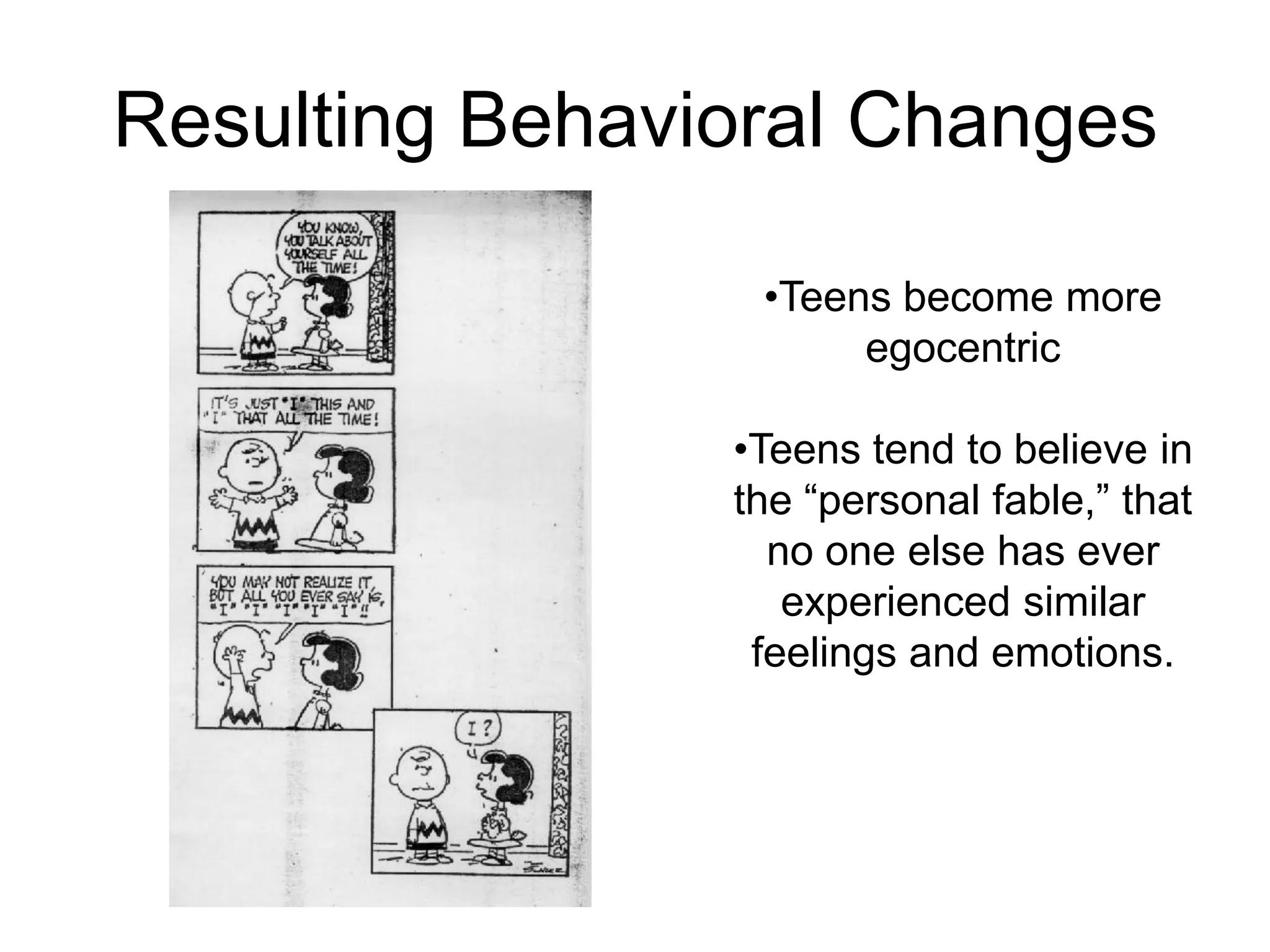
                 •Teens become more
                      egocentric

                •Teens tend to believe in
                the “personal fable,” that
                  no one else has ever
                   experienced similar
                 feelings and emotions.
Resulting Behavioral Changes

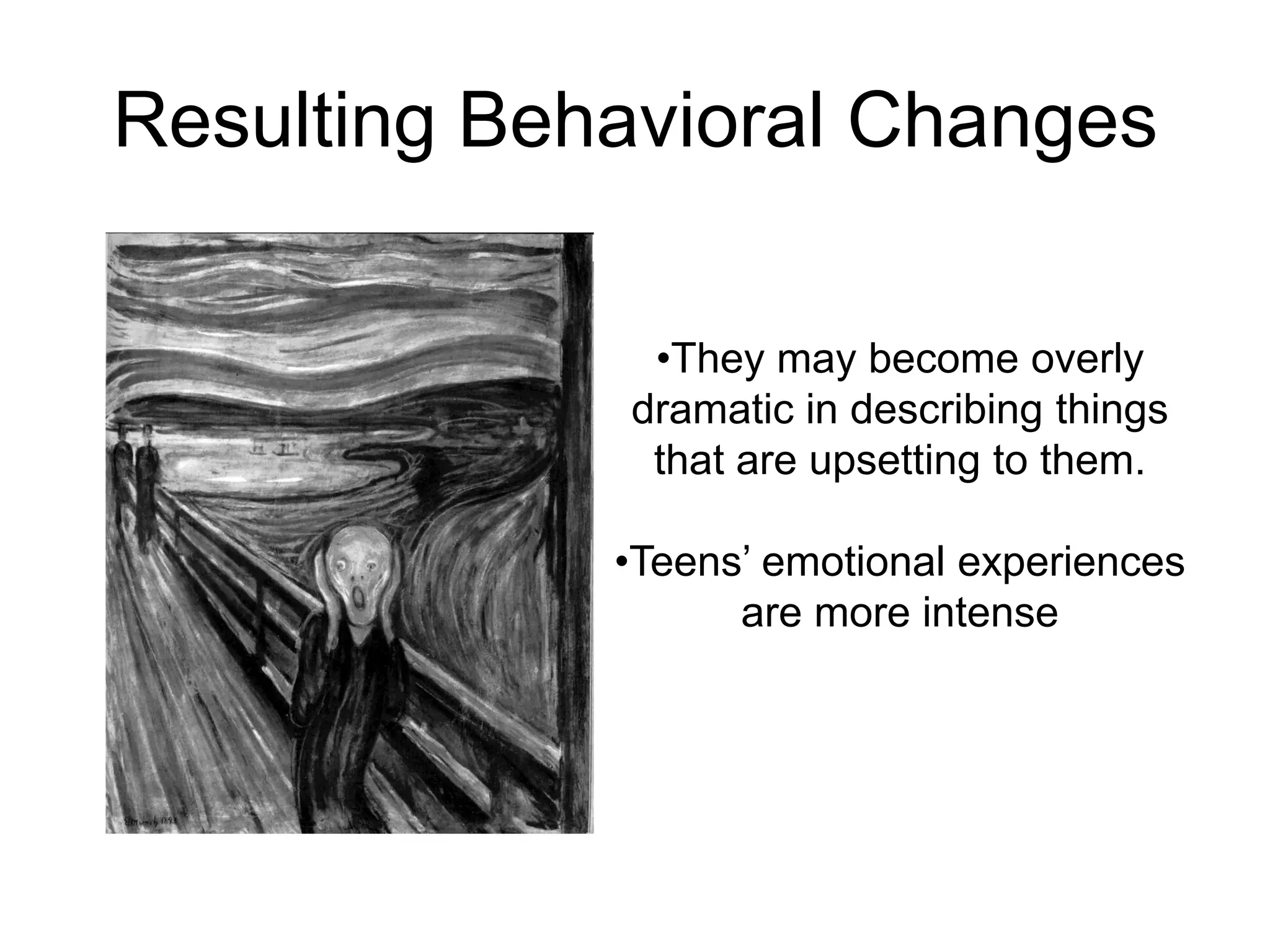
              •They may become overly
             dramatic in describing things
              that are upsetting to them.

             •Teens’ emotional experiences
                   are more intense
Adolescent Brain Development:
         Practical Implications

Focus on Well-Being – Lerner, 2000
• Competence – in basic skills
• Confidence – or positive identity
• Connections – or healthy relations
• Character – positive values & integrity
• Caring and Compassion
Practical Implications:
         The Importance of Sleep


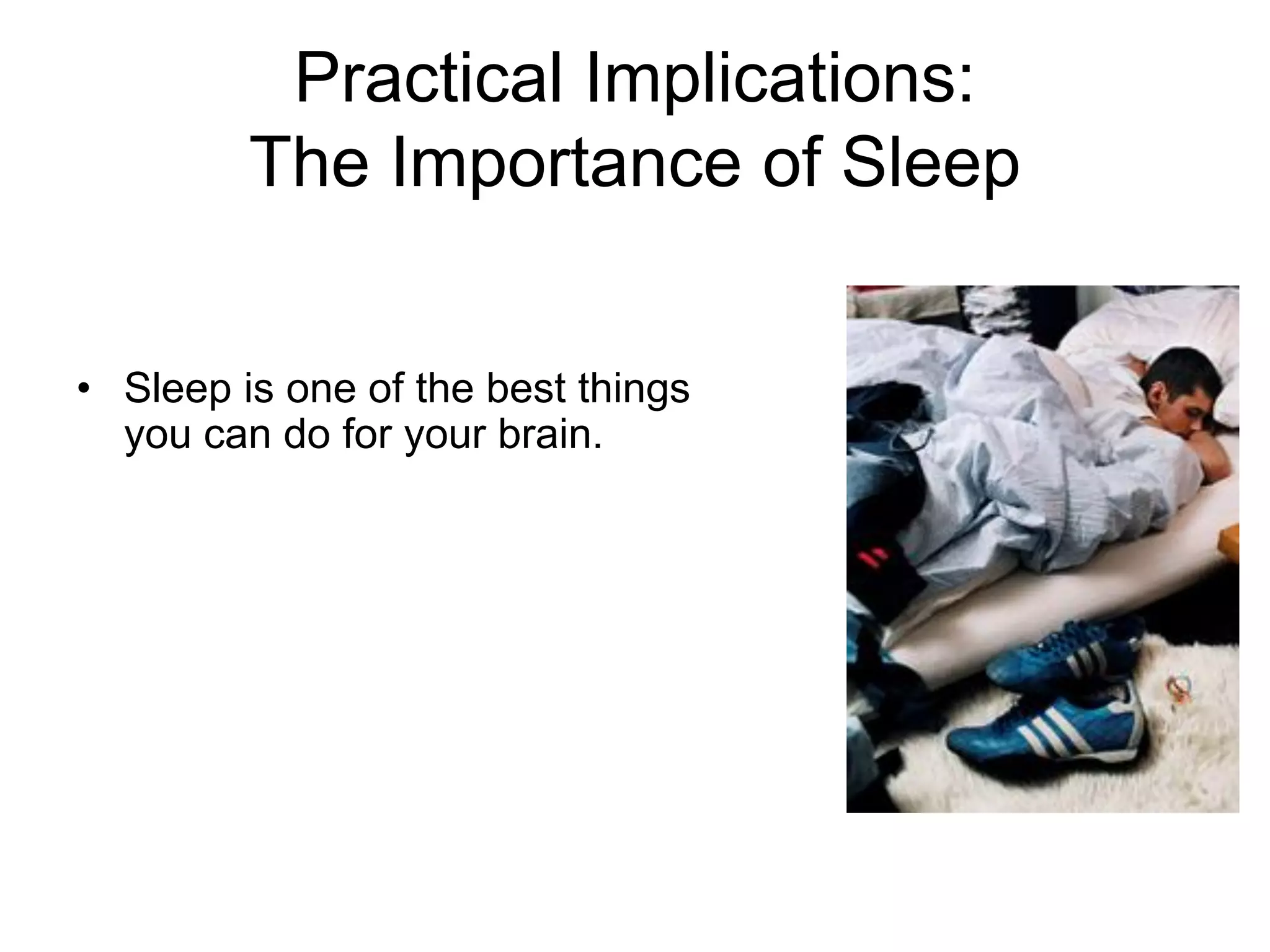
• Sleep is one of the best things
  you can do for your brain.
Practical Implications:
          The Importance of Sleep
• Studies of sleep patterns in adolescents
  reveal two important findings:

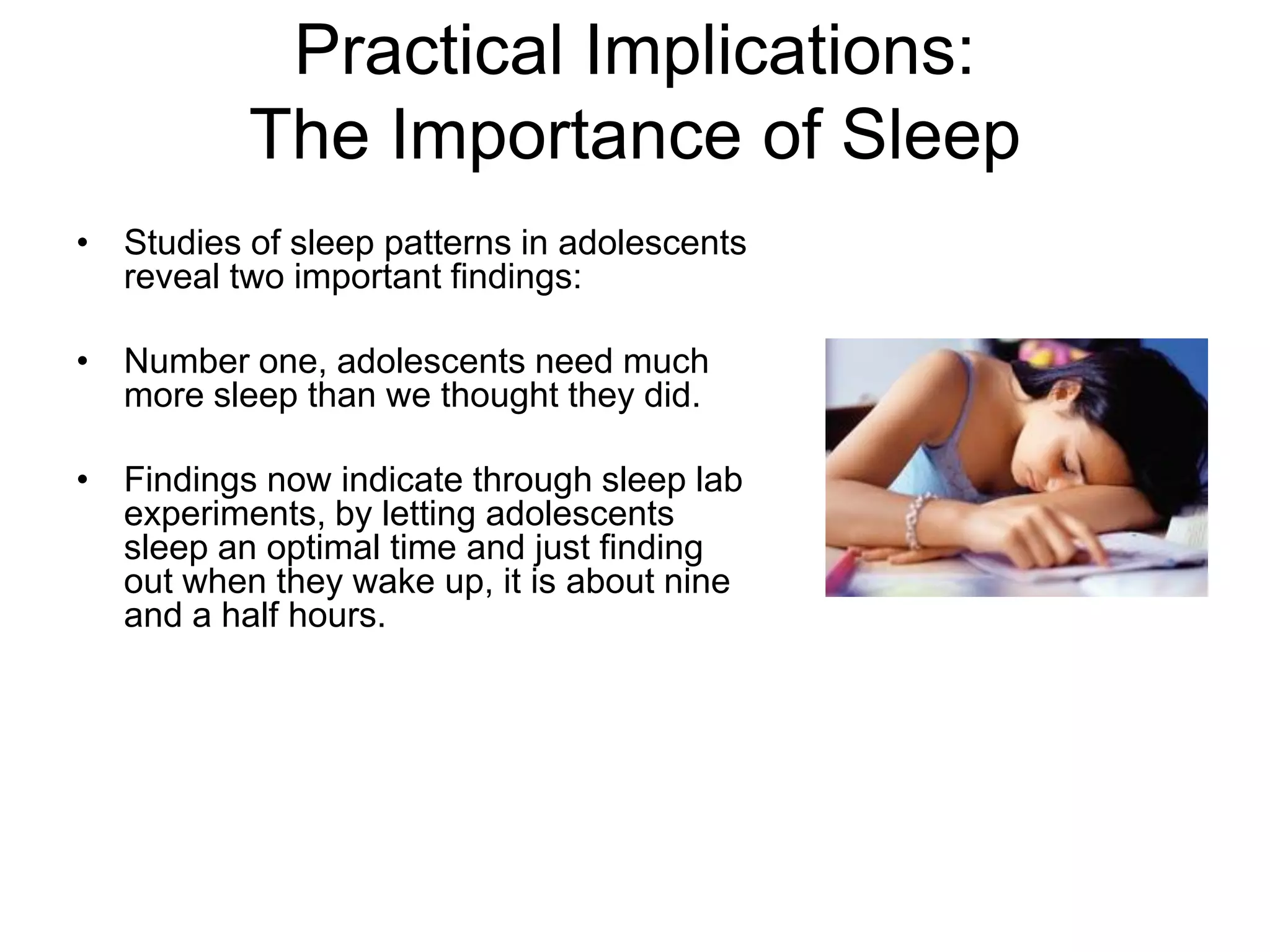
• Number one, adolescents need much
  more sleep than we thought they did.

• Findings now indicate through sleep lab
  experiments, by letting adolescents
  sleep an optimal time and just finding
  out when they wake up, it is about nine
  and a half hours.
Practical Implications:
            The Importance of Sleep

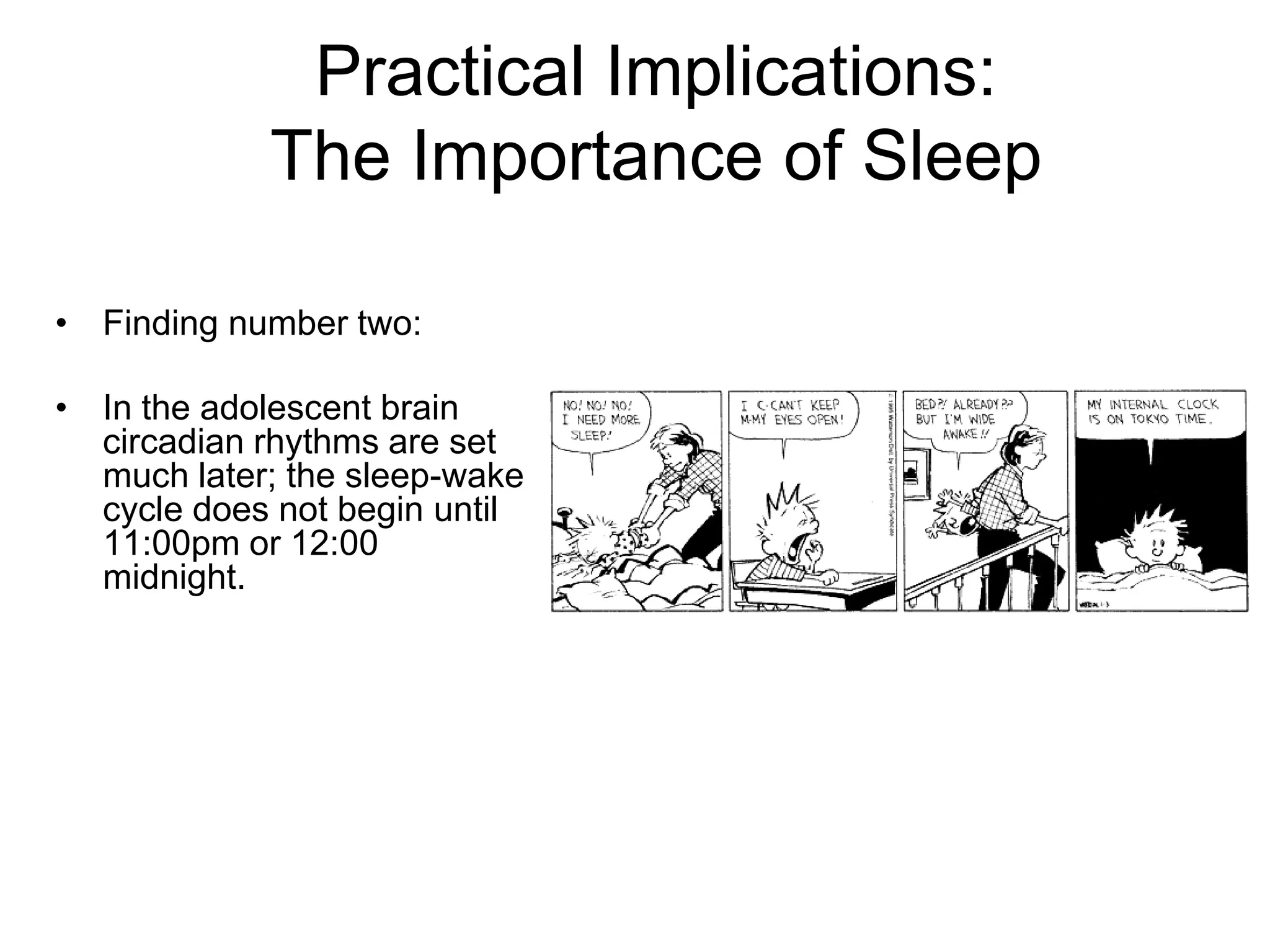
• Finding number two:

• In the adolescent brain
  circadian rhythms are set
  much later; the sleep-wake
  cycle does not begin until
  11:00pm or 12:00
  midnight.
Practical Implications:
        Provide Learning Moments

Adults need to take
  advantage of some of the
  characteristics of the
  adolescent brain:
• They are argumentative but
  maybe this would be a
  really good time to engage
  them in debates in
  classrooms.
Practical Implications:
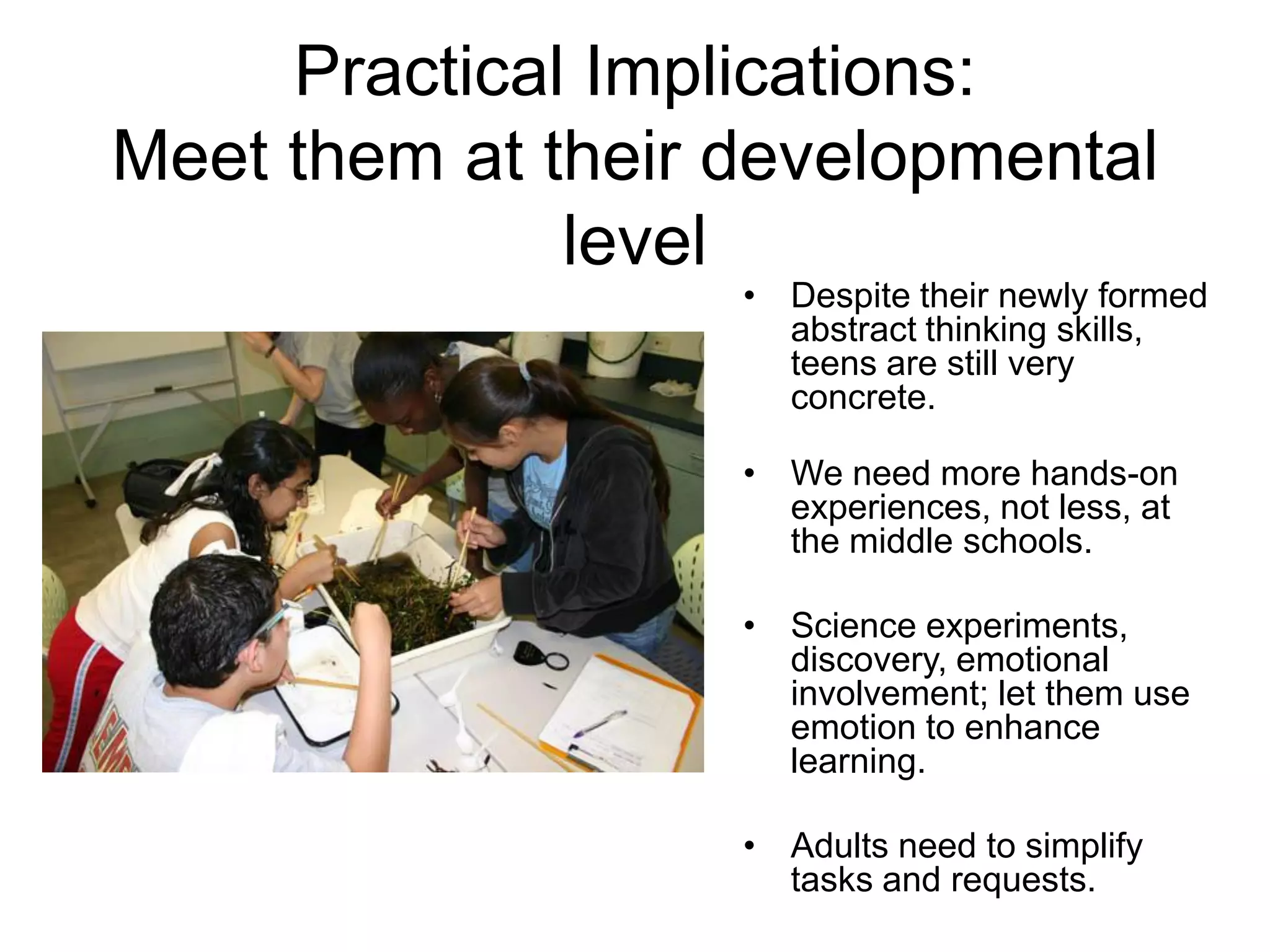
Meet them at their developmental
              level
                   • Despite their newly formed
                     abstract thinking skills,
                     teens are still very
                     concrete.

                   • We need more hands-on
                     experiences, not less, at
                     the middle schools.

                   • Science experiments,
                     discovery, emotional
                     involvement; let them use
                     emotion to enhance
                     learning.

                   • Adults need to simplify
                     tasks and requests.
Practical Implications:
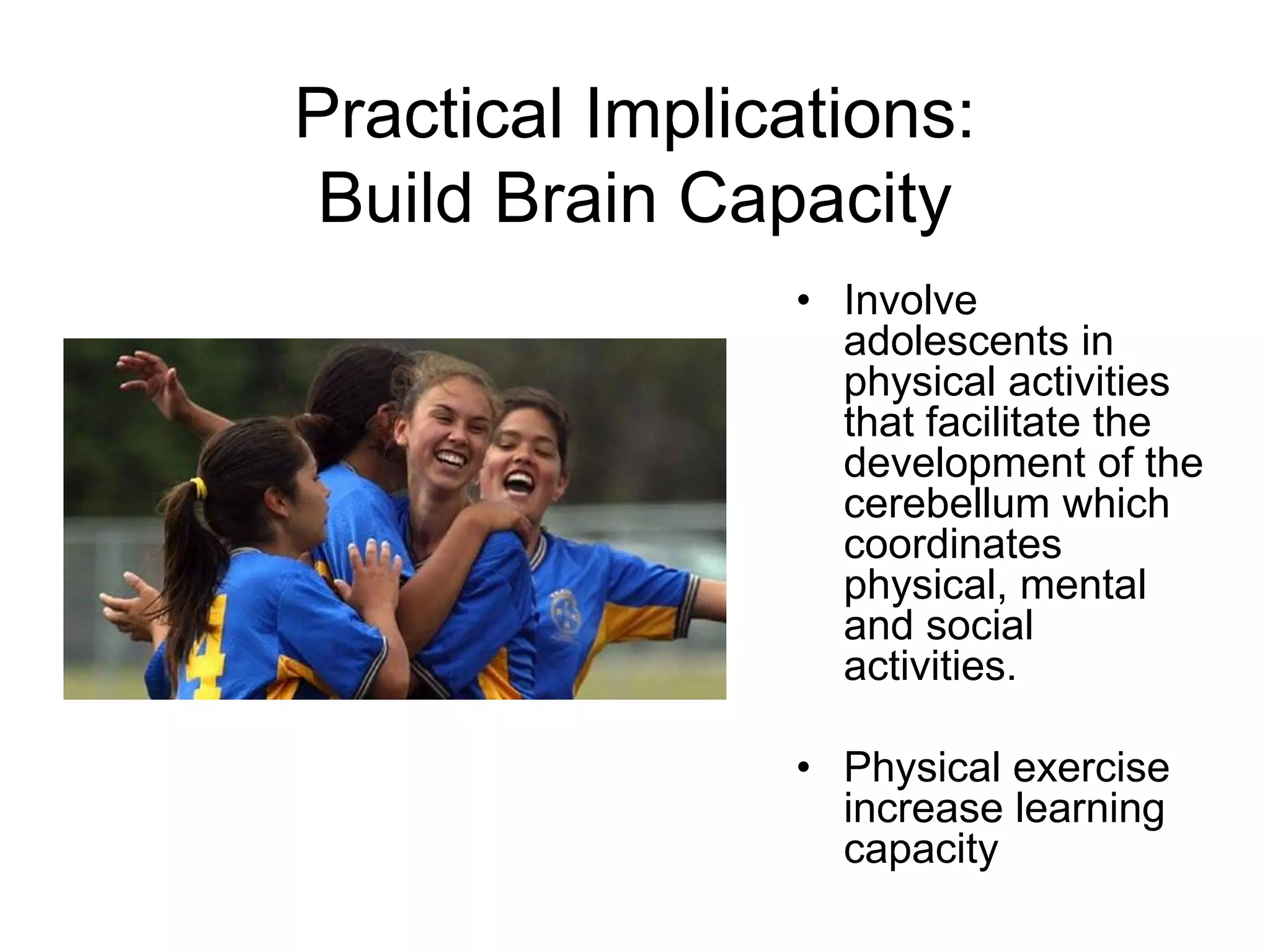
 Build Brain Capacity
                • Involve
                  adolescents in
                  physical activities
                  that facilitate the
                  development of the
                  cerebellum which
                  coordinates
                  physical, mental
                  and social
                  activities.

                • Physical exercise
                  increase learning
                  capacity
Practical Implications:
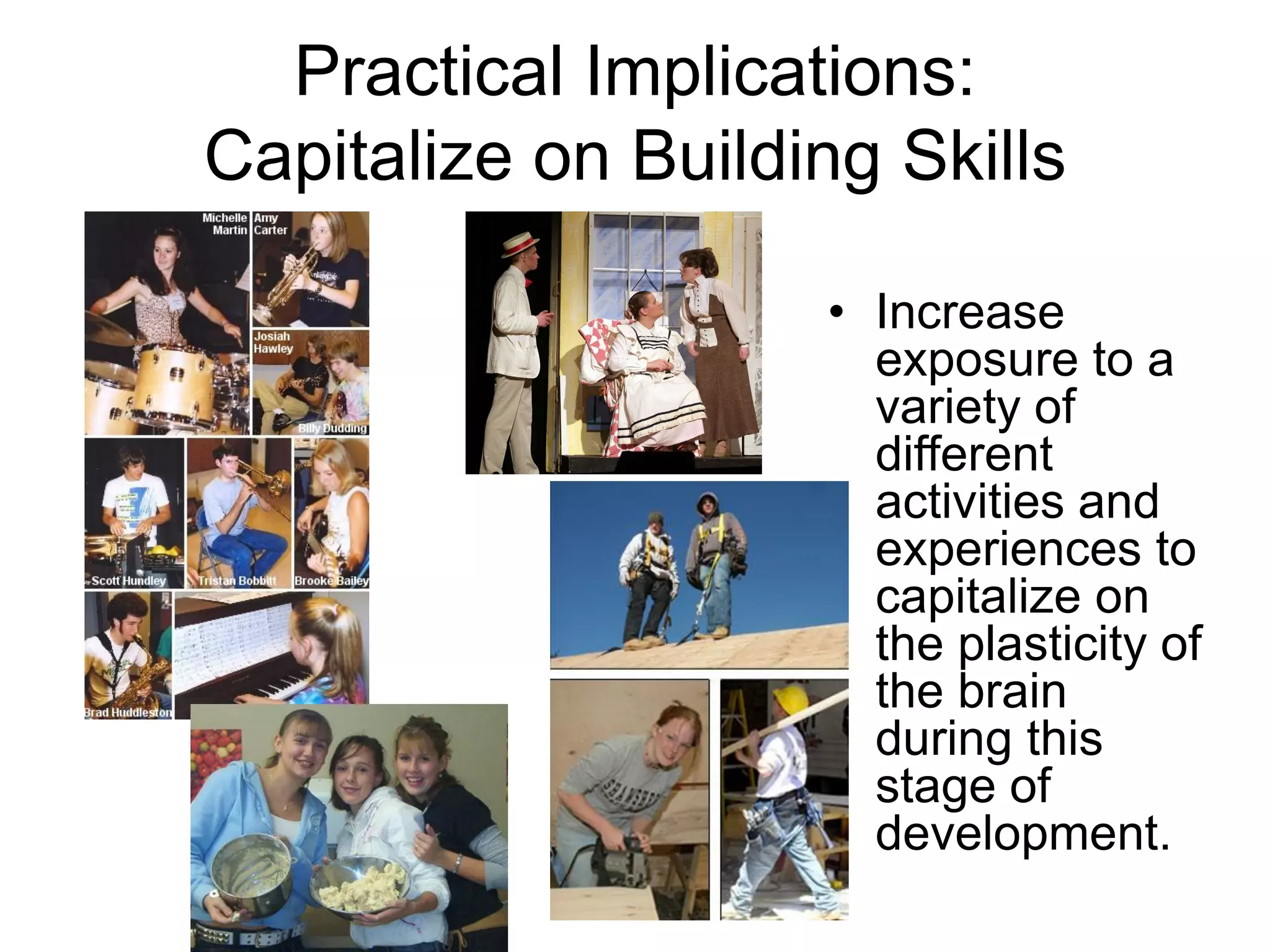
Capitalize on Building Skills

                    • Increase
                      exposure to a
                      variety of
                      different
                      activities and
                      experiences to
                      capitalize on
                      the plasticity of
                      the brain
                      during this
                      stage of
                      development.
Practical Implications:
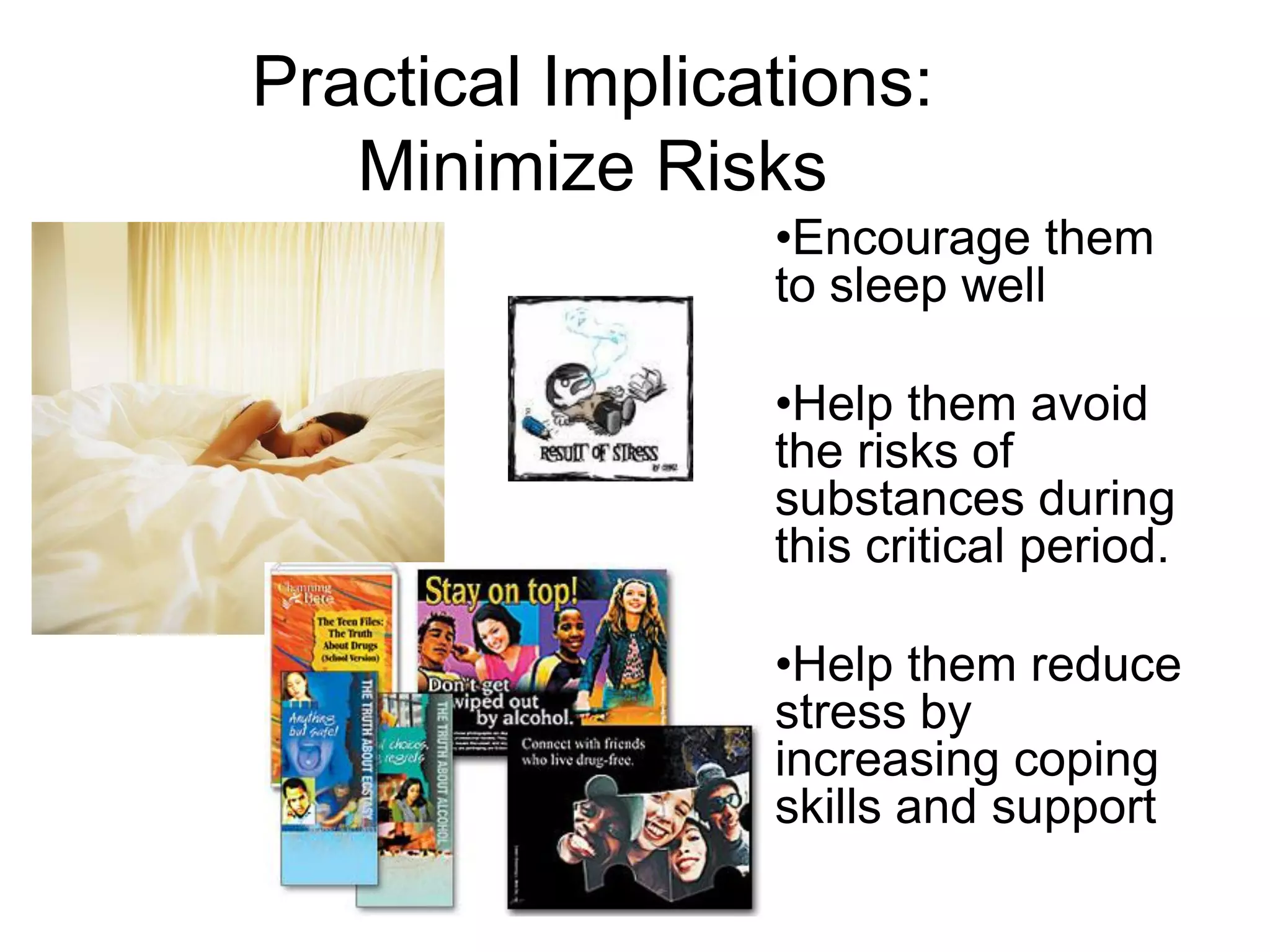
   Minimize Risks
                 •Encourage them
                 to sleep well

                 •Help them avoid
                 the risks of
                 substances during
                 this critical period.

                 •Help them reduce
                 stress by
                 increasing coping
                 skills and support
Resources
• R.A. Ozretich, S.R. Bowman

• Pat Wolfe, Mind Matters, Inc., Napa, CA: The
  Adolescent Brain: A Work in Progress

• Adolescent Growth and Development
  Author: Angela Huebner, Assistant Professor and
  Extension Specialist, Family and Child Development,
  Virginia Tech
• Sam Goldstein, Hardwired to Learn, Learning and the
  Brain Conference, 2008
Q&A


Robin E. Donaldson, M.A., L.M.H.C.
rdonaldson@nationalsafeplace.org

Adolescent Brain Development And Its Effects

  • 1.
    Adolescent Brain Development: Behavioral Implications
  • 2.
    Adolescence Adolescence is defined as the transition from childhood to adulthood or the psychological, social and emotional changes that accompany puberty
  • 3.
    Erikson’s Psychosocial Theory ofDevelopment Adolescence: Ages 12-18 (or 20 or 22 or 24) Identity versus role confusion A time for testing limits, for breaking dependent ties, and for establishing a new identity. Major conflicts center on clarification of self-identity, life goals, and life's meaning. Failure to achieve a sense of identity results in role confusion.
  • 5.
    Brain Development Overview It now appears the brain continues to change into the early 20's with the frontal lobes, responsible for reasoning and problem solving, developing last.
  • 6.
  • 7.
    Synaptic Growth Spurt •Between seven and 11, the brain undergoes a huge spurt of growth of connections just like they were doing around 18 months to two. •Most of this growth is in the temporal lobes and in the parietal lobes.
  • 8.
    Temporal Lobes The temporal lobes handle auditory information. But deep down within the temporal lobes is a structure called the hippocampus, and it is responsible for memory. The part of the brain between, seven and 11, that works really efficiently and is growing a lot and developing a lot is the part of the brain that handles memory and shows tremendous growth.
  • 9.
  • 10.
    Synaptic Pruning The first change after this synaptic growth spurt is a selective pruning which takes place. In adolescence, most of this pruning is taking place in the frontal lobes. The adolescent loses approximately 3 percent of the gray matter in the frontal lobes.
  • 11.
    The Results ofSynaptic Pruning • Red indicates grey matter which is mainly responsible for information processing (neuron bodies). • Blue indicates myelination • These changes may parallel a pruning process that that appears to follow the principle of "use-it-or-lose- it:" neural connections, or synapses, that get exercised are retained, while those that don't are lost.
  • 12.
    Synaptic Pruning • ResearcherJay Giedd compares this pruning to Michelangelo with a block of marble. He begins to sculpt away until David emerges. • This is precisely what is going on in the adolescent brain, starting around 11. The brain is pruning away, sculpting away excess material, excess connections, to make a more refined, more efficient, more adult brain.
  • 13.
    Adolescent Brain Development: Myelination • The second change is in myelination; in adolescence, it is not finished. The last part of the brain to myelinate is the frontal lobes. And myelination is not complete in the frontal lobes of the brain until around 18 to 20 or later. • Myelination on a neuron allows it to operate more efficiently.
  • 14.
    Adolescent Brain Development: Myelination • Myelination happens in the temporal and parietal lobes before it happens in the frontal lobes. What does that mean? • Teens are moving from concrete to abstract thinking. • Teens tend to become very idealistic & cause-oriented.
  • 15.
    Resulting Behavioral Changes Early Adolescence (ages 11-14) Middle Adolescence (ages 15-18) Variation btwn those still focused on logic & Major broadening of thinking those able to combine logical & abstract abilities: can think abstractly and thinking. hypothetically; discern underlying principles of various phenomena & Some can't think ahead to consequences of apply them to new situations; can their actions. think about the future, considering many possibilities & logical Dvlp new thinking skills: possibilities, outcomes. thinking abstractly, thinking about the process of thinking & in multiple dimensions which Greater perspective-taking = more leads to questioning empathy & concern of others & new interest in societal issues. Practicing new thinking skills through humor & by arguing with parents and others. Humor See things as relative not absolute focused on satire, sarcasm, and sex
  • 16.
    Prefrontal Lobes The last area of the brain to develop is the prefrontal lobes
  • 17.
    Prefrontal Lobes • The prefrontal lobes are responsible for: • Reasoning ability. • Adults can provide “learning moments” to strengthen this skill in adolescence • Remember, it is a learned skill
  • 18.
    Prefrontal Lobes The prefrontal lobes are responsible for: Goal and priority setting. Adolescents have a great deal of difficulty prioritizing.
  • 19.
    Prefrontal Lobes • The prefrontal lobes are responsible for: • Planning and organization of multiple tasks. • Adolescents do not seem to be able to do this. • Adolescents are terrible at multitasking.
  • 20.
    Prefrontal Lobes The prefrontallobes are responsible for: • Impulse inhibition.
  • 21.
    Resulting Behavioral Change Teens experience a greater desire & need for thrill-seeking than any other age group. Teens tend to exhibit the "it can't happen to me" syndrome also known as the "invincible fable.”
  • 22.
    Prefrontal Lobes • Determiningcause and effect relationships.
  • 23.
    The Prefrontal Lobes •The prefrontal lobe is responsible for: • Determining right from wrong.
  • 24.
    Resulting Behavioral Changes • Teens tend to exhibit a "justice" orientation and a strong belief in individual rights. •They are quick to point out inconsistencies between adults' words and their actions. •They begin to question rules and adult decisions •They have difficulty seeing shades of gray. They see little room for error.
  • 25.
    The Prefrontal Lobes Theprefrontal lobes are responsible for: • Ability to make sound judgments
  • 26.
  • 27.
    The Prefrontal Lobes Theprefrontal lobes are responsible for: • Emotional control, the third change in the adolescent brain.
  • 28.
    Emotional Control • Theamygdala is responsible for processing incoming sensory information • The role of the amygdala is to holds emotional memory. • It is the amygdala that is going to start off the fight or flight response if that sense that is coming in is dangerous. That is its main role. • Key: the amygdala develops before the frontal lobes develop.
  • 29.
    Resulting Behavioral Change •Adolescents are not good at reading emotions. • Adolescents tend to label neutral or ambiguous facial expressions and tones as negative.
  • 30.
    Emotional Control • Ifyou are working out of your amygdala instead of your cortex, what are your actions going to look like if the amygdala is taking precedence?
  • 31.
    Emotional Control • Thereare real differences in an adolescent brain and an adult brain when they are in an emotional situation.
  • 32.
    Emotional Control •What adultshave the ability to do is to reflect •This does not happen in the adolescent brain.
  • 33.
    Resulting Behavioral Changes •Teens demonstrate a heightened level of self- consciousness. • Teens tend to believe that everyone is as concerned with their thoughts and behaviors as they are. This leads teens to believe that they have an "imaginary audience" of people who are always watching them.
  • 34.
    Resulting Behavioral Changes •Teens become more egocentric •Teens tend to believe in the “personal fable,” that no one else has ever experienced similar feelings and emotions.
  • 35.
    Resulting Behavioral Changes •They may become overly dramatic in describing things that are upsetting to them. •Teens’ emotional experiences are more intense
  • 36.
    Adolescent Brain Development: Practical Implications Focus on Well-Being – Lerner, 2000 • Competence – in basic skills • Confidence – or positive identity • Connections – or healthy relations • Character – positive values & integrity • Caring and Compassion
  • 37.
    Practical Implications: The Importance of Sleep • Sleep is one of the best things you can do for your brain.
  • 38.
    Practical Implications: The Importance of Sleep • Studies of sleep patterns in adolescents reveal two important findings: • Number one, adolescents need much more sleep than we thought they did. • Findings now indicate through sleep lab experiments, by letting adolescents sleep an optimal time and just finding out when they wake up, it is about nine and a half hours.
  • 39.
    Practical Implications: The Importance of Sleep • Finding number two: • In the adolescent brain circadian rhythms are set much later; the sleep-wake cycle does not begin until 11:00pm or 12:00 midnight.
  • 40.
    Practical Implications: Provide Learning Moments Adults need to take advantage of some of the characteristics of the adolescent brain: • They are argumentative but maybe this would be a really good time to engage them in debates in classrooms.
  • 41.
    Practical Implications: Meet themat their developmental level • Despite their newly formed abstract thinking skills, teens are still very concrete. • We need more hands-on experiences, not less, at the middle schools. • Science experiments, discovery, emotional involvement; let them use emotion to enhance learning. • Adults need to simplify tasks and requests.
  • 42.
    Practical Implications: BuildBrain Capacity • Involve adolescents in physical activities that facilitate the development of the cerebellum which coordinates physical, mental and social activities. • Physical exercise increase learning capacity
  • 43.
    Practical Implications: Capitalize onBuilding Skills • Increase exposure to a variety of different activities and experiences to capitalize on the plasticity of the brain during this stage of development.
  • 44.
    Practical Implications: Minimize Risks •Encourage them to sleep well •Help them avoid the risks of substances during this critical period. •Help them reduce stress by increasing coping skills and support
  • 45.
    Resources • R.A. Ozretich,S.R. Bowman • Pat Wolfe, Mind Matters, Inc., Napa, CA: The Adolescent Brain: A Work in Progress • Adolescent Growth and Development Author: Angela Huebner, Assistant Professor and Extension Specialist, Family and Child Development, Virginia Tech • Sam Goldstein, Hardwired to Learn, Learning and the Brain Conference, 2008
  • 46.
    Q&A Robin E. Donaldson,M.A., L.M.H.C. rdonaldson@nationalsafeplace.org