Adolescent
Psychological
Development
Turki Homod ALBatti, MD.
Clinical Associate Professor
Child Psychiatry
Why is it important for a adolescent
health clinicians to know the basics
about adolescent development?
• They are frequently asked the question by
parents, “Is this normal or a sign of pathology?”
(e.g. moodiness, withdrawal, rebelliousness,
defiance, irrationality, argumentativeness)
• They can be faced with teen emotions while
interviewing adolescent patients that impede
diagnosis and treatment.
Why is it important for a clinicians to
know the basics about adolescent
development?
They may experience personal reactions that hinder effective
medical transactions if they don’t understand the dynamics of
adolescent development.
“My 15 year old son…
“ My 15 year old son, Randy, is rude, won’t talk at dinner, wants to just
hang out in his room, won’t share any information with us, cares more
about his electronics than anything, becomes irrational when we
confront him, hogs the bathroom, is highly emotionally reactive, and
has lied, snuck out and drank alcohol at a party and violated our
internet rules.”
“A website on drug abuse cited these warning signs:
• withdrawal
• moodiness
• increased family conflict
• argumentativeness
• over-reactivity to criticism
• sloppiness in appearance
• spending time isolating in room
• poor attitude
• disrespect
• loss of interest in family activities.”
“Does my son have a drug abuse problem?”
definition of puberty
• Pubertas – Latin word for “adult”
• Narrow definition: The process by
which an individual becomes capable
of reproduction.
– The activation of the HPG/HPA axis
• Broad definition: The physical,
psychological, and cultural changes
that occur as the growing child
transitions into adulthood.
time periods of adolescent
• Adolescence is a unique developmental period
– it keeps changing!
• Early adolescence – 11 to 13 years old
– Continues to be pushed earlier (9-10…)
• Middle adolescence – 14 to 17 years old
• Late adolescence (early adulthood) – 18 to 20
years old
– Continues to be pushed later (21-24…)
Adolescent Psychological
Development
• Physical development
• Cognitive development
• Social development
• Identity development
• Moral development
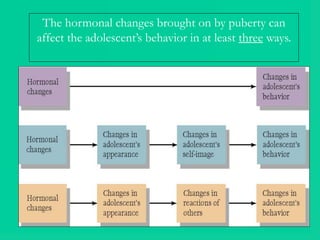
The hormonal changes brought on by puberty can
affect the adolescent’s behavior in at least three ways.
9
Adolescence can be divided into 3
sections
A.) Early – ages 11-14
B.) Mid – ages 14-16
C.) Late – ages 17-19
Many aspects of adolescence persist into
20’s
impacts of puberty
• Sleep patterns
– Delayed phase preference
– 9 hours: 1 am to 10 am
• Family relations
– Transformation of parent-child bond
• Peer relations
– Transformation of friendships, romantic
relationships
identity development
• Adolescence  Erickson stage of identity
crisis
• Identity
– Sense of individual self
– Selection of commitments, beliefs, values
• Interpersonal process
– Taking their place in the adult community
cognitive changes
• Importance of conceptual structure of thinking
 Propositional logic: thinking constrained by logical relations
– Emphasis on rationality and scientific methodology
• Importance of conceptual resources employed
in thinking
 Five process: Attention, working memory, processing speed,
organization, meta-cognition
cognitive changes
• Piaget’s – Formal Operational Thought
– Logical, abstract thinking
• Thinking about possibilities
– “If-then” thinking
– Connection between how things are and how they
might have been or could be.
• Thinking about thinking
– Understanding knowledge (how/when gained)
– Monitoring one’s own mental states
relativism
• Not everything is “black and white”
– Recognition of importance of perspective
– Death of childish “realism/absolutism”
Can result in extreme skepticism
• Rejection of authority
• Rejection of cultural/social norms
• Everything is “ok” – no right/wrong
Tolerance for different beliefs
• Though less tolerance for actual interaction/helping
impacts of puberty
• Self-esteem
– Changing body image
– Changing sense of self
• Moods
– Increased stress + Increased sensitivity
• Fluctuation of moods
– Due to hormones or environment?
– “Storm and stress”: myth or fact?
adolescent egocentrism
• Increased introspection, self-consciousness,
rationalization
• Responsible for adolescent version of
egocentrism.
– Imaginary audience
– Personal fable
– Importance of personal individuality
• Crisis never begins: diffusion
• Crisis begins –> ends with foreclosure
• Crisis begins –> ends with achievement
• Psychosocial moratorium
– Period of exploration
• Importance in contemporary society?
18
Early Adolescence
A.) Focus upon physical changes
B.) Developing interests which may change
rapidly
C.) Need adult supervision
D.) Need structure and monitored
expectations
19
Early Adolescence, cont.
E.) Want greater privacy
F.) More aware of emotional experience
G.) Beginning to reflect on self and
experience
H.) Impulse control can be a challenge
20
Mid Adolescence
A.) More time with peers
B.) Strong desire to belong, activities based
on belonging
C.) Beginning partnering
21
Mid Adolescence, cont.
D.) Abstract reasoning, problem solving
used more frequently
E.) Wants and utilizes more independence
in decision making
F.) Expects competence and expects to
make contributions to social groups
22
Late Adolescence
A.) Greater self-direction, self-monitoring
B.) Greater capacity for judgment and
impulse control
23
Late Adolescence, cont.
C.) More independent decision making
D.) More involvement in longer term
relationships
E.) Parents/adults more in the role of
advisor/ mentor
F.) More consistent values and beliefs
24
Characteristics of Positive Youth
Development:
Confidence
Competence
Caring
Connection
Character
25
Youth who do well:
A.) Have a positive connection with their
school
B.) Have positive relationships with youth
who have a positive relationship with
school
C.) Are engaged positively with adults who
care about them
Physical development
• Pubertal development
• Bodily changes resulting in increased self-
consciousness, preoccupation and questions
of “Am I normal?’
• Alterations in sleep (and less!)
• Sexual interests and changes in social
responses
• Sexual identity development
Cognitive Development
(historical review)
• Shift from concrete to formal operations, allowing
for greater abstract thinking skills, symbolic
reasoning and hypothetical analysis (Jean Piaget)
• Cognitive style is characterized by egocentricism
• “magical thinking”; imaginary audience”; “myth
of immunity”; and “personal fable” (Elkind)
• And then the game-changer~ Brain imaging
research…
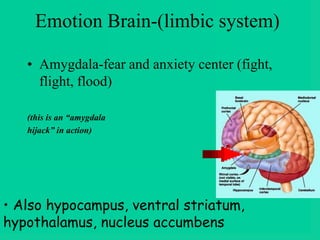
Emotion Brain-(limbic system)
• Amygdala-fear and anxiety center (fight,
flight, flood)
(this is an “amygdala
hijack” in action)
• Also hypocampus, ventral striatum,
hypothalamus, nucleus accumbens
Brain Maturation
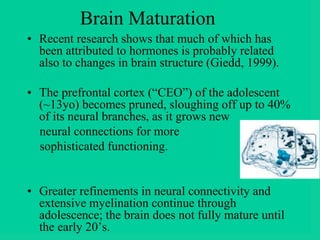
• Recent research shows that much of which has
been attributed to hormones is probably related
also to changes in brain structure (Giedd, 1999).
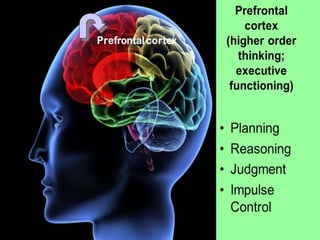
• The prefrontal cortex (“CEO”) of the adolescent
(~13yo) becomes pruned, sloughing off up to 40%
of its neural branches, as it grows new
neural connections for more
sophisticated functioning.
• Greater refinements in neural connectivity and
extensive myelination continue through
adolescence; the brain does not fully mature until
the early 20’s.
Teen Brain
NASCAR
Metaphor
• Big engine—maturing bodies,
independence-striving
• Poor Driver—immature PFC and judgment
• Faulty Brake system—immature inhibitory
mechanisms in PFC
• High octane fuel—hormones
Put
simply…
…
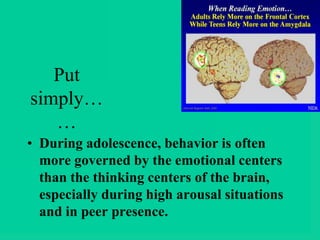
• During adolescence, behavior is often
more governed by the emotional centers
than the thinking centers of the brain,
especially during high arousal situations
and in peer presence.
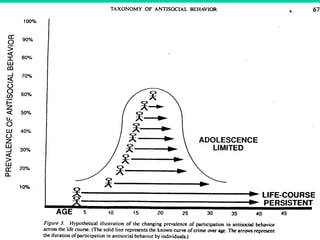
Adolescence:
“Storm and stress” theory
• Adolescent difficulties are neither inevitable or
universal
• Research on large populations of adolescents
indicates that teens experience more rapid mood
changes but no more depression/anxiety/pathology
than adult samples (Csikszentmihalyi & Larson)
• Surveys reveal that most adolescents describe
themselves as “mostly happy” and are adequately
adjusted (Offer)
Developmental research qualifiers:
• Marked changes in moodiness, emotional reactivity and
risk-taking among adolescents are neither universal or
inevitable (cultural and class differences exist)
• Although gender, culture and age differences among
adolescents can be important, temperament is a powerful
predictor of behavior
• Discussions with parents about their interpretations
regarding their teen’s behavior is tricky terrain
• What is interpreted as “normal” depends on the clinician’s
psychosocial assessment, sophistication of knowledge
about adolescence and personal “filters.”
Neuroendocrine system changes
• Testosterone in boys can increase by 100% by the
end of puberty, and 20 X more than girls of same
age.
• Amygdala has receptors for testosterone, which
probably contributes to increased novelty seeking,
territoriality and exploration for stimulation.
• Hormones have impact on neurotransmitters,
moods and symptoms: norepinephrine
(energizer); dopamine (pleasure); and serotonin
(mood stabilization, relaxation, confidence)
Sensitivity of the teen brain to
substances
• Alcohol stimulates the release of dopamine during the
“sensitive period” of adolescence, decreasing the natural
production.
• Heavy alcohol use interferes with memory and glutamate
functioning.
• Nicotine stimulates dopamine supply and affects other
neurotransmitters, allowing rapid addiction.
• Dopamine “squirts” result from computer games,
stimulating media, gambling and other high arousal
pursuits.
• Changes in circadian rhythms alter alert-fatigue signals,
affecting memory and biorhythms
In sum, the impact of brain changes on
adolescent reasoning, behavior and mood:
• Decision-making models don’t apply in high
arousal situations ( “cold” logic, as compared to
“hot” arousal situations)
• Impulse control reduction
• Poor risk assessment
• Executive functioning impairment
• Desire to escape boredom and negative affect by
“revving” up and seeking stimulation
• Parental disciplinary efforts at times of high
arousal can result in explosive conflict
Social Development
• Desire for increased independence
• Preference for spending time with peers, orienting
increasingly to peers for social influence and
values clarification
• Most teens are more “attached” to their parents,
but they prefer the company of their friends
• Individuation from the family
• Cultural context plays a large role in determining
diverse paths within these developmental and
universal trajectories.
Ethnic Diversity
• Developing a strong ethnic identity contributes to
high self-esteem among ethnic minority
adolescents (Carlson et al, 2000).
• Parents and role models are key for establishing
pride in shared values, traditions and practices of a
cultural group.
• Adolescence may be the first time they reflect on
the implications of their group identification.
Identity development
• Erik Erikson’s major task of adolescence was
constructed as “identity v. role confusion” (Who
am I uniquely?)
• Researchers have documented how teens explore
beliefs with various levels of “crisis and
commitment” (e.g. religion, politics, sexuality,
educational and vocational choices).
• By their twenties, they will have an integrated set
of values reflecting their experiences and parental,
generational and cultural influences.
Moral development theories focus on moral
reasoning (highly dependent on environment and
cognitive maturity)
• Lawrence Kohlberg’s theory demonstrates that
adolescents’ moral reasoning reflects a maturing
value on the rights of others, the importance of
law and justice and universal principles.
• Carol Gilligan pioneered the special value that
females place on responsibility and the caring of
others for moral reasoning.
• Jonathan Haidt and others emphasize that moral
reasoning doesn’t necessarily dictate moral action.
Kohlberg’s stages of moral
reasoning
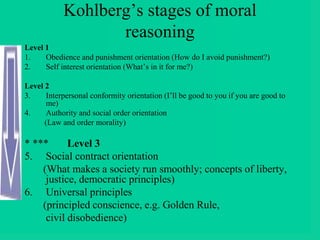
Level 1
1. Obedience and punishment orientation (How do I avoid punishment?)
2. Self interest orientation (What’s in it for me?)
Level 2
3. Interpersonal conformity orientation (I’ll be good to you if you are good to
me)
4. Authority and social order orientation
(Law and order morality)
* *** Level 3
5. Social contract orientation
(What makes a society run smoothly; concepts of liberty,
justice, democratic principles)
6. Universal principles
(principled conscience, e.g. Golden Rule,
civil disobedience)
Adolescence as a period of
normal risk-taking and behavioral
experimentation
• Adaptive identity development for most, but can
carry high risks and long term harm for others
• Early adolescence as a time of particular
vulnerability (school failure, STD’s, substance
use)
• Family cohesiveness and authoritative parenting
are significant predictors for successful and safe
adolescent outcome (Baumrind; Shedler and
Block; Blum)
Parenting strengths that predict optimal
adjustment in late adolescence
• Close relationship to caring parent figure
• Authoritative parenting: warmth, effective
communication, monitoring and structure.
• Socioeconomic advantages
• Connections to extended supportive family networks
• Bonds to prosocial adults outside the family
• Connections to prosocial organizations
• Attending effective schools
“My 15 year old son…
Remember Randy’s “warning signs”:
• withdrawal
• moodiness
• increased family conflict
• argumentativeness
• over-reactivity to criticism
• sloppiness in appearance
• spending time isolating in room
• poor attitude
• disrespect
• loss of interest in family activities.”
In the context of positive reports about functioning in family, school,
extracurricular activities, emotional/social life, Randy is likely
experiencing normal adolescent development.
Take homes
• Remember your own teen vulnerabilities—it will enhance
your empathy
• Normal adolescent development is usually messy—so
you’ll hear about messy behaviors and see them too—even
when they are healthy!
• A comprehensive teen, parent, and social system review is
the only way to evaluate many of the problems you are
consulted about (e.g. drugs, depression, etc).
• Most morbidity and mortality among adolescents has
psychosocial/behavioral components, so focusing just on
“medical issues” is not an option.
• Because teens are vulnerable, fascinating and challenging,
they can be among your most rewarding patients when you
connect with them in a genuine way!
A clinician’s crash course in
adolescent development.
In summary,
• Assess the “big picture” of a teen’s life
• Appreciate that diversity includes many
domains
• Find something in the teen to appreciate
• Be curious
• Remember your own vulnerable teen
moments
• Be authentic, humble and sincere

Adolescent Psychology Presentation Slides.ppt

  • 1.
    Adolescent Psychological Development Turki Homod ALBatti,MD. Clinical Associate Professor Child Psychiatry
  • 2.
    Why is itimportant for a adolescent health clinicians to know the basics about adolescent development? • They are frequently asked the question by parents, “Is this normal or a sign of pathology?” (e.g. moodiness, withdrawal, rebelliousness, defiance, irrationality, argumentativeness) • They can be faced with teen emotions while interviewing adolescent patients that impede diagnosis and treatment.
  • 3.
    Why is itimportant for a clinicians to know the basics about adolescent development? They may experience personal reactions that hinder effective medical transactions if they don’t understand the dynamics of adolescent development.
  • 4.
    “My 15 yearold son… “ My 15 year old son, Randy, is rude, won’t talk at dinner, wants to just hang out in his room, won’t share any information with us, cares more about his electronics than anything, becomes irrational when we confront him, hogs the bathroom, is highly emotionally reactive, and has lied, snuck out and drank alcohol at a party and violated our internet rules.” “A website on drug abuse cited these warning signs: • withdrawal • moodiness • increased family conflict • argumentativeness • over-reactivity to criticism • sloppiness in appearance • spending time isolating in room • poor attitude • disrespect • loss of interest in family activities.” “Does my son have a drug abuse problem?”
  • 5.
    definition of puberty •Pubertas – Latin word for “adult” • Narrow definition: The process by which an individual becomes capable of reproduction. – The activation of the HPG/HPA axis • Broad definition: The physical, psychological, and cultural changes that occur as the growing child transitions into adulthood.
  • 6.
    time periods ofadolescent • Adolescence is a unique developmental period – it keeps changing! • Early adolescence – 11 to 13 years old – Continues to be pushed earlier (9-10…) • Middle adolescence – 14 to 17 years old • Late adolescence (early adulthood) – 18 to 20 years old – Continues to be pushed later (21-24…)
  • 7.
    Adolescent Psychological Development • Physicaldevelopment • Cognitive development • Social development • Identity development • Moral development
  • 8.
    The hormonal changesbrought on by puberty can affect the adolescent’s behavior in at least three ways.
  • 9.
    9 Adolescence can bedivided into 3 sections A.) Early – ages 11-14 B.) Mid – ages 14-16 C.) Late – ages 17-19 Many aspects of adolescence persist into 20’s
  • 10.
    impacts of puberty •Sleep patterns – Delayed phase preference – 9 hours: 1 am to 10 am • Family relations – Transformation of parent-child bond • Peer relations – Transformation of friendships, romantic relationships
  • 11.
    identity development • Adolescence Erickson stage of identity crisis • Identity – Sense of individual self – Selection of commitments, beliefs, values • Interpersonal process – Taking their place in the adult community
  • 12.
    cognitive changes • Importanceof conceptual structure of thinking  Propositional logic: thinking constrained by logical relations – Emphasis on rationality and scientific methodology • Importance of conceptual resources employed in thinking  Five process: Attention, working memory, processing speed, organization, meta-cognition
  • 13.
    cognitive changes • Piaget’s– Formal Operational Thought – Logical, abstract thinking • Thinking about possibilities – “If-then” thinking – Connection between how things are and how they might have been or could be. • Thinking about thinking – Understanding knowledge (how/when gained) – Monitoring one’s own mental states
  • 14.
    relativism • Not everythingis “black and white” – Recognition of importance of perspective – Death of childish “realism/absolutism” Can result in extreme skepticism • Rejection of authority • Rejection of cultural/social norms • Everything is “ok” – no right/wrong Tolerance for different beliefs • Though less tolerance for actual interaction/helping
  • 15.
    impacts of puberty •Self-esteem – Changing body image – Changing sense of self • Moods – Increased stress + Increased sensitivity • Fluctuation of moods – Due to hormones or environment? – “Storm and stress”: myth or fact?
  • 16.
    adolescent egocentrism • Increasedintrospection, self-consciousness, rationalization • Responsible for adolescent version of egocentrism. – Imaginary audience – Personal fable – Importance of personal individuality
  • 17.
    • Crisis neverbegins: diffusion • Crisis begins –> ends with foreclosure • Crisis begins –> ends with achievement • Psychosocial moratorium – Period of exploration • Importance in contemporary society?
  • 18.
    18 Early Adolescence A.) Focusupon physical changes B.) Developing interests which may change rapidly C.) Need adult supervision D.) Need structure and monitored expectations
  • 19.
    19 Early Adolescence, cont. E.)Want greater privacy F.) More aware of emotional experience G.) Beginning to reflect on self and experience H.) Impulse control can be a challenge
  • 20.
    20 Mid Adolescence A.) Moretime with peers B.) Strong desire to belong, activities based on belonging C.) Beginning partnering
  • 21.
    21 Mid Adolescence, cont. D.)Abstract reasoning, problem solving used more frequently E.) Wants and utilizes more independence in decision making F.) Expects competence and expects to make contributions to social groups
  • 22.
    22 Late Adolescence A.) Greaterself-direction, self-monitoring B.) Greater capacity for judgment and impulse control
  • 23.
    23 Late Adolescence, cont. C.)More independent decision making D.) More involvement in longer term relationships E.) Parents/adults more in the role of advisor/ mentor F.) More consistent values and beliefs
  • 24.
    24 Characteristics of PositiveYouth Development: Confidence Competence Caring Connection Character
  • 25.
    25 Youth who dowell: A.) Have a positive connection with their school B.) Have positive relationships with youth who have a positive relationship with school C.) Are engaged positively with adults who care about them
  • 26.
    Physical development • Pubertaldevelopment • Bodily changes resulting in increased self- consciousness, preoccupation and questions of “Am I normal?’ • Alterations in sleep (and less!) • Sexual interests and changes in social responses • Sexual identity development
  • 27.
    Cognitive Development (historical review) •Shift from concrete to formal operations, allowing for greater abstract thinking skills, symbolic reasoning and hypothetical analysis (Jean Piaget) • Cognitive style is characterized by egocentricism • “magical thinking”; imaginary audience”; “myth of immunity”; and “personal fable” (Elkind) • And then the game-changer~ Brain imaging research…
  • 28.
    Emotion Brain-(limbic system) •Amygdala-fear and anxiety center (fight, flight, flood) (this is an “amygdala hijack” in action) • Also hypocampus, ventral striatum, hypothalamus, nucleus accumbens
  • 30.
    Brain Maturation • Recentresearch shows that much of which has been attributed to hormones is probably related also to changes in brain structure (Giedd, 1999). • The prefrontal cortex (“CEO”) of the adolescent (~13yo) becomes pruned, sloughing off up to 40% of its neural branches, as it grows new neural connections for more sophisticated functioning. • Greater refinements in neural connectivity and extensive myelination continue through adolescence; the brain does not fully mature until the early 20’s.
  • 31.
    Teen Brain NASCAR Metaphor • Bigengine—maturing bodies, independence-striving • Poor Driver—immature PFC and judgment • Faulty Brake system—immature inhibitory mechanisms in PFC • High octane fuel—hormones
  • 32.
    Put simply… … • During adolescence,behavior is often more governed by the emotional centers than the thinking centers of the brain, especially during high arousal situations and in peer presence.
  • 33.
    Adolescence: “Storm and stress”theory • Adolescent difficulties are neither inevitable or universal • Research on large populations of adolescents indicates that teens experience more rapid mood changes but no more depression/anxiety/pathology than adult samples (Csikszentmihalyi & Larson) • Surveys reveal that most adolescents describe themselves as “mostly happy” and are adequately adjusted (Offer)
  • 35.
    Developmental research qualifiers: •Marked changes in moodiness, emotional reactivity and risk-taking among adolescents are neither universal or inevitable (cultural and class differences exist) • Although gender, culture and age differences among adolescents can be important, temperament is a powerful predictor of behavior • Discussions with parents about their interpretations regarding their teen’s behavior is tricky terrain • What is interpreted as “normal” depends on the clinician’s psychosocial assessment, sophistication of knowledge about adolescence and personal “filters.”
  • 36.
    Neuroendocrine system changes •Testosterone in boys can increase by 100% by the end of puberty, and 20 X more than girls of same age. • Amygdala has receptors for testosterone, which probably contributes to increased novelty seeking, territoriality and exploration for stimulation. • Hormones have impact on neurotransmitters, moods and symptoms: norepinephrine (energizer); dopamine (pleasure); and serotonin (mood stabilization, relaxation, confidence)
  • 37.
    Sensitivity of theteen brain to substances • Alcohol stimulates the release of dopamine during the “sensitive period” of adolescence, decreasing the natural production. • Heavy alcohol use interferes with memory and glutamate functioning. • Nicotine stimulates dopamine supply and affects other neurotransmitters, allowing rapid addiction. • Dopamine “squirts” result from computer games, stimulating media, gambling and other high arousal pursuits. • Changes in circadian rhythms alter alert-fatigue signals, affecting memory and biorhythms
  • 38.
    In sum, theimpact of brain changes on adolescent reasoning, behavior and mood: • Decision-making models don’t apply in high arousal situations ( “cold” logic, as compared to “hot” arousal situations) • Impulse control reduction • Poor risk assessment • Executive functioning impairment • Desire to escape boredom and negative affect by “revving” up and seeking stimulation • Parental disciplinary efforts at times of high arousal can result in explosive conflict
  • 39.
    Social Development • Desirefor increased independence • Preference for spending time with peers, orienting increasingly to peers for social influence and values clarification • Most teens are more “attached” to their parents, but they prefer the company of their friends • Individuation from the family • Cultural context plays a large role in determining diverse paths within these developmental and universal trajectories.
  • 40.
    Ethnic Diversity • Developinga strong ethnic identity contributes to high self-esteem among ethnic minority adolescents (Carlson et al, 2000). • Parents and role models are key for establishing pride in shared values, traditions and practices of a cultural group. • Adolescence may be the first time they reflect on the implications of their group identification.
  • 41.
    Identity development • ErikErikson’s major task of adolescence was constructed as “identity v. role confusion” (Who am I uniquely?) • Researchers have documented how teens explore beliefs with various levels of “crisis and commitment” (e.g. religion, politics, sexuality, educational and vocational choices). • By their twenties, they will have an integrated set of values reflecting their experiences and parental, generational and cultural influences.
  • 42.
    Moral development theoriesfocus on moral reasoning (highly dependent on environment and cognitive maturity) • Lawrence Kohlberg’s theory demonstrates that adolescents’ moral reasoning reflects a maturing value on the rights of others, the importance of law and justice and universal principles. • Carol Gilligan pioneered the special value that females place on responsibility and the caring of others for moral reasoning. • Jonathan Haidt and others emphasize that moral reasoning doesn’t necessarily dictate moral action.
  • 43.
    Kohlberg’s stages ofmoral reasoning Level 1 1. Obedience and punishment orientation (How do I avoid punishment?) 2. Self interest orientation (What’s in it for me?) Level 2 3. Interpersonal conformity orientation (I’ll be good to you if you are good to me) 4. Authority and social order orientation (Law and order morality) * *** Level 3 5. Social contract orientation (What makes a society run smoothly; concepts of liberty, justice, democratic principles) 6. Universal principles (principled conscience, e.g. Golden Rule, civil disobedience)
  • 44.
    Adolescence as aperiod of normal risk-taking and behavioral experimentation • Adaptive identity development for most, but can carry high risks and long term harm for others • Early adolescence as a time of particular vulnerability (school failure, STD’s, substance use) • Family cohesiveness and authoritative parenting are significant predictors for successful and safe adolescent outcome (Baumrind; Shedler and Block; Blum)
  • 45.
    Parenting strengths thatpredict optimal adjustment in late adolescence • Close relationship to caring parent figure • Authoritative parenting: warmth, effective communication, monitoring and structure. • Socioeconomic advantages • Connections to extended supportive family networks • Bonds to prosocial adults outside the family • Connections to prosocial organizations • Attending effective schools
  • 46.
    “My 15 yearold son… Remember Randy’s “warning signs”: • withdrawal • moodiness • increased family conflict • argumentativeness • over-reactivity to criticism • sloppiness in appearance • spending time isolating in room • poor attitude • disrespect • loss of interest in family activities.” In the context of positive reports about functioning in family, school, extracurricular activities, emotional/social life, Randy is likely experiencing normal adolescent development.
  • 47.
    Take homes • Rememberyour own teen vulnerabilities—it will enhance your empathy • Normal adolescent development is usually messy—so you’ll hear about messy behaviors and see them too—even when they are healthy! • A comprehensive teen, parent, and social system review is the only way to evaluate many of the problems you are consulted about (e.g. drugs, depression, etc). • Most morbidity and mortality among adolescents has psychosocial/behavioral components, so focusing just on “medical issues” is not an option. • Because teens are vulnerable, fascinating and challenging, they can be among your most rewarding patients when you connect with them in a genuine way!
  • 48.
    A clinician’s crashcourse in adolescent development. In summary, • Assess the “big picture” of a teen’s life • Appreciate that diversity includes many domains • Find something in the teen to appreciate • Be curious • Remember your own vulnerable teen moments • Be authentic, humble and sincere